Math

Learn Multiplication Tables Fast | Tips, Tricks & Practice

Learn multiplication tables fast with proven patterns, memory tricks, daily practice routines, charts, games, and parent-friendly tips for lasting recall.
Multiplication fluency guide

Learn Multiplication Tables Fast (Tips & Tricks)

Learning multiplication tables fast is not about staring at a chart until every fact sticks. The quickest path is to understand what multiplication means, learn the easiest patterns first, use smart shortcuts for the harder rows, and practice retrieval in short, regular sessions until the answers feel automatic.

Patterns before pressure Daily 10-minute routine Tricks for 2 through 12 Practice drill included

The Fastest Way to Learn Multiplication Tables

The fastest practical way to learn multiplication tables is to reduce the amount of memorization. A 12 by 12 table looks like 144 separate answers, but it is much smaller when students use structure. The zero and one facts are immediate. The two facts are doubles. The five and ten facts follow counting patterns. The four facts are double the two facts. The nine facts can be built from ten minus one group. The twelve facts can be built from ten groups plus two groups. Because multiplication is commutative, facts such as \(3 \times 7\) and \(7 \times 3\) are the same product, so learning one also teaches the other.

A good learning sequence is: understand equal groups, learn anchor facts, add pattern-based facts, then practice mixed recall. Students who only chant tables in order often freeze when a fact appears out of order, such as \(8 \times 7\). Students who practice with patterns and mixed questions learn how to retrieve facts from any direction. That is why this guide combines memory tricks with reasoning strategies, charts, games, and a short practice routine.

If you need a reference chart beside this article, use the full multiplication table or a printable 12x12 multiplication chart. Those resources are useful for checking and pattern spotting. This page is the learning guide: it explains how to turn the chart into fast recall without overwhelming the learner.

Short version: learn easy anchors first, connect new facts to facts you already know, practice for a few minutes every day, and mix the order once accuracy improves.

Start With Meaning: Equal Groups, Arrays, and Skip Counting

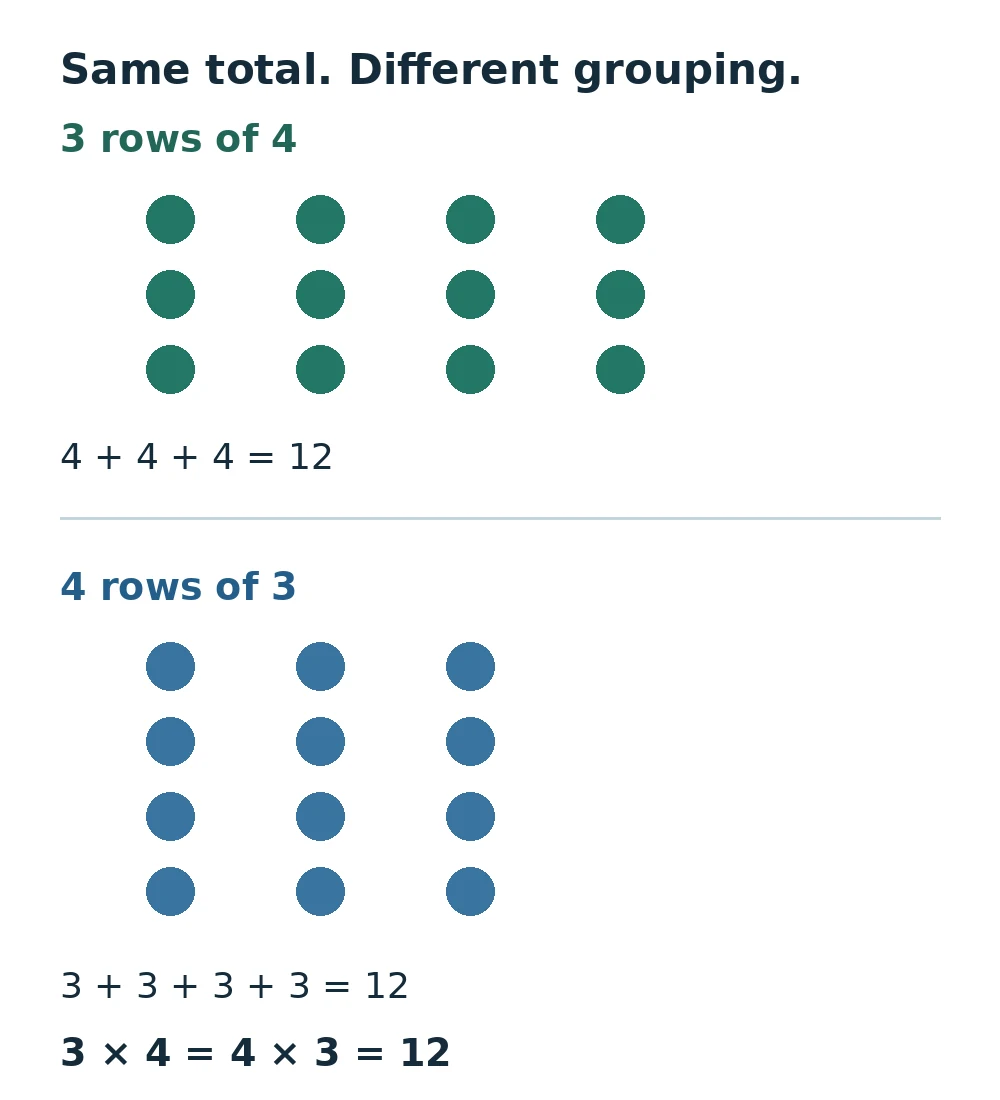
Multiplication is a shortcut for equal groups. The expression \(4 \times 6\) can mean four groups of six, six groups of four, an array with 4 rows and 6 columns, or a rectangle with side lengths 4 and 6. All of those models lead to the same product, \(24\). When a learner sees multiplication this way, facts become connected ideas rather than isolated sounds.

A child who understands addition already has the foundation for multiplication. Repeated addition writes the same group size several times, such as \(6 + 6 + 6 + 6 = 24\). Multiplication writes the same idea more efficiently as \(4 \times 6 = 24\). If a student still needs support with the meaning of joining quantities, review the addition definition and examples before pushing multiplication speed. Fluency grows faster when the underlying operation makes sense.

Arrays are especially helpful because they show why changing the order does not change the answer. A rectangle with 3 rows of 8 dots has 24 dots. Turn the rectangle and it has 8 rows of 3 dots, still 24 dots. This is the commutative property of multiplication:

\[a \times b = b \times a\]

This simple property cuts the work nearly in half. After a learner knows \(6 \times 8 = 48\), the fact \(8 \times 6 = 48\) is not a new fact to memorize. It is the same rectangle seen from another direction. For visual learners, the multiplication from area models page is a strong companion because it connects facts to rectangles, partial products, and the thinking students use later for multi-digit multiplication.

Skip counting is useful, but it should be treated as a bridge rather than the final goal. Counting 6, 12, 18, 24, 30 helps a learner enter the six table. Eventually, though, \(6 \times 8\) should be recalled directly as 48. If a student has to count through every earlier multiple, the fact is not fluent yet. The goal is not to ban skip counting; the goal is to use it until the pattern is familiar enough for direct recall.

The Best Order to Learn Times Tables

Trying to memorize every multiplication fact from \(1 \times 1\) through \(12 \times 12\) in numerical order can feel slow because the hard facts appear before the learner has enough anchors. A better order is based on how easy the patterns are. Start with the facts that have the strongest visual or counting patterns, then use those facts to build the next ones.

Begin with 0, 1, 2, 5, and 10. These are high-confidence tables. Zero means no groups, one keeps the other factor unchanged, two means doubles, five follows the 5, 10, 15, 20 pattern, and ten adds a zero in whole-number facts. These tables immediately give the learner many correct answers and make the chart feel less intimidating.

Next, learn 3, 4, 6, 8, and 9. The three table benefits from skip counting and grouping. The four table is double the two table. The six table can be seen as three doubled or five plus one more group. The eight table is double the four table. The nine table has some of the strongest tricks in the entire chart: \(9n = 10n - n\), the digit-sum pattern for one-digit products, and the rising tens/falling ones pattern from 09 to 90.

Finally, focus on 7, 11, and 12. The seven table often feels hardest because it has fewer obvious daily-life anchors, but by the time a student reaches it, many seven facts are already known from other tables. The eleven table is easy through \(11 \times 9\), and the twelve table is best learned as ten groups plus two groups. Students who need a structured printable can pair this order with the printable times table chart and cover the facts they have already mastered.

StageTablesWhy This Order WorksUseful Practice Focus
Stage 10, 1, 2, 5, 10These facts have the clearest patterns and build confidence quickly.Say the pattern, write the products, then answer mixed questions.
Stage 23, 4, 6, 8, 9These tables connect to doubles, near tens, and known anchor facts.Use tricks first, then fade the trick until the answer is instant.
Stage 37, 11, 12Many products are already known through commutativity, so fewer facts remain.Practice the remaining unknown facts in random order every day.
Stage 4Mixed factsReal math rarely asks tables in perfect order.Use short timed rounds only after accuracy is steady.

The important point is not that every learner must use exactly this order. The point is to avoid presenting the chart as 144 unrelated answers. A sequence based on patterns makes progress visible. It also prevents the common problem where a student can recite a row but cannot answer a single fact when it appears in isolation.

The Four Multiplication Ideas That Make Tables Easier

Most multiplication tricks are based on a small set of mathematical properties. These properties do not have to be taught as formal vocabulary at first, but they should be used repeatedly because they give students a reliable way to reconstruct an answer when memory is not immediate.

Commutative property

Switching the factors keeps the product the same: \(a \times b = b \times a\). This means \(7 \times 8\) and \(8 \times 7\) are one fact, not two.

Distributive property

Break a factor apart: \(a(b+c)=ab+ac\). For example, \(7 \times 8 = 7 \times (5+3)=35+21=56\).

Doubling

Use a known double to find related facts. Since \(4 \times n = 2 \times (2 \times n)\), the 4s are double the 2s.

Near facts

Build from a friendly fact. Since \(9 \times n = 10 \times n - n\), the 9s are one group less than the 10s.

These ideas are not shortcuts around understanding; they are understanding. When a learner says, "I do not remember \(6 \times 7\), but I know \(5 \times 7 = 35\), so one more 7 gives \(42\)," that student is using structure. With enough repetition, the final answer becomes automatic, but the reasoning remains available when memory slips.

For students who enjoy pattern hunting, the multiplication table patterns page can reinforce these ideas visually. Patterns are especially useful for students who feel that memorization is arbitrary. A pattern gives the fact a place to live.

Multiplication Table Tricks from 0 to 12

The table below gives a compact overview of the most useful tricks. After the table, each family of facts is explained in more detail. The best trick is the one the learner can explain, use accurately, and eventually outgrow. A trick should not become a long detour every time the fact appears. Its job is to help the answer become familiar.

TableFast TrickExampleWhat to Watch For
0Zero groups make zero.\(0 \times 9 = 0\)Do not confuse with the one table.
1One group keeps the number.\(1 \times 9 = 9\)Say "one group of nine" to keep meaning clear.
2Double the number.\(2 \times 8 = 16\)Use known addition doubles.
3Use skip counting or add one more group to the 2s.\(3 \times 7 = 14 + 7 = 21\)Move from counting to recall.
4Double, then double again.\(4 \times 6 = 12 + 12 = 24\)Useful for mental math beyond tables.
5Products end in 0 or 5.\(5 \times 7 = 35\)Odd factors end in 5; even factors end in 0.
6Use 5 groups plus 1 group, or double the 3s.\(6 \times 8 = 40 + 8 = 48\)Good bridge to distributive thinking.
7Use known facts, 5 plus 2, or nearby anchors.\(7 \times 8 = 5 \times 8 + 2 \times 8 = 56\)Practice mixed facts often.
8Double the 4s or double three times.\(8 \times 7 = 56\)Keep track of each doubling step.
9Ten groups minus one group.\(9 \times 8 = 80 - 8 = 72\)Check the digit sum for 9 facts through 10.
10Ten groups place a zero after the factor.\(10 \times 12 = 120\)Explain with place value, not only a rule.
11Repeat the digit for 1 through 9; use 10 plus 1 after that.\(11 \times 7 = 77\)For \(11 \times 12\), use \(120 + 12\).
12Ten groups plus two groups.\(12 \times 8 = 80 + 16 = 96\)Works well after 2s and 10s are fluent.

The 0, 1, and 2 Tables: Build Early Confidence

The zero table is a concept, not a pattern to memorize. If there are zero groups of eight apples, there are no apples. If there are eight groups of zero apples, there are still no apples. That is why \(0 \times n = 0\) and \(n \times 0 = 0\). Students sometimes confuse this with addition because \(n + 0 = n\). The difference is worth saying out loud: adding zero changes nothing, but multiplying by zero means there are no groups or no items in each group.

The one table is also conceptual. One group of a number is the number itself, so \(1 \times n = n\). This is the multiplicative identity property. A young learner does not need the formal term immediately, but the phrase "one group of" is useful. One group of seven is seven. One group of twelve is twelve. This keeps the fact connected to meaning instead of treating it as a mysterious rule.

The two table is the first major speed builder because it is simply doubles. If a learner knows addition doubles, then \(2 \times 6\) is the same as \(6 + 6\). This makes the two table a bridge between addition fluency and multiplication fluency:

\[2 \times n = n + n\]

Practice the two table in three ways. First, say the products in order: 2, 4, 6, 8, 10, and so on. Second, answer facts out of order, such as \(2 \times 9\), \(2 \times 4\), and \(2 \times 11\). Third, connect the facts to real doubles: two hands with five fingers, two weeks with seven days each, two rows of chairs, or two equal stacks of cards. This helps the learner see multiplication as a useful operation rather than a school-only chant.

The 5 and 10 Tables: Use Counting Patterns and Place Value

The five table is one of the easiest to learn because the products end in 5 or 0. Odd factors give products ending in 5, and even factors give products ending in 0. For example, \(5 \times 3 = 15\), \(5 \times 4 = 20\), \(5 \times 5 = 25\), and \(5 \times 6 = 30\). Counting nickels, tally marks, or minute marks on a clock can make the pattern concrete.

The ten table is even more direct for whole-number facts from 1 to 12: \(10 \times n\) gives ten groups of \(n\), which is the same as \(n\) tens. That is why \(10 \times 8 = 80\). It is tempting to teach this only as "add a zero," but the deeper explanation is place value. Eight tens equals eighty. Twelve tens equals one hundred twenty. Understanding that reason prevents later confusion when students multiply decimals, such as \(10 \times 0.8 = 8\), where simply adding a zero is not a reliable description.

Once the five and ten tables are known, they become anchors for harder facts. The six table can be built as five groups plus one more group. The nine table can be built as ten groups minus one group. The twelve table can be built as ten groups plus two groups. This is the beginning of mental multiplication: use an easy fact, adjust it, and keep the meaning clear.

\[6 \times n = 5 \times n + 1 \times n\]
\[9 \times n = 10 \times n - 1 \times n\]

For printable practice that supports these anchors, use printable multiplication charts or build custom rows with the free multiplication table generator. Keep the practice focused: a learner working on 5s and 10s does not need a full mixed sheet yet.

The 4 and 8 Tables: Double Once, Then Double Again

The four table becomes much easier when students already know the two table. Four groups of a number is the same as two groups doubled. For example, \(4 \times 7\) can be found by first doubling 7 to get 14, then doubling 14 to get 28. This is quicker and more reliable than skip counting 4, 8, 12, 16, 20, 24, 28 every time.

\[4 \times n = 2 \times (2 \times n)\]

The eight table extends the same idea. Eight groups can be found by doubling three times: double the number, double the result, then double the result again. For \(8 \times 6\), double 6 to get 12, double 12 to get 24, and double 24 to get 48. This is not only a table trick; it is a mental math habit that remains useful for percentages, scaling, and estimating.

\[8 \times n = 2 \times (2 \times (2 \times n))\]

Some students find multiple doubling steps hard to track. If that happens, use the four table as the anchor for the eight table. Since \(8 \times n = 4 \times n + 4 \times n\), a known four fact can be doubled. For example, \(4 \times 9 = 36\), so \(8 \times 9 = 72\). The learner has a choice: double the original number three times or double the four-table product once.

For targeted table work, the individual 8 times table with games page can help students practice the row after they understand the trick. The goal is to move from "I can derive it" to "I can recall it" without losing the reasoning path.

The 3 and 6 Tables: Group, Double, and Use Known Facts

The three table is often learned by skip counting: 3, 6, 9, 12, 15, 18, and so on. Skip counting is useful, but students should also connect it to addition and arrays. Three groups of seven means \(7 + 7 + 7\), which is 21. A 3 by 7 array has 21 dots. When the learner can see the structure, the product has more than one memory path.

The six table is easier when treated as a combination table. A six fact can be built as double a three fact:

\[6 \times n = 2 \times (3 \times n)\]

For example, if \(3 \times 8 = 24\), then \(6 \times 8 = 48\). A six fact can also be built as five groups plus one group:

\[6 \times n = 5n + n\]

For \(6 \times 7\), five groups of 7 is 35, and one more group of 7 gives 42. This method is especially helpful because the five table is usually fluent before the six table. It also introduces the distributive property in a natural way. Students are not just memorizing \(6 \times 7 = 42\); they are seeing \(6\) as \(5 + 1\).

The pattern for even factors in the six table is also memorable. When multiplying 6 by an even number, the ones digit of the product matches the even factor's ones digit in the common one-digit facts: \(6 \times 2 = 12\), \(6 \times 4 = 24\), \(6 \times 6 = 36\), and \(6 \times 8 = 48\). This pattern should be used as a check rather than the only method. For extra practice, use the 6 times table with games page after the learner can explain one strategy.

The 9 Table: The Most Useful Set of Tricks

The nine table has several reliable patterns, which makes it a perfect example of learning smarter instead of harder. The strongest mental method is to use ten groups minus one group. Since nine is one less than ten, \(9 \times n\) is the same as \(10 \times n - n\). For \(9 \times 7\), ten groups of 7 is 70, and one group of 7 removed leaves 63. This method works beyond the basic table, so it is more powerful than a one-off memory trick.

\[9n = 10n - n\]

The digit pattern is also useful for facts from \(9 \times 1\) through \(9 \times 10\). The tens digit increases from 0 to 9 while the ones digit decreases from 9 to 0: 09, 18, 27, 36, 45, 54, 63, 72, 81, 90. In each of these products, the digits add to 9. For example, \(7 + 2 = 9\) in 72, and \(6 + 3 = 9\) in 63. That digit-sum check helps students catch errors quickly.

There is also the finger method for 9s. Hold up ten fingers. For \(9 \times 4\), fold down the fourth finger. There are three fingers to the left and six to the right, giving 36. This method can be a helpful early bridge, but it should not be the final strategy forever. The ten-minus-one method is better for long-term mental math because it explains why the product is what it is.

Many students who struggle with the nine table are actually trying to memorize it in isolation. Connect it to the ten table every time. Say, "nine groups is one group less than ten groups." Then practice in both directions: \(9 \times 8\) and \(8 \times 9\). The individual 9 times table page can be used for focused review once the learner understands these patterns.

The 7 Table: How to Learn the Hardest Row

The seven table has a reputation for being difficult because it has fewer obvious shortcuts than the two, five, nine, and ten tables. The good news is that by the time a learner reaches the seven table, many seven facts have already been learned through other rows. For example, \(2 \times 7\), \(3 \times 7\), \(4 \times 7\), \(5 \times 7\), \(6 \times 7\), \(8 \times 7\), \(9 \times 7\), \(10 \times 7\), \(11 \times 7\), and \(12 \times 7\) can all connect to earlier strategies.

The toughest cluster is often \(7 \times 7\), \(7 \times 8\), and sometimes \(7 \times 6\). Treat these as a small group of facts, not as a whole row crisis. For \(7 \times 6\), use \(5 \times 6 + 2 \times 6 = 30 + 12 = 42\). For \(7 \times 8\), use \(5 \times 8 + 2 \times 8 = 40 + 16 = 56\). For \(7 \times 7\), use \(5 \times 7 + 2 \times 7 = 35 + 14 = 49\). The same structure works every time:

\[7n = 5n + 2n\]

Another way to learn the seven table is to attach each fact to a short story or visual anchor. Seven days make one week, so \(7 \times 4 = 28\) can mean four weeks. Seven groups of eight can be seen as five eights plus two eights. Seven nines can be seen as nine sevens or as \(70 - 7\). The point is not to create a long story for every fact; it is to give the learner one strong handle for the facts that do not stick.

Practice the seven table in short bursts. Ask only three or four facts at a time, then mix them with easier facts so the learner experiences success and retrieval. The 7 times table with games page is a good place to continue after a student has learned the anchor methods. If a learner is still counting all the way through the row, slow down and rebuild the hardest three facts with arrays or the five-plus-two strategy.

The 11 and 12 Tables: Finish the Core Facts

The eleven table is friendly through \(11 \times 9\). The product repeats the digit: \(11 \times 2 = 22\), \(11 \times 5 = 55\), and \(11 \times 9 = 99\). This pattern is easy to learn, but students should still understand it as ten groups plus one group. For \(11 \times 7\), ten groups of 7 is 70, and one more group gives 77.

\[11n = 10n + n\]

For \(11 \times 10\), \(11 \times 11\), and \(11 \times 12\), use the same ten-plus-one idea. \(11 \times 12 = 120 + 12 = 132\). This prevents the common misconception that the eleven trick always means repeating a digit, which does not work for all factors.

The twelve table is best learned as ten groups plus two groups. Because the learner should already know 10s and 2s, every twelve fact has a simple build. For \(12 \times 7\), ten groups of 7 is 70 and two groups of 7 is 14, so the product is 84. For \(12 \times 9\), ten groups is 90 and two groups is 18, so the product is 108.

\[12n = 10n + 2n\]

Once the twelve table is complete, students can comfortably use multiplication in division, fractions, measurement, and multi-step problem solving. For focused review, the 11 times table page can reinforce the pattern. Keep the twelve facts connected to the idea of adding a ten fact and a double.

A 10-Minute Daily Practice Routine That Actually Works

Short, repeated practice is usually more effective than one long session. Ten focused minutes a day is enough for most students to make visible progress because multiplication fluency depends on retrieval. Retrieval means pulling the answer from memory, not just recognizing it on a chart. Looking at \(7 \times 8 = 56\) teaches the fact a little; trying to answer \(7 \times 8\) and then checking teaches it much more.

Use this simple daily structure. Spend two minutes reviewing a small set of known facts. Spend three minutes learning or rebuilding one target group of facts with a pattern. Spend three minutes answering mixed questions that include the target facts and older facts. Spend the final two minutes correcting mistakes. The correction step matters because wrong answers can become familiar if they are repeated without attention.

  1. Warm up with known facts. Ask five to ten facts the learner usually gets right. This reduces anxiety and prepares the brain for recall.
  2. Teach one pattern. Choose one strategy, such as doubling for 4s, ten-minus-one for 9s, or five-plus-two for 7s.
  3. Practice target facts. Ask the same facts in different orders. Include both directions, such as \(6 \times 8\) and \(8 \times 6\).
  4. Mix old and new facts. Add easier facts so the student must choose rather than follow a row in order.
  5. Correct and repeat. Write missed facts on a small list and ask them again later, not immediately ten times in a row.

Use timing carefully. Timed practice can build speed after accuracy is established, but it can create stress if used too early. A better early goal is "answer correctly with a strategy." The later goal is "answer correctly without needing the strategy every time." Speed follows accuracy and familiarity. It should not replace them.

For mixed practice beyond the quick drill on this page, use times table practice. A dedicated practice page is better when students need many randomized questions, while this guide is better for choosing the right strategy and fixing the facts that keep causing trouble.

Quick Multiplication Practice Drill

Use this short drill after studying a trick above. Choose one table when learning a new pattern, or choose mixed facts when reviewing. The goal is not to race first. Aim for accurate recall, then improve speed once the facts are stable.

Why Reciting Tables in Order Is Not Enough

Many students can chant a row perfectly but still hesitate when asked a single fact. This happens because reciting in order depends on sequence memory. The learner may know that 42 comes after 36 in the six table, but not immediately connect 42 to \(6 \times 7\). Sequence memory is helpful for entering a table, but multiplication fluency requires direct access to individual facts.

To move beyond chanting, practice facts in random order. Ask \(6 \times 8\), then \(3 \times 4\), then \(9 \times 7\), then \(6 \times 8\) again later. The repeated target fact appears among other facts, so the learner has to retrieve it rather than continue a chant. This is called mixed practice. It feels harder than blocked practice, but it prepares students for real assignments and tests.

Another useful method is flash-and-explain. Show a fact, give the learner a few seconds to answer, and then ask, "How did you know?" If the learner says, "I just knew it," that is fine for fluent facts. If the learner hesitates, encourage a strategy: double, use five plus one, use ten minus one, or switch the order. The explanation reveals whether the fact is connected to understanding or only guessed.

Keep practice sets small. A learner struggling with six facts does not need fifty random problems. Choose five target facts, mix them with five easy facts, and repeat over several days. This focused approach is faster because it attacks the actual weak facts instead of exhausting the learner with facts they already know.

Use Spaced Repetition Instead of Cramming

Multiplication facts become durable when they are reviewed after a little time has passed. If a learner studies \(7 \times 8 = 56\) and answers it correctly five seconds later, that is a good start. If the learner answers it correctly the next day, then three days later, then a week later, the fact is becoming stable. This is why small daily practice beats cramming the night before a quiz.

A simple spaced repetition plan uses three boxes or lists. New facts go in the daily list. Facts answered correctly for two or three sessions move to the every-other-day list. Facts answered correctly across several days move to the weekly review list. Missed facts move back to the daily list. This keeps attention on what the learner actually needs, not on the whole chart every time.

Spaced repetition also reduces frustration. Students often feel that they "forgot everything" when a fact disappears after one day. That is normal. Forgetting is part of the learning process. The solution is not to start over with the entire table; the solution is to retrieve the fact again, reconnect it to a strategy, and review it after a short delay.

Parents and teachers can make this very practical with index cards or a small notebook. Write the fact on one side and the product plus strategy on the other side. For \(8 \times 7\), the back might say "56; double 28 or use 5 eights plus 2 eights." This way, a missed fact immediately points to a method, not just a correct answer.

How to Use a Multiplication Chart Without Becoming Dependent on It

A multiplication chart is a learning tool, not a permanent crutch. At the beginning, it helps students see structure. They can notice that the products mirror across the diagonal, that the five row alternates 5 and 0, that the nine row has digit patterns, and that square numbers run along the diagonal. These observations make the chart less intimidating.

Use the chart actively. Ask the learner to color facts they already know, circle facts that have tricks, and mark the few facts that still need practice. This changes the chart from a wall of numbers into a progress map. A student may discover that only a small cluster remains: perhaps \(6 \times 7\), \(7 \times 7\), \(7 \times 8\), and \(8 \times 8\). That is much more manageable than "I do not know multiplication."

Gradually fade the chart. First, let the student use it freely while learning patterns. Next, cover the products and ask the student to predict them. Then use the chart only for checking. Finally, remove it for short recall rounds. The chart has done its job when it has helped the learner build mental structure.

For printable support, the multiplication grid and multiplication square resources can help students inspect rows, columns, and repeated products. Use them to ask questions like, "Where else do you see 24?" and "Why does 36 appear in more than one place?" These questions strengthen number sense while supporting fluency.

Games That Build Fluency Without Wasting Practice Time

Games can make multiplication practice easier to sustain, but the game should still require recall. A game that lets the learner guess randomly does not build fluency. A good multiplication game gives quick feedback, repeats missed facts, and keeps the number of target facts small enough for real improvement.

One simple game is fact match. Write multiplication expressions on one set of cards and products on another. The learner matches \(7 \times 8\) with 56, \(9 \times 6\) with 54, and so on. To make the game more strategic, include related facts such as \(8 \times 7\), \(5 \times 8 + 2 \times 8\), and 56. This helps the student connect facts rather than memorize in isolation.

Another game is beat your own score. Give the learner one minute to answer a small set of facts, but compare the score only to the learner's previous score. This avoids unhealthy comparison and keeps the focus on progress. Accuracy should matter more than speed. For example, 9 correct and 0 wrong is better than 11 attempted with 4 errors.

For online-style practice, use the multiplication table game after teaching the relevant trick. A game is most useful when it follows instruction: learn the pattern, practice slowly, then play to build recall.

Common Mistakes and How to Fix Them

One common mistake is mixing up nearby products, especially in the 6s, 7s, and 8s. A student might say \(7 \times 8 = 54\) because 54 belongs to \(6 \times 9\), or say \(8 \times 8 = 63\) because 63 belongs to \(7 \times 9\). The fix is not simply to repeat the correct answer. Compare the confused facts side by side and attach each one to a strategy. For example, \(7 \times 8 = 56\) can be built as \(5 \times 8 + 2 \times 8\), while \(6 \times 9 = 54\) can be built as \(60 - 6\).

Another mistake is relying too long on skip counting. If a learner answers \(8 \times 7\) by counting 8, 16, 24, 32, 40, 48, 56, the answer may be correct but slow. To improve, ask for a shortcut after the answer: "Can you find it from \(4 \times 7\)?" or "Can you use five 8s plus two 8s?" This builds a faster pathway.

A third mistake is practicing too many facts at once. When a worksheet contains every fact from 0 to 12, the learner may spend most of the time on facts already mastered and still miss the same hard facts. Keep an error list. If the missed facts are \(6 \times 7\), \(7 \times 8\), and \(8 \times 9\), practice those directly with related anchor facts. Then mix them into a small set.

A fourth mistake is treating wrong answers as carelessness when they may show weak structure. If a learner repeatedly says \(9 \times 8 = 73\), the issue may be an incomplete nine-table pattern. Rebuild the fact as \(80 - 8 = 72\), check that \(7 + 2 = 9\), and ask it again later. Correcting the thinking is better than only marking the answer wrong.

Tips for Parents and Teachers

The best support is calm, specific, and brief. Multiplication facts can become emotionally loaded when adults treat hesitation as laziness. A learner who pauses on \(7 \times 8\) may not be refusing to think; the fact may simply not be automatic yet. Instead of saying "You should know this," ask, "Which strategy can help?" That question keeps the learner engaged and gives a route to the answer.

Use praise carefully. Praise the strategy and the correction, not only fast answers. Say, "You used ten minus one for the nine fact," or "You caught the mistake and fixed it with an array." This teaches students that mathematical thinking is valuable. Speed is useful, but speed without understanding can be fragile.

Keep sessions short enough to end before frustration takes over. Five to ten minutes of focused practice is often better than thirty minutes of tense drilling. Stop after a small win when possible: one hard fact answered correctly, one row completed accurately, or one mistake explained. The brain remembers the emotional tone of practice, and multiplication should not become a daily battle.

Teachers can differentiate by giving students different fact sets while keeping the class goal shared. One student might work on 3s and 4s, another on 7s and 8s, and another on mixed review. The visible assignment can look similar, but the facts should match each student's readiness. This is more efficient than giving everyone the same full-page worksheet.

Parents can connect multiplication to daily life. Count pairs of socks, rows of muffins, wheels on toy cars, minutes in groups of five, or weeks in a calendar. These moments do not need to become formal lessons. A quick question such as "There are 4 plates with 3 cookies each; how many cookies?" helps multiplication feel useful. When students see facts in ordinary situations, recall becomes more meaningful.

Move From Facts to Word Problems

Multiplication fluency matters because it frees attention for problem solving. A student who knows \(8 \times 6 = 48\) can focus on what the problem is asking instead of spending all working memory on the fact. But facts alone are not enough. Students also need to recognize when multiplication is the right operation.

Common multiplication situations include equal groups, arrays, area, combinations, and scaling. Equal groups might say, "There are 6 bags with 8 marbles in each bag." Arrays might say, "A garden has 5 rows with 9 plants in each row." Area might say, "A rectangle is 7 cm by 4 cm." Scaling might say, "A recipe uses 3 cups of flour, and we make 4 batches." Each situation can be represented with multiplication.

Ask students to draw or describe the situation before calculating. If they can explain that \(6 \times 8\) means six groups of eight, the product 48 has context. This habit also prevents operation confusion. In a word problem, numbers sitting near each other do not automatically mean multiply. The question must involve equal groups, repeated groups, area, combinations, or scaling.

After multiplication facts are comfortable, division becomes easier because division reverses multiplication. If \(6 \times 8 = 48\), then \(48 \div 6 = 8\) and \(48 \div 8 = 6\). Students can review this connection with the division meaning, steps, and examples page. Treat multiplication and division as fact families rather than separate lists.

Use Fact Families to Make Division Easier

A multiplication fact family contains related multiplication and division facts. For the numbers 6, 7, and 42, the family is \(6 \times 7 = 42\), \(7 \times 6 = 42\), \(42 \div 6 = 7\), and \(42 \div 7 = 6\). Learning facts this way helps students understand why multiplication fluency is so important for division.

\[a \times b = c \quad \Rightarrow \quad c \div a = b \text{ and } c \div b = a\]

Fact families also help students check answers. If a learner says \(56 \div 7 = 9\), ask what multiplication fact would prove it. Since \(7 \times 9 = 63\), the answer cannot be 9. The correct relationship is \(7 \times 8 = 56\), so \(56 \div 7 = 8\). This turns division checking into multiplication reasoning.

For students preparing for long division, fractions, or ratios, multiplication facts reduce cognitive load. Long division requires repeated multiplication estimates. Fraction simplification requires recognizing common factors. Ratios require scaling quantities. A learner who knows the core facts can spend more attention on the new idea instead of recalculating basic products every time.

Why Multiplication Tables Help With Fractions Later

Multiplication tables are not just a third-grade or fourth-grade skill. They support fractions, equivalent fractions, simplifying, common denominators, mixed numbers, and fraction multiplication. When a student knows that \(6 \times 8 = 48\), it is easier to see that 6 and 8 are factors of 48. When a student knows that \(7 \times 9 = 63\), it is easier to simplify expressions that contain those products.

Equivalent fractions depend heavily on multiplication. For example, \(\frac{3}{4}\) can be changed to \(\frac{6}{8}\) by multiplying the numerator and denominator by 2:

\[\frac{3}{4} = \frac{3 \times 2}{4 \times 2} = \frac{6}{8}\]

Multiplying fractions also becomes clearer when students understand multiplication as scaling. The expression \(\frac{2}{3} \times 12\) means two-thirds of 12, which is 8. The expression \(\frac{3}{4} \times \frac{2}{5}\) uses numerator times numerator and denominator times denominator:

\[\frac{3}{4} \times \frac{2}{5} = \frac{3 \times 2}{4 \times 5} = \frac{6}{20} = \frac{3}{10}\]

When the basic products are automatic, the learner can focus on the fraction idea. For the next stage, use the multiplying fractions notes or the multiply fractions and whole numbers tool after multiplication facts are reasonably fluent.

A Two-Week Plan to Learn Multiplication Tables Fast

This plan assumes the learner practices about ten minutes per day. It can be shortened for older students or stretched for younger students. The purpose is not to rush. The purpose is to keep practice focused, build confidence, and review facts before they fade.

DayFocusPractice TaskCheck for Understanding
1Meaning of multiplicationDraw equal groups and arrays for small facts.Can the learner explain \(3 \times 4\) as three groups of four?
20, 1, and 2 tablesPractice zero, one, and doubles in mixed order.Can the learner explain why zero facts equal zero?
35 and 10 tablesUse clocks, nickels, and tens place value.Can the learner predict whether a five fact ends in 5 or 0?
4Review 0, 1, 2, 5, 10Do a short mixed set and mark missed facts.Are anchor facts mostly accurate without counting?
53 tableUse skip counting, arrays, and two groups plus one group.Can the learner answer 3s out of order?
64 tableDouble once, then double again.Can the learner use \(2 \times n\) to find \(4 \times n\)?
7Mixed reviewReview 0 through 5 and start small timed accuracy rounds.Which three facts need the most review?
86 tableUse double the 3s and five-plus-one.Can the learner explain \(6 \times 8\) two ways?
98 tableDouble the 4s and practice hard facts.Can the learner derive \(8 \times 7\) without counting from 8?
109 tableUse ten-minus-one and digit checks.Can the learner show \(9 \times 8 = 80 - 8\)?
117 tableFocus on \(7 \times 7\), \(7 \times 8\), and related facts.Can the learner use five-plus-two for 7s?
1211 and 12 tablesUse ten-plus-one and ten-plus-two.Can the learner find \(12 \times 9\) from 90 and 18?
13Mixed factsPractice all facts in random order with corrections.Are missed facts recorded with strategies?
14Fluency checkDo a calm mixed review and compare to Day 1.Which facts are fluent, developing, or still new?

Repeat any day when accuracy is below about 80 percent. There is no benefit in racing ahead if the anchor facts are weak. A slower day spent correcting \(6 \times 7\), \(7 \times 8\), and \(8 \times 9\) can save many future mistakes.

How to Know When a Fact Is Fluent

A multiplication fact is fluent when the learner can answer it accurately, reasonably quickly, and in different contexts. Reasonably quickly does not mean instant under pressure for every child. It means the learner does not need to count from the beginning of a row each time. If the learner can answer \(8 \times 7\), \(7 \times 8\), "eight groups of seven," and "seven rows of eight" with confidence, the fact is becoming fluent.

Use three checks. First, ask the fact by itself. Second, ask the reversed fact. Third, place it in a word problem. For example, ask \(6 \times 9\), then \(9 \times 6\), then "There are 6 boxes with 9 pencils in each box. How many pencils?" If the student succeeds in all three formats, the fact is more than a memorized sound.

Do not require every fact to be answered at identical speed. Some facts naturally become automatic earlier. Others need more repetitions. Track progress by the number of facts that move from "I need a strategy" to "I know it" while still allowing strategy use when needed. Mature fluency includes both memory and backup reasoning.

What to Do When Multiplication Facts Are Not Sticking

If facts are not sticking, reduce the load. Choose fewer facts, make the strategy clearer, and increase successful retrieval. A learner who misses ten facts on a page does not need more of the same page. The learner needs a smaller set with direct support.

Start by sorting facts into three groups: known, developing, and unknown. Known facts are answered correctly without effort. Developing facts are answered correctly with a strategy or after a pause. Unknown facts are guessed or repeatedly missed. Practice should focus on developing and unknown facts while still reviewing known facts briefly so they stay fluent.

Use visual models for stubborn facts. If \(7 \times 8\) will not stick, draw a 7 by 8 rectangle and split it into a 5 by 8 part and a 2 by 8 part. The learner can see 40 and 16 combining to 56. Then write the equation:

\[7 \times 8 = (5 \times 8) + (2 \times 8) = 40 + 16 = 56\]

Repeat the fact later in the session, then again the next day. Do not ask it ten times in a row immediately after teaching it. That can create short-term echo memory without long-term recall. Spacing the fact is more useful.

If a learner continues to struggle despite consistent practice, check whether prerequisite skills are secure. Addition doubles, skip counting, place value, and understanding equal groups all matter. Also consider attention, anxiety, language, and working memory. Multiplication fluency is a math goal, but the support may need to include pacing, visuals, movement, or reduced pressure.

Advanced Mental Math Tips After the Basic Tables

Once the core facts through 12 are fluent, the same strategies extend to larger numbers. The distributive property helps with products such as \(14 \times 6\). Break 14 into 10 and 4:

\[14 \times 6 = (10 \times 6) + (4 \times 6) = 60 + 24 = 84\]

Near facts also extend. To find \(19 \times 7\), use \(20 \times 7 - 7 = 140 - 7 = 133\). To find \(12 \times 15\), use \(10 \times 15 + 2 \times 15 = 150 + 30 = 180\). These methods are the same ideas used in the basic table, just applied to larger numbers.

This is one reason memorization should not be separated from reasoning. A student who only memorizes facts may know \(12 \times 8 = 96\) but feel lost with \(13 \times 8\). A student who understands ten-plus-two can adjust to ten-plus-three. The basic table becomes a foundation for flexible multiplication.

If a learner wants extra rows beyond 12, resources such as the 13 times table and 15 times table can extend practice. Keep the same habit: find an anchor, split the factor, and explain the product.

A Sample Lesson for One Hard Fact

Suppose the target fact is \(8 \times 7\). Begin by asking what the learner already knows. Many students know \(4 \times 7 = 28\) or \(5 \times 7 = 35\). Choose the anchor that feels strongest. If the learner knows \(4 \times 7\), double 28 to get 56. If the learner knows \(5 \times 8\), add two more eights: 40 plus 16 equals 56.

Next, show the fact visually. Draw an 8 by 7 rectangle. Split it into two 4 by 7 rectangles or into a 5 by 8 rectangle plus a 2 by 8 rectangle. Write both equations:

\[8 \times 7 = (4 \times 7) + (4 \times 7) = 28 + 28 = 56\]
\[7 \times 8 = (5 \times 8) + (2 \times 8) = 40 + 16 = 56\]

Then ask the fact in several forms: \(8 \times 7\), \(7 \times 8\), eight groups of seven, seven rows of eight, and 56 divided by 8. End by writing the fact on the error list with the chosen strategy. Ask it again later, not immediately over and over. This one-fact lesson may take only three minutes, but it teaches the learner how to attack other stubborn facts.

What Helps and What Slows Students Down

Helpful HabitWhy It WorksHabit to AvoidWhy It Slows Learning
Practicing a few target facts dailyAttention goes to the facts that need improvement.Doing full worksheets every timeStudents repeat known facts and may still miss the same hard facts.
Using arrays and equal groupsFacts connect to meaning and visual structure.Memorizing sounds onlyStudents may recite in order but fail in mixed problems.
Explaining a strategyThe learner has a backup plan when memory slips.Demanding instant answers too earlyPressure can increase guessing and anxiety.
Mixing old and new factsStudents learn to retrieve facts in real contexts.Practicing only one row in orderSequence memory can hide weak recall.
Reviewing after delaysSpaced retrieval strengthens long-term memory.Cramming onceShort-term familiarity fades quickly.

Choosing the Right Practice Material

The right material depends on the goal. If the goal is pattern discovery, use a chart. If the goal is retrieval, use flashcards or short mixed drills. If the goal is motivation, use a game. If the goal is written accuracy, use a small worksheet. Matching the material to the goal keeps practice efficient.

For beginners, a chart is helpful because it shows the whole structure. For learners who already know several rows, a blank or partially blank chart is better because it requires retrieval. For students who need repeated custom practice, a generator is useful because it can focus on a specific table or range. For fluency maintenance, quick mixed drills work best.

Avoid giving too many formats at once. A student does not need a chart, flashcards, a game, a worksheet, and a timed quiz in the same session. Pick one main task, keep it short, and finish with correction. Consistency matters more than variety.

When building a home or classroom practice set, combine one reference resource with one active practice resource. For example, use a printed chart to study patterns, then use a short set from a generator or practice page to retrieve facts. The guide to multiplication tables can support broader homework planning, while this page focuses on fast learning strategies and daily fluency routines.

Frequently Asked Questions

What is the fastest way to learn multiplication tables?

The fastest reliable way is to learn multiplication as equal groups, master easy anchor tables first, use tricks for harder facts, and practice short mixed retrieval every day. Do not try to memorize the whole chart as unrelated facts. Use structure: doubles for 2s and 4s, five and ten anchors, ten-minus-one for 9s, and ten-plus-two for 12s.

How many multiplication facts does a student really need to memorize?

A 12 by 12 chart contains 144 entries, but many are repeats or simple identity facts. Because \(a \times b = b \times a\), learning \(6 \times 8\) also covers \(8 \times 6\). Zero, one, two, five, and ten facts are pattern-based. The number of facts that need focused memorization is much smaller than the chart first suggests.

Should children memorize or understand multiplication first?

Understanding should come first, but memorization still matters. Students should know that multiplication represents equal groups, arrays, area, and scaling. Then they should practice until common products can be recalled quickly. Understanding without recall can be slow, while recall without understanding can be fragile. The strongest learners build both.

Which times tables are usually hardest?

The 6, 7, and 8 tables are often the hardest, especially facts such as \(6 \times 7\), \(7 \times 7\), \(7 \times 8\), \(8 \times 8\), and \(8 \times 9\). These facts improve when students use anchors like 5 plus 2, doubling the 4s, or ten-minus-one for 9s.

How long should multiplication practice take each day?

Ten focused minutes is enough for many students. A useful session includes a short warm-up, one target strategy, mixed retrieval, and correction. Longer sessions can work, but they often become less efficient if the learner is tired or frustrated.

Are timed tests good for learning multiplication tables?

Timed tests can be useful after accuracy is strong, but they are not the best first teaching tool. If a student is still learning strategies, timing can increase guessing. Start with accurate answers and explanations. Add gentle timing later to build speed.

What should I do if my child keeps missing the same fact?

Do not simply repeat the fact louder or more often. Rebuild it with a strategy and a visual model. For \(7 \times 8\), use \(5 \times 8 + 2 \times 8 = 40 + 16 = 56\). Then review it later the same day and again on following days. Keep a small error list so practice is focused.

Is skip counting enough?

Skip counting is a useful bridge, especially for 2s, 3s, 5s, and 10s. It is not the final goal because it can be slow. Students should move from skip counting to direct recall by using mixed practice and strategies that connect facts to known anchors.

How can I make multiplication practice less stressful?

Keep sessions short, start with known facts, teach one strategy at a time, and compare the learner to their own previous progress instead of to other students. Avoid turning every hesitation into a correction. Ask, "What strategy can help?" and give time to think.

Should students learn tables past 12?

Facts through 12 are the most common school target. Students can extend beyond 12 when they are ready, especially if they enjoy mental math. The same strategies work: split larger factors into tens and ones, use near facts, and connect products to known facts.

How do multiplication tables help with division?

Division uses multiplication in reverse. If \(8 \times 7 = 56\), then \(56 \div 8 = 7\) and \(56 \div 7 = 8\). Students who know multiplication facts can solve division facts, long division estimates, and factor problems more confidently.

What is the best first step today?

Choose one small fact set. If the learner is new, start with 0, 1, 2, 5, and 10. If the learner already knows those, pick one hard cluster such as 6s, 7s, or 8s. Teach one pattern, practice ten mixed questions, correct mistakes, and stop after a focused session.

Shares:

Related Posts

Math

A Level Math

 *NEW* Quadratic Expressions and Equations Fill in the Blanks (Editable Word | PDF | Answers)*NEW* More Quadratic Expressions and Equations Fill in the Blanks (Editable Word | PDF | Answers)​*NEW* Solving Quadratics by Rearranging Practice Grid (Editable Word | PDF | Answers)*NEW* Sketching Quadratic Graphs Fill