
Understand • practise • print
Build the 13 times table from 10 + 3
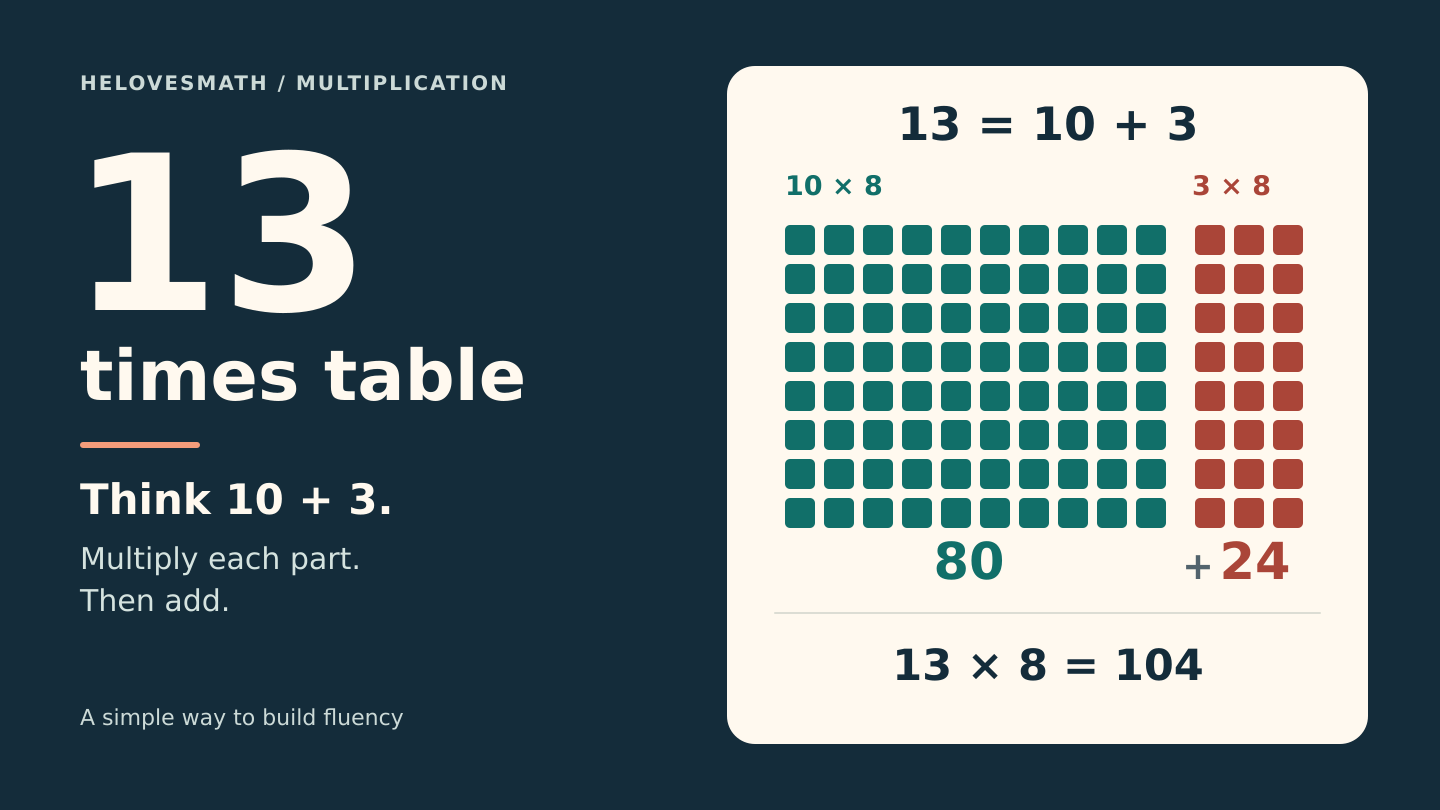
To multiply a number by 13, multiply it by 10 and by 3, then add the two answers. For example, 13 × 8 = 80 + 24 = 104.
The first twelve positive multiples are 13, 26, 39, 52, 65, 78, 91, 104, 117, 130, 143 and 156. Also, 13 × 0 = 0. The table continues beyond any chart shown here.
Interactive chart and practice quiz
13 times table
Select a range, then choose Practice quiz for eight different questions from that range. There is no timer. Change the range to start a fresh chart.
| Multiply | Answer |
|---|---|
| 13 × 1 | 13 |
| 13 × 2 | 26 |
| 13 × 3 | 39 |
| 13 × 4 | 52 |
| 13 × 5 | 65 |
| 13 × 6 | 78 |
| 13 × 7 | 91 |
| 13 × 8 | 104 |
| 13 × 9 | 117 |
| 13 × 10 | 130 |
| 13 × 11 | 143 |
| 13 × 12 | 156 |
Showing factors 1 to 12. Zero is also a multiple: 13 × 0 = 0.
Print this view prints the selected chart or a blank version of the quiz. For a fixed worksheet and separate answer key, use the three-page printable below. Interactive controls need JavaScript; the full chart and written practice remain available without it.
Multiply by 13 or check a multiple
These tools use whole numbers: 0, 1, 2, 3, … Enter digits only, without commas, signs or decimal points. The limits keep every result exact.
0 to 1,000,000,000,000
0 to 1,000,000,000,000,000
Enter a whole number in either tool. For example, 13 × 8 = 104; 80 = 13 × 6 + 2, so 80 is not a multiple of 13.
What does multiplying by 13 mean?
Think of equal groups. Eight bags with 13 counters in each contain 8 × 13 counters. Multiplication can be done in either order, so 8 × 13 = 13 × 8 = 104. Adding eight lots of 13 gives the same total.
In 13 × 8 = 104, 13 and 8 are factors; 104 is their product and a multiple of 13. Multiplying by zero gives zero: zero bags contain zero counters.
Three ways to work out a forgotten fact
1. Split 13 into 10 and 3
Each bag of 13 can be split into 10 counters and 3 counters. With eight bags, there are eight lots of each part:
13 × 8 = (10 × 8) + (3 × 8)
= 80 + 24 = 104
This is the distributive property: 13 × n = 10 × n + 3 × n. Both parts must be multiplied by the same number.

2. Use a nearby fact
If you know 13 × 10 = 130, remove one group of 13 to get 13 × 9:
13 × 9 = 130 − 13 = 117
For a larger example, start at 13 × 20 = 260. Then 13 × 19 = 260 − 13 = 247. To move one step along the 13 table, add or subtract 13.
3. Use the 12 table or double a fact
If 12 × 8 = 96 is familiar, add one more eight: 13 × 8 = 96 + 8 = 104. The general rule is 13 × n = 12 × n + n.
Or double a known answer: 13 × 7 = 91, so 13 × 14 = 2 × 91 = 182. Doubling the multiplier doubles the product.
The 13 times table from 1 to 25
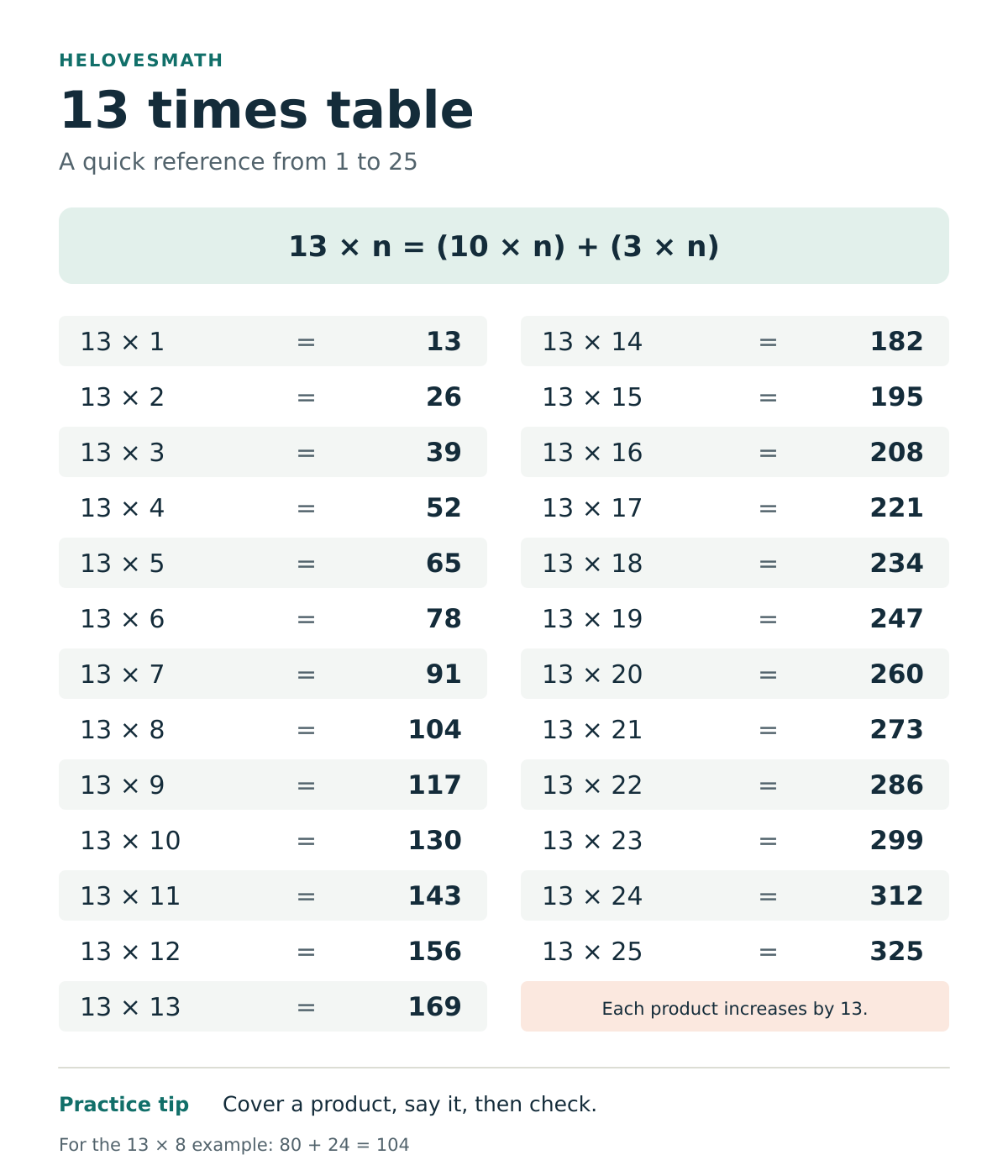
The table to 12 ends at 156; to 20 it ends at 260; to 25 it ends at 325. These are display limits, not the end of the sequence. Remember the zero fact too: 13 × 0 = 0.
| Multiply | Answer |
|---|---|
| 13 × 1 | 13 |
| 13 × 2 | 26 |
| 13 × 3 | 39 |
| 13 × 4 | 52 |
| 13 × 5 | 65 |
| 13 × 6 | 78 |
| 13 × 7 | 91 |
| 13 × 8 | 104 |
| 13 × 9 | 117 |
| 13 × 10 | 130 |
| 13 × 11 | 143 |
| 13 × 12 | 156 |
| Multiply | Answer |
|---|---|
| 13 × 13 | 169 |
| 13 × 14 | 182 |
| 13 × 15 | 195 |
| 13 × 16 | 208 |
| 13 × 17 | 221 |
| 13 × 18 | 234 |
| 13 × 19 | 247 |
| 13 × 20 | 260 |
| 13 × 21 | 273 |
| 13 × 22 | 286 |
| 13 × 23 | 299 |
| 13 × 24 | 312 |
| 13 × 25 | 325 |
Patterns you can use to check an answer
- Add 13 each time. From 78, the next two multiples are 91 and 104.
- Odd, even, odd, even. Because 13 is odd, an odd multiplier gives an odd product and an even multiplier gives an even product. For example, 13 × 7 = 91 and 13 × 8 = 104.
- The ones digits repeat every ten steps: 3, 6, 9, 2, 5, 8, 1, 4, 7, 0, then the same cycle again. Moving ten steps adds 130, which leaves the ones digit unchanged.
- 13 × 13 is a square: 169. Its neighbouring facts are 156 and 182.
A last-digit check can rule out an answer, but cannot prove it. For example, both 104 and 114 end in 4; only 104 equals 13 × 8.
Is a number in the 13 times table?
Divide by 13. A whole number is a multiple of 13 exactly when the remainder is zero. In this lesson, the table uses nonnegative whole-number multipliers, so zero qualifies: 0 = 13 × 0.
Is 247 a multiple of 13?
Yes: 13 × 19 = 247, so 247 ÷ 13 = 19 with no remainder.
Are 67 and 80 multiples of 13?
67 is not: 67 = 13 × 5 + 2. It lies between 65 and 78.
80 is not: 80 = 13 × 6 + 2. It lies between 78 and 91.
More generally, negative integer multiples exist, such as −26 = 13 × (−2). They are outside this page’s whole-number practice tools. A decimal quotient by itself does not make a number a whole-number multiple.
Worked examples with missing numbers and groups
Find the missing factor: 13 × □ = 156
Ten groups of 13 give 130. The remaining 156 − 130 = 26 is two more groups. So the missing factor is 12.
Check: 13 × 12 = 130 + 26 = 156.
Pack 182 cards into packs of 13
There are 182 ÷ 13 packs. Since 13 × 14 = 182, the answer is 14 complete packs, with no cards left over.
Six boxes, then give eight away
Each box contains 13 pencils. First find the total: 6 × 13 = 78 pencils. Give away eight: 78 − 8 = 70 pencils remain.
The subtraction happens after the multiplication because the eight pencils are removed from the whole collection.
Common mistakes and how to repair them
- Writing 13 × 6 = 60 + 3. Each of the six groups has three extra objects. Use 60 + (6 × 3) = 60 + 18 = 78.
- Adding 13 and 8 instead of multiplying. 13 + 8 = 21; 13 × 8 means eight groups of 13 and equals 104.
- Adding 13 when changing 12 × 8 to 13 × 8. The number of groups increases from 12 to 13, so add one group of 8: 96 + 8 = 104.
- Treating every number ending in 3 as a multiple of 13. 13 is a multiple, but 23 is not. Check the complete product or the remainder.
- Stopping the table at 12. The next factor gives 13 × 13 = 169. A printed chart has an endpoint; multiplication does not.
Try these questions without the chart
Write an answer and, where asked, a reason. Check the explanations after your first attempt.
- 13 × 4 = ?
- 13 × 7 = ?
- 13 × 11 = ?
- 13 × 0 = ?
- 13 × □ = 195. Find the missing number.
- 169 ÷ 13 = ?
- Continue: 78, 91, __, __.
- Which are multiples of 13: 65, 80, 117, 144?
- Nine bags hold 13 buttons each. How many buttons altogether?
- 13 × 12 or 13 × 13: which is greater, and by how much?
- Explain the error in 13 × 5 = 50 + 3.
- Extension: find 13 × 24 using 13 × 20 and 13 × 4.
Show all 12 answers with methods
- 52. 40 + 12 = 52.
- 91. 70 + 21 = 91.
- 143. 130 + 13 = 143.
- 0. Zero groups have no objects.
- 15. 130 + 65 = 195, or 195 ÷ 13 = 15.
- 13. 13 × 13 = 169.
- 104, 117. Add 13 each time.
- 65 and 117. They are 13 × 5 and 13 × 9. The remainders for 80 and 144 are 2 and 1.
- 117 buttons. 9 × 13 = 90 + 27.
- 13 × 13 is greater by 13. 169 − 156 = 13.
- The 3 must also be multiplied by 5. 50 + 15 = 65.
- 312. 260 + 52 = 312.
A short practice routine for learners and helpers
- Build one fact. Draw an array or use counters to show 13 as 10 + 3.
- Try a few mixed questions. Cover the answers rather than copying the whole chart. Include a missing-factor or division question.
- Check and explain. If an answer is wrong, rebuild it with a known fact. Ask “Did you include three extra counters in every group?” when partitioning is incomplete.
- Revisit later. Return to missed facts after a delay, alongside a few facts already known. Increase the range when the learner can explain the method comfortably.
Spacing practice and revisiting questions are supported by learning research; there is no fixed number of minutes or guaranteed mastery time for every learner. For further ideas, use our guide to learning multiplication tables.
Do students need to memorise the 13 table?
Requirements depend on the curriculum. In England, the Year 4 recall requirement is multiplication and division facts up to 12 × 12. The 13 table is useful extension work for applying known facts and splitting a two-digit number; memorising it to 25 is not that statutory recall requirement.
A learner who can explain 13 × n = 10 × n + 3 × n can work out unfamiliar facts without memorising a separate list. If the earlier facts need support, revisit the 12 × 12 multiplication chart.
Five useful anchor facts
- 13 × 1 = 13
- 13 × 5 = 65
- 13 × 10 = 130
- 13 × 13 = 169
- 13 × 20 = 260
Use an anchor to derive a nearby fact, then check with the 10 + 3 method.
Printable 13 times table chart and worksheet
Download the three-page 13 times table PDF for an original chart, twelve mixed practice questions, and a separate answer page with methods. It is free to open; no account is needed. The PDF questions are a separate practice set from the questions above.
Print page 1 for the chart, page 2 for the worksheet, and page 3 when you want the answers. Use “Fit to printable area” on A4 or US Letter.
View or save a chart image
Open the 1–25 chart image. All 25 facts are also available as selectable text in the full table above.
Frequently asked questions
What is 13 times 12?
156. Work it out as 120 + 36, or 130 + 26.
What is 13 times 13?
169. This is 13 squared: 130 + 39.
Where does 52 appear in the table?
At 13 × 4 = 52. Reversing the calculation, 52 ÷ 13 = 4.
Is zero in the 13 times table?
Yes, when the table includes whole-number multipliers: 13 × 0 = 0. Many charts start at 1 simply to focus on positive facts.
Is every multiple of 26 also a multiple of 13?
Yes. Since 26 = 2 × 13, multiplying 26 by a whole number gives an even-numbered multiple of 13. For example, 26 × 3 = 78 = 13 × 6. Not every multiple of 13 is a multiple of 26: 39 is one counterexample.
How can I remember 13 × 8?
Split 13 into 10 and 3: 80 + 24 = 104. Or use 12 × 8 = 96 and add one more 8.
Can I practise without a timer?
Yes. This page’s quiz is untimed. Select 1–12, 1–20 or 1–25, start a quiz, and use the worked feedback to correct missed facts.
Sources & References
The explanations, questions, diagrams and printable on this page are original. The sources below support the mathematical representations, curriculum distinction and practice approach.
- Department for Education: mathematics programmes of study, particularly Year 4 multiplication, division and derived facts.
- Common Core: Grade 3 operations and algebraic thinking, for equal groups, arrays, unknown factors and multiplication properties. This does not make the 13 table a required Grade 3 memorisation set.
- Institute of Education Sciences: Organizing Instruction and Study to Improve Student Learning, for spacing practice, worked examples and revisiting material through quizzes.