
Find AQA A-level Further Mathematics 7367 question papers and mark schemes, choose the right Paper 3 options, and use each paper to improve a specific skill. This archive pairs the original 2019–2022 papers and specimen materials with an independent revision guide and original practice.
Check the qualification first. These are AQA A-level Further Mathematics 7367 resources. AQA AS Further Mathematics is 7366; OxfordAQA International Further Mathematics is a different qualification. The historical URL is retained, but the previous AS/OxfordAQA label did not correctly describe these documents.
Which papers do I need?
AQA 7367 is a linear A-level: the assessments are taken at the end of the course. Papers 1 and 2 examine compulsory content. Paper 3 examines two of the three optional areas: mechanics, statistics and discrete mathematics. Check the pair taught by your school or agreed with your examination centre before planning revision.
| Assessment | Content | Time and marks |
|---|---|---|
| Paper 1 · 7367/1 | Compulsory content A–J | 2 hours · 100 marks · one third of A-level |
| Paper 2 · 7367/2 | Compulsory content A–J | 2 hours · 100 marks · one third of A-level |
| Paper 3 · two options | Choose the correct two from 3M mechanics, 3S statistics and 3D discrete | 2 hours total · 100 marks total · one third of A-level; each option has 50 marks |
The separate Paper 3 PDFs below are option components. A single 50-mark file is not the whole Paper 3 assessment. For a full timed rehearsal, use both of your chosen options from the same series and follow the instructions printed on them.
The compulsory topics include proof, complex numbers, matrices, further algebra and functions, further calculus, further vectors, polar coordinates, hyperbolic functions, differential equations and numerical methods. Topic names are a map, not a guarantee that a particular past question will recur. Use the current specification to check the precise content and notation.
This is a historical archive, not a claim to contain every paper or the newest secure assessments. Use the official assessment-resource page in the final reference section for additional public materials. The specimen set illustrates the assessment style; it is not a dated examination series. Some November 2020–2021 papers retain June wording inside the document; match the series, component and corresponding mark scheme rather than renaming the archive from one cover line alone.
A revision cycle that makes past papers useful
- Match before you start. Check AQA, 7367, year/series, component and QP versus MS. Save the matching mark scheme for later. For Paper 3, check both option names.
- Attempt without the solution. Start with a topic set if the content is new. Once familiar, work under the time and calculator conditions printed on the paper. Write reasoning, diagrams and units, not just calculator outputs.
- Mark the method as well as the result. Follow the official mark scheme, including required justification and acceptable alternatives. Do not invent partial credit; note any uncertainty to discuss with a teacher.
- Classify the error. Was it a concept, an algebra slip, notation, modelling, or time? Record the question reference and the first point where your reasoning diverged.
- Repair and retrieve. Rework the question on a blank page, then try a different question testing the same idea after a delay. Recognising a solution is not the same as independently producing it.
For example, “lost four marks on complex numbers” is too broad to guide the next session. “Used arctan(y/x) without checking the quadrant” identifies a repair: plot the point first, then find the argument in the required interval. Keep a short log of the error, the corrected rule and one successful fresh attempt.
For prerequisite support, use our AQA A-level Mathematics 7357 guide, A-level textbook guide and algebra worksheet library. Further Mathematics questions often combine new concepts with ordinary algebra, trigonometry and calculus.
Six original worked examples
These short examples are written for this guide. They are not copied examination questions and do not replace full specification coverage. The first four sample compulsory skills; the final two practise mechanics and statistics foundations for the optional routes.
1. Read a complex number geometrically
For z = 3 + 4i, find the modulus, principal argument and conjugate.
|z| = √(3² + 4²) = 5
arg(z) = arctan(4/3) ≈ 0.9273 radians
conjugate(z) = 3 − 4i
The point (3, 4) is in the first quadrant, so the positive acute angle is appropriate. Conjugation reflects the point in the real axis; it preserves the modulus. As a check, (3 + 4i)(3 − 4i) = 25 = |z|².
Watch for: the imaginary part is the real number 4, not 4i. An inverse-tangent calculation alone may give the wrong quadrant for other points.

2. Apply a rotation matrix in the correct order
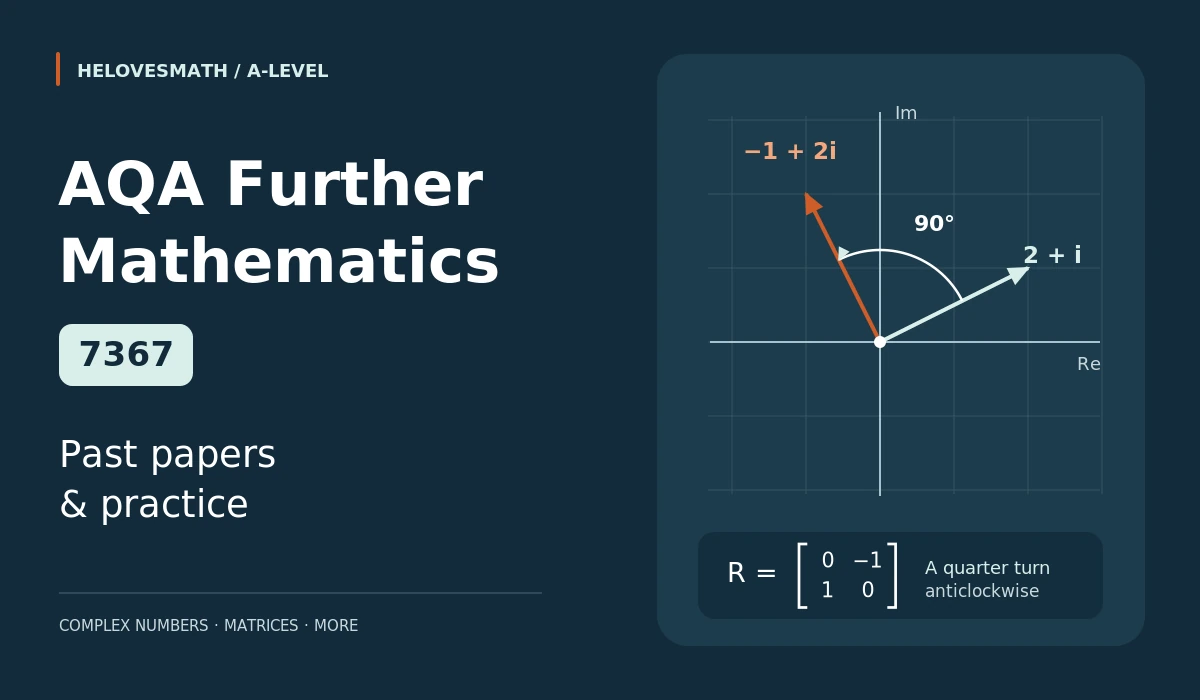
Use the matrix R with rows (0, −1) and (1, 0) to transform the column vector (2, 1).
R(2, 1)ᵀ = (0×2 − 1×1, 1×2 + 0×1)ᵀ = (−1, 2)ᵀ
This is a 90° anticlockwise rotation about the origin, using column vectors. The original and image points both lie √5 units from the origin. Applying R twice gives (−2, −1), a 180° rotation. For two different transformations A then B, the combined matrix acting on a column vector is BA; order generally matters.

3. Show the induction step, not just a pattern
Prove that 1 + 3 + 5 + … + (2n − 1) = n² for positive integers n.
For n = 1, both sides equal 1. Assume the sum of the first k odd numbers is k². The next odd number is 2(k + 1) − 1 = 2k + 1, so the sum of the first k + 1 terms is k² + 2k + 1 = (k + 1)². Thus the statement holds for k + 1 whenever it holds for k. With the base case, induction proves it for every positive integer n.
Watch for: checking several numerical cases suggests a pattern but is not a proof for all positive integers.
4. Use an initial condition in a differential equation
Solve dy/dx = 2xy with y(0) = 3.
Since the given solution starts nonzero, separate variables: dy/y = 2x dx. Integrating gives ln|y| = x² + C, hence y = Aex². The condition y(0) = 3 gives A = 3, so y = 3ex². Differentiating returns y′ = 6xex² = 2xy.
The differential equation also has the zero solution, which division by y would omit. It does not satisfy this initial condition. Always check both the equation and the condition.
5. Separate signed impulse from its magnitude
A 0.20 kg ball moves at +6.0 m/s and rebounds at −4.0 m/s along the same line. Find the impulse on it.
J = m(v − u) = 0.20(−4.0 − 6.0) = −2.0 N s
The impulse is 2.0 N s in the negative direction. Its magnitude is 2.0 N s. Adding speeds without a chosen direction hides the sign convention. Momentum change has the same units, kg m/s; 1 N s = 1 kg m/s. This is an optional mechanics example.
6. Standardise a normal model with the standard deviation
Suppose X is normally distributed with mean 50 and variance 16. Find P(X > 54).
The standard deviation is √16 = 4. Therefore z = (54 − 50)/4 = 1, and P(X > 54) = 1 − Φ(1) ≈ 0.1587, about 15.87%.
We use the assumed normal model. Dividing by the variance 16 would give the wrong standardisation. The continuous distribution gives zero probability to one exact point, so > and ≥ give the same answer here. This is a statistics foundation for the optional route.
Common mistakes to catch before a mock
- Mixing qualifications: 7357 Mathematics, 7366 AS Further Mathematics and 7367 A-level Further Mathematics are not interchangeable paper codes
- Practising only one option: the Paper 3 assessment uses two chosen option areas
- Unexplained decimal answers: retain exact forms where requested, show reasoning, and round only at the appropriate final stage
- Using a calculator result as proof: a numeric check can support verification but does not establish a general algebraic statement
- Forgetting conventions: state the positive direction in mechanics, the vector convention in transformations, and the angle interval/unit in complex numbers
- Treating a raw percentage as a guaranteed grade: use the official grade boundary for the correct qualification and series; a short topic test does not predict an A-level grade
Eight practice questions with explained answers
Try each question before opening its answer. Questions 1–6 target compulsory foundations; questions 7–8 cover mechanics and statistics respectively.
1. For z = −5 + 12i, find |z| and its conjugate.
|z| = √(25 + 144) = 13; the conjugate is −5 − 12i. Conjugation changes only the sign of the imaginary part.
2. Simplify (2 + i)(3 − 2i).
Expand: 6 − 4i + 3i − 2i² = 8 − i, because i² = −1.
3. Rotate (−3, 2) by 90° anticlockwise about the origin.
The rule (x, y) → (−y, x) gives (−2, −3). The squared distance from the origin stays 13.
4. Find the determinant of the matrix with rows (2, 1) and (3, 4).
The determinant is 2×4 − 1×3 = 5. It is nonzero, so this matrix is invertible; do not multiply all four entries together.
5. Find the sum of the first 20 positive odd numbers.
By the proved identity, the sum is 20² = 400. The last term is 2×20 − 1 = 39.
6. Solve dy/dx = 3y with y(0) = 2.
The solution is y = 2e³ˣ. Its derivative is 6e³ˣ = 3y, and at x = 0 it equals 2.
7. A 0.50 kg object changes velocity from −2 m/s to +4 m/s. Find the signed impulse.
J = 0.50[4 − (−2)] = +3 N s, in the chosen positive direction. This is an optional mechanics question.
8. X is normal with mean 10 and standard deviation 2. Find P(X ≤ 8).
z = (8 − 10)/2 = −1, so P(X ≤ 8) = Φ(−1) ≈ 0.1587. This is an optional statistics question.
Frequently asked questions
Are these OxfordAQA International papers?
No. The documents linked in this archive are AQA A-level Further Mathematics 7367. OxfordAQA International uses a separate specification and assessment structure. Check the examination board and code on your entry statement.
Do I need all three Paper 3 options?
No. AQA 7367 requires two of mechanics, statistics and discrete mathematics. Match the two options taught and entered by your centre. All three option resources are preserved here so students on each permitted route can find their files.
Should I start with a full timed paper?
If you have not learnt the topic, begin with a short untimed set and diagnose the gaps. Use full timed papers later to rehearse selection, pacing and clear written solutions. Both kinds of practice have a purpose.
Can I use a mark scheme as a worked solution?
It explains how marks are awarded, but it may omit intermediate teaching steps. Attempt the question first, compare your reasoning with the scheme and ask for help with any unexplained step. The original examples above show the kind of intermediate reasoning worth writing.
Sources & References
Qualification guidance checked 5 October 2026. HeLovesMath is an independent study resource. AQA owns the linked official papers and mark schemes; they stay on AQA’s servers and are not rehosted here. External resources open in a new tab.
Official specification and assessment sources
Qualification details checked against AQA and OxfordAQA sources on 5 October 2026. Always use your centre’s confirmed option route and the current awarding-body guidance.
- AQA 7367 assessment structure and option combinations
- AQA 7367 scheme of assessment and grade-route guidance
- AQA A-level Further Mathematics specification (PDF)
- AQA 7367 assessment resources, including newer public materials
- AQA compulsory content; mechanics; statistics; discrete mathematics
- AQA 2025/26 entry-code booklet (PDF, Further Mathematics on printed page 35)
- AS Further Mathematics 7366: separate assessment structure
- OxfordAQA International Further Mathematics 9665 and forthcoming revised 9765 qualification
Original question-paper and mark-scheme archive
Choose a series, then match the component and document type. All 50 original destinations are retained. These are public historical materials; check AQA for additional releases and the current specification.
Past-paper and specimen library
This collection preserves 50 original AQA PDF links: five papers or option booklets, each paired with its mark scheme, across four examination archive sets and one specimen set. Choose both of your Paper 3 options. Paper 3 gives two hours for the selected pair together.
Archive note: PDFs under the November 2020 and November 2021 links retain June production labels. Some 2020 covers also retain scheduled May/June dates. The original archive labels and URLs are retained here. Sample set 1 is specimen material, not an examination sitting.
June 2022
| Paper or option | Question paper | Mark scheme |
|---|---|---|
| Paper 1 | Paper 1 question paper (PDF) | Paper 1 mark scheme (PDF) |
| Paper 2 | Paper 2 question paper (PDF) | Paper 2 mark scheme (PDF) |
| Paper 3 Discrete | Paper 3 Discrete question paper (PDF) | Paper 3 Discrete mark scheme (PDF) |
| Paper 3 Mechanics | Paper 3 Mechanics question paper (PDF) | Paper 3 Mechanics mark scheme (PDF) |
| Paper 3 Statistics | Paper 3 Statistics question paper (PDF) | Paper 3 Statistics mark scheme (PDF) |
November 2021
| Paper or option | Question paper | Mark scheme |
|---|---|---|
| Paper 1 | Paper 1 question paper (PDF) | Paper 1 mark scheme (PDF) |
| Paper 2 | Paper 2 question paper (PDF) | Paper 2 mark scheme (PDF) |
| Paper 3 Discrete | Paper 3 Discrete question paper (PDF) | Paper 3 Discrete mark scheme (PDF) |
| Paper 3 Mechanics | Paper 3 Mechanics question paper (PDF) | Paper 3 Mechanics mark scheme (PDF) |
| Paper 3 Statistics | Paper 3 Statistics question paper (PDF) | Paper 3 Statistics mark scheme (PDF) |
November 2020
| Paper or option | Question paper | Mark scheme |
|---|---|---|
| Paper 1 | Paper 1 question paper (PDF) | Paper 1 mark scheme (PDF) |
| Paper 2 | Paper 2 question paper (PDF) | Paper 2 mark scheme (PDF) |
| Paper 3 Discrete | Paper 3 Discrete question paper (PDF) | Paper 3 Discrete mark scheme (PDF) |
| Paper 3 Mechanics | Paper 3 Mechanics question paper (PDF) | Paper 3 Mechanics mark scheme (PDF) |
| Paper 3 Statistics | Paper 3 Statistics question paper (PDF) | Paper 3 Statistics mark scheme (PDF) |
June 2019
| Paper or option | Question paper | Mark scheme |
|---|---|---|
| Paper 1 | Paper 1 question paper (PDF) | Paper 1 mark scheme (PDF) |
| Paper 2 | Paper 2 question paper (PDF) | Paper 2 mark scheme (PDF) |
| Paper 3 Discrete | Paper 3 Discrete question paper (PDF) | Paper 3 Discrete mark scheme (PDF) |
| Paper 3 Mechanics | Paper 3 Mechanics question paper (PDF) | Paper 3 Mechanics mark scheme (PDF) |
| Paper 3 Statistics | Paper 3 Statistics question paper (PDF) | Paper 3 Statistics mark scheme (PDF) |
Sample set 1 (specimen)
| Paper or option | Question paper | Mark scheme |
|---|---|---|
| Paper 1 | Paper 1 question paper (PDF) | Paper 1 mark scheme (PDF) |
| Paper 2 | Paper 2 question paper (PDF) | Paper 2 mark scheme (PDF) |
| Paper 3 Discrete | Paper 3 Discrete question paper (PDF) | Paper 3 Discrete mark scheme (PDF) |
| Paper 3 Mechanics | Paper 3 Mechanics question paper (PDF) | Paper 3 Mechanics mark scheme (PDF) |
| Paper 3 Statistics | Paper 3 Statistics question paper (PDF) | Paper 3 Statistics mark scheme (PDF) |
All 50 original PDF links were reachable when checked on 5 October 2026. The June 2022 Paper 2 mark-scheme URL contains an encoded space; it has been retained exactly and was verified to open the correct document.