ALGEBRA • LEARN, PRACTISE, CONNECT
Find an algebra topic, understand the method, then choose a practice resource. This guide brings together an existing secondary-school resource library with original worked examples and a short diagnostic. Start with the explanations below if a method is unfamiliar, or jump to a topic in the resource directory when you know what you need.
The collection spans introductory algebra, GCSE-style work and some extension material. These are topic labels, not a guarantee that every linked task matches your exam board, tier or current specification. England’s national curriculum includes expressions, equations, sequences and graphs; individual courses organise and assess them differently.
Which algebra resource should I use?
Choose by the step you cannot yet explain. Being able to copy a procedure is different from recognising when it applies. Try one question without notes, inspect the first uncertain line, then practise that skill before moving on.
- Letters feel unfamiliar: begin with forming expressions, substitution and function machines. Read 3x as three times x, not as the two-digit number “3x”.
- You know the notation but lose signs: use simplifying, single brackets and common-factor factorising. Write the intermediate products rather than doing every step mentally.
- You can simplify but cannot find an unknown: use linear equations, rearranging formulae and inequalities. Name the operation applied to both sides.
- You need to connect patterns and pictures: use linear sequences, linear graphs and simultaneous equations. Explain what each coordinate or term means.
- You are ready for more demanding work: choose quadratics, algebraic fractions, functions or proof. Check prerequisites and restrictions first.
For a smaller practice collection, use the GCSE algebra worksheets guide. The broader algebra worksheet library provides another topic-based route. Work independently first; a calculator can check a result, but it cannot replace the written reasoning your teacher or examination requires.
Ten worked examples that connect the main ideas
1. Form an expression, then substitute carefully
A notebook costs p pounds. Three notebooks and a £2 delivery charge cost 3p + 2 pounds. The delivery charge is added once. The expression 3(p + 2) would charge delivery three times.
If p = 4.50, the total is 3 × 4.50 + 2 = £15.50. Keep the units in the interpretation: p represents a price measured in pounds, while the coefficient 3 counts notebooks.
For a negative input, brackets protect the sign. At x = −2, x² − 3x = (−2)² − 3(−2) = 4 + 6 = 10. The expression −x² means −(x²), so it would equal −4 at this input.
2. Collect like terms and distribute a negative
Simplify 4x + 3 − 2(x − 5). First multiply both terms inside the bracket by −2: −2(x − 5) = −2x + 10. Then 4x + 3 − 2x + 10 = 2x + 13.
Terms can be combined by addition when their variable parts match. Thus 4x − 2x = 2x, but 4x + 3 cannot become 7x. Likewise x + x = 2x, whereas x × x = x². Addition and multiplication use different rules.
3. Expand two brackets using area
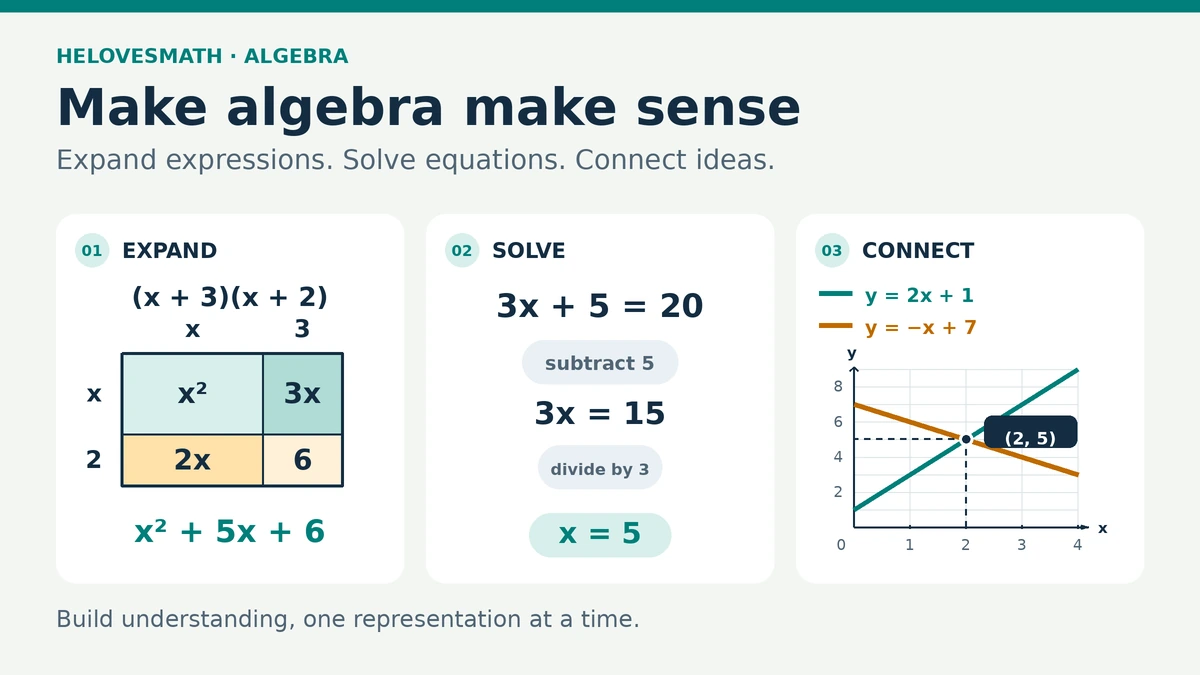
For (x + 3)(x + 2), multiply each term in the first bracket by each term in the second: x² + 2x + 3x + 6 = x² + 5x + 6. The two middle products both matter.

Factorising reverses this process: x² + 5x + 6 = (x + 2)(x + 3), because 2 + 3 = 5 and 2 × 3 = 6. Always expand your proposed factors to check them. For 6x² + 9x, take the common factor 3x to obtain 3x(2x + 3).
4. Solve an equation by preserving equality
Solve 3(x − 2) + 4 = 2x + 9. Expanding gives 3x − 6 + 4 = 2x + 9, so 3x − 2 = 2x + 9. Subtract 2x from both sides: x − 2 = 9. Add 2 to both sides: x = 11.
Check in the original equation: 3(11 − 2) + 4 = 31 and 2(11) + 9 = 31. Matching sides confirm this candidate solution. A step such as “move it across and change the sign” is shorthand for a valid operation on both sides, not a separate algebraic law.
Some equations have no solution or infinitely many solutions. For example, 2(x + 1) = 2x + 3 reduces to 2 = 3, so it has no solution. The equation 2(x + 1) = 2x + 2 is true for every real x. Do not divide by a variable expression without considering whether it can be zero.
5. Rearrange a formula and keep restrictions
Make h the subject of A = ½bh. Multiply by 2, giving 2A = bh. Divide by b to get h = 2A/b, provided b ≠ 0. For a triangle with A = 24 cm² and b = 8 cm, h = 48/8 = 6 cm.
Rearranging changes the subject while keeping the relationship. If the formula contains a square, square-rooting may introduce two algebraic possibilities: x² = 25 gives x = ±5. A positive-length context can then rule out the negative value.
6. Reverse an inequality when dividing by a negative
Solve 5 − 2x < 11. Subtract 5: −2x < 6. Dividing both sides by −2 reverses the order, so x > −3. The boundary −3 is excluded because the original inequality is strict: it gives 11 < 11, which is false.
Test one included value, x = 0: 5 < 11 is true. On a number line, use an open circle at −3 and shade to the right. For a non-strict inequality, the boundary would be included and shown with a filled circle.
7. Find a sequence rule, then test it
The arithmetic sequence 7, 11, 15, 19, … increases by 4. With the first term at n = 1, its nth term is 7 + 4(n − 1) = 4n + 3. The tenth term is 43. To test whether 50 occurs, solve 4n + 3 = 50: n = 47/4 = 11.75, which is not a positive integer. Therefore 50 is not a term of this stated arithmetic sequence.
A finite list alone does not determine a unique infinite sequence. The answer above uses the stated constant-difference rule. For quadratic-sequence tasks with equally spaced n, constant second differences suggest a quadratic rule; further checks are still needed. Use the nth-term calculator as a check after you state the pattern assumption.
8. Connect simultaneous equations to an intersection
Solve y = 2x + 1 and y = −x + 7 together. At an intersection the y-values are equal, so 2x + 1 = −x + 7. Hence 3x = 6, x = 2 and y = 5. The ordered pair is (2, 5); it satisfies both original equations.

The gradients are 2 and −1, while the y-intercepts are 1 and 7. Parallel distinct lines would have no intersection; two equations describing the same line would have infinitely many shared points.
9. Factorise a quadratic and respect a fraction’s domain
Solve x² − x − 12 = 0. Numbers −4 and 3 multiply to −12 and add to −1, so (x − 4)(x + 3) = 0. At least one factor must be zero: x = 4 or x = −3. This zero-product reasoning applies because the product equals zero.
Now simplify (x² − 9)/(x − 3). Factor the numerator as (x − 3)(x + 3), then cancel the common factor to obtain x + 3 for x ≠ 3. The original fraction remains undefined at x = 3. Cancelling a factor does not restore an excluded input, and individual terms cannot be cancelled across addition.
10. Compose functions and give a general proof
Let f(x) = 2x + 1 and g(x) = x². Then f(g(3)) = f(9) = 19, while g(f(3)) = g(7) = 49. Read composition from the inside out. The order matters, and f(x) means the output of f at x, not f multiplied by x.
For a short proof, take any three consecutive integers n, n + 1 and n + 2, where n is an integer. Their sum is 3n + 3 = 3(n + 1), an integer multiple of 3. This proves the claim for every such triple. Checking 4 + 5 + 6 = 15 illustrates the claim but does not prove all cases.
A 12-question algebra check, with explained answers
Try each question on paper before opening its answer. If your result differs, compare the first line of your method with the explanation. Questions 1–6 focus on foundations; 7–12 connect sequences, graphs and more advanced algebra.
- Write the cost of five tickets at t pounds each plus one £3 booking fee.
Show answer 1
5t + 3 pounds. The fee is paid once. 5(t + 3) would add five fees.
- Evaluate 2a² − b when a = −3 and b = 4.
Show answer 2
14. 2(−3)² − 4 = 2 × 9 − 4 = 14. Square the negative number before multiplying by 2.
- Simplify 7x − 3 + 2x + 8.
Show answer 3
9x + 5. Combine the x-terms and the constants separately.
- Expand −3(2x − 5).
Show answer 4
−6x + 15. Multiply both terms by −3; a negative multiplied by a negative is positive.
- Factorise 8x² − 12x fully.
Show answer 5
4x(2x − 3). Both terms contain 4x. Expanding checks the result.
- Solve 4x + 7 = 2x − 5.
Show answer 6
x = −6. Subtract 2x and 7 to get 2x = −12, then divide by 2. Both original sides equal −17.
- Find the nth term of the arithmetic sequence 12, 9, 6, 3, …, starting at n = 1.
Show answer 7
15 − 3n. Use 12 − 3(n − 1). The first term is 12 and each increase in n decreases the value by 3.
- Solve 2 − 3x ≤ 14.
Show answer 8
x ≥ −4. Subtract 2, then divide by −3 and reverse the inequality. The boundary is included.
- Find the intersection of y = x + 2 and y = 8 − 2x.
Show answer 9
(2, 4). Equate x + 2 = 8 − 2x to obtain 3x = 6. Substitute x = 2 into either line.
- Solve x² + 2x − 15 = 0.
Show answer 10
x = 3 or x = −5. Factorise as (x + 5)(x − 3) = 0, then set each factor equal to zero.
- Simplify (x² − 16)/(x − 4), including the restriction.
Show answer 11
x + 4, with x ≠ 4. The numerator is (x − 4)(x + 4). The original denominator cannot be zero.
- Prove that the sum of any two consecutive odd integers is divisible by 4.
Show answer 12
Write them as 2n + 1 and 2n + 3 for an integer n. Their sum is 4n + 4 = 4(n + 1), so it is divisible by 4. The reasoning includes negative odd integers.
How to turn a worksheet into useful practice
Choose a short set with a clear purpose: fluent substitution, careful negative signs, selecting a method or explaining why a claim is true. Attempt it before consulting answers. Mark errors by cause, such as an incorrect expansion or a lost restriction, then write a corrected example without copying the answer line.
After success on one familiar format, change the form of the task. Explain an error, compare two methods, match an equation to a graph or create a question with a specified solution. Return to a few questions later without notes. One high score immediately after a worked example does not establish lasting understanding.
Teachers should preview each external resource, confirm its licence and check its answers before classroom use. Some links lead to a landing page, an account requirement or paid material. Titles containing “new GCSE”, an old grade label or an older exam year are historical resource titles, not a claim about today’s qualification.
For checking symbolic steps after an independent attempt, try the algebra calculator. Keep exact fractions where appropriate, explain any rounding, and use your course’s permitted calculator rules.
Jump to a resource topic
The existing collection is retained below in Sources & References, grouped by topic. Each jump takes you to the original resource links and credits. Use your browser’s Find command to locate a named author or a phrase such as “answers”.
- Forming Expressions
- Function Machines
- Simplifying Expressions
- Expanding Single Brackets
- Expanding Double Brackets
- Expanding Cubics
- Factorising (Single Brackets)
- Rearranging Formulae
- Substitution
- Linear Sequences
- Quadratic Sequences
- Other Sequences
- Linear Equations
- Linear and Graphical Inequalities
- Quadratic Inequalities
- Linear Graphs
- Quadratics
- Iteration
- Simultaneous Equations
- Algebraic Fractions
- Functions
- Graphing Functions
- Graph Transformations
- Algebraic Proof and Identities
- Equation of a Circle & Tangent to a Circle
- Gradient of a Curve
- Area under a Graph
- Algebra Mixed/Revision
Sources & References
Resource credit. The retained external library follows Jo Morgan’s Resourceaholic Algebra collection. Its original first-person credits have been clarified as Jo Morgan/Resourceaholic credits, while the named resource creators remain credited beside their links. External resources are linked at the URLs recorded in the original library; availability and access conditions may change. Inclusion does not transfer copyright or imply endorsement.
- Jo Morgan, Resourceaholic: Algebra resource library — provenance of the retained collection and its author credits
- Resourceaholic: About Jo Morgan — authorship context
- Department for Education: mathematics programmes of study for England — curriculum context, not a match guarantee for every resource
- OpenStax: a general strategy for solving linear equations — equality-preserving operations and checking solutions
Access reviewed 4 October 2026 (UTC). Original destinations are retained, including links with access limitations. A working web page or file endpoint does not establish that an entire worksheet, answer key or download has been checked. Notices identify unavailable responses and pages/viewers that may require further steps. A provider may require registration, payment or permission. Do not enter credentials on an unexpected destination; return to the provider’s official site. The worked examples and twelve answers above are original HeLovesMath teaching material.
Forming Expressions
- Introduction to writing algebraically [Access limited or not independently verified] – by Jo Morgan (Resourceaholic)
- Translating English to algebra [Web page or viewer; download/access conditions may apply] – Median Don Steward
- Forming expressions textbook exercise – Corbett Maths
- Number tricks – mathspad.co.uk
- Three operations, expressions [Web page or viewer; download/access conditions may apply] – Median Don Steward
- Algebraic expressions – Standards Unit
- abc [Access limited or not independently verified] – SMILE
- Words won’t fail me [Web page or viewer; download/access conditions may apply] – SMILE
Function Machines
- Function machines – Corbett Maths
- Function Machines Worksheet [Web page or viewer; download/access conditions may apply] – Mr Thompson on TES
- Language of functions topic check-in – OCR
- Algebraic Function Machines [Web page or viewer; download/access conditions may apply] – by Jo Morgan (Resourceaholic), based on the resource by MissBrookesMaths
- Function machines – writing algebraically – MissBrookesMaths
- Bridging Unit: Functional Notation [Web page or viewer; download/access conditions may apply] – AQA
- An Introduction to Function Notation [Access limited or not independently verified] – TeachIt Maths
Simplifying Expressions
- Interactive simplifying activities [Access limited or not independently verified] – mathspad.co.uk
- Like terms search [Web page or viewer; download/access conditions may apply] – @sgiekAHS [Access limited at review (HTTP 404)]
- Collecting like terms task cards [Web page or viewer; download/access conditions may apply] – GottaLuvItCreations on TES
- Simplifying expressions questions (answers) – @taylorda01
- Collecting like terms textbook exercise – Corbett Maths
- Collecting like terms worksheet – Richard Tock via variationtheory.com
- Multiplying terms textbook exercise – Corbett Maths
- Simplifying Expressions by Multiplying Fill in the Blanks (Answers) – DrAustinMaths
- Simplifying Expressions by Dividing Fill in the Blanks (Answers) – DrAustinMaths
- Algebraic Multiplication and Division Fill in the Blanks (Answers) – DrAustinMaths
- Simplifying Expressions Involving Brackets and Powers (Answers [Access limited at review (HTTP 404)]) – DrAustinMaths
- Algebra pyramids [Access limited at review (HTTP 403)] – Teachit Maths
- Algebra match [Web page or viewer; download/access conditions may apply] – SMILE
- Expression Pyramids [Access limited or not independently verified] – Median Don Steward
- Transforming expressions [Web page or viewer; download/access conditions may apply] – Median Don Steward
- L shaped perimeters [Web page or viewer; download/access conditions may apply] – Median Don Steward
- Algebra true or false [Web page or viewer; download/access conditions may apply] – by Jo Morgan (Resourceaholic)
- Algebra True or False Cards [Web page or viewer; download/access conditions may apply] – Phlynn on TES
- Six legs [Access limited at review (HTTP 503)] – Median Don Steward
- Algebraic Expressions Spiders [Web page or viewer; download/access conditions may apply] – alutwyche on TES
- Six-a-side maths (simplifying algebra) [Access limited or not independently verified] – @dooranran on TES
- One incorrect simplification [Access limited or not independently verified] – Median Don Steward
- Algebraic Expressions Maze [Web page or viewer; download/access conditions may apply] – MEI
- Algebraic order of operations [Web page or viewer; download/access conditions may apply] – by Jo Morgan (Resourceaholic)
- Three operations, expressions [Web page or viewer; download/access conditions may apply] – Median Don Steward
- A level simplifying worksheet [Web page or viewer; download/access conditions may apply] (solutions [Access limited or not independently verified]) – Solomon
- Algebra exercises from the 1950s [Web page or viewer; download/access conditions may apply]
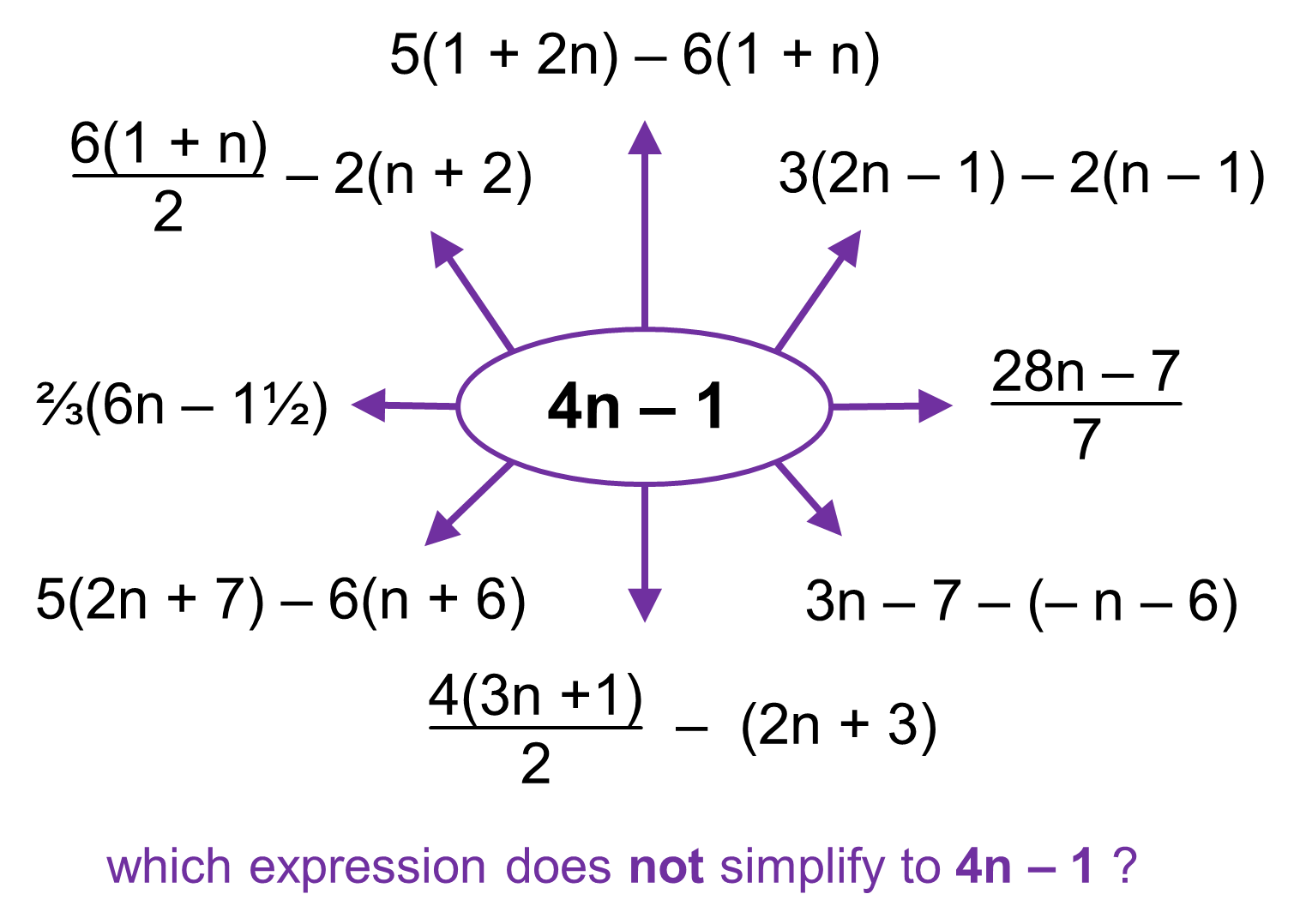 |
| One incorrect simplification – Median Don Steward |
Expanding Single Brackets
- Expanding Single Brackets Fill in the Blanks (answers) – DrAustinMaths
- Expanding Single Brackets Name the Film [Access limited or not independently verified] (answers [Access limited or not independently verified]) – DrAustinMaths
- Expanding Single Brackets Odd One Out (answers) – DrAustinMaths
- Series of lessons on expanding and factorising [Web page or viewer; download/access conditions may apply] – cparkinson3 on TES
- Expanding brackets questions (answers & supporting material) – @taylorda01
- Expanding a bracket [Web page or viewer; download/access conditions may apply] – Maths4Everyone on TES
- Expanding single brackets maze [Web page or viewer; download/access conditions may apply] – Mr Thompson on TES
- Expand and simplify [Web page or viewer; download/access conditions may apply] – Maths4Everyone on TES
- ‘Easy’ Brackets [Web page or viewer; download/access conditions may apply] – typed up by @FitzchivalryF
- Expanding single brackets textbook exercise – Corbett Maths
- Find the gaps [Web page or viewer; download/access conditions may apply] – Median Don Steward
- Expanding and simplifying [Web page or viewer; download/access conditions may apply] – Median Don Steward
- Expanding and Simplifying (positives only) Rich Task [Web page or viewer; download/access conditions may apply] – Mr Thompson on TES
- Miscellaneous Brackets [Web page or viewer; download/access conditions may apply] – typed up by @InteractMaths
Expanding Double Brackets
- Expanding Double Brackets Fill in the Blanks (answers) – DrAustinMaths
- Expanding Harder Double Brackets Fill in the Blanks (answers) – DrAustinMaths
- Series of lessons on expanding and factorising [Web page or viewer; download/access conditions may apply] – cparkinson3 on TES
- Expanding Double Brackets (Basic) – Matching Task [Web page or viewer; download/access conditions may apply] – Mr Thompson on TES
- Equivalence route [Web page or viewer; download/access conditions may apply] – Median Don Steward
- Multiplying two brackets [Web page or viewer; download/access conditions may apply] – Maths4Everyone on TES
- Expanding double brackets textbook exercise – Corbett Maths
- Describing area – mathspad.co.uk
- Double Brackets Task – Karen Hancock
- Double bracket expansion [Access limited at review (HTTP 403)] (grid method, leading to factorising) – GoTeachMaths
- Expanding brackets: quadratic expressions [Web page or viewer; download/access conditions may apply] – Median Don Steward
- Multiplying brackets – algebra learning grid [Web page or viewer; download/access conditions may apply] – @dooranran on TES
- Expanding Harder Brackets Fill in the Blanks (Answers) – DrAustinMaths
- Expanding double brackets [Web page or viewer; download/access conditions may apply] (with grids) – ayoob
- A level expanding worksheet [Web page or viewer; download/access conditions may apply] (solutions [Access limited or not independently verified]) – Solomon
- Expanding/factorising card sort, student sheet [Access limited or not independently verified], notes & ppt – Nuffield Foundation
 [Embedded preview access could not be confirmed during review; the original image URL is retained.] [Embedded preview access could not be confirmed during review; the original image URL is retained.] |
| Extract from a textbook exercise by Barbara Young |
Expanding Cubics
- Expanding triple brackets textbook exercise [Access limited or not independently verified] – Corbett Maths
- Expanding triple brackets [Web page or viewer; download/access conditions may apply] – Maths4Everyone on TES
- Expanding Polynomials [Web page or viewer; download/access conditions may apply] (cubics – new GCSE) – @dooranran on TES
- Expanding brackets II questions [Access limited or not independently verified] (answers) – @taylorda01
- Grid method polynomial expansions [Access limited or not independently verified] – MEI
- Expanding binomials – Squares – Just Maths
- Triple Brackets – Boarding Card – Just Maths
- Expanding triple brackets exam-style questions (answers [Access limited or not independently verified]) – 1st Class Maths
Factorising (Single Brackets)
- Series of lessons on expanding and factorising [Web page or viewer; download/access conditions may apply] – cparkinson3 on TES
- Basic Factorising – full lesson [Access limited or not independently verified] – Boss Maths
- Factorisation textbook exercise [Access limited or not independently verified] – Corbett Maths
- Factorising Linear Expressions [Web page or viewer; download/access conditions may apply] – Richard Tock on TES
- Factorising questions (answers & supporting materials) – @taylorda01
- Factors by grouping [Access limited or not independently verified] – typed up by @PaulRodrigo2718 [Access limited or not independently verified]
- Expanding and factorising – mathshelper.co.uk
- Harder factorising [Access limited or not independently verified] – mathshelper.co.uk
- Subtle Factorising – mathshelper.co.uk
- Factorising (Single Brackets) – Algebraic Product Puzzles [Web page or viewer; download/access conditions may apply] – Mr Thompson on TES
- Factorising and Multiplying Algebraic Expressions [Web page or viewer; download/access conditions may apply] – Mr Thompson on TES
- Increasing difficult common factors [Web page or viewer; download/access conditions may apply] – Chris McGrane
- Factorising with common factors fill in the blanks (answers) – DrAustinMaths
- See below for factorising quadratics
 [Access limited or not independently verified]
Rearranging Formulae
- Introduction to rearranging formula – visual scaffolding – mathspad.co.uk
- Rearranging formulae variation – PixiMaths via variationtheory.com
- Grouping formulae by changing the subject [Access limited or not independently verified] – Teachit Maths
- Changing the subject questions (answers) – @taylorda01
- Changing the subject activity – The Chalk Face
- Changing the subject – mathshelper.co.uk
- Rearranging formula booklet [Access limited at review (HTTP 404)] – Aquinas Maths Department
- Changing the subject of science formulae [Access limited or not independently verified] – by Jo Morgan (Resourceaholic)
- Maths skills in science – rearranging formulae [Access limited at review (HTTP 403)] – TeachIt Science (free registration required)
- Rearranging formula – student sheet, sorting cards [Access limited or not independently verified], notes, ppt – Nuffield Foundation
- Rearrangement Steps [Web page or viewer; download/access conditions may apply] – Median Don Steward
- Easy Literal Equations [Web page or viewer; download/access conditions may apply] (download) – typed up by @mathsbox1
- Changing the Subject Full Coverage GCSE Questions [Access limited at review (HTTP 404)] – compiled by Dr Frost
Substitution
- Basic substitution questions (answers) – @taylorda01
- Substitution into formulae [Web page or viewer; download/access conditions may apply] – Maths4Everyone on TES
- Substitution Tree [Web page or viewer; download/access conditions may apply] – Median Don Steward
- Substitution code breaker [Access limited or not independently verified] – Teachit Maths
- Substitution code breaker [Access limited or not independently verified] (harder) – Teachit Maths
- Negative numbers substitution code breaker [Access limited or not independently verified] – Teachit Maths
- Substitution scenarios [Access limited or not independently verified] – Teachit Maths
- Substitution quiz [Web page or viewer; download/access conditions may apply] – original library attribution: author unknown; reportedly sourced from TES
- Substitution puzzle – mathsteaching.wordpress.com
- Superhero substitution [Access limited or not independently verified] – @dooranran on TES
- To and fro [Web page or viewer; download/access conditions may apply] – Median Don Steward
- Formulas [Web page or viewer; download/access conditions may apply] – Median Don Steward
- Loop Cards [Web page or viewer; download/access conditions may apply] – Median Don Steward
- Equivalence [Web page or viewer; download/access conditions may apply] – Median Don Steward
- Pattern Answers [Web page or viewer; download/access conditions may apply] – Median Don Steward
- Developing [Web page or viewer; download/access conditions may apply] – Median Don Steward
- Various formulas [Web page or viewer; download/access conditions may apply] – Median Don Steward
- Substitution with fractions [Web page or viewer; download/access conditions may apply] – typed up by Steve Bishop
Linear Sequences
- nth term of a linear sequence practice – DrAustinMaths.com (answers here)
- Linear sequences fill in the blanks – DrAustinMaths.com (answers here [Access limited or not independently verified])
- Sequences fill in the gaps [Web page or viewer; download/access conditions may apply] – Nathan Day
- nth terms and equations [Access limited or not independently verified] – Median Don Steward
- Interactive Find the Sequence [Web page or viewer; download/access conditions may apply] – mathspad.co.uk
- Extending and generalising number sequences [Access limited or not independently verified] – Don Steward
- Extending sequences questions (answers) – @taylorda01
- Interactive Find the nth term [Access limited or not independently verified] – mathspad.co.uk
- nth term of a decreasing arithmetic sequence [Web page or viewer; download/access conditions may apply] – Mr Thompson Maths
- Sequences forwards and backwards – mathspad.co.uk
- Sequences booklet – pattern spotting [Web page or viewer; download/access conditions may apply] – Nick McIvor via Mark Horley
- Introduction to linear sequences [Access limited or not independently verified] – Teachit Maths
- Nth term textbook exercise – Corbett Maths
- Sequences fill in the gaps [Access limited or not independently verified] – Karen Hancock
- Position-to-term rules questions (answers) – @taylorda01
- Linear sequences dominoes [Access limited or not independently verified] – Teachit Maths
- Sequences Search [Web page or viewer; download/access conditions may apply] – Tristan Jones
- Sequences Search – using the nth term (Substitution) [Web page or viewer; download/access conditions may apply] – Mr Thompson on TES
- Arithmetic sequences GCSE revision [Web page or viewer; download/access conditions may apply] – Maths4Everyone on TES
- Generating Sequences and Nth Term – Access Maths
- Sequences Venn tasks [Web page or viewer; download/access conditions may apply] – mathsvenns.com
- Rich tasks for sequences [Web page or viewer; download/access conditions may apply] – scottyknowles18 on TES
Quadratic Sequences
- Quadratic Sequences by Comparison [Web page or viewer; download/access conditions may apply] – by Jo Morgan (Resourceaholic)
- Completion Table – Linear and Quadratic Sequences [Web page or viewer; download/access conditions may apply] – Mr Thompson on TES
- Nth term of quadratic sequences questions (answers) – @taylorda01
- Quadratic sequences [Web page or viewer; download/access conditions may apply] – Don Steward
- Quadratic nth term [Web page or viewer; download/access conditions may apply] – Don Steward
- Quadratic sequences textbook chapter [Web page or viewer; download/access conditions may apply]
- Quadratic sequences mixed worksheet [Access limited at review (HTTP 404)] – Maria Howard
- Quadratic sequences exam-style questions (answers) – 1st Class Maths
Other Sequences
- See the Resourceaholic post New GCSE: Sequences [Web page or viewer; download/access conditions may apply] for historical discussion of changes to this GCSE topic
- Continuing sequences fill in the blanks – DrAustinMaths.com (answers here [Access limited or not independently verified])
- Fibonacci sequences practice – DrAustinMaths.com (answers here)
- Fibonacci sequences and equations [Web page or viewer; download/access conditions may apply] – Median Don Steward
- Fibonacci patterns [Web page or viewer; download/access conditions may apply] – Median Don Steward
- Recognising and using Fibonacci type sequences [Access limited or not independently verified] – Boss Maths
- Arithmetic, Geometric or Quadratic Sequence? [Web page or viewer; download/access conditions may apply] – Mr Thompson on TES
- Nth term formulae [Access limited or not independently verified] – Maths4Everyone on TES
- Term-to-term rules matching cards [Access limited or not independently verified] – Teachit Maths
- Types of sequence puzzles [Web page or viewer; download/access conditions may apply] – MathsPad
- Sequences with surds [Access limited or not independently verified] – Nathan Day
- Sequences Problem [Web page or viewer; download/access conditions may apply] – @jase_wanner
- Odd One Out [Access limited or not independently verified] – @jase_wanner
- 4 in a line – Extending Sequences – MissBrookesMaths
- Types of sequence Tick or Trash – MissBrookesMaths
- Generating Sequences Quiz Quiz Trade – MissBrookesMaths
- Geometric sequences [Web page or viewer; download/access conditions may apply] – Median Don Steward
- Geometric sequences – some with surds [Web page or viewer; download/access conditions may apply] – Median Don Steward
- Sequences chapter (answers [Web page or viewer; download/access conditions may apply]), slides and exercises [Web page or viewer; download/access conditions may apply] – CIMT
 [Embedded preview access could not be confirmed during review; the original image URL is retained.] [Access limited or not independently verified] [Embedded preview access could not be confirmed during review; the original image URL is retained.] [Access limited or not independently verified] |
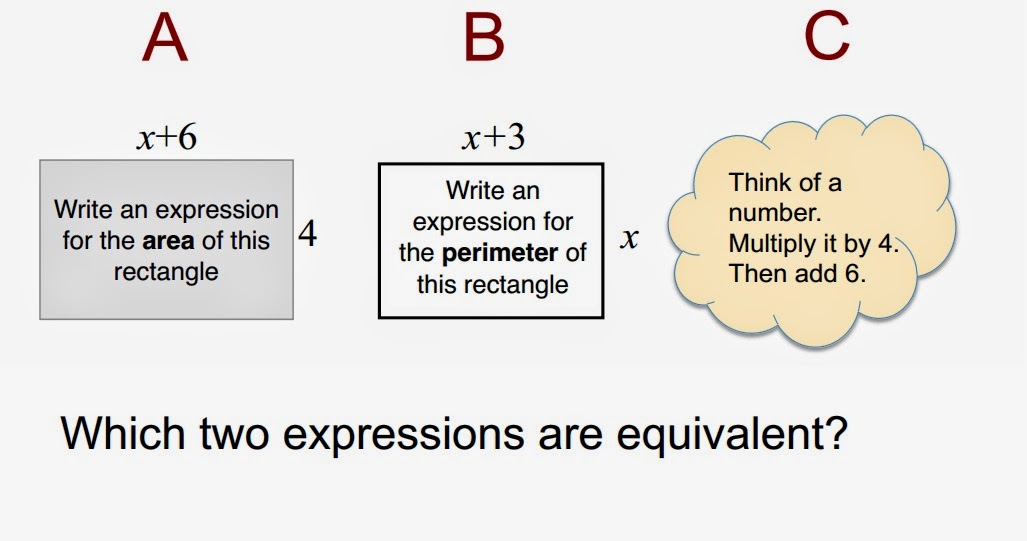
| Steps to Solving Equations – MAP |
Linear Equations
- Solving equations – visual scaffolding – mathspad.co.uk
- One Step Equations – colouring [Web page or viewer; download/access conditions may apply] – Mr Thompson on TES
- Find the mystery number – mathspad.co.uk
- I’m thinking of a number – mathspad.co.uk
- Equations crossnumber – mathspad.co.uk
- Worms, beetles and loops [Web page or viewer; download/access conditions may apply] – Median Don Steward
- One step equations [Web page or viewer; download/access conditions may apply] – Maths4Everyone on TES
- One Step Equations No Negatives Colour & Maze [Web page or viewer; download/access conditions may apply] – GottaLuvItCreations on TES
- Solving linear equations questions (answers) – @taylorda01
- Steps to Solving Equations [Web page or viewer; download/access conditions may apply] – Mathematics Assessment Project
- Linear equations sheets [Web page or viewer; download/access conditions may apply] – Median Don Steward
- Introduction to equations [Access limited at review (HTTP 404)] – lessons plans and activities – Project Maths
- Puzzles that you could use algebra to solve [Web page or viewer; download/access conditions may apply] – Median Don Steward
- Forming equations textbook exercise – CorbettMaths
- Forming equations – mathshelper.co.uk
- Solving Equations and Simplifying Expressions – Pyramids [Web page or viewer; download/access conditions may apply] – Mr Thompson Maths
- Forming and solving linear equations [Web page or viewer; download/access conditions may apply] – steele1989 on TES
- Solving Equations with Fractional Answers [Web page or viewer; download/access conditions may apply] – Mr Thompson on TES
- Solving equations with area [Access limited or not independently verified] – Access Maths
- Solving equations with perimeter – Access Maths
- Solving equations with brackets – @FortyNineCubed
- Solving Equations with Brackets – Challenge Questions [Web page or viewer; download/access conditions may apply] – Mr Thompson on TES
- Equations involving brackets [Web page or viewer; download/access conditions may apply] – typed up by Justin Thompson
- Some wrong equation solving [Access limited or not independently verified] – Median Don Steward
- Linear equations cross-puzzles [Web page or viewer; download/access conditions may apply] – Median Don Steward
- Forming and solving equations [Access limited or not independently verified] – Teachit Maths
- Two step equations [Web page or viewer; download/access conditions may apply] – Maths4Everyone on TES
- Equations with an x on both sides [Web page or viewer; download/access conditions may apply] – Maths4Everyone on TES
- Equations – x on both sides – Problem Solving [Web page or viewer; download/access conditions may apply] – Mr Thompson on TES
- Equations with unknown on both sides notes and exercises – martahidegkuti.com
- Solving linear equations [Access limited at review (HTTP 404)] – Cazoom Maths
- Expression polygons – Colin Foster
- Linear equation extras [Web page or viewer; download/access conditions may apply] – Median Don Steward
- Challenging linear equations [Access limited or not independently verified] – mathshelper
- Equations exercises from the 1950s [Access limited or not independently verified]
- Solving Linear Equations Full Coverage GCSE Questions [Access limited at review (HTTP 404)] – compiled by Dr Frost
- GCSE 9-1 Exam Practice Questions (Algebraic Problems) [Web page or viewer; download/access conditions may apply] – Maths4Everyone on TES
- One step linear equations exam-style questions (answers [Access limited or not independently verified]) – 1st Class Maths
- Two step linear equations exam-style questions (answers) – 1st Class Maths
Linear and Graphical Inequalities
- Evaluating Statements about Number Operations [Web page or viewer; download/access conditions may apply] – Mathematics Assessment Project
- Manipulating inequalities [Web page or viewer; download/access conditions may apply] – Karen Hancock
- Inequalities and number lines [Web page or viewer; download/access conditions may apply] – Maths4Everyone on TES
- Solving Linear Inequalities Practice Grid (Answers) – Dr Austin Maths
- Solving Compound Inequalities Practice Grid (Answers) – Dr Austin Maths
- Compound inequalities [Web page or viewer; download/access conditions may apply] – Maths4Everyone on TES
- Set notation for inequalities [Web page or viewer; download/access conditions may apply] (new GCSE) – by Jo Morgan (Resourceaholic)
- Representing Inequalities Practice Grid (Answers) – Dr Austin Maths
- Representing Double Inequalities Practice Grid (Answers) – Dr Austin Maths
- Representing Inequalities Match-Up (Answers) – Dr Austin Maths
- Linear inequalities notes and exercises – martahidegkuti.com (more practice here)
- Inequalities Spiders [Web page or viewer; download/access conditions may apply] – Andy Lutwyche on TES
- Inequalities – mathshelper.co.uk
- Inequalities and number lines [Web page or viewer; download/access conditions may apply] – TeachIt Maths
- Introduction to inequalities [Access limited at review (HTTP 404)] – lesson plans and activities – Project Maths
- Linear Inequalities [Access limited or not independently verified] – Median Don Steward
- Inequality scenarios [Web page or viewer; download/access conditions may apply] – TeachIt Maths
- Solving inequalities [Web page or viewer; download/access conditions may apply] – TeachIt Maths
- Solving Linear Inequalities Match-Up (Answers) – Dr Austin Maths
- Solving Compound Inequalities Name the Film (Answers [Access limited or not independently verified]) – Dr Austin Maths
- Linear Inequalities True or False (Answers) – Dr Austin Maths
- Solving inequalities topic review sheet [Web page or viewer; download/access conditions may apply] – Maths4Everyone
- Defining Regions Using Inequalities [Web page or viewer; download/access conditions may apply] – Mathematics Assessment Project
- Inequations: Regions [Web page or viewer; download/access conditions may apply] – Median Don Steward
- Graphing Inequalities 1 & Graphing Inequalities 2 – MissBrookesMaths
- Graphical inequalities: drawing – topic review sheet [Access limited or not independently verified] – Maths4Everyone
- Graphical inequalities: identifying – topic review sheet [Web page or viewer; download/access conditions may apply] – Maths4Everyone
- Shading Graphical Inequalities Practice Grid (Answers) – Dr Austin Maths
- Shading Harder Graphical Inequalities Practice Grid (Answers) – Dr Austin Maths
- Describing Graphical Inequalities Practice Grid (Answers) – Dr Austin Maths
- Describing Harder Graphical Inequalities Practice Grid (Answers) – Dr Austin Maths
- Graphical Inequalities Match-Up (Editable Word | PDF | Answers) – Dr Austin Maths
- Inequalities and regions exam-style questions (answers) – 1st Class Maths
- Shading and Describing Harder Graphical Inequalities Practice Grid (Answers) – Dr Austin Maths
- Solving Equations and Inequalities Revision Practice Grid (Answers) – Dr Austin Maths
- Inequalities practice/revision [Web page or viewer; download/access conditions may apply] – AS Resource Pack
- Inequalities Chapter (answers [Web page or viewer; download/access conditions may apply]) – CIMT
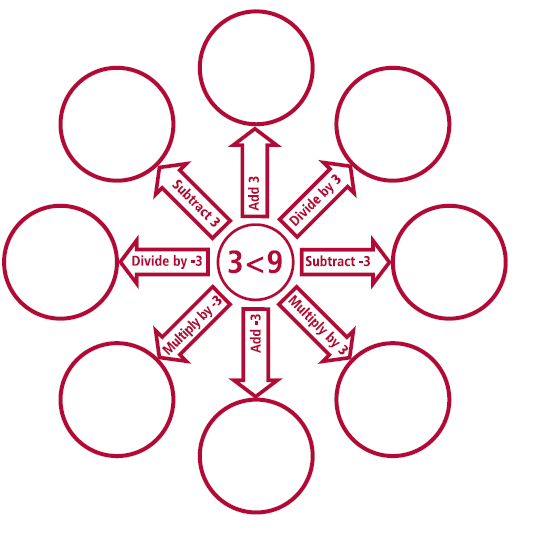 |
| Introduction to Inequalities – projectmaths.ie |
Quadratic Inequalities
- Quadratic inequalities worksheets [Web page or viewer; download/access conditions may apply] – SRWhitehouse on TES
- Quadratic inequalities worksheet [Web page or viewer; download/access conditions may apply] – phildb on TES
- Quadratic inequalities – mssteelmaths.com
- Spot the mistake [Web page or viewer; download/access conditions may apply] – by Jo Morgan (Resourceaholic)
- Solving Quadratic Inequalities Fill in the Blanks [Web page or viewer; download/access conditions may apply] – Andy Lutwyche
- Solving Quadratic Inequalities Fill In The Blanks (Answers) – DrAustinMaths
- Solving Harder Quadratic Inequalities Fill In The Blanks (Answers) – DrAustinMaths
- Inequalities for some occasions [Web page or viewer; download/access conditions may apply] – Underground Mathematics
- Quadratic inequalities exam-style questions (answers) – 1st Class Maths
- A level inequalities worksheet [Web page or viewer; download/access conditions may apply] (solutions [Web page or viewer; download/access conditions may apply]) – Solomon
- A level inequalities problem solving worksheet [Web page or viewer; download/access conditions may apply] (solutions [Access limited or not independently verified]) – Solomon
- See the Resourceaholic blog post [Web page or viewer; download/access conditions may apply] for teaching methods
Linear Graphs
Plotting- Cartesian Coordinates and Straight Lines booklet [Web page or viewer; download/access conditions may apply] – Teachit Maths
- Plotting Linear Graphs Practice Grid (Answers) – DrAustinMaths
- Plotting graphs [Web page or viewer; download/access conditions may apply] – Median Don Steward
- Plotting Linear Graphs Fill in the Blanks (Answers) – Dr Austin
- Drawing straight line graphs [Web page or viewer; download/access conditions may apply] – Teachit Maths
- Plotting lines from equations [Access limited or not independently verified] – Teachit Maths
- The algebra of straight lines [Access limited or not independently verified] – TeachIt Maths
- Graph snaps [Web page or viewer; download/access conditions may apply] – Don Steward
- Plotting Straight Line Graphs: ax + by = c [Web page or viewer; download/access conditions may apply] – Mr Thompson on TES
- Drawing straight line graphs exam-style questions [Access limited or not independently verified] (answers) – 1st Class Maths
- Gradient [Web page or viewer; download/access conditions may apply] – mathshko
- Introduction to gradient [Web page or viewer; download/access conditions may apply] – Teachit Maths
- Finding Gradients of Straight Lines Practice Grid (Answers) – DrAustinMaths
- Finding Fractional Gradients Practice Grid [Access limited or not independently verified] (Answers) – DrAustinMaths
- Gradient exercise – CorbettMaths
- Gradient and y-intercept [Web page or viewer; download/access conditions may apply] – TeachIt Maths
- Gradient resources and geogebra tools [Access limited at review (HTTP 403)]
- Gradient and intercept from an equation [Access limited at review (HTTP 401)] – rogradymaths.blogspot.co.uk
- Straight Line Graphs in Desmos [Web page or viewer; download/access conditions may apply] – by Jo Morgan (Resourceaholic)
- ‘Understanding y = mx+c’ worksheet [Access limited or not independently verified] – Teachit Maths
- Gradient and y-intercept Fill in the Blanks (Answers) – DrAustinMaths
- Equation of a Straight Line Fill In The Blanks [Access limited or not independently verified] (Answers) – DrAustinMaths
- Blog post: ‘All about gradient’ [Web page or viewer; download/access conditions may apply]
- True/false activity [Access limited at review (HTTP 401)] – rogradymaths.blogspot.co.uk
- Reciprocals Odd One Out [Web page or viewer; download/access conditions may apply] – MathsPad
- Perpendicular gradients – MathsPad
- Lessons: parallel lines [Access limited at review (HTTP 409)] and perpendicular lines [Access limited at review (HTTP 409)] – Richard Tock
- Classifying Equations of Parallel and Perpendicular Lines – Mathematics Assessment Project
- Perpendicular Lines Worksheet [Web page or viewer; download/access conditions may apply] – by Jo Morgan (Resourceaholic)
- Parallel and Perpendicular Lines Spiders [Web page or viewer; download/access conditions may apply] – alutwyche on TES
- Parallel and Perpendicular Lines Match-Up (Answers) – Dr Austin
- Parallel and Perpendicular Lines True or False (Answers) – Dr Austin
- Equation of parallel lines exam-style questions (Answers) – 1st Class Maths
- Equations of perpendicular lines exam-style questions (answers) – 1st Class Maths
- Straight line graphs problem solving [Web page or viewer; download/access conditions may apply] – Maria Howard on TES
- Coordinate Geometry Problems – Access Maths
- Equation of a Straight Line – Fill in the Gaps [Web page or viewer; download/access conditions may apply] – Mr Thompson on TES
- Linear Graphs homework sheet [Web page or viewer; download/access conditions may apply] – Mathattack
- Topic checklist – thechalkface.net
- Foundation: Linear Graphs ‘I Can’ [Web page or viewer; download/access conditions may apply] – Mathsbox
- Equation of a straight line questions (supporting material) – @taylorda01
- Linear rules, with contexts [Web page or viewer; download/access conditions may apply] – Median Don Steward
- Linear equations and Mr Venn [Access limited at review (HTTP 503)] – Median Don Steward
- Straight line graphs review [Access limited or not independently verified] – TeachIt Maths
- Coordinate Geometry [Web page or viewer; download/access conditions may apply] – Straight Lines – TeachIt Maths
- A level coordinate geometry worksheet [Web page or viewer; download/access conditions may apply] (solutions [Web page or viewer; download/access conditions may apply]) – Solomon
- Two Points Spider Diagrams (Answers) – Dr Austin
- Harder Coordinate Geometry Practice Grid (Answers) – Dr Austin
- Linear graphs GCSE questions [Web page or viewer; download/access conditions may apply] – AQA and Edexcel, compiled by Jo Morgan (Resourceaholic)
- Equation of a line exam-style questions (answers) – 1st Class Maths
[Embedded preview access could not be confirmed during review; the original image URL is retained.]
Factorising Quadratics Practice from @DJUdall
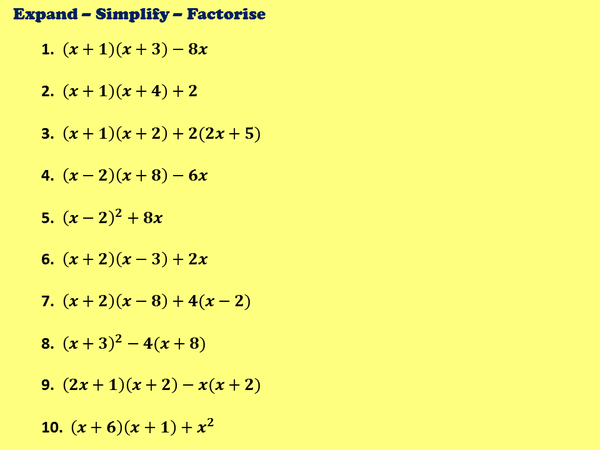
- Sum Product Tasks [Web page or viewer; download/access conditions may apply] – Nathan Day
- Series of lessons on expanding and factorising [Web page or viewer; download/access conditions may apply] – cparkinson3 on TES
- Factorising Quadratics Fill in the Blanks (Answers) – Dr Austin Maths
- Factorising quadratics questions (answers) – @taylorda01
- Factorising quadratics [Web page or viewer; download/access conditions may apply] – SRWhitehouse on TES
- Double bracket expansion [Access limited at review (HTTP 403)] (grid method, leading to factorising) – GoTeachMaths
- Difference of Two Squares [Web page or viewer; download/access conditions may apply] – Median Don Steward
- Factorising Quadratics puzzle (positives only) [Web page or viewer; download/access conditions may apply] – Mr Thompson on TES
- Quadratic Areas Puzzle [Access limited or not independently verified] – Chritsopher on TES
- Miscellaneous Factors [Web page or viewer; download/access conditions may apply] – typed up by @InteractMaths
- See the Resourceaholic blog post [Web page or viewer; download/access conditions may apply] about factorising harder quadratics
- Tap Top [Web page or viewer; download/access conditions may apply] (includes questions with a > 1) – Median Don Steward
- A level factorising worksheet [Web page or viewer; download/access conditions may apply] (solutions [Web page or viewer; download/access conditions may apply]) – Solomon
- Factorising Non-Monic Quadratics by Inspection [Web page or viewer; download/access conditions may apply] – by Jo Morgan (Resourceaholic)
- Factorising Full Coverage GCSE Questions [Access limited at review (HTTP 404)] – compiled by Dr Frost
- Expanding and factorising revision – fill in the blanks (answers) – DrAustinMaths
Quadratic graphs – plotting, sketching and recognising
- Sketching Quadratics [Web page or viewer; download/access conditions may apply] – source unknown
- Plotting Basic Quadratic Graphs [Web page or viewer; download/access conditions may apply] – Mr Thompson Maths
- Sketching Quadratics from Intersections with Axes [Access limited or not independently verified] – Chris McGrane
- Plotting Quadratic Graphs Practice Grid (Answers) – Dr Austin Maths
- Sketching Quadratic Graphs Practice (Answers) – Dr Austin Maths
- GCSE Quadratics Graphs Worksheets [Web page or viewer; download/access conditions may apply] – taylorr9 on TES
- Plotting Quadratics [Access limited or not independently verified] – MathAttack
- Solving quadratic equations using graphs [Access limited or not independently verified] – @nishadealwis
- Quadratics – Roots, y-Intercepts & Turning Points worksheet [Web page or viewer; download/access conditions may apply] – Mr Thompson on TES
- Quadratics card sort – Standards Unit
- Quadratic Points [Web page or viewer; download/access conditions may apply] – Median Don Steward
- Quadratic Functions [Web page or viewer; download/access conditions may apply] – Susan Wall
- Sketching quadratics [Web page or viewer; download/access conditions may apply] – SRWhitehouse on TES
- Quadratic matching [Web page or viewer; download/access conditions may apply] – Median Don Steward
- Quadratics from roots, vertex and y-intercept [Access limited or not independently verified] – Median Don Steward
- Which graph? [Web page or viewer; download/access conditions may apply] – Median Don Steward
- Quadratic graphs – fill in the gaps [Web page or viewer; download/access conditions may apply] – Craig Barton
- Representing Quadratic Functions Graphically – Mathematics Assessment Project
- Solving Equations Graphically Practice Grid [Access limited or not independently verified] (Answers) – Dr Austin Maths
- See the Resourceaholic blog post [Web page or viewer; download/access conditions may apply] about finding the vertex of a quadratic function
Forming and solving quadratic equations
- Introduction to Quadratic Equations [Access limited at review (HTTP 404)] – lesson plans and activities – Project Maths
- Solving Quadratics Spiders [Web page or viewer; download/access conditions may apply] – Andy Lutwyche on TES
- Solving quadratics by factorising questions (answers) – @taylorda01
- Solving Quadratics by Factorising Match-Up (answers) – Dr Austin Maths
- Dominoes – Solving Quadratics [Access limited or not independently verified] – Teachit Maths
- Quadratic equations – Median Don Steward
- Codebreaker – Solving Quadratics (by factorising) [Web page or viewer; download/access conditions may apply] – Andy Lutwyche on TES
- Quadratic equations collect a joke [Web page or viewer; download/access conditions may apply] – Dan Walker on TES
- Solving Quadratic Equations (with Re-arrangement) [Web page or viewer; download/access conditions may apply] – Mr Thompson on TES
- Form and solve an equation [Web page or viewer; download/access conditions may apply] – Median Don Steward
- Forming and solving quadratics in context (answers) – Dr Austin Maths
- Making quadratics from areas [Web page or viewer; download/access conditions may apply] – pas1001 on TES
- Factorising and solving quadratic equations – CrashMaths
- Mixed Linear and Quadratic Equations [Web page or viewer; download/access conditions may apply] – Chris McGrane
- Harder Quadratics – mathshelper.co.uk
- Tough equations – Median Don Steward
- Solving Quadratic Equations Full Coverage GCSE Questions [Access limited at review (HTTP 404)] – compiled by Dr Frost
- Quadratic ‘show that’ GCSE questions [Web page or viewer; download/access conditions may apply] – Maths4Everyone on TES
Quadratic Formula
- The Quadratic Formula [Web page or viewer; download/access conditions may apply] – Andy Lutwyche on TES
- Using the Quadratic Formula Fill In The Blanks (Answers) – Dr Austin Maths
- Quadratic formula lesson and activities [Access limited at review (HTTP 409)] – Richard Tock
- Quadratic formula lesson [Web page or viewer; download/access conditions may apply] – LawrenceHouldsworth on TES
- Quadratic formula [Web page or viewer; download/access conditions may apply] – Median Don Steward
- Quadratic formula – mathshelper.co.uk
- Quadratic formula revision worksheet [Web page or viewer; download/access conditions may apply] – timcw on TES
- Quadratic formula worksheet – CrashMaths
- Quadratic formula GCSE revision [Web page or viewer; download/access conditions may apply] – Maths4Everyone on TES
- Quadratic formula Open Middle problem [Web page or viewer; download/access conditions may apply] – openmiddle.com
- Quadratic formula exam-style questions [Access limited or not independently verified] (answers) – 1st Class Maths
Completing the Square
- Completing the square questions (answers) – @taylorda01
- Completing the square [Web page or viewer; download/access conditions may apply] – Maths4Everyone on TES
- Completing the square to sketch [Web page or viewer; download/access conditions may apply] – SRWhitehouse on TES
- Completing the square activity and notes (teacher notes and slides) – Nuffield Foundation
- Completing the Square Dominoes [Access limited or not independently verified] – Teachit Maths
- Completing the square codebreaker [Web page or viewer; download/access conditions may apply] – alutwyche on TES
- A level completing the square worksheet [Web page or viewer; download/access conditions may apply] (solutions [Web page or viewer; download/access conditions may apply]) – Solomon
- Solving by Completing the Square – Matching Activity [Web page or viewer; download/access conditions may apply] – Mr Thompson on TES
- Completing the square worksheet – CrashMaths
- Completing the Squares Full Coverage GCSE Questions [Access limited at review (HTTP 404)] – compiled by Dr Frost
- Completing the square exam-style questions (answers) – 1st Class Maths
- Tricky completing the square exam-style questions (answers) – 1st Class Maths
- Finding turning points by completing the square exam-style questions (answers) – 1st Class Maths
- Solving quadratics by completing the square exam-style questions (answers) – 1st Class Maths
Mixed
- End of topic quadratics test – Crash Maths
- Quadratics resources [Web page or viewer; download/access conditions may apply] – ColmanWeb
- Quadratic Skills Problem Solving Task [Access limited or not independently verified] – Chritsopher on TES
- Odd One Out – mathspad.co.uk
- Quadratic expression versions [Web page or viewer; download/access conditions may apply] – Don Steward
- A level quadratics problems worksheet [Web page or viewer; download/access conditions may apply] (solutions [Web page or viewer; download/access conditions may apply]) – Solomon
 |
| Quadratic discs – Colmanweb |
Iteration
- Iteration lesson – full lesson [Access limited or not independently verified] – Boss Maths
- Bridging Units: Resource Pocket 4 – Iterative methods for solving equations numerically [Access limited or not independently verified] – AQA
- Destination Douze [Web page or viewer; download/access conditions may apply] and Iteration [Web page or viewer; download/access conditions may apply] – Don Steward
- Iteration practice questions [Web page or viewer; download/access conditions may apply] – Corbett Maths
- Iteration slides [Access limited or not independently verified] – Dr Frost
- Solving cubic equations iteratively [Web page or viewer; download/access conditions may apply] – Median Don Steward
- Iterations – CrashMaths
- Iteration resources [Web page or viewer; download/access conditions may apply] (subscription) – MathsPad
- Iteration AQA exam-style questions (answers) – 1st Class Maths
- Iteration Edexcel exam-style questions (answers) – 1st Class Maths
Simultaneous Equations
- Scaffolded simultaneous equations [Web page or viewer; download/access conditions may apply] – Ashton Coward
- Simultaneous equations deductions [Web page or viewer; download/access conditions may apply] – Median Don Steward
- Simultaneous equation tasks [Web page or viewer; download/access conditions may apply] – Median Don Steward
- Simultaneous equations exercises [Web page or viewer; download/access conditions may apply] – variationtheory.com
- Solving Linear Simultaneous Equations Crack the Code – DrAustinMaths.com (answers here)
- Simultaneous Scenarios [Access limited or not independently verified] – Teachit Maths
- Solving simultaneous equations by elimination – full lesson [Access limited or not independently verified] – Boss Maths
- The final step – @mathsmrgordon via variationtheory.com
- Simultaneous equations generalising [Web page or viewer; download/access conditions may apply] – Median Don Steward
- Simultaneous equations – mathshelper.co.uk
- Solving Simultaneous Equations Graphically [Web page or viewer; download/access conditions may apply] – Tristan Jones on TES
- Solving Simultaneous Equations Graphically [Web page or viewer; download/access conditions may apply] – by Jo Morgan (Resourceaholic)
- Simultaneous equations and graphs [Web page or viewer; download/access conditions may apply] – Median Don Steward
- Where lines meet [Access limited or not independently verified] – Median Don Steward
- Simultaneous Equations in Geometrical Problems [Web page or viewer; download/access conditions may apply] – Mr Thompson on TES
- Simultaneous equations GCSE revision [Web page or viewer; download/access conditions may apply] – Maths4Everyone on TES
- Miscellaneous simultaneous equations [Web page or viewer; download/access conditions may apply] – typed up by @fionajw
- Simultaneous equations questions (answers) – @taylorda01
- Quadratic meets Linear [Web page or viewer; download/access conditions may apply] – Median Don Steward
- Non-linear simultaneous equations exam-style questions (answers) – 1st Class Maths
- Simultaneous Equations Mega Sheet – mathshelper.co.uk
- One Linear and One Quadratic – examples and exercise – CIMT
- A level simultaneous equations worksheet [Access limited or not independently verified] (solutions [Web page or viewer; download/access conditions may apply]) – Solomon
- Simultaneous Equations Full Coverage GCSE Questions [Access limited or not independently verified] – compiled by Dr Frost
- Exam style questions – quadratic simultaneous equations [Web page or viewer; download/access conditions may apply] – Maths4Everyone on TES
- Exam style questions – linear simultaneous equations [Web page or viewer; download/access conditions may apply] – Maths4Everyone on TES
Algebraic Fractions
- Fractions inc algebra – Add and Subtract , Equivalent, Simplifying – MissBrookesMaths
- Ordering algebraic fractions [Web page or viewer; download/access conditions may apply] – Mr Thompson on TES
- Collection of four lessons on algebraic fractions [Web page or viewer; download/access conditions may apply] – cparkinson3 on TES
- Simplifying algebraic fractions (basic) [Access limited or not independently verified] – @fortyninecubed via variationtheory.com
- Simplifying Algebraic Fractions Fill In The Blanks (Answers) – Dr Austin
- Simplifying Algebraic Fractions Odd One Out (Answers) – Dr Austin
- Simplifying algebraic fractions by factorising questions (answers) – @taylorda01
- Simplifying algebraic fractions GCSE revision [Web page or viewer; download/access conditions may apply] – Maths4Everyone on TES
- Simplifying Algebraic Fractions Match-Up (answers) – Dr Austin
- Further Factorising [Access limited at review (HTTP 502)] – colmanweb.com
- Simplification of Fractions by Factors II [Web page or viewer; download/access conditions may apply] – typed up by @mathsbox1
- Adding and subtracting algebraic fractions GCSE revision [Web page or viewer; download/access conditions may apply] – Maths4Everyone on TES
- Multiplying Algebraic Fractions Fill In The Blanks (Answers) – Dr Austin
- Dividing Algebraic Fractions Fill In The Blanks (Answers) – Dr Austin
- Adding and Subtracting Algebraic Fractions Fill In The Blanks (Answers [Access limited or not independently verified]) – Dr Austin
- Adding and Subtracting Algebraic Fractions Match-Up (Answers) – Dr Austin
- Algebraic fractions [Web page or viewer; download/access conditions may apply] – Median Don Steward
- Challenging algebraic fraction questions – mathshelper.net
- Algebraic Fractions, Solving Equations [Web page or viewer; download/access conditions may apply] – Maths4Everyone on TES
- Simplifying Algebraic Fractions – Deliberate Practice [Web page or viewer; download/access conditions may apply] – Mr Thompson on TES
- Algebraic Fractions Full Coverage GCSE Questions [Access limited at review (HTTP 404)] – compiled by Dr Frost
- Algebraic Fractions (equations) [Access limited or not independently verified] (answers) – 1st Class Maths
- Algebraic Fractions (simplifying) (answers) – 1st Class Maths
- Algebraic Fractions (operations) (answers) – 1st Class Maths
- Algebraic Fractions Revision Practice Grid (Answers) – Dr Austin
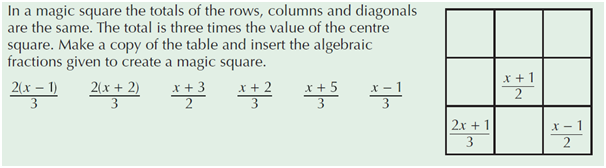
- Bridging Unit: Functional Notation [Web page or viewer; download/access conditions may apply] – AQA
- An Introduction to Function Notation [Access limited or not independently verified] – TeachIt Maths
- Two-Step Functions Fill in the Blanks (Answers) – Dr Austin Maths
- Three-Step Functions Fill in the Blanks (Answers) – Dr Austin Maths
- Evaluating Two-Step Functions Fill in the Blanks (Answers) – Dr Austin Maths
- Evaluating Three-Step Functions Fill in the Blanks (Answers) – Dr Austin Maths
- Functions questions (answers) – @taylorda01
- Evaluating Functions – mathsworksheetland.com
- Evaluating Functions Crack the Code (Answers) – Dr Austin Maths
- Functions practice questions [Web page or viewer; download/access conditions may apply] – transfinite on TES
- Functions and solving [Web page or viewer; download/access conditions may apply] – Johnathan Byrne
- Combined Functions [Web page or viewer; download/access conditions may apply] – Median Don Steward
- Composite Functions – MathsPad
- Composite Functions Match-Up (Answers) – Dr Austin Maths
- Equations with Composite Functions [Web page or viewer; download/access conditions may apply] – Maths4Everyone
- Composite Functions topic review sheet [Web page or viewer; download/access conditions may apply] – Maths4Everyone
- Combined Linear Functions [Web page or viewer; download/access conditions may apply] – Median Don Steward
- Composite functions worksheet pack – mathsworksheetland.com
- Inverse Functions Fill In The Blanks (Answers) – Dr Austin Maths
- Inverses of Discrete Functions worksheet – mathsworksheetland.com
- Function activities from MathsPad [Web page or viewer; download/access conditions may apply] (with subscription)
- Functions – mathshelper.co.uk
- Functions problems [Access limited or not independently verified] – Access Maths
- Functions multiple choice quiz [Web page or viewer; download/access conditions may apply] – Tristan Jones on TES
- Functions notes and exercises [Access limited or not independently verified] – CIMT, University of Plymouth
- Functions leading to quadratic equations [Web page or viewer; download/access conditions may apply] – Maths4Everyone on TES
- Functions Full Coverage GCSE Questions [Access limited or not independently verified] – compiled by Dr Frost (print-friendly version [Web page or viewer; download/access conditions may apply])
- Function notation exam-style questions (answers) – 1st Class Maths
- Composite functions exam-style questions (answers) – 1st Class Maths
- Functions and equations exam-style questions [Access limited or not independently verified] (answers) – 1st Class Maths
- Inverse functions exam-style questions (answers) – 1st Class Maths
Graphing Functions
- Using and Understanding Graphs True or False – MathsPad
- Exploring Graphs with Desmos [Web page or viewer; download/access conditions may apply] – by Jo Morgan (Resourceaholic)
- Representing Functions of Everyday Situations – Mathematics Assessment Project
- Recognising graphs matching activity [Web page or viewer; download/access conditions may apply] – Payphone on TES
- Recognising graphs – Higher GCSE [Web page or viewer; download/access conditions may apply] – alexwoodforth1 on TES
- Plotting Cubic Graphs Practice Grid (Answers) – Dr Austin Maths
- Plotting Reciprocal Graphs Practice Grid [Access limited or not independently verified] (Answers) – Dr Austin Maths
- Plotting Harder Non-Linear Graphs Practice Grid (Answers) – Dr Austin Maths
- Recognising Graphs Match-Up (Answers) – Dr Austin Maths
- Solving Equations Graphically Practice Grid [Access limited or not independently verified] (Answers) – Dr Austin Maths
- Plotting Linear and Non-Linear Graphs Revision Practice Grid (Answers) – Dr Austin Maths
- Graphs of linear functions, quadratic functions, simple cubic functions, and the reciprocal function – full lesson [Access limited or not independently verified] – Boss Maths
- Exponential Graphs [Access limited or not independently verified] (Answers) – Corbett Maths
- Graphs of exponential functions – full lesson [Access limited or not independently verified] – Boss Maths
- GCSE Exam Question Practice (non-linear graphs) [Web page or viewer; download/access conditions may apply] – Maths4Everyone on TES
- Curve Sketching [Web page or viewer; download/access conditions may apply] – cparkinson3 on TES
- Also see ‘Real-life graphs’ in the Shape and Measure library [Web page or viewer; download/access conditions may apply]
Graph Transformations
- Transforming parabolas [Web page or viewer; download/access conditions may apply] – by Jo Morgan (Resourceaholic)
- Translating quadratic graphs [Web page or viewer; download/access conditions may apply] – MEI
- Sketch translations and reflections of a given function – full lesson [Access limited or not independently verified] – Boss Maths
- Graph transformations chapter [Access limited or not independently verified] – CIMT
- Translating y = x squared [Web page or viewer; download/access conditions may apply] – Median Don Steward
- Graph trasformation blitz [Access limited or not independently verified] – TeachitMaths
- Transforming Graphs card match [Access limited or not independently verified] – Teachit Maths
- Graph Transformation GCSE questions [Access limited at review (HTTP 503)] – bland.in
- Transformations of graphs – Corbett Maths
- Drawing Transformations of Graphs Practice Grid (Answers) – Dr Austin
- Describing Transformations of Graphs Practice Grid (Answers) – Dr Austin
- Transformations of Points on Graphs Practice Grid (Answers) – Dr Austin
- GCSE Style Questions – Graph Transformations (Answers) – 1st Class Maths
- A level graph transformations worksheet [Web page or viewer; download/access conditions may apply] (solutions [Web page or viewer; download/access conditions may apply]) – Solomon
Algebraic Proof and Identities
- If a is an integer – mathspad.co.uk
- Prove it! [Access limited or not independently verified] – mathspad.co.uk
- Arguing mathematically – full lesson [Access limited or not independently verified] – Boss Maths
- Using algebra to construct proofs – full lessons [Access limited or not independently verified] – Boss Maths
- Consecutives [Web page or viewer; download/access conditions may apply] – Median Don Steward
- Proof notes and exercises (& answers)- CIMT
- Proof questions – Longitudinal Proof Project
- Quadratic proofs – Median Don Steward
- Algebraic proof worksheet [Web page or viewer; download/access conditions may apply] – AQA
- Proof cards [Web page or viewer; download/access conditions may apply] – via TAM course
- Proof revision mat [Web page or viewer; download/access conditions may apply] – MathedUp!
- Equating coefficients in identities [Access limited or not independently verified] – by Jo Morgan (Resourceaholic)
- Identities (equating coefficients) [Web page or viewer; download/access conditions may apply] – Mr Thompson on TES
- Identities tasks [Web page or viewer; download/access conditions may apply] – Nathan Day
- Quadratic expression versions [Web page or viewer; download/access conditions may apply] – Don Steward
- Algebraic Proofs [Access limited or not independently verified] – CrashMaths
- Algebraic Proof Practice Strips (Answers) – Dr Austin
- Algebraic Proofs Full Coverage GCSE Questions [Access limited at review (HTTP 404)] – compiled by Dr Frost
- Algebraic Proof workbook [Web page or viewer; download/access conditions may apply] – Maths4Everyone
Equation of a Circle & Tangent to a Circle
- Recognising and using the equation of a circle with the centre at the origin – full lesson [Access limited or not independently verified] – Boss Maths
- Finding the equation of a tangent to a circle at a given point- full lesson [Access limited or not independently verified] – Boss Maths
- Circle Equations [Web page or viewer; download/access conditions may apply] – Transum
- General formula for a circle [Web page or viewer; download/access conditions may apply] – headofslytherin on TES
- Equations of Tangents to Circles [Web page or viewer; download/access conditions may apply] – by Jo Morgan (Resourceaholic)
- Tangent to a circle – scaffolded worksheet [Web page or viewer; download/access conditions may apply] – Mr Thompson on TES
- Two tangents meet on the y-axis [Web page or viewer; download/access conditions may apply] – Don Steward
- Equation of a circle questions (solutions) – 1st Class Maths
- Equation of a tangent exam style questions (solutions) – 1st Class Maths
- Equation of a circle – GCSE – Difficult! [Web page or viewer; download/access conditions may apply] – pbrucemaths on TES
Gradient of a Curve
- Drawing a tangent line [Access limited at review (HTTP 404)] – NCTM
- Calculating or estimating gradients of graphs – full lesson [Access limited or not independently verified] – Boss Maths
- Finding the gradient of a curve using a tangent [Web page or viewer; download/access conditions may apply] – by Jo Morgan (Resourceaholic)
- Gradient on a curved graph [Web page or viewer; download/access conditions may apply] – Owen134866 on TES
- Gradient and Area Under Graphs – Sequence of lessons [Web page or viewer; download/access conditions may apply] – dannytheref on TES
- Using Graphs [Web page or viewer; download/access conditions may apply] – CIMT
- Textbook extract – Collins
- Estimating the Gradient of a Curve Practice Grid (Answers) – Dr Austin
- Speed and acceleration graphs [Access limited or not independently verified] – eleanorvickers on TES
- Graphing Activity [Web page or viewer; download/access conditions may apply] – @DJUdall
- Gradients of graphs textbook chapter [Web page or viewer; download/access conditions may apply]
- Speed Time Graphs (solutions) – 1st Class Maths
- See the Resourceaholic blog post New GCSE: Tangents and Areas [Web page or viewer; download/access conditions may apply] for historical discussion of this GCSE topic
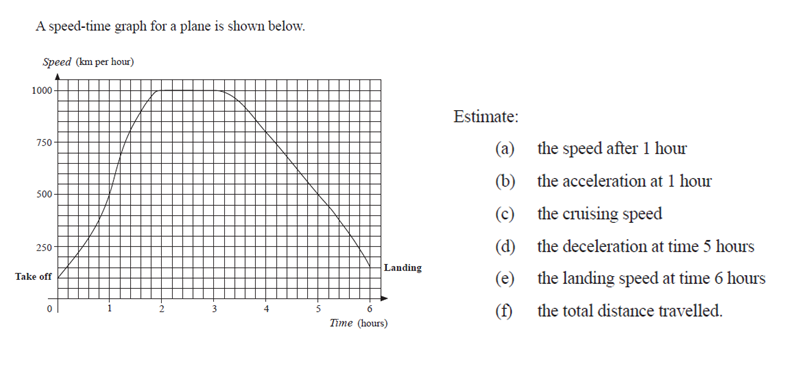 |
| Using Graphs – CIMT |
Area under a Graph
- Estimating the area under a graph – full lesson [Access limited or not independently verified] – Boss Maths
- Using Graphs [Web page or viewer; download/access conditions may apply] – CIMT
- Gradient and Area Under Graphs – Sequence of lessons [Web page or viewer; download/access conditions may apply] – dannytheref on TES
- Textbook extract – Collins
- Slides & Student sheet & Teacher notes – Nuffield Foundation
- Graphing Activity [Web page or viewer; download/access conditions may apply] – @DJUdall
- Area under a graph [Web page or viewer; download/access conditions may apply] – by Jo Morgan (Resourceaholic)
- Areas under curves textbook chapter [Web page or viewer; download/access conditions may apply]
- Exam questions [Web page or viewer; download/access conditions may apply] – from Edexcel, collated by Jo Morgan (Resourceaholic)
- Speed Time Graphs (solutions) – 1st Class Maths
Algebra Mixed/Revision
- Algebraic Manipulation Maze [Web page or viewer; download/access conditions may apply] – Dan Walker on TES
- Algebra practice makes perfect [Web page or viewer; download/access conditions may apply] – Don Steward
- GCSE A Grade Algebra matching cards [Web page or viewer; download/access conditions may apply] – colmanweb.com
- Higher Algebra textbook extract – Oxford University Press