Nine methods • 27 practice questions • nine challenges
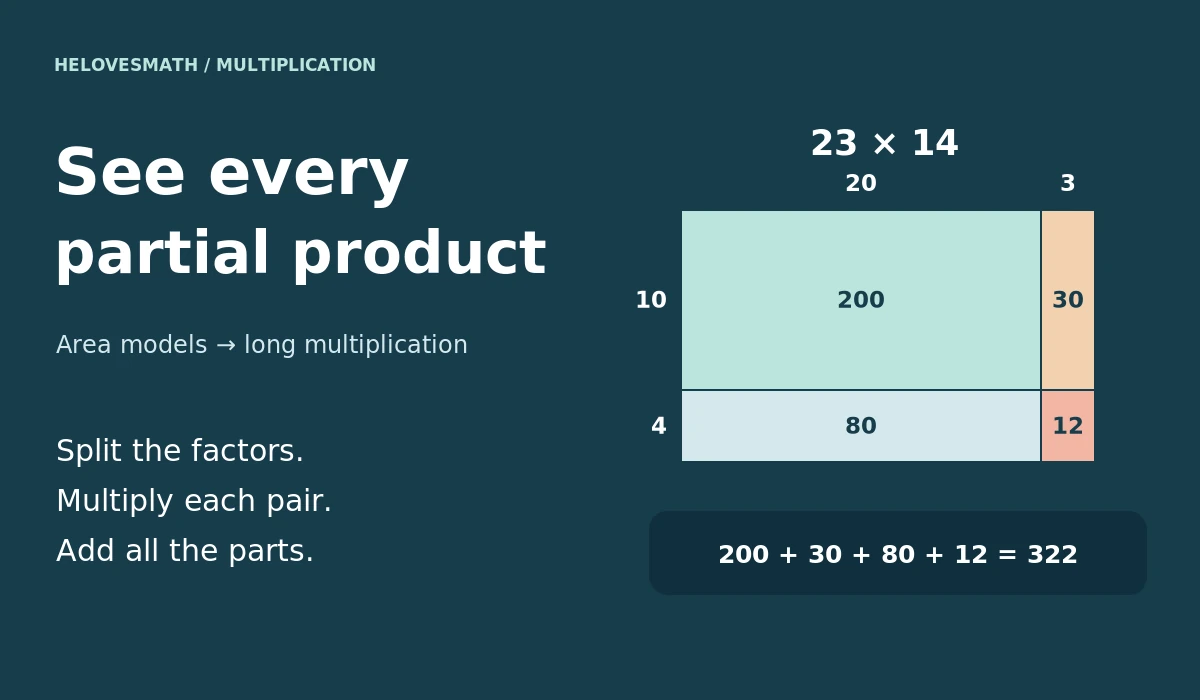
Split both factors by place value, multiply every pair of parts, and add the results. For 23 × 14, the four partial products are 200, 30, 80 and 12, giving 322.
Start with the area-model example, then connect it to partial products, lattice multiplication and the long written method. Every original practice problem and challenge has a worked answer below.
Why the area model works
Cutting a rectangle into smaller, non-overlapping rectangles does not change its total area. If the side lengths are a + b and c + d, the pieces contribute ac, ad, bc and bd. Their sum is (a + b)(c + d). This is the distributive property shown as a picture.
Each box must match its edge labels. You can use an accurately scaled drawing to see the areas, or a clearly labelled calculation grid to organise the products. A grid with equal-sized boxes is a schematic, so its drawn box sizes do not necessarily represent the numerical areas.
1. Multiply multiples of ten using place value
Write each factor as a small whole number times a power of ten. This explains the familiar trailing-zero shortcut and keeps it separate from decimal multiplication.
Worked example
40 × 300 = (4 × 10) × (3 × 100) = (4 × 3) × 1,000 = 12,000.
The three trailing zeros come from multiplying by 1,000. For whole-number multiples of ten, remove only trailing zeros, multiply the remaining whole-number factors, then restore the powers of ten. For example, 30 × 10,000 = 300,000.
Check the idea: Appending zeros is not a general decimal rule: 2.4 × 10 = 24, not 2.40. Each digit takes a value ten times as large.
Try three questions
20 × 30
Show answer 1.1
(2 × 3) × 100 = 600.
50 × 400
Show answer 1.2
(5 × 4) × 1,000 = 20,000.
600 × 7,000
Show answer 1.3
(6 × 7) × 100,000 = 4,200,000.
Challenge 1
A video creator gains 80 subscribers each day for 300 days. If every new subscriber watches 40 videos, how many subscribers and views does this model give?
Show challenge 1 solution
80 × 300 = 24,000 new subscribers. Then 24,000 × 40 = 960,000 views. These are conditional totals: they assume the daily rate stays constant and each subscriber produces exactly 40 views.
2. Estimate first, then check the exact product
An estimate is a quick reasonableness check. Say what you rounded, because different sensible rounding choices can produce different estimates. Use ≈ rather than = when replacing the exact product with an approximation.
Worked example
47 × 83 ≈ 50 × 80 = 4,000. The exact product is 47 × (80 + 3) = 3,760 + 141 = 3,901.
The estimate is 99 above the exact answer. Rounding both factors does not always give an overestimate: one factor here goes up and the other goes down.
Check the idea: Rounding is useful for checking scale, not for deciding an exact bill. Keep the unrounded values when the final question requires an exact amount.
Try three questions
Estimate 32 × 48
Show answer 2.1
To the nearest ten: 30 × 50 = 1,500. Exact check: 32 × 48 = 1,536.
Estimate 285 × 41
Show answer 2.2
Round 285 to the nearest hundred and 41 to the nearest ten: 300 × 40 = 12,000. Exact check: 11,685.
Estimate 678 × 924
Show answer 2.3
To the nearest hundred: 700 × 900 = 630,000. Exact check: 626,472.
Challenge 2
A concert has 2,875 seats at $58 each. Estimate the revenue if every seat sells, then subtract the $95,000 artist fee.
Show challenge 2 solution
Using 3,000 seats and $60 gives estimated revenue of $180,000 and about $85,000 left after the artist fee. Exact revenue is 2,875 × $58 = $166,750, leaving $71,750 after that fee. Neither remainder is net profit unless there are no other expenses. The estimate overstates each exact result by $13,250.
3. Area-model multiplication: count every rectangle
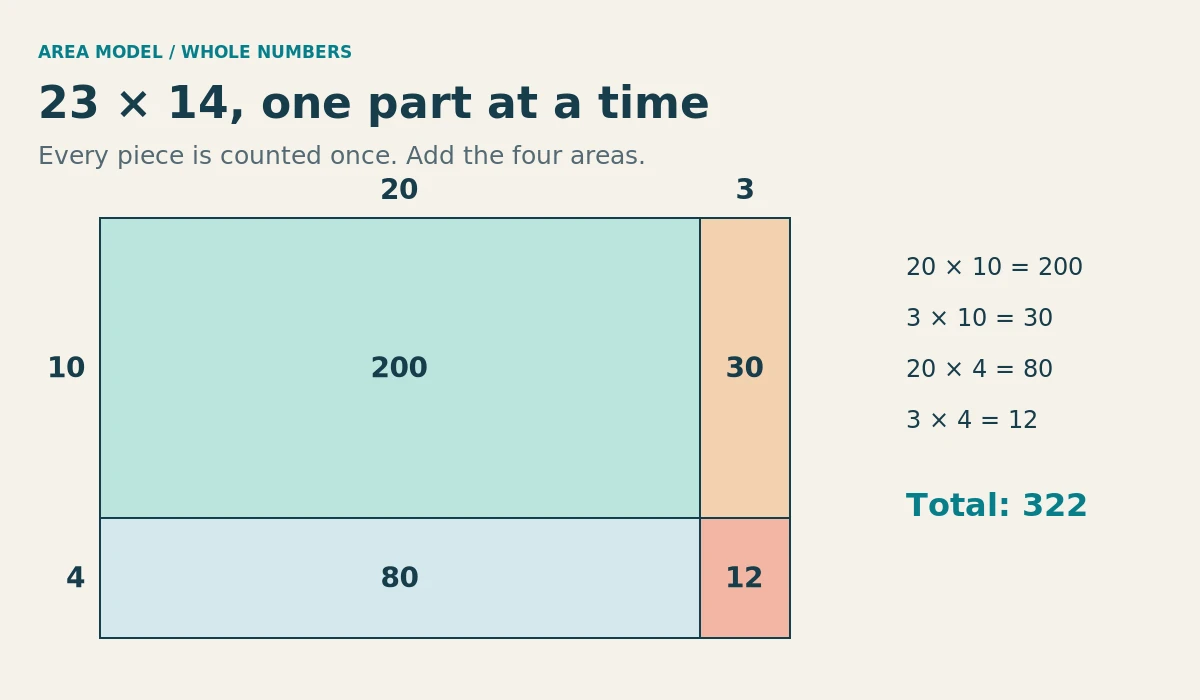
Draw one rectangle, split each side into place-value parts, multiply each column width by each row height, then add every partial product exactly once. The distributive property explains why this works.
Worked example
23 × 14 = (20 + 3) × (10 + 4).
| × | 20 | 3 |
|---|---|---|
| 10 | 200 | 30 |
| 4 | 80 | 12 |
200 + 30 + 80 + 12 = 322. Four rectangles are needed because two parts of one factor each multiply two parts of the other.
For a physical rectangle whose sides are in centimetres, the result is an area in cm². In a multiplication grid with no measurement units, the cells simply represent the partial products.
Check the idea: Multiplying only 20 × 10 and 3 × 4 misses the two cross-products. Check that every row–column pair appears once.
Try three questions
Use an area model for 12 × 13
Show answer 3.1
(10 + 2)(10 + 3) gives 100 + 30 + 20 + 6 = 156.
Use an area model for 34 × 26
Show answer 3.2
(30 + 4)(20 + 6) gives 600 + 80 + 180 + 24 = 884. The 4 × 20 rectangle is 80.
Use an area model for 58 × 47
Show answer 3.3
(50 + 8)(40 + 7) gives 2,000 + 320 + 350 + 56 = 2,726. Check each cell against its two edge labels.
Challenge 3
A room is 18 ft by 24 ft. Find its area using an area model, then find the LED-strip length for the full perimeter and one diagonal.
Show challenge 3 solution
Area: (10 + 8)(20 + 4) = 200 + 40 + 160 + 32 = 432 ft². Perimeter: 2(18 + 24) = 84 ft. The diagonal follows Pythagoras: √(18² + 24²) = √900 = 30 ft. Total modelled LED length: 84 + 30 = 114 ft. Installation allowance and connection gaps are not included. Area and strip length use different units.
4. Partial products without drawing every box
An area model and a partial-products list record the same calculation. Once the rectangle makes sense, you can write the products directly while keeping their place values visible.
Worked example
243 × 6 = (200 + 40 + 3) × 6.
- 200 × 6 = 1,200
- 40 × 6 = 240
- 3 × 6 = 18
Add: 1,200 + 240 + 18 = 1,458.
Check the idea: The 4 in 243 represents 40. Multiplying it as 4 instead of 40 loses a factor of ten.
Try three questions
Use partial products for 34 × 5
Show answer 4.1
30 × 5 + 4 × 5 = 150 + 20 = 170.
Use partial products for 256 × 8
Show answer 4.2
200 × 8 + 50 × 8 + 6 × 8 = 1,600 + 400 + 48 = 2,048.
Use partial products for 487 × 9
Show answer 4.3
400 × 9 + 80 × 9 + 7 × 9 = 3,600 + 720 + 63 = 4,383.
Challenge 4
One game-currency bundle contains 437 gems and costs $15. How many gems and what total cost for eight identical bundles?
Show challenge 4 solution
Gems: 437 × 8 = 3,200 + 240 + 56 = 3,496. Cost: $15 × 8 = $120, assuming no discounts, taxes or extra fees. Multiplying the bundle count scales both quantities by eight.
5. Lattice multiplication: diagonal place-value sums
A lattice records single-digit products in boxes, with the tens digit above the diagonal and the ones digit below it. Add diagonals from the bottom right, carrying to the next diagonal when the sum reaches ten.
Worked example
For 34 × 27, place digits 3 and 4 over the columns and 2 and 7 beside the rows. The table lists each box as tens / ones.
| × | 3 | 4 |
|---|---|---|
| 2 | 0 / 6 | 0 / 8 |
| 7 | 2 / 1 | 2 / 8 |
- Ones diagonal: 8. Write 8.
- Tens diagonal: 2 + 1 + 8 = 11. Write 1 and carry 1.
- Hundreds diagonal: 2 + 6 + 0 + the carried 1 = 9.
- The remaining leading digit is 0. Read the result as 918.
Check with partial products: 30 × 20 + 4 × 20 + 30 × 7 + 4 × 7 = 600 + 80 + 210 + 28 = 918.
Check the idea: Read the diagonal totals by place value. Writing 11 as two result digits instead of carrying changes the answer.
Try three questions
Use lattice multiplication for 23 × 14
Show answer 5.1
Cells: 02, 03 / 08, 12 (rows 1 and 4). Diagonals from bottom right: 2; 1 + 8 + 3 = 12 (write 2, carry 1); 0 + 2 + 0 + 1 = 3. Answer: 322.
Use lattice multiplication for 56 × 38
Show answer 5.2
Cells: 15, 18 / 40, 48. Diagonals: 8; 4 + 0 + 8 = 12 (write 2, carry 1); 4 + 5 + 1 + 1 = 11 (write 1, carry 1); 1 + 1 = 2. Answer: 2,128.
Use lattice multiplication for 89 × 76
Show answer 5.3
Cells: 56, 63 / 48, 54. Diagonals: 4; 5 + 8 + 3 = 16 (write 6, carry 1); 4 + 6 + 6 + 1 = 17 (write 7, carry 1); 5 + 1 = 6. Answer: 6,764.
Challenge 5
A pixel-art canvas is 64 pixels wide and 48 pixels tall. If each pixel needs exactly 3 bytes, find the raw pixel-data size.
Show challenge 5 solution
64 × 48 = 3,072 pixels. At 3 bytes each, 3,072 × 3 = 9,216 bytes. In decimal units this is 9.216 kB; in binary units it is exactly 9 KiB because 1 KiB = 1,024 bytes. This counts raw pixel data only; a saved image file can differ because of compression, headers and other data.
6. Multiply by one digit using regrouping
The compact written method combines partial products through regrouping. Work from the ones column, and keep track of the value of each carried number.
Worked example
467 × 8
- 8 × 7 ones = 56 ones. Write 6 ones and carry 5 tens.
- 8 × 6 tens + 5 tens = 53 tens. Write 3 tens and carry 5 hundreds.
- 8 × 4 hundreds + 5 hundreds = 37 hundreds.
Result: 3,736. Check: 3,200 + 480 + 56 = 3,736.
Check the idea: A carried 5 has different value in different columns. Name the unit, such as five tens, to avoid losing place value.
Try three questions
234 × 3
Show answer 6.1
600 + 90 + 12 = 702.
789 × 6
Show answer 6.2
4,200 + 480 + 54 = 4,734.
8,967 × 9
Show answer 6.3
72,000 + 8,100 + 540 + 63 = 80,703.
Challenge 6
A tournament has four brackets with 237 players in each. Every player receives an $89 gift. What is the total gift cost?
Show challenge 6 solution
237 × 4 = 948 players. Then 948 × $89 = 948 × ($90 − $1) = $85,320 − $948 = $84,372. This assumes every bracket has a different set of players and each person receives one gift.
7. Multiply by two digits: the second row is tens
Multiply once by the ones value and once by the tens value, then add the two rows. Writing the multiplier as a sum makes the alignment easier to explain.
Worked example
34 × 26 = 34 × (20 + 6).
- 34 × 6 = 204
- 34 × 20 = 680
204 + 680 = 884. The second row is multiplication by 20, which explains the zero in its ones position.
Check the idea: The digit 2 in 26 means 20. A second row of 68 would calculate 34 × 2, leaving out the tens value.
Try three questions
23 × 31
Show answer 7.1
23 × 30 + 23 × 1 = 690 + 23 = 713.
56 × 47
Show answer 7.2
56 × 40 + 56 × 7 = 2,240 + 392 = 2,632.
89 × 76
Show answer 7.3
89 × 70 + 89 × 6 = 6,230 + 534 = 6,764.
Challenge 7
A podcast gets 87 downloads per day for all 31 days of March. Each download is 45 MB. How many downloads and how much data is transferred?
Show challenge 7 solution
87 × 31 = 2,697 downloads. Then 2,697 × 45 MB = 121,365 MB. Using decimal units, 1 GB = 1,000 MB, so this is 121.365 GB, or about 121.4 GB. MB and GB are not the binary units MiB and GiB. This model excludes protocol overhead and repeated or partial downloads beyond the stated count.
8. Multiply by three digits: ones, tens and hundreds
Use three place-value rows. A zero digit still needs its position to be respected, even when its entire partial product is zero.
Worked example
234 × 156 = 234 × (100 + 50 + 6).
- 234 × 6 = 1,404
- 234 × 50 = 11,700
- 234 × 100 = 23,400
1,404 + 11,700 + 23,400 = 36,504.
Check the idea: For 123 × 201, the tens contribution is zero. The hundreds contribution is 123 × 200, not 123 × 2.
Try three questions
123 × 201
Show answer 8.1
123 × 200 + 123 × 0 + 123 × 1 = 24,600 + 0 + 123 = 24,723.
345 × 267
Show answer 8.2
69,000 + 20,700 + 2,415 = 92,115.
789 × 456
Show answer 8.3
315,600 + 39,450 + 4,734 = 359,784.
Challenge 8
A game has 234 levels with 156 collectible stars per level. Each star is worth 25 points. What is the maximum score from those stars?
Show challenge 8 solution
234 × 156 = 36,504 stars. Then 36,504 × 25 = 36,504 × 100 ÷ 4 = 912,600 points. This assumes each star can be collected and scored exactly once.
9. Long multiplication connects all the place values
The long method scales the same distributive idea to larger factors. Label the row multipliers while learning; then align the ones, tens, hundreds and higher columns carefully when adding.
Worked example
1,234 × 567 = 1,234 × (500 + 60 + 7).
- 1,234 × 7 = 8,638
- 1,234 × 60 = 74,040
- 1,234 × 500 = 617,000
8,638 + 74,040 + 617,000 = 699,678. An estimate of 1,200 × 600 = 720,000 is a useful scale check.
Check the idea: Row shifting records multiplication by powers of ten. Explain the row's value instead of treating the shift as an unexplained layout rule.
Try three questions
234 × 123
Show answer 9.1
23,400 + 4,680 + 702 = 28,782.
567 × 456
Show answer 9.2
226,800 + 28,350 + 3,402 = 258,552.
2,345 × 678
Show answer 9.3
1,407,000 + 164,150 + 18,760 = 1,589,910.
Challenge 9
An account gains 789 followers daily for 365 days. In a simplified model, every new follower produces $0.23 during a full year. Find the follower count and the full-year revenue represented by that count.
Show challenge 9 solution
789 × 365 = 287,985 new followers. Multiplying this count by $0.23 gives $66,236.55 for one full year of revenue from every follower. Because followers join on different days, this is not a justified estimate of revenue earned during their acquisition year. No real platform payout rate is implied.
Four more ways to use the model
These original examples extend the same idea. The fraction example uses a unit square as its reference whole; the measurement example uses square centimetres.
A. Keep a zero place: 507 × 24
Split 507 into 500 + 7 and 24 into 20 + 4. The four products are 10,000, 2,000, 140 and 28. Add them: 507 × 24 = 12,168. You may include a zero-width tens column, but it contributes zero; leaving it out must not change 500 into 50.
B. Decimal sides: 2.4 × 1.3
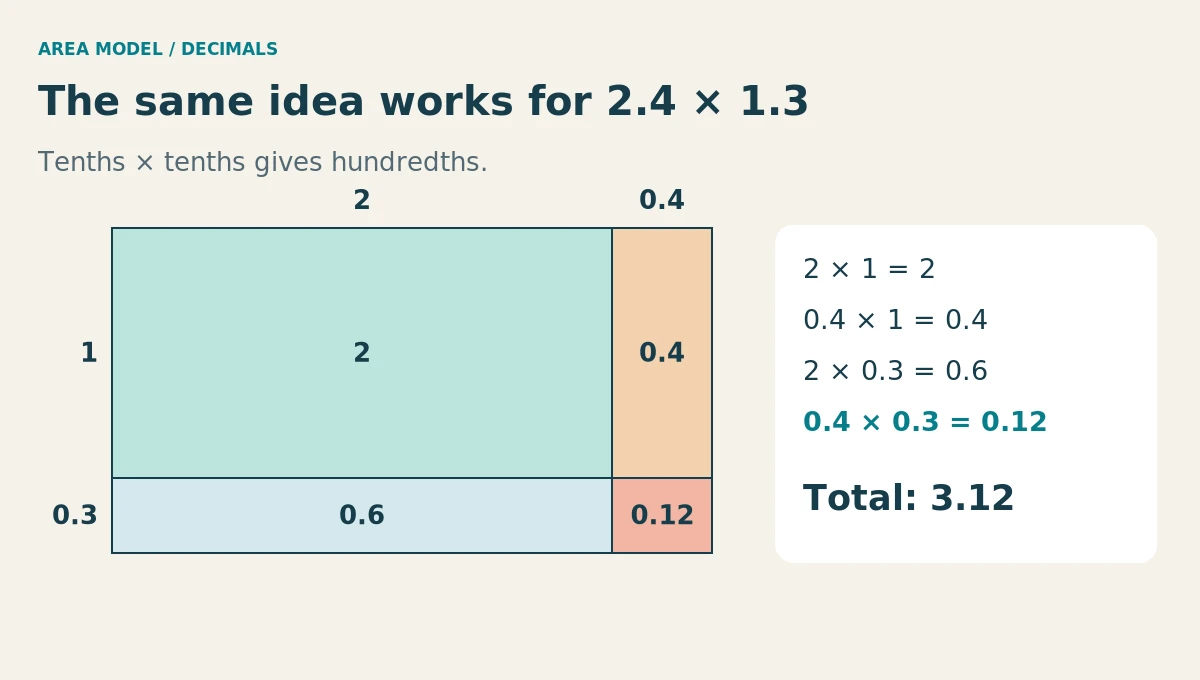
Split the sides into 2 + 0.4 and 1 + 0.3. The four products are 2, 0.4, 0.6 and 0.12. Add: 2.4 × 1.3 = 3.12. In particular, four tenths times three tenths is twelve hundredths, so 0.4 × 0.3 = 0.12.
C. Fractions of a unit square: ¾ × ⅔
Divide a unit square into four equal columns and three equal rows, making 12 equal cells. Select three of the four columns and two of the three rows. Their overlap contains 3 × 2 = 6 cells, each of area 1/12 square unit. Thus ¾ × ⅔ = 6/12 = ½.
The product is smaller than ¾ because multiplying a positive number by ⅔ takes only two-thirds of it. The whole square, the equal partitions and the overlapping region all matter.
D. Use multiplication to check a missing side
A rectangle has area 768 cm² and one side of 32 cm. To find the other side, try 20 cm first: 32 cm × 20 cm = 640 cm². The remaining area is 128 cm², which is 32 cm × 4 cm. The missing side is therefore 20 cm + 4 cm = 24 cm. Check: 32 × 24 = 768.
This is division by partial quotients viewed through area. The unknown is a length, so its unit is cm, while the rectangle's area remains in cm².
Extension self-check
- Use four partial products to calculate 3.2 × 1.4.
Show extension answer 1
3 × 1 + 0.2 × 1 + 3 × 0.4 + 0.2 × 0.4 = 3 + 0.2 + 1.2 + 0.08 = 4.48.
- Use a unit-square model for ⅔ × ⅘.
Show extension answer 2
Divide the unit square into three columns and five rows. The overlap of two columns and four rows has 8 of 15 equal cells, so the product is 8/15.
- A rectangle has area 1,080 cm² and a side of 36 cm. Find the other side.
Show extension answer 3
36 × 30 = 1,080, so the missing side is 30 cm. Divide square centimetres by centimetres to obtain centimetres.
- Explain why 42 × 13 needs more than the products 40 × 10 and 2 × 3.
Show extension answer 4
Those two products omit two rectangles. Include 40 × 3 = 120 and 2 × 10 = 20. All four pieces sum to 400 + 120 + 20 + 6 = 546.
Which multiplication method should I use?
- Learning why multiplication works: begin with an area model and label every side and cell.
- Working mentally: choose friendly partitions and estimate the result's size.
- Writing larger calculations efficiently: use partial products, then the compact long method as your place-value understanding becomes secure.
- Checking an answer: use a different partition, reverse the factor order, estimate, or divide the product by a nonzero factor.
You do not need to rush from a picture to an algorithm. Explain why the method works, then choose the representation that keeps your calculation accurate.
Related practice
- Multiplication tables and fact practice
- Geometry worksheets with area and length examples
- Data storage converter: decimal and binary units
Sources & References
The examples, explanations and practice solutions on this page are original HeLovesMath teaching material. These curriculum and measurement references support the mathematical methods and unit conventions; this lesson is not an official assessment or a claim of complete curriculum coverage.
- Common Core 3.MD.C.7.c: rectangle areas and the distributive property
- Common Core 4.NBT.B.5: place-value methods, arrays and area models
- Common Core 5.NBT.B.7: decimal arithmetic using models and place value
- Common Core 5.NF.B.4.b: rectangle areas with fractional side lengths
- Common Core 5.NF.B.5.b: multiplication as scaling
- Illustrative Mathematics: decimal products and rectangular units
- NIST: prefixes for binary multiples and decimal units