
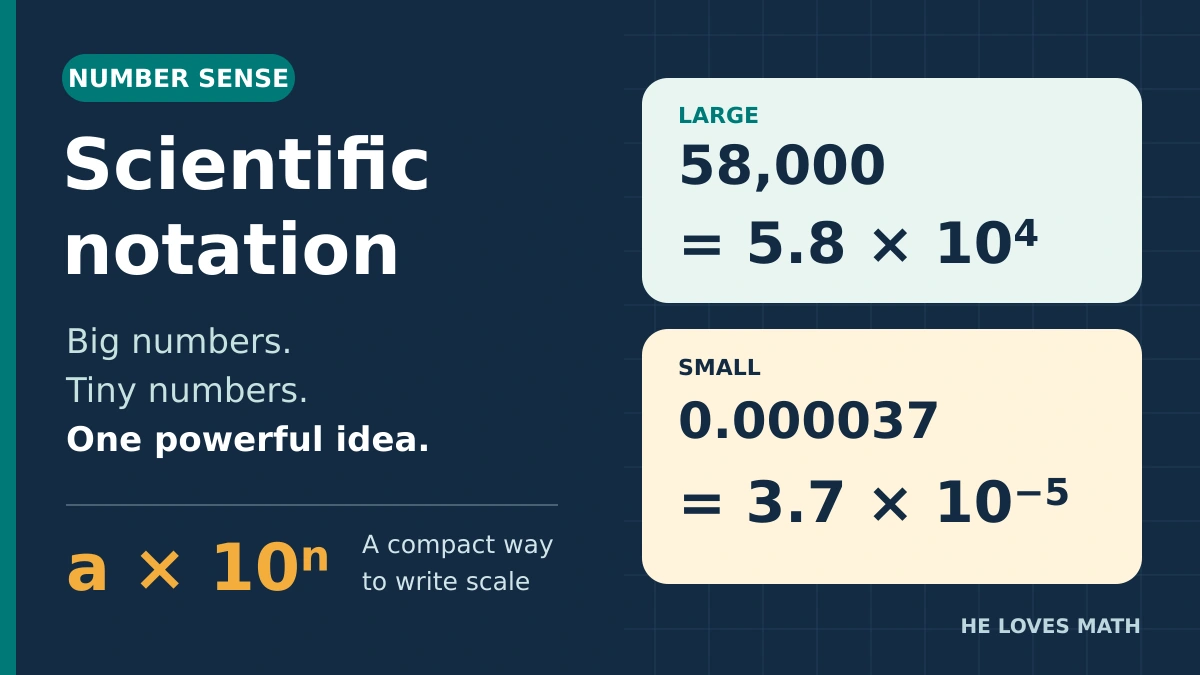
Use the examples to see what the exponent means, then try the addition calculator to check your own work. The central idea is keeping the value unchanged: when the coefficient becomes ten times smaller, the power of ten must become ten times larger.
Adding scientific notation calculator
Enter the coefficient and exponent separately for each number. Negative coefficients allow subtraction: to calculate A − B, add A and −B.
Exact sum for the entered numbers
Step-by-step solution
Show the full decimal value
The calculator uses exact decimal arithmetic within these input limits. It does not round to a measurement’s significant figures, retain trailing zeros as precision labels, or convert units. For measured quantities, decide the appropriate rounding separately.
Scientific notation examples: big, small and negative
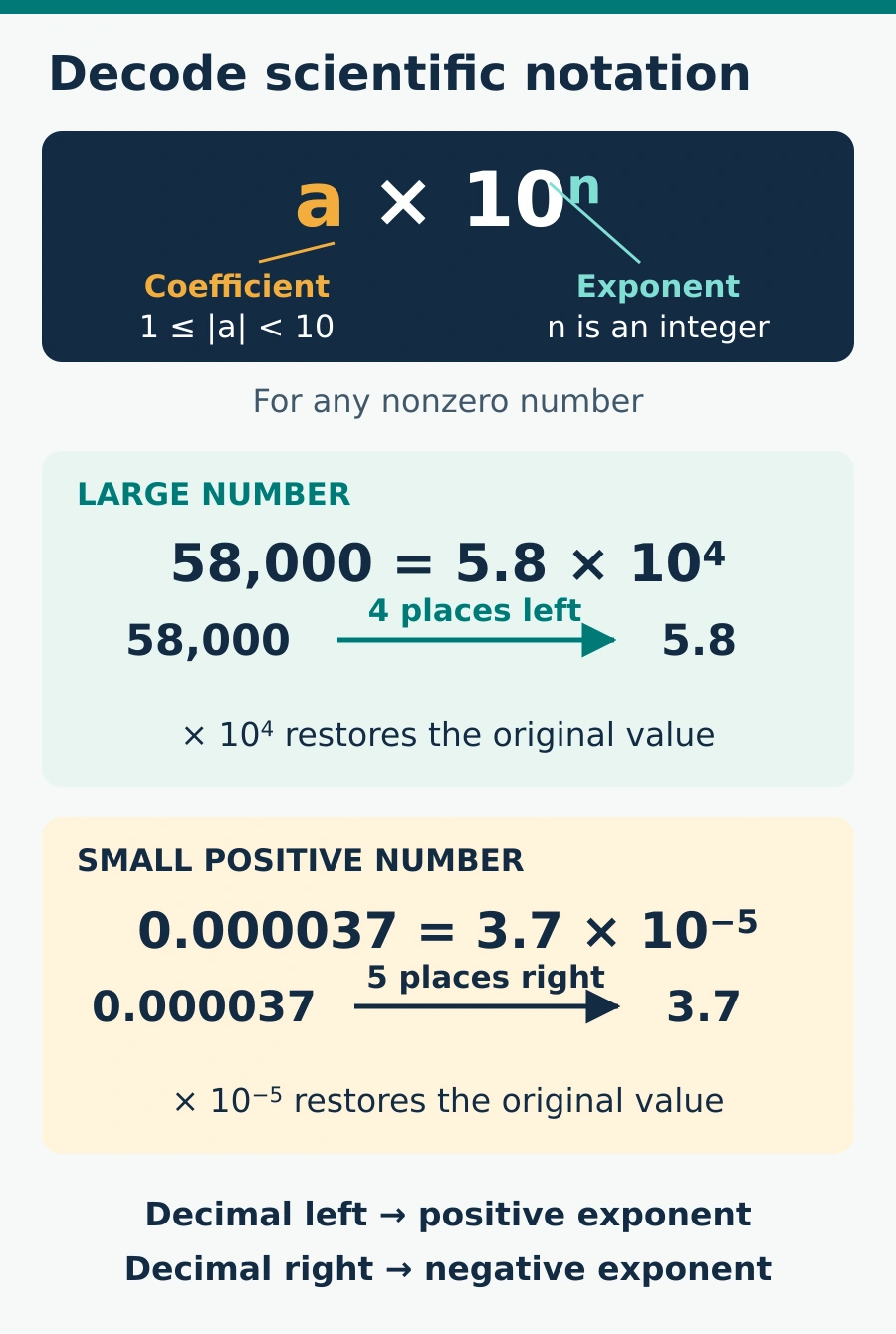
The coefficient, a, supplies the significant digits. The power, 10n, supplies the scale. The condition 1 ≤ |a| < 10 means that 1 is allowed but 10 is not; the vertical bars mean “absolute value.” A negative number keeps its minus sign on the coefficient.
| Ordinary decimal | Scientific notation | Check the scale |
|---|---|---|
| 58,000 | 5.8 × 10⁴ | 5.8 × 10,000 |
| 5,800,000,000 | 5.8 × 10⁹ | 5.8 billion |
| 0.000037 | 3.7 × 10⁻⁵ | 3.7 ÷ 100,000 |
| −0.00409 | −4.09 × 10⁻³ | −4.09 ÷ 1,000 |
| 7 | 7 × 100 | 100 = 1 |
| 1 | 1 × 100 | The lower boundary is included |
From decimal to scientific notation
- Keep the sign. Place the decimal point after the first nonzero digit to form the coefficient.
- Count how many places the point moved. For a value whose magnitude is at least 10, moving left gives a positive exponent. For a nonzero value whose magnitude is below 1, moving right gives a negative exponent.
- Multiply back to check. The power of ten must restore the original value.
For 58,000, moving four places left gives 5.8; multiplying by 104 restores 58,000. For 0.000037, moving five places right gives 3.7; dividing by 105, or multiplying by 10−5, restores 0.000037.
From scientific notation to ordinary decimal notation
Now read the multiplication directly: a positive exponent shifts the coefficient’s decimal point right; a negative exponent shifts it left. Add placeholder zeros when needed.
- 3.45 × 104 = 34,500
- 5.67 × 103 = 5,670
- 6.12 × 10−6 = 0.00000612
For more conversion practice, use the scientific notation to decimal converter. If the zeros are confusing, review the place-value chart and calculator.
Adding scientific notation: five worked examples
Match powers, add coefficients, then normalize. You can choose either exponent as the common exponent; using the larger one often keeps the arithmetic compact. When quantities have units, make the units match first too.
1. Add numbers with the same exponent
= (4.5 + 2.3) × 106
= 6.8 × 10⁶
Both coefficients count millions, so add 4.5 and 2.3. The exponent remains 6. A decimal check gives 4,500,000 + 2,300,000 = 6,800,000.
2. Add numbers with different exponents
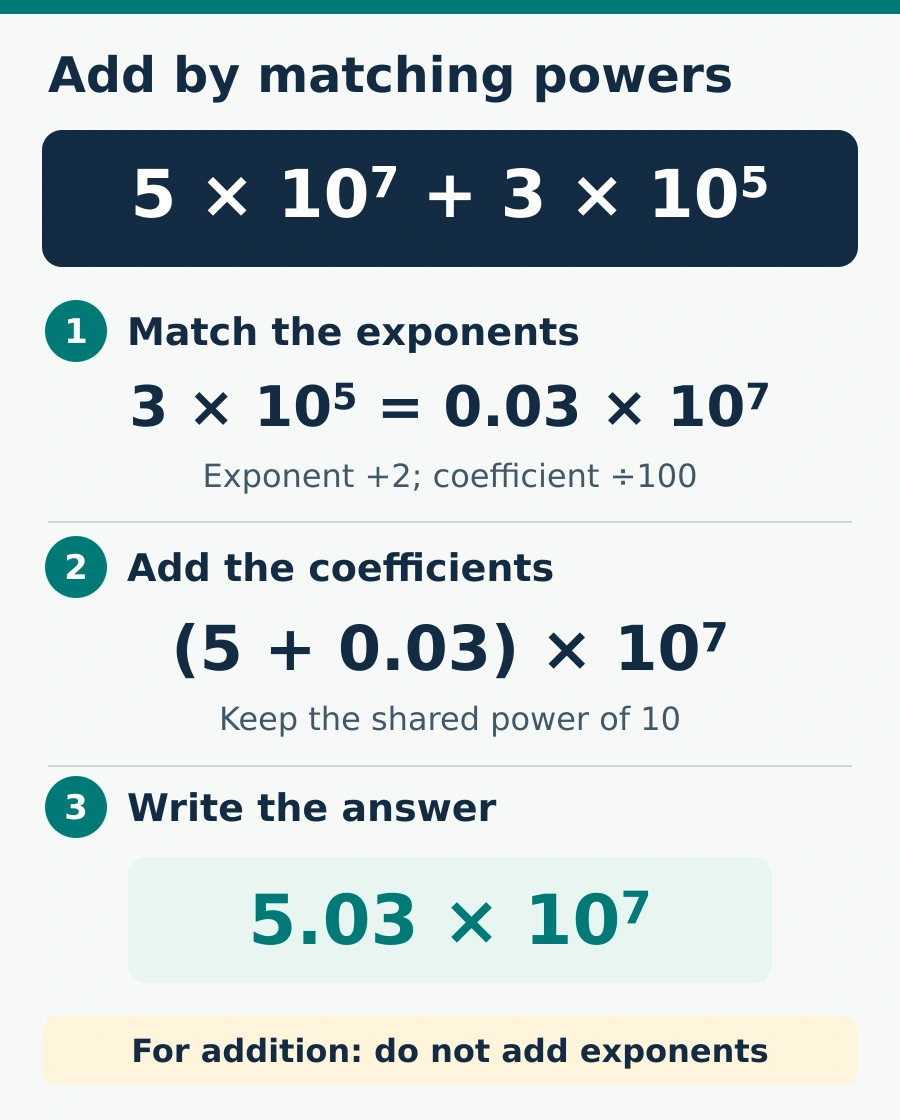
= (5 + 0.03) × 107
= 5.03 × 10⁷
Changing 105 to 107 makes the power 100 times larger. Divide its coefficient by 100 to compensate: 3 becomes 0.03. Check: 50,000,000 + 300,000 = 50,300,000.
3. Add small numbers with negative exponents
= 9.6 × 10−3 = 0.0096
A negative exponent does not make the number negative. These are 0.0075 and 0.0021, both positive. With different exponents, the same alignment rule applies: (3.6 × 10⁻⁴) + (8.7 × 10⁻⁵) = (3.6 + 0.87) × 10−4 = 4.47 × 10⁻⁴.
4. Normalize a coefficient of 10 or more
= 16.3 × 106
= 1.63 × 10⁷
The intermediate value is correct, but 16.3 is too large for normalized scientific notation. Divide the coefficient by 10 and increase the exponent by 1. Keep 1.63 rather than rounding it to 1.6 unless the question asks for that rounding.
5. Subtract or cancel terms
= −4 × 10⁵
Keep track of the signed coefficients. Equal and opposite terms, such as 7.2 × 10⁴ and −7.2 × 10⁴, sum to zero. For a refresher on signed arithmetic, see the negative numbers guide.
Common mistakes, and how to catch them
Adding the exponents
(2 × 10³) + (3 × 10³) is 5 × 10³, not 5 × 10⁶. Adding exponents belongs to multiplying powers: 103 × 103 = 106.
Changing only the exponent
3 × 10⁵ is 0.03 × 10⁷, not 3 × 10⁷. The latter is 100 times too big. Check by expanding both values.
Confusing the two minus signs
3 × 10⁻⁴ is positive 0.0003. −3 × 10⁴ is negative 30,000. The coefficient controls the sign; the exponent controls the scale.
Forgetting the final range
0.58 × 10⁵ and 58 × 103 both equal 58,000, but the normalized answer is 5.8 × 10⁴. The coefficient must have exactly one digit before its decimal point, and that digit must be nonzero.
Scientific, standard, decimal and exponential notation
Ordinary decimal notation writes out a value such as 456.789, 0.00025 or 12,500,000. In many US classrooms, “standard notation” means this ordinary form. In UK school mathematics, “standard form” commonly means scientific notation instead. Read the example or definition in your course rather than assuming these phrases always mean the same thing.
Exponential notation is broader: 28 = 256 and 105 = 100,000 are powers. Normalized scientific notation uses a power of 10 and the coefficient rule. A calculator display such as 3.7E−5 is shorthand for 3.7 × 10⁻⁵; E here is not a separate multiplier or Euler’s number. The calculator on this page asks for the two parts in separate fields.
Scientific notation can represent small everyday values such as 7 × 100 too. There is no mandatory “large enough” threshold. It is especially useful when a long line of zeros hides the size or precision of a number.
Real-life examples with units and precision
Changing notation does not change a quantity’s unit. These examples separate exact definitions from rounded representations, so the equals sign does not promise more accuracy than the value has.
| Quantity | Scientific notation | What it means |
|---|---|---|
| Speed of light in vacuum | 2.99792458 × 10⁸ m/s | Exactly 299,792,458 m/s in the SI. The familiar 3.0 × 10⁸ m/s is a rounded approximation. |
| Avogadro constant | 6.02214076 × 10²³ mol−1 | Exact SI value. One mole contains exactly this number of specified entities. 6.02 × 10²³ is a rounded count. |
| Planck constant | 6.62607015 × 10⁻³⁴ J·s | Exact SI value; 6.626 × 10⁻³⁴ J·s is a rounded form. |
| One nanometre | 1 × 10⁻⁹ m | The nano- prefix means one billionth. Thus 100 nm = 1 × 10⁻⁷ m. |
| One terabyte (decimal convention) | 1 × 1012 bytes | One trillion bytes. The binary unit tebibyte (TiB) is different: 240 bytes. |
The three physical constants above follow the SI definitions; the prefix and byte conventions are identified in the final references. For measured distances, populations or biological counts, record the source date, conditions and uncertainty before converting the number. A count of cells per microlitre is not the same quantity as a total cell count.
A practical addition example
Suppose one data file contains 2.4 × 106 bytes and another contains 7.5 × 105 bytes. Both quantities are already in bytes. Rewrite the second as 0.75 × 106 bytes, then add:
This hypothetical total is 3,150,000 bytes, or 3.15 MB in the decimal convention.
Practice: 12 questions with worked answers
Treat these numbers as exact. Try the questions before opening the answers.
- Write 58,400,000 in scientific notation.
- Write 0.0000726 in scientific notation.
- Write −0.00409 in scientific notation.
- Write 7.03 × 10⁴ as an ordinary decimal.
- Write 6.12 × 10⁻⁶ as an ordinary decimal.
- Write 9 in scientific notation.
- Add (4.6 × 10⁵) + (2.7 × 10⁵).
- Add (8.4 × 10⁶) + (7.9 × 10⁶).
- Add (6.2 × 10⁷) + (4.5 × 10⁵).
- Add (3.6 × 10⁻⁴) + (8.7 × 10⁻⁵).
- Add (−6.4 × 10⁵) + (2.4 × 10⁵).
- Add (7.2 × 10⁴) + (−7.2 × 10⁴).
Show answers 1–6: conversions
- 5.84 × 10⁷. Moving seven places left makes 5.84; multiply by 107 to recover the original.
- 7.26 × 10⁻⁵. Moving five places right makes 7.26; compensate with 10−5.
- −4.09 × 10⁻³. Keep the negative sign and use a power of 10−3 for the scale.
- 70,300. Multiply 7.03 by 10,000.
- 0.00000612. Divide 6.12 by 1,000,000.
- 9 × 100. Since 100 = 1, the value stays 9.
Show answers 7–12: addition
- 7.3 × 10⁵. Add 4.6 + 2.7 = 7.3 and keep the common exponent.
- 1.63 × 10⁷. The sum 16.3 × 10⁶ must be normalized.
- 6.245 × 10⁷. Rewrite 4.5 × 10⁵ as 0.045 × 10⁷, then add 6.2 + 0.045.
- 4.47 × 10⁻⁴. Rewrite 8.7 × 10⁻⁵ as 0.87 × 10⁻⁴; 3.6 + 0.87 = 4.47.
- −4 × 10⁵. The coefficients sum to −6.4 + 2.4 = −4.
- 0. Equal and opposite terms cancel.
Five scientific notation project ideas
- Powers-of-ten poster. Choose six sourced quantities from microscopic to astronomical scales. Give each a unit, a scientific-notation label and a citation. Do not mix diameters, masses and distances on a single unlabelled size axis.
- Number scavenger hunt. Collect 10–20 large or small values from textbooks or reliable sources. Convert each both ways and have a partner check the zeros. Mark estimates clearly.
- Solar-system scale model. Use one consistent astronomical dataset and specify whether each distance is an average or an instantaneous distance. Choose a scale in metres per astronomical unit, convert every value to the same unit and explain why the model cannot show planet sizes at the same convenient scale.
- Microscopic-to-cosmic booklet. Research a representative size for each chosen object. Describe the specific object and measurement, rather than assuming all viruses, cells or galaxies have one fixed size. Use a log-scale layout so each equal step represents a factor of ten.
- Numbers in the news. Compare dated values from the same category, currency and measurement period. Write out one example in decimal form to prove your conversion. If comparing budgets, distinguish annual spending from accumulated debt.
Frequently asked questions
Can scientific notation have a negative exponent?
Yes. For example, 4.2 × 10−3 = 0.0042. The exponent says to divide by 1,000; it does not make the result negative.
What happens when the coefficient equals 10?
Renormalize it: 10 × 104 = 1 × 10⁵. The scientific-notation upper boundary is strictly less than 10.
Why can’t I add the coefficients immediately?
The coefficients must describe equal-sized units. Five lots of 107 and three lots of 105 are different-sized lots. Rewrite them using a common power before adding.
How is multiplication different from addition?
Multiply the coefficients and add the exponents, then normalize: (3.2 × 10⁵)(4 × 10⁻³) = 12.8 × 102 = 1.28 × 10³. For division, divide coefficients and subtract exponents. See the exponents and scientific notation guide.
Sources & References
Definitions and factual quantities were checked against the sources below. Worked exercises, calculator implementation and diagrams on this page are original. Reference links open in a new tab.
- OpenStax, Prealgebra 2e, §10.5: powers of ten and scientific notation.
- NIST, SI Brochure, §2: exact SI defining constants and units.
- NIST, SI Brochure, §3: decimal SI prefixes and the distinction from binary prefixes.
- NIST, SI Guide, Appendix B: interpretation of E notation.
- OpenStax, Chemistry 2e, §1.5: significant figures and rounding arithmetic with measured values.
- AQA GCSE Mathematics, Number N9: the UK school term “standard form.”