Calculator

Place Value Calculator with Decimals & Chart

Use this place value calculator to find the value and position of any digit in whole numbers or decimals. Generate place-value charts, expanded form, word form, powers of ten, and highest-place estimates.
Educational place-value chart showing a highlighted digit, decimal places, powers of ten, and a calculator
Base-ten math helper • Whole numbers • Decimals • Expanded form

Place Value Calculator with Decimals & Chart

Use this place value calculator to identify digit places, digit values, decimal place names, powers of ten, word form, a full place value chart, and highest-place estimates for whole numbers and decimals.

Quick answer: what place value means

Place value is the value a digit has because of its position in a base-ten number. For example, in 45,219, the digit 5 is in the thousands place, so its value is 5,000. In 8.037, the digit 3 is in the hundredths place, so its value is 0.03.

Use this tool to identify a digit’s place, calculate its value, read the number in words, build a decimal place-value chart, convert a digit to a place value, and estimate a sum at the highest relevant place.

Source note: This guide follows the base-ten place-value convention described by OpenStax on positional notation and OpenStax on decimals and decimal place names. Decimal places correspond to fractions with powers of ten as denominators; negative powers of ten describe reciprocal place values.

  • Find the place and value of every digit in whole numbers and decimals.
  • Read a decimal place value chart with powers of ten from millions to millionths.
  • Convert a digit and place into its value, then estimate sums by highest place.

Interactive Place Value Calculator Online

MathJax formulas enabled

Enter a number such as 704,582.0369, 0.00457, or -91,250.6. The tool keeps decimal places visible so a trailing zero can still be discussed as a place-value digit.

Commas are allowed. Use a decimal point for decimals.
Enter one digit from 0 to 9. The calculator lists every match.
Used to estimate the sum to the highest place value.
Example: digit 7 in thousands = 7,000.
Core formula: \(\text{digit value}=\text{digit}\times 10^{\text{place exponent}}\). For decimals, the exponents are negative: tenths use \(10^{-1}\), hundredths use \(10^{-2}\), thousandths use \(10^{-3}\), and ten-thousandths use \(10^{-4}\).
Normalized number
Highest non-zero place
Word form

Expanded Place Value Form

Place Value and Value Table

This table powers the place value and value calculator, place value decimal calculator, and find the place value calculator features.

Decimal Place Value Chart Calculator

A clear place value chart with decimals calculator view from large whole-number places through decimal places.

Digit Lookup, Converter & Estimation

Place Value Visual Model

The SVG below is intentionally simple and high-contrast: hundreds blocks, tens rods, ones cubes, tenths strips, hundredths squares, and thousandths marks show how base-ten pieces shrink or grow by powers of ten.

Base-ten place value diagram A labeled SVG diagram showing hundreds, tens, ones, tenths, hundredths, and thousandths as powers of ten. Hundreds \(10^2=100\) Tens \(10^1=10\) Ones \(10^0=1\) Tenths \(10^{-1}=0.1\) Hundredths \(10^{-2}\) Thousandths \(10^{-3}\)

What Is a Place Value Calculator?

A place value calculator is a math tool that reads every digit in a number and explains what that digit means according to its position. The digit itself is only a symbol. Its value changes when the digit moves left or right in the number. In \(5\), the digit 5 means five ones. In \(50\), the same digit means five tens, or fifty. In \(500\), it means five hundreds, or five hundred. In \(0.5\), it means five tenths, or one half. This is the reason a calculator for place value is useful for students, teachers, parents, and anyone who wants a fast explanation of a number.

Use this calculator for whole numbers and decimals when you need to locate a chosen digit and show whether it is in the ones, tens, hundreds, thousandths, or another place. It also works as a decimal place value calculator because it understands digits to the right of the decimal point. The calculator shows the chart, expanded form, powers of ten, word form, and individual digit values in one place. If your main goal is to write a number as a full sum of digit values, the related expanded form calculator is the more focused page; this page is centered on identifying places and values.

Place value is based on the base-ten number system. Base ten means each place is ten times the place to its right and one tenth of the place to its left. Moving one step left multiplies by \(10\). Moving one step right divides by \(10\). This simple pattern creates the whole number places such as ones, tens, hundreds, thousands, ten thousands, hundred thousands, and millions. It also creates decimal places such as tenths, hundredths, thousandths, ten-thousandths, hundred-thousandths, and millionths.

The calculator is especially helpful when a learner asks questions like “What is the place value of 7 in 704,582.0369?” or “How do I write 704,582.0369 in expanded form?” Instead of giving only one answer, it breaks the number into all its parts. It shows that the first 7 is in the hundred-thousands place, the 4 is in the thousands place, the 5 is in the hundreds place, and the decimal digits continue into tenths, hundredths, thousandths, and ten-thousandths.

The central question on this page is precise: where is the digit, and what is it worth? For \(704,582.0369\), the digit \(0\) appears more than once. One zero is in the ten-thousands place, where it has value \(0\times10^4=0\). Another zero is in the tenths place, where it has value \(0\times10^{-1}=0\). Both zeros have value zero, but they hold different positions. The chart makes that distinction visible, which is why place-value learning should include position as well as value.

How the Calculator Finds Place Value

The calculator reads the number as a sequence of digits. First, it separates the whole-number part from the decimal part. For example, in \(704,582.0369\), the whole-number part is \(704,582\), and the decimal part is \(0369\). Then it counts positions from the decimal point. Whole-number positions count to the left: ones, tens, hundreds, thousands, ten thousands, and so on. Decimal positions count to the right: tenths, hundredths, thousandths, ten-thousandths, and so on.

The place exponent is the power of ten attached to a digit. The ones place has exponent \(0\), so its place value factor is \(10^0=1\). The tens place has exponent \(1\), so its factor is \(10^1=10\). The hundreds place has exponent \(2\), so its factor is \(10^2=100\). On the decimal side, the tenths place has exponent \(-1\), the hundredths place has exponent \(-2\), the thousandths place has exponent \(-3\), and the ten-thousandths place has exponent \(-4\).

The formula used by the place value and value calculator is: \[\text{value of a digit}=\text{digit}\times 10^n\] where \(n\) is the place exponent. If the digit is 8 in the thousands place, the value is \(8\times 10^3=8,000\). If the digit is 8 in the thousandths place, the value is \(8\times 10^{-3}=0.008\). The same digit can therefore represent very different quantities depending on where it appears.

When you click Calculate, the tool produces three major outputs. The first output is the place value chart. This acts like a decimal place value chart calculator because it lays out digits under their place names. The second output is expanded form, which writes the number as a sum of digit values. The third output is a lookup result, which finds every occurrence of a chosen digit. These outputs answer different questions: the chart answers “where,” the value table answers “how much,” and the expanded expression answers “how the number is built.”

The calculator also treats the number as text before interpreting its value. That matters for decimals because typed zeros may be meaningful. For example, \(4.20\) and \(4.2\) are equal as numbers, but they are not always identical in measurement context. The notation \(4.20\) can communicate measurement to the nearest hundredth, while \(4.2\) communicates measurement to the nearest tenth. A place value chart should preserve those written places so the learner can discuss them.

Whole Number Place Value

Whole number place value begins at the ones place. The digit directly to the left of the decimal point is the ones digit. One step to the left is tens. Another step to the left is hundreds. After hundreds, the pattern repeats in groups of three: thousands, ten thousands, hundred thousands; then millions, ten millions, hundred millions; then billions, ten billions, hundred billions; and so on.

For example, in \(583,214\), the digit 4 is in the ones place, the digit 1 is in the tens place, the digit 2 is in the hundreds place, the digit 3 is in the thousands place, the digit 8 is in the ten-thousands place, and the digit 5 is in the hundred-thousands place. The expanded form is \(500,000+80,000+3,000+200+10+4\). This is not just a different writing style; it reveals the actual structure of the number.

A greatest place value calculator or highest place value calculator usually identifies the largest non-zero place in a number. In \(583,214\), the highest non-zero place is hundred thousands because the leftmost non-zero digit is 5 and its value is \(500,000\). In \(40,065\), the highest non-zero place is ten thousands because the 4 represents \(40,000\). In \(0.082\), there is no non-zero whole-number place, so the highest non-zero place is a decimal place: hundredths.

Zeros require careful attention. A zero can hold a place without adding value. In \(704,582\), the 0 in the ten-thousands place means there are zero ten-thousands, but the zero is still necessary because it keeps the 7 in the hundred-thousands place and the 4 in the thousands place. Without the zero, \(74582\) would be a different number. This is why the calculator keeps zeros visible in the chart instead of hiding them.

The easiest way to read large whole numbers is to group them into periods of three digits. The number \(583,214\) has a thousands period and a ones period. The number \(6,583,214\) adds a millions period. The place names still follow the same pattern: ones, tens, hundreds; thousands, ten thousands, hundred thousands; millions, ten millions, hundred millions. A place value chart helps students see that the pattern repeats, rather than memorizing every place name as an isolated fact.

This repeated pattern also helps with estimating and checking answers. If a number has six digits and the leftmost digit is nonzero, the highest place is hundred thousands. If a calculation involving two six-digit numbers gives a three-digit answer, the result may still be possible for subtraction but is probably not reasonable for addition. Place value is therefore not only a naming skill; it is a number-sense skill used to judge the size of answers.

Decimal Place Value Calculator Guide

A decimal place value calculator explains digits to the right of the decimal point. The first digit after the decimal point is tenths. The second digit is hundredths. The third digit is thousandths. The fourth digit is ten-thousandths. The fifth digit is hundred-thousandths, and the sixth digit is millionths. Each step to the right divides the value by 10. For a broader lesson on decimal notation, see the guide to decimals in maths.

For example, in \(0.3764\), the digit 3 is in the tenths place and has value \(0.3\). The digit 7 is in the hundredths place and has value \(0.07\). The digit 6 is in the thousandths place and has value \(0.006\). The digit 4 is in the ten-thousandths place and has value \(0.0004\). The expanded decimal form is \(0.3+0.07+0.006+0.0004\).

This page also works as a decimal place value hundreds to ten thousandths calculator. That phrase often appears when students are asked to read numbers that include whole-number places like hundreds and decimal places as small as ten-thousandths. For example, \(284.3917\) uses hundreds, tens, ones, tenths, hundredths, thousandths, and ten-thousandths. The calculator shows all of those places together so the learner can see the full number from left to right.

Decimal zeros matter just like whole-number zeros. In \(0.506\), the zero in the hundredths place tells us there are no hundredths, but it keeps the 6 in the thousandths place. In \(4.20\), the trailing zero can show precision to the hundredths place, even though \(4.20\) and \(4.2\) represent the same numerical amount. For measurement, money, science, and classroom rounding, that trailing zero may carry meaning, so this calculator preserves typed decimal digits whenever possible.

A decimal place value chart is also a strong way to compare decimals. To compare \(0.58\) and \(0.6\), line them up by place: \(0.58\) has 5 tenths, while \(0.6\) has 6 tenths. Since 6 tenths is greater than 5 tenths, \(0.6>0.58\). This is safer than comparing the visible digits as if \(58\) and \(6\) were whole numbers. Decimals must be compared place by place from left to right.

Decimal place value is closely connected to fractions. The tenths place represents \(\frac{1}{10}\), the hundredths place represents \(\frac{1}{100}\), and the thousandths place represents \(\frac{1}{1000}\). That means \(0.375=\frac{3}{10}+\frac{7}{100}+\frac{5}{1000}\). If you need to convert the entire decimal into one simplified fraction, use the decimal to fraction calculator. If your goal is to name each digit’s place, this calculator is the right tool.

Place Value Chart with Decimals

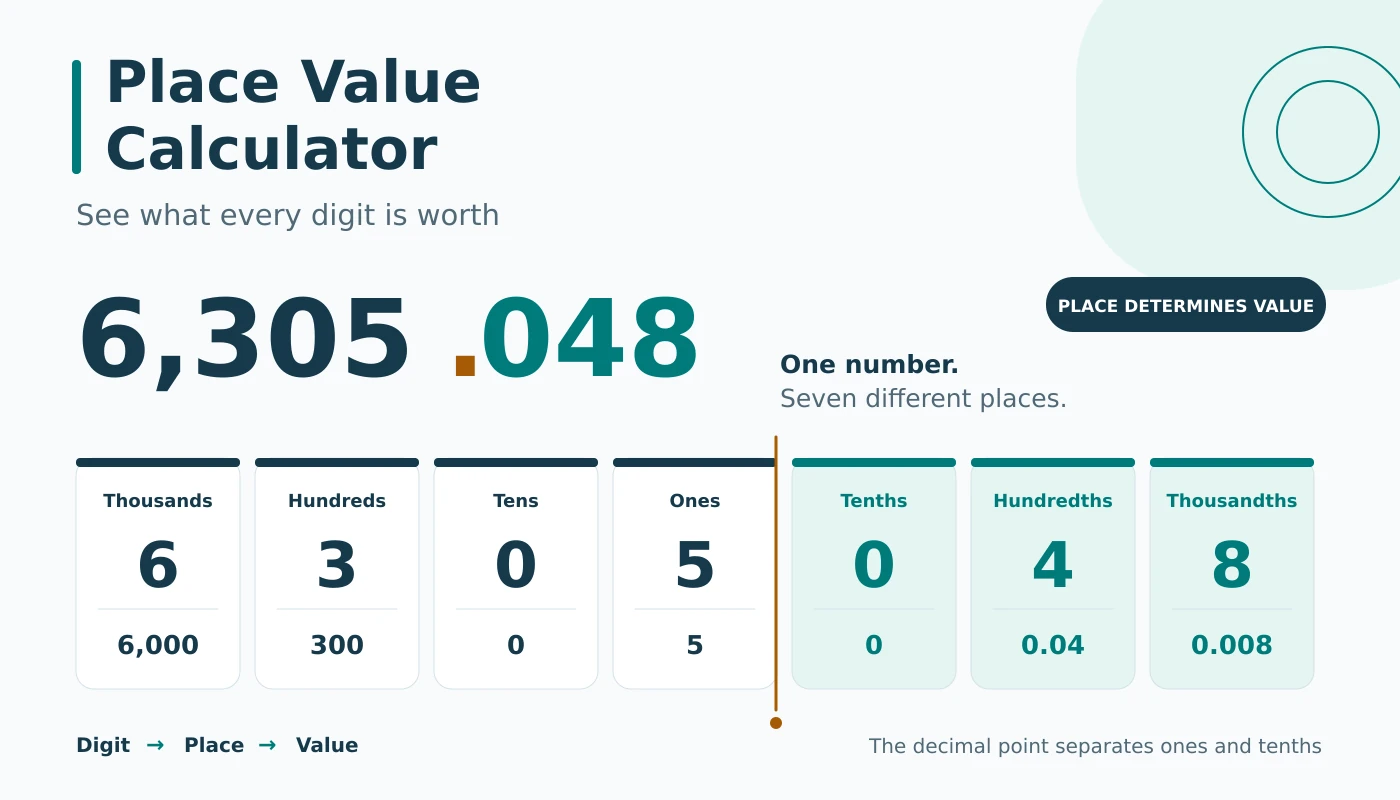
A place value chart with decimals calculator is one of the easiest ways to teach the base-ten structure. The chart puts every digit under a place name. Whole-number places appear on the left of the decimal point. Decimal places appear on the right. The decimal point is the boundary between ones and tenths. The places immediately around the decimal point are important: ones are \(10^0\), and tenths are \(10^{-1}\). There is no “oneths” place.

For a number like \(6,305.048\), the chart shows 6 in thousands, 3 in hundreds, 0 in tens, 5 in ones, 0 in tenths, 4 in hundredths, and 8 in thousandths. The zeros are visible because they protect the positions of the other digits. The chart makes it much easier to understand why \(6,305.048\) is not the same as \(635.048\), \(6,350.48\), or \(6,305.48\).

Students often make errors when reading decimal places because the names sound similar. Hundredths and hundreds are not the same. Thousandths and thousands are not the same. A digit in the hundreds place is large because it is multiplied by \(100\). A digit in the hundredths place is small because it is multiplied by \(\frac{1}{100}\). The decimal point changes the direction and the size of the place values.

Use the chart output when you need a fast visual answer. Use the table output when you need a deeper explanation. The chart is best for seeing position. The table is best for seeing digit, place name, power of ten, and exact value. Together, they make the tool stronger than a simple answer-only place value decimal calculator.

When using a chart by hand, always place the decimal point first. Then put the ones digit immediately to its left and the tenths digit immediately to its right. From there, fill left and right one place at a time. This avoids the common mistake of leaving an empty column between ones and tenths. The decimal point is not a place value; it is a separator between the whole-number side and the fractional side.

The chart also shows why there is no greatest possible place value. Numbers can keep growing leftward into billions, trillions, and beyond. Likewise, decimals can keep extending rightward into millionths, billionths, and smaller places. This calculator includes common large and small places, but the base-ten rule continues indefinitely: every step left multiplies by \(10\), and every step right divides by \(10\).

Expanded Place Value Form

Expanded place value form writes a number as a sum of the values of its digits. For whole numbers, \(4,829\) becomes \(4,000+800+20+9\). For decimals, \(4.829\) becomes \(4+0.8+0.02+0.009\). This form helps students see that every digit contributes a specific amount. It also shows why moving a digit changes the number so strongly.

The expanded place value form calculator on this page gives two versions. The first version uses ordinary decimal values, such as \(700,000+4,000+500+80+2+0.03+0.006+0.0009\). The second version uses powers of ten, such as \(7\times 10^5+4\times 10^3+5\times 10^2+8\times 10^1+2\times 10^0+3\times 10^{-2}+6\times 10^{-3}+9\times 10^{-4}\). Both are correct. The first is easier for many students to read. The second is more precise for connecting place value with exponents and scientific notation.

Expanded form also helps with mental math. If you understand that \(382\) is \(300+80+2\), then adding, subtracting, rounding, and estimating becomes easier. If you understand that \(0.382\) is \(0.3+0.08+0.002\), then decimal comparison becomes clearer. For example, \(0.4\) is greater than \(0.382\) because 4 tenths is greater than 3 tenths, even though 382 looks larger than 4 when the decimal point is ignored.

Teachers can use expanded form to identify misconceptions. If a student writes \(0.45\) as \(4+5\), the student is ignoring decimal places. If a student writes \(4,500\) as \(4+500\), the student is missing the thousands place. A good expanded form answer must preserve the place of every non-zero digit.

This section intentionally keeps expanded form in a supporting role. The main intent of a place value calculator is to identify digit positions and values. Expanded form is included because it proves those values. If your assignment asks mostly for expanded notation, powers-of-ten notation, or conversion back from expanded form, use the expanded form calculator so the two pages stay useful for separate tasks.

Place Value and Value: What Is the Difference?

Place value and value are related, but they are not the same. Place value is the position name, such as tens, hundreds, thousandths, or ten-thousandths. Value is the amount represented by the digit in that position. In \(9,452\), the digit 4 is in the hundreds place. Its value is \(400\). In \(0.004\), the digit 4 is in the thousandths place. Its value is \(0.004\).

This distinction is why a place value and value calculator is more useful than a tool that only names the position. If a student asks for the place value of 6 in \(62.718\), the answer is tens. If the student asks for the value of 6, the answer is \(60\). If a student asks for the place value of 6 in \(0.006\), the answer is thousandths. If the student asks for the value of 6, the answer is \(0.006\).

The place value and value of decimals calculator feature is especially important because decimal values are easy to confuse. A digit in the tenths place is ten times larger than the same digit in the hundredths place. A digit in the hundredths place is ten times larger than the same digit in the thousandths place. So \(0.7\), \(0.07\), and \(0.007\) all contain the digit 7, but their values are different by factors of 10.

When you teach or study place value, use both words: place and value. Ask “What place is the digit in?” and then ask “What is the value of that digit?” The first question checks position. The second checks quantity. The calculator answers both questions in the table.

A useful classroom rule is: place value is a label; digit value is a number. In \(2,946\), the digit \(9\) has place value “hundreds” and digit value \(900\). In \(0.009\), the digit \(9\) has place value “thousandths” and digit value \(0.009\). If an answer says only “hundreds” when the question asks for value, it is incomplete. If an answer says only \(900\) when the question asks for place value, it gives the amount but not the place name.

Highest Place Value, Greatest Place Value, and Estimation

The highest place value of a number is usually the largest non-zero place that appears in the number. For \(8,416\), the highest place value is thousands because the leftmost non-zero digit is 8 in the thousands place. For \(92,003\), it is ten thousands. For \(0.058\), it is hundredths because the first non-zero digit after the decimal point is 5 in the hundredths place.

Some teachers use “greatest place value” and “highest place value” in the same way. Others use “greatest place value” to mean the largest place shown in the chart, even if the digit is zero. This calculator focuses on the highest non-zero place because that is the most useful interpretation for rounding and estimation. The chart still shows zero places so the full structure remains visible.

The estimate the sum to the highest place value feature uses a common classroom strategy: round each addend to its highest non-zero place, then add the rounded numbers. For example, \(704,582.0369\) has a highest non-zero place of hundred thousands, so it rounds to \(700,000\). \(28,417.49\) has a highest non-zero place of ten thousands, so it rounds to \(30,000\). The estimated sum is approximately \(730,000\). This is not the exact sum; it is a fast, reasonable estimate.

Estimation is valuable because it builds number sense. Before doing exact calculation, a learner should know the approximate size of the answer. If the exact calculation gives a result far away from the estimate, that is a signal to check the work. Place-value estimation also helps with money, measurement, data interpretation, and mental arithmetic. For a calculator focused specifically on rounding rules and target places, use the rounding rule calculator.

Highest-place estimation is different from exact addition. If the goal is to estimate \(482+319\), the highest-place strategy gives \(500+300=800\). The exact sum is \(801\). In this case the estimate is very close, but that will not always happen. For example, \(549+549\) rounds to \(500+500=1,000\) when using nearest hundred, while the exact sum is \(1,098\). The estimate is still useful because it predicts the correct magnitude.

Place Value Calculator in Words

A place value calculator in words converts the number into readable language. Word form is not always as simple as saying the digits one by one. For whole numbers, \(3,482\) is “three thousand four hundred eighty-two.” For decimals, there are two common reading styles. The first style reads the decimal point as “point,” as in “three point four eight two.” The second style reads the decimal as a fraction, as in “three and four hundred eighty-two thousandths.”

The calculator provides a practical word form that is suitable for learning. For decimals, it keeps the decimal portion understandable by naming the denominator place of the last decimal digit. For example, \(0.45\) can be read as “forty-five hundredths,” while \(0.045\) can be read as “forty-five thousandths.” This reinforces the difference between hundredths and thousandths.

Word form is useful because it tests whether the student understands the decimal point. Many learners can type or copy a number but struggle to read it aloud correctly. If a student reads \(7.09\) as “seven point nine,” the zero in the tenths place has been ignored. A better reading is “seven and nine hundredths” or “seven point zero nine.” The zero changes the place of the 9 from tenths to hundredths.

Use word form together with the chart. The chart shows position visually. Word form shows position linguistically. Expanded form shows position arithmetically. When all three match, place value understanding is strong.

Word form is also useful for catching decimal errors in money and measurement. The amount \(\$12.05\) should be read as twelve dollars and five cents, not twelve dollars and five tenths of a dollar. The zero in the tenths place tells us the \(5\) is in hundredths, which matches cents. In measurement, \(3.04\) meters means three meters and four hundredths of a meter, not three meters and four tenths.

Place Value Converter and Generator

The place value converter changes a digit and a place into a value. For example, digit 9 in the ten-thousands place gives \(90,000\). Digit 9 in the ten-thousandths place gives \(0.0009\). This small conversion is powerful because it isolates the exact operation behind every place-value question: multiply the digit by a power of ten.

The place value generator creates practice numbers. A basic generated number may include hundreds, tens, ones, tenths, hundredths, and thousandths. A decimal generated number can focus on hundreds to ten-thousandths. A larger generated number can include millions and millionths. Generating examples is useful for classroom warmups, tutoring sessions, worksheet creation, and quick self-practice.

To make practice stronger, do not only ask for the final answer. Ask the learner to explain the position, value, and reasoning. For example: “In \(518.047\), what is the place value of 4?” The answer is hundredths. Then ask: “What is the value of 4?” The answer is \(0.04\). Then ask: “Why is it not \(0.004\)?” The answer is because \(0.004\) would place the 4 in the thousandths place, but here the 4 is the second digit after the decimal point.

The generator can also support comparison problems. Generate two decimals and compare them using place value from left to right. Compare ones first, then tenths, then hundredths, then thousandths. This prevents the common mistake of treating decimals like whole numbers.

For extra practice, ask students to convert the same digit into several places. For digit \(6\), the values are \(6,000\) in the thousands place, \(600\) in the hundreds place, \(60\) in the tens place, \(6\) in the ones place, \(0.6\) in the tenths place, \(0.06\) in the hundredths place, and \(0.006\) in the thousandths place. This one sequence makes the base-ten pattern visible in both directions.

When to Use This Page Instead of a Related Calculator

Several math tools deal with numbers, decimals, and notation, but they answer different questions. Use this place value calculator when the question is about a digit’s position or value: “What place is the 8 in?” “What is the value of the 3?” “Which digit is in the hundredths place?” “What is the highest place value?” These are place-value questions, and the chart is the main evidence.

Use the expanded form calculator when the question is mainly about writing the entire number as a sum, converting expanded form back to standard form, or using expanded form with multiplication and algebra. Expanded form appears here because it supports place value, but the expanded-form page is designed for that broader notation task. Keeping the intent separate helps students choose the right explanation.

Use the rounding rule calculator when the task is to round to the nearest ten, hundred, thousand, tenth, hundredth, or another specified place. Place value tells you which digit to inspect; rounding decides whether the target digit stays the same or increases. For example, place value identifies the hundreds digit in \(3,482\). Rounding to the nearest hundred then looks at the tens digit to decide that \(3,482\) rounds to \(3,500\).

Use fraction and decimal tools when the task moves beyond digit places. If the question asks whether \(0.375\) equals \(\frac{3}{8}\), a place value chart can show \(3\) tenths, \(7\) hundredths, and \(5\) thousandths, but it does not simplify the whole decimal into a reduced fraction. The decimal to fraction calculator is a better fit for that conversion. If the question asks how to add or compare fractions after conversion, the fractions calculator is more appropriate.

Use the long division calculator when the question is about division steps, remainders, quotients, or decimal division. Place value still matters in long division because each digit position affects the quotient, but the procedure is different. A place-value chart explains number structure; a long-division tool explains repeated division and regrouping.

Step-by-Step Method for Finding Place Value

The most reliable method begins with the decimal point. If the number has no visible decimal point, imagine one at the end of the whole number. In \(4,825\), the decimal point is after the 5, so the 5 is in the ones place, the 2 is in the tens place, the 8 is in the hundreds place, and the 4 is in the thousands place. This anchor keeps the places from shifting.

Next, count left or right from the ones place. Moving left gives \(10^1\), \(10^2\), \(10^3\), and so on. Moving right gives \(10^{-1}\), \(10^{-2}\), \(10^{-3}\), and so on. The exponent tells you the place-value factor. A digit in the \(10^4\) place is in the ten-thousands place. A digit in the \(10^{-4}\) place is in the ten-thousandths place.

Then multiply the digit by the place-value factor. If the digit \(7\) is in the thousands place, the value is \(7\times10^3=7,000\). If the digit \(7\) is in the thousandths place, the value is \(7\times10^{-3}=0.007\). The digit is the same, but the exponent changes the value. This is the key idea behind every place-value question.

Finally, check whether the digit appears more than once. In \(707.07\), the digit \(7\) appears in the hundreds place, ones place, and hundredths place. Their values are \(700\), \(7\), and \(0.07\). A digit lookup should list every occurrence because “the value of 7” is ambiguous unless the position is specified. This calculator handles that by showing all matches for the digit you enter.

For decimals, read the places carefully. The first digit after the decimal point is tenths, not ones. The second is hundredths, not tens. The third is thousandths, not hundreds. The “ths” ending matters because it signals a fractional place. If you hear “hundreds,” think \(100\). If you hear “hundredths,” think \(\frac{1}{100}\).

For negative numbers, the place names stay the same, but the digit values are part of a negative quantity. In \(-482\), the digit \(4\) is still in the hundreds place. The number can be understood as \(-(400+80+2)\). Some contexts describe the digit value as \(400\) inside the magnitude, while the contribution to the signed number is \(-400\). The calculator keeps the sign visible so users can interpret the result in context.

Reading Decimal Places from Tenths to Millionths

Decimal places become easier when you connect each name to a fraction. Tenths mean pieces of size \(\frac{1}{10}\). Hundredths mean pieces of size \(\frac{1}{100}\). Thousandths mean pieces of size \(\frac{1}{1000}\). Millionths mean pieces of size \(\frac{1}{1,000,000}\). Each place is ten times smaller than the place before it.

Consider \(0.2047\). The digit \(2\) is in the tenths place, so its value is \(0.2\). The digit \(0\) is in the hundredths place, so it holds that place without adding value. The digit \(4\) is in the thousandths place, so its value is \(0.004\). The digit \(7\) is in the ten-thousandths place, so its value is \(0.0007\). The expanded decimal value is \(0.2+0.004+0.0007\).

Now compare \(0.2047\) with \(0.2407\). Both numbers have 2 tenths. The next place is hundredths: \(0.2047\) has 0 hundredths, while \(0.2407\) has 4 hundredths. Because \(4\) hundredths is greater than \(0\) hundredths, \(0.2407\) is greater. You do not need to compare every later digit once a larger place has decided the comparison.

Decimal place value also explains why adding zeros at the end of a decimal does not change its value. The numbers \(0.5\), \(0.50\), and \(0.500\) are equal because \(5\) tenths is the same as \(50\) hundredths and \(500\) thousandths. However, zeros between the decimal point and a nonzero digit do change place. The numbers \(0.5\), \(0.05\), and \(0.005\) are not equal. The digit \(5\) moves from tenths to hundredths to thousandths.

This distinction is important in science and measurement. A measurement written as \(2.50\) may communicate more precision than \(2.5\), even though both have the same numerical value. In a classroom place-value chart, it is reasonable to show the final zero because it tells the reader the measurement was recorded to the hundredths place. In exact arithmetic, the two numbers are equivalent; in measurement language, the notation can carry extra information.

Place Value in Addition, Subtraction, Multiplication, and Division

Place value is the reason standard arithmetic algorithms work. In addition, digits must be aligned by place before they are added. Ones add to ones, tens add to tens, tenths add to tenths, and hundredths add to hundredths. If decimals are not aligned, the result can be badly wrong. For example, \(4.5+0.32\) is \(4.82\), not \(0.77\) or \(4.37\). The decimal point anchors the places.

In subtraction, place value explains regrouping. The expression \(502-178\) is difficult because there are not enough ones or tens in the visible digits. Regrouping changes one hundred into ten tens and one ten into ten ones while preserving the total value. If a student understands that \(500=400+100=400+90+10\), the subtraction algorithm becomes more meaningful. For a plain-language review of subtraction before place-value regrouping, see what subtraction means in math.

In multiplication, place value creates partial products. The calculation \(34\times26\) can be read as \((30+4)(20+6)\). The products \(600\), \(180\), \(80\), and \(24\) add to \(884\). This is the same base-ten structure behind area models and the standard multiplication algorithm. For a broader operation review, see multiplication definitions and examples or the visual explanation in multiplication from area models.

In division, place value explains why quotient digits appear in particular positions. Dividing \(846\) by \(3\) begins with hundreds because \(8\) hundreds can be shared into 3 groups. The quotient \(282\) means \(2\) hundreds, \(8\) tens, and \(2\) ones. Decimal division follows the same principle, but the quotient can continue into tenths, hundredths, and thousandths. Place value does not replace division practice, but it makes the steps easier to interpret.

Because place value supports all four operations, the chart should be used as a reasoning aid, not only as a reference table. When an answer looks suspicious, estimate by place value. When decimal arithmetic feels confusing, align by place value. When multiplication becomes mechanical, break factors into place-value parts. The same base-ten idea keeps reappearing.

Using Place Value with Powers of Ten and Exponents

Every place in a base-ten number corresponds to a power of ten. The ones place is \(10^0\), the tens place is \(10^1\), the hundreds place is \(10^2\), and the thousands place is \(10^3\). Decimal places use negative powers: tenths are \(10^{-1}\), hundredths are \(10^{-2}\), and thousandths are \(10^{-3}\). This is why the calculator shows a power-of-ten column.

The exponent column is useful because it connects elementary place value to later math. Scientific notation, standard form in science, exponential growth, and metric prefixes all depend on powers of ten. A student who understands that \(4\) in the thousands place means \(4\times10^3\) is better prepared to understand \(4.2\times10^6\). For more background on powers, use the complete exponents study guide.

Powers of ten also explain why multiplying by \(10\) changes place value. If a digit has exponent \(n\), multiplying by \(10\) changes the factor from \(10^n\) to \(10^{n+1}\). Dividing by \(10\) changes it to \(10^{n-1}\). This is more accurate than saying the decimal “moves.” The digits are being reinterpreted in new places relative to the decimal point.

For example, \(3.42=3\times10^0+4\times10^{-1}+2\times10^{-2}\). Multiplying by \(10\) gives \(34.2=3\times10^1+4\times10^0+2\times10^{-1}\). Each digit’s exponent increases by one. Dividing by \(10\) would give \(0.342=3\times10^{-1}+4\times10^{-2}+2\times10^{-3}\). The calculator’s power-expanded output makes this structure visible.

Worked Examples

Example 1: Find the place value of 5 in \(45,219\)

The digit 5 is in the thousands place because it is four places from the right if we count ones, tens, hundreds, thousands. Its value is \(5\times 1,000=5,000\). The expanded form of the number is \(40,000+5,000+200+10+9\).

Example 2: Find the value of 3 in \(8.037\)

The digit 3 is the second digit after the decimal point, so it is in the hundredths place. Its value is \(3\times 10^{-2}=0.03\). The expanded form is \(8+0.03+0.007\). The zero in the tenths place is important because it places the 3 in hundredths instead of tenths.

Example 3: Write \(906.2045\) in expanded form

The number \(906.2045\) is \(900+6+0.2+0.004+0.0005\). The zero in the tens place and the zero in the hundredths place do not add value, but both are part of the number's structure. The digit 5 is in the ten-thousandths place, so its value is \(0.0005\).

Example 4: Estimate \(7,842+361\) to the highest place value

The highest non-zero place in \(7,842\) is thousands, so \(7,842\) rounds to \(8,000\). The highest non-zero place in \(361\) is hundreds, so \(361\) rounds to \(400\). The estimated sum is \(8,400\). The exact sum is \(8,203\), so the estimate is close enough for a quick reasonableness check.

Example 5: Compare \(0.306\) and \(0.36\)

Write each number by place. The number \(0.306\) has 3 tenths, 0 hundredths, and 6 thousandths. The number \(0.36\) has 3 tenths and 6 hundredths. The tenths are equal, so compare hundredths. Since 6 hundredths is greater than 0 hundredths, \(0.36>0.306\).

Example 6: Find every 4 in \(40,404.04\)

The first \(4\) is in the ten-thousands place and has value \(40,000\). The second \(4\) is in the hundreds place and has value \(400\). The third \(4\) is in the hundredths place and has value \(0.04\). The same digit appears three times, but each occurrence has a different place and value.

Example 7: Convert digit 8 in the ten-thousandths place

The ten-thousandths place has exponent \(-4\), so the value is \(8\times10^{-4}=0.0008\). As a fraction, that is \(\frac{8}{10000}\). This is much smaller than \(8\) in the ten-thousands place, which would be \(8\times10^4=80,000\).

Common Place Value Mistakes

The first common mistake is ignoring zeros. In \(305\), the zero is not decoration. It tells us there are zero tens and keeps the 3 in the hundreds place. In \(0.305\), the zero after the decimal point tells us there are zero tenths and keeps the 3 in the hundredths place. Removing zeros can change the meaning of a number or the precision of a measurement.

The second common mistake is confusing decimal names with whole-number names. Hundreds and hundredths are opposites in size direction. Hundreds are to the left of ones and represent groups of 100. Hundredths are to the right of tenths and represent parts of one whole, each equal to \(0.01\). The “ths” ending signals a fractional decimal place.

The third common mistake is comparing decimals by length. A learner may think \(0.65\) is greater than \(0.7\) because 65 is greater than 7. Place value shows the correct comparison: \(0.7\) is 7 tenths, while \(0.65\) is 6 tenths and 5 hundredths. Since 7 tenths is greater than 6 tenths, \(0.7>0.65\).

The fourth common mistake is rounding without identifying the correct place. To round \(3,482\) to the highest place value, identify thousands first, then look at the hundreds digit. Since the hundreds digit is 4, \(3,482\) rounds to \(3,000\). To round \(7,842\) to the highest place, identify thousands and look at hundreds. Since the hundreds digit is 8, it rounds to \(8,000\).

The fifth common mistake is assuming place value and digit value are interchangeable. If the question asks for the place value of \(2\) in \(427\), the answer is tens. If the question asks for the value of \(2\), the answer is \(20\). A complete explanation can include both, but a calculator should label them separately so the student learns the vocabulary correctly.

The sixth common mistake is reading decimals without the zero placeholders. The number \(5.08\) is not “five point eight” if you are reading every digit accurately. It is “five point zero eight,” or “five and eight hundredths.” The zero in the tenths place moves the \(8\) into the hundredths place. This is exactly the kind of detail a decimal place value chart is designed to show.

Practice Ideas for Students, Teachers, and Parents

For quick practice, choose one number and ask four questions: What is the highest non-zero place? What is the value of a chosen digit? What is the digit in the hundredths or hundreds place? What is the number in expanded form? A number such as \(6,405.072\) works well because it includes whole-number places, decimal places, and zeros.

For decimal practice, use pairs that test common misconceptions: \(0.4\) and \(0.04\), \(2.30\) and \(2.03\), \(7.008\) and \(7.08\). Ask the learner to place each number in a chart before comparing. The chart prevents the student from relying on the length of the decimal string. It also makes zeros visible, which is often the key to the comparison.

For whole-number practice, use large numbers with internal zeros: \(50,308\), \(604,019\), \(7,020,005\). Ask which zeros are placeholders and which nonzero digit has the greatest value. Then ask the student to read the number in words. Large-number word form strengthens the connection between periods, commas, and place names.

For operation practice, pair place value with addition and subtraction. Ask students to estimate first, calculate exactly, and then compare the exact answer with the estimate. If the estimate and exact answer are wildly different, students should check digit alignment. This habit is especially useful for decimals, money, and measurement problems.

For enrichment, connect place value to number systems. The numeral systems converter can help older students see that base ten is only one way to organize place value. In base ten, each place is a power of \(10\). In base two, each place is a power of \(2\). The place-value concept remains, but the base changes.

How to Use This Place Value Calculator Online

  1. Type a whole number or decimal into the number field. You may include commas for readability.
  2. Enter a digit in the digit lookup field if you want to find every place where that digit appears.
  3. Add a second number if you want to estimate the sum to the highest place value.
  4. Choose a converter place and digit if you want to convert a digit-position pair into a value.
  5. Click Calculate place value to view the chart, expanded form, word form, lookup table, converter result, and estimate.

For best learning results, read the chart from left to right and say each place name aloud. Then read the expanded form. Finally, check the power-of-ten version to connect place value with exponents. This sequence builds conceptual understanding instead of only giving a quick answer.

If the output is wider than your screen, scroll the table horizontally. Place-value charts can become wide because each digit needs its own column. This is normal for large numbers and long decimals. Focus first on the digit you are studying, then read nearby places to confirm that the position is correct.

FAQs About Place Value

What is the best calculator for place value?

The best calculator for place value should show the digit, place name, power of ten, value, chart, expanded form, and word form. A single answer is not enough for learning because place value is about structure.

Can this tool calculate decimal place value?

Yes. It works as a decimal place value calculator and identifies tenths, hundredths, thousandths, ten-thousandths, hundred-thousandths, millionths, and more.

What is a decimal place value chart calculator?

It is a tool that places every digit of a decimal number under the correct place heading, such as ones, tenths, hundredths, and thousandths.

How do I find the place value of a digit?

Locate the digit, count its position from the decimal point, name the place, and multiply the digit by that place's power of ten.

What is the difference between place value and value?

Place value is the position name. Value is the amount the digit contributes. In \(60\), the 6 is in the tens place, and its value is \(60\).

How do I estimate the sum to the highest place value?

Round each addend to its highest non-zero place, then add the rounded numbers. This gives a fast estimate for checking reasonableness.

What is expanded place value form?

Expanded place value form writes a number as the sum of its digit values. For example, \(306.4=300+6+0.4\).

Why are zeros important in place value?

Zeros hold positions. They may not add value, but they keep other digits in the correct places, especially in numbers like \(405\) and \(0.047\).

Shares:

Related Posts