Search
Menu

A Level Math

Choose a worksheet and check an algebraic result using a second representation.

Quick Answer

The A-level maths resource bank includes questions and editable practice material, with worked answers where provided. Select a topic such as quadratic expressions or equations and use the answer file to check method as well as result.

Advanced mathematics graph notebook
 
Year 1 Pure Heading.png
 
 
year 1 applied heading.png


Maths Art Heading.png

If you run or want to run a Maths Art enrichment club, then these instruction sheets for a number of different constructions might be useful. More to follow…


Origami Heading.png

Finding an origami fold that can be completed by novice origamists from Year 7 upwards can be tricky! So here are a few folds that I have tried in Origami Club and have proved popular.

Use the graph to check the factors

For the quadratic with leading coefficient one, middle coefficient minus five and constant term six, find two integers whose sum is minus five and product is six. They are minus two and minus three. The factors are x minus two and x minus three. The roots are therefore two and three. Sketch an upward-opening parabola and check the vertical intercept by substituting zero.

Recognizing Characteristics of Parabolas
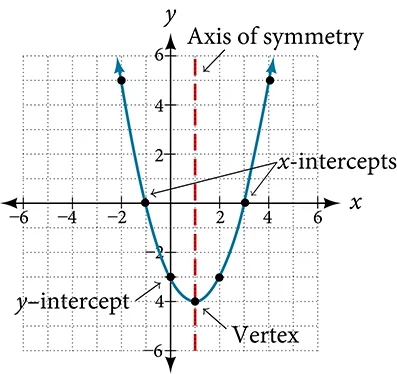
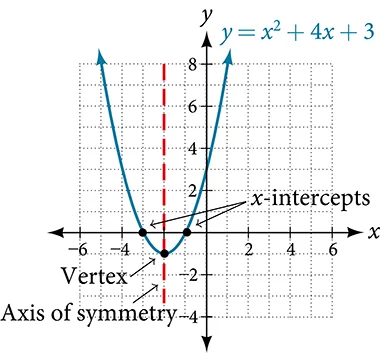
The graph of a quadratic function is a U-shaped curve called a parabola. One important feature of the graph is that it has an extreme point, called the vertex. If the parabola opens up, the vertex represents the lowest point on the graph, or the minimum value of the quadratic function. If the parabola opens down, the vertex represents the highest point on the graph, or the maximum value. In either case, the vertex is a turning point on the graph. The graph is also symmetric with a vertical line drawn through the vertex, called the axis of symmetry. These features are illustrated in diagram.
Graph of a parabola showing where the x and y intercepts, vertex, and axis of symmetry are.
The y-intercept is the point at which the parabola crosses the y-axis. The x-intercepts are the points at which the parabola crosses the x-axis. If they exist, the x-intercepts represent the zeros, or roots, of the quadratic function, the values of x at which y=0.

Identifying the Characteristics of a Parabola
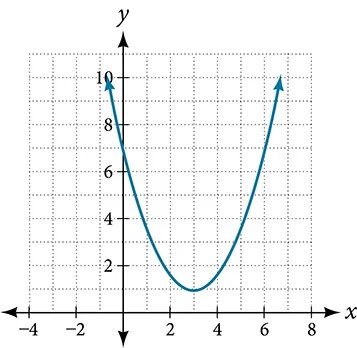
Determine the vertex, axis of symmetry, zeros, and y- intercept of the parabola shown in diagram.
Graph of a parabola with a vertex at (3, 1) and a y-intercept at (0, 7).
Solution
The vertex is the turning point of the graph. We can see that the vertex is at ( 3,1 ). Because this parabola opens upward, the axis of symmetry is the vertical line that intersects the parabola at the vertex. So the axis of symmetry is x=3. This parabola does not cross the x- axis, so it has no zeros. It crosses the y- axis at ( 0,7 ) so this is the y-intercept.

Understanding How the Graphs of Parabolas are Related to Their Quadratic Functions
The general form of a quadratic function presents the function in the form
f(x)=a x 2 +bx+c
where a,b, and c are real numbers and a≠0. If a>0, the parabola opens upward. If a<0, the parabola opens downward. We can use the general form of a parabola to find the equation for the axis of symmetry.
The axis of symmetry is defined by x=− b 2a . If we use the quadratic formula, x= −b± b 2 −4ac 2a , to solve a x 2 +bx+c=0 for the x- intercepts, or zeros, we find the value of x halfway between them is always x=− b 2a , the equation for the axis of symmetry.
diagram represents the graph of the quadratic function written in general form as y= x 2 +4x+3. In this form, a=1,b=4, and c=3. Because a>0, the parabola opens upward. The axis of symmetry is x=− 4 2( 1 ) =−2. This also makes sense because we can see from the graph that the vertical line x=−2 divides the graph in half. The vertex always occurs along the axis of symmetry. For a parabola that opens upward, the vertex occurs at the lowest point on the graph, in this instance, (−2,−1). The x- intercepts, those points where the parabola crosses the x- axis, occur at (−3,0) and (−1,0).
Graph of a parabola showing where the x and y intercepts, vertex, and axis of symmetry are for the function y=x^2+4x+3.
The standard form of a quadratic function presents the function in the form
f(x)=a (x−h) 2 +k
where ( h,k ) is the vertex. Because the vertex appears in the standard form of the quadratic function, this form is also known as the vertex form of a quadratic function.
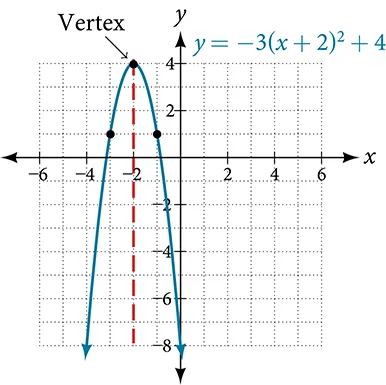
As with the general form, if a>0, the parabola opens upward and the vertex is a minimum. If a<0, the parabola opens downward, and the vertex is a maximum. diagram represents the graph of the quadratic function written in standard form as y=−3 ( x+2 ) 2 +4. Since x–h=x+2 in this example, h=–2. In this form, a=−3,h=−2, and k=4. Because a<0, the parabola opens downward. The vertex is at ( −2, 4 ).
Graph of a parabola showing where the x and y intercepts, vertex, and axis of symmetry are for the function y=-3(x+2)^2+4.
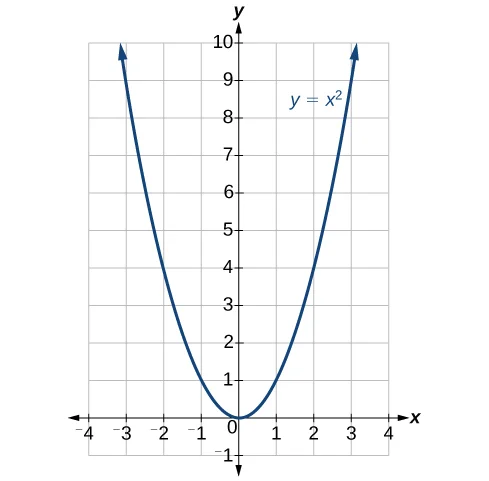
The standard form is useful for determining how the graph is transformed from the graph of y= x 2 . diagram is the graph of this basic function.
Graph of y=x^2.
If k>0, the graph shifts upward, whereas if k<0, the graph shifts downward. In diagram, k>0, so the graph is shifted 4 units upward. If h>0, the graph shifts toward the right and if h<0, the graph shifts to the left. In diagram, h<0, so the graph is shifted 2 units to the left. The magnitude of a indicates the stretch of the graph. If | a |>1, the point associated with a particular x- value shifts farther from the x-axis, so the graph appears to become narrower, and there is a vertical stretch. But if | a |<1, the point associated with a particular x- value shifts closer to the x-axis, so the graph appears to become wider, but in fact there is a vertical compression. In diagram, | a |>1, so the graph becomes narrower.
The standard form and the general form are equivalent methods of describing the same function. We can see this by expanding out the general form and setting it equal to the standard form.
a (x−h) 2 +k=a x 2 +bx+c a x 2 −2ahx+(a h 2 +k)=a x 2 +bx+c
For the linear terms to be equal, the coefficients must be equal.
–2ah=b, so h=− b 2a .
This is the axis of symmetry we defined earlier. Setting the constant terms equal:
a h 2 +k=c           k=c−a h 2             =c−a(− b 2a ) 2             =c− b 2 4a
In practice, though, it is usually easier to remember that k is the output value of the function when the input is h, so f(h)=k.

Writing the Equation of a Quadratic Function from the Graph
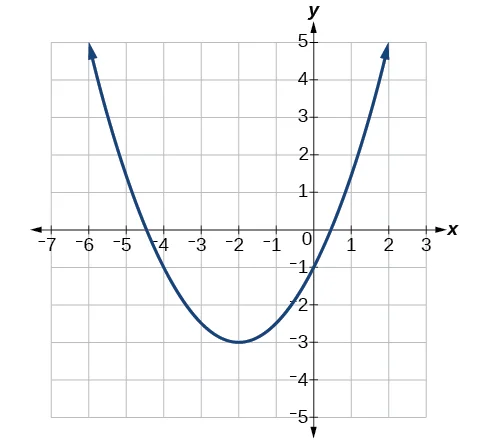
Write an equation for the quadratic function g in diagram as a transformation of f(x)= x 2 , and then expand the formula, and simplify terms to write the equation in general form.
Graph of a parabola with its vertex at (-2, -3).
Solution
We can see the graph of g is the graph of f(x)= x 2 shifted to the left 2 and down 3, giving a formula in the form g(x)=a (x+2) 2 –3.
Substituting the coordinates of a point on the curve, such as (0,−1), we can solve for the stretch factor.
−1=a (0+2) 2 −3    2=4a    a= 1 2
In standard form, the algebraic model for this graph is g(x)= 1 2 (x+2) 2 –3.
To write this in general polynomial form, we can expand the formula and simplify terms.
g(x)= 1 2 (x+2) 2 −3        = 1 2 (x+2)(x+2)−3        = 1 2 ( x 2 +4x+4)−3        = 1 2 x 2 +2x+2−3        = 1 2 x 2 +2x−1
Notice that the horizontal and vertical shifts of the basic graph of the quadratic function determine the location of the vertex of the parabola; the vertex is unaffected by stretches and compressions.

Finding the Vertex of a Quadratic Function

Find the vertex of the quadratic function f(x)=2 x 2 –6x+7. Rewrite the quadratic in standard form (vertex form).
Solution
The horizontal coordinate of the vertex will be at
h=– b 2a   =– –6 2(2)   = 6 4   = 3 2
The vertical coordinate of the vertex will be at
k=f(h)   =f( 3 2 )   =2 ( 3 2 ) 2 −6( 3 2 )+7   = 5 2
Rewriting into standard form, the stretch factor will be the same as the a in the original quadratic.
f(x)=a x 2 +bx+c f(x)=2 x 2 −6x+7
Using the vertex to determine the shifts,
f( x )=2 ( x– 3 2 ) 2 + 5 2

Finding the Domain and Range of a Quadratic Function

Any number can be the input value of a quadratic function. Therefore, the domain of any quadratic function is all real numbers. Because parabolas have a maximum or a minimum point, the range is restricted. Since the vertex of a parabola will be either a maximum or a minimum, the range will consist of all y-values greater than or equal to the y-coordinate at the turning point or less than or equal to the y-coordinate at the turning point, depending on whether the parabola opens up or down.

Finding the Domain and Range of a Quadratic Function

Find the domain and range of f(x)=−5 x 2 +9x−1.
Solution
As with any quadratic function, the domain is all real numbers.
Because a is negative, the parabola opens downward and has a maximum value. We need to determine the maximum value. We can begin by finding the x- value of the vertex.
h=− b 2a   =− 9 2(−5)   = 9 10
The maximum value is given by f(h).
f( 9 10 )=−5 ( 9 10 ) 2 +9( 9 10 )−1           = 61 20
The range is f(x)≤ 61 20 , or ( −∞, 61 20 ].

Determining the Maximum and Minimum Values of Quadratic Functions
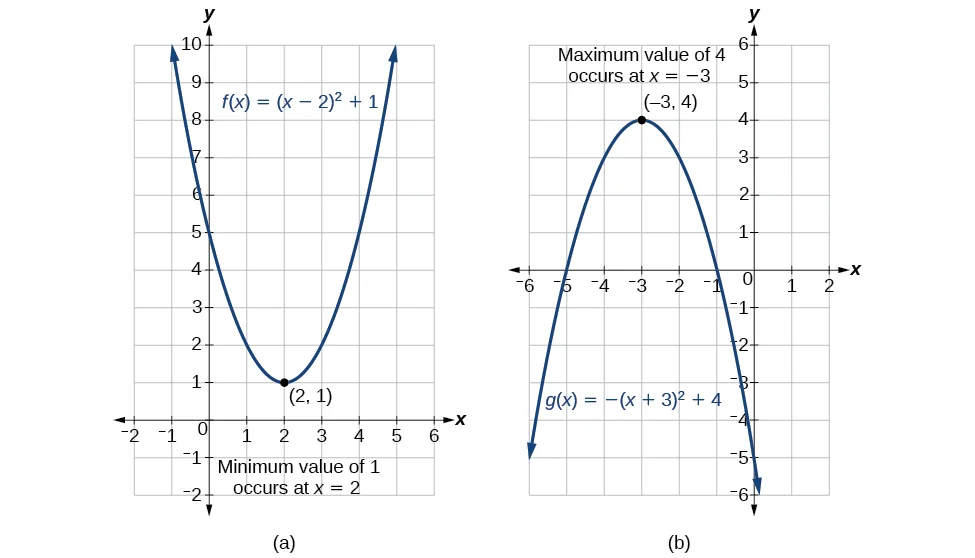
The output of the quadratic function at the vertex is the maximum or minimum value of the function, depending on the orientation of the parabola. We can see the maximum and minimum values in diagram.
Two graphs where the first graph shows the maximum value for f(x)=(x-2)^2+1 which occurs at (2, 1) and the second graph shows the minimum value for g(x)=-(x+3)^2+4 which occurs at (-3, 4).
There are many real-world scenarios that involve finding the maximum or minimum value of a quadratic function, such as applications involving area and revenue.

Finding the Maximum Value of a Quadratic Function

A backyard farmer wants to enclose a rectangular space for a new garden within her fenced backyard. She has purchased 80 feet of wire fencing to enclose three sides, and she will use a section of the backyard fence as the fourth side.
  1. ⓐ Find a formula for the area enclosed by the fence if the sides of fencing perpendicular to the existing fence have length L.
  2. ⓑ What dimensions should she make her garden to maximize the enclosed area?
Solution
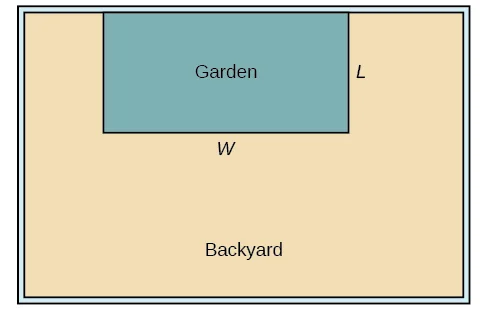
Let’s use a diagram such as diagram to record the given information. It is also helpful to introduce a temporary variable, W, to represent the width of the garden and the length of the fence section parallel to the backyard fence.
Diagram of the garden and the backyard.
  1. ⓐ We know we have only 80 feet of fence available, and L+W+L=80, or more simply, 2L+W=80. This allows us to represent the width, W, in terms of L.
    W=80−2L
    Now we are ready to write an equation for the area the fence encloses. We know the area of a rectangle is length multiplied by width, so
         A=LW=L(80−2L) A(L)=80L−2 L 2
    This formula represents the area of the fence in terms of the variable length L. The function, written in general form, is
    A(L)=−2 L 2 +80L.
  2. The quadratic has a negative leading coefficient, so the graph will open downward, and the vertex will be the maximum value for the area. In finding the vertex, we must be careful because the equation is not written in standard polynomial form with decreasing powers. This is why we rewrote the function in general form above. Since a is the coefficient of the squared term, a=−2,b=80, and c=0.
To find the vertex:
h=− 80 2(−2) k=A(20)   =20 and   =80(20)−2 (20) 2   =800
The maximum value of the function is an area of 800 square feet, which occurs when L=20 feet. When the shorter sides are 20 feet, there is 40 feet of fencing left for the longer side. To maximize the area, she should enclose the garden so the two shorter sides have length 20 feet and the longer side parallel to the existing fence has length 40 feet.

Finding Maximum Revenue

The unit price of an item affects its supply and demand. That is, if the unit price goes up, the demand for the item will usually decrease. For example, a local newspaper currently has 84,000 subscribers at a quarterly charge of $30. Market research has suggested that if the owners raise the price to $32, they would lose 5,000 subscribers. Assuming that subscriptions are linearly related to the price, what price should the newspaper charge for a quarterly subscription to maximize their revenue?
Solution
Revenue is the amount of money a company brings in. In this case, the revenue can be found by multiplying the price per subscription times the number of subscribers, or quantity. We can introduce variables, p for price per subscription and Q for quantity, giving us the equation Revenue=pQ.
Because the number of subscribers changes with the price, we need to find a relationship between the variables. We know that currently p=30 and Q=84,000. We also know that if the price rises to $32, the newspaper would lose 5,000 subscribers, giving a second pair of values, p=32 and Q=79,000. From this we can find a linear equation relating the two quantities. The slope will be
m= 79,000−84,000 32−30    = −5,000 2    =−2,500
This tells us the paper will lose 2,500 subscribers for each dollar they raise the price. We can then solve for the y-intercept.
         Q=−2500p+b Substitute in the point Q=84,000 and p=30 84,000=−2500(30)+b Solve for b           b=159,000
This gives us the linear equation Q=−2,500p+159,000 relating cost and subscribers. We now return to our revenue equation.
Revenue=pQ Revenue=p(−2,500p+159,000) Revenue=−2,500 p 2 +159,000p
We now have a quadratic function for revenue as a function of the subscription charge. To find the price that will maximize revenue for the newspaper, we can find the vertex.
h=− 159,000 2(−2,500)   =31.8
The model tells us that the maximum revenue will occur if the newspaper charges $31.80 for a subscription. To find what the maximum revenue is, we evaluate the revenue function.
maximum revenue=−2,500 (31.8) 2 +159,000(31.8)                               =2,528,100

Finding the x- and y-Intercepts of a Quadratic Function
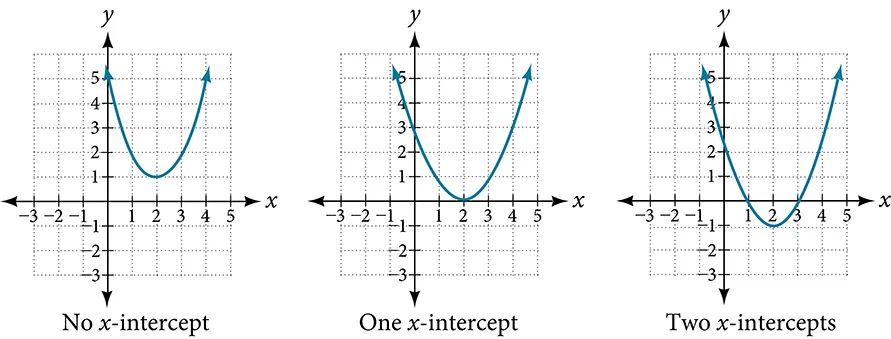
Much as we did in the application problems above, we also need to find intercepts of quadratic equations for graphing parabolas. Recall that we find the y- intercept of a quadratic by evaluating the function at an input of zero, and we find the x- intercepts at locations where the output is zero. Notice in diagram that the number of x- intercepts can vary depending upon the location of the graph.
Three graphs where the first graph shows a parabola with no x-intercept, the second is a parabola with one –intercept, and the third parabola is of two x-intercepts.
Number of x-intercepts of a parabola

Finding the y- and x-Intercepts of a Parabola

Find the y- and x-intercepts of the quadratic f(x)=3 x 2 +5x−2.
Solution
We find the y-intercept by evaluating f( 0 ).
f(0)=3 (0) 2 +5(0)−2        =−2
So the y-intercept is at ( 0,−2 ).
For the x-intercepts, we find all solutions of f( x )=0.
0=3 x 2 +5x−2
In this case, the quadratic can be factored easily, providing the simplest method for solution.
0=(3x−1)(x+2)
0=3x−1 0=x+2 x= 1 3 or x=−2
So the x-intercepts are at ( 1 3 ,0 ) and ( −2,0 ).

Rewriting Quadratics in Standard Form

In worked example, the quadratic was easily solved by factoring. However, there are many quadratics that cannot be factored. We can solve these quadratics by first rewriting them in standard form.

Finding the x- Intercepts of a Parabola

Find the x- intercepts of the quadratic function f(x)=2 x 2 +4x−4.
Solution
We begin by solving for when the output will be zero.
0=2 x 2 +4x−4
Because the quadratic is not easily factorable in this case, we solve for the intercepts by first rewriting the quadratic in standard form.
f( x )=a ( x−h ) 2 +k
We know that a=2. Then we solve for h and k.
h=− b 2a k=f(−1)   =− 4 2(2)   =2 (−1) 2 +4(−1)−4   =−1   =−6
So now we can rewrite in standard form.
f(x)=2 (x+1) 2 −6
We can now solve for when the output will be zero.
0=2 (x+1) 2 −6 6=2 (x+1) 2 3= (x+1) 2 x+1=± 3 x=−1± 3
The graph has x- intercepts at (−1− 3 ,0) and (−1+ 3 ,0).

Solving a Quadratic Equation with the Quadratic Formula

Solve x 2 +x+2=0.
Solution
Let’s begin by writing the quadratic formula: x= −b± b 2 −4ac 2a .
When applying the quadratic formula, we identify the coefficients a,b and c. For the equation x 2 +x+2=0, we have a=1,b=1,andc=2. Substituting these values into the formula we have:
x= −b± b 2 −4ac 2a   = −1± 1 2 −4⋅1⋅(2) 2⋅1   = −1± 1−8 2   = −1± −7 2   = −1±i 7 2
The solutions to the equation are −1+i 7 2 and −1−i 7 2 or −1 2 + i 7 2 and −1 2 − i 7 2 .

Applying the Vertex and x-Intercepts of a Parabola

A ball is thrown upward from the top of a 40 foot high building at a speed of 80 feet per second. The ball’s height above ground can be modeled by the equation H(t)=−16 t 2 +80t+40.
  1. ⓐ When does the ball reach the maximum height?
  2. ⓑ What is the maximum height of the ball?
  3. ⓒ When does the ball hit the ground?
Solution
  1. ⓐ The ball reaches the maximum height at the vertex of the parabola.
    h=− 80 2(−16)   = 80 32   = 5 2   =2.5
    The ball reaches a maximum height after 2.5 seconds.
  2. ⓑ To find the maximum height, find the y- coordinate of the vertex of the parabola.
    k=H( − b 2a )   =H( 2.5 )   =−16 ( 2.5 ) 2 +80( 2.5 )+40   =140
    The ball reaches a maximum height of 140 feet.
  3. ⓒ To find when the ball hits the ground, we need to determine when the height is zero, H( t )=0.
    We use the quadratic formula.
    t= −80± 80 2 −4(−16)(40) 2(−16) = −80± 8960 −32
    Because the square root does not simplify nicely, we can use a calculator to approximate the values of the solutions.
    t= −80− 8960 −32 ≈5.458 or t= −80+ 8960 −32 ≈−0.458
    The second answer is outside the reasonable domain of our model, so we conclude the ball will hit the ground after about 5.458 seconds. See diagram
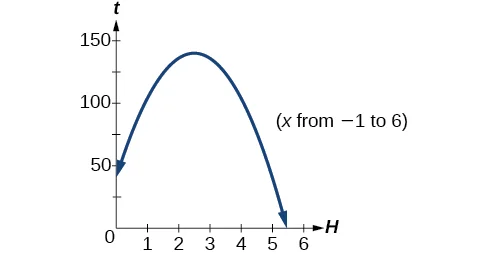
    Graph of a negative parabola where x goes from -1 to 6.

Solving Quadratic Equations by Factoring

An equation containing a second-degree polynomial is called a quadratic equation. For example, equations such as 2 x 2 +3x−1=0 and x 2 −4=0 are quadratic equations. They are used in countless ways in the fields of engineering, architecture, finance, biological science, and, of course, mathematics.
Often the easiest method of solving a quadratic equation is factoring. Factoring means finding expressions that can be multiplied together to give the expression on one side of the equation.
If a quadratic equation can be factored, it is written as a product of linear terms. Solving by factoring depends on the zero-product property, which states that if a⋅b=0, then a=0 or b=0, where a and b are real numbers or algebraic expressions. In other words, if the product of two numbers or two expressions equals zero, then one of the numbers or one of the expressions must equal zero because zero multiplied by anything equals zero.
Multiplying the factors expands the equation to a string of terms separated by plus or minus signs. So, in that sense, the operation of multiplication undoes the operation of factoring. For example, expand the factored expression ( x−2 )( x+3 ) by multiplying the two factors together.
( x−2 )( x+3 ) = x 2 +3x−2x−6 = x 2 +x−6
The product is a quadratic expression. Set equal to zero, x 2 +x−6=0 is a quadratic equation. If we were to factor the equation, we would get back the factors we multiplied.
The process of factoring a quadratic equation depends on the leading coefficient, whether it is 1 or another integer. We will look at both situations; but first, we want to confirm that the equation is written in standard form, a x 2 +bx+c=0, where a, b, and c are real numbers, and a≠0. The equation x 2 +x−6=0 is in standard form.
We can use the zero-product property to solve quadratic equations in which we first have to factor out the greatest common factor (GCF), and for equations that have special factoring formulas as well, such as the difference of squares, both of which we will see later in this section.

Solving Quadratics with a Leading Coefficient of 1

In the quadratic equation x 2 +x−6=0, the leading coefficient, or the coefficient of x 2 , is 1. We have one method of factoring quadratic equations in this form.

Factoring and Solving a Quadratic with Leading Coefficient of 1
Factor and solve the equation: x 2 +x−6=0.
Solution
To factor x 2 +x−6=0, we look for two numbers whose product equals −6 and whose sum equals 1. Begin by looking at the possible factors of −6.
1⋅(−6) (−6)⋅1 2⋅(−3) 3⋅(−2)
The last pair, 3⋅( −2 ) sums to 1, so these are the numbers. Note that only one pair of numbers will work. Then, write the factors.
( x−2 )( x+3 )=0
To solve this equation, we use the zero-product property. Set each factor equal to zero and solve.
( x−2 )( x+3 ) = 0 ( x−2 ) = 0 x = 2 ( x+3 ) = 0 x = −3
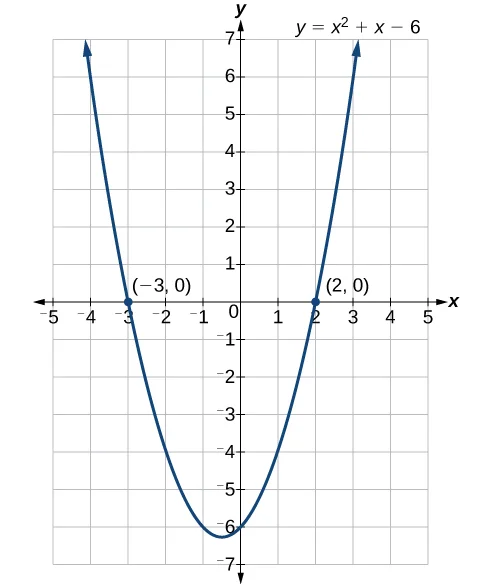
The two solutions are 2 and −3. We can see how the solutions relate to the graph in diagram. The solutions are the x-intercepts of y = x 2 +x−6=0.
Coordinate plane with the x-axis ranging from negative 5 to 5 and the y-axis ranging from negative 7 to 7. The function x squared plus x minus six equals zero is graphed, with the x-intercepts (-3,0) and (2,0), plotted as well.

Solve the Quadratic Equation by Factoring

Solve the quadratic equation by factoring: x 2 +8x+15=0.
Solution
Find two numbers whose product equals 15 and whose sum equals 8. List the factors of 15.
1⋅15 3⋅5 (−1)⋅(−15) (−3)⋅(−5)
The numbers that add to 8 are 3 and 5. Then, write the factors, set each factor equal to zero, and solve.
( x+3 )( x+5 ) = 0 ( x+3 ) = 0 x = −3 ( x+5 ) = 0 x = −5
The solutions are −3 and −5.

Using the Zero-Product Property to Solve a Quadratic Equation Written as the Difference of Squares

Solve the difference of squares equation using the zero-product property: x 2 −9=0.
Solution
Recognizing that the equation represents the difference of squares, we can write the two factors by taking the square root of each term, using a minus sign as the operator in one factor and a plus sign as the operator in the other. Solve using the zero-factor property.
x2−9 = 0 ( x−3 )( x+3 ) = 0 (x−3) = 0 x = 3 (x+3) = 0 x = −3
The solutions are 3 and −3.

Solving a Quadratic Equation by Factoring when the Leading Coefficient is not 1

When the leading coefficient is not 1, we factor a quadratic equation using the method called grouping, which requires four terms. With the equation in standard form, let’s review the grouping procedures:
  1. With the quadratic in standard form, a x 2 +bx+c=0, multiply a⋅c.
  2. Find two numbers whose product equals ac and whose sum equals b.
  3. Rewrite the equation replacing the bx term with two terms using the numbers found in step 2 as coefficients of x.
  4. Factor the first two terms and then factor the last two terms. The expressions in parentheses must be exactly the same to use grouping.
  5. Factor out the expression in parentheses.
  6. Set the expressions equal to zero and solve for the variable.

Solving a Quadratic Equation Using Grouping
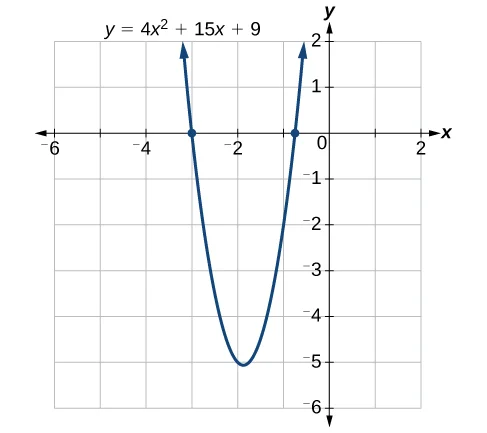
Use grouping to factor and solve the quadratic equation: 4 x 2 +15x+9=0.
Solution
First, multiply ac:4( 9 )=36. Then list the factors of 36.
1⋅36 2⋅18 3⋅12 4⋅9 6⋅6
The only pair of factors that sums to 15 is 3+12. Rewrite the equation replacing the b term, 15x, with two terms using 3 and 12 as coefficients of x. Factor the first two terms, and then factor the last two terms.
4 x 2 +3x+12x+9 = 0 x(4x+3)+3(4x+3) = 0 (4x+3)(x+3) = 0
Solve using the zero-product property.
(4x+3)(x+3) = 0 (4x+3) = 0 x = − 3 4 (x+3) = 0 x = −3
The solutions are − 3 4 , and −3. See diagram.
Coordinate plane with the x-axis ranging from negative 6 to 2 with every other tick mark labeled and the y-axis ranging from negative 6 to 2 with each tick mark numbered. The equation: four x squared plus fifteen x plus nine is graphed with its x-intercepts: (-3/4,0) and (-3,0) plotted as well.

Solving a Polynomial of Higher Degree by Factoring

Solve the equation by factoring: −3 x 3 −5 x 2 −2x=0.
Solution
This equation does not look like a quadratic, as the highest power is 3, not 2. Recall that the first thing we want to do when solving any equation is to factor out the GCF, if one exists. And it does here. We can factor out −x from all of the terms and then proceed with grouping.
−3 x 3 −5 x 2 −2x = 0 −x(3 x 2 +5x+2) = 0
Use grouping on the expression in parentheses.
−x(3 x 2 +3x+2x+2) = 0 −x[3x(x+1)+2(x+1)] = 0 −x(3x+2)(x+1) = 0
Now, we use the zero-product property. Notice that we have three factors.
−x = 0 x = 0 3x+2 = 0 x = − 2 3 x+1 = 0 x = −1
The solutions are 0, − 2 3 , and −1.