
Number Worksheets with Answers (Free PDFs)
Select a number worksheet by skill, practise the method and use the answer sheet to trace the first incorrect step.
Quick Answer
Choose a number worksheet by topic, such as place value, fractions or percentages, and check against its matching answer file. If you miss a question, identify the operation or place-value step that caused the error before moving on.

Equivalent Fractions Pixel Picture (Editable Word | PDF | Answers)
Comparing Fractions Practice Strips (Editable Word | PDF | Answers)
Ordering Fractions Practice Strips (Editable Word | PDF | Answers)
Fractions of Amounts Practice Strips (Editable Word | PDF | Answers)
Fractions of Amounts Decode the Joke (Editable Word | PDF | Answers)
Adding and Subtracting Fractions Practice Strips (Editable Word | PDF | Answers)
Adding and Subtracting Fractions Fill in the Blanks (Editable Word | PDF | Answers)
Adding and Subtracting Fractions including Mixed Numbers Practice Strips (Editable Word | PDF | Answers)
Adding and Subtracting Mixed Numbers Fill in the Blanks (Editable Word | PDF | Answers)
Adding and Subtracting Fractions Crack the Code (Editable Word | PDF | Answers)
Adding and Subtracting Fractions Worded Problems Practice Grid (Editable Word | PDF | Answers)
Multiplying Fractions Decode the Joke (Editable Word | PDF | Answers)
Dividing Fractions Fill in the Blanks (Editable Word | PDF | Answers)
Multiplying and Dividing Fractions Practice Strips (Editable Word | PDF | Answers)
Multiplying and Dividing Fractions Odd One Out (Editable Word | PDF | Answers)
Multiplying and Dividing Fractions including Mixed Numbers Practice Strips (Editable Word | PDF | Answers)
Multiplying Mixed Numbers Fill in the Blanks (Editable Word | PDF | Answers)
Dividing Mixed Numbers Fill in the Blanks (Editable Word | PDF | Answers)
Multiplying and Dividing Fractions Crack the Code (Editable Word | PDF | Answers)
Converting Improper Fractions and Mixed Numbers Match-Up (Editable Word | PDF | Answers)
Working with Mixed Numbers Practice Strips (Editable Word | PDF | Answers)
Fractions Proof Practice Strips (Editable Word | PDF | Answers)
Working with Fractions Practice Grid (Editable Word | PDF | Answers)
Problem Solving with Fractions Practice Strips (Editable Word | PDF | Answers)
Fractions Revision Practice Grid (Editable Word | PDF | Answers)

Multiplying with Integers and Decimals Practice Strips (Editable Word | PDF | Answers)
Multiplying with Decimals Practice Strips (Editable Word | PDF | Answers)
Multiplying with Decimals Name the Film (Editable Word | PDF | Answers)
Dividing with Integers and Decimals Practice Strips (Editable Word | PDF | Answers)
Dividing with Decimals Practice Strips (Editable Word | PDF | Answers)
Dividing with Decimals Odd One Out (Editable Word | PDF | Answers)
Ordering Integers and Decimals Practice Strips (Editable Word | PDF | Answers)
Fractions Decimals Percentages Conversions Practice Strips (Editable Word | PDF | Answers)
Fractions Decimals Percentages Decode the Joke (Editable Word | PDF | Answers)
Fractions Decimals Percentages Odd One Out (Editable Word | PDF | Answers)
Investigating Terminating and Recurring Decimals Activity (Editable Word | PDF | Answers)
Terminating and Recurring Decimals Practice Strips (Editable Word | PDF | Answers)
Terminating and Recurring Decimals Match-Up (Editable Word | PDF | Answers)
Recurring Decimal Proof Fill in the Blanks (Editable Word | PDF | Answers)
Recurring Decimal Proof Practice Strips (Editable Word | PDF | Answers)
Calculations with Recurring Decimals Practice Strips (Editable Word | PDF | Answers)

Percentage Multipliers Practice Strips (Editable Word | PDF | Answers)
Percentages of Amounts with Calculator Practice Strips (Editable Word | PDF | Answers)
Percentages of Amounts with Calculator Decode the Joke (Editable Word | PDF | Answers)
Percentage Increase and Decrease Decode the Joke (Editable Word | PDF | Answers)
Percentage Increase and Decrease Fill In The Blanks (Editable Word | PDF | Answers)
Percentage Increase and Decrease Crack the Code (Editable Word | PDF | Answers)
Comparing Percentages Practice Strips (Editable Word | PDF | Answers)
Percentage Change Practice Strips (Editable Word | PDF | Answers)
Percentage Change Fill in the Blanks (Editable Word | PDF | Answers)
Percentage Change Crack the Code (Editable Word | PDF | Answers)
Compound Interest Practice Strips (Editable Word | PDF | Answers)
Compound Interest Fill In The Blanks (Editable Word | PDF | Answers)
Compound Interest Match-Up (Editable Word | PDF | Answers)
Compound and Simple Interest Banking Activity (Editable Word | PDF | Answers)
Repeated Percentage Change Practice Strips (Editable Word | PDF | Answers)
Repeated Percentage Change Practice Grid (Editable Word | PDF | Answers)
More Repeated Percentage Change Practice Strips (Editable Word | PDF | Answers)
Reverse Percentages Practice Strips (Editable Word | PDF | Answers)
Reverse Percentages Fill In The Blanks (Editable Word | PDF | Answers)
Reverse Percentages Practice Grid (Editable Word | PDF | Answers)
Reverse Percentages Match-Up (Editable Word | PDF | Answers)
Percentages Sort It Out (Editable Word | PDF | Answers)
Fractions, Ratio and Percentages Worded Problems Grid (Editable Word | PDF | Answers)
Working with Percentages Practice Grid (Editable Word | PDF | Answers)
Mixed Percentages Crack the Code (Editable Word | PDF | Answers)
Mixed Percentages Revision Practice Grid (Editable Word | PDF | Answers)
Percentages Maths Challenge Questions (Editable Word | PDF | Answers)

Factors Practice Strips (Editable Word | PDF | Answers)
Factor Bugs Activity (Editable Word | PDF | Answers)
Factors True or False (Editable Word | PDF | Answers)
Multiples Practice Strips (Editable Word | PDF | Answers)
Multiples True or False (Editable Word | PDF | Answers)
Factors, Multiples and Primes Practice Grid (Editable Word | PDF | Answers)
Factors, Multiples and Primes Decode the Joke (Editable Word | PDF | Answers)
Factors and Multiples Crack the Code (Editable Word | PDF | Answers)
Highest Common Factor Practice Strips (Editable Word | PDF | Answers)
Highest Common Factor Match-Up (Editable Word | PDF | Answers)
Highest Common Factor by Listing Fill In The Blanks (Editable Word | PDF | Answers)
Lowest Common Multiple Practice Strips (Editable Word | PDF | Answers)
Lowest Common Multiple Match-Up (Editable Word | PDF | Answers)
Lowest Common Multiple by Listing Fill In The Blanks (Editable Word | PDF | Answers)
Investigating Prime Numbers Activity (Editable Word | PDF | Answers)
Prime Numbers Crack the Code (Editable Word | PDF | Answers)
Prime Factors Puzzle (Editable Word | PDF | Answers)
Investigating Prime Factors Activity (Editable Word | PDF | Answers)
Investigating Prime Factors of Squares and Cubes (Editable Word | PDF | Answers)
Prime Factors and Factor Trees Practice Strips (Editable Word | PDF | Answers)
Prime Factor Decomposition with Factor Trees Fill in the Blanks (Editable Word | PDF | Answers)
More Prime Factor Decomposition with Factor Trees Fill in the Blanks (Editable Word | PDF | Answers)
Prime Factor Decomposition Practice Strips (Editable Word | PDF | Answers)
LCM and HCF Practice Strips (Editable Word | PDF | Answers)
LCM and HCF Using Repeated Division Fill In The Blanks (Editable Word | PDF | Answers)
LCM and HCF Using Venns Fill In The Blanks (Editable Word | PDF | Answers)
Using Venns for HCF and LCM Problems Practice Strips (Editable Word | PDF | Answers)
LCM and HCF Crack the Code (Editable Word | PDF | Answers)
Harder HCF and LCM Problems (Editable Word | PDF | Answers)
LCM and HCF from Prime Factorisation Practice Strips (Editable Word | PDF | Answers)
Factors, Multiples and Primes Revision Practice Grid (Editable Word | PDF | Answers)

Simplifying Ratios Pixel Picture (Editable Word | PDF | Answers)
Simplifying Ratios Odd One Out (Editable Word | PDF | Answers)
Equivalent Ratios Match-Up (Editable Word | PDF | Answers)
Working with Ratio Practice Strips (Editable Word | PDF | Answers)
Dividing in a Ratio Practice Strips (Editable Word | PDF | Answers)
Dividing in a Ratio Fill in the Blanks (Editable Word | PDF | Answers)
Dividing in a Ratio Crack the Code (Editable Word | PDF | Answers)
Combining Ratios Practice Strips (Editable Word | PDF | Answers)
Sharing and Combining Ratios Practice Strips (Editable Word | PDF | Answers)
Solving Ratio Problems Practice Strips (Editable Word | PDF | Answers)
Solving Ratio Problems Practice Grid (Editable Word | PDF | Answers)
Harder Ratio Problems Practice Strips (Editable Word | PDF | Answers)
Fractions and Ratio Worded Problems Practice Strips (Editable Word | PDF | Answers)
Unitary Method Practice Strips (Editable Word | PDF | Answers)
Unitary Method Match-Up (Editable Word | PDF | Answers)
Best Buys Practice Strips (Editable Word | PDF | Answers)
Best Buys Fill in the Blanks (Editable Word | PDF | Answers)
Currency Conversions Practice Strips (Editable Word | PDF | Answers)
Proportion Worded Problems Practice Strips (Editable Word | PDF | Answers)
Proportion Worded Problems Practice Grid (Editable Word | PDF | Answers)
Mixed Ratio and Proportion Revision Practice Grid (Editable Word | PDF | Answers)

Squares, Cubes and Roots Practice Strips (Editable Word | PDF | Answers)
Squares, Cubes and Roots Decode the Joke (Editable Word | PDF | Answers)
Squares, Cubes and Roots Crack the Code (Editable Word | PDF | Answers)
Laws of Indices Practice Strips (Editable Word | PDF | Answers)
Laws of Indices Odd One Out (Editable Word | PDF | Answers)
Laws of Indices Match-Up (Editable Word | PDF | Answers)
Power of Zero Practice Strips (Editable Word | PDF | Answers)
Algebraic Laws of Indices Practice Grid (Editable Word | PDF | Answers)
Negative Indices Practice Strips (Editable Word | PDF | Answers)
Negative Indices Decode the Joke (Editable Word | PDF | Answers)
Fractional Indices Practice Strips (Editable Word | PDF | Answers)
Fractional Indices Match-Up (Editable Word | PDF | Answers)
Fractional and Negative Indices True or False (Editable Word | PDF | Answers)
Harder Indices Practice Strips (Editable Word | PDF | Answers)
Harder Indices Odd One Out (Editable Word | PDF | Answers)
Harder Indices Crack the Code (Editable Word | PDF | Answers)
Harder Indices Match-Up (Editable Word | PDF | Answers)
Algebraic Indices Practice Strips (Editable Word | PDF | Answers)
Solving Equations with Indices Practice Strips (Editable Word | PDF | Answers)
Change of Base Practice Strips (Editable Word | PDF | Answers)
Powers and Roots Revision Practice Grid (Editable Word | PDF | Answers)

Writing Large Numbers in Standard Form Practice Strips (Editable Word | PDF | Answers)
Writing Small Numbers in Standard Form Practice Strips (Editable Word | PDF | Answers)
Writing in Standard Form Practice Strips (Editable Word | PDF | Answers)
Writing Large Numbers in Standard Form Crack the Code (Editable Word | PDF | Answers)
Writing Small Numbers in Standard Form Crack the Code (Editable Word | PDF | Answers)
Writing in Standard Form Odd One Out (Editable Word | PDF | Answers)
Writing in Standard Form Decode the Joke (Editable Word | PDF | Answers)
Standard Form Using a Calculator Practice Strips (Editable Word | PDF | Answers)
Standard Form Without a Calculator Practice Gird (Editable Word | PDF | Answers)
Practical Standard Form Practice Grid (Editable Word | PDF | Answers)
Standard Form Revision Practice Grid (Editable Word | PDF | Answers)

Rational and Irrational Numbers Fill In The Blanks (Editable Word | PDF | Answers)
Rational and Irrational Numbers Always, Sometimes, Never (Editable Word | PDF | Answers)
Surd or Not a Surd Activity (Editable Word | PDF | Answers)
Introducing Surds Practice Grid (Editable Word | PDF | Answers)
Multiplying and Dividing Surds Crack the Code (Editable Word | PDF | Answers)
Multiplying and Dividing Surds Decode the Joke (Editable Word | PDF | Answers)
Simplifying Surds Using Prime Factors Fill In The Blanks (Editable Word | PDF | Answers)
Simplifying Surds Using Square Numbers Fill In The Blanks (Editable Word | PDF | Answers)
*NEW* More Simplifying Surds Practice Grid (Editable Word | PDF | Answers)
Multiplying, Dividing and Simplifying Surds Practice Grid (Editable Word | PDF | Answers)
Adding and Subtracting Surds Practice Strips (Editable Word | PDF | Answers)
Manipulating Surds Practice Strips (Editable Word | PDF | Answers)
Manipulating Surds Practice Grid (Editable Word | PDF | Answers)
Expanding Brackets with Surds Practice Strips (Editable Word | PDF | Answers)
Surds with Algebra Practice Strips (Editable Word | PDF | Answers)
Surds with Perimeter, Area and Volume Practice Strips (Editable Word | PDF | Answers)
Rationalising the Denominator Fill In The Blanks (Editable Word | PDF | Answers)
Rationalising the Denominator Practice Strips (Editable Word | PDF | Answers)
Rationalising the Denominator Crack the Code (Editable Word | PDF | Answers)
Rationalising the Denominator Proof Practice Strips (Editable Word | PDF | Answers)
Surds Revision Practice Grid (Editable Word | PDF | Answers)

Rounding to Decimals Places Practice Strips (Editable Word | PDF | Answers)
Rounding to Decimal Places Decode the Joke (Editable Word | PDF | Answers)
Rounding to Decimal Places Pixel Picture (Editable Word | PDF | Answers)
Rounding to Significant Figures Practice Strips (Editable Word | PDF | Answers)
Rounding to Significant Figures Pixel Picture (Editable Word | PDF | Answers)
Rounding to Significant Figures Practice Grid (Editable Word | PDF | Answers)
*NEW* Rounding to One Significant Figure Practice Grid (Editable Word | PDF | Answers)
Rounding Crack the Code (Editable Word | PDF | Answers)
Estimation and Approximation Practice Strips (Editable Word | PDF | Answers)
Estimation Practice Grid (Editable Word | PDF | Answers)
Estimation Odd One Out (Editable Word | PDF | Answers)
Error Intervals and Bounds Practice Strips (Editable Word | PDF | Answers)
Upper and Lower Bounds Fill in the Blanks (Editable Word | PDF | Answers)
More Upper and Lower Bounds Fill in the Blanks (Editable Word | PDF | Answers)
Upper and Lower Bounds Decode the Joke (Editable Word | PDF | Answers)
Upper and Lower Bounds Odd One Out (Editable Word | PDF | Answers)
Calculating with Bounds Practice Strips (Editable Word | PDF | Answers)
Calculating with Bounds Practice Grid (Editable Word | PDF | Answers)
Calculating with Bounds Crack the Code (Editable Word | PDF | Answers)
Upper and Lower Bounds Revision Practice Grid (Editable Word | PDF | Answers)

Ordering Negative Numbers Practice Strips (Editable Word | PDF | Answers)
Adding and Subtracting with Negative Numbers Match-Up (Editable Word | PDF | Answers)
More Adding and Subtracting with Negative Numbers Match-Up (Editable Word | PDF | Answers)
Adding and Subtracting with Negative Numbers Practice Strips (Editable Word | PDF | Answers
Adding and Subtracting with Negative Numbers Name the Film (Editable Word | PDF | Answers)
Multiplying with Negative Numbers Odd One Out (Editable Word | PDF | Answers)
Multiplying with Negative Numbers Crack the Code (Editable Word | PDF | Answers)
Dividing with Negative Numbers Name the Film (Editable Word | PDF | Answers)
Multiplying and Dividing with Negative Numbers Practice Strips (Editable Word | PDF | Answers)
Negative Numbers True or False (Editable Word | PDF | Answers)
Mixed Operations with Negative Numbers Practice Strips (Editable Word | PDF | Answers)
Practical Negative Numbers Practice Grid (Editable Word | PDF | Answers)
Negative Numbers Decode the Joke (Editable Word | PDF | Answers)
Negative Numbers Crack the Code (Editable Word | PDF | Answers)

Order of Operations Practice Strips (Editable Word | PDF | Answers)
Order of Operations Decode the Joke (Editable Word | PDF | Answers)
Order of Operations Odd One Out (Editable Word | PDF | Answers)
Order of Operations Practice Grid (Editable Word | PDF | Answers)
Order of Operations Match-Up (Editable Word | PDF | Answers)
Using Brackets in Calculations Practice Strips (Editable Word | PDF | Answers)

Using a Calculator Practice Grid (Editable Word | PDF | Answers)
Using a Calculator Crack the Code (Editable Word | PDF | Answers)
Using a Calculator Match-Up (Editable Word | PDF | Answers)
Use estimation before exact arithmetic
For 398 plus 267, rounding to four hundred plus about two hundred seventy gives a result near 670. An exact method is to move two units from 267 to 398, giving four hundred plus 265, or 665. This transfer preserves the total. A result of 565 would conflict with the estimate and suggests a missed hundred during regrouping. Ask which place value changed before starting a second worksheet.
Identify the Place Value of a Digit
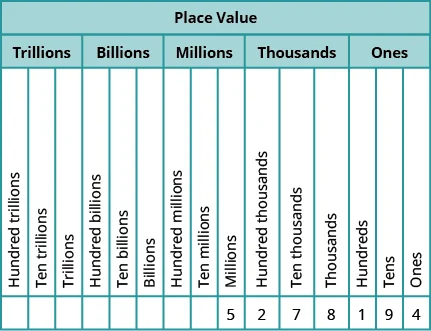
- The digit is in the millions place. Its value is
- The digit is in the hundred thousands place. Its value is
- The digit is in the ten thousands place. Its value is
- The digit is in the thousands place. Its value is
- The digit is in the hundreds place. Its value is
- The digit is in the tens place. Its value is
- The digit is in the ones place. Its value is
- ⓐ
- ⓑ
- ⓒ
- ⓓ
- ⓔ
Solution
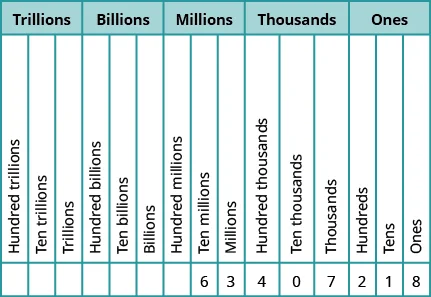
- ⓐ The is in the thousands place.
- ⓑ The is in the ten thousands place.
- ⓒ The is in the tens place.
- ⓓ The is in the ten millions place.
- ⓔ The is in the millions place.
Use Place Value to Name Whole Numbers
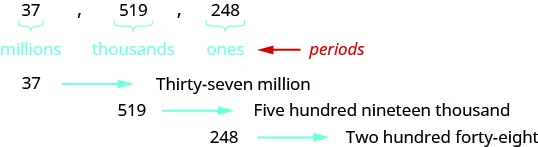
Solution
| Begin with the leftmost digit, which is 8. It is in the trillions place. | eight trillion |
| The next period to the right is billions. | one hundred sixty-five billion |
| The next period to the right is millions. | four hundred thirty-two million |
| The next period to the right is thousands. | ninety-eight thousand |
| The rightmost period shows the ones. | seven hundred ten |
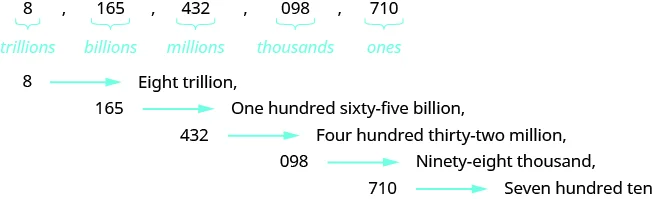
Solution
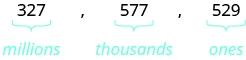
Use Place Value to Write Whole Numbers
- ⓐ fifty-three million, four hundred one thousand, seven hundred forty-two
- ⓑ nine billion, two hundred forty-six million, seventy-three thousand, one hundred eighty-nine
Solution
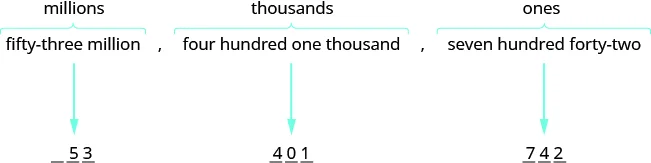

Solution
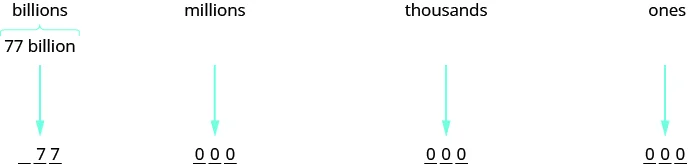
Round Whole Numbers



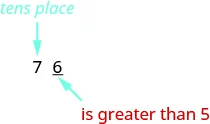
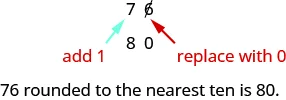
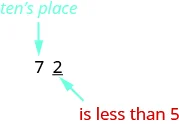

Solution
| Locate the tens place. |
 |
| Underline the digit to the right of the tens place. |
 |
| Since 3 is less than 5, do not change the digit in the tens place. |
 |
| Replace all digits to the right of the tens place with zeros. |
 |
| Rounding 843 to the nearest ten gives 840. |
- ⓐ
- ⓑ
Solution
| ⓐ | |
| Locate the hundreds place. | 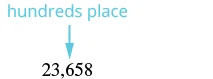 |
| The digit to the right of the hundreds place is 5. Underline the digit to the right of the hundreds place. |  |
| Since 5 is greater than or equal to 5, round up by adding 1 to the digit in the hundreds place. Then replace all digits to the right of the hundreds place with zeros. | 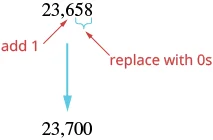 So 23,658 rounded to the nearest hundred is 23,700. |
| ⓑ | |
| Locate the hundreds place. |  |
| Underline the digit to the right of the hundreds place. |  |
| The digit to the right of the hundreds place is 7. Since 7 is greater than or equal to 5, round up by adding 1 to the 9. Then place all digits to the right of the hundreds place with zeros. | 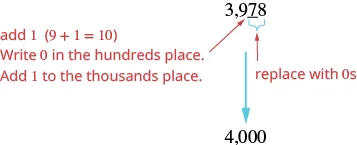 So 3,978 rounded to the nearest hundred is 4,000. |
- ⓐ
- ⓑ
Solution
| ⓐ | |
| Locate the thousands place. Underline the digit to the right of the thousands place. | 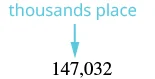 |
| The digit to the right of the thousands place is 0. Since 0 is less than 5, we do not change the digit in the thousands place. |  |
| We then replace all digits to the right of the thousands pace with zeros. |  So 147,032 rounded to the nearest thousand is 147,000. |
| ⓑ | |
| Locate the thousands place. |  |
| Underline the digit to the right of the thousands place. |  |
| The digit to the right of the thousands place is 5. Since 5 is greater than or equal to 5, round up by adding 1 to the 9. Then replace all digits to the right of the thousands place with zeros. | 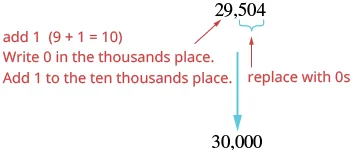 So 29,504 rounded to the nearest thousand is 30,000. |
Model Subtraction of Whole Numbers
| We start by modeling the first number, 7. |  |
| Now take away the second number, 3. We'll circle 3 blocks to show that we are taking them away. | 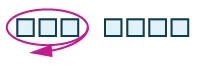 |
| Count the number of blocks remaining. |  |
| There are 4 ones blocks left. | We have shown that . |
Solution
| means the difference of 8 and 2. | |
| Model the first, 8. |  |
| Take away the second number, 2. |  |
| Count the number of blocks remaining. |  |
| There are 6 ones blocks left. | We have shown that . |
Solution
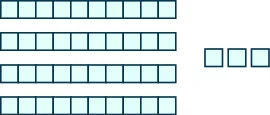
| Model the first number, 13. We use 1 ten and 3 ones. |  |
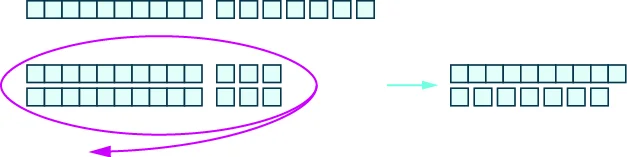
| Take away the second number, 8. However, there are not 8 ones, so we will exchange the 1 ten for 10 ones. |  |
| Now we can take away 8 ones. | 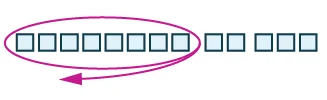 |
| Count the blocks remaining. |  |
| There are five ones left. | We have shown that . |
Solution

Subtract Whole Numbers
- ⓐ
- ⓑ
Solution
| ⓐ | |
| Subtract 7 from 9. | |
| Check with addition. |
| ⓑ | |
| Subtract 3 from 8. | |
| Check with addition. |
Solution
| Write the numbers so the ones and tens digits line up vertically. | |
| Subtract the digits in each place value.Subtract the ones: Subtract the tens: | |
| Check using addition. |
Solution
| Write the numbers so each place value lines up vertically. |  |
| Subtract the ones. We cannot subtract 6 from 3, so we borrow 1 ten. This makes 3 tens and 13 ones. We write these numbers above each place and cross out the original digits. |  |
| Now we can subtract the ones. We write the 7 in the ones place in the difference. |  |
| Now we subtract the tens. We write the 1 in the tens place in the difference. |  |
Check by adding. Our answer is correct. |
Solution
| Write the numbers so each place value lines up vertically. |  |
| Subtract the ones. Write the 3 in the ones place in the difference. |  |
| Subtract the tens. We cannot subtract 6 from 0 so we borrow 1 hundred and add 10 tens to the 0 tens we had. This makes a total of 10 tens. We write 10 above the tens place and cross out the 0. Then we cross out the 2 in the hundreds place and write 1 above it. |  |
| Now we subtract the tens. We write the 4 in the tens place in the difference. |  |
| Finally, subtract the hundreds. There is no digit in the hundreds place in the bottom number so we can imagine a 0 in that place. Since we write 1 in the hundreds place in the difference. |  |
Check by adding.
 Our answer is correct. |
Solution
| Write the numbers so each place value lines up vertically. |  |
| Subtract the ones. We cannot subtract 6 from 0, so we borrow 1 ten and add 10 ones to the 0 ones we had. This makes 10 ones. We write a 0 above the tens place and cross out the 1. We write the 10 above the ones place and cross out the 0. Now we can subtract the ones. |  |
| Write the 4 in the ones place of the difference. |  |
| Subtract the tens. We cannot subtract 8 from 0, so we borrow 1 hundred and add 10 tens to the 0 tens we had, which gives us 10 tens. Write 8 above the hundreds place and cross out the 9. Write 10 above the tens place. |  |
| Now we can subtract the tens. . |  |
| Subtract the hundreds place. Write the 3 in the hundreds place in the difference. |  |
Check by adding.  Our answer is correct. |
Solution
| Write the numbers so each place value lines up vertically. |  |
| Subtract the ones. Since we cannot subtract 9 from 2, borrow 1 ten and add 10 ones to the 2 ones to make 12 ones. Write 5 above the tens place and cross out the 6. Write 12 above the ones place and cross out the 2. |  |
| Now we can subtract the ones. | |
| Write 3 in the ones place in the difference. |  |
| Subtract the tens. Since we cannot subtract 7 from 5, borrow 1 hundred and add 10 tens to the 5 tens to make 15 tens. Write 0 above the hundreds place and cross out the 1. Write 15 above the tens place. | 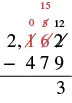 |
| Now we can subtract the tens. | |
| Write 8 in the tens place in the difference. |  |
| Now we can subtract the hundreds. | 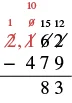 |
| Write 6 in the hundreds place in the difference. |  |
| Subtract the thousands. There is no digit in the thousands place of the bottom number, so we imagine a 0. Write 1 in the thousands place of the difference. |  |
| Check by adding. |
Comparing Integers

Comparing Integers Using a Number Line

Comparing Negative Integers
