
Reference · practice · printable
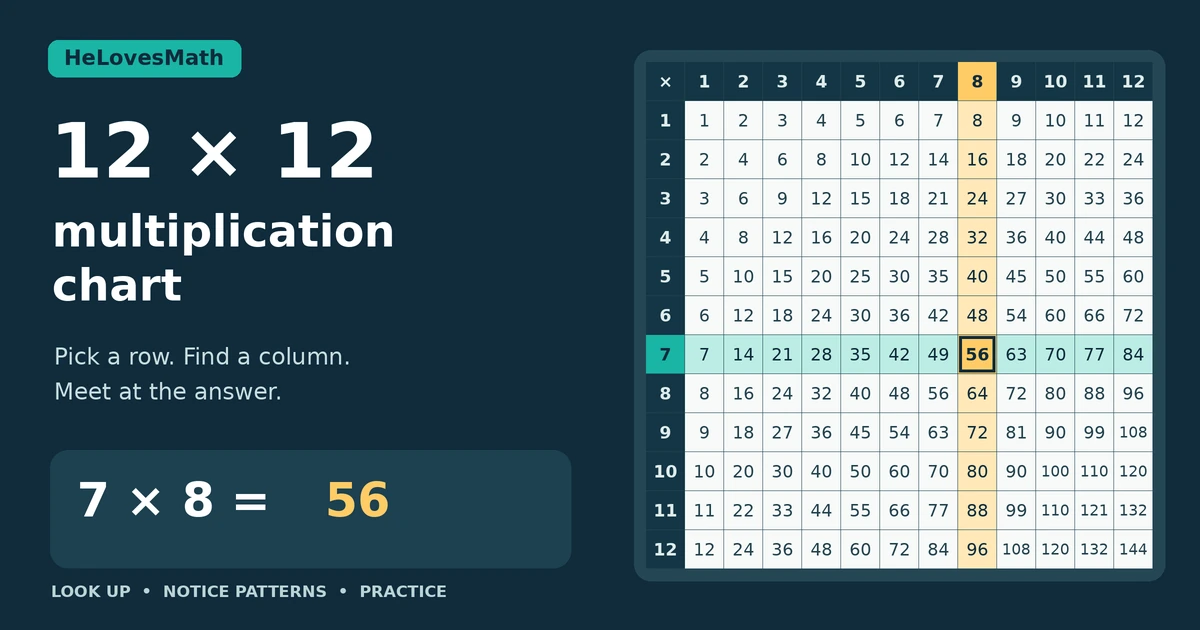
A 12×12 multiplication chart shows the products of every pair of whole numbers from 1 to 12. Choose one number down the left and one across the top; their intersection gives the answer. For example, row 7 and column 8 meet at 56, while 12 × 12 = 144.
Use the complete chart below, fill in the blank grid, or download the two-page print pack with an answer chart and an empty practice sheet. No sign-in is needed.
12×12 multiplication chart
HeLovesMath.com · Name: ____________________ · Date: __________
Gold cells show square numbers. On a small screen, swipe within the chart to see columns to the right. Blank grid keeps your entries while you switch modes, until you reload or choose Start again.
| × | 1 | 2 | 3 | 4 | 5 | 6 | 7 | 8 | 9 | 10 | 11 | 12 |
|---|---|---|---|---|---|---|---|---|---|---|---|---|
| 1 | 1 | 2 | 3 | 4 | 5 | 6 | 7 | 8 | 9 | 10 | 11 | 12 |
| 2 | 2 | 4 | 6 | 8 | 10 | 12 | 14 | 16 | 18 | 20 | 22 | 24 |
| 3 | 3 | 6 | 9 | 12 | 15 | 18 | 21 | 24 | 27 | 30 | 33 | 36 |
| 4 | 4 | 8 | 12 | 16 | 20 | 24 | 28 | 32 | 36 | 40 | 44 | 48 |
| 5 | 5 | 10 | 15 | 20 | 25 | 30 | 35 | 40 | 45 | 50 | 55 | 60 |
| 6 | 6 | 12 | 18 | 24 | 30 | 36 | 42 | 48 | 54 | 60 | 66 | 72 |
| 7 | 7 | 14 | 21 | 28 | 35 | 42 | 49 | 56 | 63 | 70 | 77 | 84 |
| 8 | 8 | 16 | 24 | 32 | 40 | 48 | 56 | 64 | 72 | 80 | 88 | 96 |
| 9 | 9 | 18 | 27 | 36 | 45 | 54 | 63 | 72 | 81 | 90 | 99 | 108 |
| 10 | 10 | 20 | 30 | 40 | 50 | 60 | 70 | 80 | 90 | 100 | 110 | 120 |
| 11 | 11 | 22 | 33 | 44 | 55 | 66 | 77 | 88 | 99 | 110 | 121 | 132 |
| 12 | 12 | 24 | 36 | 48 | 60 | 72 | 84 | 96 | 108 | 120 | 132 | 144 |
Filled chart ready. Choose Blank grid to practise.
Print chart prints the current grid. For a clean ready-made worksheet, download the filled and blank 12×12 charts (PDF, 2 pages). Print page 1 for answers or page 2 for practice; choose fit to page if necessary.
What the chart includes
The top and side numbers are factors, the numbers being multiplied. The 144 cells inside are products. The headers are labels, so they are not counted among the 144 answers. This chart begins at 1 rather than 0. The zero fact is still useful: 0 × any number = 0.
The chart is a reference, not a list of every number from 1 to 144. Some answers repeat, and some do not occur at all. For example, 24 appears as 2 × 12, 3 × 8 and 4 × 6, as well as their reversals; 13 does not appear because neither factor can be 13.
How to read the chart: three worked examples
1. Look up 7 × 8
- Find 7 in the left-hand header.
- Follow that row across to the column headed 8.
- The meeting cell is 56. Therefore 7 × 8 = 56.
Check the neighbouring cell: 7 × 7 = 49. One more group of 7 gives 49 + 7 = 56. Reversing the factors also works: row 8, column 7 gives the same product.
2. Build 12 × 8 from easier facts
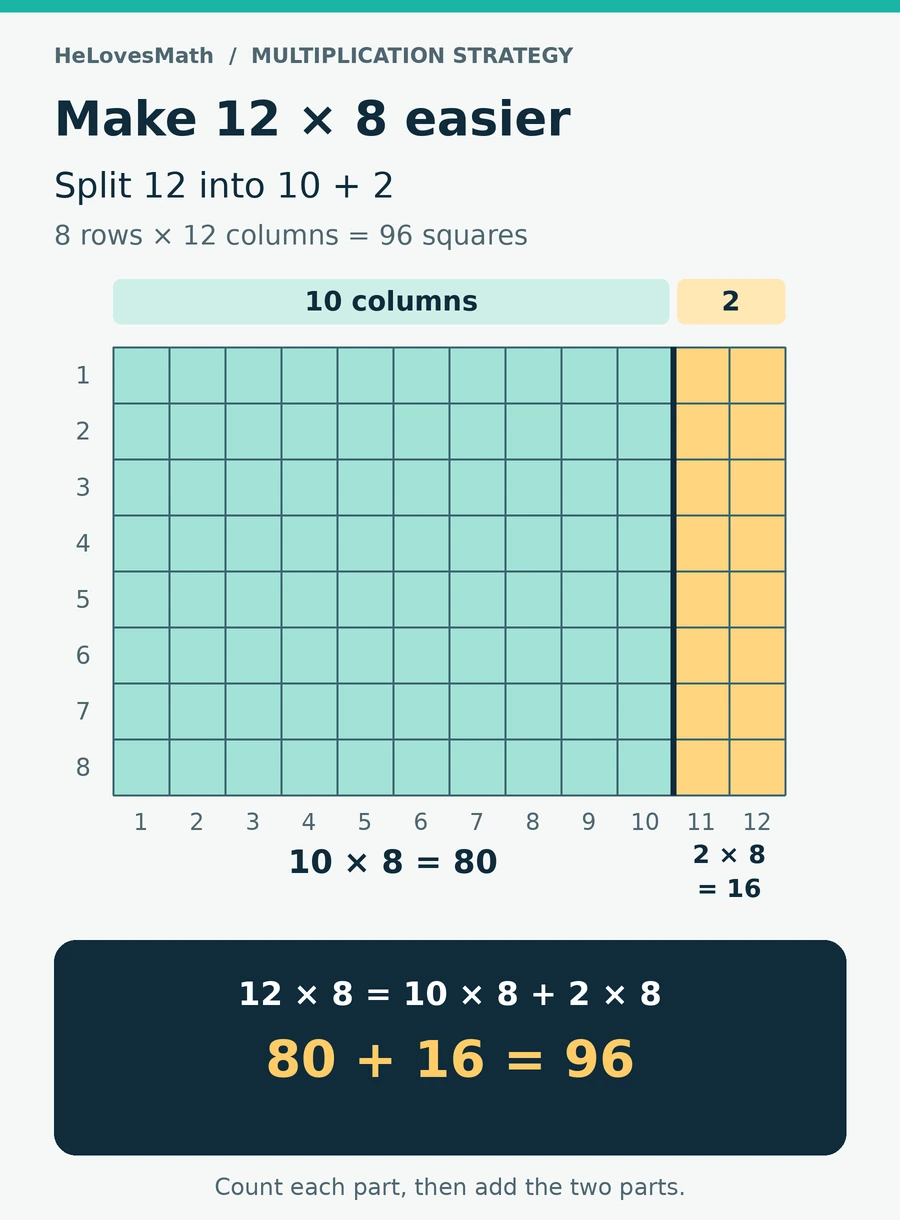
Split 12 into 10 and 2. Eight rows of 12 objects can be split into eight rows of 10 and eight rows of 2.
12 × 8 = (10 × 8) + (2 × 8)
= 80 + 16 = 96
This is the distributive property. The split changes how you calculate, not the total number of objects. It also explains the complete 12 row: each answer is the corresponding 10-row answer plus the 2-row answer.
3. Solve an equal-groups problem
A class has 9 trays with 12 pencils in each tray. The number of pencils is 9 × 12 = 108. You can check using 9 × 10 + 9 × 2 = 90 + 18 = 108.
Include the unit: 108 pencils. The chart supplies the number; the context tells you what it counts.
Use the chart for division and factor pairs
For 96 ÷ 8, find 8 on the left, then look along its row for 96. The column header is 12, so 96 ÷ 8 = 12. In a sharing problem, 96 counters shared equally between 8 people gives 12 counters each. In a grouping problem, 96 counters arranged in groups of 8 gives 12 groups.
A useful fact family is 7 × 12 = 84, 12 × 7 = 84, 84 ÷ 7 = 12 and 84 ÷ 12 = 7. Division reverses multiplication here; it does not mean that you can reverse a division without changing its answer.
Patterns you can use and check
- Equal steps: move one cell right in row 6 and the product increases by 6. Thus 6 × 7 = 42 follows 6 × 6 = 36.
- Mirror pairs: a × b = b × a. The cells for 4 × 9 and 9 × 4 both contain 36. This is the commutative property.
- Square diagonal: 1, 4, 9, 16, 25, 36, 49, 64, 81, 100, 121 and 144 are the products of each header multiplied by itself.
- Even rows: an even whole-number factor times any whole number gives an even product. This does not extend to arbitrary decimals: 2 × 0.5 = 1.
- Fives and tens: whole-number multiples of 5 end in 0 or 5; whole-number multiples of 10 end in 0.
- Nines: use 9 × n = 10 × n − n. For 9 × 8, calculate 80 − 8 = 72. A digit-sum check can catch some mistakes but cannot identify the answer uniquely: 63 and 72 both have digit sum 9.
For more examples, see multiplication table patterns.
144 cells, 78 combinations, 59 different answers
These are three different counts. There are 12 × 12 = 144 ordered cells. The 12 square cells stay on the diagonal; the other 132 form 66 mirrored pairs. Counting each reversed pair once gives 66 + 12 = 78 factor combinations. That does not mean 78 different answers: the grid contains only 59 distinct product values, because different combinations can produce the same number.
For example, 2 × 6 and 3 × 4 are different factor combinations, yet both give 12. Use “78 combinations” when discussing the symmetry, rather than “78 unique products.”
Why learn tables up to 12?
England’s Year 4 mathematics programme includes recall of multiplication and division facts up to 12 × 12. This is a curriculum expectation for England, not a universal age rule. Other curricula may organise this learning differently.
Twelve also appears in dozens and in the 12 inches in a foot. For example, 7 dozen eggs means 7 × 12 = 84 eggs. Understanding equal groups and being able to reconstruct a fact matter alongside recall.
Learn a small set, then mix it up
Begin with facts you can explain: multiplying by 1 leaves the number unchanged; multiplying by 2 doubles it. Connect harder facts to ones you know. If you know 5 × 8 = 40, then 6 × 8 = 40 + 8 = 48. If you know 10 × 7 = 70, then 12 × 7 = 70 + 14 = 84.
Choose a manageable handful, attempt them without looking, then check and explain any errors. Revisit the same facts in a later session and mix them with familiar ones. There is no fixed number of minutes or days that guarantees fluency. The multiplication learning guide gives a fuller practice routine.
Blank-grid practice and twelve questions
Choose Blank grid and complete one row or a small block before attempting the entire chart. Check answers reports correct, incorrect and empty cells separately. A solid green border marks a correct entry; a dashed red border marks an attempted answer to revisit. Empty cells are not counted as incorrect attempts.
Try these without the chart, then open the explanations. For questions 10–12, explain your reasoning as well as giving a number.
- 6 × 7 = ?
- 8 × 9 = ?
- 12 × 11 = ?
- 7 × □ = 84
- 96 ÷ 12 = ?
- □ × □ = 81, with the same number from 1 to 12 in both boxes
- 12 × 6 = (10 × 6) + (2 × 6) = ?
- There are 8 boxes of 12 crayons. How many crayons?
- 72 stickers are shared equally among 9 children. How many each?
- Is 7 × 8 = 54 correct? Explain a way to check.
- List every positive factor pair of 36. Which pairs are missing from the chart?
- Does “78 combinations” mean the chart has 78 different product values?
Show all twelve answers and explanations
- 42. 6 × 7 = 6 × 5 + 6 × 2 = 30 + 12.
- 72. 8 × 9 = 80 − 8.
- 132. 12 × 11 = 120 + 12.
- 12. 7 × 12 = 84.
- 8. 12 × 8 = 96.
- 9 and 9. 9 × 9 = 81, a square on the diagonal. The chart uses positive whole-number headers.
- 72. 60 + 12 = 72.
- 96 crayons. 8 equal groups of 12 gives 8 × 12 = 96.
- 8 stickers each. 9 × 8 = 72.
- No; the product is 56. Seven groups of 7 make 49; another group of 7 gives 56. The value 54 belongs to 6 × 9.
- 1 × 36, 2 × 18, 3 × 12, 4 × 9 and 6 × 6. The first two pairs need a header greater than 12.
- No. There are 59 different values; several combinations share an answer, such as 2 × 6 and 3 × 4.
For parents, teachers and tutors
Ask the learner to point to both headers before giving an answer. If they are one cell out, practise tracking the row and column. If they cannot explain equal groups, use counters or an array before expecting quick recall. If a small group of facts causes difficulty, work on those and reconnect them to known facts.
Use timing only when it is appropriate for that learner. Accuracy, explanation and confidence provide useful information without a countdown. Keep the answer chart available for checking after an attempt; avoid turning a blank worksheet into a copying exercise.
Quick multiplication calculator
This calculator accepts ordinary decimal numbers from 0 to 999, with up to 6 decimal places. Decimal results go beyond the whole-number chart above. Use a decimal point, without commas or exponent notation.
Enter both numbers to calculate.
Try 12 × 8 = 96 or 1.2 × 1.2 = 1.44. The entered decimals are multiplied exactly within the stated limits.
Common mistakes to catch
- Adding the headers: row 7, column 8 means 7 × 8 = 56, not 7 + 8 = 15.
- Confusing 11-table patterns: 11 × 9 = 99, but the next products are 110, 121 and 132. Repeating one digit is not a general multiplication rule.
- Assuming division is commutative: 84 ÷ 7 = 12, while 7 ÷ 84 = 1/12.
- Treating a blank as zero: an empty practice cell means unanswered. In this 1–12 grid every correct product is positive.
- Finding only chart-visible factor pairs: check larger factors separately when a question asks for all pairs.
Frequently asked questions
What is 12 × 12?
144. Twelve groups of twelve contain 144 objects. You can also calculate 12 × 10 + 12 × 2 = 120 + 24 = 144.
Can I print a blank 12×12 multiplication chart?
Yes. Use page 2 of the PDF above, or select Blank grid and then Print chart. Filled chart restores the answers. The PDF includes the answer chart on page 1.
Can I use the chart on a phone or with a keyboard?
Yes. Swipe horizontally within the table on a phone. In Hover / tap mode, tap a product or move keyboard focus to it to show its equation. Practice inputs have row-and-column labels, and the chart region can receive keyboard focus for scrolling.
Why can’t I find 13 or every factor of 36?
Both factors must be between 1 and 12 to appear in this chart. The pair 1 × 13 is outside that range. For 36, the pairs 1 × 36 and 2 × 18 are also outside the chart, even though they are valid factor pairs.
Choose the next resource
- Printable times table charts for other chart and worksheet options
- Multiplication grid guide for row-and-column practice
- Times table practice for mixed recall
- 11 times table and 13 times table for focused work or extension
- Multiplication chart 1–100 for a wider reference
Sources & References
The charts, diagrams, examples and practice questions on this page are original. These primary teaching sources support the stated curriculum expectation and the mathematical methods: