
AAL20 · AAL30 · Independent revision guide
Choose the right Algebra Award, practise the reasoning behind the methods, then use the matching paper and mark scheme. This guide separates Level 2 foundations from Level 3 extensions and keeps the original Pearson resource archive below.
Level 2 or Level 3: start with the paper code
The awards are small, stand-alone qualifications. A qualification at Level 2 is not the same size or content as a complete GCSE; an award at Level 3 is not a complete A level. Choose the course your teacher or centre has entered you for, rather than guessing from a paper’s year.
| Check | Level 2 | Level 3 |
|---|---|---|
| Paper reference | AAL20/01 | AAL30/01 |
| Time and marks | 90 minutes; 80 marks | 120 minutes; 90 marks |
| Calculator | Not allowed | Not allowed |
| Assessment | One external paper; pass or unclassified | One external paper; pass or unclassified |
| Starting point | Algebra notation, manipulation, formulae, linear equations and inequalities, sequences and graphs | Level 2 knowledge, then more demanding equations, functions and graph reasoning |
Pearson’s currently linked specification is Issue 3, June 2019. Level 2 includes reading approximate quadratic solutions from graphs. Algebraic quadratic solving and simultaneous equations appear in Level 3. Level 3 also covers topics such as quadratic inequalities, arithmetic series, surds, proportion and the trapezium rule. The short lesson here is a diagnostic starting point, not the whole specification.
Use the official specification in Sources & References to make your complete checklist. For broader practice, see our algebra worksheets with answers and algebra resources.
Worked examples: understand each move
1. Level 2 foundation: collect like terms
Simplify 5a−2b+3a+7b. Group terms with exactly the same letter part: (5+3)a+(−2+7)b. The result is 8a+5b. You cannot combine this into 13ab: addition of unlike terms does not become multiplication.
2. Level 2 foundation: expand, then factor back
In 3(2x−5), multiply every term in the bracket by 3. That gives 3×2x+3×(−5)=6x−15. Expansion removes brackets; factorisation reverses the operation.
For 12x2−18x, the highest common numerical factor is 6 and both terms contain x. Take out 6x: 6x(2x−3). Check by re-expanding: 6x×2x=12x2 and 6x×(−3)=−18x.
3. Level 2 foundation: solve and check
Solve 4x−7=21. Add 7 to both sides, giving 4x=28. Divide both sides by 4: x=7. Substitution checks the original equation: 4(7)−7=21. Writing the same operation on both sides makes the reasoning clear.
Rearranging a formula uses the same idea. From y=3x−25, multiply by 5 to get 5y=3x−2; add 2, then divide by 3. Therefore x=5y+23. The whole numerator is divided by 3.
4. Level 2 foundation: find a straight-line equation
A line passes through (1,3) and (4,9). Its gradient is change in y divided by change in x: m=9−34−1=63=2. In y=mx+c, substitute (1,3): 3=2(1)+c, so c=1. The equation is y=2x+1. It also gives y=9 when x=4.

5. Level 3: solve simultaneous equations
For 2x+y=11 and x−y=1, add the equations. The y terms cancel and 3x=12, so x=4. Substitute into x−y=1: 4−y=1, giving y=3. Check both equations: 2(4)+3=11 and 4−3=1.
6. Level 3: roots and quadratic inequalities
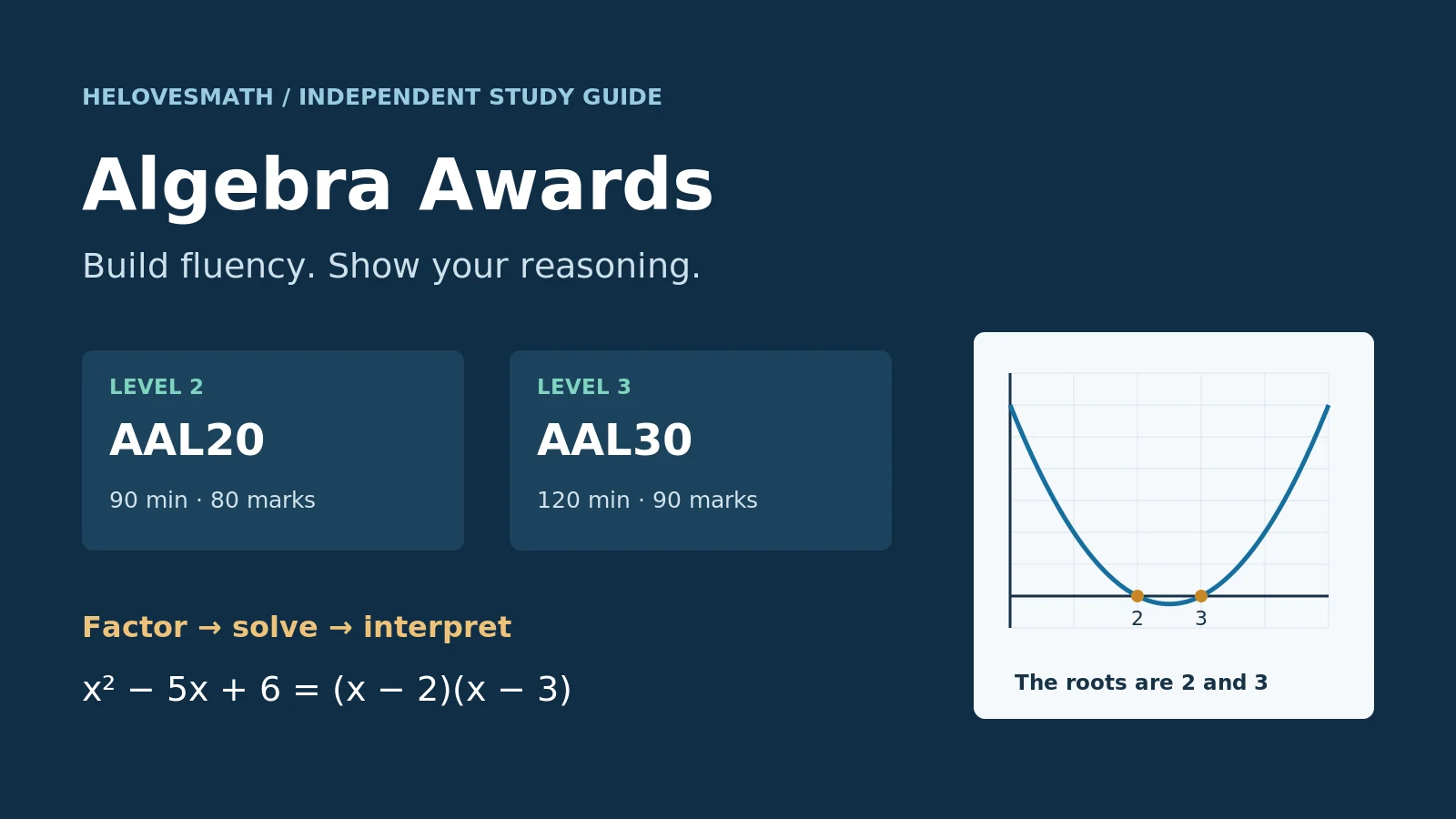
Solve x2−5x+6=0. Find two numbers whose product is 6 and sum is −5: −2 and −3. Factorise to (x−2)(x−3)=0. At least one factor must be zero, so x=2 or x=3.
Now solve x2−5x+6≤0. The roots locate the boundaries, but the inequality asks for an interval. The parabola opens upward and is at or below the x-axis between the roots. Hence 2≤x≤3. Both endpoints are included because the sign is ≤. With < instead, the answer would be 2<x<3.

Try these ten questions before opening the answers
Work without a calculator. Questions 1–7 focus on Level 2 foundations; questions 8 and 10 add Level 3 reasoning, with question 9 as a substitution bridge. Keep your working so you can find the first incorrect step.
1. Simplify 7p−3q−2p+8q.
Answer: 5p+5q. Collect the p coefficients: 7−2=5; collect the q coefficients: −3+8=5.
2. Expand −2(3x−4).
Answer: −6x+8. The product of −2 and −4 is positive.
3. Factorise fully 15y2+10y.
Answer: 5y(3y+2). Re-expanding returns 15y2+10y.
4. Solve 5x−3=2x+9.
Answer: x=4. Subtract 2x and add 3 to get 3x=12. Check: both original sides equal 17.
5. Rearrange v=u+at to make t the subject.
Answer: t=v−ua, provided a≠0. If a=0, the original equation becomes v=u and does not determine one unique t.
6. Find the nth term of 5,8,11,14,…, starting at n=1.
Answer: 3n+2. The difference is 3, and 3(1)+2 gives the first term 5.
7. Solve −3x<12.
Answer: x>−4. Dividing by a negative number reverses the inequality. The boundary −4 is excluded.
8. Solve x2−7x+12=0.
Answer: x=3 or x=4, since (x−3)(x−4)=0. The roots sum to 7 and multiply to 12.
9. For f(x)=2x2−3, find f(−2).
Answer: 5. Substitute with brackets: 2(−2)2−3=2(4)−3=5.
10. Solve x2−7x+12≤0.
Answer: 3≤x≤4. The parabola opens upward and is at or below zero between its roots, including both endpoints.
Common mistakes and quick checks
- Multiplying only the first bracket term: 3(2x−5) is 6x−15, not 6x−5. At x=0, the original is −15; the incorrect version is −5. One counterexample disproves an identity, but one matching value does not prove it.
- Losing the sign when squaring: (−2)2=4, whereas −22=−4. Bracket a negative number when substituting it into x2.
- Forgetting an inequality reversal: divide −3x<12 by −3 and reverse the sign: x>−4.
- Stopping at the roots: this quadratic equation asks where the expression is zero; a quadratic inequality may ask for a whole interval.
- Confusing indices with addition: x3×x4=x7, but x3+x4 cannot be combined using that multiplication rule.
- Using the wrong paper or mark scheme: match AAL20/AAL30 and component 01, then confirm session and year from the resource listing and matching mark scheme. Some question-paper covers omit the session date.
- Treating all graphs as distance–time graphs: a horizontal distance–time segment means stationary; a horizontal speed–time segment means constant speed.
Turn one past paper into a useful revision cycle
- Identify the paper. Start with the level and the cover instructions, then choose the matching session’s mark scheme. Use a modified paper only if it suits your access needs.
- Attempt it independently. For timed practice, allow 90 minutes at Level 2 or 120 minutes at Level 3. Show all working and practise non-calculator arithmetic.
- Mark the method as well as the result. Award marks using that paper’s scheme; do not invent a universal pass mark or transfer a threshold from a different session.
- Classify each error. Was it the mathematical idea, a sign, arithmetic, notation, or reading the question? Redo the exact step with a short explanation.
- Retest later. Try a fresh question on the same skill without looking at the solution. Move on when the reasoning is repeatable, not merely familiar.
Questions students often ask
Are the awards withdrawn?
No. Pearson’s live qualification page says Level 2 and Level 3 are extended until 2029. Check with your centre for the exact sessions and entry arrangements available to you.
Can I use a calculator?
The verified AAL20/01 and AAL30/01 papers are non-calculator. Build fluency with fractions, signed numbers and exact algebra, and follow the instructions on your own paper.
Does this archive include all current papers?
No. The preserved collection contains historical sessions through January 2023 and support files. Use Pearson’s live qualification page for its current public materials. Some recent or historical files may require authorised centre access.
The examples and practice answers above are original HeLovesMath teaching material. Pearson owns its examination resources; HeLovesMath is independent and does not claim exam-board endorsement. External resource availability can change.