PLACE VALUE · POWERS OF TEN · ALGEBRA
Expanded Form Calculator
Split a whole number or decimal into digit values, fractions and powers of ten. Switch tabs to combine an expanded sum, expand or factor basic algebra, see partial products, or estimate a sum.
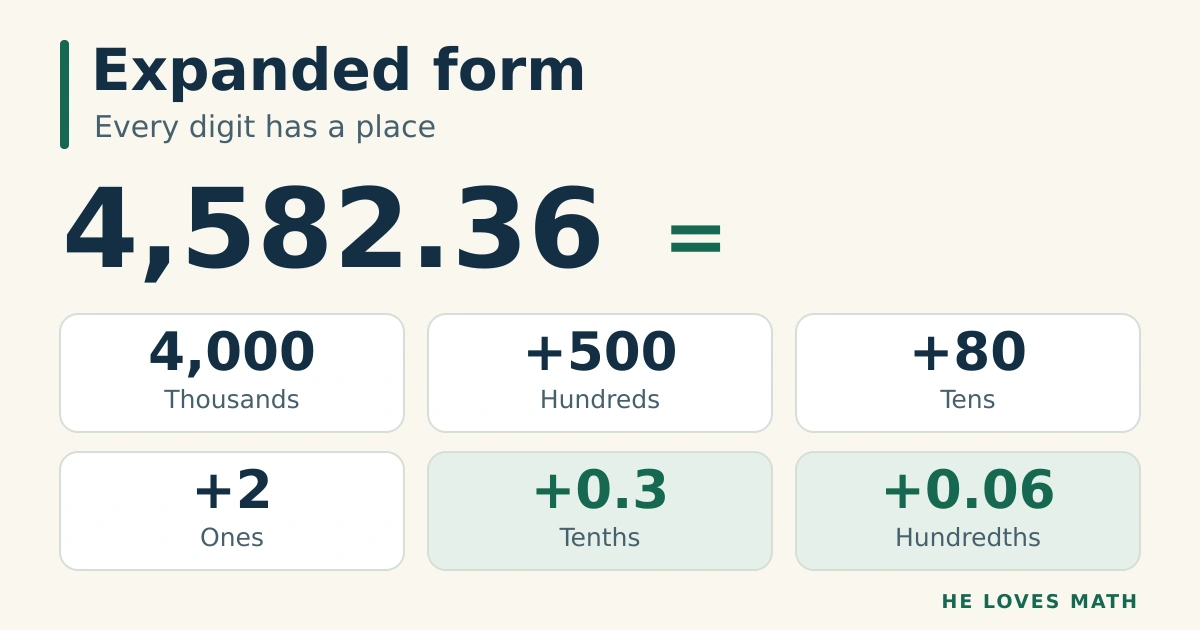
Quick answer: Expanded form writes a number as the sum of the value of each digit. For example, 4,582.36 becomes 4,000 + 500 + 80 + 2 + 0.3 + 0.06, or 4 × 10³ + 5 × 10² + 8 × 10¹ + 2 × 10⁰ + 3 × 10⁻¹ + 6 × 10⁻². Use the calculator below to see each representation and the place-value reasoning.
Calculator for expanded form
Enter an integer or decimal. The calculator shows ordinary expanded form, place-value factor form, expanded exponential form, fraction-place form, word form, and a full digit breakdown.
Result
Example: 4,582.36 = 4,000 + 500 + 80 + 2 + 0.3 + 0.06.
Press Calculate expanded form to show every digit’s place value.
Expanded form to standard form calculator
Type an expanded expression and convert it back into one number. This works for forms such as 300 + 40 + 5, 7×10^3 + 2×10^1, and 4/10 + 6/100.
Standard form result
Algebra expanded form calculator
Expand simple binomial products or factor a quadratic expression. Multiply each term, then combine like terms. Use Factor quadratic to reverse the process for supported quadratic inputs in x.
Algebra result
Expanded form multiplication calculator
Enter two numbers to see how expanded form supports multiplication through the distributive property.
Tip: Try 34 and 26 first, then 2.4 and 1.3. Signed decimals of up to 120 digits each are supported. The display is limited to 1,600 partial products. Subtraction shows decomposition and the difference; see the worked regrouping lesson below.
Operation result
Estimate the sum to the highest place value
Enter addends separated by commas. The calculator rounds each addend to its own highest nonzero place, then adds the rounded values.
Estimated sum
What is expanded form?
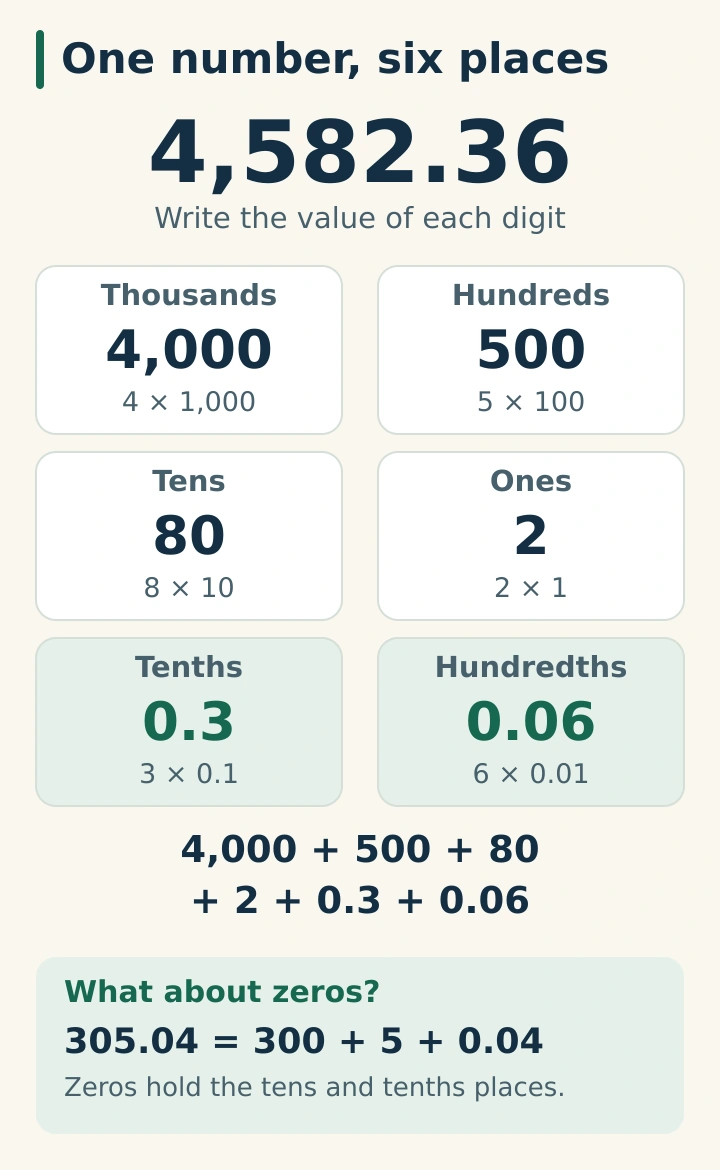
Expanded form writes a number as a sum of its digit values. In 4,582.36, the 4 means four thousands, the 5 means five hundreds, and the decimal digits mean three tenths and six hundredths:
4,582.36 = 4,000 + 500 + 80 + 2 + 0.3 + 0.06
The rule is digit × place value, then add the terms. A digit is a symbol such as 5; its value depends on its position. The 5 in 50 is worth ten times the 5 in 5. Each place to the left is ten times as large; each place to the right is one tenth as large.
A reliable three-step method
- Find the ones place immediately to the left of the decimal point. For a whole number, it is the rightmost digit.
- Name each place and multiply the digit by its place value. Keep zero placeholders in your chart.
- Add the nonzero values. Recombine them to check that you get the original number.
For 82,406, the places are ten-thousands, thousands, hundreds, tens and ones. So 82,406 = 80,000 + 2,000 + 400 + 6. The zero tens term may be omitted from the sum; it still keeps the 4 in the hundreds place. To inspect just one digit, use the place value calculator.
Decimals, fractions and zero placeholders
After the decimal point, the places are tenths, hundredths, thousandths and so on. A decimal digit contributes that many parts out of 10, 100, 1,000, or the appropriate power of ten.
Worked example: 82.406
- The whole-number part is 8 tens plus 2 ones: 80 + 2.
- The decimal part is 4 tenths, 0 hundredths and 6 thousandths: 0.4 + 0 + 0.006.
- Combine them: 82.406 = 80 + 2 + 0.4 + 0.006.
The same expansion in fraction-place form is 80 + 2 + 4/10 + 6/1,000. The denominator records the digit’s place; do not change 6/1,000 into 6/100.
Compare 3.05 and 3.5: 3.05 = 3 + 5/100, while 3.5 = 3 + 5/10. They are different numbers. But 3.050 and 3.05 have the same value: the extra trailing zero adds zero thousandths. Typed trailing zeros can still matter when recording measurement precision.
More examples: 0.4826 = 0.4 + 0.08 + 0.002 + 0.0006; 6.347 = 6 + 3/10 + 4/100 + 7/1,000. To compare 0.4 and 0.36, rewrite 0.4 as 40/100: forty hundredths is greater than thirty-six hundredths.
Fraction-place form is not necessarily one simplified fraction. For example, 0.375 = 3/10 + 7/100 + 5/1,000 = 375/1,000 = 3/8. Use the decimal-to-fraction calculator for that final reduction. A fraction such as 7/8 may also be decomposed into seven copies of 1/8; that is a different decomposition from decimal place value. See the decimal guide or adding fractions for further practice.
Expanded exponential form and number names
Replace each place value with a power of ten. The ones place is 100 = 1; tens are 101; hundreds are 102. Decimal places use negative powers: 10−1 = 1/10, 10−2 = 1/100 and 10−3 = 1/1,000.
7,204.09 = 7 × 10³ + 2 × 10² + 4 × 100 + 9 × 10⁻²
This is the same value as 7,000 + 200 + 4 + 0.09. Its word form can be read as “seven thousand two hundred four and nine hundredths.” The calculator uses English short-scale names, such as billion = 109. Classroom wording varies, especially the use of “and.”
“Standard form” has two common meanings. Here it means ordinary digit notation, such as 7,204.09. In many UK maths and science courses, standard form means scientific notation. Expanded exponential form is a sum of powers of ten; scientific notation uses one coefficient with magnitude at least 1 and less than 10 for a nonzero number.
For example, 642,000 = 6 × 10⁵ + 4 × 10⁴ + 2 × 10³, while its scientific notation is 6.42 × 10⁵. And 0.00000042 expands to 4 × 10⁻⁷ + 2 × 10⁻⁸. See scientific notation examples and the exponents guide.
Multiplying 3.42 by 10 raises each place-value exponent by one: 3 × 101 + 4 × 100 + 2 × 10−1 = 34.2. Dividing by ten lowers each exponent by one.
Negative and very large numbers
Keep the minus sign with the whole quantity: −5,091 = −(5,000 + 90 + 1) = −5,000 − 90 − 1. Writing −5,000 + 90 + 1 would change the value.
For a long number, work in groups: 6,318,045,902 = 6,000,000,000 + 300,000,000 + 10,000,000 + 8,000,000 + 40,000 + 5,000 + 900 + 2. The Number & Decimal mode reads digits as text, so a long input is not first rounded to a JavaScript floating-point number. Use the stated input limits and scroll within the result chart when necessary.
Convert expanded form back to standard form
Evaluate each term, then add by place value. These three expressions all give 432:
- 400 + 30 + 2
- 4 × 100 + 3 × 10 + 2 × 1
- 4 × 10² + 3 × 101 + 2 × 100
For 6 × 10⁴ + 2 × 10² + 8 × 10⁻¹, evaluate the terms as 60,000 + 200 + 0.8. The answer is 60,200.8. Missing powers correspond to zero placeholders.
In the Expanded → Standard tab, type powers with a caret, such as 10^3 or 10^-2. Use * or × for multiplication and / for fractions. Explicit multiplication is required: write 4*(100+2), rather than 4(100+2). A useful reverse check is 8 + 6/100 = 8.06, not 8.6.
A fraction that repeats, such as 1/3, has no finite decimal expansion. For such results, this calculator returns the exact reduced fraction instead of a rounded decimal. General fraction arithmetic is also available in the fractions calculator.
Algebraic expansion uses distribution
Algebraic expansion removes brackets using a(b + c) = ab + ac. Unlike a base-ten expansion, the variable x is not fixed at 10.
Worked example: (2x + 3)(x − 5)
- Multiply every term in the first bracket by every term in the second: 2x·x + 2x·(−5) + 3·x + 3·(−5).
- Calculate the four products: 2x2 − 10x + 3x − 15.
- Combine like terms: 2x2 − 7x − 15.
For a square, (x − 4)2 means (x − 4)(x − 4). Its expansion is x2 − 8x + 16, not x2 + 16: the two cross-products produce −8x.
Factoring reverses expansion. For x2 + 5x + 6, find two numbers with product 6 and sum 5: 2 and 3. Thus x2 + 5x + 6 = (x + 2)(x + 3). Expanding the brackets checks the factorization.
The algebra mode supports two linear factors or a squared linear factor, and quadratic expressions in x for factoring. It is not a general symbolic algebra system. A quadratic may have rational, irrational or complex roots; “no rational linear factors” does not mean it has no roots. For solving an equation rather than rewriting an expression, see the quadratic equation calculator.
Expanded multiplication and subtraction
Multiplication: every part multiplies every part
34 × 26 = (30 + 4)(20 + 6). The four partial products are 600, 180, 80 and 24. Add them to get 884. For 48 × 17, the matching calculation is 400 + 280 + 80 + 56 = 816.
Decimals work the same way: 2.4 × 1.3 = (2 + 0.4)(1 + 0.3) = 2 + 0.6 + 0.4 + 0.12 = 3.12. Negative signs must remain on the partial products: −34 × 26 = −600 − 180 − 80 − 24 = −884. If either factor is zero, the product is zero.
An area model makes the four products visible. For 23 × 14, a rectangle split into 20 + 3 and 10 + 4 has parts 200, 80, 30 and 12, totaling 322. Review multiplication methods for more examples.
Subtraction: regroup without changing the value
The tool displays the expanded values and checks their difference. It does not replace a written column-regrouping lesson. Here is the missing reasoning for a zero in the middle:
- For 502 − 178, rewrite 502 as 400 + 100 + 2.
- Exchange one ten: 502 = 400 + 90 + 12. Check: these still add to 502.
- Subtract by place: (400 − 100) + (90 − 70) + (12 − 8) = 300 + 20 + 4 = 324.
For 746 − 328, regroup 746 as 700 + 30 + 16, giving 400 + 10 + 8 = 418. For 5.02 − 3.78, regroup 5.02 as 4 + 0.9 + 0.12, giving 1 + 0.2 + 0.04 = 1.24. Align decimal places before subtracting. See the subtraction guide.
Flexible decomposition can also use a difference: 99 × 37 = (100 − 1) × 37 = 3,700 − 37 = 3,663. This uses distribution, though 100 − 1 is not the usual digit-by-digit expanded form of 99.
Estimate a sum to the highest place
This tool rounds each addend to its own highest nonzero place, then adds. It is a one-significant-figure estimate, not a rule that every assignment must use. If your teacher specifies “nearest hundred,” round all addends to hundreds instead.
For 358 + 421 + 76, round to 400 + 400 + 80 = 880. The exact sum is 855. For 4,892 + 6,103, the estimate is 5,000 + 6,000 = 11,000; the exact answer is 10,995.
Taking only the leading term is a different method: 7,842 has leading term 7,000, while rounding to the nearest thousand gives 8,000. Neither step should be called an exact equality to 7,842. The rounding calculator covers other target places.
Enter separate addends without thousands separators in this tab: 1200, 35 means two numbers, while 1,200,35 means three entries. Zero contributes zero. The calculator explains its halfway convention in the result.
Practice: try first, then reveal the answers
For each expansion, name the place of one digit aloud. If you can explain why a denominator is 1,000 rather than 100, you have checked the reasoning as well as the arithmetic.
- Write 305, 4,720 and 9,018 in expanded form.
- Expand 9.305 and 0.048 in decimal and fraction-place form.
- Write 6,204.09 using powers of ten.
- Convert 7,000 + 40 + 9/100 to ordinary notation.
- Expand −342. Explain why −300 + 40 + 2 is wrong.
- Compare each pair: 0.7 and 0.07; 5.3 and 5.03; 12.4 and 12.04.
- Expand (x + 2)(x + 5), (x − 3)(x + 4) and (2x + 1)(x + 6).
- Calculate 23 × 14 using partial products.
- Estimate 358 + 421 by this tool’s highest-place method.
Show answers and checks
- 305 = 300 + 5; 4,720 = 4,000 + 700 + 20; 9,018 = 9,000 + 10 + 8. Zero places are omitted only from the sums.
- 9.305 = 9 + 0.3 + 0.005 = 9 + 3/10 + 5/1,000. Also 0.048 = 0.04 + 0.008 = 4/100 + 8/1,000.
- 6 × 10³ + 2 × 10² + 4 × 100 + 9 × 10⁻².
- 7,040.09. The 9 belongs in the hundredths place.
- −342 = −(300 + 40 + 2). All three contributions are negative. The incorrect expression equals −258.
- 0.7 > 0.07; 5.3 > 5.03; 12.4 > 12.04. Compare tenths and hundredths, not just the digits.
- x2 + 7x + 10; x2 + x − 12; 2x2 + 13x + 6.
- 200 + 80 + 30 + 12 = 322.
- 400 + 400 = 800. The exact sum is 779.
More quick checks
583 = 500 + 80 + 3; 7,040 = 7,000 + 40; 42.705 = 40 + 2 + 0.7 + 0.005. For algebra, (x + 6)(x + 2) = x2 + 8x + 12 and (x + 4)(x + 9) = x2 + 13x + 36.
For teachers and parents: ask “What is that digit worth?” before asking for a formula. If a learner writes 3,040 = 300 + 40, ask them to locate the thousands place. Use a whole number, a decimal, an internal-zero example and a negative number to find which idea needs practice. Expand 482 = 400 + 80 + 2 before connecting it to addition, subtraction, multiplication or rounding. As a further connection, 586 + 214 = (500 + 200) + (80 + 10) + (6 + 4) = 800.
Common mistakes to catch
- Dropping a placeholder: 9,008 expands to 9,000 + 8, not 900 + 8.
- Adding digits instead of values: 0.46 = 0.4 + 0.06, not 4 + 6.
- Confusing tens and tenths: tens are left of ones; tenths are right of the decimal point.
- Starting exponents at 1: the ones place is 100. Thus 7 × 100 = 7, while 7 × 101 = 70.
- Losing a minus sign: −(300 + 40 + 2) negates every term.
- Missing algebra cross-products: squaring a sum or difference requires multiplying both terms by both terms.
Expanded form questions
Do I have to include zero terms?
No, adding zero does not change the value, so zero terms are usually omitted. Include them when your assignment asks to show every place. For zero itself, the expanded form is simply 0.
Does this expand a fraction like 7/8?
Number & Decimal accepts ordinary integers or finite decimals, such as 0.875. Expanded → Standard accepts fraction expressions such as 7/8. Decimal fraction-place form then writes 0.875 as 8/10 + 7/100 + 5/1,000.
Can I use negatives, trailing zeros and large numbers?
Yes, within the displayed limits. The number mode preserves typed decimal places and groups the whole expanded sum under a minus sign for negative values. Arithmetic modes check their own limits and report unsupported inputs rather than silently changing them.
Is expanded exponential form scientific notation?
No. Expanded exponential form adds separate digit-times-power terms. Scientific notation combines the value into one coefficient and one power of ten, such as 4.82 × 10⁵.
Why might an algebra input be rejected?
The algebra mode only accepts its stated expression forms in x. Extra symbols, unsupported powers or incomplete terms can change the meaning. Use the examples as syntax guides; do not delete part of an expression just to make it fit.
What should I do after getting an answer?
Recombine the terms to check the number. For algebra, multiply the factors back out. For subtraction, check by adding the difference to the subtrahend. For division steps, continue to the long division calculator.
Choose the right next tool
Use place value for a single digit, rounding for an estimate, and equation standard form for lines and other equations. The last tool uses a different meaning of “standard form” from this page.
Sources & References
The explanations and practice examples above are original. The following textbook sections support the underlying conventions; classroom wording and whether to show zero terms may vary.
- OpenStax: Hindu-Arabic positional system — place values, powers and number expansion.
- OpenStax: Decimals — decimal places and decimal arithmetic.
- OpenStax: Integer powers of ten — positive, zero and negative exponents.
- OpenStax: Multiply polynomials — the distributive property and binomial products.