
Work through every question in the English-language January 2026 Algebra I Regents. Each solution explains the method, gives the final answer, and highlights details that matter for a complete written response.
Try the question first, then compare your reasoning with the steps below. Tap or click any question image to open its full-resolution version. The question numbers and paper-page references follow the official exam. The original paper and NYSED scoring documents are linked in Sources & References.
For Parts II–IV, show your method. A final number on its own can lose substantial credit, and a question that specifies graphing or the quadratic formula requires that method.
These are independent HeLovesMath explanations, not an official NYSED publication. Answers and required methods were checked against the official scoring key, rating guide, and model response set. Valid alternative methods can also earn credit unless a question specifies a method.
Quick check: Part I answer choices
- Q1: (1)
- Q2: (1)
- Q3: (3)
- Q4: (1)
- Q5: (3)
- Q6: (4)
- Q7: (1)
- Q8: (3)
- Q9: (1)
- Q10: (3)
- Q11: (3)
- Q12: (1)
- Q13: (2)
- Q14: (2)
- Q15: (2)
- Q16: (4)
- Q17: (2)
- Q18: (4)
- Q19: (1)
- Q20: (4)
- Q21: (4)
- Q22: (3)
- Q23: (3)
- Q24: (4)
Use the worked explanations below to check why each answer is correct.
Part I: Multiple-choice solutions
Questions 1–24 • 2 credits each • 48 credits total
Question 1: Read the vertex and axis of symmetry
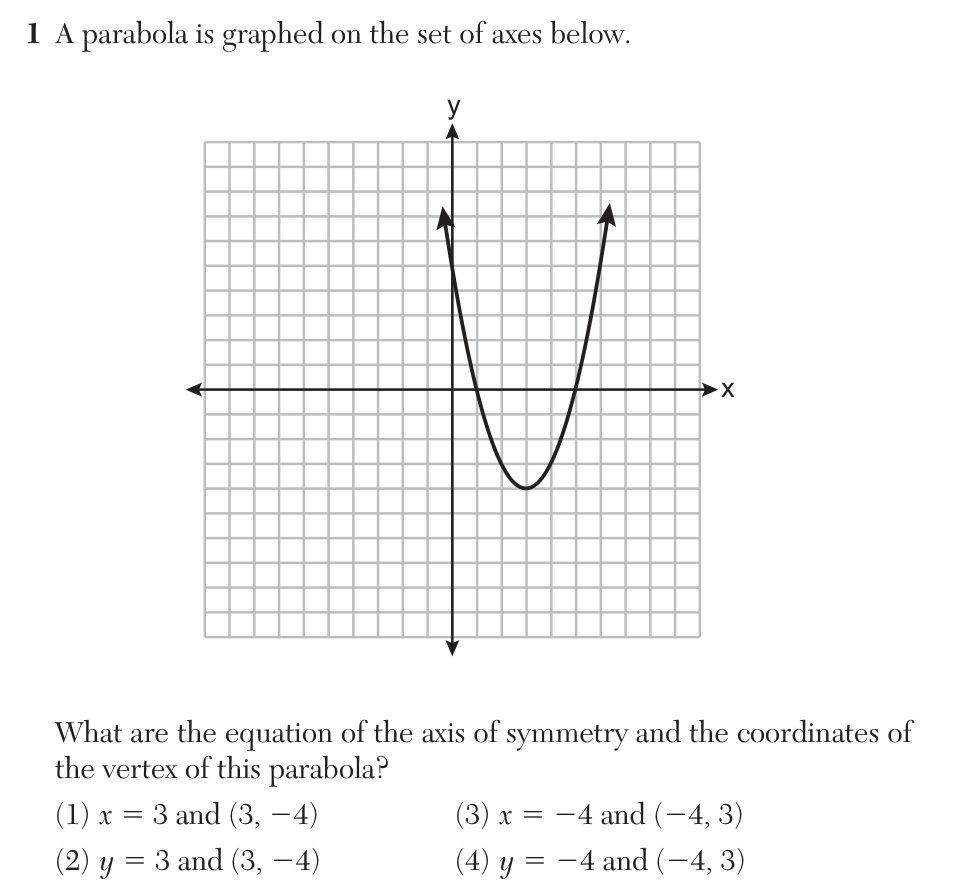
- The lowest point is 3 squares to the right of the vertical axis and 4 squares below the horizontal axis. The vertex is .
- A vertical parabola is symmetric about the vertical line through its vertex. Every point on that line has the same x-coordinate, 3.
Exam detail: An axis of symmetry is a line, so give an equation, not just the number 3.
Question 2: Classify a product of square roots

- Simplify the perfect-square factor: .
- The product is . Since the square root of 2 is irrational, multiplying it by the nonzero rational number 5 keeps it irrational.
Exam detail: Do not assume that every product involving radicals is irrational. Simplify the actual factors first.
Question 3: Find a listed intersection of two functions
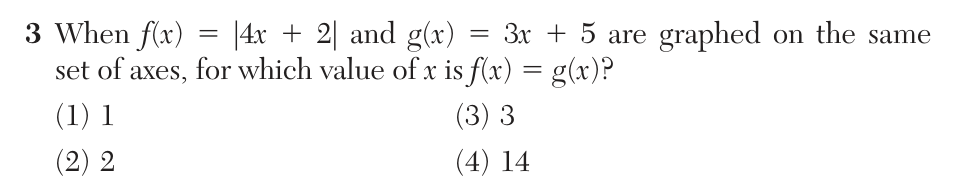
- The answer choices are positive. For these inputs, , so the absolute value equals .
- Set the outputs equal and solve:
- Check both functions at this input: and .
Exam detail: This is the correct listed value, not the only intersection overall. The negative branch also gives , where both outputs equal 2.
Question 4: Factor a quadratic trinomial

- Find two integers whose product is and whose sum is . They are 4 and −30.
- Use those values in the factors:
- Expansion checks the middle coefficient: .
Question 5: Combine like radical terms

- The two radical terms have the same radicand, 5, so add their coefficients.
- Keep the constant separate:
Exam detail: Adding like radicals does not add the numbers inside the square roots.
Question 6: Identify degree, leading coefficient, and constant
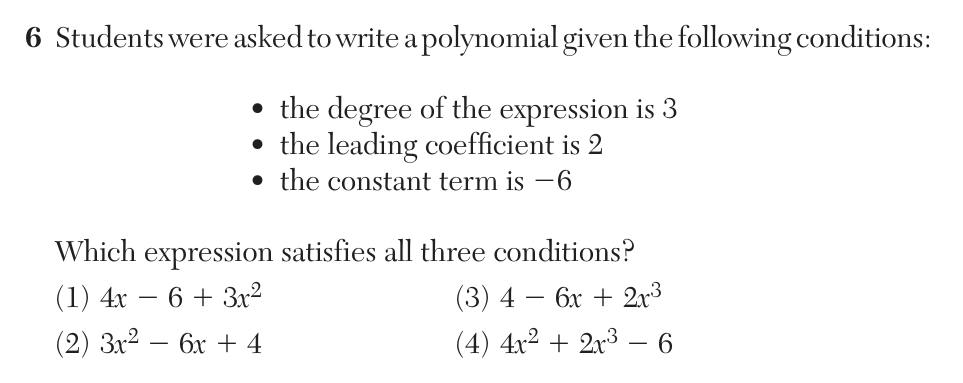
- Put the terms of choice (4) in descending powers:
- The greatest exponent is 3, its coefficient is 2, and the term with no variable is −6. All three conditions hold.
Exam detail: The leading term means the highest-degree term, even when the printed expression is not in standard form.
Question 7: Apply the vertical-line test
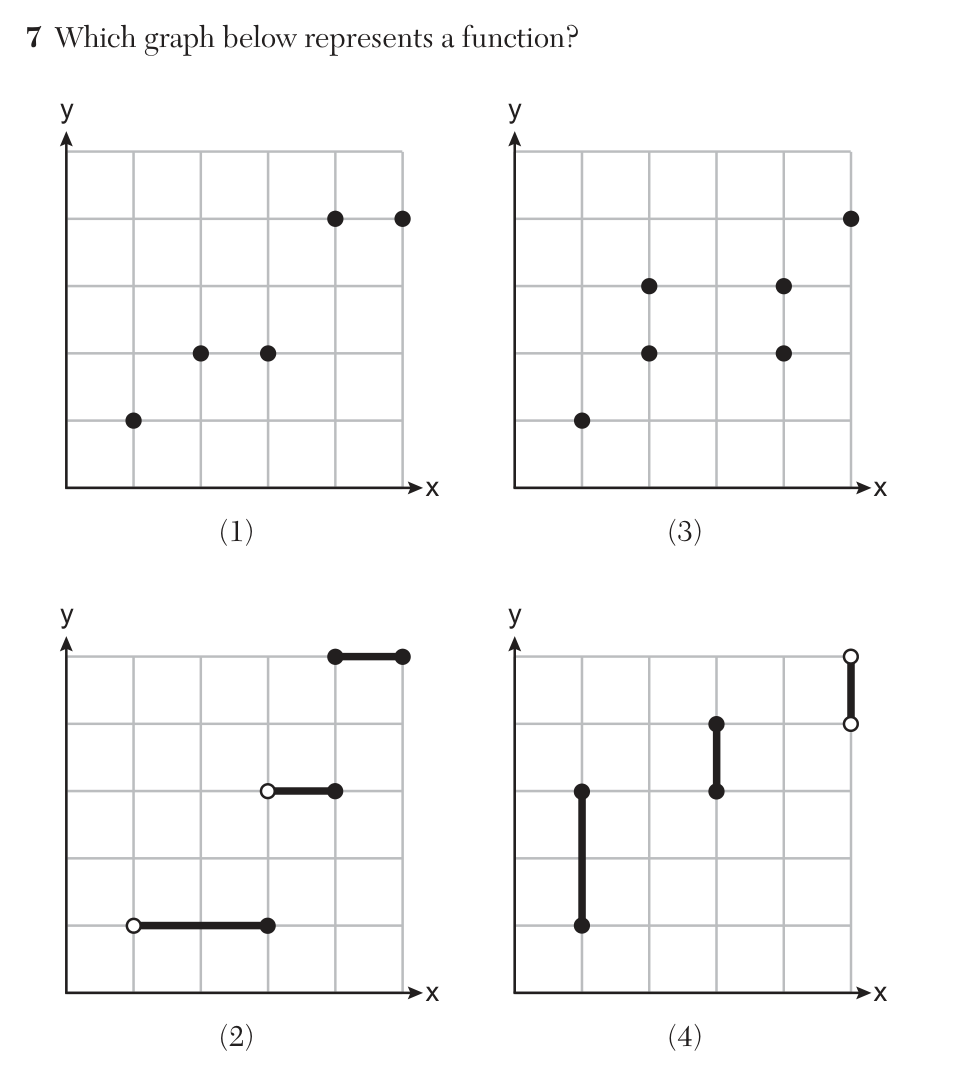
- A function gives exactly one output for each input in its domain. A vertical line must never hit two included points.
- In graph (1), every plotted point has a different x-coordinate. Repeated y-values are allowed.
- Graph (2) includes two filled points at the join between its upper two steps. Graph (3) repeats inputs with different outputs. Graph (4) has vertical segments.
Exam detail: Open circles are excluded, but filled endpoints are included. Check those endpoints carefully on step graphs.
Question 8: Find an exponential model’s initial value
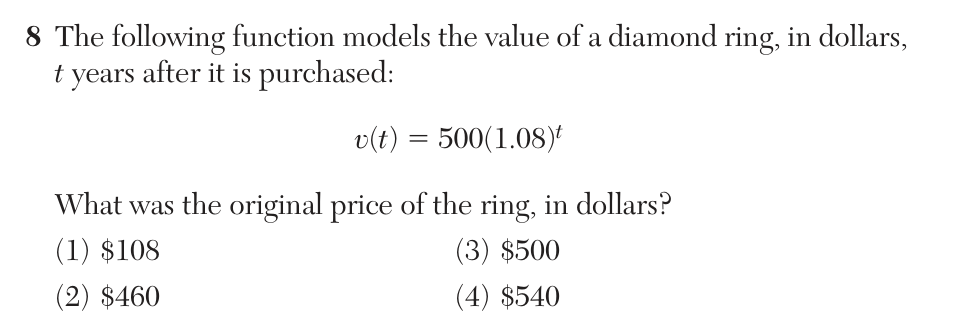
- The purchase date corresponds to .
- Substitute zero into the model:
Exam detail: In an exponential model , the initial value is a.
Question 9: Rearrange the cylinder surface-area formula
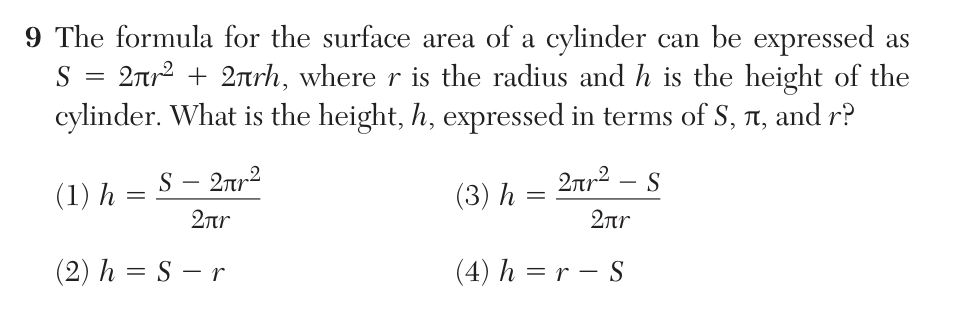
- Subtract the two circular bases from both sides:
- Divide by to isolate the height:
Exam detail: The division applies to the entire numerator. A cylinder’s radius is positive, so the divisor is nonzero.
Question 10: Substitute an expression for a variable
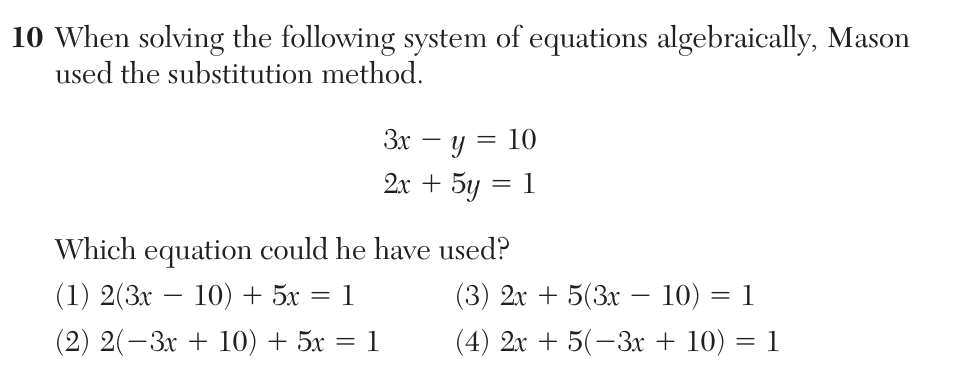
- Rearrange the first equation to isolate y:
- Replace y in the second equation with that complete expression:
Exam detail: Keep parentheses around the substituted expression because all of it is multiplied by 5.
Question 11: Solve and graph a strict inequality
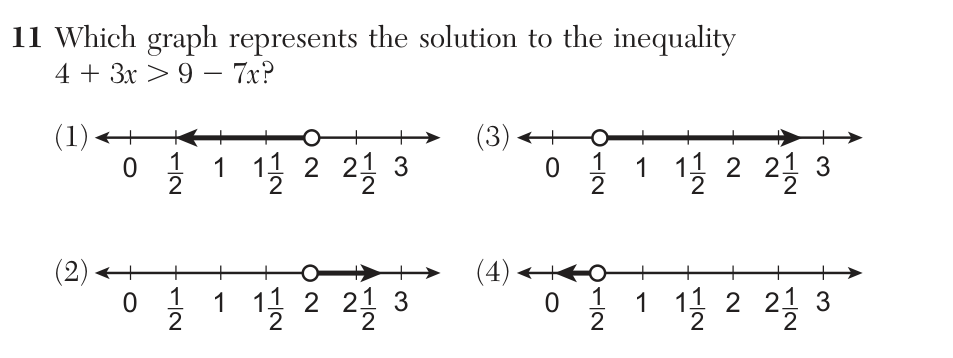
- Add to both sides and subtract 4:
- Divide by positive 10:
- Use an open circle at one-half and a ray pointing right. The boundary is excluded because the inequality is strict.
Question 12: Name the equality property
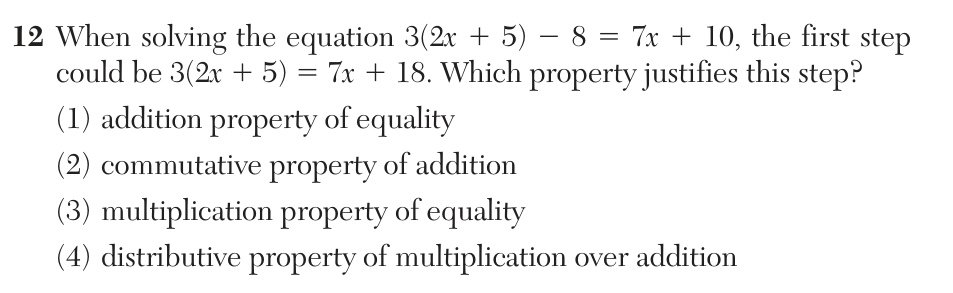
- The −8 on the left disappears because 8 was added to both sides.
- The same operation changes the right side from to . Adding equal quantities to equal expressions preserves equality.
Question 13: Recognize exponential decay in a table
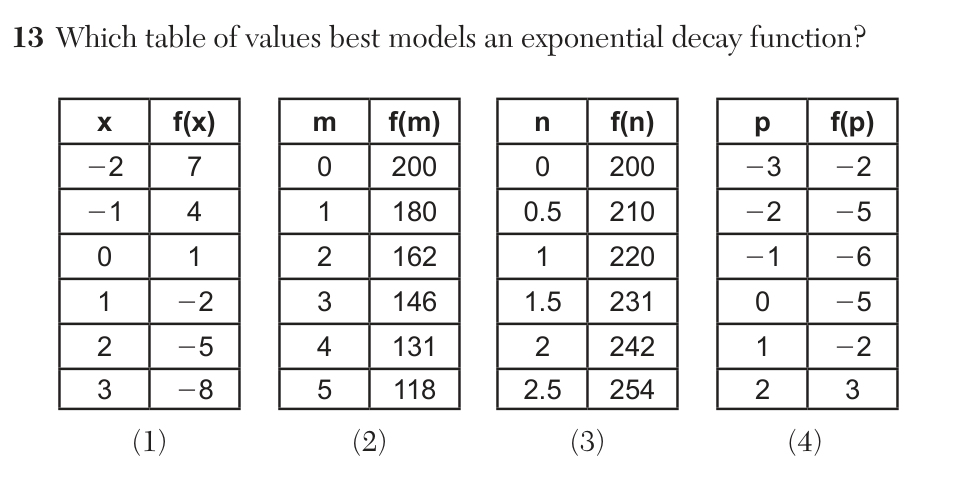
- For equal increases in the input, exponential decay multiplies positive outputs by approximately the same factor between 0 and 1.
- In table (2), and . The remaining values agree with a 10% decrease after rounding to whole numbers.
- For example, and .
Exam detail: A constant difference describes a linear pattern. Exponential change uses a constant ratio, allowing for displayed rounding.
Question 14: Evaluate a square-root function

- Replace the input by 3 and keep the +1 inside the radical:
- Simplify in order:
Exam detail: The +5 is outside the square root.
Question 15: Translate a parabola left
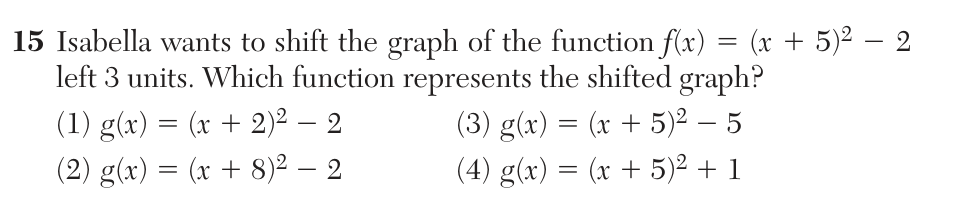
- A shift left by 3 replaces each input x by .
- Substitute into the entire original input:
- The vertex moves from to , confirming the direction.
Question 16: Find all zeros of a factored polynomial

- Factor the difference of squares:
- By the zero-product property, set each factor equal to zero:
Exam detail: The factor x contributes a zero at 0; do not drop it.
Question 17: Find inputs for a specified quadratic output
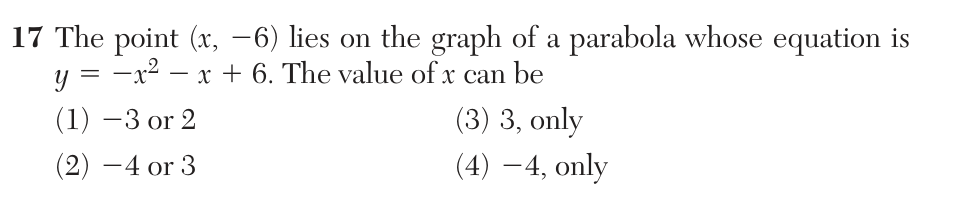
- The point’s output is −6. Substitute it into the equation:
- Move the terms to one side and factor:
- The zero-product property gives or . Substitution makes the original output −6 in either case.
Question 18: Calculate a joint relative frequency
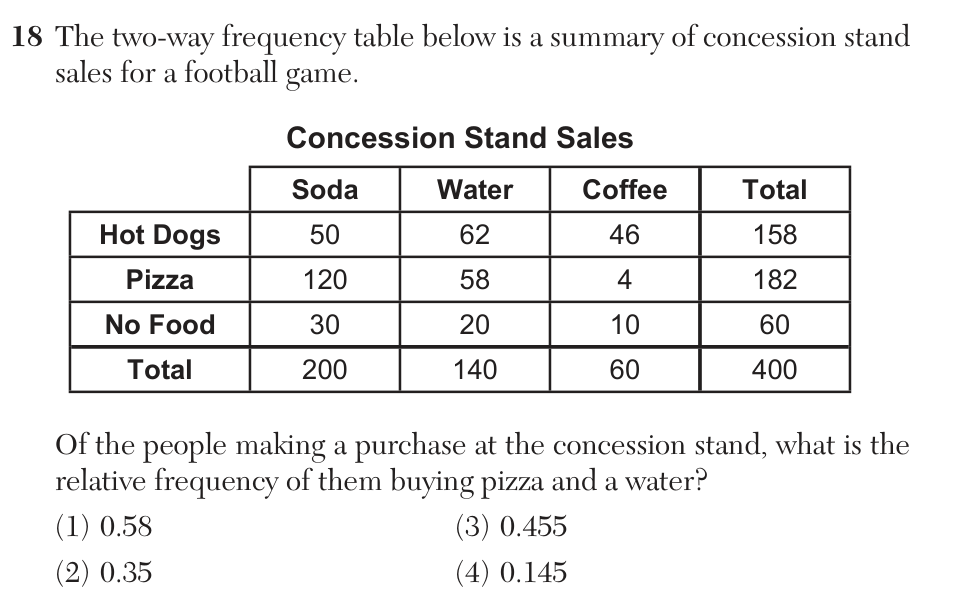
- The cell for buying both pizza and water contains 58 people.
- The question concerns everyone making a purchase, so the denominator is the grand total, 400:
Exam detail: Do not divide by the pizza-row or water-column total: that would answer a conditional-frequency question.
Question 19: Track the surviving measurement units
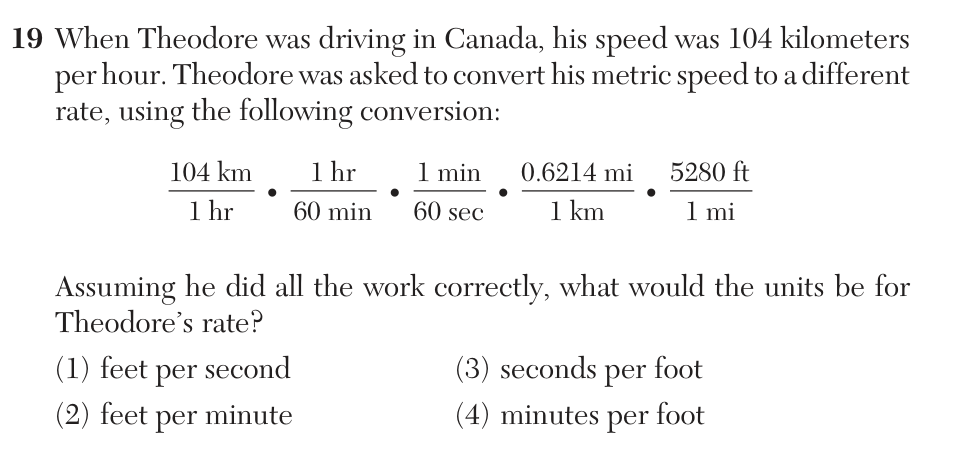
- The conversion factors cancel kilometers against kilometers, hours against hours, minutes against minutes, and miles against miles.
- After cancellation, feet remain in the numerator and seconds remain in the denominator. The numerical multiplication is unnecessary for a question about units.
Exam detail: Write conversion factors so each unwanted unit occurs once above and once below a fraction bar.
Question 20: Raise a monomial to a power

- Apply the outer exponent to the coefficient and the variable factor:
- An odd power keeps the negative sign, and a power of a power multiplies exponents:
Question 21: Calculate an average rate of change
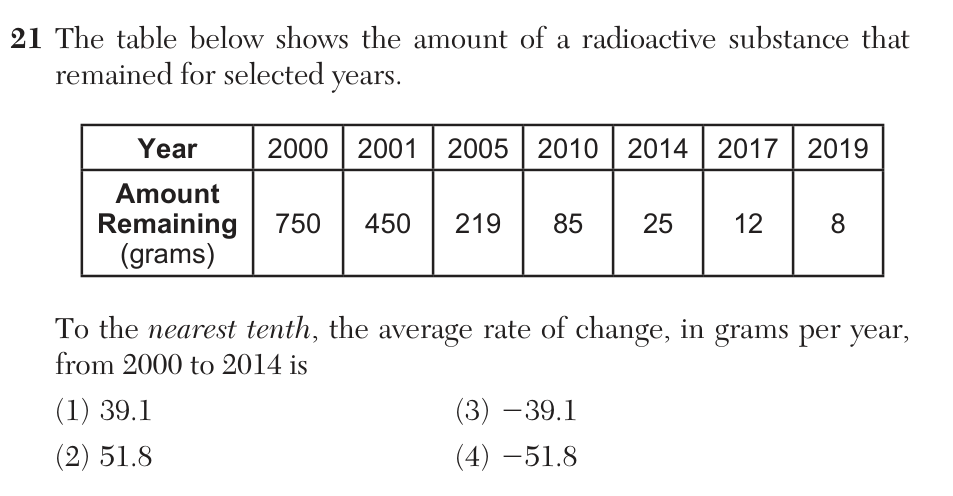
- Use the endpoint values from 2000 and 2014. The amount changes from 750 grams to 25 grams across 14 years.
- Divide the change in amount by the change in time:
- The negative sign indicates that the amount decreased.
Exam detail: Use the interval length of 14 years, not the number of displayed observations.
Question 22: Subtract polynomials in the correct order

- “Subtracted from” makes the second named expression the starting quantity:
- Distribute the subtraction sign to every term in the second group:
- Combine like terms:
Question 23: Complete the square

- Half of the coefficient −6 is −3. Squaring gives 9.
- Add 9 to both sides, then write the left side as a perfect square:
Exam detail: Adding 9 only to the left would change the solution set.
Question 24: Find a term in a geometric sequence
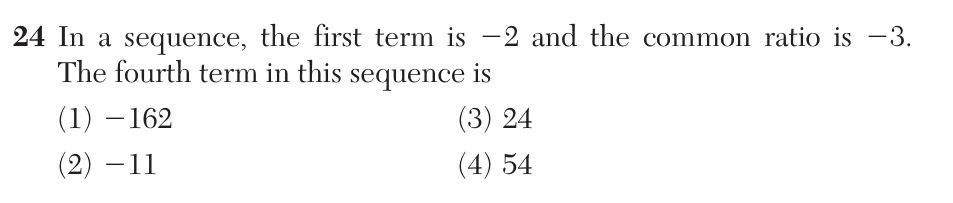
- Multiply by the common ratio −3 once for each step:
- Equivalently, the fourth term is the first term times the ratio cubed:
Exam detail: The English-paper answer is choice (4). NYSED issued a separate blanket-credit notice for students using the Spanish edition of this question.
Part II: Short constructed responses
Questions 25–30 • 2 credits each • 12 credits total
Question 25: Solve a linear equation

- Distribute 3, then combine like terms on the right:
- Subtract and divide by 12:
- Check: the left side is , and the right side is .
Exam detail: Show the distribution and isolation steps; an unsupported numerical answer receives only partial credit.
Question 26: Draw an exponential curve on a closed interval
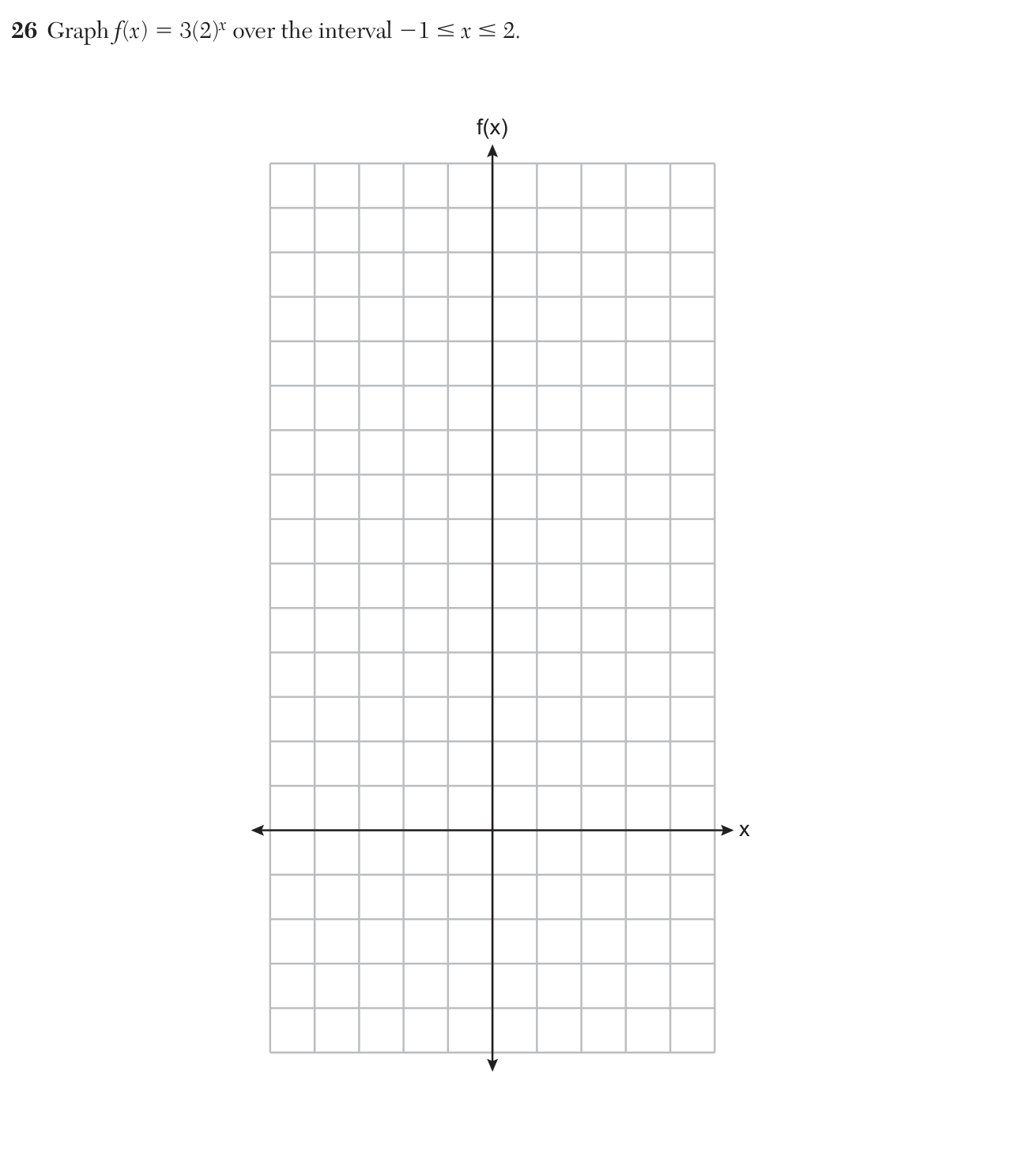
- Evaluate convenient inputs in the required interval:
- Plot , , , . Connect them with a smooth increasing exponential curve that bends upward.
- Both inequality symbols include equality, so use filled endpoints at and . Stop at those endpoints.
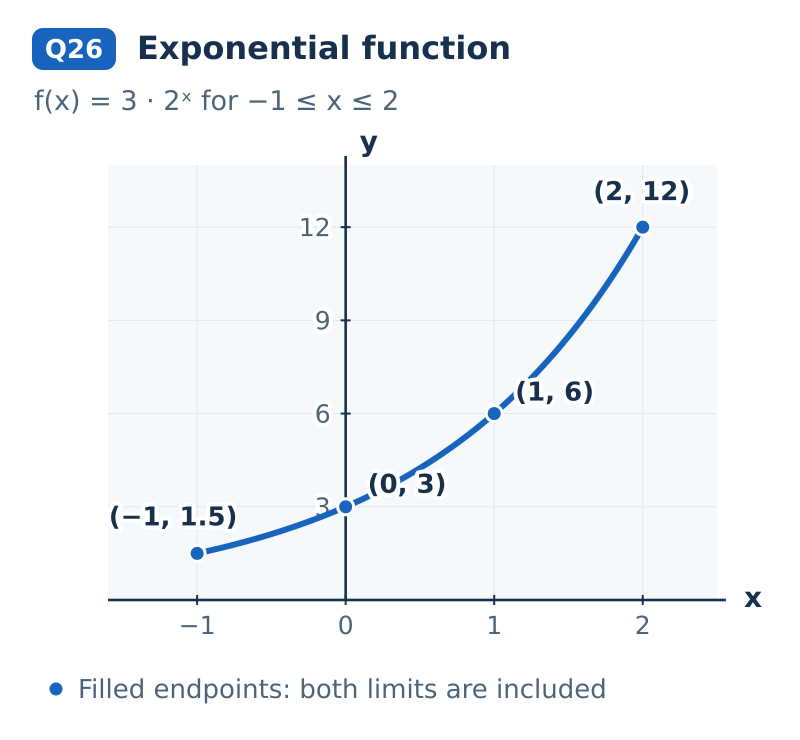
Exam detail: Do not draw a straight broken line between the points or extend the curve beyond the stated interval.
Question 27: Multiply a binomial and a trinomial

- Multiply the trinomial by each term of the binomial:
- Write all six products:
- Combine terms with equal powers and order from highest to lowest degree:
Question 28: Construct a box plot
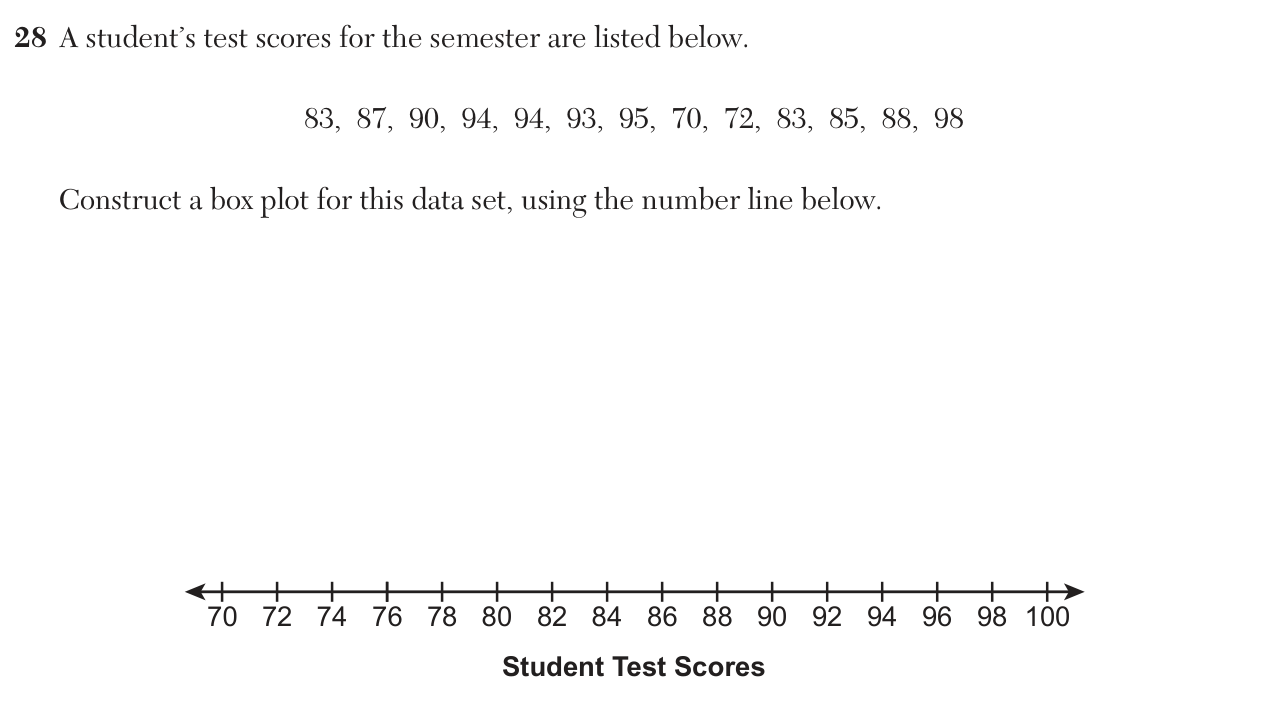
- Sort the scores: 70, 72, 83, 83, 85, 87, 88, 90, 93, 94, 94, 95, 98.
- There are 13 scores, so the seventh score is the median: 88. Exclude that median when dividing the remaining scores into lower and upper halves.
- The lower-half middle scores are 83 and 83, so . The upper-half middle scores are 94 and 94, so its quartile is 94.
- Draw a box from 83 to 94, a median line at 88, and whiskers to the minimum 70 and maximum 98.
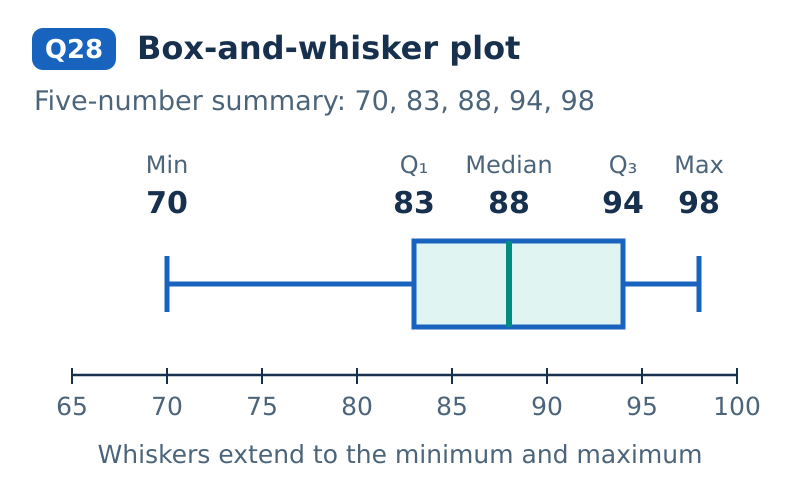
Exam detail: The requested answer is a box plot. Listing the five numbers alone is not a substitute for drawing it.
For more practice, use the quartile calculator with the median-excluded convention.
Question 29: Find a slope-intercept equation

- Use with slope . Substitute the given point to find the intercept:
- Simplify and isolate the intercept:
- Insert the slope and intercept into the line equation:
Exam detail: The requested form is slope-intercept form, so isolate y.
Question 30: Find the maximum whole-number purchase

- Let n be the number of ride tickets. Food plus tickets cannot exceed the budget:
- Subtract the food cost and divide by the positive ticket price:
- Tickets must be whole numbers, so the maximum is 5. Check: five tickets bring the total to $19.75; six bring it to $22.00, which exceeds the budget.
Exam detail: This question requires an algebraic method. Show the inequality or an equivalent equation before interpreting the whole-number result.
Part III: Extended constructed responses
Questions 31–34 • 4 credits each • 16 credits total
Question 31: Model a rocket’s flight with a quadratic
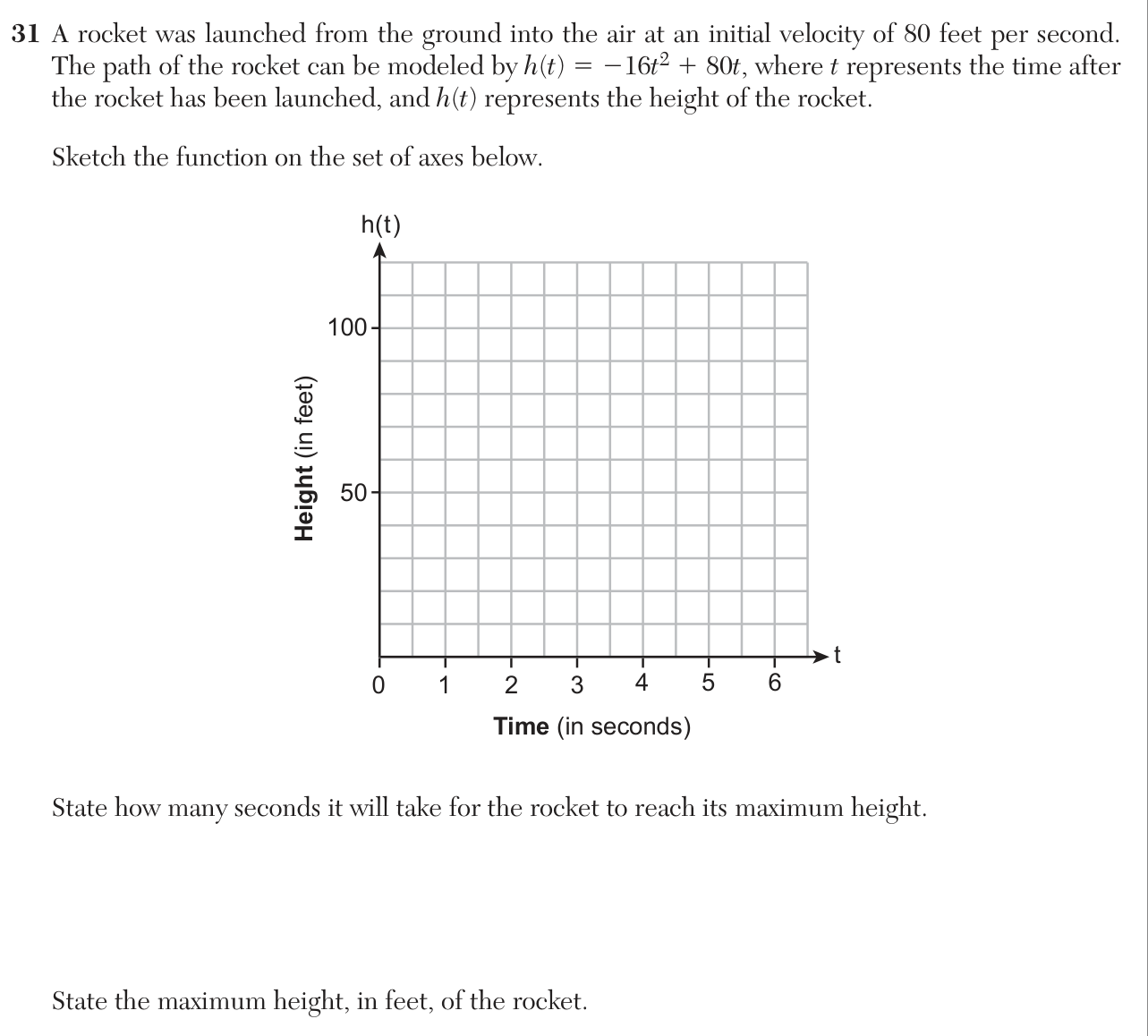
- Factor to find when the rocket is on the ground:The intercepts are and . The physical flight is .
- Find the vertex time using the axis-of-symmetry formula:
- Evaluate the height there:
- Sketch a smooth downward-opening arc through , , , , , , .
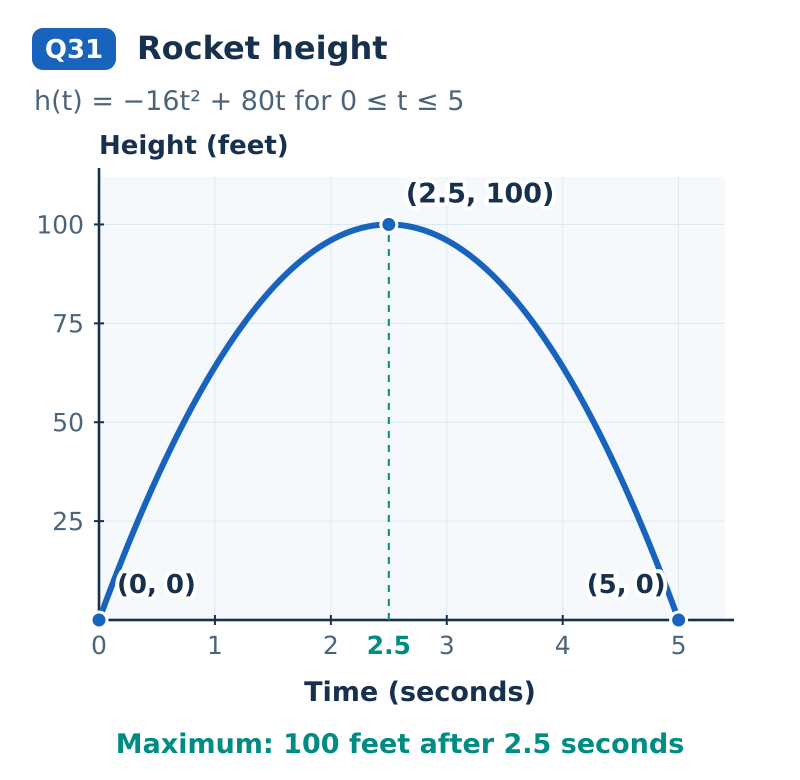
Exam detail: Use a scale that shows the vertex accurately. Draw the physical arc with endpoints and no arrowheads on the parabola; continuing below ground is inappropriate for this model.
Question 32: Use the quadratic formula and simplify exactly

- Identify . Use the required quadratic formula:
- Substitute the signed values carefully:
- The discriminant is , and . Therefore:
Exam detail: Keep both exact roots. The question specifically requires the quadratic formula and simplest radical form; decimal roots alone do not meet those instructions.
Check a new example with the quadratic equation calculator.
Question 33: Fit and interpret a linear regression model
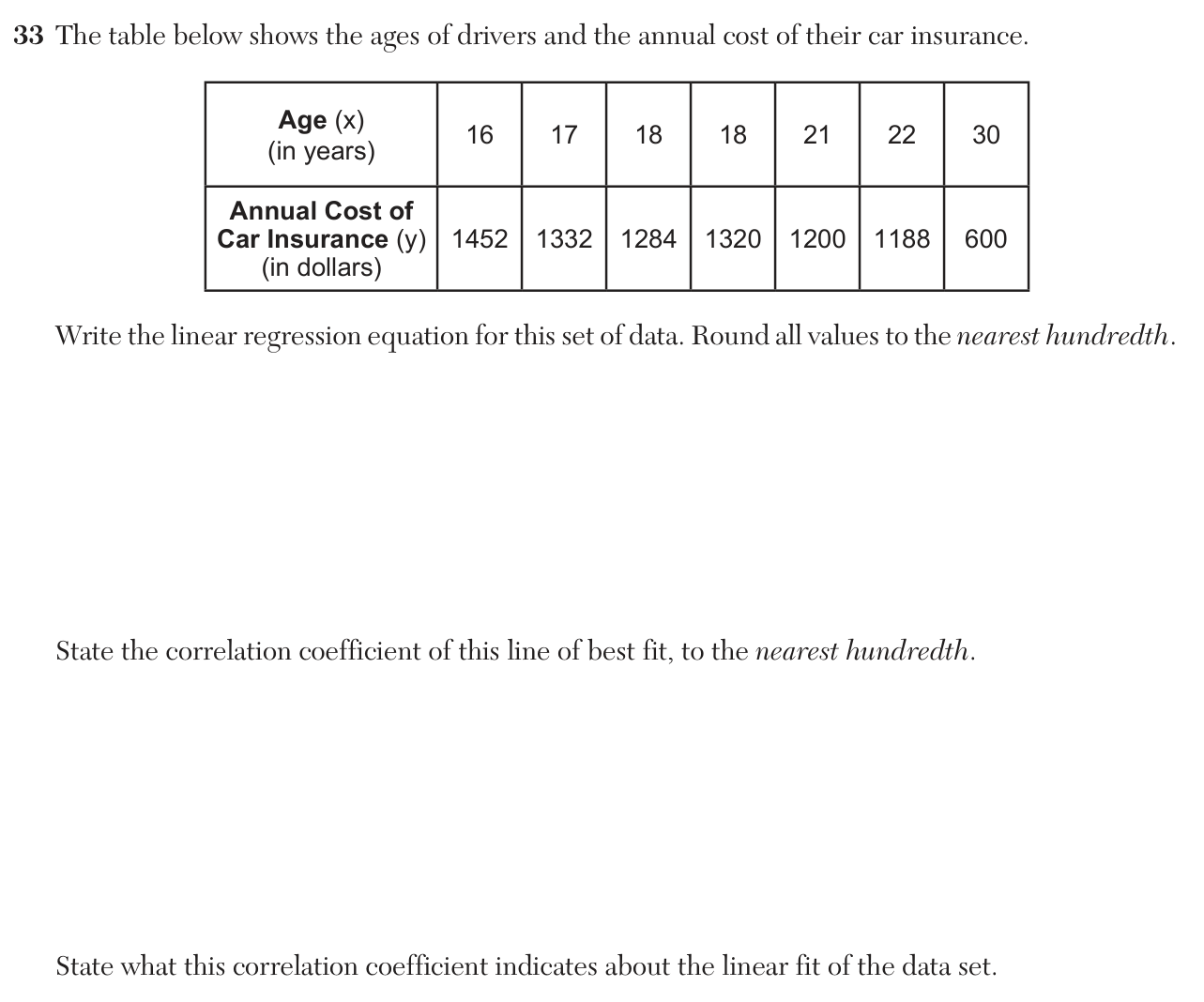
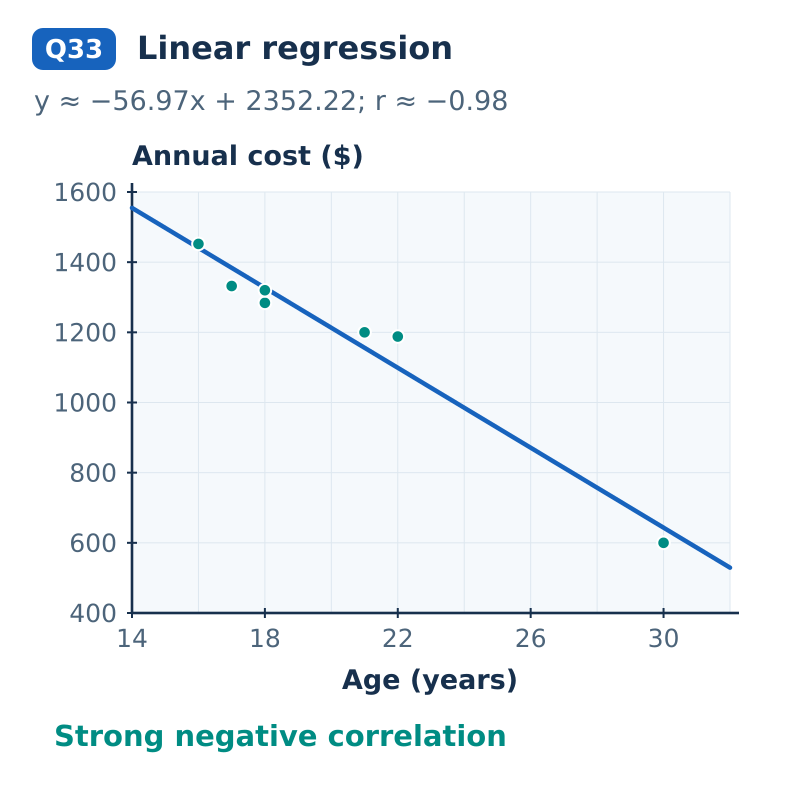
- Enter the seven ages in one calculator list and the seven annual costs in a second list, preserving each age-cost pair. Keep both observations at age 18.
- Run linear regression with age as the input and annual cost as the output. Before rounding, the slope is about −56.968815 and the intercept is about 2352.224532.
- Round the two coefficients to the nearest hundredth:
- The correlation is approximately −0.982077, which rounds to . Its size is close to 1 and its sign is negative, indicating a strong negative linear relationship: in these data, cost tends to decrease as age increases.
Exam detail: Use all seven pairs, not a line through two endpoints. Say “strong” as well as “negative.” Correlation alone does not establish causation.
Explore the data with the regression analysis calculator.
Question 34: Graph the intersection of two half-planes
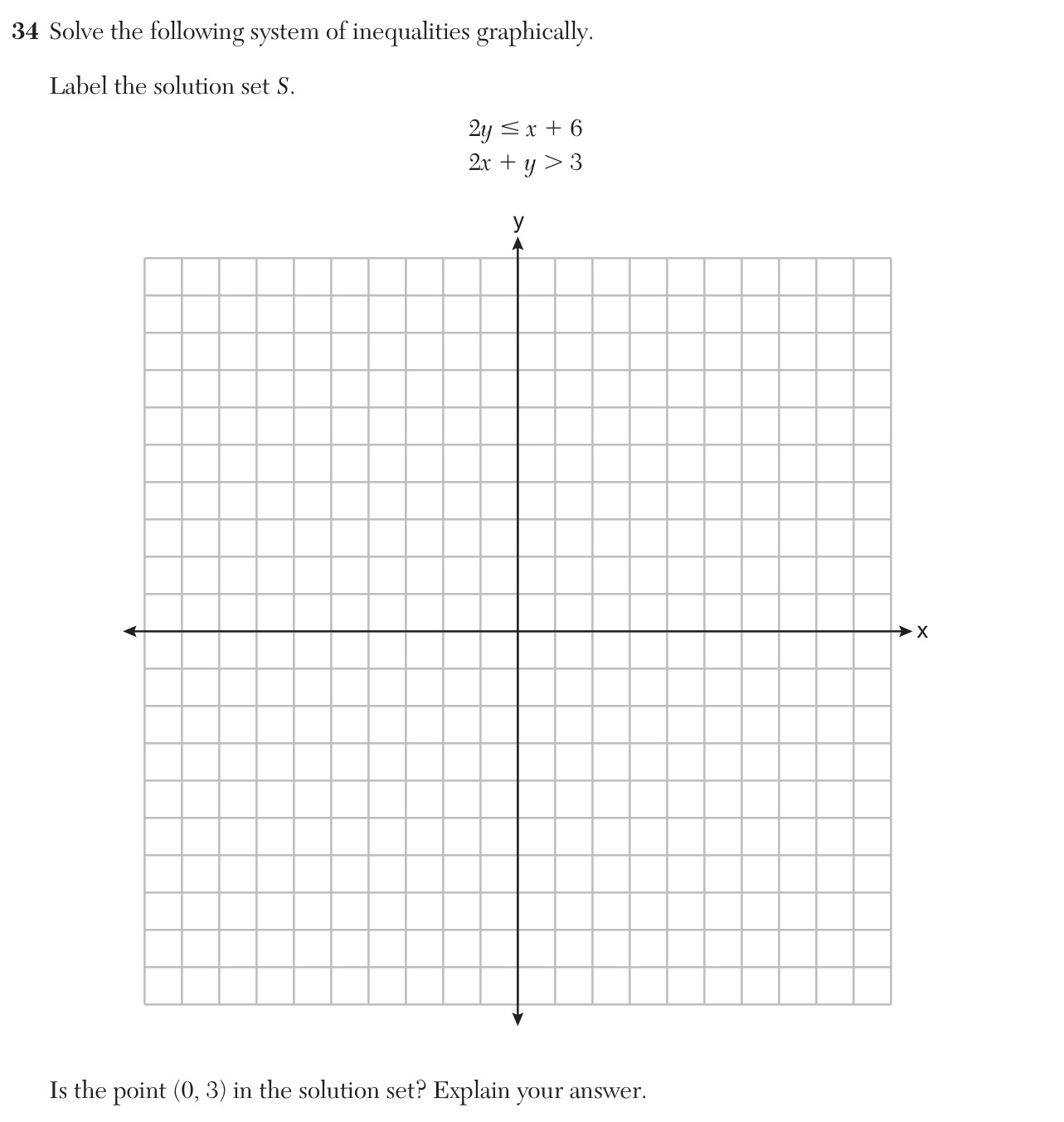
- Rewrite both inequalities in slope-intercept form:
- Draw as a solid line and shade below it. Draw as a dashed line and shade above it.
- The boundary lines meet at . Their overlap lies to the right of this point, above the dashed line and on or below the solid line. Label the overlap S and label the boundary equations.
- Test the requested point: the first inequality gives , which is true. The second gives , which is false. A solution must satisfy both.
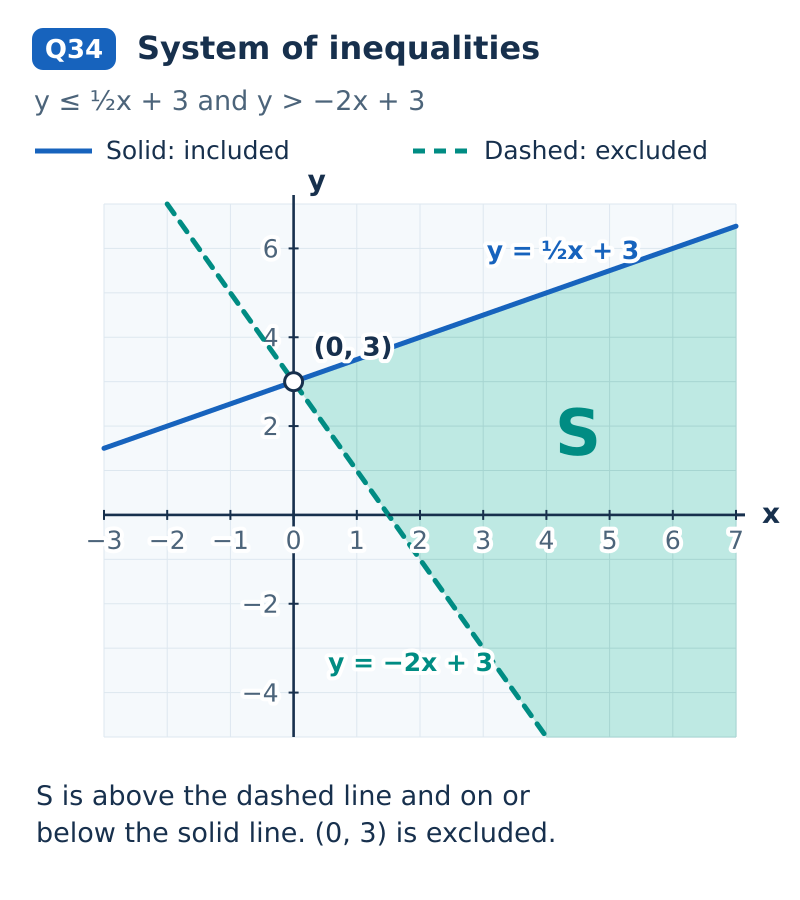
Exam detail: The intersection point is excluded even though it lies on the solid boundary, because it also lies on the excluded dashed boundary.
Part IV: Multi-step modeling problem
Question 35 • 6 credits
Question 35: Build, test, and solve a two-variable model
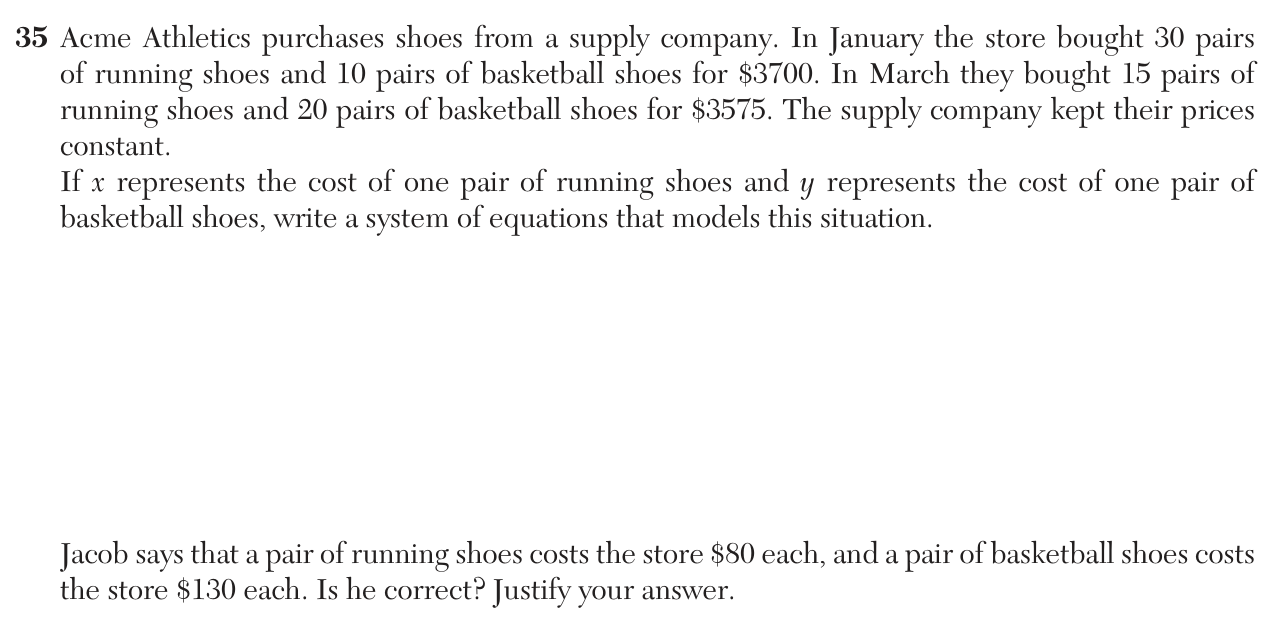

- Let x be the cost of one pair of running shoes and y the cost of one pair of basketball shoes. The two orders give:
- Check the proposed prices . The January order would total , but March would total , not 3575. Therefore the proposed pair is not a solution.
- To solve algebraically, double the second equation:
- Subtract the first equation from this new equation:
- Substitute into the first equation:
- Check both original totals: and .
Exam detail: This question continues onto exam page 21. A complete response includes the model, a justification about the proposed prices, and an algebraic solution for both actual prices.
Check your score carefully
The maximum raw score is 82, but the reported Regents score is a scaled score. Use the official January 2026 conversion chart for this administration. Do not substitute a conversion chart from a different month or year. The Algebra 1 Regents score calculator is a practice aid; the official administration-specific chart remains the source for an exact conversion.
Sources & References
Official materials accessed October 6, 2026. Question and scoring references use the English edition except where the Spanish-only notice is identified.
- Official January 2026 Algebra I examination (questions; PDF)
- Official January 2026 multiple-choice scoring key (PDF)
- Official January 2026 rating guide (PDF)
- Official January 2026 model response set (PDF)
- Official January 2026 conversion chart (PDF)
- Official Spanish-edition-only question 24 notice (PDF)
- NYSED Algebra I past-examination index
- NYSED terms of use and reproduction conditions
From the New York State Education Department. Regents Examination in Algebra I, January 2026. Internet. Available from the official examination link above; accessed 6 October 2026. Original question images are distinguished from HeLovesMath’s original explanations and solution diagrams.