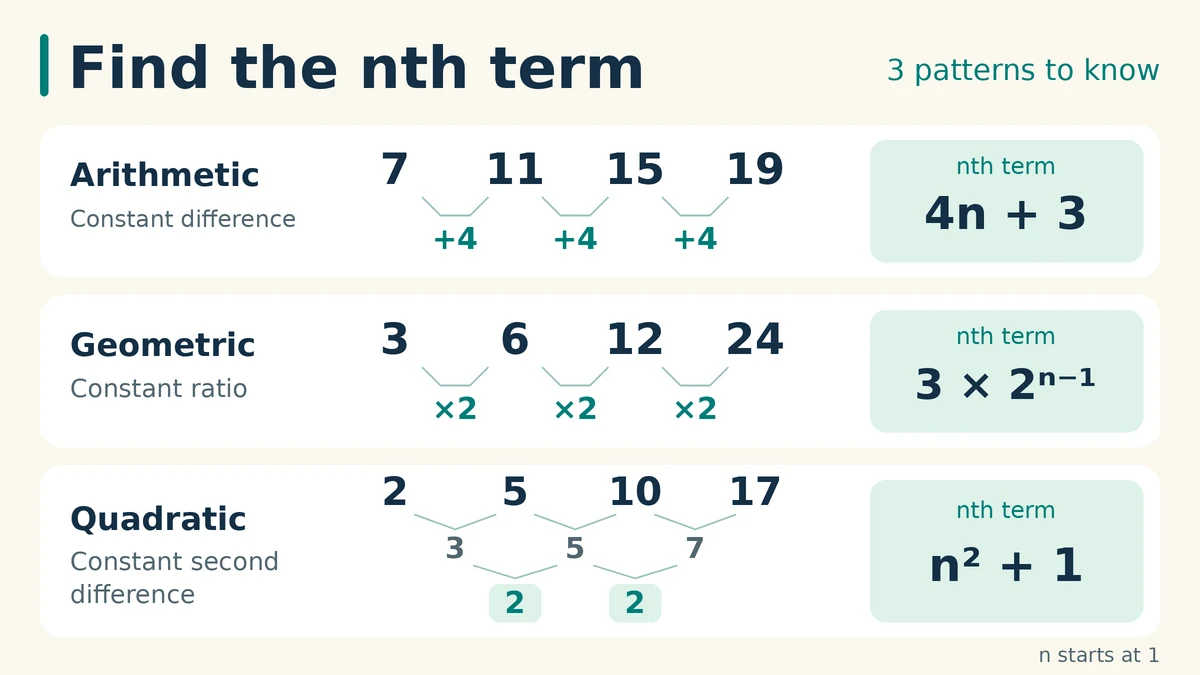
An nth-term rule tells you the value at position n. For 7, 11, 15, 19, …, the arithmetic rule is tn = 4n + 3, so the 10th term is 43. Use this calculator to find a rule, see the working and check a particular term.
Find the nth term
Choose a known sequence type, or use From Sequence to test arithmetic, geometric and quadratic patterns. Positions start at n = 1.
Enter integers, decimals, simple fractions such as −3/4, or scientific notation such as 2e-3. Use up to 12 digits per number (per integer in a fraction); scientific exponents must be from −12 to 12. Use a whole-number position from 1 to 1000. Commas separate terms, so write 1000 rather than 1,000.
A matching pattern is a candidate rule. A finite list can fit infinitely many continuations. This tool checks every supplied term exactly, but it cannot prove what the next term was intended to be. Rounded measurements are not automatically treated as exact patterns.
What does “nth term” mean?
The letter n is a position, not a term value. If tn = 3n + 2, the fourth term is t4 = 3 × 4 + 2 = 14. The answer 14 is the value at position 4. Some books write an, un or Tn; the idea is the same.
A term-to-term rule, such as “add 4”, tells you how to move to the next term and needs a starting value. A position-to-term rule, such as 4n + 3, jumps directly to a requested position. In this page, the first term always has position 1. Check the starting index when using a textbook that starts at 0.
Arithmetic sequences: add the same amount
If each new term is the previous term plus d, then getting from term 1 to term n takes n − 1 steps. Starting with a gives:
tn = a + (n − 1)d = dn + (a − d)
Worked example: 7, 11, 15, 19, 23, …
- Subtract neighbouring terms: 11 − 7 = 4, 15 − 11 = 4 and 19 − 15 = 4.
- Use a = 7 and d = 4: tn = 7 + 4(n − 1).
- Expand: 7 + 4n − 4 = 4n + 3.
- Check n = 1: 4 + 3 = 7. Check n = 5: 20 + 3 = 23.
- The 10th term is 4 × 10 + 3 = 43.
The coefficient of n is the common difference. The constant is not usually the first term: it adjusts the rule so that n = 1 produces a.
Decreasing sequences and membership
For 12, 9, 6, 3, 0, …, the difference is −3. The rule is 12 − 3(n − 1) = 15 − 3n; the eighth term is −9. A negative difference is valid, and a sequence can pass through zero.
To ask whether 79 belongs to 7, 11, 15, …, solve 4n + 3 = 79. This gives n = 19, a positive integer, so 79 is the 19th term. For 80, n = 77/4 = 19.25, so 80 is not a term of that arithmetic sequence. Revisit GCSE algebra practice for solving equations.
Geometric sequences: multiply by the same factor
With first term a and nonzero common ratio r, the terms are a, ar, ar², ar³, … . There have been n − 1 multiplications at position n:
tn = arn − 1
Worked example: 5, 15, 45, 135, 405, …
Each term is three times the one before it, so a = 5 and r = 3. The rule is tn = 5 × 3n − 1. At n = 10, this gives 5 × 3⁹ = 5 × 19,683 = 98,415. Using 3¹⁰ instead would move one position too far.
Ratios need not be positive integers. The sequence 3, −6, 12, −24, 48, … has r = −2 and rule 3 × (−2)n − 1. Brackets keep the negative base together. Meanwhile 32, 16, 8, 4, … has r = 1/2 and sixth term 1. For a nonzero starting value, |r| < 1 makes the magnitudes shrink; |r| > 1 makes them grow; a negative r alternates signs.
What about zero? The recurrence “multiply by 0” gives the first term a, then only zeros. The calculator writes this separately as t1 = a and tn = 0 for n ≥ 2. A list such as 1, 0, 1, 0 cannot follow one constant multiplier: once multiplication reaches zero, a later term cannot become nonzero. An all-zero list is reported as a constant rule; its terms do not determine a unique multiplier.
Quadratic sequences: take second differences
A quadratic rule has the form tn = An² + Bn + C, where A ≠ 0. For equally spaced consecutive positions, the second difference is 2A. First differences change, but the difference between those differences stays fixed.
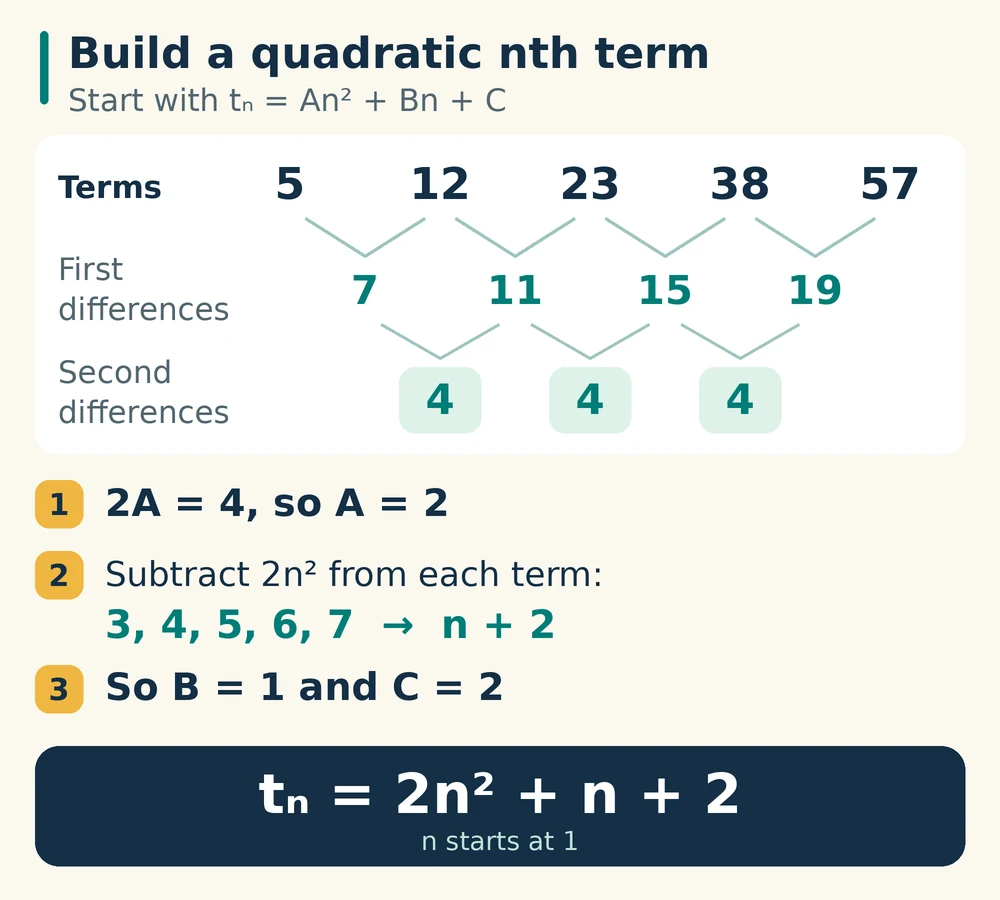
Worked example: 5, 12, 23, 38, 57, …
- First differences are 7, 11, 15, 19.
- Second differences are 4, 4, 4, so A = 4 ÷ 2 = 2.
- Subtract 2n² from each term: 5 − 2 = 3, 12 − 8 = 4, 23 − 18 = 5, 38 − 32 = 6, 57 − 50 = 7.
- The remaining sequence 3, 4, 5, 6, 7 has rule n + 2.
- Combine the parts: tn = 2n² + n + 2. At n = 10: 200 + 10 + 2 = 212.
A useful coefficient shortcut is A = (second difference)/2, B = (t2 − t1) − 3A, and C = t1 − A − B. Here B = 7 − 6 = 1 and C = 5 − 2 − 1 = 2. The factor 3 comes from t2 − t1 = (4A + 2B + C) − (A + B + C) = 3A + B.
Squares and triangular numbers
For 2, 5, 10, 17, 26, …, subtract n² and the remainder is always 1, giving n² + 1. The sixth term is 37. For 1, 3, 6, 10, 15, …, the second difference is 1, so A = 1/2. The full rule is n(n + 1)/2, giving the 10th triangular number 55. A quadratic coefficient can be a fraction even when every term is an integer.
A second difference of zero means the simpler rule is linear or constant, not genuinely quadratic. Three terms determine one polynomial of degree at most two, but provide only one second difference. This calculator requests at least four so it can compare second differences and test the fitted rule against more than three points.
Nth term or sum of terms?
A term is one value; a sum combines several. For 3, 7, 11, …, the tenth term is 39, while the sum of the first ten is 210. The arithmetic and geometric modes show both when you enter n.
| Pattern | Sum Sn |
|---|---|
| Arithmetic | n[2a + (n − 1)d]/2 |
| Geometric, r ≠ 1 | a(rn − 1)/(r − 1) |
| Geometric, r = 1 | na |
For 2, 6, 18, …, the seventh term is 2 × 3⁶ = 1,458, while S7 = 2(3⁷ − 1)/(3 − 1) = 2,186. These are finite sums; no infinite-series convergence claim is being made.
What the calculator can and cannot infer
It checks familiar families, not every possible formula. Cubes 1, 8, 27, 64, … have rule n³ and nonzero constant third differences. Fibonacci numbers 1, 1, 2, 3, 5, … use t1 = t2 = 1 and tn = tn − 1 + tn − 2 for n ≥ 3. Neither is among the three families tested automatically. Mixed rules such as 2n + 3ⁿ also need another approach.
A short list cannot establish a unique infinite rule. The four terms 2, 4, 6, 8 fit tn = 2n. They also fit 2n + (n − 1)(n − 2)(n − 3)(n − 4), because the added product is zero at positions 1 to 4. At n = 5, the first rule gives 10 and the second gives 34. In an exercise, use the stated sequence type or the pattern's construction to justify continuation.
Input values are taken exactly. Entering 1/3 preserves that fraction; 0.333 is exactly 333/1000. A list rounded from an underlying geometric pattern may fail the exact check. Do not “fix” a mismatch by hiding inconvenient terms. Check transcription, units and whether the entries really occupy consecutive positions.
Display limits are separate from mathematical limits. This tool limits positions to 1000 and input length to keep calculations responsive. It uses integer/fraction arithmetic internally. Long outputs are marked ≈ and shortened to 10 significant figures in scientific notation. See scientific notation examples to interpret those results.
Common mistakes worth catching
- Using the first difference as the whole formula. “Add 4” is not the same as 4n. Adjust to match the first term.
- Confusing term number and term value. In 4n + 3, n = 10 produces 43; do not substitute 43 unless you want the 43rd term.
- Ignoring a negative sign. In 15 − 3n, calculate 3n before subtracting it from 15. Use the negative numbers guide if sign rules need practice.
- Forgetting the factor of two. A second difference of 6 gives A = 3, not 6.
- Using the same letter for two jobs. Here a is a first term; capital A is the coefficient of n².
- Checking only the first term. Test every supplied term. One successful substitution cannot validate a rule.
Try it yourself: eight questions
For questions 1–6, assume the stated pattern continues. Write a rule before opening the answer.
1. Arithmetic: 8, 13, 18, 23, … . Find the rule and 20th term.
d = 5, so tn = 8 + 5(n − 1) = 5n + 3. The 20th term is 100 + 3 = 103.
2. Arithmetic: 4, 1, −2, −5, … . Find the 12th term.
d = −3. The rule is 4 − 3(n − 1) = 7 − 3n. At n = 12, 7 − 36 = −29.
3. Geometric: 3, 6, 12, 24, … . Find the rule and 8th term.
r = 2, so tn = 3 × 2n − 1. The eighth term is 3 × 2⁷ = 384.
4. Geometric: 16, −8, 4, −2, … . Find the 6th term.
r = −1/2. The sixth term is 16 × (−1/2)⁵ = −1/2. The fifth term is 1, which helps check the sign.
5. Quadratic: 3, 8, 15, 24, 35, … . Find the rule and 10th term.
First differences are 5, 7, 9, 11; second differences are 2. Subtract n² to get 2, 4, 6, 8, 10. Thus tn = n² + 2n, and t10 = 120.
6. Quadratic: 1, 4, 9, 16, … . Is 50 a term?
The rule is n². Since 7² = 49 and 8² = 64, no positive integer position gives 50. So 50 is not a term.
7. Does 0, 2, 6, 18 have a common ratio of 3?
No. Although 2 × 3 = 6 and 6 × 3 = 18, multiplying the first term 0 by 3 gives 0, not 2. Every transition must fit.
8. Does seeing 2, 4, 6, 8 prove the next term is 10?
No. Ten is the next value under the arithmetic rule 2n. Other rules can match those four terms and then differ. The sequence type or construction supplies the missing assumption.
For more written work, use the algebra worksheet library. Try the question first, use this calculator to compare your rule, and explain any disagreement rather than copying an output.
Frequently asked questions
Can the nth term be negative or fractional?
Yes. The position n is a positive integer in this tool, but the term value can be negative, zero or a fraction. For example, 7 − 3n is negative from n = 3 onward.
Can I enter terms from the middle of a sequence?
The sequence-input modes treat your first entry as t1 and assume consecutive positions. If you enter t5 through t8, the returned rule will be re-indexed. For a known arithmetic sequence with terms tj and tk, use d = (tk − tj)/(k − j) and a = tj − (j − 1)d, then enter a and d in Arithmetic mode.
Why does my constant sequence show as arithmetic?
A constant list has common difference 0. A nonzero constant list also fits the geometric rule with r = 1. The automatic mode reports the simpler constant/arithmetic description first.
Why use four terms for quadratic detection?
Three terms allow a degree-at-most-two fit, so fitting those three alone is a weak check. A fourth term gives another second difference to compare. Additional matching terms strengthen evidence for the pattern, but never prove an unlimited continuation.
Sources & References
Formula and method references; the worked explanations, questions, diagrams and calculator on this page are original.
- OpenStax: Arithmetic Sequences — definitions and nth-term formulas.
- OpenStax: Geometric Sequences — ratios, recurrence and explicit rules.
- Pearson Edexcel: Quadratic Sequences (PDF) — second differences and the coefficient method.
- NIST Digital Library of Mathematical Functions: Interpolation — background on fitting finite sets of values.