
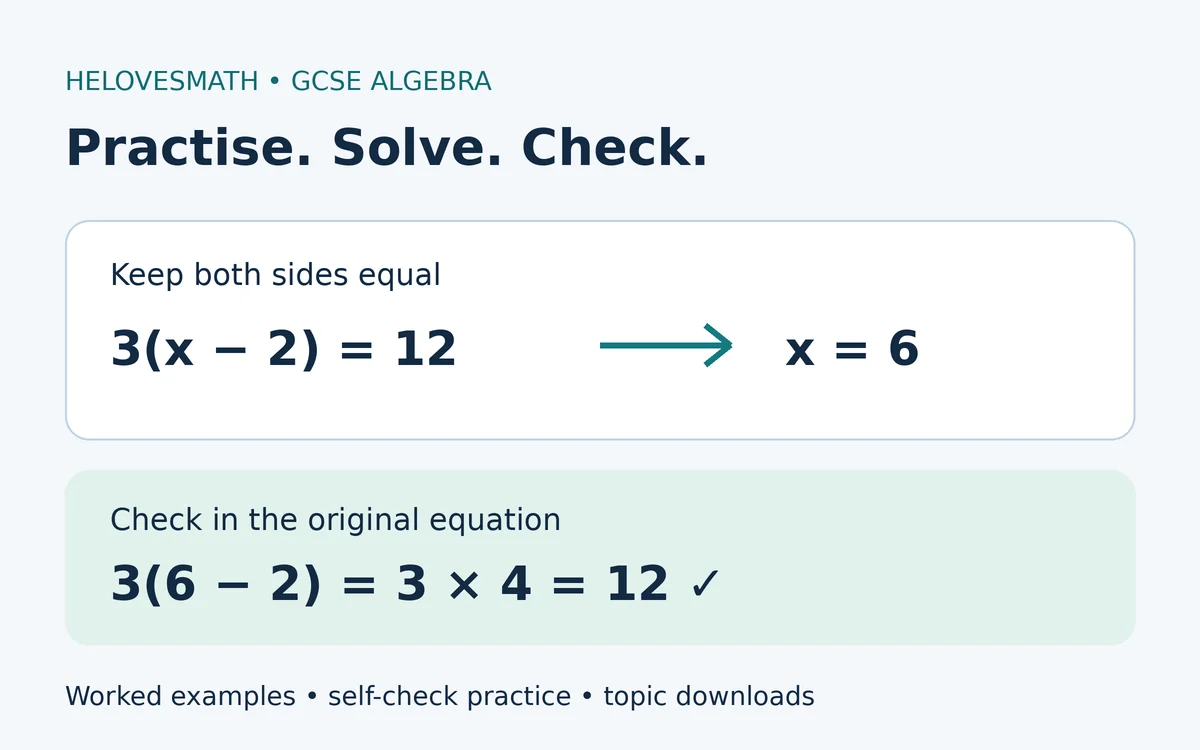
GCSE revision • expressions, equations and graphs
Choose an algebra skill, try a short question, then use the topic library for more practice. This page combines 12 original questions with worked answers, four worked examples and the existing 67 resource links across 31 topics.
The linked resources include 66 PDF entries and one PNG image, with one PDF listed under two topics. They are hosted by M4ths; their availability and answer-key coverage are not guaranteed. Our own questions and answers below are available without opening a download.
Choose the right algebra practice
These routes refer to GCSE (9–1) Mathematics in England. Higher-tier students also need the Foundation skills. The route is a guide to the skill, not a verified tier label for every external worksheet; a file may mix easier and harder questions. Check your exam board's current specification and your teacher's plan.
Build the essentials
Start with like terms, substitution, single brackets, common factors, linear equations and linear sequences. These underpin both tiers.
Connect the skills
Practise expanding two brackets, factorising simple quadratics, two linear simultaneous equations and straight-line graphs. These are not automatically Higher-only topics.
Extend at Higher tier
Move on to completing the square, algebraic fractions, the quadratic formula, linear–quadratic simultaneous equations, quadratic nth terms, inverse/composite functions and graph transformations.
Need broader practice? Explore our algebra worksheet library. If signs are causing mistakes, review negative numbers before tackling substitution and rearrangement.
A useful 20-minute revision routine
- Choose one target. For example, “solve equations with x on both sides”, rather than “revise algebra”.
- Try three questions unaided. Keep every algebraic line so you can locate the first error.
- Check and repair. Substitute solutions into the original equation; expand a factorised answer to check it.
- Retry a similar question later. Explain why each step is valid. Correcting a method matters more than copying the answer.
Four worked GCSE algebra examples
1. Expand two brackets and collect like terms
Expand (x + 2)(x + 3). Every term in the first bracket multiplies every term in the second:
(x + 2)(x + 3) = x² + 3x + 2x + 6 = x² + 5x + 6
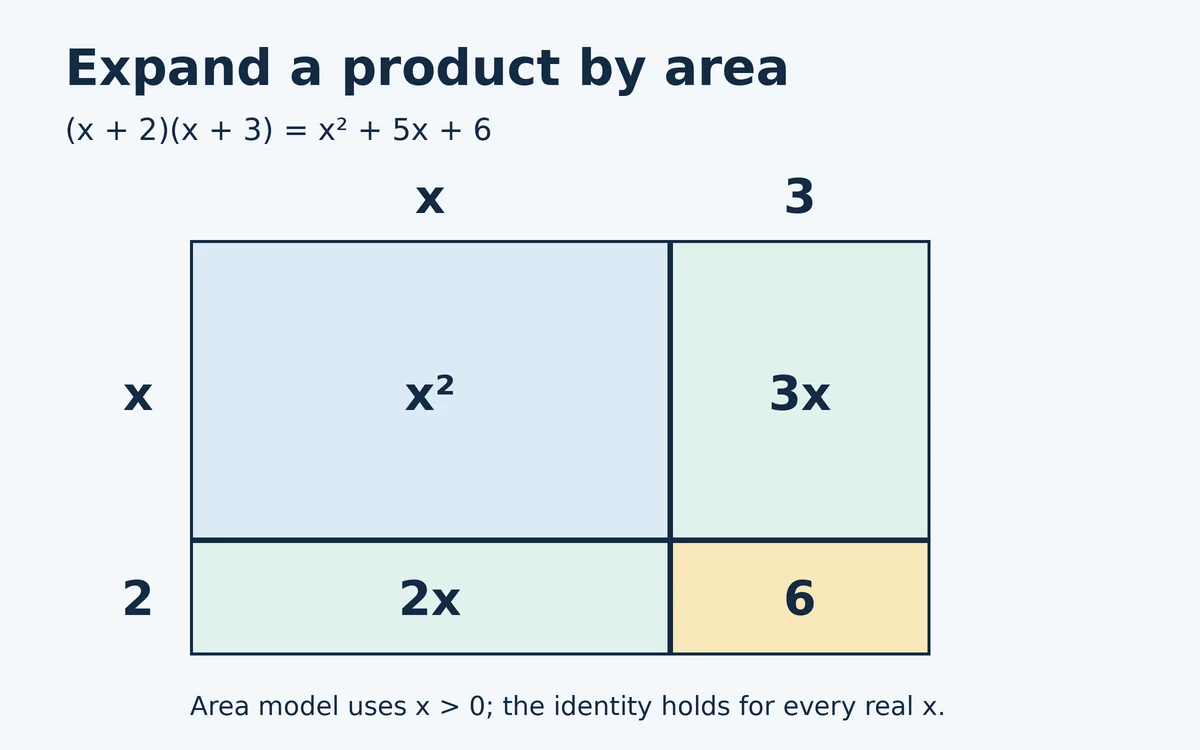
Common mistake: x² and 5x are unlike terms, so they cannot be combined into 6x². As a quick check, x = 1 gives (1 + 2)(1 + 3) = 12 and 1 + 5 + 6 = 12. One numerical check can catch a mistake, but it does not prove an identity for every x.
2. Solve an equation with x on both sides
Solve 5x − 7 = 2x + 8. Do the same operation to both sides:
- Subtract 2x: 3x − 7 = 8
- Add 7: 3x = 15
- Divide by 3: x = 5
Check: left side 5 × 5 − 7 = 18; right side 2 × 5 + 8 = 18. A solution makes the original equation true. “Move it and change the sign” is a shortcut for applying an inverse operation to both sides, not a separate rule.
3. Find a line's gradient and intercept
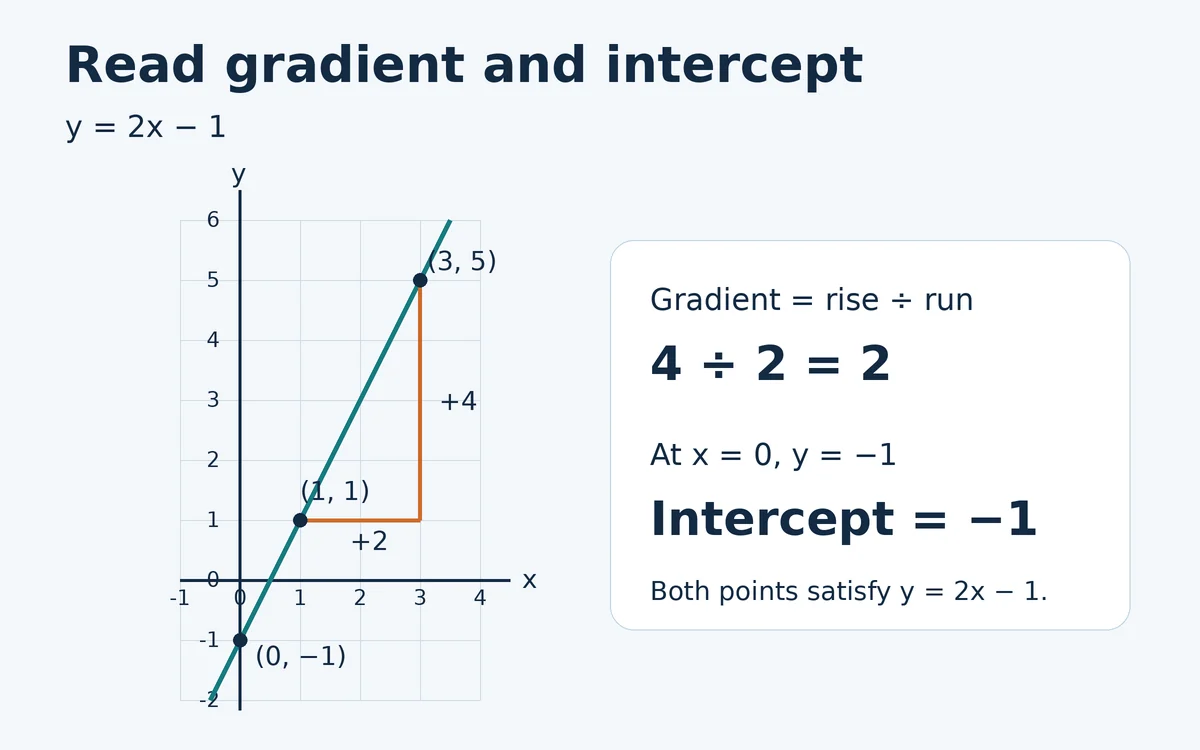
The line passes through (1, 1) and (3, 5). The change in y is 5 − 1 = 4, and the change in x is 3 − 1 = 2. Its gradient is m = 4/2 = 2.
Substitute (1, 1) into y = mx + c: 1 = 2 × 1 + c, so c = −1. The equation is y = 2x − 1.
4. Simplify an algebraic fraction without losing a restriction
For x ≠ 3, factorise the numerator:
(x² − 9)/(x − 3) = [(x − 3)(x + 3)]/(x − 3) = x + 3, with x ≠ 3
We cancel a common factor, not separate terms. The restriction remains because the original denominator is zero at x = 3. In particular, solving (x² − 9)/(x − 3) = 6 appears to give x = 3, but that value is excluded: the original equation has no solution.
12 original practice questions
Work on paper before opening the answers. Questions 1–10 build and connect skills found across the two tiers; questions 11–12 use Higher-tier methods. This is a short diagnostic set, not a complete exam or a grade predictor.
- Simplify 7a + 3b − 2a + 5b.
- Expand −3(2x − 5).
- Factorise fully: 12x² − 18x.
- Factorise x² − x − 12.
- Solve 4(2x − 1) = 20.
- Evaluate 2x² − 3x when x = −2.
- Solve 3 − 2x ≤ 11.
- Find the nth term of 6, 10, 14, 18, …, with the first term at n = 1. Then find the 20th term.
- Solve simultaneously: 2x + y = 11 and x − y = 1.
- Find the gradient and equation of the straight line through (−1, −3) and (2, 3).
- Write x² + 6x + 5 in completed-square form. State its minimum value and the x-value at which it occurs.
- Simplify (2x² − 8)/(x − 2), and state the excluded value.
Worked answers and checks
Show all 12 worked answers
- 5a + 8b. Combine a-terms and b-terms separately: (7 − 2)a + (3 + 5)b.
- −6x + 15. Multiply both terms by −3. The product (−3)(−5) is positive.
- 6x(2x − 3). The greatest common factor of both terms is 6x. Expanding gives 12x² − 18x again.
- (x − 4)(x + 3). The two numbers multiply to −12 and add to −1. Check: x² + 3x − 4x − 12 = x² − x − 12.
- x = 3. Divide by 4: 2x − 1 = 5. Add 1, then divide by 2. Check: 4(6 − 1) = 20.
- 14. Write brackets: 2(−2)² − 3(−2) = 2 × 4 + 6 = 14. Squaring −2 gives 4.
- x ≥ −4. Subtract 3: −2x ≤ 8. Dividing by −2 reverses the inequality. Check the boundary x = −4: both sides are 11. Values larger than −4 also work.
- 4n + 2; the 20th term is 82. The constant difference is 4. Since 4 × 1 + 2 = 6, the adjustment is +2. Then 4 × 20 + 2 = 82.
- x = 4, y = 3. Add the equations to eliminate y: 3x = 12. Substitute into x − y = 1. Check 2 × 4 + 3 = 11 and 4 − 3 = 1.
- Gradient 2; y = 2x − 1. m = [3 − (−3)]/[2 − (−1)] = 6/3 = 2. Using (2, 3), 3 = 4 + c gives c = −1.
- (x + 3)² − 4; minimum −4 at x = −3. Expanding the square gives x² + 6x + 9; subtracting 4 leaves +5. A real square is at least zero.
- 2(x + 2), with x ≠ 2. Factorise 2x² − 8 = 2(x − 2)(x + 2), then cancel the common factor x − 2. The original expression remains undefined at x = 2.
If you missed several questions, return to one matching topic below. For notation such as ≠ and ≤, see our maths symbols reference.
Questions about the worksheet library
Do the downloaded worksheets include answers?
Answer-key coverage has not been verified. All 66 unique external file URLs returned an access-control response during our 3 October 2026 automated check, so we could not inspect their contents. This does not establish that they are unavailable to every visitor. The 12 original questions on this page have worked answers immediately above.
Are these official GCSE exam papers?
No. This is a topic-practice directory linking to third-party teaching resources. A worksheet title is not evidence that its questions are official exam-board questions, current-specification material or suitable for a particular tier.
How should I print or use a worksheet?
Open the file on its publisher's site, check the content and any usage notice, then use your PDF viewer's print controls if printing is permitted. Check the first page before printing a long file. These resources remain on their original host; HeLovesMath does not claim ownership of them.
Why do some topics have no download?
Four headings in the existing directory have no separate file: factorising expressions, number patterns, polynomial/exponential graphs and trigonometric graphs. They are retained so existing topic links still work. Use the original examples above or a related topic where appropriate; an empty heading is not a download.
Sources & References
Topic worksheet downloads
Source credit: the following 67 entries link to files hosted by M4ths (m4ths.com). Individual authors retain their rights. Titles are the existing directory labels; content, answer keys and exact tier alignment have not been independently verified.
Access note, checked 3 October 2026: our requests to all 66 unique file URLs received HTTP 406 “Not Acceptable” HTML responses rather than the files. Links are preserved for readers who can access them. If a file does not open, use the on-page practice above or ask your teacher for an accessible alternative. No worksheet or answer-key file is rehosted here.
Showing 67 resource links across 31 topics.
No matching topics or resources. Try a shorter word, or clear the search.
Collecting Like Terms (Simplifying Expressions)
Combine terms with the same variable part. Products and quotients use multiplication, division and index rules rather than the rule for adding like terms.
Collecting Like Terms Worksheet 1
PDF Worksheet • hosted by M4ths
Open resourceCollecting Like Terms Worksheet 2
PDF Worksheet • hosted by M4ths
Open resourceThe Rules of Indices
Multiplying, dividing, raising to a power, the zero power, fractional and negative powers, and solving equations with powers.
Rules of Indices Worksheet 1
PDF Worksheet • hosted by M4ths
Open resourceRules of Indices Worksheet 2
PDF Worksheet • hosted by M4ths
Open resourceRules of Indices Worksheet 3
PDF Worksheet • hosted by M4ths
Open resourceRules of Indices Worksheet 4
PDF Worksheet • hosted by M4ths
Open resourceIndices Worksheet 5
PDF Worksheet • hosted by M4ths
Open resourceIdentities and Indices Worksheet
PDF Worksheet • hosted by M4ths
Open resourceIndices Worksheet 6
PDF Worksheet • hosted by M4ths
Open resourceRules of Indices Harder
PDF Worksheet • hosted by M4ths
Open resourceExpanding Brackets (Multiplying Out Brackets)
Single brackets. Double brackets are usually covered in quadratic work.
Expanding Brackets Worksheet 1
PDF Worksheet • hosted by M4ths
Open resourceExpanding Brackets Worksheet 2
PDF Worksheet • hosted by M4ths
Open resourceFactoring (Factorising Algebraic Expressions)
Core GCSE algebra factorising practice and revision.
No separate download is listed for this topic in the existing set.
Algebraic Fractions
Simplifying, multiplying, dividing, adding, subtracting and solving equations with algebraic fractions.
Algebraic Fractions Worksheet 1
PDF Worksheet • hosted by M4ths
Open resourceAlgebraic Fractions Worksheet 2
PDF Worksheet • hosted by M4ths
Open resourceForming Algebraic Expressions
Using letters for word-based algebra problems.
Forming Algebraic Expressions Worksheet
PDF Worksheet • hosted by M4ths
Open resourceFormulae (Substitution)
Swapping numbers for letters by substituting values into expressions and formulae.
Substitution Worksheet
PDF Worksheet • hosted by M4ths
Open resourceIdentities
Equating coefficients to find missing values in identities.
Identities Worksheet 1
PDF Worksheet • hosted by M4ths
Open resourceIdentities Worksheet 2
PDF Worksheet • hosted by M4ths
Open resourceAlgebraic Identities Questions
PDF Worksheet • hosted by M4ths
Open resourceIdentities Worksheet 3
PDF Worksheet • hosted by M4ths
Open resourceIdentities Worksheet 4
PDF Worksheet • hosted by M4ths
Open resourceRearranging Equations (Changing the Subject of a Formula)
Making a letter the subject of an equation.
Rearranging Equations Worksheet 1
PDF Worksheet • hosted by M4ths
Open resourceMaking x the Subject Worksheet 2
PDF Worksheet • hosted by M4ths
Open resourceMaking x the Subject Worksheet 3
PDF Worksheet • hosted by M4ths
Open resourceSolving Equations (Linear Equations with One Unknown)
Solving for x with unknowns on one side and both sides, including fractions and negatives.
Solving Linear Equations Worksheet 1
PDF Worksheet • hosted by M4ths
Open resourceSolving Linear Equations Worksheet 2
PDF Worksheet • hosted by M4ths
Open resourceSolving Linear Equations Worksheet 3
PDF Worksheet • hosted by M4ths
Open resourceSetting Up and Solving Linear Equations
Forming and solving equations from word-based problems.
Setting Up and Solving Linear Equations Worksheet
PDF Worksheet • hosted by M4ths
Open resourceQuadratic Equations and Expressions
Factorising, square roots, using the formula, and completing the square.
Quadratic Expressions and Equations Worksheet 1
PDF Worksheet • hosted by M4ths
Open resourceQuadratic Worksheet 2
PDF Worksheet • hosted by M4ths
Open resourceQuadratic Worksheet 3
PDF Worksheet • hosted by M4ths
Open resourceQuadratic Worksheet 4
PDF Worksheet • hosted by M4ths
Open resourceQuadratic Worksheet 5
PDF Worksheet • hosted by M4ths
Open resourceQuadratics Worksheet 6
PDF Worksheet • hosted by M4ths
Open resourceQuadratic Expressions (Completing the Square)
Completing the square for quadratic expressions and equations.
Completing the Square Worksheet 1
PDF Worksheet • hosted by M4ths
Open resourceCompleting the Square Worksheet 2
PDF Worksheet • hosted by M4ths
Open resourceSimultaneous Equations (Linear)
Two unknowns and two equations.
Simultaneous Equations Linear Worksheet 1
PDF Worksheet • hosted by M4ths
Open resourceBasic Simultaneous Equations
PDF Worksheet • hosted by M4ths
Open resourceSimultaneous Equations Worksheet 2
PDF Worksheet • hosted by M4ths
Open resourceSimultaneous Equations Image
PNG Resource • hosted by M4ths
Open resourceSimultaneous Equations (Linear and Non-Linear)
One linear equation and one non-linear equation, such as a quadratic, circle, or another non-linear function.
Linear and Non-Linear Simultaneous Equations Worksheet
PDF Worksheet • hosted by M4ths
Open resourceSolving Equations Graphically
Equations and simultaneous equations solved with graphs rather than algebraic methods.
Solving Equations Graphically Worksheet
PDF Worksheet • hosted by M4ths
Open resourceLinear Inequalities
Reading, writing, number lines, and solving inequalities.
Linear Inequalities Worksheet
PDF Worksheet • hosted by M4ths
Open resourceQuadratic Inequalities
Solving and sketching quadratic inequalities.
Quadratic Inequalities Worksheet
PDF Worksheet • hosted by M4ths
Open resourceShading Inequalities (Two Variables)
Solving with graphs and shading feasible regions.
Shading Inequalities Worksheet
PDF Worksheet • hosted by M4ths
Open resourceFunctions
Evaluating functions, composite functions, and inverse functions.
Functions Worksheet 1
PDF Worksheet • hosted by M4ths
Open resourceFunctions Worksheet 2
PDF Worksheet • hosted by M4ths
Open resourceFunctions Worksheet 3
PDF Worksheet • hosted by M4ths
Open resourceNumber Patterns
Pattern recognition and sequence thinking in GCSE algebra.
No separate download is listed for this topic in the existing set.
Nth Term of a Linear (Arithmetic) Sequence
Finding the nth term, finding terms, and solving problems in context.
Nth Term of a Linear Sequence Worksheet
PDF Worksheet • hosted by M4ths
Open resourceQuadratic, Geometric, Fibonacci and General Sequences
Finding the nth term of a quadratic sequence, spotting special number patterns, and solving sequence problems.
Quadratic Sequences Worksheet
PDF Worksheet • hosted by M4ths
Open resourceSequences Worksheet
PDF Worksheet • hosted by M4ths
Open resourceSequences and Number Patterns Worksheet
PDF Worksheet • hosted by M4ths
Open resourcePlotting Quadratic (and Other Non-Linear) Graphs
Drawing graphs from a table of values.
Plotting Curves from a Table of Values
PDF Worksheet • hosted by M4ths
Open resourcePlotting Non-Linear Graphs Worksheet 2
PDF Worksheet • hosted by M4ths
Open resourcePolynomial and Exponential Graphs and Functions
Polynomial and exponential graph work within GCSE and extension algebra.
No separate download is listed for this topic in the existing set.
Graphs of Trigonometric Functions
Trigonometric graph skills and algebraic graph interpretation.
No separate download is listed for this topic in the existing set.
Gradient of a Line
Change in y over change in x.
Gradient of a Line Worksheet
PDF Worksheet • hosted by M4ths
Open resourceLine Segments (Length and Midpoint)
Finding the midpoint of two points and the length of a line segment using Pythagoras' Theorem.
Line Lengths and Midpoints Worksheet
PDF Worksheet • hosted by M4ths
Open resourceStraight Line Graphs (Linear Functions) y = mx + c
Plotting straight line graphs from a table of values.
Straight Line Graphs Worksheet 1
PDF Worksheet • hosted by M4ths
Open resourceStraight Line Graphs Worksheet 2
PDF Worksheet • hosted by M4ths
Open resourceStraight Line Graphs Worksheet 3
PDF Worksheet • hosted by M4ths
Open resourceDrawing Straight Line Graph Test
PDF Worksheet • hosted by M4ths
Open resourceMore Straight Lines
PDF Worksheet • hosted by M4ths
Open resourceParallel and Perpendicular Lines (Algebraically)
Parallel and perpendicular lines, including perpendicular bisectors and different forms of the equation of a line.
Parallel and Perpendicular Lines Worksheet 1
PDF Worksheet • hosted by M4ths
Open resourceParallel and Perpendicular Lines Worksheet 2
PDF Worksheet • hosted by M4ths
Open resourceGraph Transformations
Translations and reflections of graphs.
Graph Transformations Worksheet 1
PDF Worksheet • hosted by M4ths
Open resourceGraph Transformations Worksheet 2
PDF Worksheet • hosted by M4ths
Open resourceGraph Transformations Worksheet 3
PDF Worksheet • hosted by M4ths
Open resourceGraph Transformations Worksheet 4
PDF Worksheet • hosted by M4ths
Open resource