
Negative Numbers: Guide with Examples
Use direction and distance to distinguish signed values from their magnitudes.
Quick Answer
If you multiply or divide both sides by the same negative number, reverse the inequality sign.
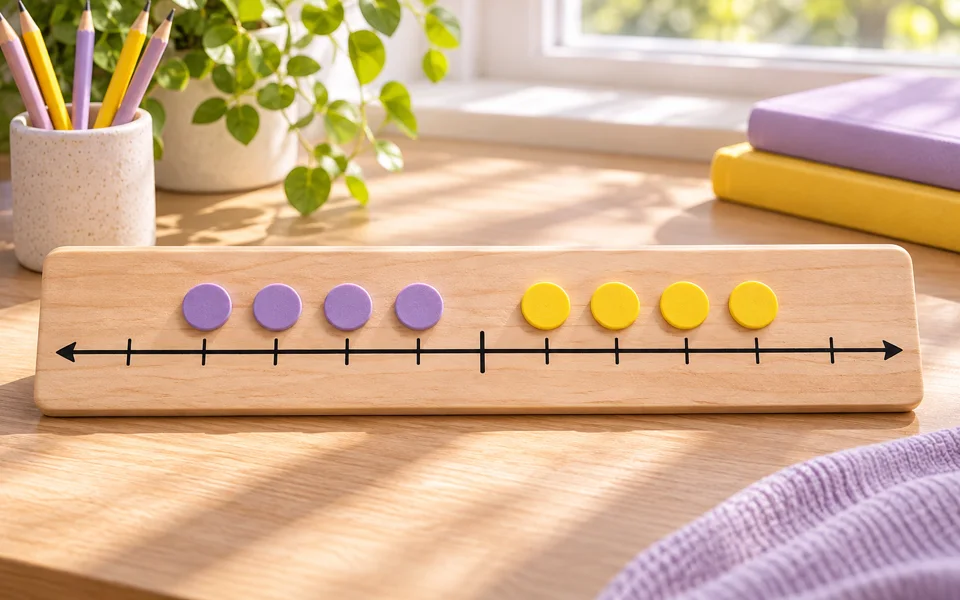
Tracking a temperature across zero
The temperature starts at minus six degrees and rises by nine. Six degrees of warming bring it to zero. The remaining three degrees bring it to positive three. A fall of five degrees from there ends at minus two. Read each move from the previous position.
Identify Expressions and Equations
What is the difference in English between a phrase and a sentence? A phrase expresses a single thought that is incomplete by itself, but a sentence makes a complete statement. “Running very fast” is a phrase, but “The football player was running very fast” is a sentence. A sentence has a subject and a verb.
In algebra, we have expressions and equations. An expression is like a phrase. Here are some examples of expressions and how they relate to word phrases:
| Expression | Words | Phrase |
| the sum of three and five | ||
| minus one | the difference of and one | |
| the product of six and seven | ||
| divided by | the quotient of and |
Notice that the phrases do not form a complete sentence because the phrase does not have a verb. An equation is two expressions linked with an equal sign. When you read the words the symbols represent in an equation, you have a complete sentence in English. The equal sign gives the verb. Here are some examples of equations:
| Equation | Sentence |
| The sum of three and five is equal to eight. | |
| minus one equals fourteen. | |
| The product of six and seven is equal to forty-two. | |
| is equal to fifty-three. | |
| plus nine is equal to two minus three. |
Determine if each is an expression or an equation:
- ⓐ
- ⓑ
- ⓒ
- ⓓ
Solution
Solution
| ⓐ | This is an equation—two expressions are connected with an equal sign. |
| ⓑ | This is an expression—no equal sign. |
| ⓒ | This is an expression—no equal sign. |
| ⓓ | This is an equation—two expressions are connected with an equal sign. |
Simplify Expressions with Exponents
To simplify a numerical expression means to do all the math possible. For example, to simplify we’d first multiply to get and then add the to get A good habit to develop is to work down the page, writing each step of the process below the previous step. The example just described would look like this:
Suppose we have the expression We could write this more compactly using exponential notation. Exponential notation is used in algebra to represent a quantity multiplied by itself several times. We write as and as In expressions such as the is called the base and the is called the exponent. The exponent tells us how many factors of the base we have to multiply.

We say is in exponential notation and is in expanded notation.
For powers of and we have special names.
table lists some examples of expressions written in exponential notation.
| Exponential Notation | In Words |
| to the second power, or squared | |
| to the third power, or cubed | |
| to the fourth power | |
| to the fifth power |
Write each expression in exponential form:
- ⓐ
- ⓑ
- ⓒ
- ⓓ
Solution
Solution
| ⓐ The base 16 is a factor 7 times. | |
| ⓑ The base 9 is a factor 5 times. | |
| ⓒ The base is a factor 4 times. | |
| ⓓ The base is a factor 8 times. |
Write each exponential expression in expanded form:
- ⓐ
- ⓑ
Solution
Solution
ⓐ The base is and the exponent is so means
ⓑ The base is and the exponent is so means
To simplify an exponential expression without using a calculator, we write it in expanded form and then multiply the factors.
Simplify:
Solution
Solution
| Expand the expression. | |
| Multiply left to right. | |
| Multiply. |
Identify Multiples of Numbers
Annie is counting the shoes in her closet. The shoes are matched in pairs, so she doesn’t have to count each one. She counts by twos: She has shoes in her closet.
The numbers are called multiples of Multiples of can be written as the product of a counting number and The first six multiples of are given below.
A multiple of a number is the product of the number and a counting number. So a multiple of would be the product of a counting number and Below are the first six multiples of
We can find the multiples of any number by continuing this process. table shows the multiples of through for the first twelve counting numbers.
| Counting Number | ||||||||||||
Recognizing the patterns for multiples of will be helpful to you as you continue in this course.
diagram shows the counting numbers from to Multiples of are highlighted. Do you notice a pattern?

The last digit of each highlighted number in diagram is either This is true for the product of and any counting number. So, to tell if any number is a multiple of look at the last digit. If it is then the number is a multiple of
Determine whether each of the following is a multiple of
- ⓐ
- ⓑ
Solution
Solution
| ⓐ | |
| Is 489 a multiple of 2? | |
| Is the last digit 0, 2, 4, 6, or 8? | No. |
| 489 is not a multiple of 2. |
| ⓑ | |
| Is 3,714 a multiple of 2? | |
| Is the last digit 0, 2, 4, 6, or 8? | Yes. |
| 3,714 is a multiple of 2. |
Now let’s look at multiples of diagram highlights all of the multiples of between and What do you notice about the multiples of

All multiples of end with either or Just like we identify multiples of by looking at the last digit, we can identify multiples of by looking at the last digit.
Determine whether each of the following is a multiple of
- ⓐ
- ⓑ
Solution
Solution
| ⓐ | |
| Is 579 a multiple of 5? | |
| Is the last digit 5 or 0? | No. |
| 579 is not a multiple of 5. |
| ⓑ | |
| Is 880 a multiple of 5? | |
| Is the last digit 5 or 0? | Yes. |
| 880 is a multiple of 5. |
diagram highlights the multiples of between and All multiples of all end with a zero.

Determine whether each of the following is a multiple of
- ⓐ
- ⓑ
Solution
Solution
| ⓐ | |
| Is 425 a multiple of 10? | |
| Is the last digit zero? | No. |
| 425 is not a multiple of 10. |
| ⓑ | |
| Is 350 a multiple of 10? | |
| Is the last digit zero? | Yes. |
| 350 is a multiple of 10. |
diagram highlights multiples of The pattern for multiples of is not as obvious as the patterns for multiples of

Unlike the other patterns we’ve examined so far, this pattern does not involve the last digit. The pattern for multiples of is based on the sum of the digits. If the sum of the digits of a number is a multiple of then the number itself is a multiple of See table.
Consider the number The digits are and and their sum is Since is a multiple of we know that is also a multiple of
Determine whether each of the given numbers is a multiple of
- ⓐ
- ⓑ
Solution
Solution
ⓐ Is a multiple of
| Find the sum of the digits. | |
| Is 15 a multiple of 3? | Yes. |
| If we're not sure, we could add its digits to find out. We can check it by dividing 645 by 3. | |
| The quotient is 215. |
ⓑ Is a multiple of
| Find the sum of the digits. | |
| Is 16 a multiple of 3? | No. |
| So 10,519 is not a multiple of 3 either.. | |
| We can check this by dividing by 10,519 by 3. |
When we divide by we do not get a counting number, so is not the product of a counting number and It is not a multiple of
Look back at the charts where you highlighted the multiples of of and of Notice that the multiples of are the numbers that are multiples of both and That is because Likewise, since the multiples of are the numbers that are multiples of both and
Use Common Divisibility Tests
Another way to say that is a multiple of is to say that is divisible by In fact, is so is Notice in source illustration or discussion that is not a multiple When we divided by we did not get a counting number, so is not divisible by
Since multiplication and division are inverse operations, the patterns of multiples that we found can be used as divisibility tests. table summarizes divisibility tests for some of the counting numbers between one and ten.
| Divisibility Tests | |
| A number is divisible by | |
| if the last digit is | |
| if the sum of the digits is divisible by | |
| if the last digit is or | |
| if divisible by both and | |
| if the last digit is |
Determine whether is divisible by
Solution
Solution
table applies the divisibility tests to In the far right column, we check the results of the divisibility tests by seeing if the quotient is a whole number.
| Divisible by…? | Test | Divisible? | Check |
| Is last digit Yes. | yes | ||
| Yes. | yes | ||
| Is last digit or Yes. | yes | ||
| Is last digit Yes. | yes |
Thus, is divisible by
Determine whether is divisible by
Solution
Solution
table applies the divisibility tests to and tests the results by finding the quotients.
| Divisible by…? | Test | Divisible? | Check |
| Is last digit No. | no | ||
| Yes. | yes | ||
| Is last digit is or Yes. | yes | ||
| Is last digit No. | no |
Thus, is divisible by and but not or
Find the Least Common Multiple (LCM) of Two Numbers
One of the reasons we look at multiples and primes is to use these techniques to find the least common multiple of two numbers. This will be useful when we add and subtract fractions with different denominators.
Listing Multiples Method
A common multiple of two numbers is a number that is a multiple of both numbers. Suppose we want to find common multiples of and We can list the first several multiples of each number. Then we look for multiples that are common to both lists—these are the common multiples.
We see that and appear in both lists. They are common multiples of and We would find more common multiples if we continued the list of multiples for each.
The smallest number that is a multiple of two numbers is called the least common multiple (LCM). So the least LCM of and is
Find the LCM of and by listing multiples.
Solution
Solution
List the first several multiples of and of Identify the first common multiple.
The smallest number to appear on both lists is so is the least common multiple of and
Notice that is on both lists, too. It is a common multiple, but it is not the least common multiple.
Prime Factors Method
Another way to find the least common multiple of two numbers is to use their prime factors. We’ll use this method to find the LCM of and
We start by finding the prime factorization of each number.
Then we write each number as a product of primes, matching primes vertically when possible.
Now we bring down the primes in each column. The LCM is the product of these factors.
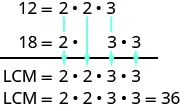
Notice that the prime factors of and the prime factors of are included in the LCM. By matching up the common primes, each common prime factor is used only once. This ensures that is the least common multiple.
Find the LCM of and using the prime factors method.
Solution
Solution
| Write each number as a product of primes. |  |
| Write each number as a product of primes, matching primes vertically when possible. |  |
| Bring down the primes in each column. | 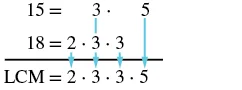 |
| Multiply the factors to get the LCM. | The LCM of 15 and 18 is 90. |
Find the LCM of and using the prime factors method.
Solution
Solution
| Write the prime factorization of each number. |  |
| Write each number as a product of primes, matching primes vertically when possible. |  |
| Bring down the primes in each column. | 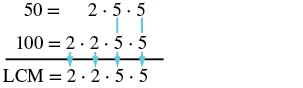 |
| Multiply the factors to get the LCM. | The LCM of 50 and 100 is 100. |
Key Concepts
- Find the prime factorization of a composite number using the tree method.
- Find any factor pair of the given number, and use these numbers to create two branches.
- If a factor is prime, that branch is complete. Circle the prime.
- If a factor is not prime, write it as the product of a factor pair and continue the process.
- Write the composite number as the product of all the circled primes.
- Find the prime factorization of a composite number using the ladder method.
- Divide the number by the smallest prime.
- Continue dividing by that prime until it no longer divides evenly.
- Divide by the next prime until it no longer divides evenly.
- Continue until the quotient is a prime.
- Write the composite number as the product of all the primes on the sides and top of the ladder.
- Find the LCM by listing multiples.
- List the first several multiples of each number.
- Look for multiples common to both lists. If there are no common multiples in the lists, write out additional multiples for each number.
- Look for the smallest number that is common to both lists.
- This number is the LCM.
- Find the LCM using the prime factors method.
- Find the prime factorization of each number.
- Write each number as a product of primes, matching primes vertically when possible.
- Bring down the primes in each column.
- Multiply the factors to get the LCM.
Simplify Expressions Using the Order of Operations
We’ve introduced most of the symbols and notation used in algebra, but now we need to clarify the order of operations. Otherwise, expressions may have different meanings, and they may result in different values.
For example, consider the expression:
Imagine the confusion that could result if every problem had several different correct answers. The same expression should give the same result. So mathematicians established some guidelines called the order of operations, which outlines the order in which parts of an expression must be simplified.
Students often ask, “How will I remember the order?” Here is a way to help you remember: Take the first letter of each key word and substitute the silly phrase. Please Excuse My Dear Aunt Sally.
| Order of Operations | |
| Please | Parentheses |
| Excuse | Exponents |
| My Dear | Multiplication and Division |
| Aunt Sally | Addition and Subtraction |
It’s good that ‘My Dear’ goes together, as this reminds us that multiplication and division have equal priority. We do not always do multiplication before division or always do division before multiplication. We do them in order from left to right.
Similarly, ‘Aunt Sally’ goes together and so reminds us that addition and subtraction also have equal priority and we do them in order from left to right.
Simplify the expressions:
- ⓐ
- ⓑ
Solution
Solution
| ⓐ | |
 |
|
| Are there any parentheses? No. | |
| Are there any exponents? No. | |
| Is there any multiplication or division? Yes. | |
| Multiply first. |  |
| Add. |  |
 |
| ⓑ | |
 |
|
| Are there any parentheses? Yes. |  |
| Simplify inside the parentheses. |  |
| Are there any exponents? No. | |
| Is there any multiplication or division? Yes. | |
| Multiply. |  |
Simplify:
- ⓐ
- ⓑ
Solution
Solution
| ⓐ | |
 |
|
| Are there any parentheses? No. | |
| Are there any exponents? No. | |
| Is there any multiplication or division? Yes. | |
| Multiply and divide from left to right. Divide. |  |
| Multiply. |  |
| ⓑ | |
 |
|
| Are there any parentheses? No. | |
| Are there any exponents? No. | |
| Is there any multiplication or division? Yes. | |
| Multiply and divide from left to right. | |
| Multiply. |  |
| Divide. |  |
Simplify:
Solution
Solution
 |
|
| Parentheses? Yes, subtract first. |  |
| Exponents? No. | |
| Multiplication or division? Yes. | |
| Divide first because we multiply and divide left to right. |  |
| Any other multiplication or division? Yes. | |
| Multiply. |  |
| Any other multiplication or division? No. | |
| Any addition or subtraction? Yes. |  |
When there are multiple grouping symbols, we simplify the innermost parentheses first and work outward.
Solution
Solution
 |
|
| Are there any parentheses (or other grouping symbol)? Yes. | |
| Focus on the parentheses that are inside the brackets. |  |
| Subtract. |  |
| Continue inside the brackets and multiply. |  |
| Continue inside the brackets and subtract. |  |
| The expression inside the brackets requires no further simplification. | |
| Are there any exponents? Yes. | |
| Simplify exponents. |  |
| Is there any multiplication or division? Yes. | |
| Multiply. |  |
| Is there any addition or subtraction? Yes. | |
| Add. |  |
| Add. |  |
 |
Simplify:
Solution
Solution
 |
|
| If an expression has several exponents, they may be simplified in the same step. | |
| Simplify exponents. |  |
| Divide. |  |
| Add. |  |
| Subtract. |  |
 |