Convert length with the units shown
Convert between twelve metric, international inch–foot–yard–mile, and nautical-mile units. See the conversion factor, a rounded display and the exact value for the number you entered.
Enter a decimal or scientific notation such as 1e-6. No commas, unit text, feet-and-inches notation or fractions. Up to 80 digits and an exponent from −100 to 100 are supported. Signed values are accepted for displacement; an ordinary physical length is nonnegative.
2, 4 or 6 decimal places; Auto shows up to 12 significant digits. Very small or large results use scientific notation; 2, 4 or 6 then sets decimal places in its coefficient. Halfway values round away from zero. Trailing decimal zeros are hidden.
Changing either unit recalculates the same entered number. Swap reverses the unit selectors, not the numerical value. Reset clears the main value and all quick cards, restores feet to meters and selects four decimal places. A copied result is the displayed approximation, not the entire exact fraction.
Quick length conversions
These twelve cards use the same exact factors as the main converter. Their displays use Auto precision. For instance, 12 feet converts to exactly 4 yards, without a rounded 0.33333 multiplier.

The conversion method: cancel the starting unit
A conversion changes the number and its unit while leaving the length itself unchanged. First write a relationship equal to one: 100 cm / 1 m. Multiplying 2.7 m by this ratio cancels meters and leaves 270 cm. If you accidentally use its reciprocal, the units will not cancel the way you need.
Result = input × meters per starting unit ÷ meters per target unit. For 12 feet to centimeters: 12 × 0.3048 ÷ 0.01 = 365.76 cm. The reference table below supplies these exact factors. When converting back, reverse the ratio rather than inventing a second rounded multiplier.
A quick estimate catches many errors. A centimeter is smaller than a meter, so the same length needs more centimeters. A mile is longer than a kilometer, so a distance expressed in kilometers has a larger number. This check tells you the direction, although it does not replace the actual factor.
Metric prefixes: follow the factor, not the number of arrows
The meter (also spelled metre) is the SI base unit of length. Kilo- means 1000, deci- means one tenth, centi- one hundredth, milli- one thousandth, micro- one millionth and nano- one billionth of a meter. Prefix symbols are case-sensitive: mm is millimeter, whereas Mm would mean megameter and is not a selectable unit here.
The simplified route km → m → cm → mm skips some prefixes. Its factors are ×1000, ×100 and ×10, not ×10 at every arrow. In reverse, divide by those same factors. Smaller units give a larger numerical count; the object does not get longer.

Length Conversion Chart – Metric and Imperial
Read each row as equivalent lengths. The metric-only chart and imperial-to-metric values are exact. Nonterminating values in the imperial and mixed charts are rounded to the digits shown. A dash means the value is omitted, not zero. On a phone, swipe a table sideways or focus it and use the arrow keys.
Metric units: common values
| mm | cm | m | km |
|---|---|---|---|
| 1 mm | 0.1 cm | 0.001 m | 0.000001 km |
| 10 mm | 1 cm | 0.01 m | 0.00001 km |
| 100 mm | 10 cm | 0.1 m | 0.0001 km |
| 1,000 mm | 100 cm | 1 m | 0.001 km |
| 10,000 mm | 1,000 cm | 10 m | 0.01 km |
| 100,000 mm | 10,000 cm | 100 m | 0.1 km |
| 1,000,000 mm | 100,000 cm | 1,000 m | 1 km |
Imperial / customary units: common values
| Inches (in) | Feet (ft) | Yards (yd) | Miles (mi) |
|---|---|---|---|
| 1 in | 1/12 ft | 0.0278 yd | 0.0000158 mi |
| 12 in | 1 ft | 1/3 yd | 0.000189 mi |
| 36 in | 3 ft | 1 yd | 0.000568 mi |
| 63,360 in | 5,280 ft | 1,760 yd | 1 mi |
Metric to imperial: key reference values
| Metric | Inches | Feet | Yards | Miles |
|---|---|---|---|---|
| 1 mm | 0.03937 in | 0.003281 ft | 0.001094 yd | — |
| 1 cm | 0.3937 in | 0.03281 ft | 0.01094 yd | — |
| 10 cm | 3.937 in | 0.3281 ft | 0.1094 yd | — |
| 30.48 cm | 12 in | 1 ft | 1/3 yd | — |
| 1 m | 39.37 in | 3.2808 ft | 1.0936 yd | 0.000621 mi |
| 100 m | 3,937 in | 328.08 ft | 109.36 yd | 0.0621 mi |
| 1 km | 39,370 in | 3,280.8 ft | 1,093.6 yd | 0.6214 mi |
| 1.609344 km | 63,360 in | 5,280 ft | 1,760 yd | 1 mi |
Imperial to metric: key reference values
| Imperial | mm | cm | m | km |
|---|---|---|---|---|
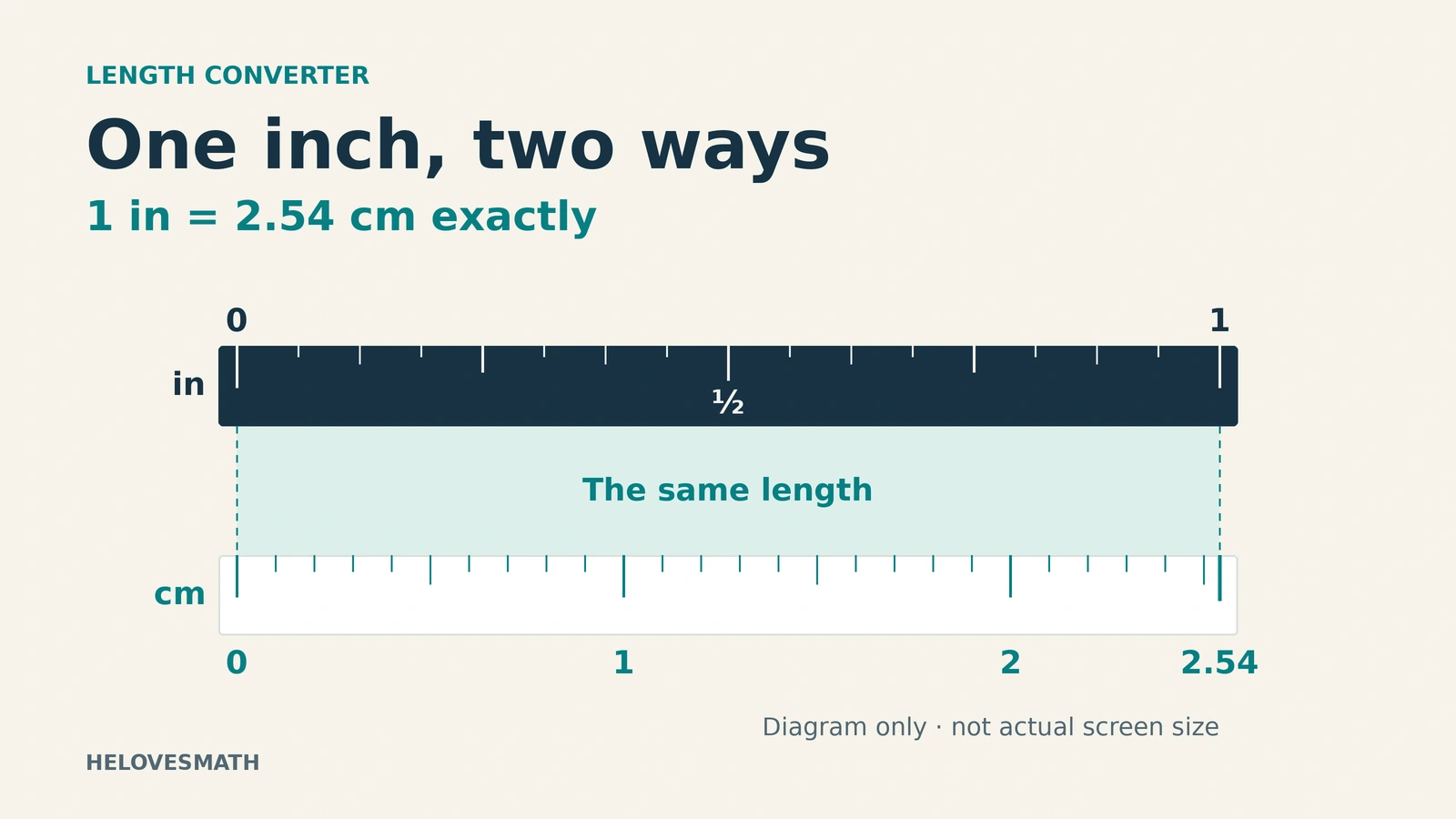
| 1 inch | 25.4 mm | 2.54 cm | 0.0254 m | — |
| 1 foot | 304.8 mm | 30.48 cm | 0.3048 m | 0.0003048 km |
| 1 yard | 914.4 mm | 91.44 cm | 0.9144 m | 0.0009144 km |
| 1 mile | 1,609,344 mm | 160,934.4 cm | 1,609.344 m | 1.609344 km |
Length Units Reference Table
| Unit | Symbol | System | Value in Meters | Common Use |
|---|---|---|---|---|
| Nanometer | nm | Metric | 0.000000001 m (10⁻⁹) | Atomic/molecular scale, light wavelengths |
| Micrometer | μm | Metric | 0.000001 m (10⁻⁶) | Bacteria size, engineering tolerances |
| Millimeter | mm | Metric | 0.001 m | Ruler measurements, rainfall, product specs |
| Centimeter | cm | Metric | 0.01 m | Body measurements, clothing, screen sizes |
| Decimeter | dm | Metric | 0.1 m | One tenth of a meter |
| Meter | m | Metric | 1 m (base unit) | Room dimensions, building heights, athletics |
| Kilometer | km | Metric | 1,000 m | Road distances, maps, geography |
| Inch | in | Imperial | 0.0254 m | Screen diagonals and small lengths |
| Foot | ft | Imperial | 0.3048 m | Height, US construction, floor plans |
| Yard | yd | Imperial | 0.9144 m | American football, fabric, US landscaping |
| Mile | mi | Imperial | 1,609.344 m | Road distances in US and UK |
| Nautical Mile | nmi | Navigation | 1,852 m | Maritime and aviation navigation |
Length conversion formula cheat sheet
Additional exact formulas: inches × 2.54 = centimeters; centimeters × 10 = millimeters; miles × 1.609344 = kilometers; kilometers ÷ 1.609344 = miles; meters ÷ 1000 = kilometers. Use the full factor before rounding.
Worked examples with checks
1. 250 mm to cm
Since 10 mm = 1 cm, divide by 10: 250 ÷ 10 = 25 cm. Check by reversing: 25 × 10 = 250 mm. The number falls because centimeters are the larger unit.
2. 1800 mm to m
There are 1000 mm in a meter: 1800 ÷ 1000 = 1.8 m. Keeping the unit beside each line helps distinguish 1.8 m from 1.8 cm. No rounding is needed.
3. 5 km to mm
First, 5 km = 5000 m. Then 5000 × 1000 = 5000000 mm. Equivalently, 5 × 1000000 gives the same result. Counting only the arrows in a shortened metric diagram can produce the wrong power of ten.
4. 12 ft to m, then back
Use the exact definition: 12 × 0.3048 = 3.6576 m. At two decimal places the display is 3.66 m. To recover exactly 12 ft, divide the unrounded 3.6576 by 0.3048, not the rounded 3.66.
5. 6 ft to yards
One yard contains 3 feet: 6 ÷ 3 = 2 yd. For 1 ft the exact answer is 1/3 yd, a recurring decimal. Rounding 1/3 to 0.33333 before multiplication loses information; use division by 3.
6. 24.5 cm to inches
Compute 24.5 ÷ 2.54 = 1225/127 in, which is approximately 9.64566929134 in and rounds to 9.646 in at three decimal places. This is a length conversion, not a shoe-size recommendation; shoe labels require the manufacturer’s own chart.
7. 1000 mm and 2.5 m to feet
1000 mm = 1 m, so 1000 ÷ 304.8 ≈ 3.28083989501 ft. Similarly, 2.5 ÷ 0.3048 ≈ 8.20209973753 ft. For mixed units, the fractional part 0.20209973753 × 12 is about 2.4252 inches: approximately 8 ft 2.43 in.
8. 5 ft 9 in to centimeters
Convert the components separately: 5 × 30.48 = 152.4 cm and 9 × 2.54 = 22.86 cm. Add to get 175.26 cm. Alternatively, 5 + 9/12 = 5.75 ft, then 5.75 × 30.48 = 175.26. Entering 5.9 ft would instead give 179.832 cm.
9. A mile and a nautical mile
One international mile equals 1.609344 km; one international nautical mile equals 1.852 km. They are different units. For 2 nautical miles, multiply 2 × 1.852 = 3.704 km. A knot is a nautical mile per hour, a speed, so it is outside this length-only converter.
10. A tiny length without a false zero
One millimeter is 0.000001 km = 1e-6 km. A fixed four-decimal display alone would show 0.0000, hiding the nonzero length. This converter switches to scientific notation when the result is too small for the chosen decimal setting. The exact-value line remains available.
Dimensions, area and volume need different factors
For a room described as 12 ft × 10 ft × 8 ft, convert each linear dimension: 3.6576 m × 3.048 m × 2.4384 m. If the task asks for floor area, multiply two lengths. The unit becomes square meters, so the conversion factor is squared.
1 ft² = (0.3048 m)² = 0.09290304 m². Thus 120 ft² = 120 × 0.09290304 = 11.1483648 m². For volume, cube the factor: 1 ft³ = 0.028316846592 m³. Entering 120 into a feet-to-meters length converter cannot answer an area question.

Use the Area Converter for square units. If you need the length between two points before changing its unit, use the Distance Calculator. For a decimal-inch result on a ruler, the Inch Fraction Calculator explains rounding to a chosen fraction.
Exact definitions are different from measurement precision
Some unit relationships are exact by definition, such as 1 in = 2.54 cm. A measurement taken with a ruler still has uncertainty. Writing more decimal digits after conversion does not make that ruler more accurate. Keep extra digits during the calculation, then choose a final precision appropriate to the original measurement and its use.
This tool treats your entered decimal as an exact rational number. It combines it with exact unit factors using integer arithmetic, then rounds the display. It does not infer significant figures from your input, propagate measurement uncertainty or certify an engineering result. The exact-value line may show a fraction when a decimal repeats or would be very long.
At an exact halfway rounding case, this tool rounds away from zero: 1.005 m to two decimal places displays 1.01 m; −1.005 m displays −1.01 m. Other standards may use half-to-even. State the rounding convention if you are following a laboratory, exam or reporting rule. Auto is a convenient display of up to twelve significant digits, not unlimited precision.
The international foot used here is exactly 0.3048 m. Historical U.S. survey data may instead use 1200/3937 m per foot. That older unit was superseded for modern use from January 1, 2023, but legacy files still need their specified definition. This calculator does not convert survey feet; do not silently relabel old survey coordinates.
Common mistakes and practical limits
- Using a rounded multiplier as an exact definition. Divide meters by 0.3048 rather than treating 3.28084 as the exact number of feet per meter.
- Reading a unit label as a size standard. A screen diagonal, foot length or product dimension can be converted; a shoe size or nominal timber size cannot be inferred from that conversion alone.
- Using the illustration as a physical ruler. Browser zoom, screen density and printing scale change its size. The diagrams teach relationships and are not calibrated measurement devices.
- Mixing signed displacement and distance. −3 m may describe a displacement along a chosen axis; its displacement magnitude is 3 m. Conversion preserves the sign and does not choose the physical interpretation.
- Rounding before a reverse conversion. Reuse the exact value or the original input when possible. A round trip through a shortened display can differ slightly.
- Confusing decimal feet with feet and inches. The decimal fraction of a foot is multiplied by 12 to obtain inches. It is not read as an inch count.
Practice: try first, then reveal the answer
Include a unit in every answer. Exact answers are shown unless the question requests rounding.
1. 0.75 km to m
0.75 × 1000 = 750 m.
2. 4250 mm to m
4250 ÷ 1000 = 4.25 m.
3. 3.5 in to cm
3.5 × 2.54 = 8.89 cm.
4. 18 ft to yd
18 ÷ 3 = 6 yd.
5. 2 mi to km
2 × 1.609344 = 3.218688 km.
6. 500 μm to mm
500 ÷ 1000 = 0.5 mm.
7. 2.54 cm to in
2.54 ÷ 2.54 = 1 in, exactly. A rounded reciprocal would miss this exact result.
8. 6 ft 2 in to cm
6 × 30.48 + 2 × 2.54 = 182.88 + 5.08 = 187.96 cm.
9. 10 ft² to m²
Use the squared factor: 10 × 0.09290304 = 0.9290304 m². This is an area problem, not a linear conversion.
10. 1 nm to m
0.000000001 m = 1e-9 m. It is not zero.
11. −2.5 m displacement to cm
−2.5 × 100 = −250 cm. The displacement magnitude is 250 cm.
12. Is 5.9 ft equal to 5 ft 9 in?
No. 0.9 × 12 = 10.8, so 5.9 ft = 5 ft 10.8 in. Meanwhile, 5 ft 9 in = 5.75 ft.
Frequently asked questions
How do I convert feet to meters?
Multiply feet by exactly 0.3048. For example, 10 ft = 3.048 m. Reverse the conversion by dividing meters by 0.3048.
How many millimeters are in a kilometer?
Exactly 1000000. One kilometer contains 1000 meters, and each meter contains 1000 millimeters.
What does Auto mean?
It displays up to twelve significant digits, removing unnecessary trailing decimal zeros. The exact-value line gives a finite decimal or rational fraction for the entered number.
Why does my result contain e?
It is scientific notation. For example, 1e-6 km means 1 × 10⁻⁶ km, or 0.000001 km. Scientific notation keeps a small nonzero value visible.
Can I enter feet and inches or a fraction?
Convert mixed units first: 5 ft 9 in becomes 5.75 ft. For 3/8 inch, enter 0.375 in. The input accepts decimals and scientific notation, not unit text or fraction bars.
Does the tool handle square or cubic units?
No. Use squared or cubed conversion factors for area or volume, as explained above. A length factor alone will not give the correct result.
Can I convert centimeters into a shoe size?
The converter can give foot length in inches. Shoe sizing depends on the manufacturer, sizing system and fit allowance; use the relevant size chart.
Are meters and metres different units?
No. They are different spellings of the same SI unit, symbol m. Likewise, centimeter and centimetre refer to the same unit.
Related calculators
The Scientific Calculator supports follow-on calculations. Keep the unit alongside each intermediate result when you use a general calculator.
Sources & References
Primary references reviewed October 4, 2026. NIST pages were readable through web research; direct automated requests returned HTTP 403, so access may vary. The worked examples, questions and diagrams are original teaching material.
- BIPM: the SI metre — the SI base unit of length.
- BIPM: SI prefixes — exact decimal multiples and submultiples.
- NIST Guide to the SI, Appendix B — conversion-factor use, international-foot definition and rounding guidance. The calculator’s explicitly stated halfway rule is away from zero.
- NIST conversion factors by quantity — inch, foot, yard, mile and nautical-mile factors.
- NIST: U.S. survey foot — modern definition and the exception for historical/legacy applications.