Convert mass between ten units
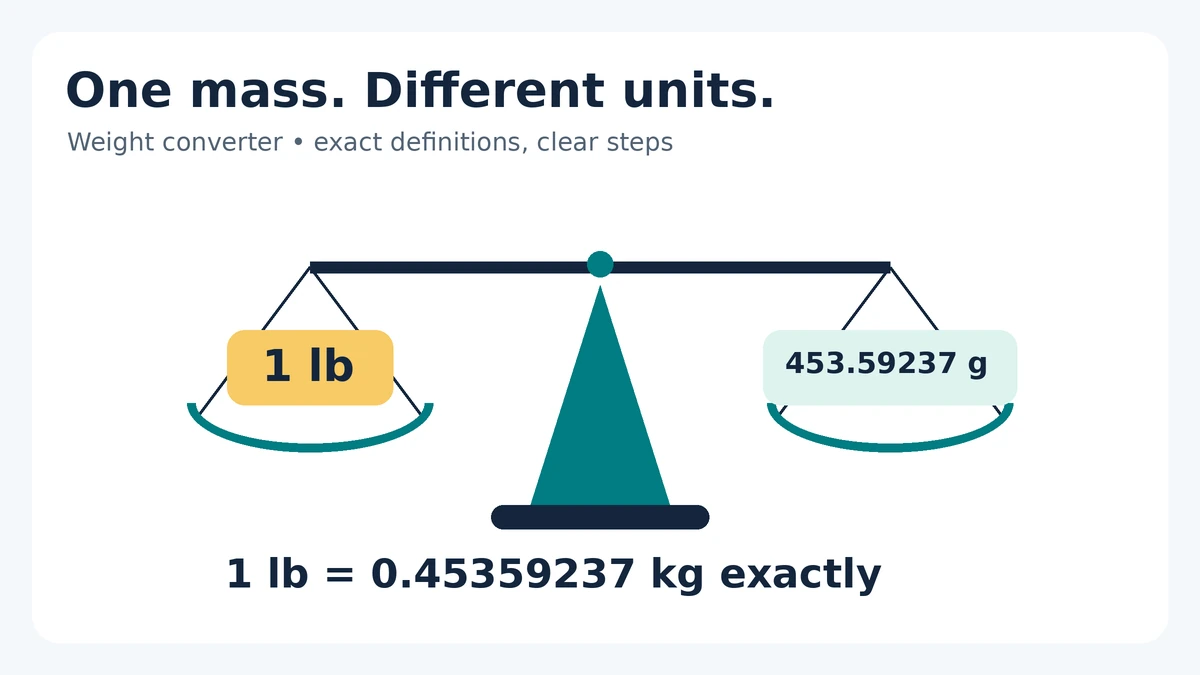
1 pound = 0.45359237 kilograms exactly. Divide kilograms by 0.45359237 to get pounds; multiply pounds by that factor to get kilograms. Use the converter for metric units, everyday ounces, stone, three kinds of ton, and troy ounces.
Although everyday language calls this a “weight converter,” kg and lb here are units of mass. Physical weight is a force: see the mass, gravity and weight explanation for F = mg and newtons.
Enter a nonnegative number without commas or units. Scientific notation is accepted (2.5e3 = 2500). Limits: zero, or 1e-300 to 1e300; at most 100 significant digits and 256 characters. Decimal-place buttons show up to 2, 4 or 6 places; very small or large results use scientific notation.
Quick Weight Conversions – Most Popular Pairs
kg to Stone and Pounds – Dedicated Converter
Stone is used in the UK and Ireland to express body weight. 1 stone = 14 pounds = 6.35029318 kg exactly. Use this dedicated tool to convert between kg, stone, and pounds in one step. In the mixed fields, enter a whole number of stones and a pounds remainder from 0 up to, but not including, 14. One blank component means zero; both blank clears the result. For decimal stones such as 11.5 st, use the main converter.
Weight Conversion Chart
These are mass conversions using the exact factors below. Displayed results are rounded; trailing zeros are omitted. Total pounds are rounded before splitting into groups of 14, so a rounded remainder never equals 14.
kg to lbs – common values
| Kilograms (kg) | Pounds (lb) | Stone + lb | Grams (g) |
|---|---|---|---|
| 1 kg | 2.205 lb | 0 st 2.205 lb | 1,000 g |
| 5 kg | 11.023 lb | 0 st 11.023 lb | 5,000 g |
| 10 kg | 22.046 lb | 1 st 8.046 lb | 10,000 g |
| 20 kg | 44.092 lb | 3 st 2.092 lb | 20,000 g |
| 45 kg | 99.208 lb | 7 st 1.208 lb | 45,000 g |
| 50 kg | 110.231 lb | 7 st 12.231 lb | 50,000 g |
| 55 kg | 121.254 lb | 8 st 9.254 lb | 55,000 g |
| 60 kg | 132.277 lb | 9 st 6.277 lb | 60,000 g |
| 70 kg | 154.324 lb | 11 st 0.324 lb | 70,000 g |
| 75 kg | 165.347 lb | 11 st 11.347 lb | 75,000 g |
| 80 kg | 176.37 lb | 12 st 8.37 lb | 80,000 g |
| 90 kg | 198.416 lb | 14 st 2.416 lb | 90,000 g |
| 100 kg | 220.462 lb | 15 st 10.462 lb | 100,000 g |
| 110 kg | 242.508 lb | 17 st 4.508 lb | 110,000 g |
| 120 kg | 264.555 lb | 18 st 12.555 lb | 120,000 g |
lbs to kg – common values
| Pounds (lb) | Kilograms (kg) | Stone + lb | Grams (g) |
|---|---|---|---|
| 1 lb | 0.454 kg | 0 st 1 lb | 453.592 g |
| 10 lb | 4.536 kg | 0 st 10 lb | 4535.924 g |
| 50 lb | 22.68 kg | 3 st 8 lb | 22679.619 g |
| 100 lb | 45.359 kg | 7 st 2 lb | 45359.237 g |
| 130 lb | 58.967 kg | 9 st 4 lb | 58967.008 g |
| 150 lb | 68.039 kg | 10 st 10 lb | 68038.856 g |
| 160 lb | 72.575 kg | 11 st 6 lb | 72574.779 g |
| 175 lb | 79.379 kg | 12 st 7 lb | 79378.665 g |
| 190 lb | 86.183 kg | 13 st 8 lb | 86182.55 g |
| 200 lb | 90.718 kg | 14 st 4 lb | 90718.474 g |
oz to g – common values
| Ounces (oz) | Grams (g) | Pounds (lb) | Kilograms (kg) |
|---|---|---|---|
| 1 oz | 28.35 g | 0.0625 lb | 0.02835 kg |
| 4 oz | 113.398 g | 0.25 lb | 0.113398 kg |
| 8 oz | 226.796 g | 0.5 lb | 0.226796 kg |
| 12 oz | 340.194 g | 0.75 lb | 0.340194 kg |
| 16 oz | 453.592 g | 1 lb | 0.453592 kg |
| 32 oz | 907.185 g | 2 lb | 0.907185 kg |
Metric Weight System – g, kg, mg, tonne
The metric system organizes mass using decimal prefixes:
- 1 tonne (metric ton) = 1,000 kg
- 1 kilogram (kg) = 1,000 g (the SI base unit of mass)
- 1 gram (g) = 1,000 mg
- 1 milligram (mg) = 0.001 g = 0.000001 kg
| Unit | mg | g | kg | tonne |
|---|---|---|---|---|
| 1 mg | 1 | 0.001 | 0.000001 | 0.000000001 |
| 1 g | 1,000 | 1 | 0.001 | 0.000001 |
| 100 g | 100,000 | 100 | 0.1 | 0.0001 |
| 500 g | 500,000 | 500 | 0.5 | 0.0005 |
| 1 kg | 1,000,000 | 1,000 | 1 | 0.001 |
| 10 kg | 10,000,000 | 10,000 | 10 | 0.01 |
| 100 kg | 100,000,000 | 100,000 | 100 | 0.1 |
| 1,000 kg | 1,000,000,000 | 1,000,000 | 1,000 | 1 |
Weight Units Reference Table
All kilogram factors in this table are exact definitions or exact products of definitions. NIST Handbook 44 gives the pound and the integer relationships; the kilogram is the SI unit of mass. “lb” and “oz” in this tool mean avoirdupois unless troy is explicitly selected.
| Unit | Symbol | System | Exact mass in kg | Use / relationship |
|---|---|---|---|---|
| Milligram | mg | Metric | 0.000001 | Small laboratory masses |
| Gram | g | Metric | 0.001 | Food portions, postage |
| Kilogram | kg | SI base unit | 1 | Mass in science and everyday use |
| Metric tonne | t | Metric | 1000 | Cargo and industrial mass |
| Ounce, avoirdupois | oz | Imperial / US customary | 0.028349523125 | Everyday ounce; 1/16 lb |
| Pound, avoirdupois | lb | Imperial / US customary | 0.45359237 | Shipping and everyday mass |
| Stone | st | Imperial | 6.35029318 | 14 lb |
| US short ton | short ton | US customary | 907.18474 | 2000 lb |
| UK long ton | long ton | Imperial | 1016.0469088 | 2240 lb |
| Troy ounce | troy oz | Troy | 0.0311034768 | Commonly used for precious metals |
Weight Conversion Formula Cheat Sheet
Common conversion examples
Answers below are rounded to three decimal places. Use the main converter for a different display precision.
How the conversion works
Choose one common unit as a bridge. This converter uses kilograms: multiply by the source unit’s kilogram factor, then divide by the destination unit’s factor. If a quantity is x in unit A, the number in unit B is x × (kg per A) ÷ (kg per B). The units cancel, leaving the unit you want.
For 2.5 lb to grams, write 2.5 lb × 0.45359237 kg/lb × 1000 g/kg. Both “lb” and “kg” cancel, leaving 1133.980925 g. This check prevents multiplying by an upside-down conversion factor. A larger unit gives a smaller numerical value for the same mass: kilograms to grams increases the number, while grams to kilograms decreases it.
Exact conversion factors do not make a measurement exact. If a scale reads 2.5 kg, displaying many decimal places after conversion cannot recover precision the scale did not measure. Round the final answer to suit the measurement or the question; keep extra digits during intermediate steps. The 12-significant-digit display is still rounded when a quotient repeats.
Six worked examples, step by step
1. Convert 75 kg to stone and pounds
First find total pounds: 75 ÷ 0.45359237 ≈ 165.346696639 lb. Eleven complete groups of 14 use 154 lb. The remainder is about 11.346696639 lb, so 75 kg ≈ 11 st 11.35 lb to the nearest hundredth of a pound.
Do not read 11.81 decimal stones as 11 st 81 lb. The fractional part of a stone must be multiplied by 14. If rounding a remainder gives 14.00 lb, carry one stone and show 0 lb.
2. Convert 12 stone 6 pounds to kg
Combine the two parts first: 12 × 14 + 6 = 174 lb. Then 174 × 0.45359237 = 78.92507238 kg. Thus 12 st 6 lb ≈ 78.93 kg to two decimal places. Multiplying 12.6 by the stone factor would describe a different mass.

3. Convert 12 oz to grams
Select the everyday avoirdupois ounce: 12 × 28.349523125 = 340.1942775 g. Therefore 12 oz ≈ 340.19 g. Since 16 oz = 1 lb, twelve ounces is exactly three quarters of a pound, not just under it.
4. Convert 2.5 lb to grams
One pound is exactly 453.59237 g. Multiplying gives 2.5 × 453.59237 = 1133.980925 g. To the nearest gram this is 1134 g; to four decimal places in kilograms it is 1.1340 kg. These are rounded descriptions of the same mass.
5. Convert 2500 g to kg, then mg
Because 1000 g = 1 kg, divide by 1000: 2500 g = 2.5 kg. Because 1 g = 1000 mg, multiply by 1000 in the other direction: 2500 g = 2,500,000 mg. Notice that “kilo” and “milli” change the numerical value in opposite directions.

6. Compare the three tons
A 2-ton load is ambiguous without its system. Two US short tons = 2 × 2000 lb = 1814.36948 kg. Two metric tonnes = 2000 kg. Two UK long tons = 2 × 2240 lb = 2032.0938176 kg. The largest and smallest differ by 217.7243376 kg. Identify the unit before converting.
Practice: eight questions with explained answers
Try each one before opening its answer. Factors are exact; use the requested rounding only at the end.
1. Convert 3.2 kg to grams.
3.2 × 1000 = 3200 g. A gram is smaller than a kilogram, so the number increases.
2. Convert 500 mg to kg.
500 ÷ 1,000,000 = 0.0005 kg. Moving mg → g → kg divides by 1000 twice.
3. Convert 150 lb to kg to two decimal places.
150 × 0.45359237 = 68.0388555 kg, which rounds to 68.04 kg.
4. Write 160 lb as stone and pounds.
160 = 11 × 14 + 6, so the result is exactly 11 st 6 lb. The remainder is below 14.
5. Convert 2 lb 8 oz to kg to four decimal places.
8 oz = 8/16 lb = 0.5 lb. Total mass is 2.5 lb, so 2.5 × 0.45359237 = 1.133980925 kg ≈ 1.1340 kg.
6. Convert 0.75 metric tonnes to kg.
0.75 × 1000 = 750 kg. This uses a metric tonne, not either pound-based ton.
7. Which is heavier: one troy ounce or one everyday ounce, and by how much?
One troy ounce is heavier. 31.1034768 − 28.349523125 = 2.753953675 g. Relative to the everyday ounce, that is about 9.71%.
8. Is 11.5 stone the same as 11 stone 5 pounds?
No. 0.5 stone = 7 lb, so 11.5 st = 11 st 7 lb. In kilograms, 11.5 × 6.35029318 = 73.02837157 kg.
Weight & BMI – What's the Difference?
Common weight-to-BMI searches — such as "convert kg to BMI" or "BMI to kg conversion" — cannot be answered with weight alone. A person weighing 70 kg at 1.60 m has a different BMI than someone at 1.80 m. Use this converter to express your weight in the units your BMI calculator requires, then use the BMI tool for the full calculation.
Common Weight Conversion Mistakes
Ounces are not fluid ounces. An ounce here measures mass; a fluid ounce measures volume. Use the fluid-ounce to milliliter converter for volume, or the density-based liters to kilograms calculator when changing between volume and mass.

- Confusing kg and lbs. 1 kg ≠ 1 lb. 1 kg ≈ 2.205 lbs. A person saying "I weigh 70" means very different things in kilograms versus pounds.
- Forgetting that 1 stone = 14 pounds — not 10 or 12. Stone is often confused with other units. The conversion is exactly 14 lbs per stone.
- Rounding 1 kg = 2.2 lbs as exact. 1 kg ≈ 2.20462 lb. The exact operation is kg ÷ 0.45359237. More displayed digits do not establish measurement accuracy.
- Mixing grams and kilograms. A recipe calling for "500 g" is 0.5 kg, not 500 kg. Always confirm the prefix: "kilo" means ×1000.
- Confusing troy ounces with avoirdupois ounces. 1 troy oz = 31.1034768 g; 1 everyday avoirdupois oz = 28.349523125 g. Troy ounces are commonly used for precious metals. Choose the unit named by the source.
- Confusing weight with BMI. The everyday “weight” in kg or lb is a mass measurement. BMI is a ratio calculated from mass and height; it is not a direct measurement of body composition. They cannot be directly converted into each other without the height value.
- Mixing US tons and metric tonnes. 1 US short ton = 2,000 lbs ≈ 907 kg. 1 metric tonne = 1,000 kg ≈ 2,205 lbs. They are close but not the same — using the wrong one in shipping or industrial contexts creates real errors.
Frequently Asked Questions
Related Calculators
Sources & References
Primary definitions checked October 5, 2026. NIST references were readable in research, but direct automated requests returned HTTP 403; availability may depend on the connection. The explanations, questions and illustrations above are original worked applications of these definitions.
- NIST Handbook 44, Appendix C: General Tables of Units of Measurement (PDF) — pound, ounce, troy, stone and ton relationships; exact pound-to-gram definition.
- NIST Guide to the SI, Appendix B.9 — mass and force conversion tables. Some displayed factors are rounded; exact relationships from Handbook 44 are used in this tool.
- BIPM: SI base unit kilogram — the kilogram is the SI unit of mass.