
Turn decimal inches into a simplified ruler fraction. Choose a grid from 1/2 to 1/128 inch, compare rounding methods, and see exactly how much the rounded value differs from your input.
Convert decimal inches to fractions
Example: 12.375 in = 12 3/8 in exactly. For a value between ruler marks, choose how to round.
Plain decimals only, up to 12 decimal places; whole feet. Each input and the total: at most 1,000,000,000 in magnitude. Signed components use 12 × feet + inches. Input guide.
Your inch fraction result
12 3/8 in
Default example: 12.375 in on the 1/16-in grid; exact match.
- Input inches
- 12.375 in
- Rounded decimal inches
- 12.375 in
- Input millimeters
- 314.325 mm
- Rounded millimeters
- 314.325 mm
- Signed rounding error
- 0 in / 0 mm
- Normalized feet and inches
- 1 ft 0 3/8 in
3/8 of an inch, after 12 whole inches. Diagram is not to physical scale.
Calculation steps
- 12.375 × 16 = 198 grid intervals.
- 198/16 = 99/8 = 12 3/8 in, so no rounding is needed.
Exact fraction or nearest ruler mark?
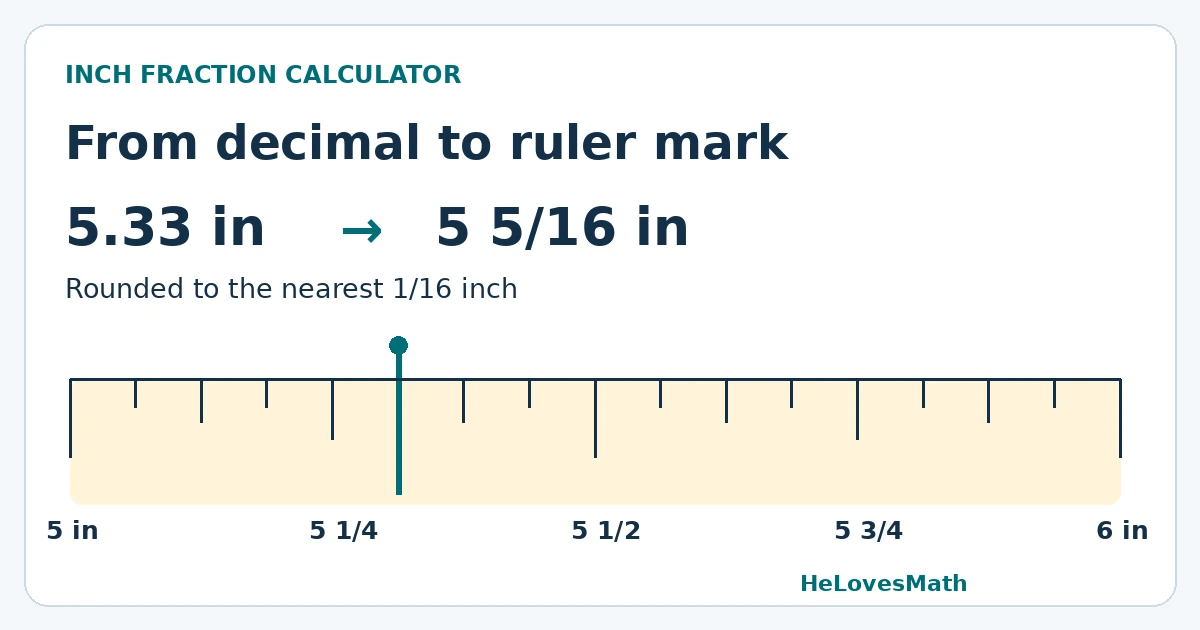
0.375 in = 3/8 in exactly. But 0.33 in = 33/100 in, not exactly 1/3 in and not exactly 5/16 in. On a ruler marked in sixteenths, the nearest available mark is 5/16 in = 0.3125 in. The calculator answers the second question: which mark on your selected fractional-inch grid should represent the decimal you entered?
That distinction matters whenever a decimal dimension is transferred to a ruler, drawing, craft pattern, or workshop layout. An equals sign means the values match; an approximation sign, ≈, means some difference remains. The signed error shown above makes that difference visible.
A ruler fraction is still an ordinary fraction. For help changing between mixed and improper forms, use the mixed number calculator. For the decimal-place meaning of 0.375, review decimal place value.
How to use the inch fraction calculator
- Choose your input form. Decimal Inches accepts a complete value such as 12.375. Feet + Decimal Inches accepts separate components, such as 5 and 7.625. It combines them using 12 × feet + inches.
- Choose a grid. A denominator of 16 means multiples of 1/16 inch. Available grids run from halves to 128ths. The fraction is simplified after rounding, so a result of 6/16 appears as 3/8.
- Choose rounding. Nearest uses the closest grid mark; at an exact halfway point, this tool rounds away from zero. Down and Up use the numerical meanings explained below.
- Read the error and units. Compare the input with the rounded decimal, the input and rounded millimeters, and the normalized feet-and-inches result. Confirm that the chosen error is acceptable for your task.
Enter plain decimals with a dot, up to 12 decimal places. Do not enter commas, inch symbols, fractions, or scientific notation. Feet must be whole numbers. Each component and the combined total are limited to a magnitude of 1,000,000,000. A blank is not zero: type 0 when you mean zero.
Signed entries are allowed for offsets. In feet mode, signs belong to their individual inputs: 5 ft plus −7.625 in means 60 − 7.625 = 52.375 in. A negative normalized result is written with its sign outside parentheses, for example −(1 ft 2 in) = −14 in. For an ordinary physical length, use nonnegative inputs.
The conversion method, step by step
Let x be the input in inches and D the selected denominator. Work with the total number of grid intervals, so carrying across a whole inch happens automatically:
Grid intervals = x × D
Rounded inches = rounded grid intervals ÷ D
Signed error = rounded inches − input inches
For 5.33 in to the nearest 1/16 in: 5.33 × 16 = 85.28 intervals. The nearest whole number is 85. Therefore 85/16 = 5 + 5/16, so 5.33 in ≈ 5 5/16 in. Its decimal value is 5.3125 in and its signed error is 5.3125 − 5.33 = −0.0175 in. A negative error means the rounded answer is smaller than the input.
To simplify a fraction, divide its numerator and denominator by their greatest common divisor. For 0.375 in on a sixteenth-inch grid, 0.375 × 16 = 6. Then 6/16 = 3/8. This time there is no rounding error.
Nearest, down, and up are different operations
- Nearest: choose the closest grid mark. Exact halfway ties go away from zero in this calculator: 0.1875 in at eighths becomes 1/4 in, and −0.1875 in becomes −1/4 in.
- Down: choose the greatest grid value that does not exceed the input, also called rounding toward negative infinity. −1.2 in at sixteenths becomes −1 1/4 in.
- Up: choose the least grid value that is not below the input, also called rounding toward positive infinity. −1.2 in at sixteenths becomes −1 3/16 in.
For positive dimensions, Down can keep a rounded value below a stated maximum, and Up can keep it above a stated minimum. These options do not account for cutting losses, material movement, measurement uncertainty, or a required engineering tolerance. Choose the method from the actual task, not the calculator's default.
Choose the grid your ruler and task need
A larger denominator gives smaller steps: 1/32 inch is half of 1/16 inch. With nearest rounding, the absolute rounding error is at most half of one step. This is a bound on the arithmetic approximation, not a guarantee about the accuracy of a physical measurement.
| Grid | Step in inches | Maximum absolute error |
|---|---|---|
| 1/8 | 0.125 | 0.0625 in |
| 1/16 | 0.0625 | 0.03125 in |
| 1/32 | 0.03125 | 0.015625 in |
| 1/64 | 0.015625 | 0.0078125 in |
| 1/128 | 0.0078125 | 0.00390625 in |
If your ruler only shows sixteenths, a displayed 21/64 inch will not suddenly add those marks to it. Conversely, a finer grid can be useful when comparing a supplied decimal with a more finely graduated tool. Follow the drawing or project's specified units and tolerance.


Feet, decimal feet, and carrying into the next foot
One foot equals 12 inches. Thus 5 ft 7.625 in = (5 × 12) + 7.625 = 67.625 in. Since 0.625 = 5/8, this is exactly 5 ft 7 5/8 in.
Decimal feet are different: 5.5 ft = 66 in = 5 ft 6 in. They do not mean 5 ft 5 in. Convert decimal feet to total inches by multiplying by 12, then use Decimal Inches. The Feet field deliberately rejects 5.5 rather than silently discarding its fractional part.
Carry whenever the rounded inches reach 12. For 2 ft 11.99 in at sixteenths, the total is 35.99 in. Multiply by 16 to get 575.84, round to 576, then divide by 16 to get 36 in. That is 3 ft 0 in, with a +0.01 in rounding error. Values above 12 in in the second field are normalized in the same way.
Convert the input and rounded result to millimeters
The international inch is defined as exactly 25.4 millimeters. Multiply inches by 25.4, or divide millimeters by 25.4 to obtain inches. The exact conversion factor does not remove uncertainty in a measurement.
For 12.375 in: 12.375 × 25.4 = 314.325 mm. For 5.33 in, the input is 135.382 mm. Its nearest-sixteenth result, 5.3125 in, is 134.9375 mm. The difference is −0.4445 mm, matching −0.0175 × 25.4.
The calculator keeps the entered decimal and the selected fractional result separate. Its arithmetic uses exact integer ratios for supported decimal inputs, including exact halfway decisions. All displayed decimal values terminate; trailing zeros are omitted. “Input” means the number you entered, not a claim that a real object has been measured without error.
Worked examples you can check
1. An exact decimal: 4.1875 in
At sixteenths, 4.1875 × 16 = 67, already a whole number. So 67/16 = 4 3/16 in. Error: 0. The fractional part is three marks after the 4-inch line on a sixteenth-inch ruler.
2. A halfway case: 0.3125 in at eighths
0.3125 × 8 = 2.5. The input is exactly halfway between 2/8 = 1/4 and 3/8. Under this calculator's ties-away-from-zero rule, choose 3/8 in. At sixteenths the same input is exactly 5/16, so no rounding would be needed.
3. A carry: 1.99 in at sixteenths
1.99 × 16 = 31.84. Round to 32; 32/16 = 2 in. The fraction does not remain “1 16/16”: that extra sixteen-sixteenths is one whole inch. Error: +0.01 in.
4. A signed offset: −1.2 in
At sixteenths, −1.2 × 16 = −19.2. Nearest gives −19/16 = −1 3/16 in; Down gives −20/16 = −1 1/4 in; Up gives −19/16. Rounding down makes this negative value more negative.
5. Read a fraction back as a decimal
7 13/16 in = 7 + (13 ÷ 16) = 7.8125 in. To see division produce a terminating decimal, try 13 ÷ 16 in the long division calculator.
Fraction-to-decimal inch chart
These are exact equivalents, not rounded entries. The millimeter column uses exactly 25.4 mm per inch.
| Fractional inch | Decimal inch | Millimeters |
|---|---|---|
| 1/16 in | 0.0625 | 1.5875 |
| 1/8 in | 0.125 | 3.175 |
| 3/16 in | 0.1875 | 4.7625 |
| 1/4 in | 0.25 | 6.35 |
| 5/16 in | 0.3125 | 7.9375 |
| 3/8 in | 0.375 | 9.525 |
| 7/16 in | 0.4375 | 11.1125 |
| 1/2 in | 0.5 | 12.7 |
| 9/16 in | 0.5625 | 14.2875 |
| 5/8 in | 0.625 | 15.875 |
| 11/16 in | 0.6875 | 17.4625 |
| 3/4 in | 0.75 | 19.05 |
| 13/16 in | 0.8125 | 20.6375 |
| 7/8 in | 0.875 | 22.225 |
| 15/16 in | 0.9375 | 23.8125 |
| 1 in | 1 | 25.4 |
Common mistakes and quick checks
- Reading 0.25 as 1/25. Two decimal places means hundredths: 0.25 = 25/100 = 1/4.
- Assuming more digits mean a better measurement. Reporting 1/128 in cannot improve a measurement taken only to the nearest 1/8 in.
- Mixing inch and foot notation. 5 ft 5 in is 65 in; 5.5 ft is 66 in. Label units before calculating.
- Ignoring the sign of the error. Rounded − input tells you which side of the input you landed on. Its absolute value tells you the size of the difference.
- Adding separately rounded parts. Round the total when that is the required final dimension. Repeatedly rounding intermediate values can change the final result.
- Using the image as a measuring tool. Browser zoom, screen density, and printing scale change its physical size. Use a suitable physical ruler or calibrated instrument.
Practice: predict, then check
Use nearest rounding with exact ties away from zero unless a question specifies otherwise.
- Convert 0.625 in to a fraction at sixteenths.
- Convert 2.7 in to the nearest eighth. Find the signed error.
- Convert 0.33 in to the nearest 1/32 in.
- Convert 3 ft 11.98 in to the nearest 1/16 in, in feet and inches.
- Convert 1/8 in to millimeters.
- Round −0.1 in down and up to the 1/16-in grid.
- Convert 6.25 ft to feet and inches.
- Round 0.00390625 in to the nearest 1/128 in. Why is it a tie?
Show answers and explanations
- 5/8 in. 0.625 × 16 = 10; 10/16 simplifies to 5/8.
- 2 3/4 in; +0.05 in. 2.7 × 8 = 21.6, which rounds to 22. Then 22/8 = 2.75.
- 11/32 in. 0.33 × 32 = 10.56, which rounds to 11. Its decimal is 0.34375 and error is +0.01375 in.
- 4 ft 0 in. The total 47.98 in rounds to 48 in. Error: +0.02 in.
- 3.175 mm. 0.125 × 25.4 = 3.175.
- Down: −1/8 in. Up: −1/16 in. −0.1 × 16 = −1.6; floor is −2 and ceiling is −1.
- 6 ft 3 in. The 0.25 ft part is 0.25 × 12 = 3 in.
- 1/128 in. 0.00390625 × 128 = 0.5, exactly halfway between 0 and 1 interval. The tie rule selects 1 interval.
Frequently asked questions
What is 0.375 inches as a fraction?
It is exactly 3/8 in. You can write 0.375 = 375/1000, then divide numerator and denominator by 125.
Why does a 1/16-inch setting give a fraction with denominator 8?
The grid controls the rounding, while simplification controls the final form. Six sixteenths equals three eighths, so 3/8 is the simplest name for that same mark.
Is 0.33 inch the same as one-third of an inch?
No. 0.33 = 33/100, while 1/3 = 0.3333… with a repeating decimal. They may round to the same selected ruler mark, but they are different exact numbers.
Can I enter a fractional inch or a millimeter value directly?
This tool accepts decimal inches or separate feet and decimal inches. Divide a fraction's numerator by its denominator to get decimal inches first. Divide millimeters by 25.4 to obtain inches. If that division repeats, any shortened decimal entered here is an approximation.
Does choosing 1/128 inch guarantee that accuracy?
No. It selects an arithmetic grid. Accuracy depends on the original measurement, equipment, method, environment, and required tolerance. Use appropriate calibrated equipment for safety-critical work.
Sources & References
The unit definitions and decimal-conversion principles below support this guide. Examples, practice questions, diagrams, and calculator implementation on this page were created for HeLovesMath. Checked October 4, 2026.
- NIST: SI Units – Length — definition of the international inch as exactly 25.4 mm.
- NIST: Guide to the SI, Appendix B — conversion factors and their use.
- OpenStax: Prealgebra 2e, Decimals and Fractions — decimal and fractional forms.