Try each part before reading its solution. Questions 1–2 require a graphing calculator in radian mode; Questions 3–6 do not allow a calculator. Write the mathematical setup even when a calculator gives the number. Keep unrounded values in your calculations and give final decimal answers to three places unless the question says otherwise.
This guide covers the single released 2026 AB free-response set linked on AP Central, checked October 10, 2026. It is not a complete exam and contains no unreleased multiple-choice questions. Questions 1–2 form Section II Part A (30 minutes); Questions 3–6 form Part B (60 minutes). Each question is worth 9 points. The explanations are original HeLovesMath work, checked against the official scoring guidelines.
For more practice, browse our AP Calculus AB past-exam collection.
Bird arrivals: rates, accumulated change, and the Intermediate Value Theorem
Part A
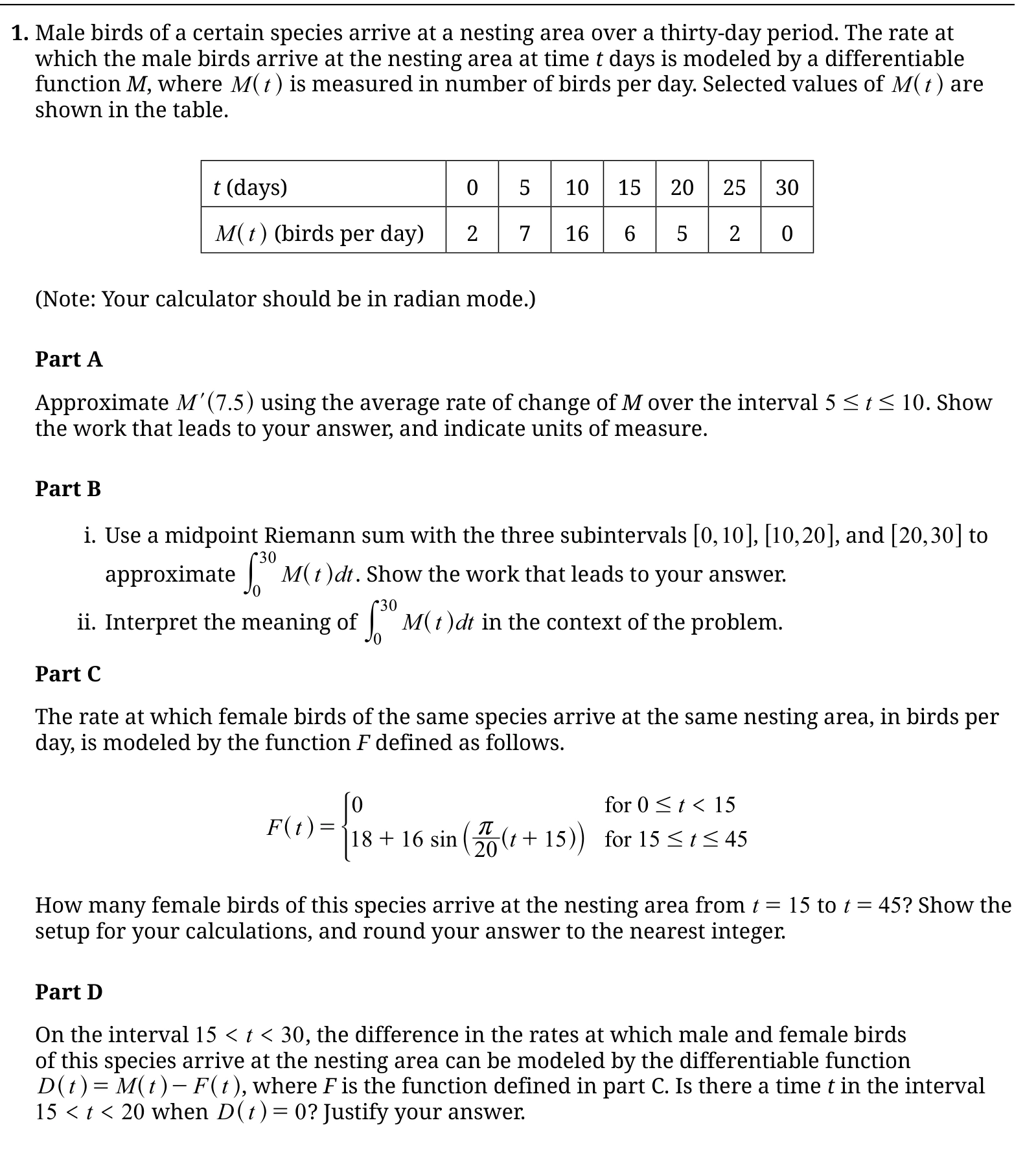
- Approximate the instantaneous rate of change at the midpoint with the secant slope across : .
- Substitute the table values and : .
- The numerator measures a change in birds per day, and the denominator is measured in days. Therefore the derivative is measured in birds per day per day, or birds per day squared.
Credit check: The two scoring points cover the numerical difference quotient with supporting work and the derivative's units. Show the actual table values in the quotient; an unsupported is insufficient.
Part B(i)
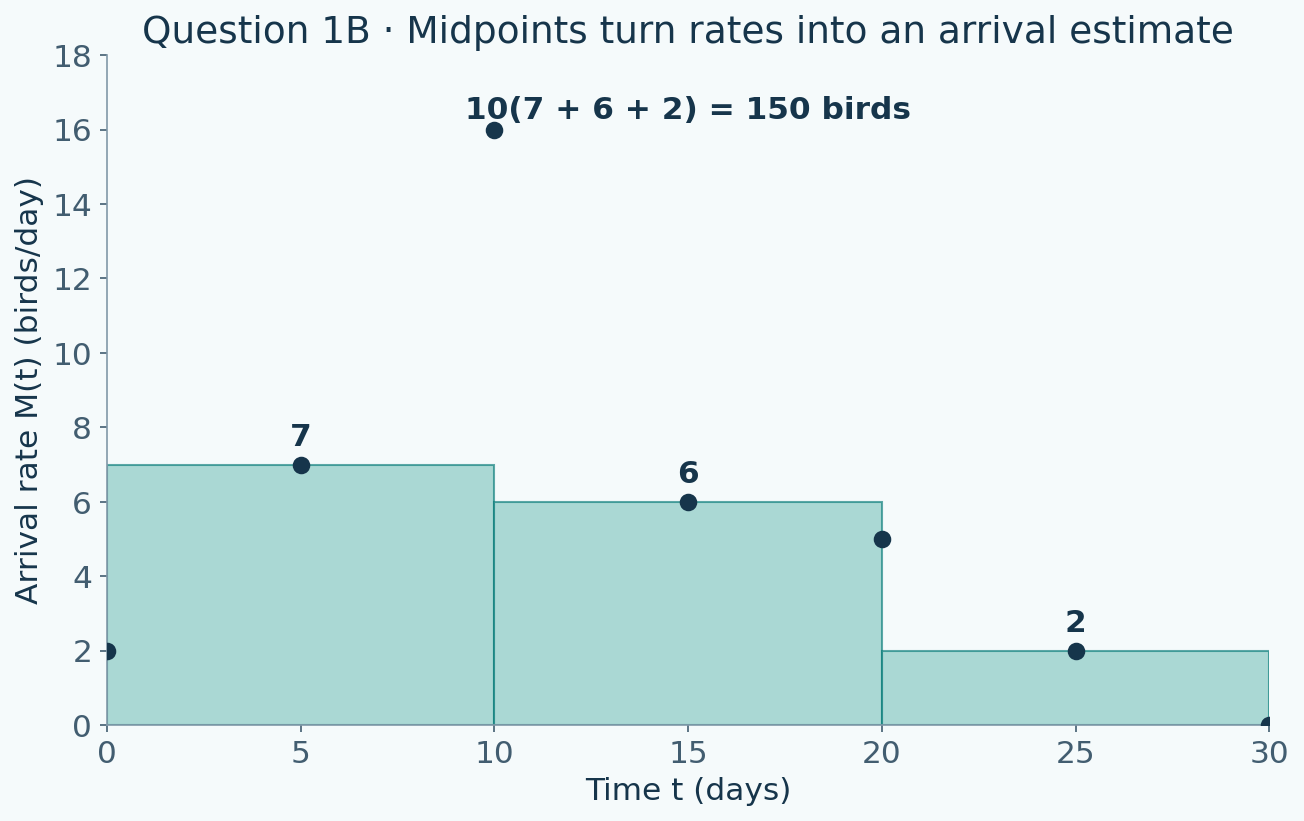
- Each requested subinterval has width days. Their midpoints are , , and .
- Use the arrival rate at each midpoint as the height of its rectangle: .
- Substitute and add: . Multiplying birds per day by days gives birds.
Credit check: Show all three midpoint rate-times-width products. The midpoint-sum form and the supported approximation account for two points.
Part B(ii)
- gives the rate at which male birds arrive, so integrating this rate adds up arrivals over time.
- The limits and select the entire thirty-day arrival period. Thus the integral represents the number of male birds of this species that arrive at the nesting area from day through day .
Credit check: For the interpretation point, include both what accumulates (male bird arrivals) and the time interval. This integral is a number of birds, not an arrival rate.
Part C
- An arrival rate accumulates to a total through integration. On , use .
- Set up the total number of female arrivals as .
- A calculator in radian mode gives . Alternatively, an antiderivative is , so the exact integral is .
- Round the final total to the nearest integer, as requested: female birds.
Credit check: The two points cover the definite-integral setup and its numerical value. Keep the integration limits at and , use radians, and follow the requested whole-bird rounding.
Part D
- Use the continuity condition for the Intermediate Value Theorem. Since is differentiable, it is continuous. At the endpoint , the formulas for and the sine branch of also give a continuous restriction of to .
- At the left endpoint, , so .
- At the right endpoint, . Thus .
- Because is continuous on and lies strictly between and , the Intermediate Value Theorem guarantees some with . At that time, the male and female arrival rates are equal.
Credit check: Explicitly connect differentiability to continuity for one point. For the other point, show the opposite endpoint signs and explain why continuity guarantees a zero. Naming the IVT alone is insufficient, and the evidence does not establish uniqueness.
Areas between curves, rectangular cross sections, and solids of revolution
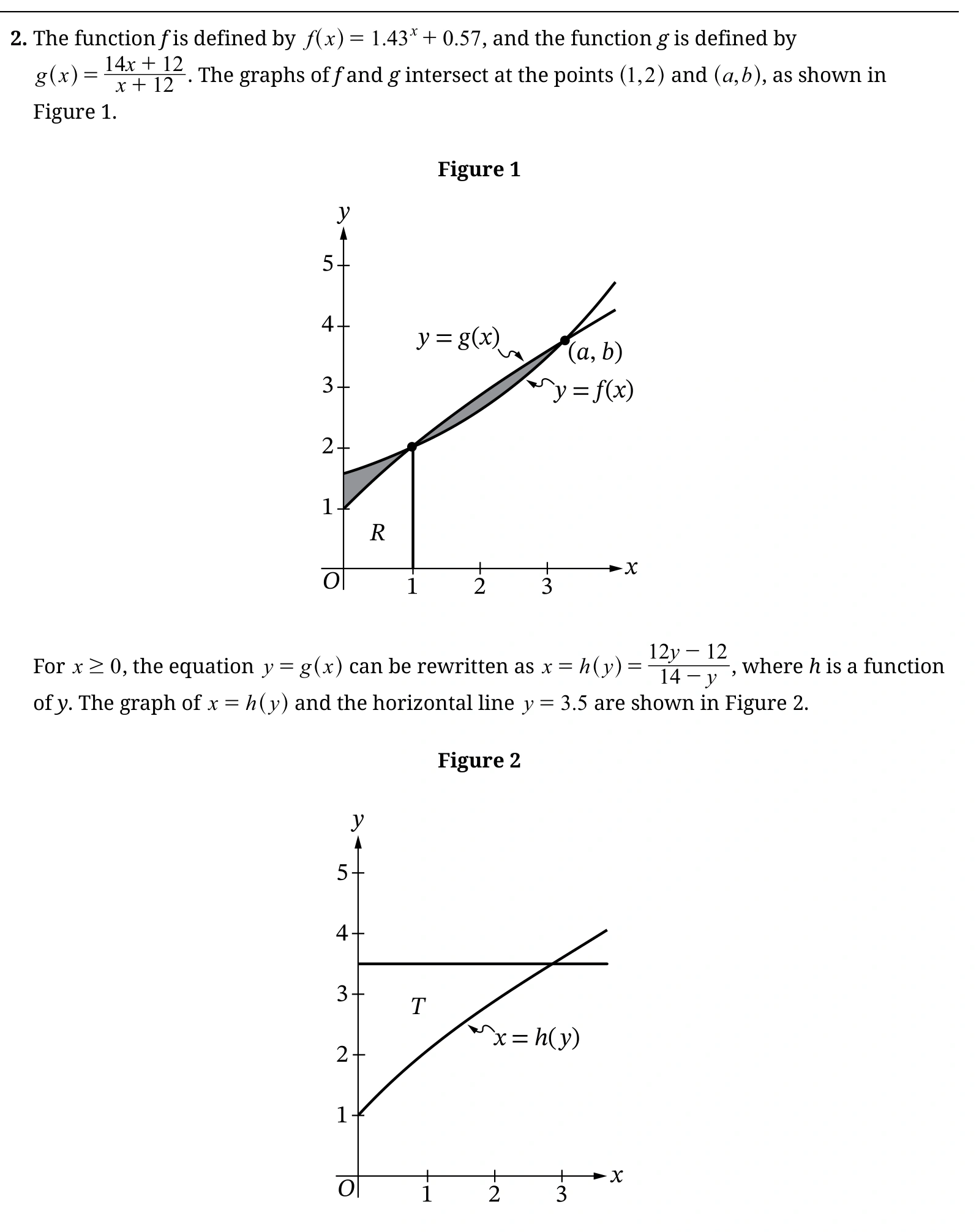
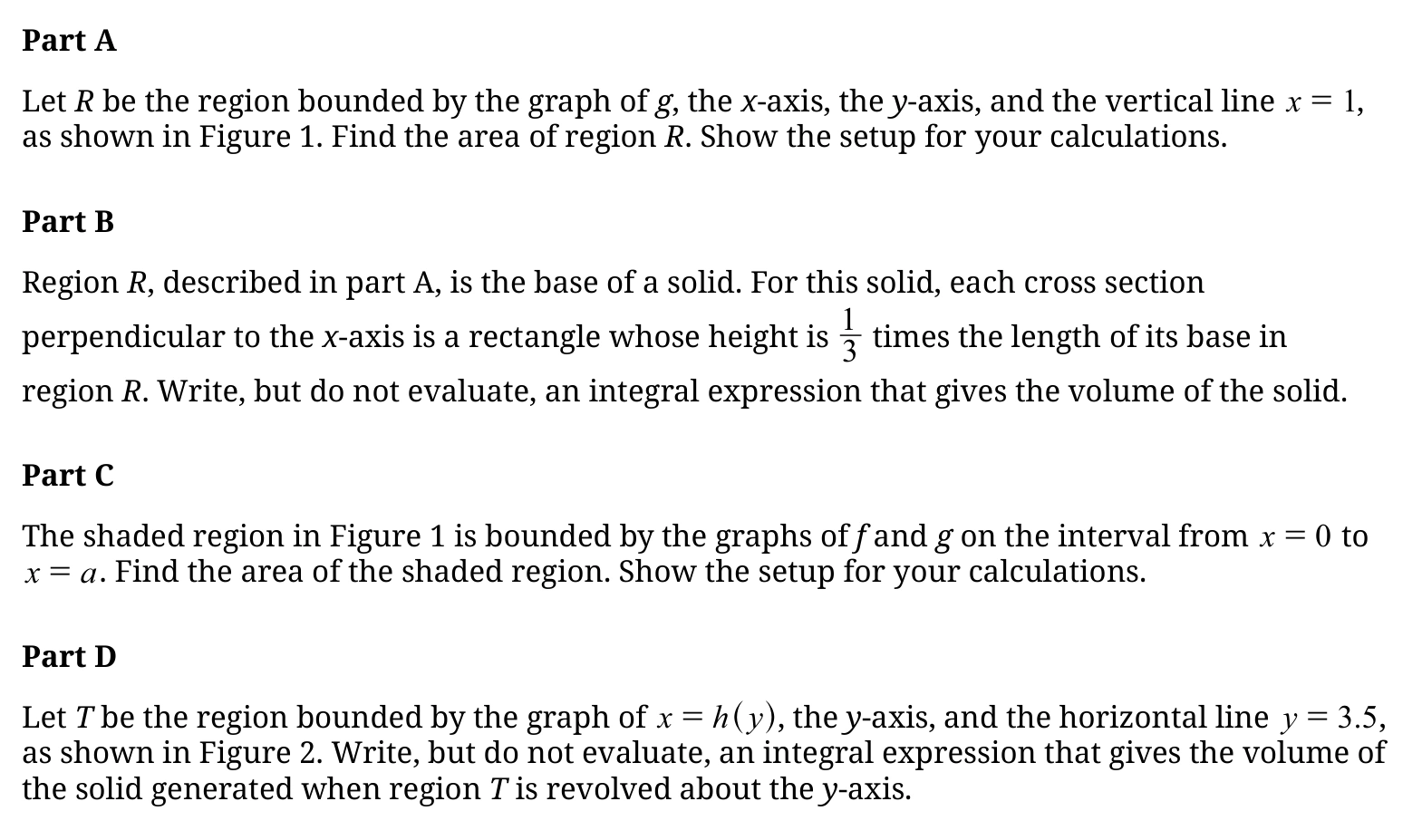
Part A
- Region lies between and for , where . The vertical height of the region is therefore .
- Set up its area as .
- Numerical integration gives . As an exact check, rewrite ; integration gives .
- Report the area to three decimal places: square units.
Credit check: The two points cover the integral and its value. Region is the region under on , so its height is rather than the gap between and .
Part B
- A cross section perpendicular to the -axis uses a vertical segment of as its base. That base has length .
- The rectangle's height is one-third of its base: .
- Multiply base by height to find the cross-sectional area: .
- Integrate cross-sectional area across the base region: . Leave this integral unevaluated.
Credit check: The two points cover the squared-base integrand and the correct coefficient and bounds. A rectangle needs base times height, so the integrand contains , not just .
Part C
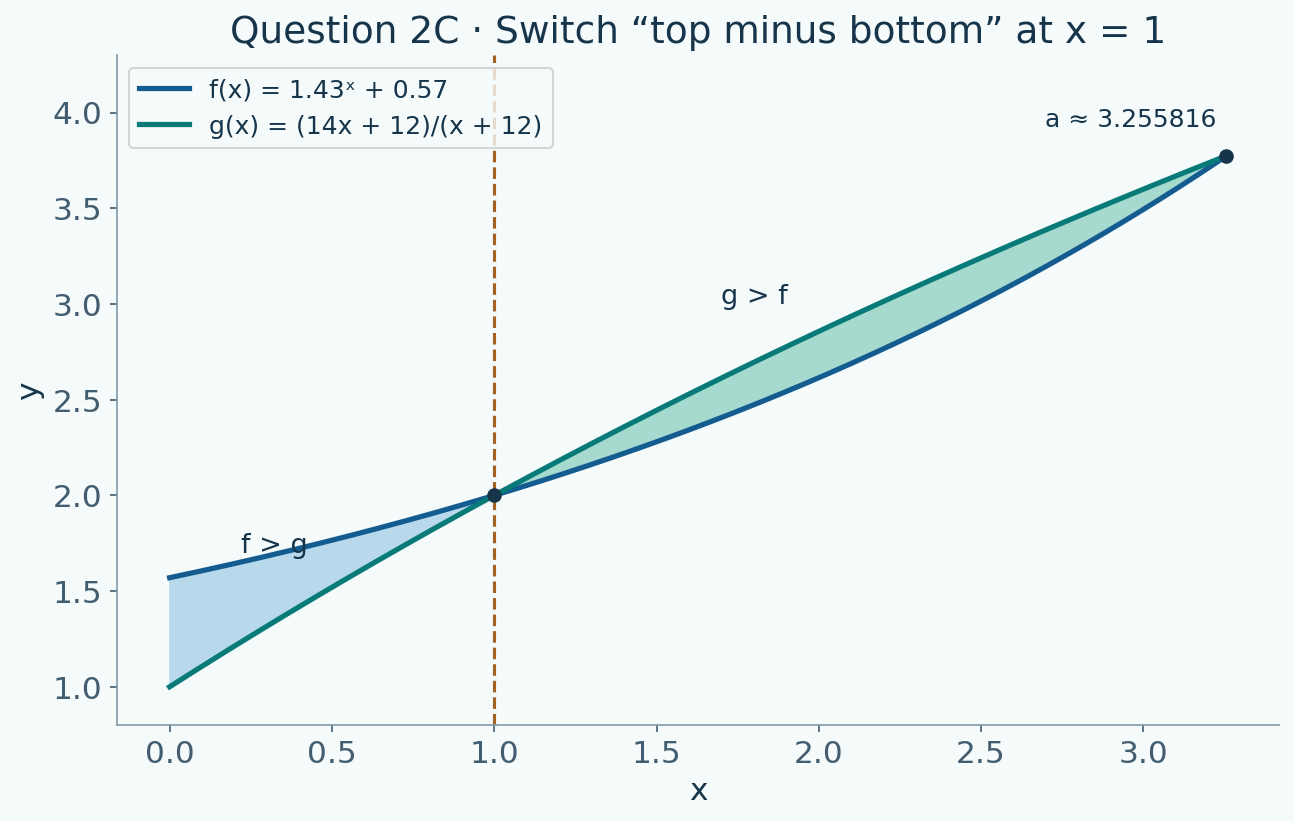
- Use the exponential function and the rational function . Find the second intersection by solving for the root greater than ; this gives .
- The curves switch vertical order at : on , whereas on .
- Add the two positive areas: . Equivalently, use .
- Numerical integration gives and .
- Add before rounding: , so the shaded area is approximately square units.
Credit check: The three points cover an appropriate difference integrand, the complete area integral, and the final value. Split at or use an absolute value; a single signed integral would allow the two regions to cancel. Keep extra digits in during calculation.
Part D
- Use horizontal slices because the curve is given by and the axis of rotation is the -axis.
- The lower boundary is where the curve meets the -axis: gives . The upper boundary is .
- At height , the slice runs from to . Revolving it about the -axis makes a disk with radius and area .
- Add the disk volumes with respect to : . Leave the integral unevaluated.
Credit check: The two points cover the squared-radius integrand and the complete disk integral. Include , the bounds and , and the differential ; the region starts at , not at the origin.
Newton's law of cooling: slope fields, tangent lines, and separation of variables
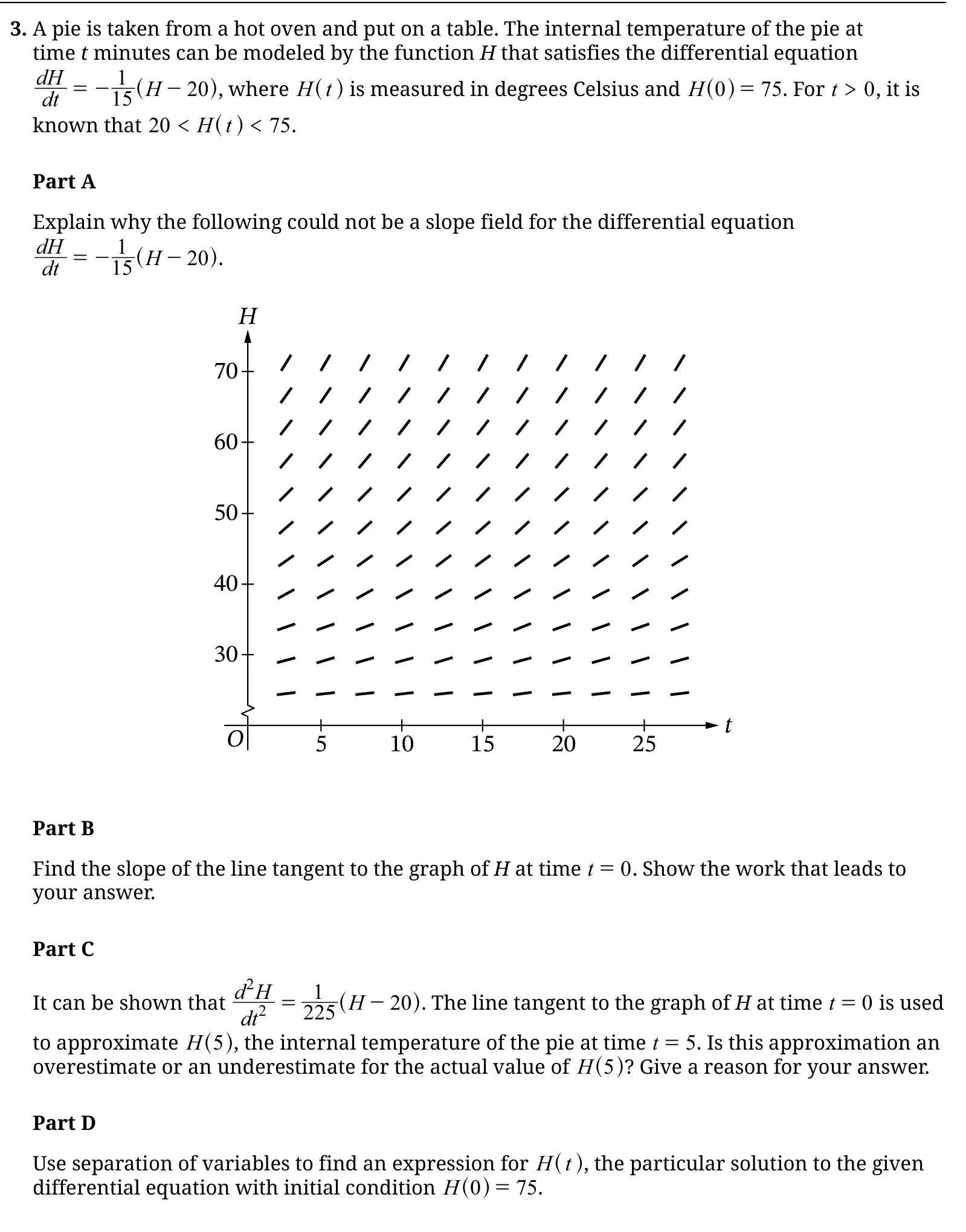
Part A
- The differential equation assigns each point the slope .
- In the displayed temperature range, , so and hence . A correct slope field would have downward-sloping line segments at these points.
- The displayed line segments instead have positive slopes. Their signs contradict the negative slopes required by the differential equation, so this cannot be its slope field.
Credit check: For the explanation point, explicitly compare the signs of the drawn line-segment slopes with the signs required by the equation. Merely saying the temperature decreases does not make that comparison clear.
Part B
- The tangent-line slope at is . Substitute the initial temperature into the differential equation.
- .
- Because measures degrees Celsius and measures minutes, this slope is in degrees Celsius per minute. The negative sign describes the pie cooling initially.
Credit check: Show the substitution of into the differential equation for the supporting-work point. Use an exact fraction; this question belongs to the no-calculator section.
Part C
- Throughout , the given inequality makes .
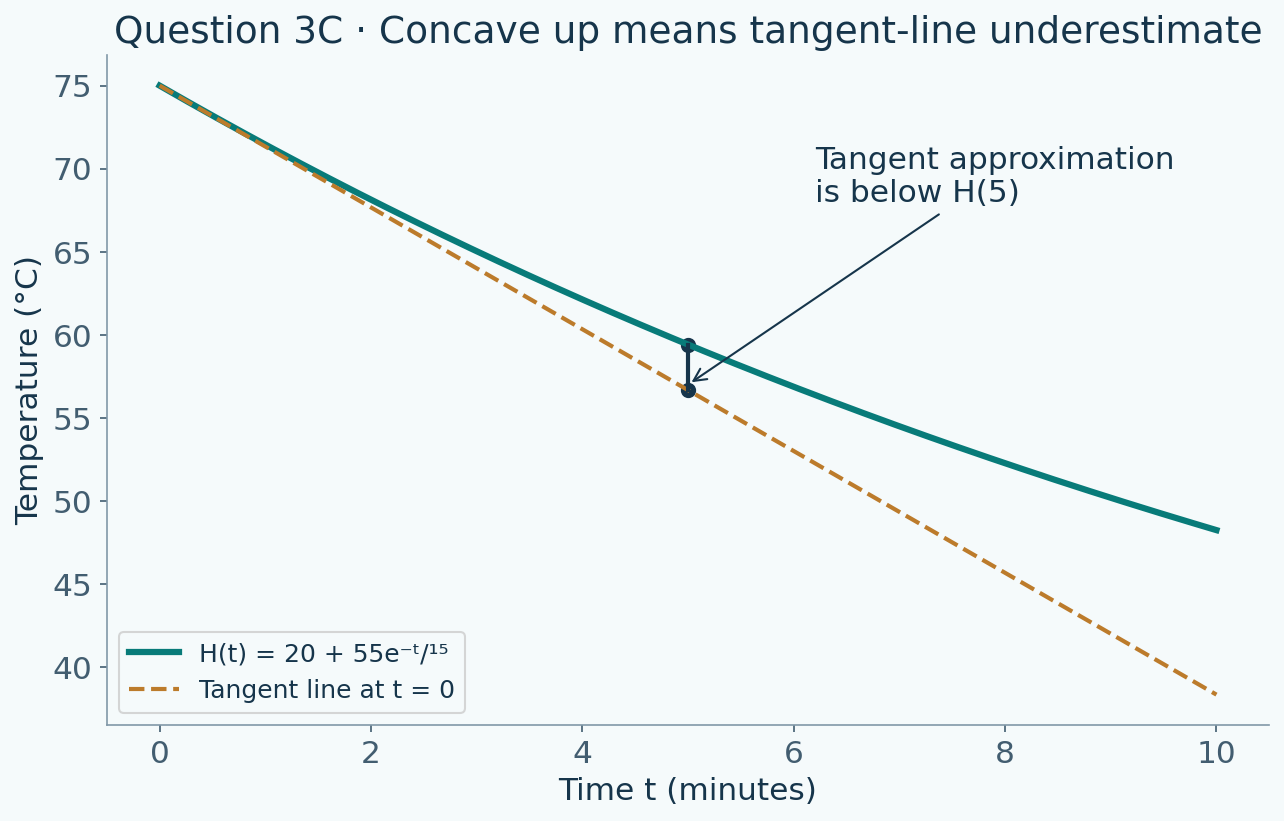
- Therefore the graph of is concave up throughout the interval used for the approximation. Its tangent line at lies below the graph to the right of the tangency point.
- Consequently, evaluating that tangent line at underestimates the actual temperature .
- Optional numerical form of the approximation: , so degrees Celsius. This value is below .
Credit check: The two points require consideration of the second derivative's sign and the resulting underestimate with a reason. Establish concavity on the relevant interval, rather than only checking . Computing is optional.
Part D
- Start with . Since along the solution, divide by and separate variables: .
- Integrate both sides: , giving .
- Apply : , so .
- Substitute this constant and exponentiate: implies . Because , use the positive branch: .
- Solve explicitly: . As a check, , and .
Credit check: Show separation, both antiderivatives, a constant of integration, substitution of the initial condition, and the explicit solution. These account for five points. The rubric awards no points in this part when separation of variables is absent, even if the final formula is correct.
Reading a derivative graph: concavity and absolute extrema
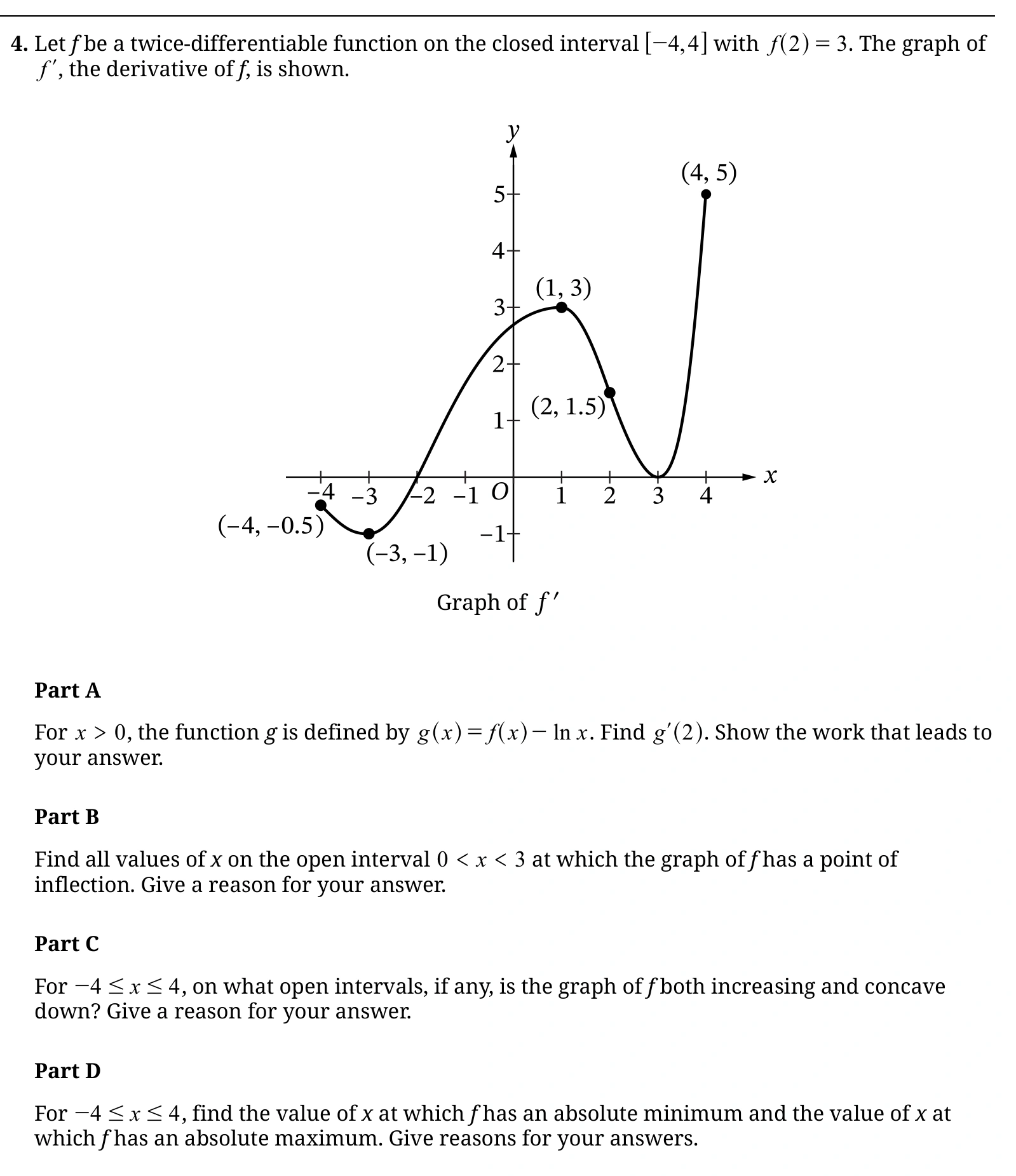
Part A
- Differentiate term by term: .
- The point is on the graph of , so .
- Substitute : .
Credit check: Show the derivative setup. The given value is a function value; the graph supplies the different quantity .
Part B
- A point of inflection of occurs where its concavity changes. On a graph of , look for a change between increasing and decreasing.
- On the requested interval , increases on and decreases on .
- Thus changes from concave up to concave down at , the only such value in .
Credit check: Connect the reason explicitly to the given graph of . Merely saying that changes concavity, or that changes sign, does not supply the graph-based justification required by the rubric.
Part C
- For to be increasing, its derivative must be positive. The graph shows on and .
- For to be concave down, must be decreasing. That happens on and .
- The two requirements hold together only on : there, is both positive and decreasing.
Credit check: State both conditions: and is decreasing. The sign of alone does not determine concavity.
Part D
- Since is continuous on the closed interval, its absolute extrema occur at endpoints or critical points. The graph gives at and , so consider these values together with and .
- The graph has on , so decreases toward . It has on and , so increases after . The isolated zero at does not change this increasing behavior. Therefore the absolute minimum occurs at .
- The absolute maximum must be at one of the endpoints. Use the Fundamental Theorem of Calculus to compare them: .
- The positive area under is greater than the magnitude of the negative area. For a concrete bound visible in the graph, the negative area on has magnitude at most , while the positive area on alone is at least ; all other contributions on are nonnegative. Thus .
- Consequently , so the absolute maximum occurs at .
Credit check: Explicitly identify the critical-point condition and compare the endpoint values using signed area. Increasing near the right endpoint, by itself, does not prove that the right endpoint beats the left endpoint.
Toy-car motion: acceleration, distance, and average velocity
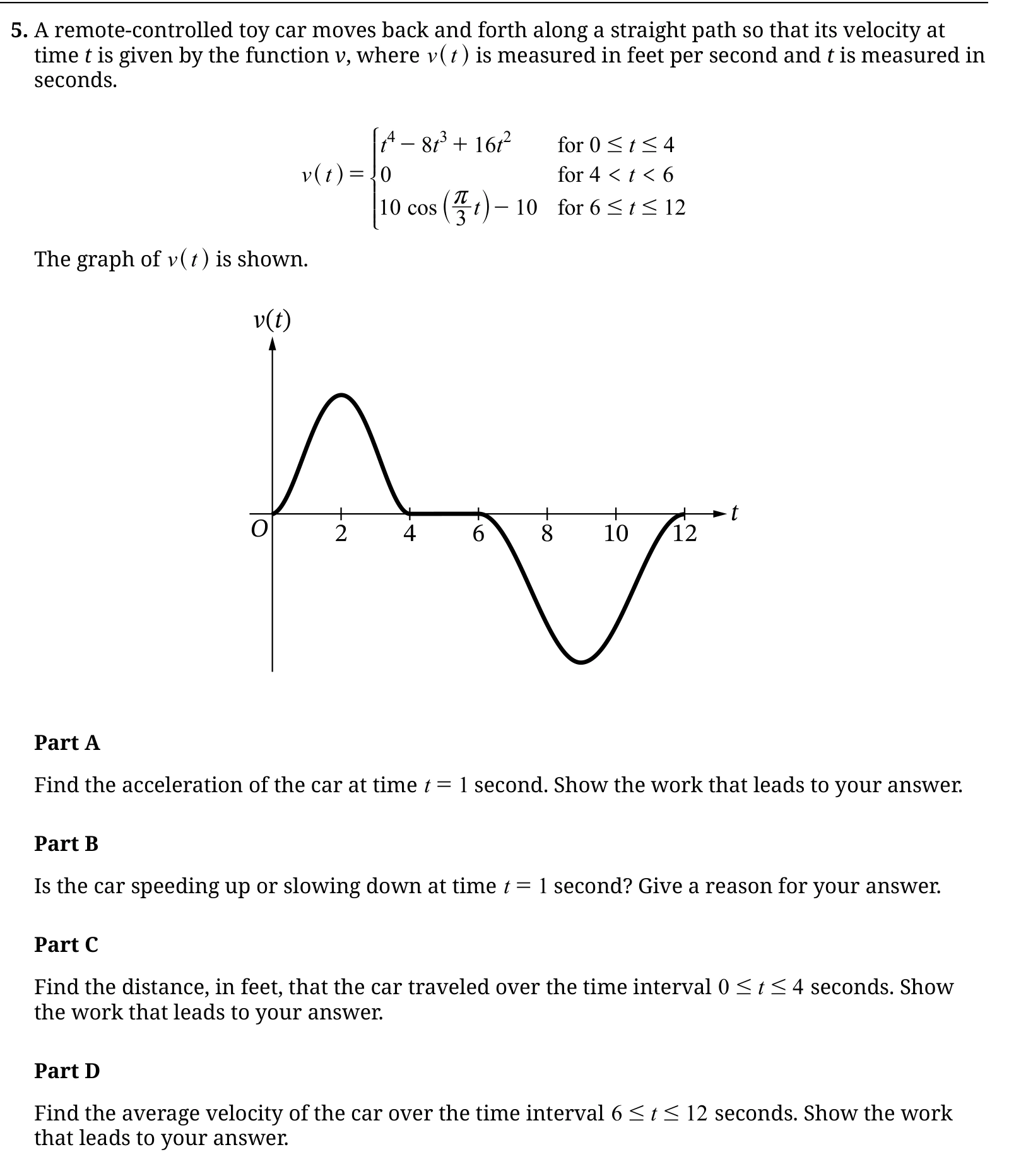
Part A
- Acceleration is the derivative of velocity: . Since lies in the first piece of the velocity function, use .
- Differentiate: for .
- Evaluate at : . Differentiating feet per second with respect to seconds gives feet per second squared.
Credit check: Show that acceleration comes from and use the polynomial piece that contains .
Part B
- Find the velocity sign at the same time: .
- From part A, .
- Velocity and acceleration have the same sign, so the magnitude of velocity is increasing. The car is speeding up at second.
Credit check: Use both velocity and acceleration. A positive acceleration alone is not enough to conclude that a car is speeding up.
Part C
- Total distance is the integral of speed: .
- On this interval, . Therefore and the distance is .
- Integrate term by term: .
- Evaluate: feet.
Credit check: Show the definite integral, an antiderivative, and the endpoint evaluation. Distance normally requires ; here the factorization proves that the velocity never becomes negative on .
Part D
- Average velocity is displacement divided by elapsed time, equivalently the average value of : .
- Use the third piece of : .
- Account for the inner derivative when integrating the cosine: .
- Because , the result is feet per second.
Credit check: Include the factor for average value and retain the sign of velocity. An integral of would give average speed instead.
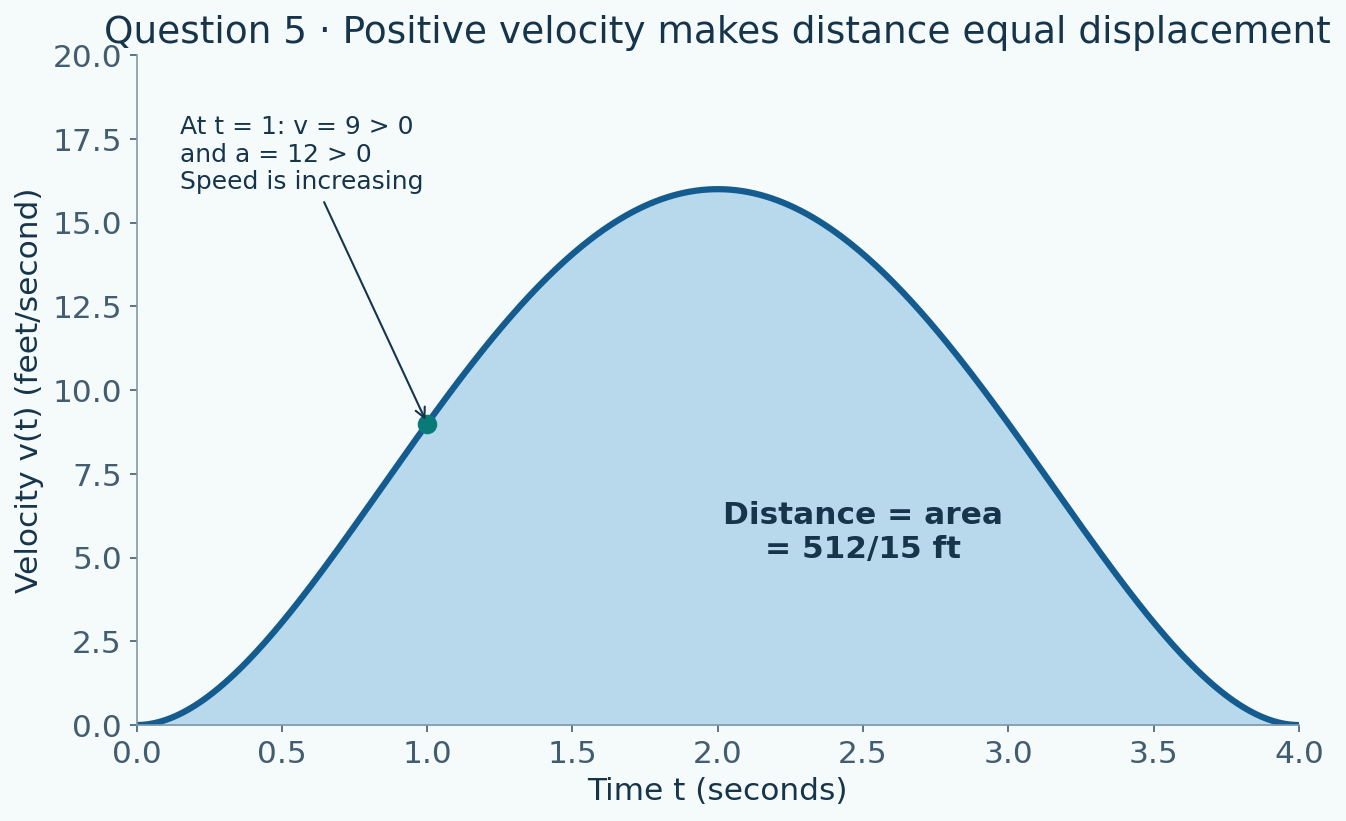
Table-based calculus: limits, chain rule, and accumulation
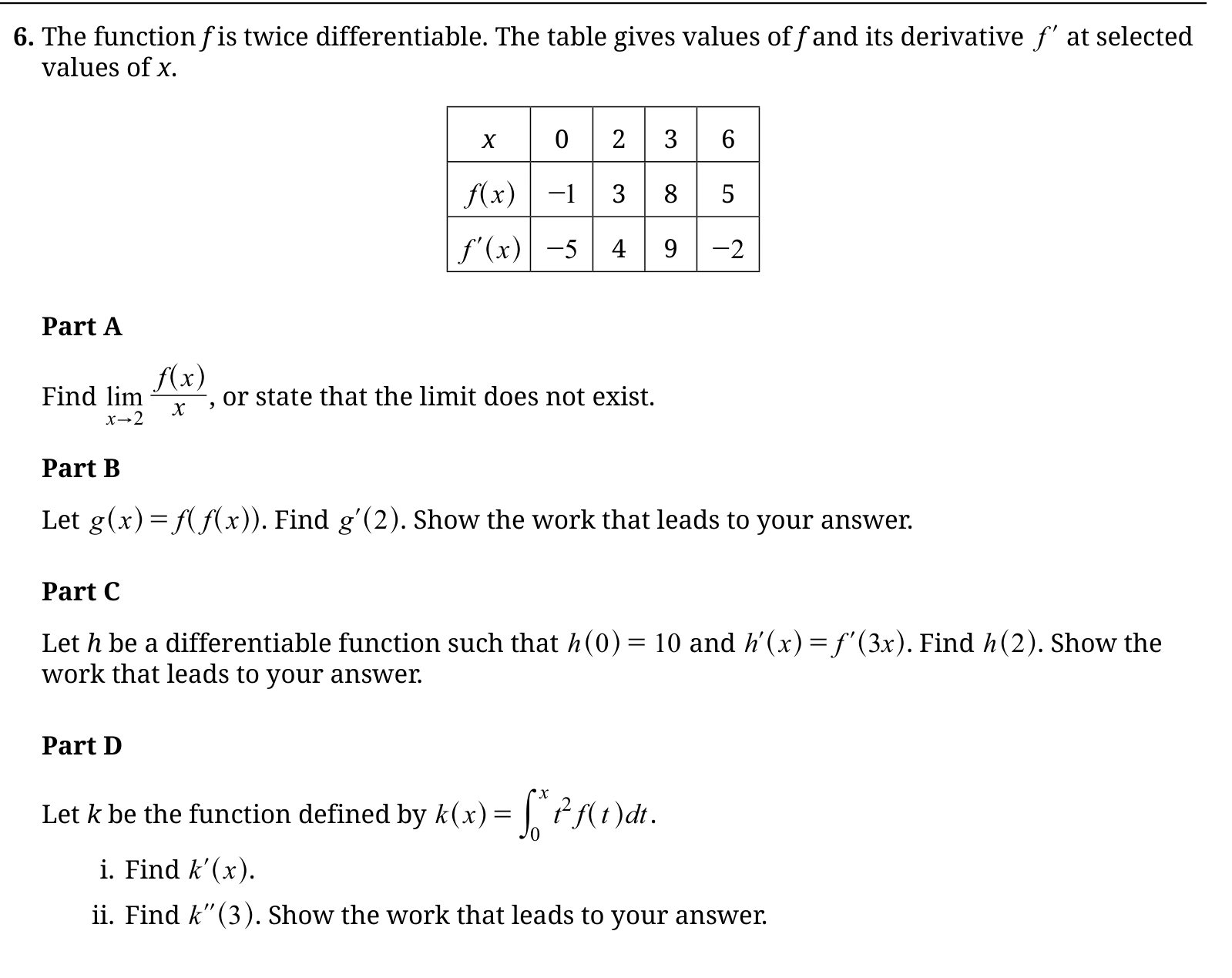
Part A
- Twice differentiability implies that is continuous at .
- Since the denominator approaches the nonzero value , use direct substitution: .
- The table gives , so the limit is .
Credit check: This is not a or form. Direct substitution applies; L'Hôpital's rule does not.
Part B
- For the composition , the chain rule gives .
- At , the inner value is , so .
- Use the derivative row of the table: and . Therefore .
Credit check: Show the chain-rule product. The outer derivative is evaluated at , while the inner derivative is evaluated at .
Part C
- Recover the change in by integrating its derivative: .
- Let , so . The limits become and , giving .
- Apply the Fundamental Theorem of Calculus: .
- The table gives and . Thus .
Credit check: The input introduces a factor of when integrating. Include the initial value and keep it outside the integral.
Part D(i)
- The integrand is continuous because is differentiable.
- By the Fundamental Theorem of Calculus, differentiating an integral from a constant to returns its integrand evaluated at : .
Credit check: Replace the integration variable with the upper limit . The upper limit has derivative , so no additional chain-rule factor changes the result.
Part D(ii)
- Differentiate using the product rule: .
- Substitute : .
- Using and from the table, .
Credit check: Differentiate both factors in . The rubric requires the correct result from D(i) and the product-rule setup before the final numerical point is available.
Sources & References
Official question images: © 2026 College Board. Source pages are identified beneath each image. The solutions, explanatory diagrams, and feature artwork are original HeLovesMath materials. AP and Advanced Placement are registered trademarks of College Board. This page is not affiliated with or endorsed by College Board.
- College Board: AP Calculus AB past exam questions — the official release index, checked October 10, 2026.
- 2026 AP Calculus AB Free-Response Questions — 10-page released question PDF; Questions 1–6 appear on pages 3–5 and 7–10.
- 2026 AP Calculus AB Scoring Guidelines — 26-page official rubric used to check every subpart.
At the source check, the 2026 AB index listed one unnumbered free-response set and its scoring guidelines, with no separate 2026 question erratum linked. Course-and-exam-description updates for the 2026–27 school year are different documents and are not corrections to this released paper.