Looking for Edexcel International GCSE Maths A Modular papers and mark schemes? Start by matching your unit and tier. Download the June 2025 question papers and matching mark schemes, use the official sample pack, and turn your results into a focused revision plan. The original specimen-paper links are preserved too.
Qualification guidance checked 3 October 2026. HeLovesMath is an independent learning resource; the original practice questions below are not Pearson exam questions.
Which modular paper do you need?
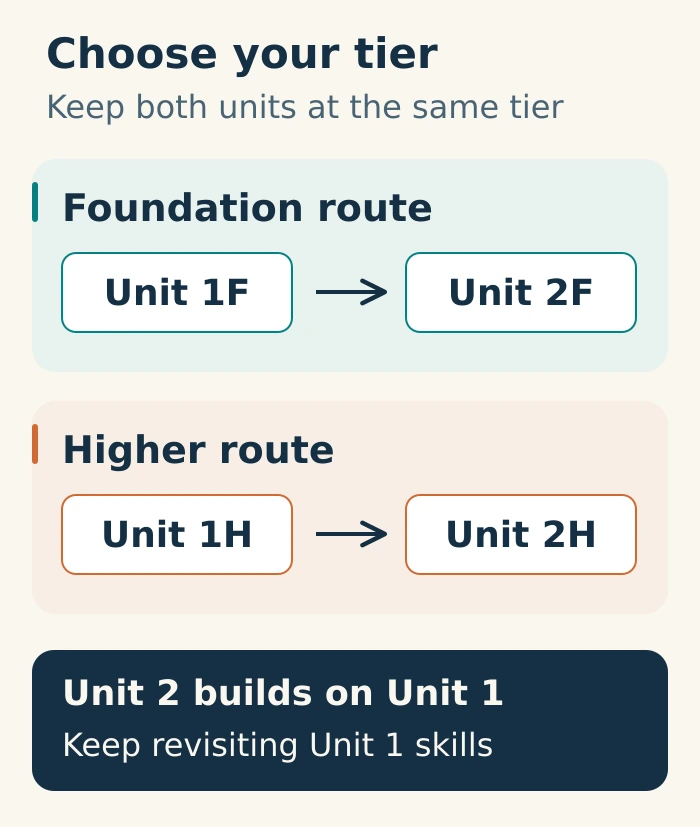
For this route, 1 or 2 identifies the unit, and F or H identifies the tier. A Unit 1 Higher paper is 4WM1H/01; a Unit 2 Foundation paper is 4WM2F/01. The final /01 belongs to the assessment code, so do not use it alone to decide which unit you have.
| Route | Unit 1 | Unit 2 |
|---|---|---|
| Foundation | 4WM1F/01 | 4WM2F/01 |
| Higher | 4WM1H/01 | 4WM2H/01 |
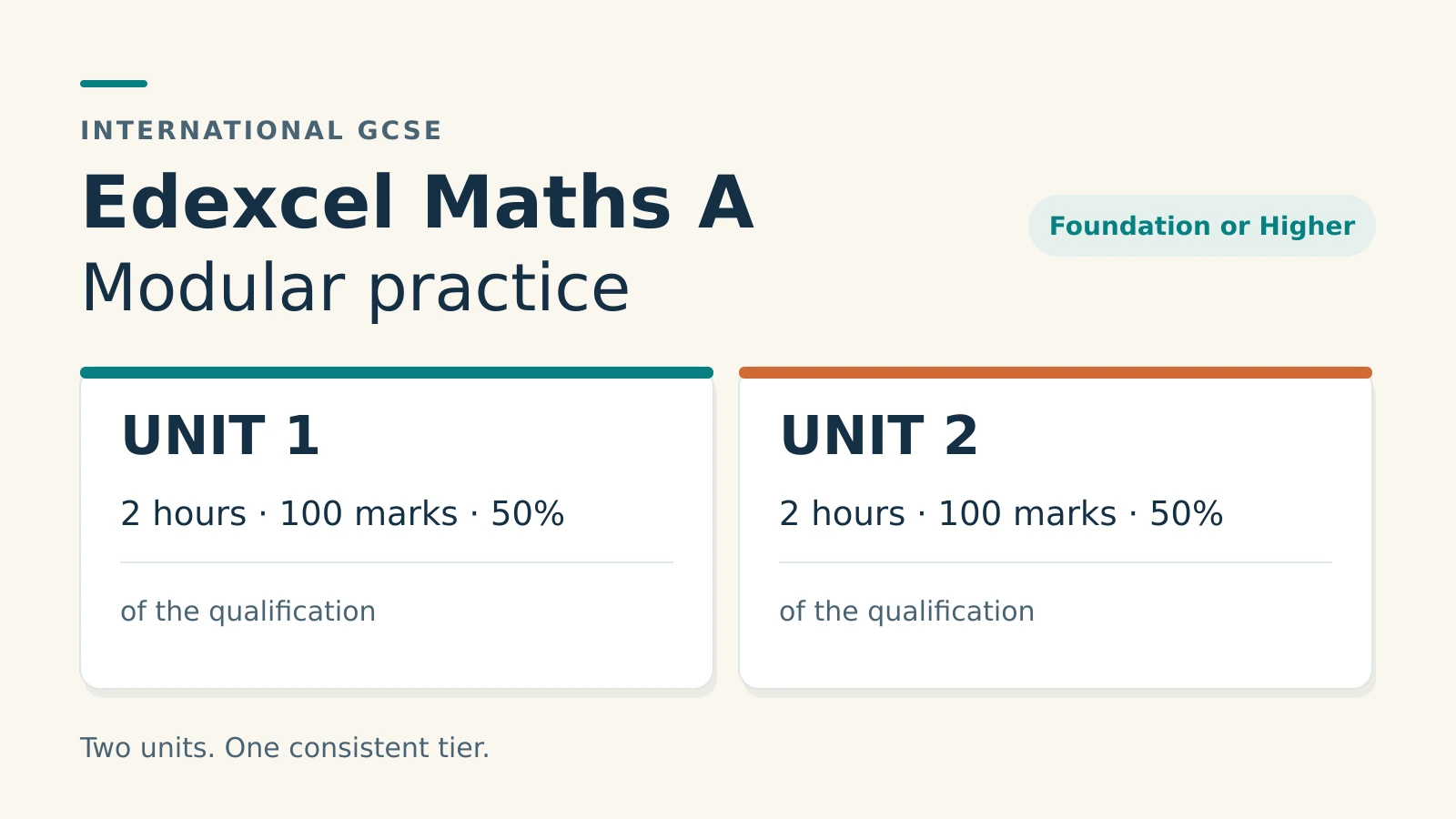
| Each assessment | 2 hours 100 marks 50% of qualification | 2 hours 100 marks 50% of qualification |
| Calculator | Allowed | Allowed |
Use the same tier for both units. Unit 2 draws on Unit 1 knowledge, so finishing the Unit 1 exam does not mean those skills can be forgotten. Pearson advises first attempts in unit order; Unit 2 is not simply a “harder paper”. Your teacher’s scheme of work and the official specification determine which topics you should prepare.
Modular, linear and UK GCSE are different routes
Do not select papers only because a search result says “Edexcel maths”. Maths A Modular uses the 4WM unit codes above. The linear International GCSE Maths A route uses 4MA1; UK GCSE Mathematics uses 1MA1. They can provide extra topic practice, but their paper structure is not interchangeable. Confirm your qualification, tier and unit with your school or exam centre.
Pearson’s July 2024 correction notice confirms the current qualification and cash-in codes: 4XMAF for Foundation and 4XMAH for Higher. These are different from the unit codes printed on question papers. The modular route is offered to schools outside the UK and was first examined in June 2025.
A paper is a diagnosis, not just a score
Use one paper in three stages: attempt, explain, then reattempt. The valuable outcome is knowing what to practise next. A high score achieved with the mark scheme open tells you much less than an honest attempt followed by careful correction.
- Check the cover. Match the unit and tier, read the instructions, and have the permitted calculator and drawing equipment ready. Use the formula information supplied with that paper.
- Choose your mode. For a realistic full attempt, allow two hours and avoid notes. For learning, work through a shorter topic selection without timing it; label this as practice rather than a mock score.
- Show the method. Write the equation, substitution or diagram before using the calculator. Keep intermediate digits; round at the end to the accuracy requested.
- Mark using the matching scheme. Check the paper code and edition. Award only the marks supported by your written work, and use the scheme’s own instructions for method, accuracy and follow-through marks.
- Repair one cause at a time. Was the lost mark caused by a missing fact, a wrong model, algebra, calculator entry, units or rounding? Rewrite the first incorrect step rather than copying the final answer.
- Reattempt later without the solution. Try the original question again after a gap, then try a new question using the same skill. Familiarity with the answer is not the same as being able to reconstruct the method.
A rough pacing guide is 120 ÷ 100 = 1.2 minutes per mark, or 72 seconds. This is a planning average, not a rule for every question. Some early marks should be quicker; leave time to return to questions and check answers.
| What happened? | What to record | Next action |
|---|---|---|
| Expanded 3(2x − 1) as 6x − 1 | The multiplier applies to both terms | Practise brackets, then redo the equation |
| Found a gradient but missed the intercept | Substitute a point into y = mx + c | Write and check a complete line equation |
| Rounded an intermediate value | Keep the stored calculator value | Repeat the calculation, rounding only at the end |
For focused follow-up, use the algebra worksheet library. If signs caused the error, review negative numbers; for powers of ten, see the scientific notation worked examples.
Three worked examples: make the reasoning visible
These original examples illustrate the kind of mathematical working that is useful during revision. They are not a predicted paper, an official mark scheme or a complete unit-content checklist.
1. Reverse a percentage change
A jacket costs £72 after a 20% discount. Find its original price.
The sale price is 80% of the original. If the original price is P, then 0.8P = 72.
P = 72 ÷ 0.8 = £90
Check: 20% of £90 is £18, and £90 − £18 = £72. Adding 20% to £72 gives £86.40, which uses the wrong starting amount.
2. Solve an equation with brackets
Solve 3(2x − 1) = 4x + 11.
6x − 3 = 4x + 11
2x − 3 = 11
2x = 14
x = 7
Multiply both terms inside the bracket by 3, subtract 4x from both sides, then add 3 and divide by 2. Check in the original equation: 3(14 − 1) = 39 and 28 + 11 = 39.
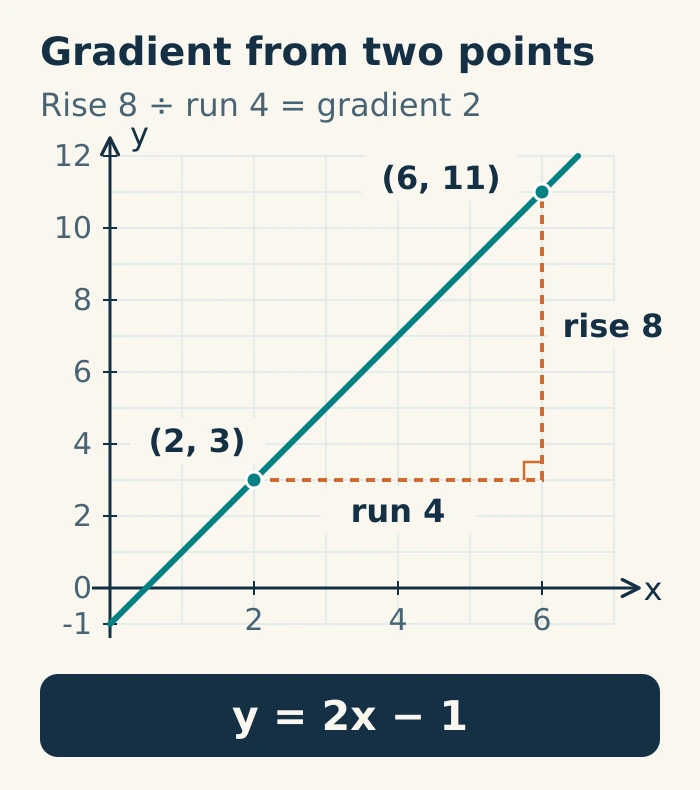
3. Find an equation from two points
A straight line passes through (2, 3) and (6, 11). Find its equation.
The change in y is 11 − 3 = 8 and the change in x is 6 − 2 = 4. Keep the points in the same order in both subtractions.
Gradient m = 8 ÷ 4 = 2
y = 2x + c
3 = 2(2) + c, so c = −1
y = 2x − 1
Check the second point: 2(6) − 1 = 11. A gradient of 2 means y increases by 2 for each increase of 1 in x; it does not mean the line passes through (0, 2).
10 original practice questions with answers
Try these before opening the answers. They sample different skills and are not assigned to a particular unit or tier. Use the official content list for your own course. Questions 8–10 add algebraic and accuracy challenges.
1. Calculate 3/4 − 2/5. Give the answer in simplest form.
Use a common denominator of 20: 15/20 − 8/20 = 7/20. Subtracting the denominators would not produce an equivalent fraction.
2. Share £64 in the ratio 5 : 3.
There are 8 equal parts, worth £64 ÷ 8 = £8 each. The shares are 5 × £8 = £40 and 3 × £8 = £24. They add to £64 and simplify to the ratio 5 : 3.
3. Increase 240 by 15%.
15% of 240 is 36, so the new value is 276. Equivalently, 240 × 1.15 = 276. The increase is 36; the question asks for the final value.
4. Solve 5x − 7 = 18.
Add 7 to both sides: 5x = 25. Divide by 5: x = 5. Check: 5(5) − 7 = 18.
5. A right-angled triangle has perpendicular sides 9 cm and 12 cm. Find its hypotenuse and area.
The hypotenuse is √(9² + 12²) = √225 = 15 cm. The area is ½ × 9 × 12 = 54 cm². The hypotenuse must be longer than either other side, and area needs square units.
6. A bag holds 3 red and 2 blue counters. Two are drawn at random without replacement. Find P(both red).
P(first red) = 3/5. After a red is removed, P(second red) = 2/4. Multiply: (3/5) × (2/4) = 6/20 = 3/10. Using 3/5 twice would incorrectly assume replacement.
7. Find the gradient and equation of the line through (1, 4) and (4, 13).
Gradient = (13 − 4)/(4 − 1) = 9/3 = 3. Substitute (1, 4) into y = 3x + c: c = 1. The equation is y = 3x + 1. Check: 3(4) + 1 = 13.
8. Solve x² − x − 12 = 0.
Factorise: (x − 4)(x + 3) = 0. At least one factor must be zero, giving x = 4 or x = −3. Both values satisfy the original equation. Do not lose one root by dividing by a factor that could be zero.
9. Solve y = x + 1 and x² + y² = 25 simultaneously.
Substitute y: x² + (x + 1)² = 25. Expand and simplify to 2x² + 2x − 24 = 0, then x² + x − 12 = 0. Factorise: (x + 4)(x − 3) = 0. Thus (x, y) = (3, 4) or (−4, −3). Check each pair: 9 + 16 = 25 and 16 + 9 = 25, and both satisfy y = x + 1.
10. A rectangle measures 8.4 cm by 3.2 cm, each rounded to the nearest 0.1 cm. Find bounds for its area.
8.35 ≤ length < 8.45 and 3.15 ≤ width < 3.25. All values are positive, so multiply the lower bounds and then the upper bounds: 26.3025 cm² ≤ area < 27.4625 cm². The nominal product 8.4 × 3.2 = 26.88 cm² is not an upper bound. The upper endpoint is excluded because both measurement intervals are open at the top.
How should you interpret a practice score?
Record your raw score out of 100 and which topics need attention. Do not convert a sample-paper percentage straight into a qualification grade. The modular qualification uses a Uniform Mark Scale (UMS), and raw-mark boundaries depend on the assessment series. A raw mark is not automatically the same number of UMS marks.
For actual results, use the correct series’ official boundaries and your centre’s advice. Resitting a unit and combining results involves entry and cash-in rules; ask your exams officer before making a plan. A revision website cannot confirm your registration, eligibility or final award.
Common questions
Are the specimen papers real past exam papers?
They are official sample assessments created to illustrate the qualification. They are useful for practice, but they are not labelled June or November live papers. Keep your practice log clear about which kind of paper you used.
Can I use linear International GCSE papers for revision?
They can help with individual topics that appear in your specification. They should not replace matching modular papers when rehearsing the unit structure. Check coverage with your teacher rather than assuming every question belongs to your upcoming unit.
What if a download does not open?
Use Pearson’s full official sample pack below as the first alternative. The eight retained third-party links returned HTTP 403 during our automated check on 3 October 2026; we could not revalidate their files. That does not establish whether they will open in your browser. No account or payment is needed to read the official sample PDF checked here.
Where should I practise a weak topic?
Start with the correction you could not explain. Use the algebra worksheet collection for equation, graph and expression practice, then return to the original question. Avoid completing whole papers repeatedly while leaving the same underlying misconception unresolved.
Sources & References
The external resources below open in a new tab. Pearson owns its assessment materials; Save My Exams hosts the retained individual PDF links. HeLovesMath links to these resources and does not claim authorship or official endorsement.
June 2025 past papers and mark schemes
These 16 official Pearson PDFs were accessible in our 3 October 2026 check. R denotes the regional paper variant: match a /01R question paper with its /01R mark scheme. Confirm your own exam variant with your centre.
Standard papers
Regional R papers
This is the June 2025 exam series, even where a unit was sat in May. More recent resources may have restricted access on Pearson’s website; they are not advertised here as verified free downloads.
Official sample pack and guidance
- Complete official sample assessment materials: all four question papers and mark schemes (PDF, about 27.5 MB). The complete pack is the verified alternative if an individual link is unavailable.
- Official Maths A Modular specification: unit content, assessment structure, tier and qualification rules.
- Pearson Maths A Modular course materials and released past papers: check the displayed series, unit and access status.
- Pearson qualification-code correction notice (July 2024)
- Pearson course overview and availability
- Pearson guidance on past-paper access
- Pearson guide to the modular route and results
| Paper | Question paper starts | Mark scheme starts |
|---|---|---|
| Unit 1 Foundation | Printed page 5 | Printed page 31 |
| Unit 2 Foundation | Printed page 45 | Printed page 73 |
| Unit 1 Higher | Printed page 91 | Printed page 117 |
| Unit 2 Higher | Printed page 137 | Printed page 165 |
These are the page numbers printed in the document, which can differ from the PDF viewer’s page counter.
Original individual specimen-paper links
All four original pairs are retained below. Their availability could not be confirmed in the latest automated check; use the official pack above if access is restricted. QP means question paper; MS means mark scheme.
Resource availability and examination arrangements can change. Check Pearson and your exams officer for the current position. No exam result or grade is guaranteed by using these resources.