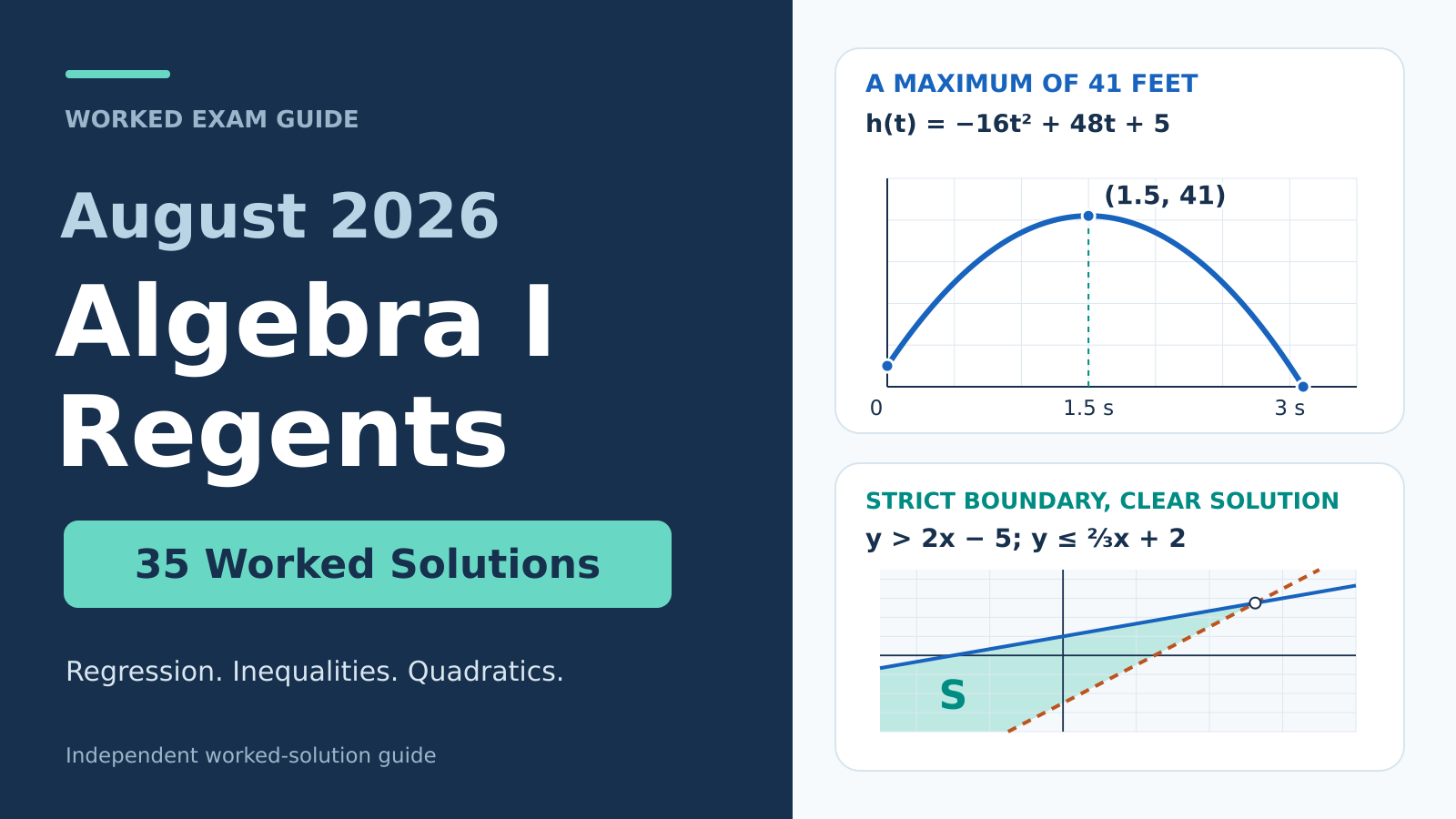
Work through every question in the English-language August 2026 Algebra I Regents. Each solution explains the method, gives the final answer, and highlights details that matter for a complete written response.
Try the question first, then compare your reasoning with the steps below. Select a question image or diagram to open a larger view. The question numbers and paper-page references follow the official exam. The original paper and NYSED scoring documents are linked in Sources & References.
For Parts II–IV, show your method. A final number on its own can lose substantial credit, and a question that specifies graphing or the quadratic formula requires that method.
These are independent HeLovesMath explanations, not an official NYSED publication. Answers and required methods were checked against the official scoring key, rating guide, and model response set. Valid alternative methods can also earn credit unless a question specifies a method.
Quick check: Part I answer choices
- Q1: (3)
- Q2: (1)
- Q3: (1)
- Q4: (2)
- Q5: (4)
- Q6: (3)
- Q7: (2)
- Q8: (4)
- Q9: (2)
- Q10: (2)
- Q11: (4)
- Q12: (4)
- Q13: (1)
- Q14: (3)
- Q15: (4)
- Q16: (2)
- Q17: (3)
- Q18: (1)
- Q19: (1)
- Q20: (1)
- Q21: (4)
- Q22: (4)
- Q23: (3)
- Q24: (4)
Use the worked explanations below to check why each answer is correct.
Part I: Multiple-choice solutions
Questions 1–24 • 2 credits each • 48 credits total
Question 1: Recognize exponential growth
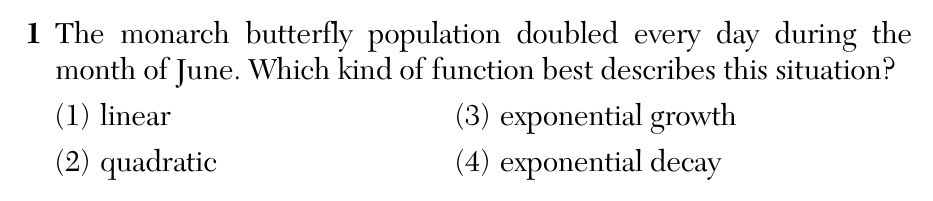
- Doubling means multiplying the population by 2 each day. Equal time intervals produce a constant multiplicative factor.
- An exponential model has the form . Because the multiplier is greater than 1, this is growth.
Exam detail: Linear growth adds a fixed amount; this situation multiplies by a fixed factor.
Question 2: Solve a linear equation with decimals
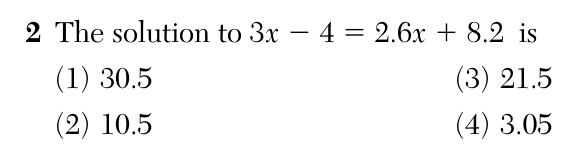
- Subtract from both sides:
- Add 4 and divide by 0.4:
- Check: both original sides equal 87.5 when .
Question 3: Substitute an expression into a system
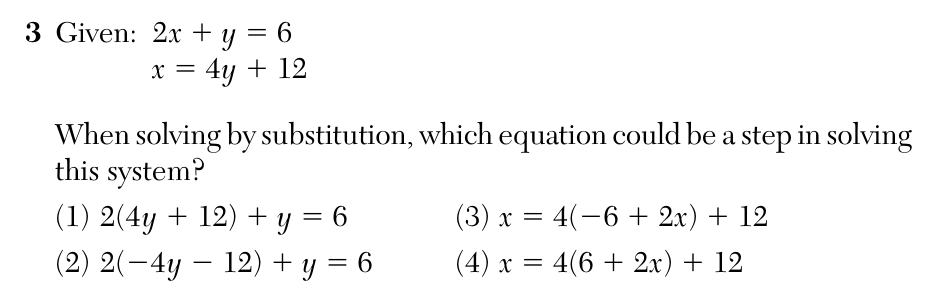
- The second equation already isolates x: .
- Replace x in with the entire expression, using parentheses:
Exam detail: The factor 2 multiplies both terms of the substituted expression.
Question 4: Translate a verbal inequality
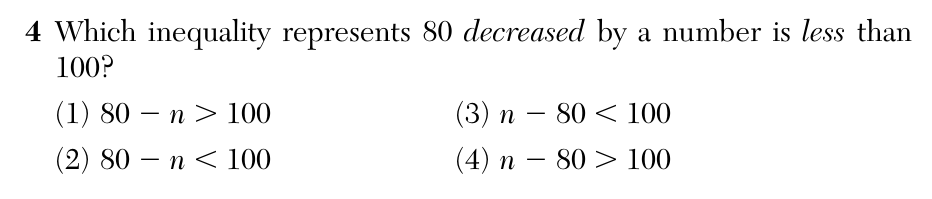
- Let n represent the number. “80 decreased by a number” means start with 80 and subtract n: .
- “Is less than 100” uses a strict less-than sign:
Question 5: Model annual depreciation
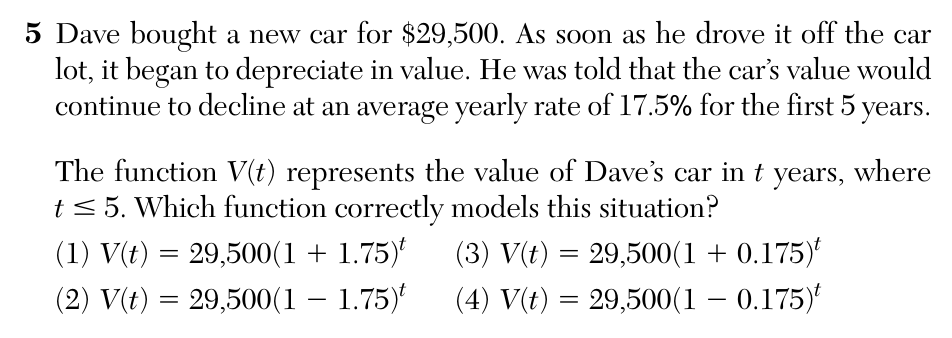
- The initial value is $29,500. Convert the annual decrease to a decimal: 17.5% is 0.175.
- Each year the car retains the fraction of its previous value.
- The exponential decay model is:Use it over the stated first five years, .
Exam detail: Subtract the decimal rate from 1; do not use 1.75 for 17.5%.
Question 6: Factor a difference of squares
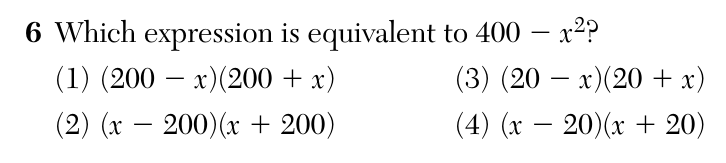
- Write 400 as . The expression is .
- Apply :
Exam detail: Reversing the subtraction would change the sign of the expression.
Question 7: Estimate from a scatter plot
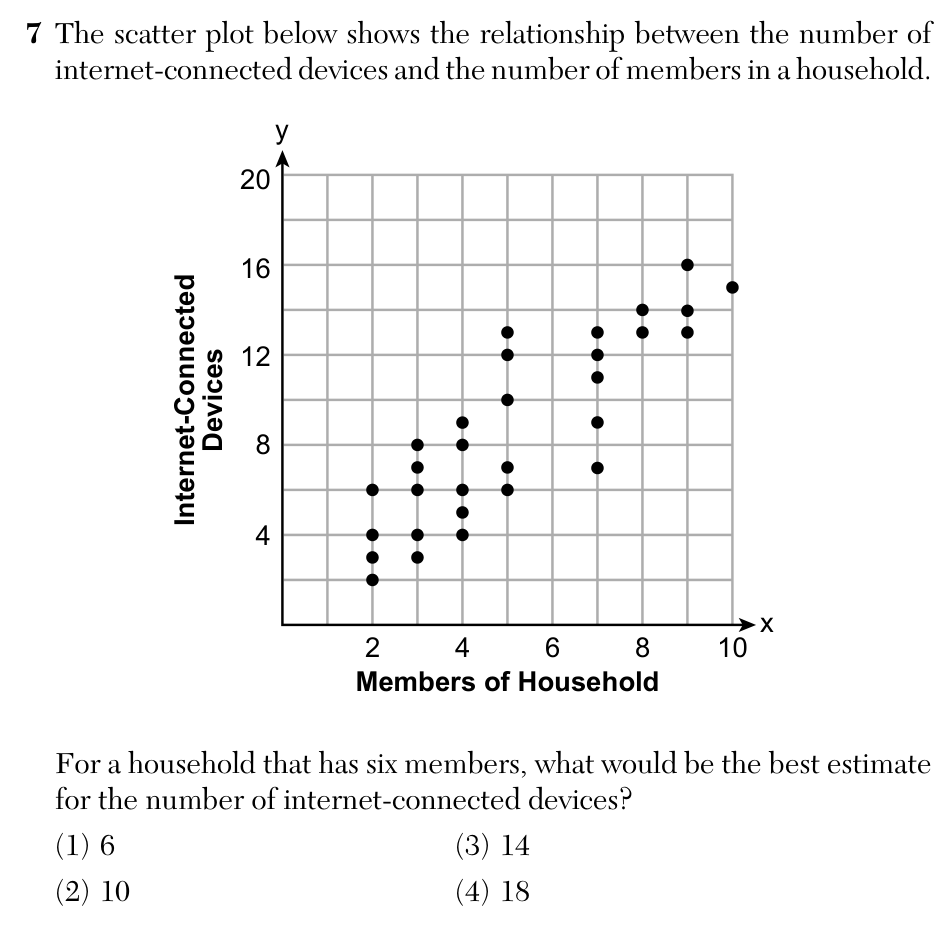
- Locate six household members on the horizontal axis.
- Follow the upward trend of the nearby points. A vertical reading at six members is around ten connected devices.
- Of the listed values, 10 best represents the center of that trend.
Exam detail: This is an estimate from the pattern, not a claim that every six-member household has exactly ten devices.
Question 8: Find a parabola’s axis of symmetry

- For , the symmetry line is . Here and .
- Substitute the signed coefficients:
Exam detail: An axis of symmetry is a vertical line, so its equation begins with x, not y.
Question 9: Identify the operation that preserves equality
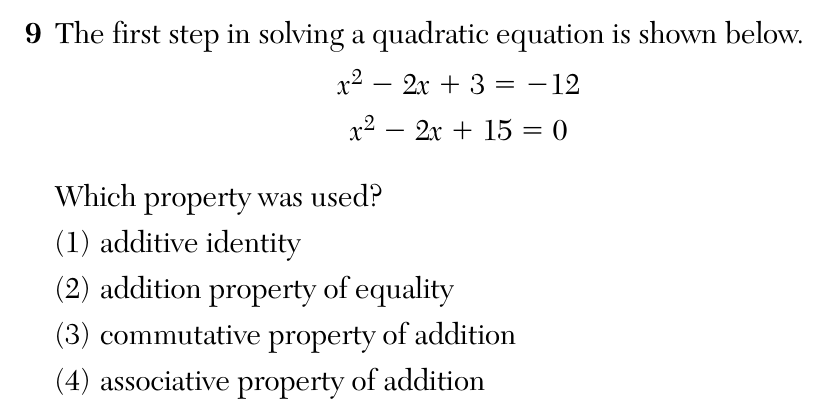
- The first line has −12 on the right. Adding 12 to both sides makes that side zero.
- The left constant becomes , giving .
- Adding the same quantity to both sides uses the addition property of equality.
Question 10: Write a polynomial in standard form
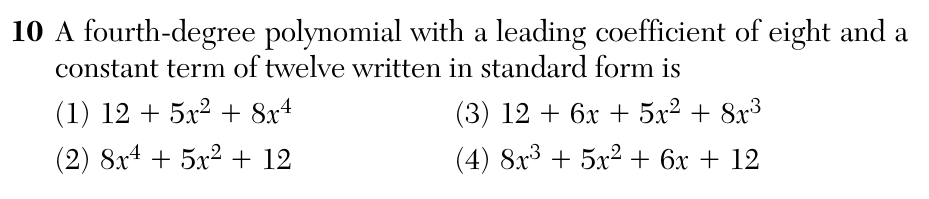
- Fourth degree requires a highest exponent of 4. A leading coefficient of 8 requires the first term when powers are ordered from largest to smallest.
- The constant term must be +12. The matching standard-form polynomial is:
Exam detail: Choice (1) has the same terms but does not place them in descending-power order.
Question 11: Evaluate a function at a negative input
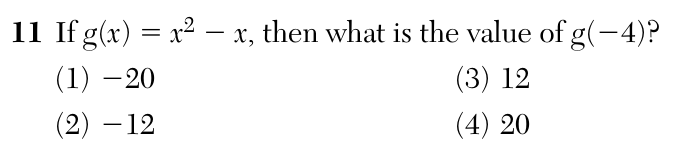
- Put −4 in parentheses wherever x occurs:
- Calculate the square and subtract the negative:
Question 12: Scale a recipe and convert units
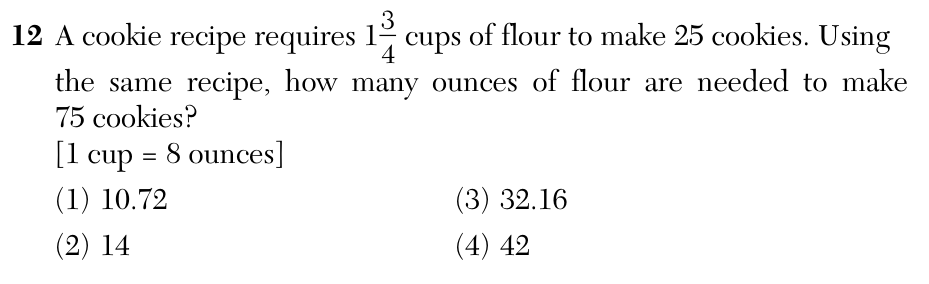
- Going from 25 cookies to 75 cookies multiplies the recipe by .
- The original flour quantity is cups. Three batches need cups.
- Use the problem’s conversion of eight ounces per cup:
Exam detail: Use the stated conversion and apply both the recipe scale factor and the unit conversion.
Question 13: Classify the product of two radicals
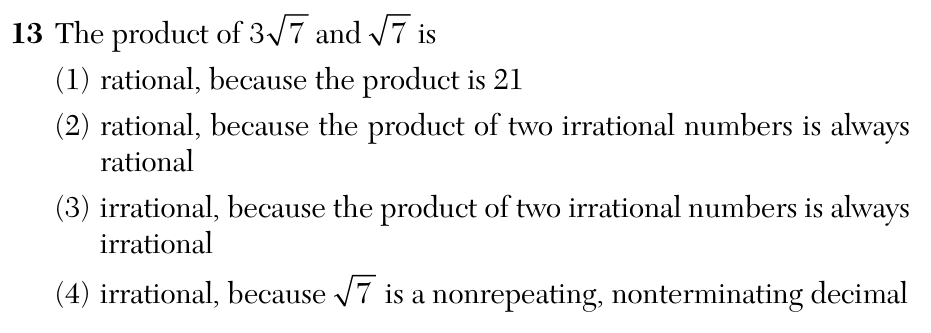
- Multiply the two square roots:
- Because 21 is an integer and can be written as , it is rational.
- The justification is this particular product. Products of irrational numbers are not always rational: for example, is irrational.
Question 14: Compare where three functions increase
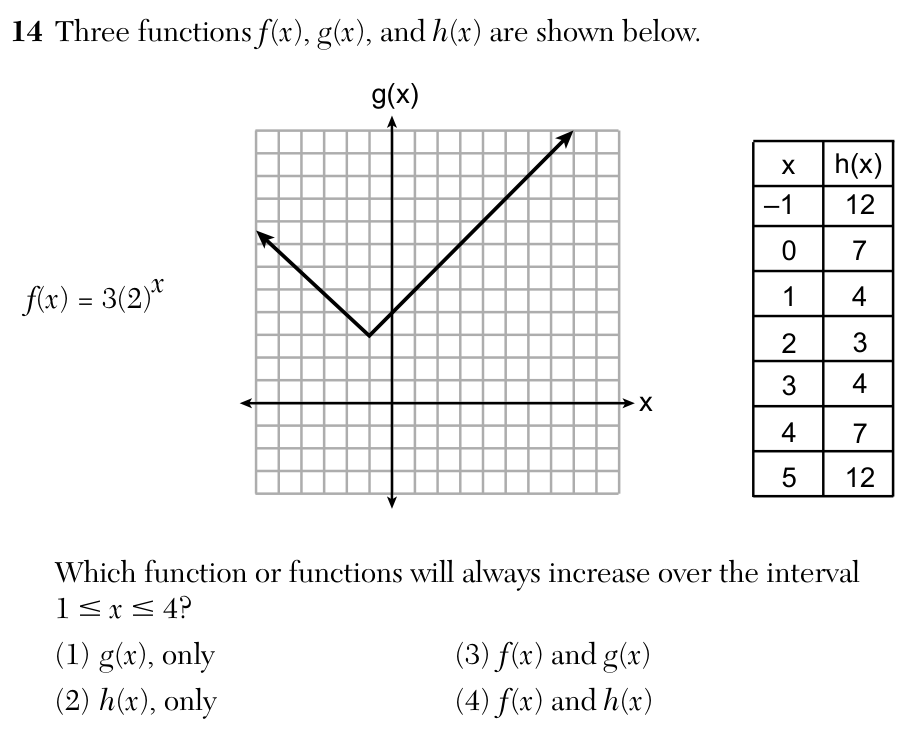
- The function increases because its positive exponential base is greater than 1.
- On the graph of , the entire interval lies on the rising branch. Thus increases there.
- The table for goes from 4 at down to 3 at , before rising again. It does not increase throughout the whole interval.
Exam detail: Check every part of the stated interval, not just its two endpoint outputs.
Question 15: Find every zero of a factored polynomial
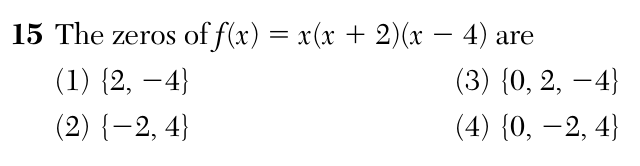
- Set each factor equal to zero:
- Solve the last two equations to get and . Include the zero from the first factor.
Question 16: Compare exponential expressions using a common base
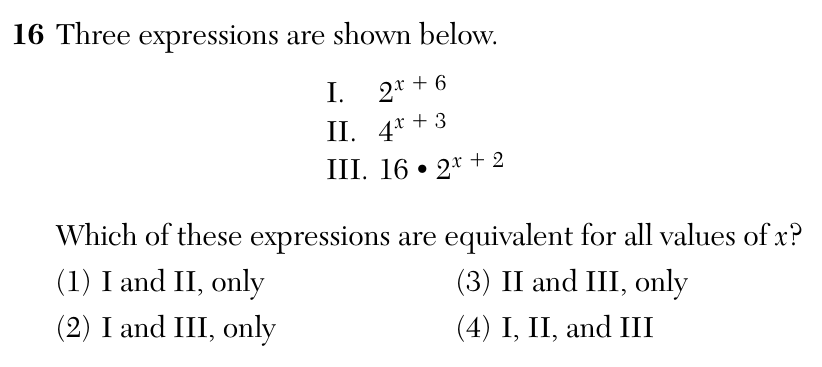
- Expression I is . Rewrite expression II using :
- Rewrite 16 as in expression III and add exponents when multiplying like bases:
- I and III match for every x. II does not: at , II is 256 while I and III are 128.
Exam detail: Keep the full exponent inside its grouping. Equality at one input would not establish equality for all inputs.
Question 17: Complete the square
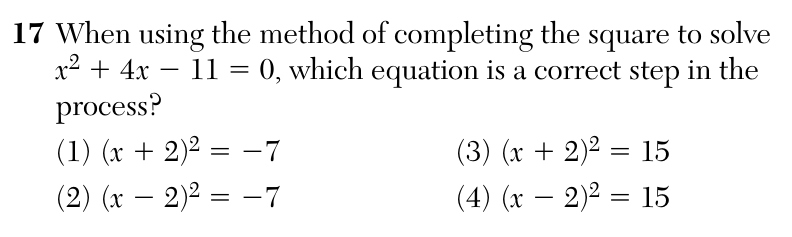
- Move the constant to the right:
- Half of 4 is 2; its square is 4. Add 4 to both sides:
- Factor the perfect-square trinomial:
Question 18: Compare means and standard deviations
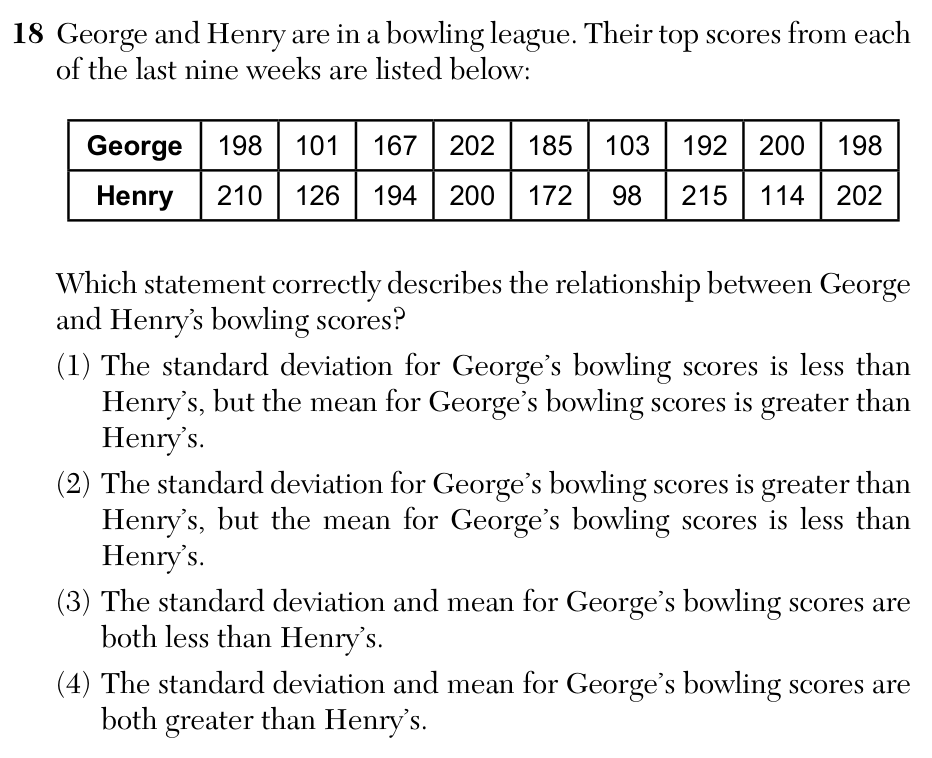
- Enter each bowler’s nine scores into a separate calculator list and run one-variable statistics.
- George’s mean is approximately 171.78, while Henry’s is approximately 170.11. George’s mean is greater.
- Using population standard deviations, George’s is approximately 38.63 and Henry’s approximately 42.67. George’s spread is smaller.
Exam detail: Using sample standard deviations instead gives approximately 40.97 and 45.26, so the same comparison holds. Do not mix the two conventions.
Question 19: Apply the function rule to a mapping
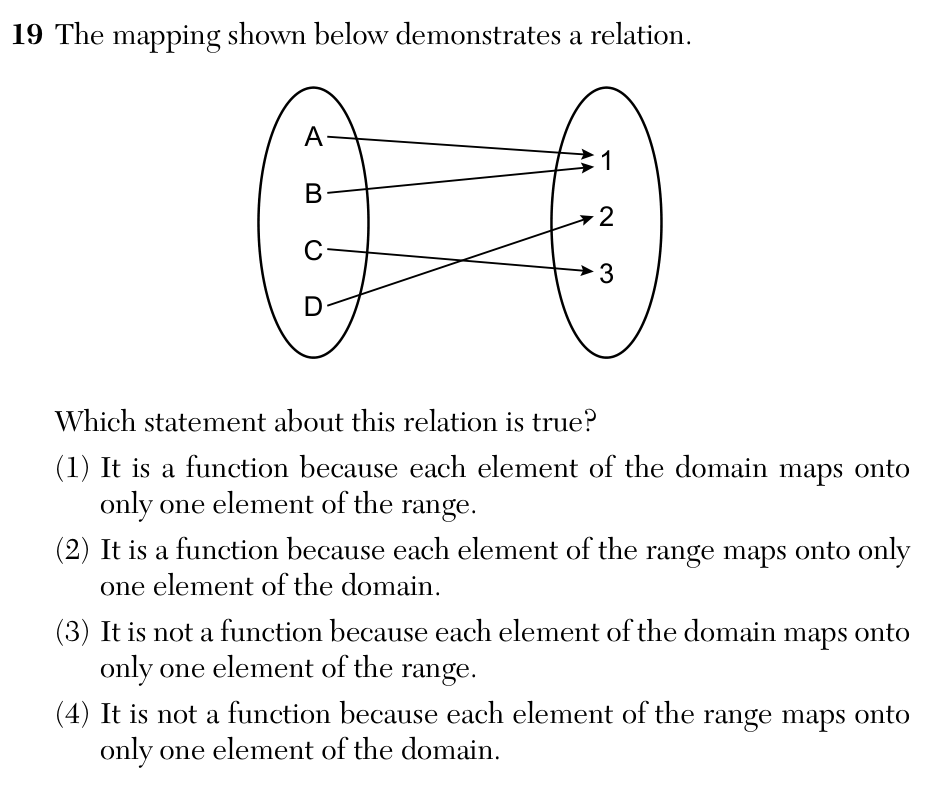
- Inspect the arrows leaving each input: A maps to 1, B maps to 1, C maps to 3, and D maps to 2.
- Each input has exactly one output, so the relation is a function.
- A and B may share an output. The restriction is on one input having multiple outputs.
Question 20: Shift an absolute-value graph to the right
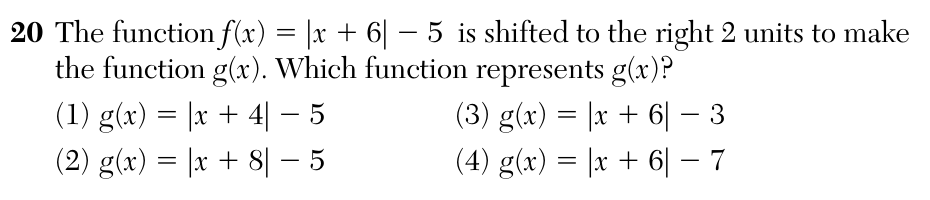
- To shift a function right by two units, replace the input x with .
- Apply the replacement to the whole input expression:
- Simplify inside the absolute-value bars:
Exam detail: The vertex moves from to , confirming a rightward shift of two units.
Question 21: Calculate average rate of change
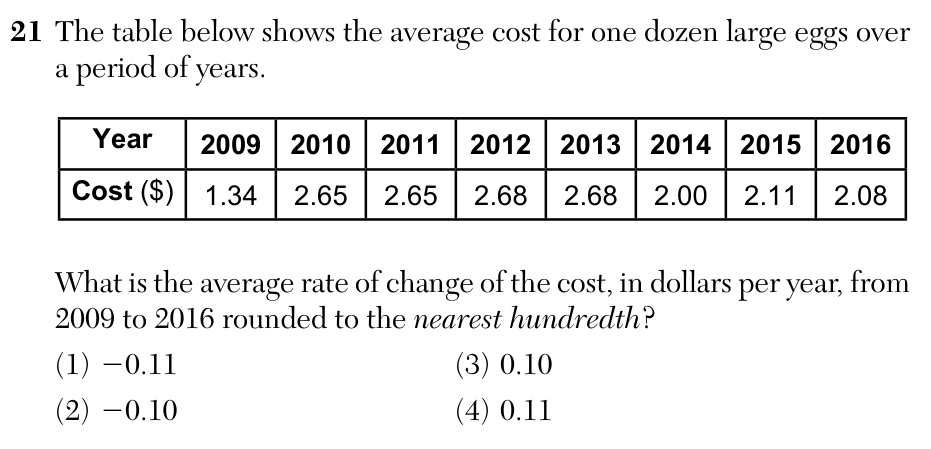
- Use the specified endpoint costs: $1.34 in 2009 and $2.08 in 2016.
- Divide the change in cost by the elapsed years:
- Round to the nearest hundredth. The positive rate is $0.11 per year.
Exam detail: The denominator is seven elapsed years, not the eight observations in the table.
Question 22: Check an ordered pair by substitution
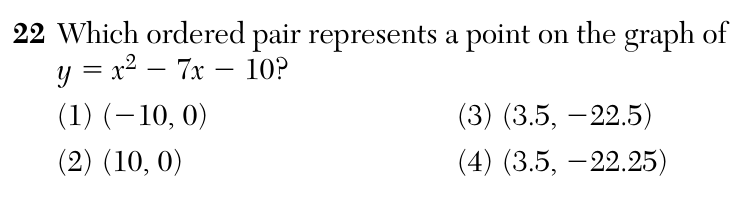
- For the two choices with , evaluate the function exactly:
- This gives . For the other listed inputs, gives 160 and gives 20, so neither has output zero.
Question 23: Factor out the greatest common factor first
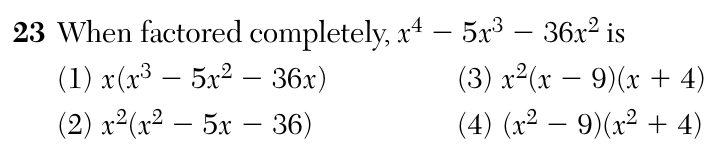
- Every term contains :
- Two numbers with product −36 and sum −5 are −9 and 4. Factor the remaining quadratic:
Exam detail: Factoring out the common factor alone does not finish the factorization.
Question 24: Subtract one polynomial from another

- “Subtracted from” puts the second named polynomial first:
- Distribute the subtraction sign to every term:
- Combine like terms:
Part II: Short constructed responses
Questions 25–30 • 2 credits each • 12 credits total
Question 25: Complete a two-way frequency table
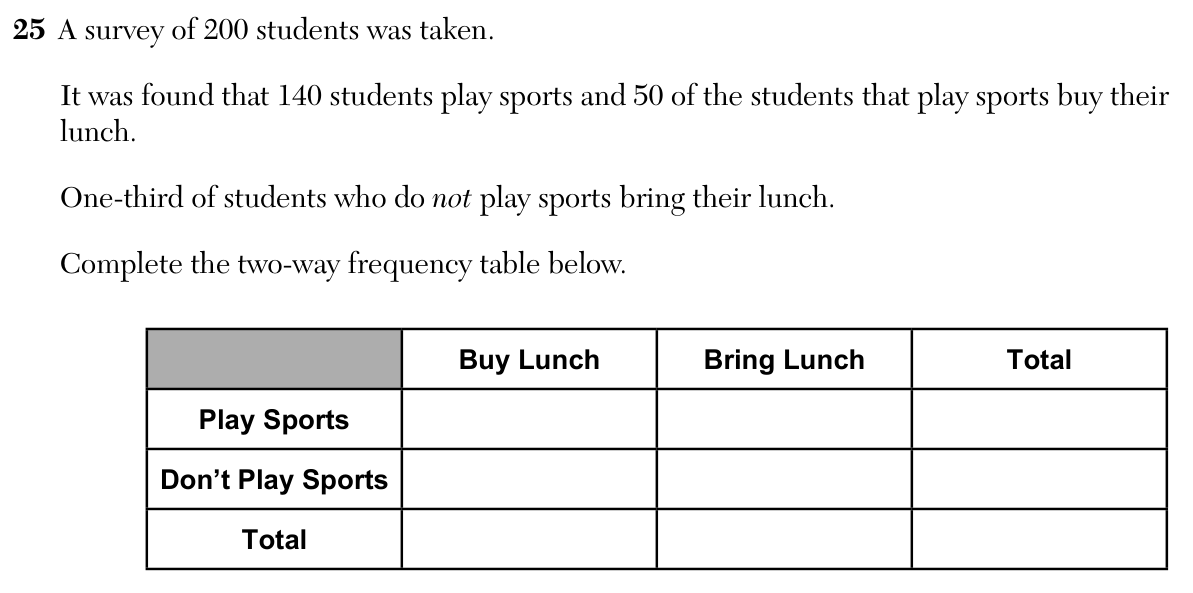
- Of the 140 students who play sports, 50 buy lunch, so bring lunch.
- The number who do not play sports is . One-third of these students bring lunch: . Therefore buy lunch.
- Add each column: buy lunch and bring lunch. The completed table is:
Completed student lunch table Group Buy lunch Bring lunch Total Play sports 50 90 140 Do not play sports 40 20 60 Total 90 110 200
Exam detail: The one-third applies only to the 60 students who do not play sports, not to all 200 students.
Question 26: Rearrange a formula to make x the subject

- Subtract b from both sides:
- Divide both sides by m:
Exam detail: This rearrangement assumes . Keep the whole difference in the numerator.
Question 27: Clear fractions in a linear inequality

- The least common denominator is 20. Multiply both sides by positive 20, so the inequality direction stays the same:
- Subtract and subtract 8 from both sides:
- Divide by positive 10 and simplify:
Exam detail: The boundary is excluded because the original inequality is strict.
Question 28: Write an arithmetic rule and use it
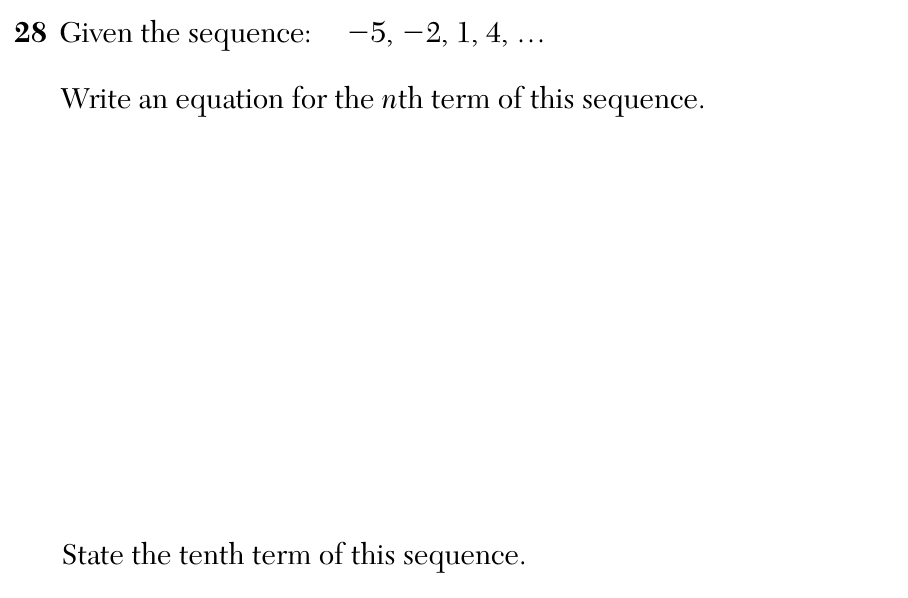
- The first term is −5 and the common difference is 3.
- Use with the first term indexed by :
- Substitute 10 for the term number:
Exam detail: Give both requested parts. The equivalent rule is also valid.
Question 29: Use the quadratic formula for exact roots

- Identify in .
- Substitute into the quadratic formula:
- Simplify the discriminant and denominator:
Exam detail: The question requires the quadratic formula and exact values; decimal approximations do not replace the radical answers.
Check a new example with the quadratic equation calculator.
Question 30: Simplify before adding radicals

- Factor the perfect square from 32:
- Substitute this into the sum and combine like radicals:
Exam detail: Only radicals with the same remaining radicand can be combined as like terms.
Part III: Extended constructed responses
Questions 31–34 • 4 credits each • 16 credits total
Question 31: Fit and interpret a regression line
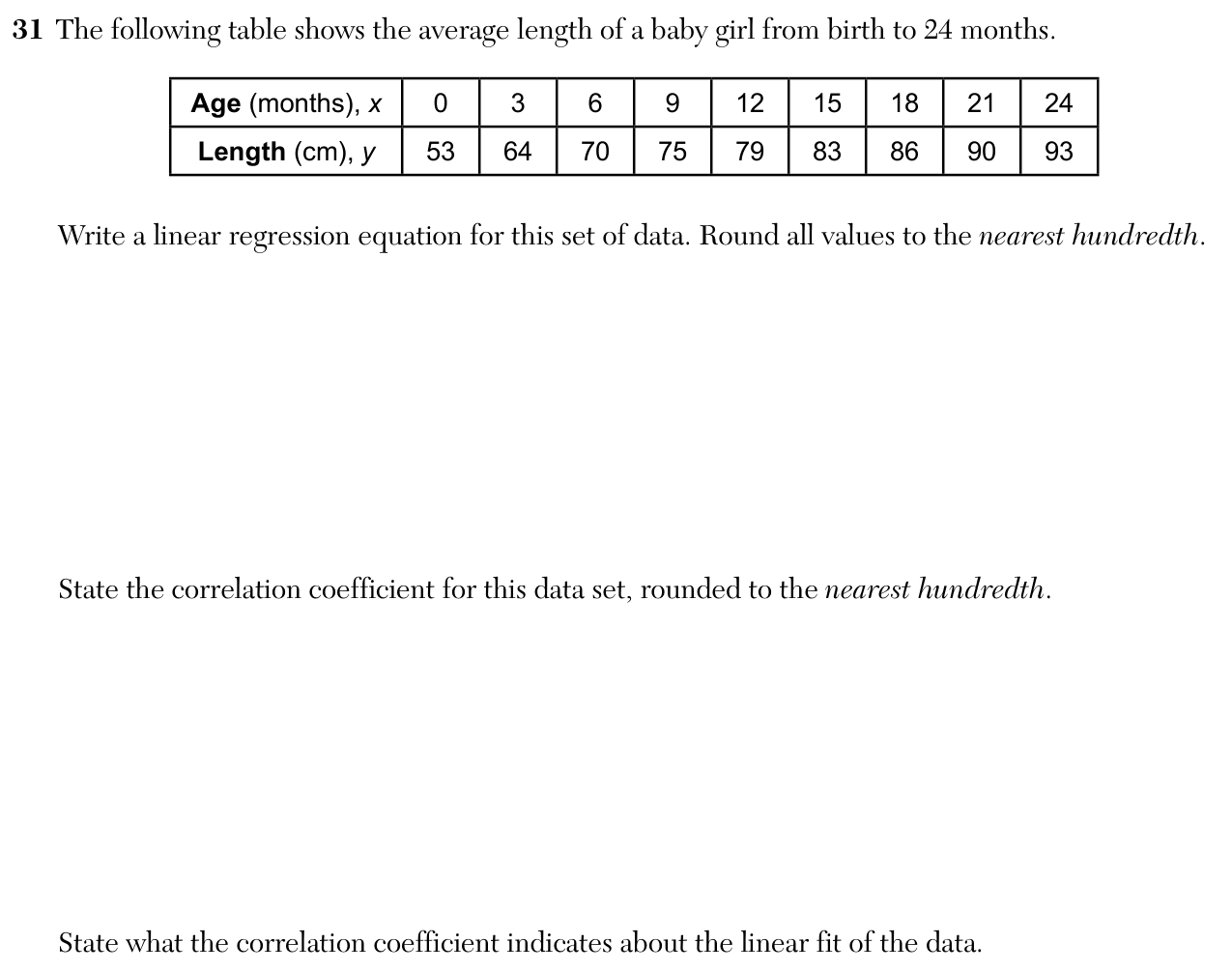
- Enter the nine ages in months into one calculator list and the corresponding lengths in centimeters into another, preserving the pairs.
- Run linear regression. The unrounded slope is approximately 1.544444 and the intercept approximately 58.466667. Round both to the nearest hundredth:
- The correlation coefficient is approximately 0.978970, which rounds to .
- This indicates a strong positive linear fit: larger ages are associated with larger lengths, and the points lie fairly close to an upward-sloping line.
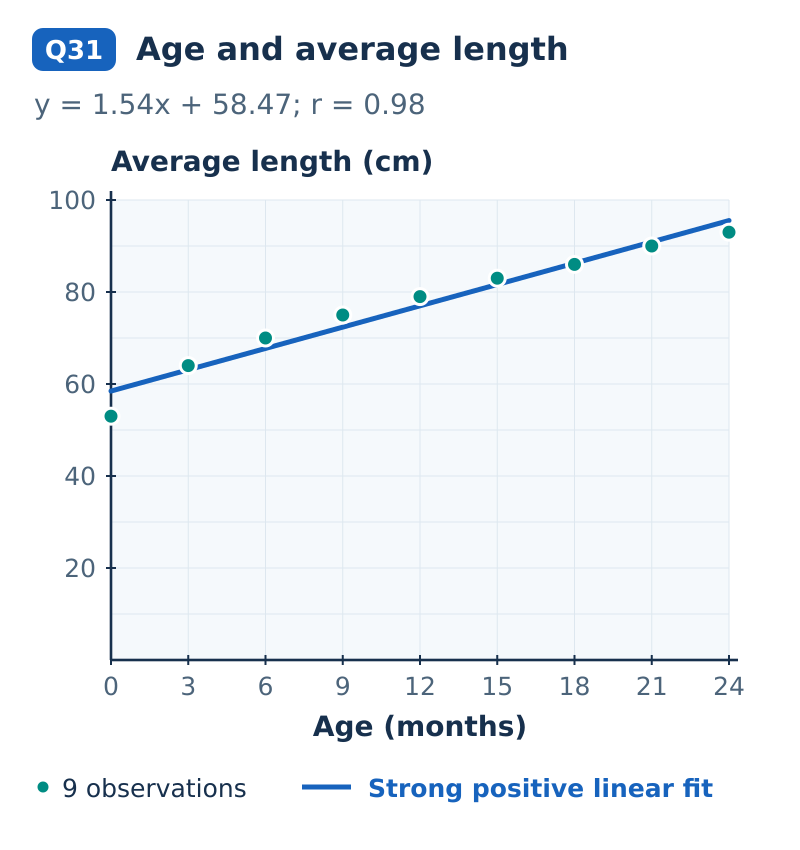
Exam detail: The best-fit line summarizes all nine points; it need not pass exactly through the birth measurement. State the strength of the fit, not merely its direction.
Explore the data with the regression analysis calculator.
Question 32: Graph inequalities and test an excluded boundary point
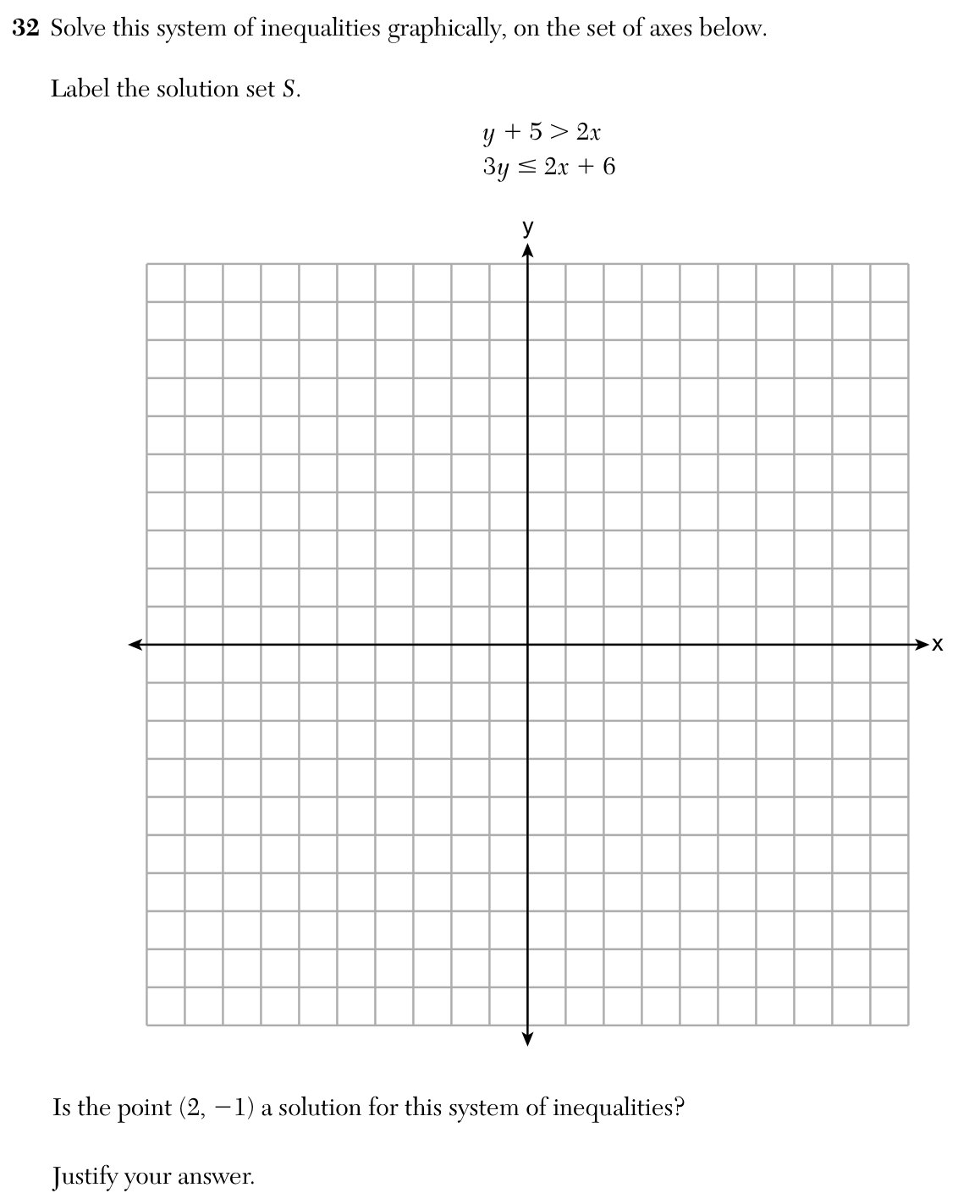
- Isolate y in each inequality:
- Draw dashed and shade above it. Draw solid and shade below it. Label the overlapping region S and label the boundary equations.
- Test in the first original inequality:This is false because equality does not satisfy a strict inequality.
- The second inequality is true:A solution must satisfy both inequalities, so passing only the second is insufficient.
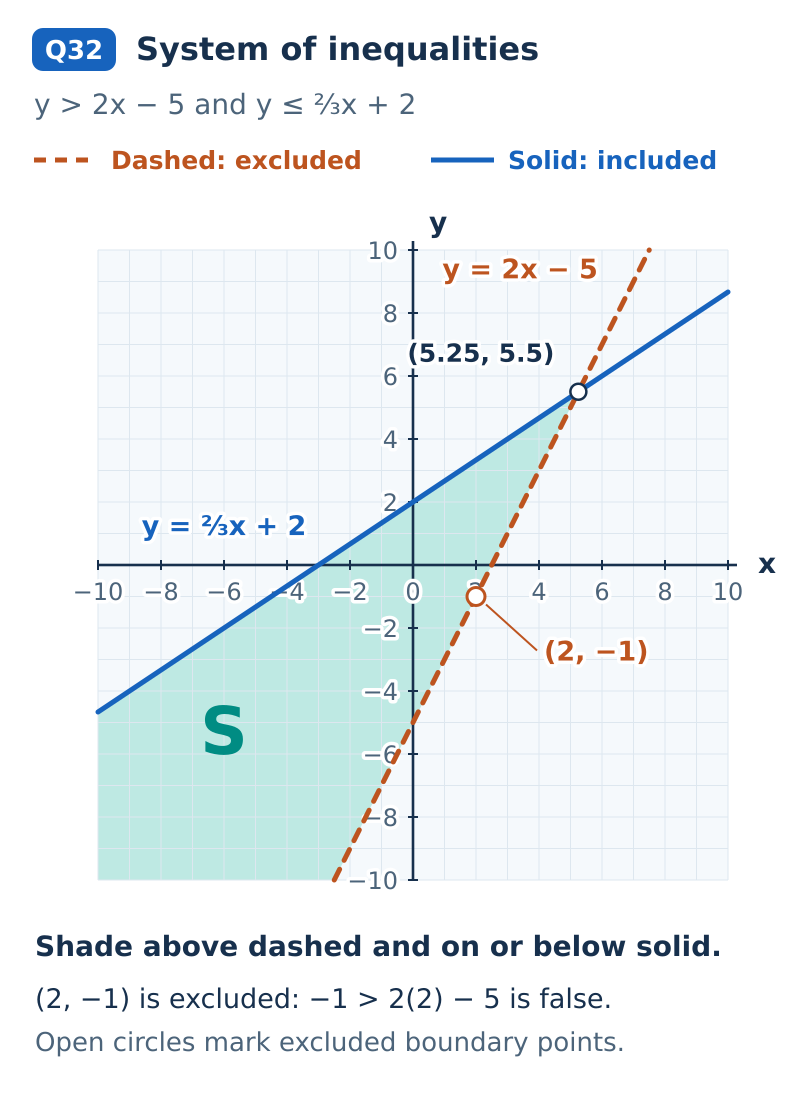
Exam detail: The point lies on the dashed boundary and is excluded. The two boundaries meet at , which is also excluded.
Question 33: Sketch a basketball’s flight and find its maximum
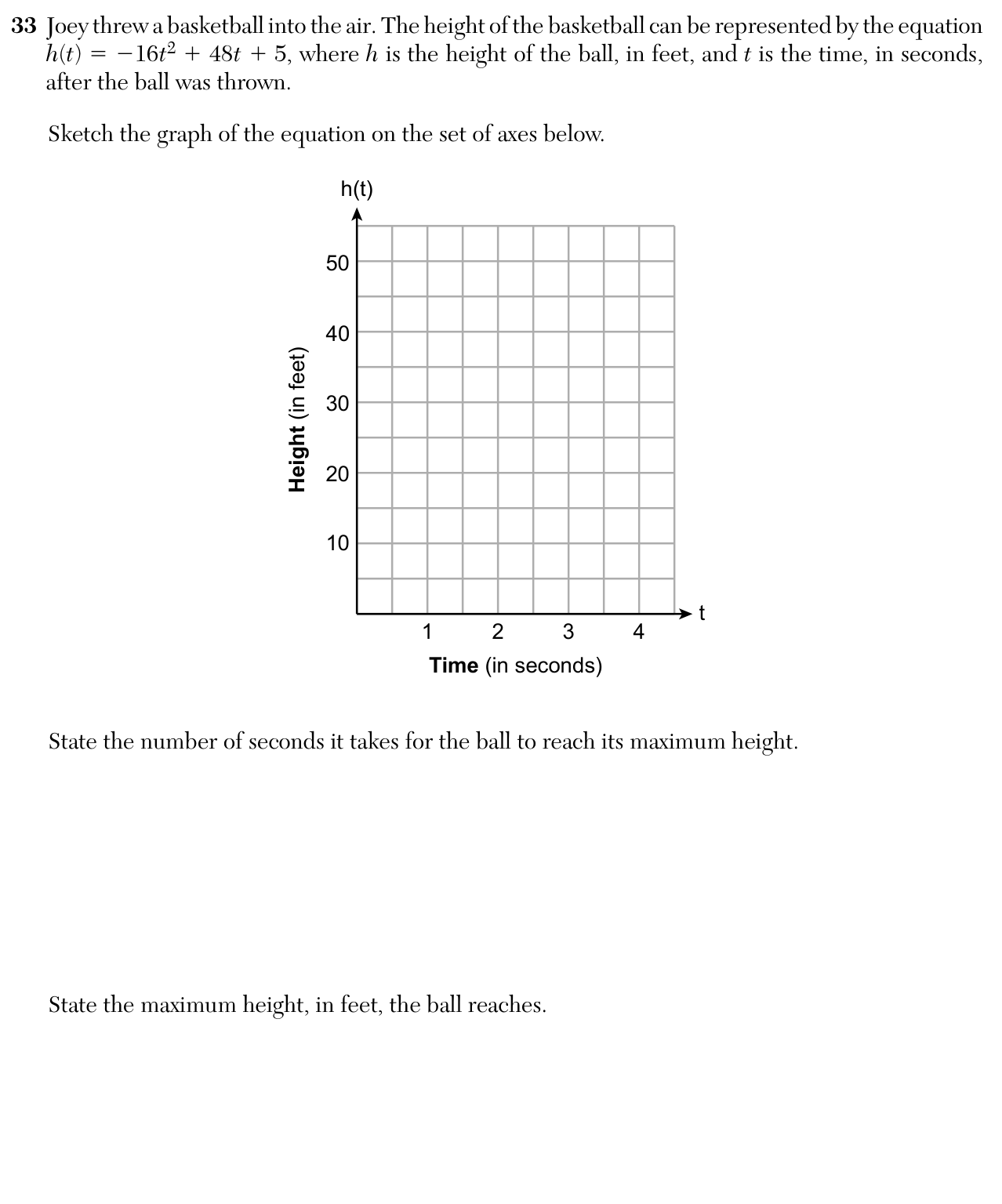
- The initial height is feet. Because the squared-term coefficient is negative, the height graph opens downward.
- Find the time coordinate of the vertex:
- Evaluate the height at this time:
- Sketch a smooth curve through , , , , , , . Stop at ground level just after 3 seconds, approximately 3.10 seconds.
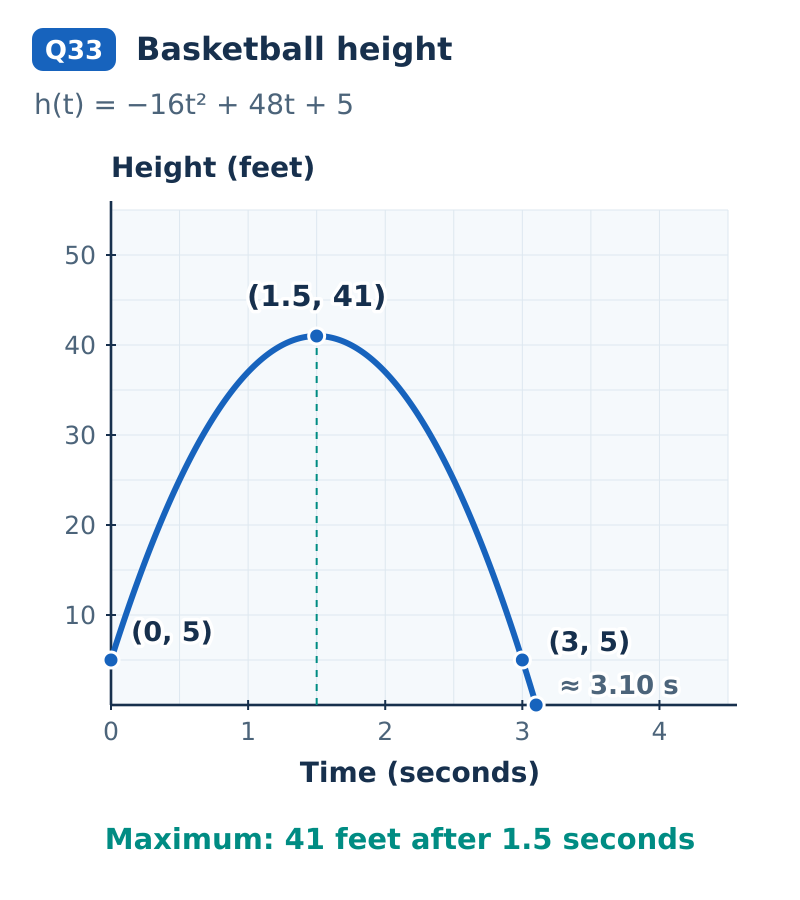
Exam detail: Include the requested sketch and both values with their meanings. Show only the physical flight, with nonnegative time and height; do not continue the curve below ground.
Question 34: Solve a linear–quadratic system algebraically

- Set the two expressions for y equal:
- Collect terms and factor:
- The zero-product property gives or . Substitute into :
- Check the quadratic: and . Both pairs satisfy both equations.
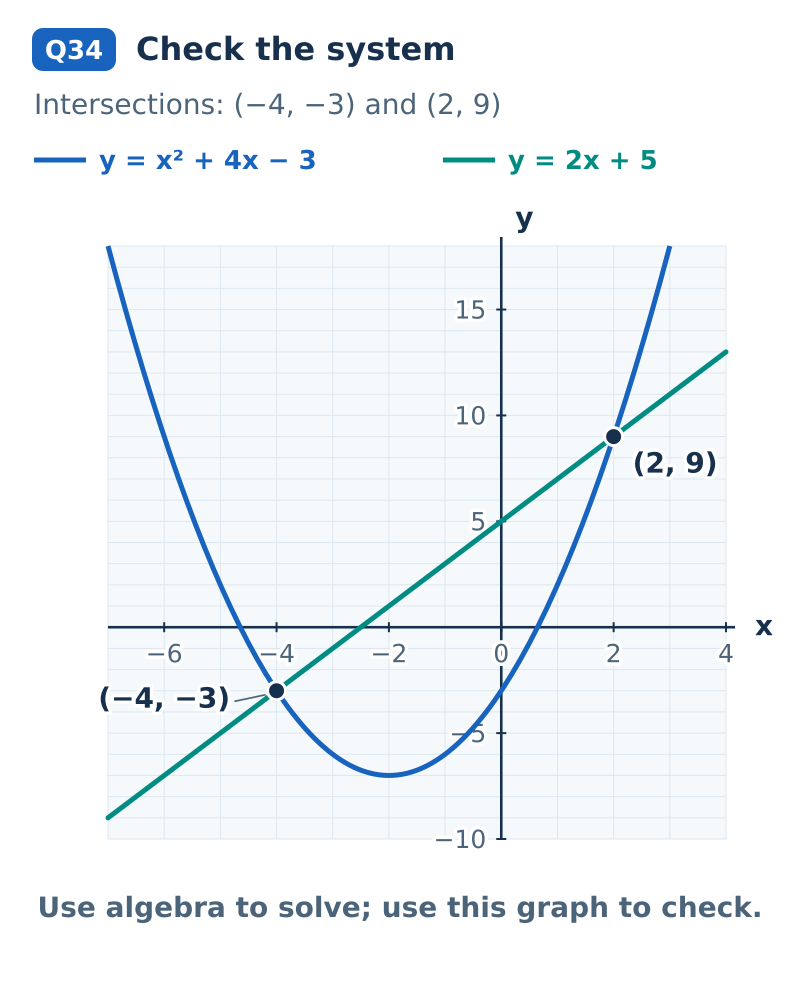
Exam detail: Algebra is required. The accompanying graph checks the two intersections but does not replace the algebraic solution.
Part IV: Multi-step modeling problem
Question 35 • 6 credits
Question 35: Model two purchases and solve exact prices
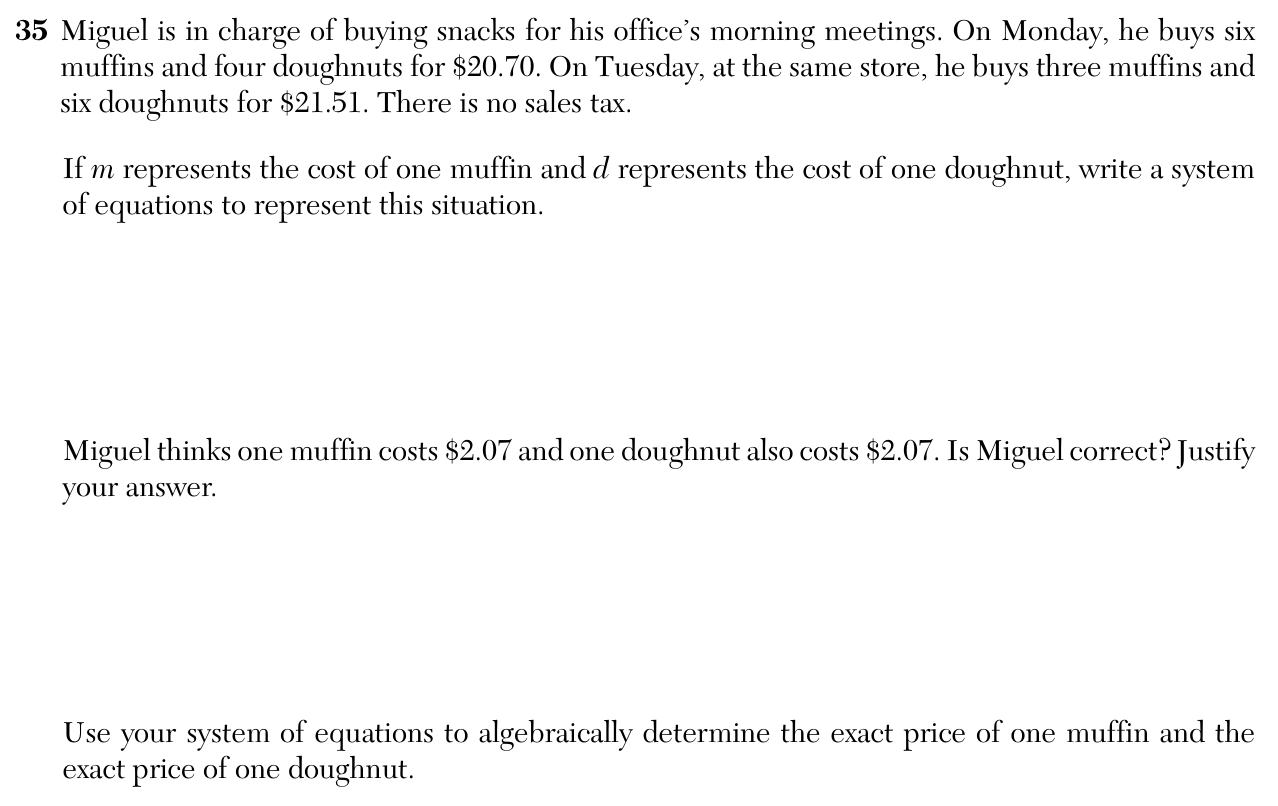
- Let m be one muffin’s price and d one doughnut’s price, in dollars. The purchases give:
- Miguel’s guess works for Monday because . It fails Tuesday: , which is not $21.51. Therefore Miguel is incorrect.
- Multiply the Tuesday equation by 2, then subtract the Monday equation:
- Substitute the doughnut price into Monday’s equation:
- Check both purchases:
Exam detail: Give the system, justify the decision about Miguel’s guess, and show the algebra for both exact prices. Matching only one purchase does not solve the system.
Check your score carefully
The maximum raw score is 82, but the reported Regents score is a scaled score. Use the official August 2026 conversion chart for this administration. Do not substitute a conversion chart from a different month or year. For more complete worked papers, see January 2026 Algebra I Regents solutions and June 2026 Algebra I Regents solutions. The official administration-specific chart remains the source for an exact conversion.
Sources & References
Official materials accessed October 7, 2026. Question and scoring references use the English edition throughout this page.
- Official August 2026 Algebra I examination (questions; PDF)
- Official August 2026 multiple-choice scoring key (PDF)
- Official August 2026 rating guide (PDF)
- Official August 2026 model response set (PDF)
- Official August 2026 conversion chart (PDF)
- NYSED Algebra I past-examination index
- NYSED terms of use and reproduction conditions
From the New York State Education Department. Regents Examination in Algebra I, August 2026. Internet. Available from the official examination link above; accessed 7 October 2026. Original question images are distinguished from HeLovesMath’s original explanations and solution diagrams.
Date note: the model response set cover prints Wednesday, August 18. The examination and rating guide identify the correct date as Tuesday, August 18, 2026, which this page follows.