
Work through every question in the English-language January 2026 Algebra II Regents. Each solution explains the method, gives the final answer, and highlights details that matter for a complete written response.
Try the question first, then compare your reasoning with the steps below. Select a question image or diagram to open a larger view. The question numbers and paper-page references follow the official exam. The original paper and NYSED scoring documents are linked in Sources & References.
For Parts II–IV, show your method. A final number on its own can lose substantial credit, and a question that specifies algebraic solution or a graph requires that method.
These are independent HeLovesMath explanations, not an official NYSED publication. Answers and required methods were checked against the official scoring key, rating guide, and model response set. Valid alternative methods can also earn credit unless a question specifies a method.
Quick check: Part I answer choices
- Q1: (4)
- Q2: (4)
- Q3: (3)
- Q4: (2)
- Q5: (2)
- Q6: (1)
- Q7: (2)
- Q8: (3)
- Q9: (3)
- Q10: (2)
- Q11: (4)
- Q12: (3)
- Q13: (1)
- Q14: (2)
- Q15: (1)
- Q16: (4)
- Q17: (2)
- Q18: (2)
- Q19: (1)
- Q20: (3)
- Q21: (3)
- Q22: (4)
- Q23: (3)
- Q24: (3)
Use the worked explanations below to check why each answer is correct.
Part I: Multiple-choice solutions
Questions 1–24 • 2 credits each • 48 credits total
Question 1: Rewrite both sides with the same base
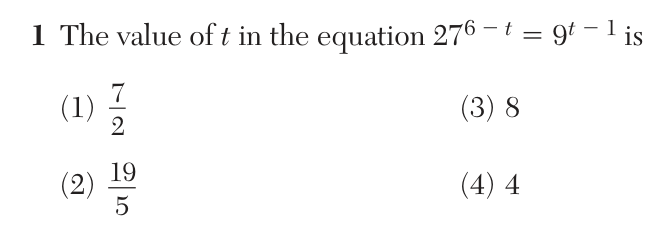
- Express both 27 and 9 as powers of 3:
- Use the power-of-a-power rule in the given equation:
- Because the common base is 3, equate exponents and solve:
Exam detail: Checking the original equation gives .
Question 2: Factor using the repeated expression
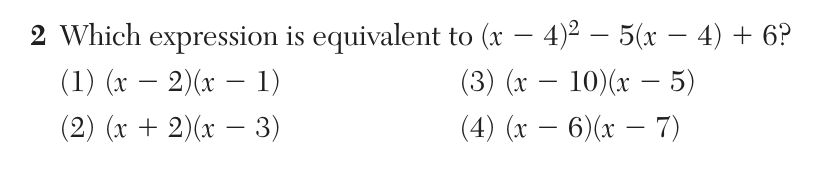
- Let . The expression becomes .
- Find two numbers with product 6 and sum −5: −2 and −3. Therefore:
- Replace u with its original expression:
Question 3: Distinguish an experiment from observation
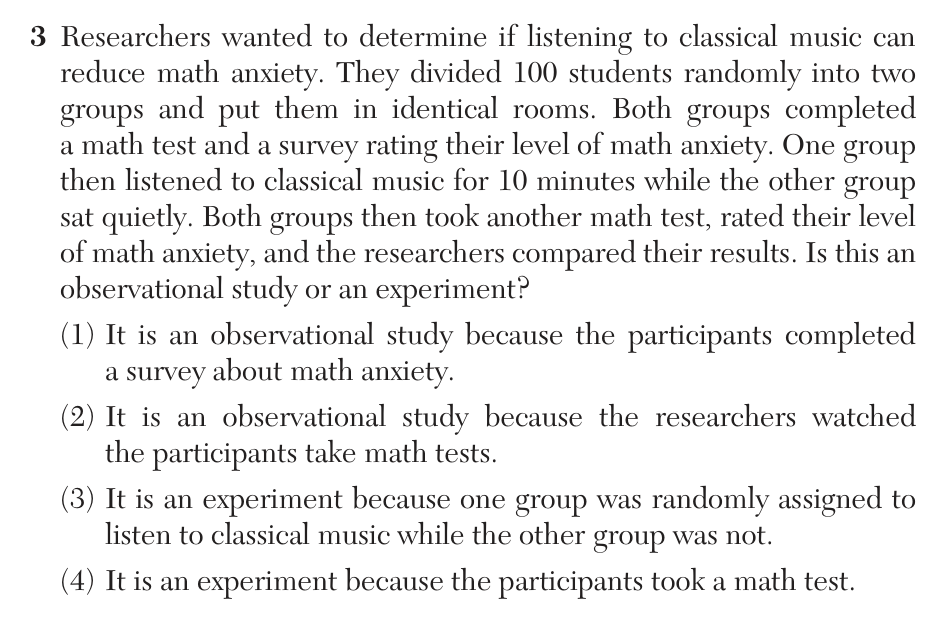
- The researchers actively assigned a treatment: one group listened to classical music while the other sat quietly.
- The students were randomly assigned to the two groups. The comparison therefore comes from an experiment rather than simply observing existing behavior.
- Taking a test or completing a survey does not by itself make a study an experiment. The imposed treatment and comparison group are the deciding features here.
Question 4: Recognize a logarithm with a base below one
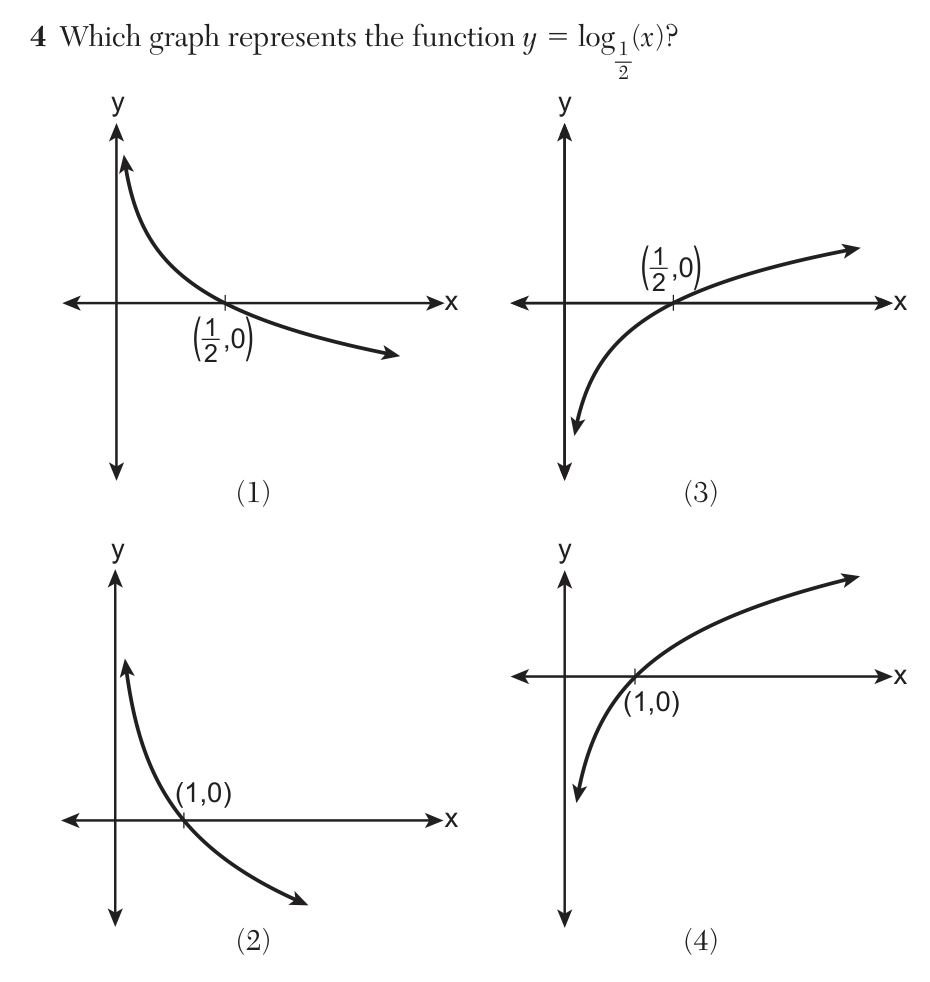
- For , the input must be positive. The graph has a vertical asymptote at .
- Every logarithm satisfies , so the x-intercept must be .
- Because the base lies between 0 and 1, the function decreases. For example, and . Select the decreasing graph through .
Question 5: Read the amplitude, midline and period
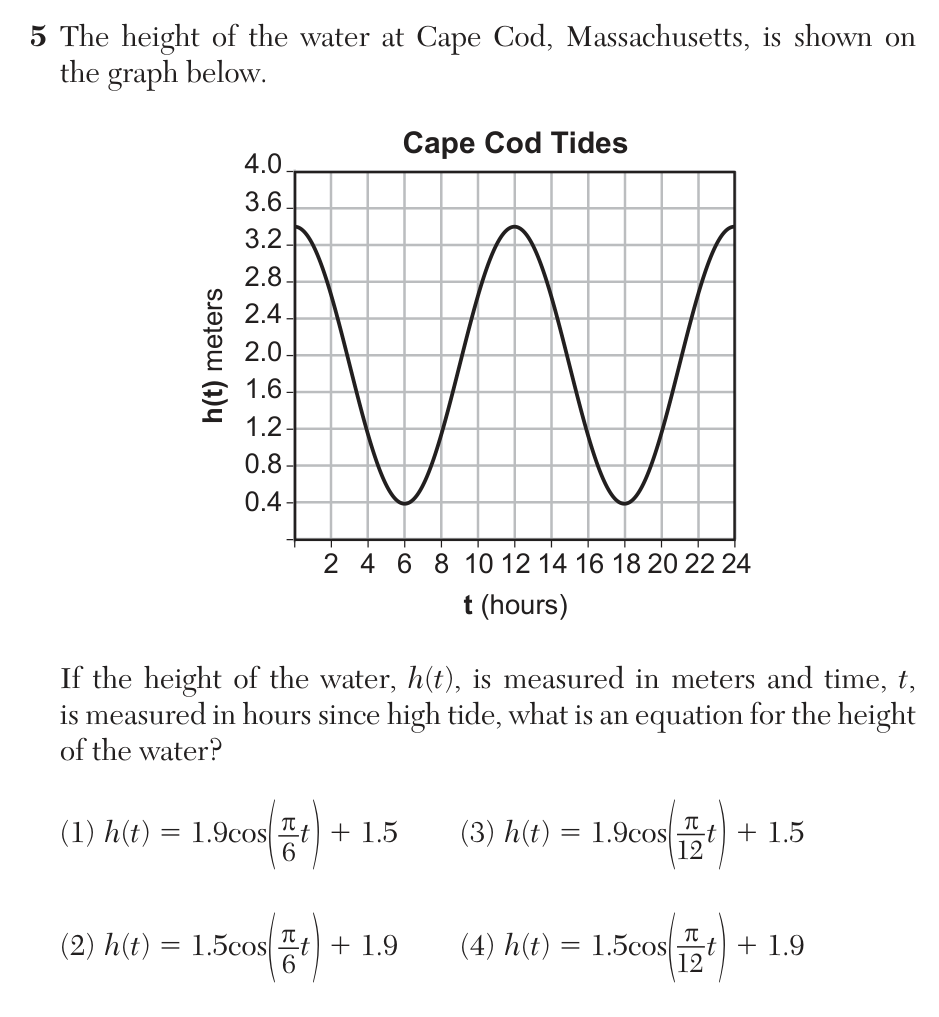
- The graph’s maximum height is 3.4 meters and minimum height is 0.4 meter. Thus:
- Consecutive high tides occur at 0, 12 and 24 hours, so the period is 12 hours. The angular coefficient is:
- Time starts at high tide, so a positive cosine with no horizontal shift fits the initial maximum:
Exam detail: Amplitude is half the maximum-to-minimum difference, not the midline height.
Question 6: Use the quadratic formula with a negative discriminant
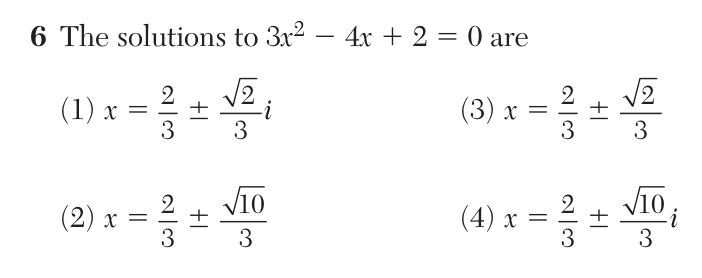
- For , the coefficients are , , and .
- Calculate the discriminant:
- Apply the quadratic formula and simplify the square root using :
Question 7: Compare exact trigonometric values
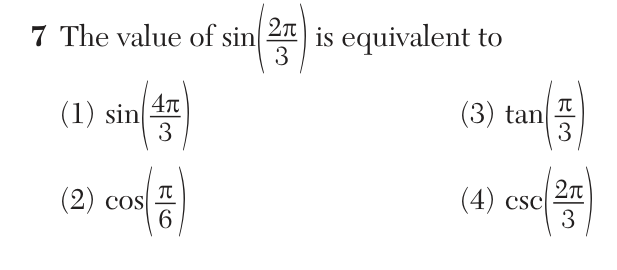
- The angle lies in Quadrant II with reference angle . Sine is positive there, so:
- The complementary angle has cosine . Therefore it gives the same value.
Question 8: Invert the given inverse function
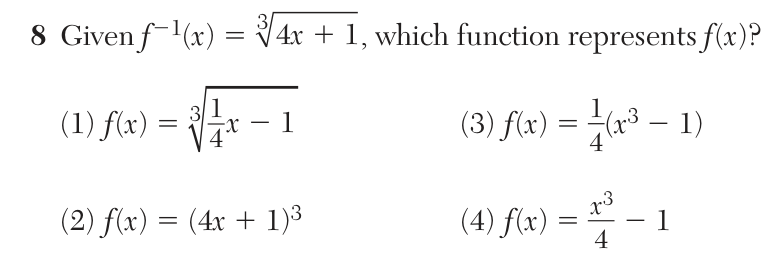
- To recover f, take the inverse of the given inverse. Start with:
- Swap x and y, then solve for y:
- Thus . Cubing undoes the cube root for every real input.
Exam detail: The inverse notation is not the reciprocal of the function.
Question 9: Calculate a normal probability between two heights
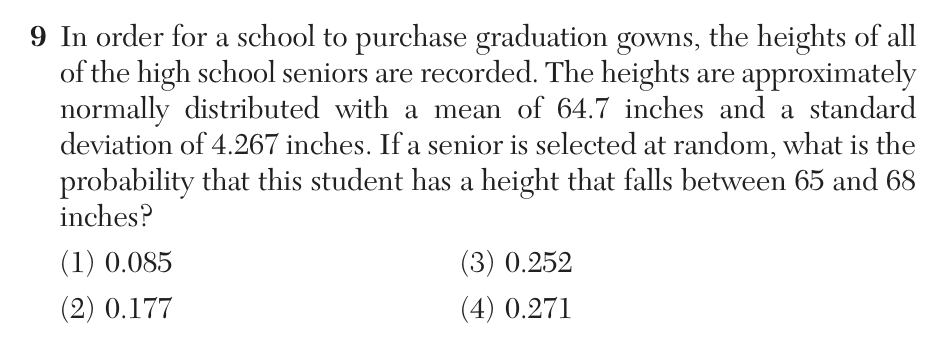
- Let X be the selected senior’s height. Use mean 64.7 inches and standard deviation 4.267 inches.
- Standardize the two bounds:
- Find the area under the normal curve between these bounds. A calculator’s normal cumulative-distribution command can use lower bound 65, upper bound 68, mean 64.7 and standard deviation 4.267 directly:
- To three decimal places, the probability is 0.252.
Exam detail: This is the area between the two heights, not the area to the left of 68 alone.
Question 10: Substitute into the circle equation
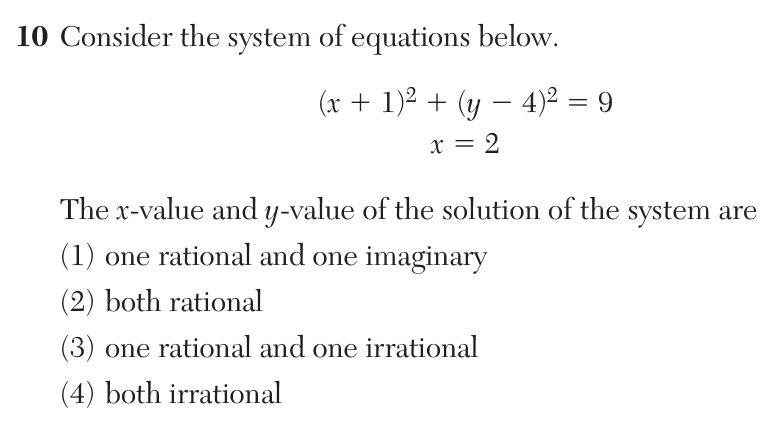
- The second equation fixes . Substitute it into the first equation:
- Simplify:
- The only solution is . Both coordinates are rational numbers.
Question 11: Check each proposed factorization
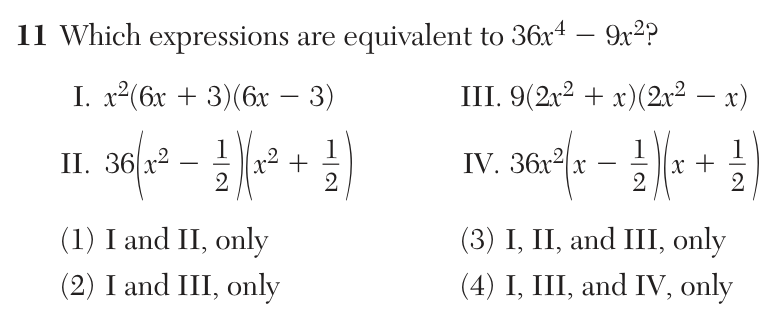
- For I, use the difference of squares:
- For II, the product gives , which lacks the required squared factor in the second term.
- For III:
- For IV:Therefore I, III and IV are equivalent to the original expression.
Question 12: Convert the annual multiplier to a monthly multiplier
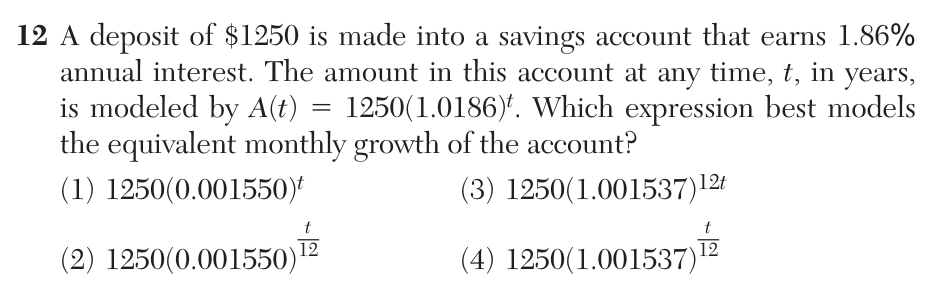
- Let b be the monthly growth factor. Twelve monthly multiplications must equal the annual factor:
- Take the twelfth root:
- There are months in t years. Use the monthly multiplier with this exponent:
Exam detail: A monthly growth factor includes the original balance, so it is slightly greater than 1.
Question 13: Use the remainder theorem on a graph
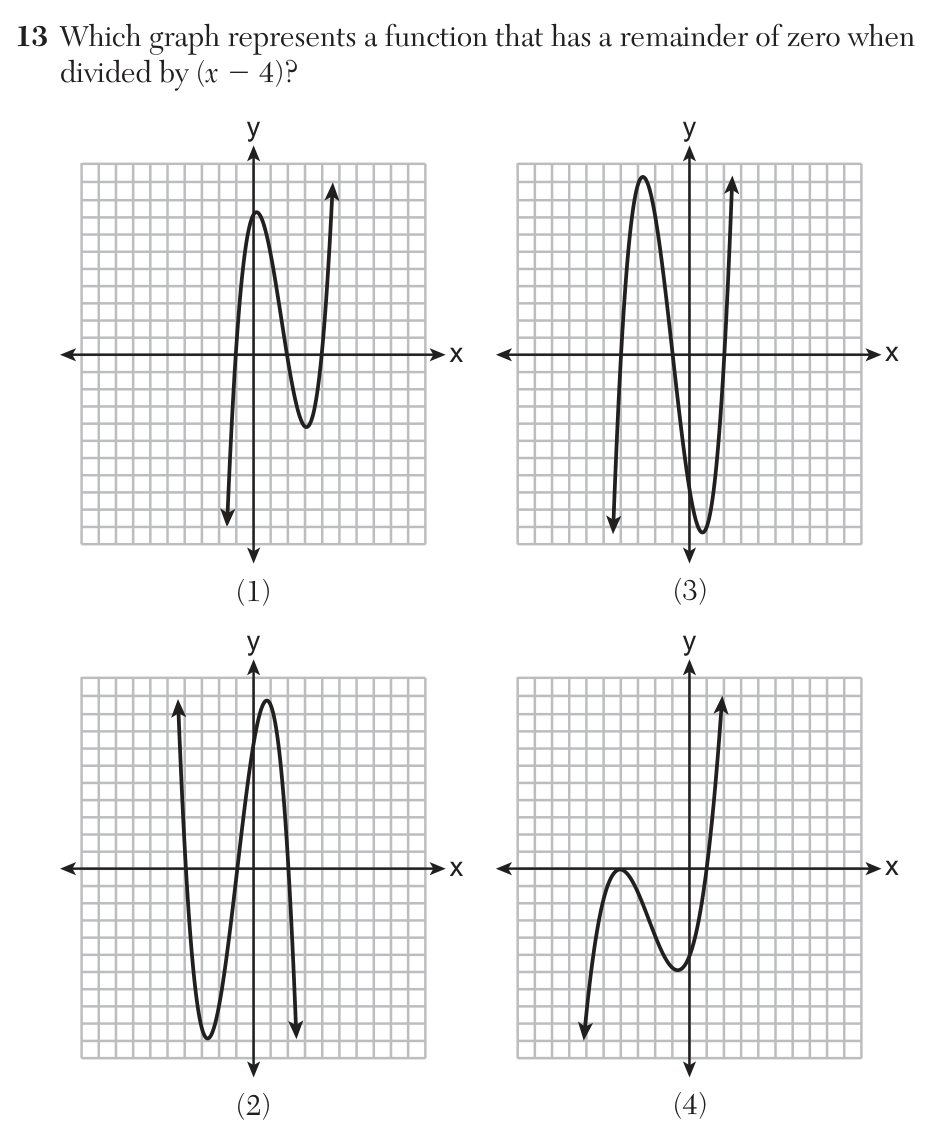
- The remainder when a polynomial f is divided by is .
- A zero remainder therefore means , so the graph must intersect the x-axis at .
- Count four grid units to the right of the y-axis. Graph (1) has an x-intercept there.
Question 14: Combine fractional exponents
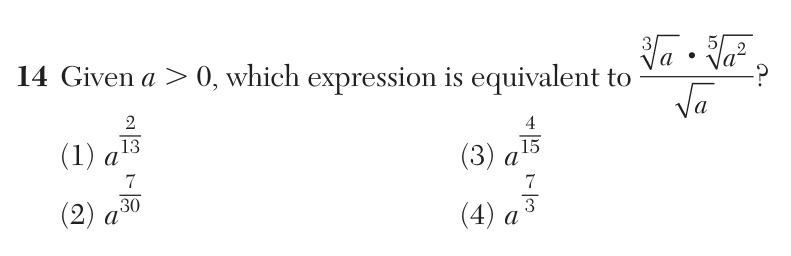
- Because , rewrite each radical as a rational exponent:
- Use a common denominator of 30:
Exam detail: Add exponents when multiplying powers with the same base, and subtract the denominator’s exponent when dividing.
Question 15: Match roots, multiplicities and end behavior
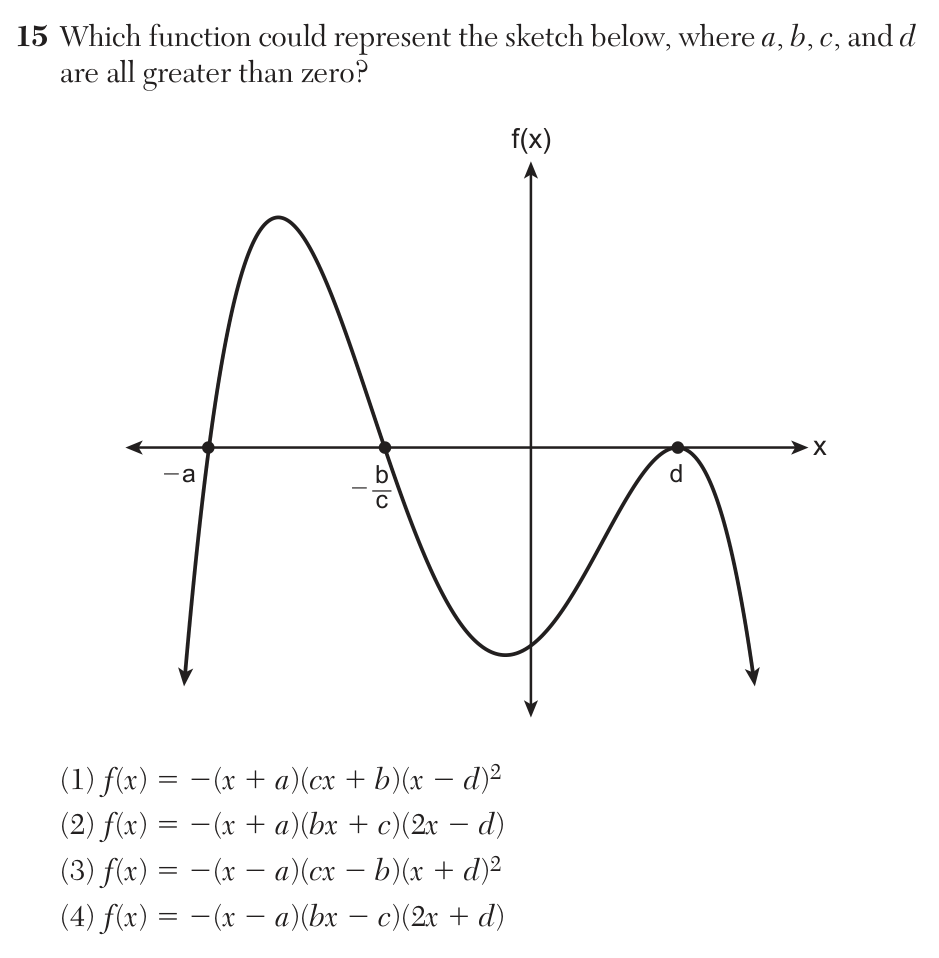
- The graph crosses the x-axis at and . These roots correspond to factors and .
- At the positive root d, the graph touches the axis and turns back. The factor supplies an even multiplicity.
- Both ends point downward. The chosen fourth-degree expression must have a negative leading coefficient. Since c is positive, a minus sign before the product gives the required behavior.
Question 16: Use the condition to choose the denominator
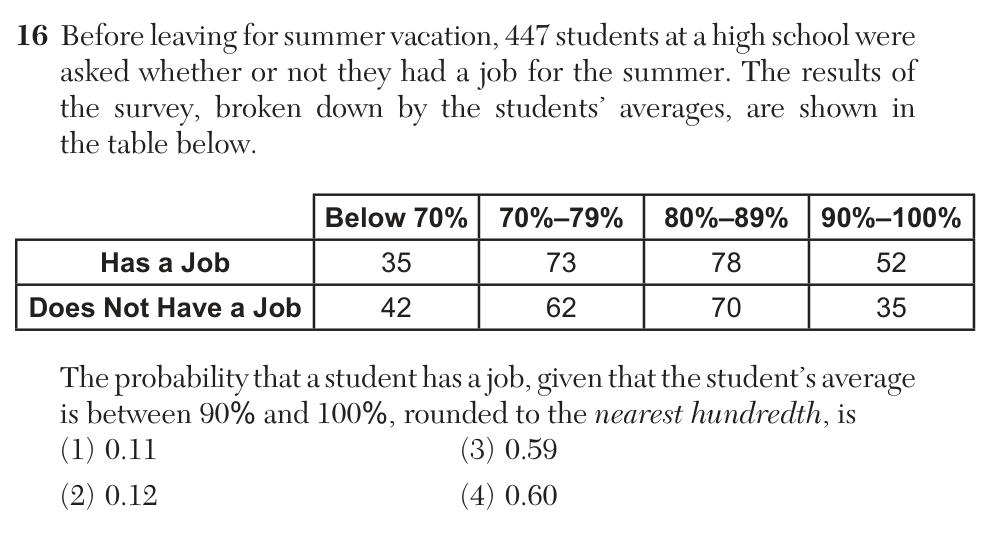
- The condition restricts the sample to students with averages between 90% and 100%. That column contains 52 students with jobs and 35 without jobs.
- The conditional probability is:
- Round to the nearest hundredth.
Exam detail: Do not divide by all 447 students; only the specified grade-average group belongs in the denominator.
Question 17: Divide the polynomial, then factor the quotient
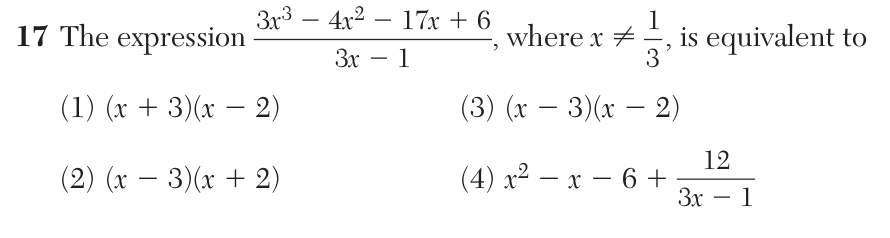
- For the first quotient term, divide by to get . Subtract from the numerator; the remainder at this stage is .
- The next quotient term is −x. Subtract to leave . The last term is −6, which leaves remainder 0.
- The quotient is . Factor it:
Exam detail: The original denominator restriction remains even when the division has no remainder.
Question 18: Identify the valid equation-solving step
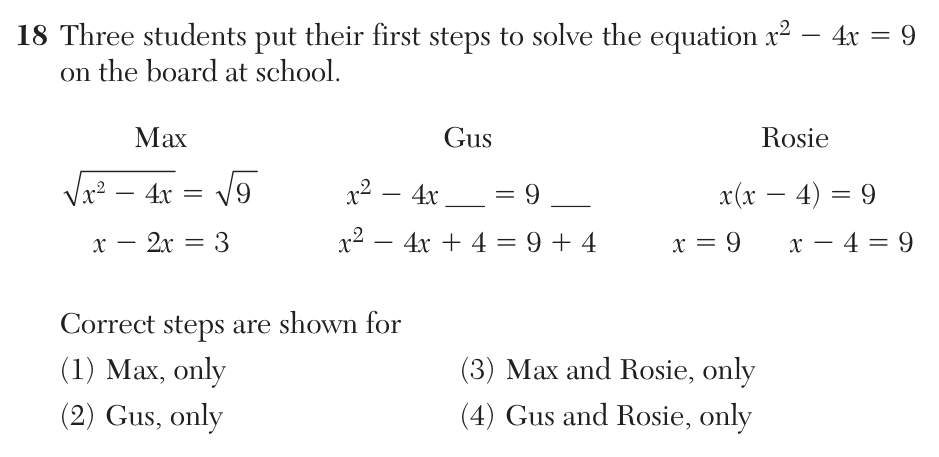
- Gus completes the square by adding 4 to both sides:This is valid because the same quantity was added to both sides, and the left side becomes .
- Max’s term-by-term square-root simplification is invalid. A square root does not distribute across subtraction, and is not generally .
- Rosie cannot set each factor equal to 9. The zero-product property applies when a product equals zero, not when it equals 9.
Question 19: Build a recursive depreciation model
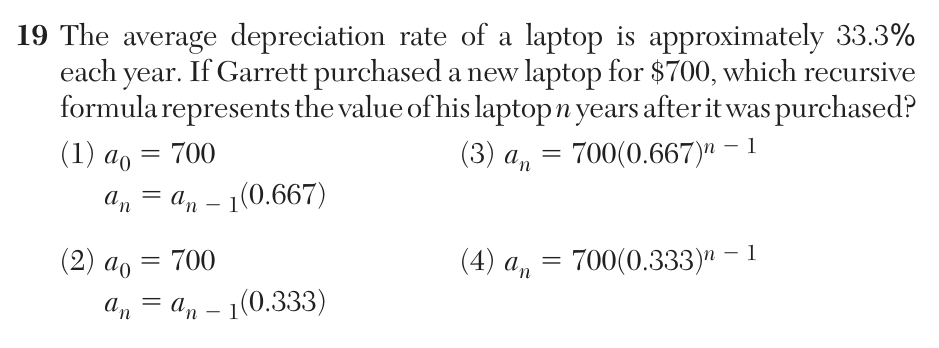
- After losing 33.3% of its value, the laptop retains each year.
- The initial value is $700 at year 0. Multiply the previous year’s value by 0.667 for each following year:for integers .
Question 20: Place the vertex halfway between focus and directrix
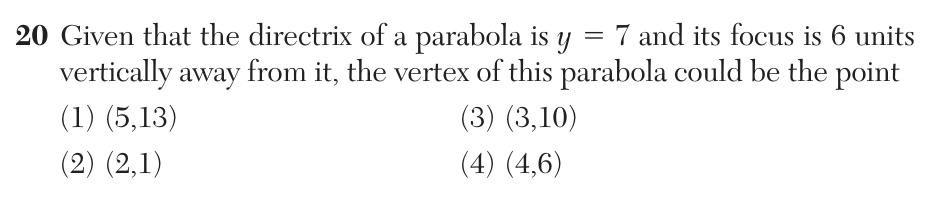
- The directrix is the horizontal line . A focus 6 units vertically away has y-coordinate or .
- The vertex lies halfway between the focus and directrix along the vertical axis of symmetry. Its y-coordinate is therefore:or
- Only the offered point has one of these possible y-coordinates. It corresponds to a focus at .
Question 21: Count valid solutions in both absolute-value cases

- The rational expression requires . Split the absolute value where , at .
- For , the right side is . Multiplying by gives:The two values are approximately −0.781 and 1.281. Both satisfy this case and avoid the excluded value 1.
- For , the right side is . Then:Only the larger value, approximately 3.281, satisfies this case. The smaller value, approximately 1.219, must be rejected.
- There are two valid solutions in the first case and one in the second, for a total of three.
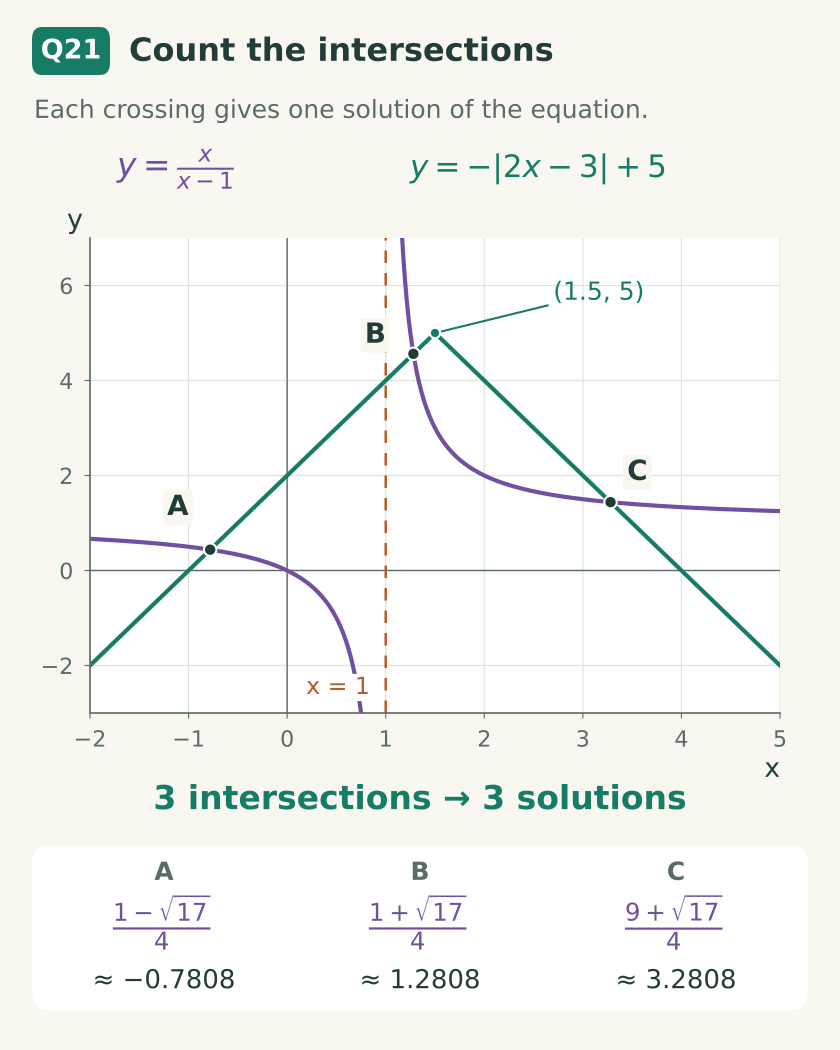
Exam detail: Always check a candidate against the case in which it was derived.
Question 22: Determine cosine from a tangent ratio
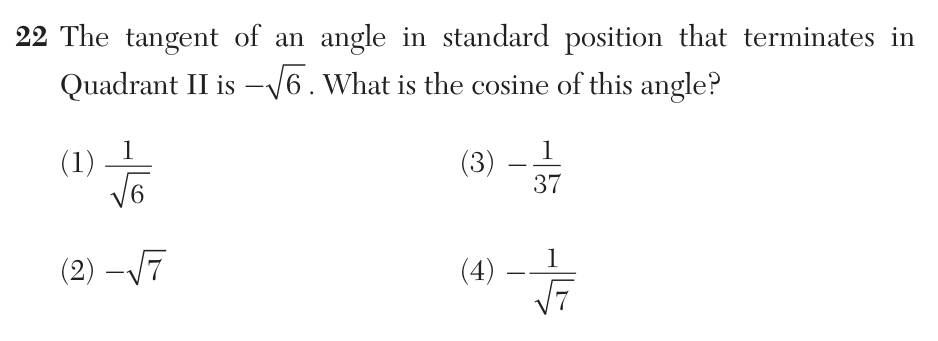
- In Quadrant II, the horizontal coordinate is negative and the vertical coordinate is positive. Choose a point on the terminal side with horizontal coordinate −1 and vertical coordinate ; their ratio is the given .
- The distance from the origin is:
- Cosine is the horizontal coordinate divided by that distance:
Question 23: Sum six annual membership payments
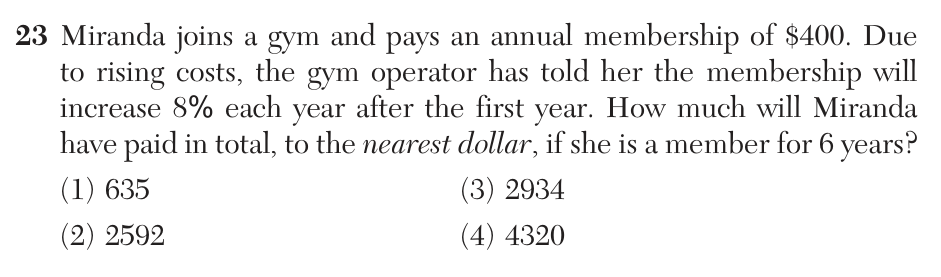
- The yearly payments form a geometric sequence with first term $400 and common ratio 1.08. Six years means the terms with exponents 0 through 5.
- Use the finite geometric-series formula:
- Evaluate before rounding:dollars. Round the total to the nearest dollar.
Exam detail: The question asks for the total of six payments, not just the sixth payment.
Question 24: Infer the doubling time from the plotted values
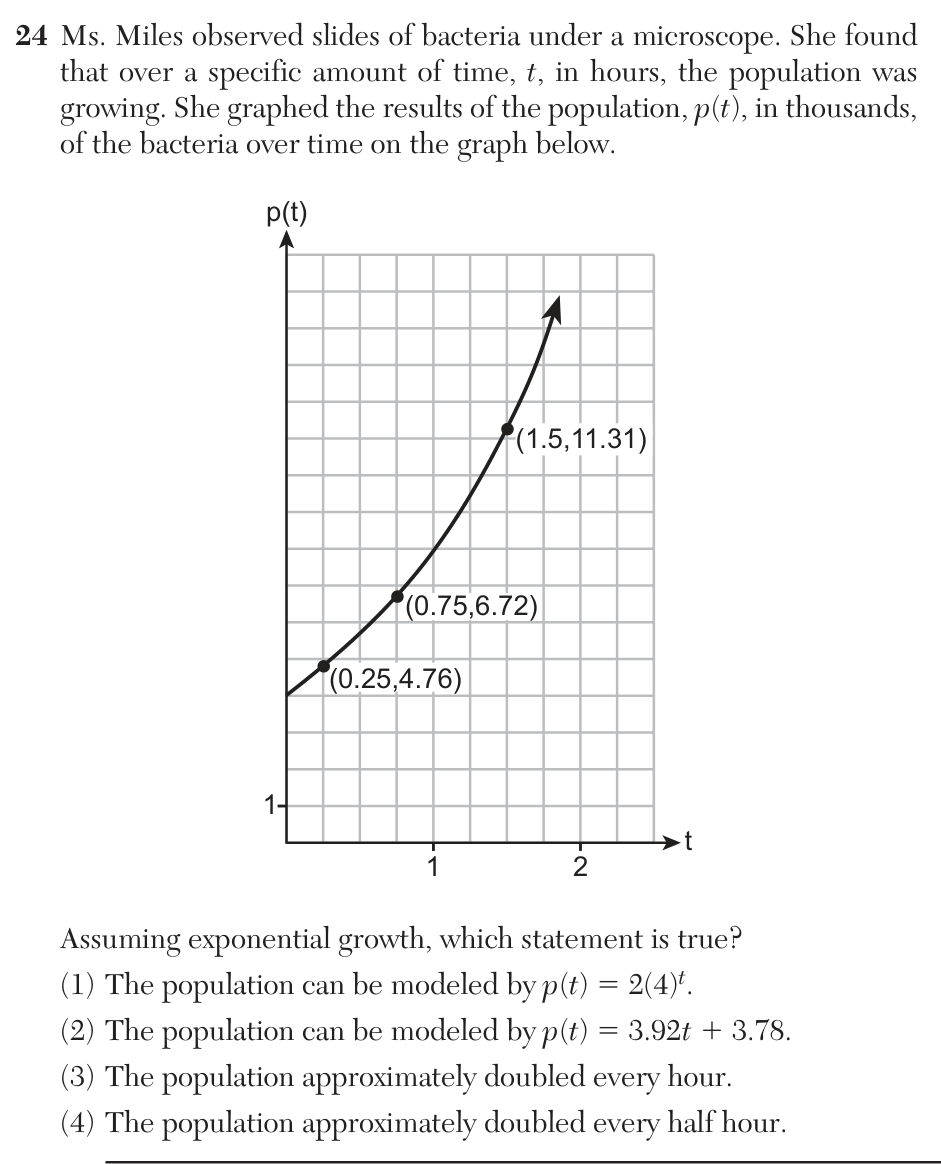
- The points at 0.25 and 0.75 hour are separated by half an hour. Their population ratio is:
- For exponential growth, equal time intervals have equal multiplication factors. Two half-hour intervals therefore give an hourly factor of approximately:which is very close to 2.
- The population approximately doubles every hour. The plotted values are approximate, so use the growth pattern rather than demanding an exact ratio from rounded labels.
Part II: Short constructed responses
Questions 25–32 • 2 credits each • 16 credits total
Question 25: Solve an exponential growth equation with logarithms

- Set the modeled attendance equal to 2,000:
- Divide by 250 and take logarithms:
- Solve and round to the nearest hundredth of an hour:
Exam detail: The same result comes from using common logarithms in both numerator and denominator.
Question 26: Evaluate the temperature and interpret the time

- Substitute into the model:
- The angle is radians and its sine is 1:
- The input counts hours after 9 a.m. Six hours later is 3 p.m., so the model predicts a temperature of 90°F at 3 p.m. on that day.
Exam detail: Use radian mode when evaluating this formula, and give the contextual meaning as well as the number.
Question 27: Use the denominator as a root index

- The exponent means take a cube root and then square:
- The cube root of −64 is −4 because . Squaring then gives:
Exam detail: The odd root of a negative number is real. Keep the parentheses around the negative base.
Question 28: Graph the shifted exponential function
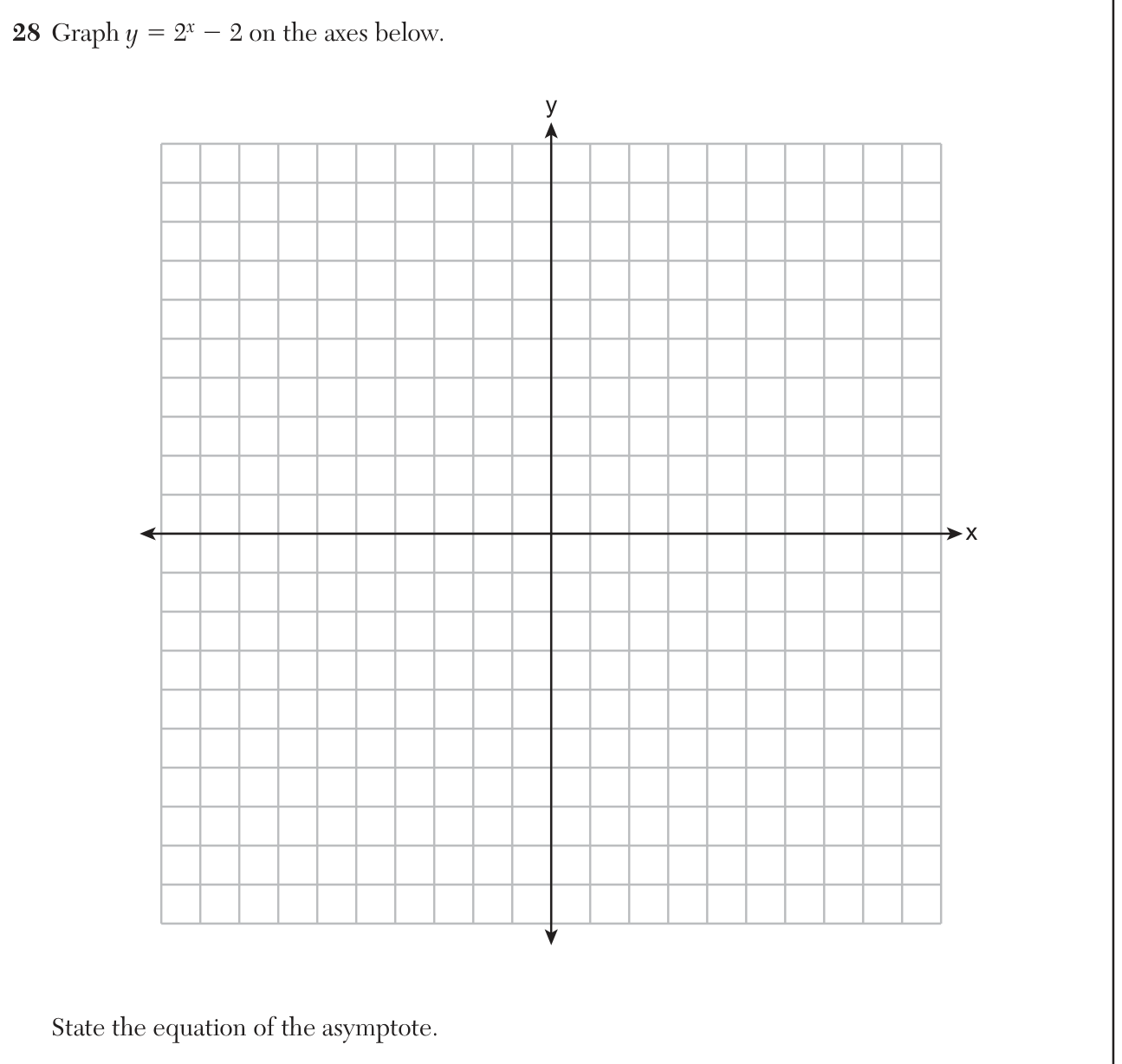
- Start with and shift the graph down 2 units. This moves its horizontal asymptote from to .
- Calculate several points: , , , , , and .
- Plot the points and draw a smooth increasing exponential curve. Extend it across the grid or use arrows. Toward the left, it approaches from above without reaching it.
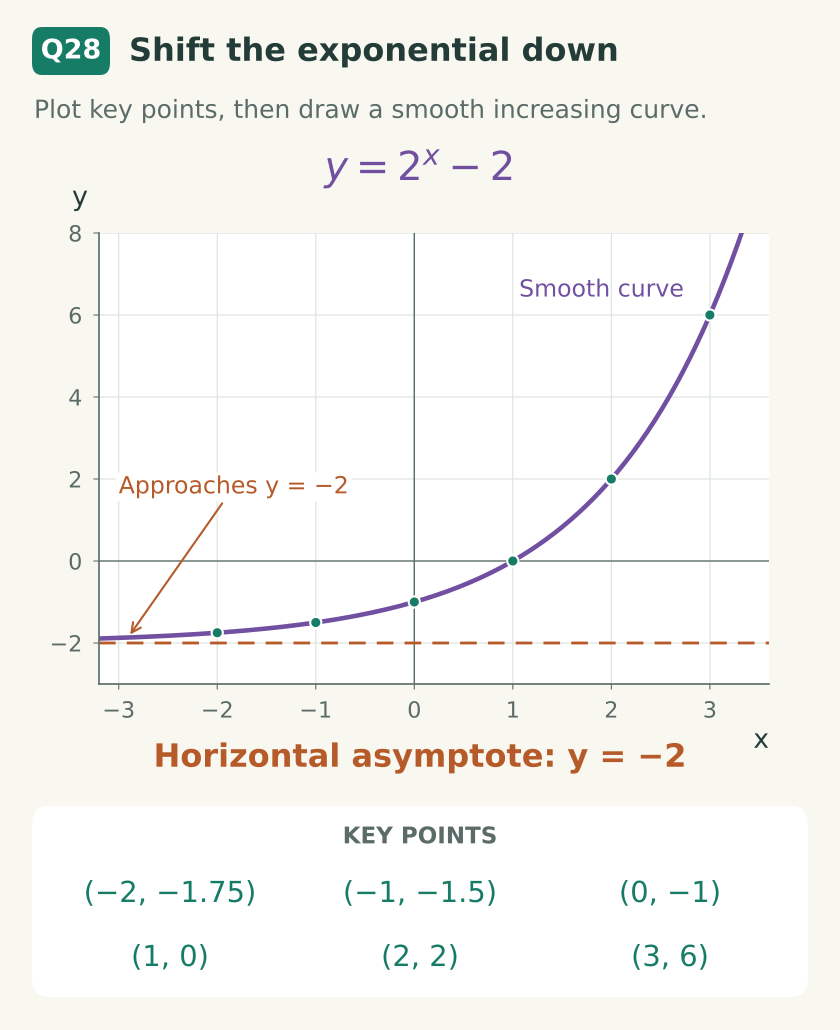
Exam detail: A graph is required. A point list alone does not replace the smooth curve.
Question 29: Apply the addition rule for an inclusive “or”

- Adding the English-fluent and Mandarin-fluent percentages counts the students fluent in both languages twice.
- Subtract the overlap once:
Exam detail: State the result as a percentage, as requested. “Or” includes students who speak both languages fluently.
Question 30: Fit the exponential regression model
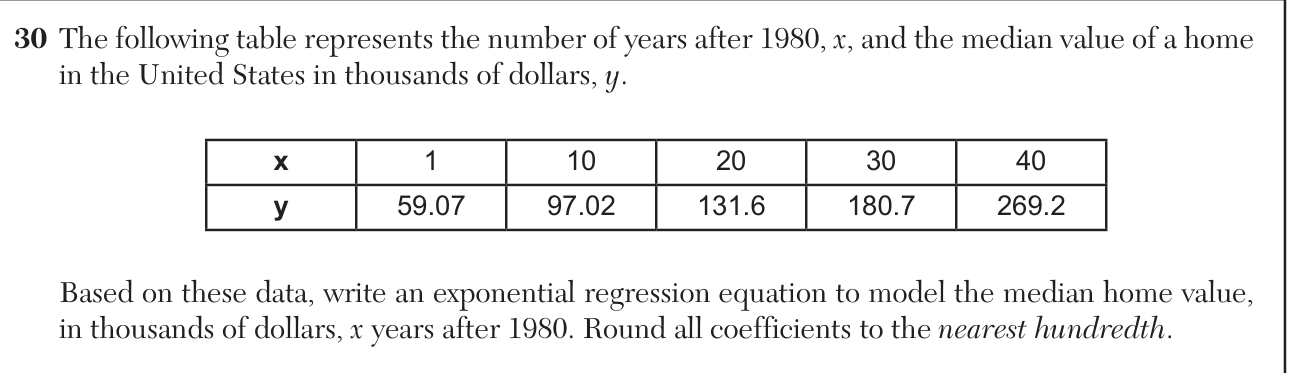
- Enter the five x-values and the five y-values into matching calculator lists. Use the supplied years after 1980, rather than substituting calendar years.
- Choose exponential regression in the form . The fitted coefficients are approximately:
- Round both coefficients to the nearest hundredth and write the complete equation:
- Here x is years after 1980 and y is the median home value in thousands of dollars. These historical exam data are used only for the stated model.
Exam detail: Include the dependent variable and exponent. Merely listing the regression coefficients is not an equation.
Question 31: Clear denominators and check restrictions

- Factor the first denominator:The original equation excludes and .
- Multiply every term by the least common denominator :
- Expand, collect terms and factor:
- The candidates are 1 and 4. Neither is excluded. At , the two sides both equal 5; at , they both equal .
Exam detail: The first numerator in the exam is positive 24; preserve its sign when clearing denominators.
Question 32: Expand and collect real and imaginary parts

- Distribute i in the first term and use :
- Expand the square separately:
- Subtract the entire squared expression:The real part is and the coefficient of i is .
Exam detail: Distribute the minus sign to every term in the expanded square.
Part III: Extended constructed responses
Questions 33–36 • 4 credits each • 16 credits total
Question 33: Use the middle 95% simulation interval
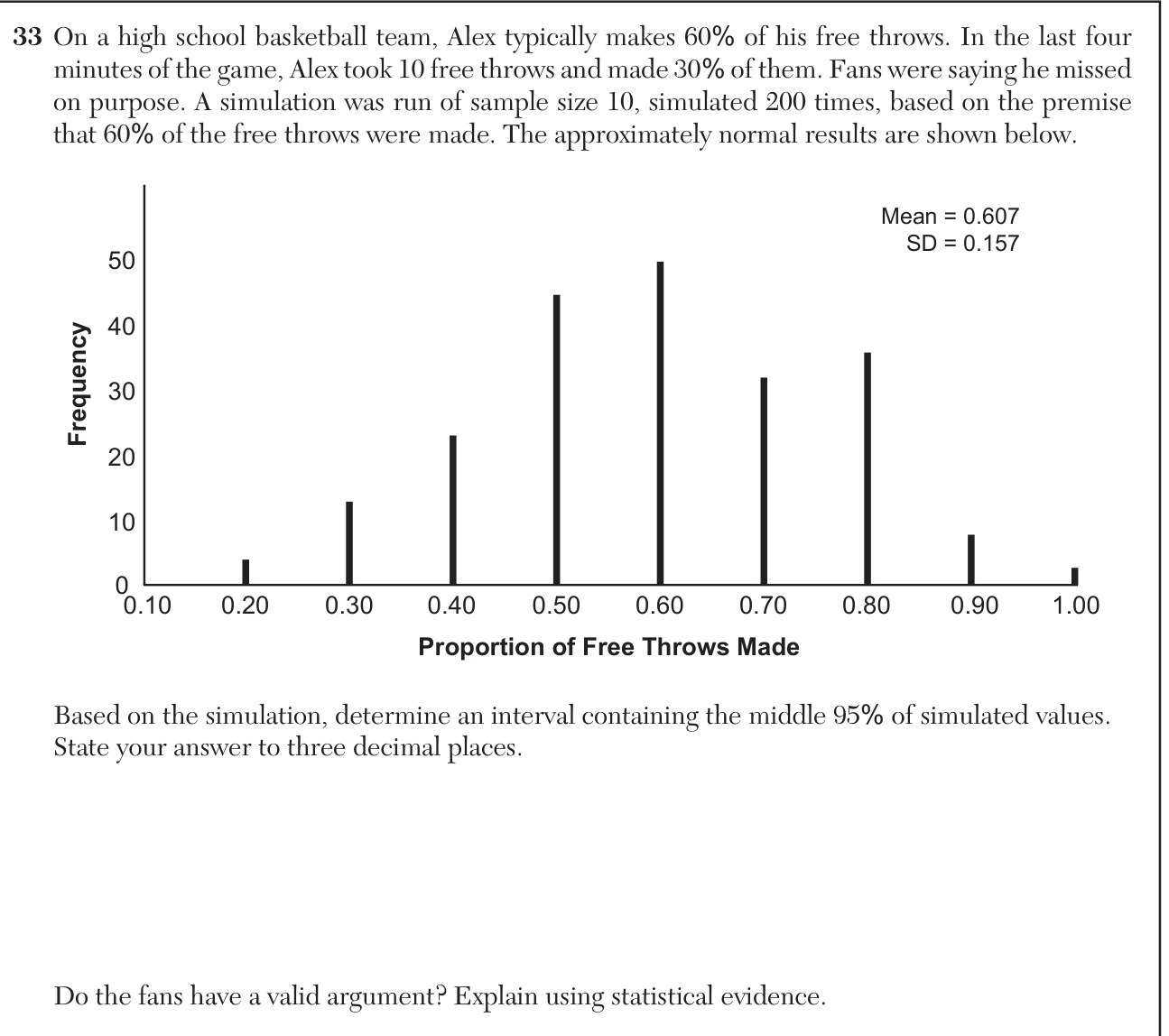
- The simulated proportions have mean 0.607 and standard deviation 0.157. For an approximately normal distribution, the middle 95% is approximated by the mean plus or minus two standard deviations.
- Compute the endpoints:
- The requested interval, written to three decimal places, is . Alex’s observed proportion is , which lies inside this interval.
- Therefore the simulation does not support the fans’ argument: a 30% result in a sample of 10 throws is within the stated typical range when the underlying success rate is 60%. These results do not establish anyone’s intent.
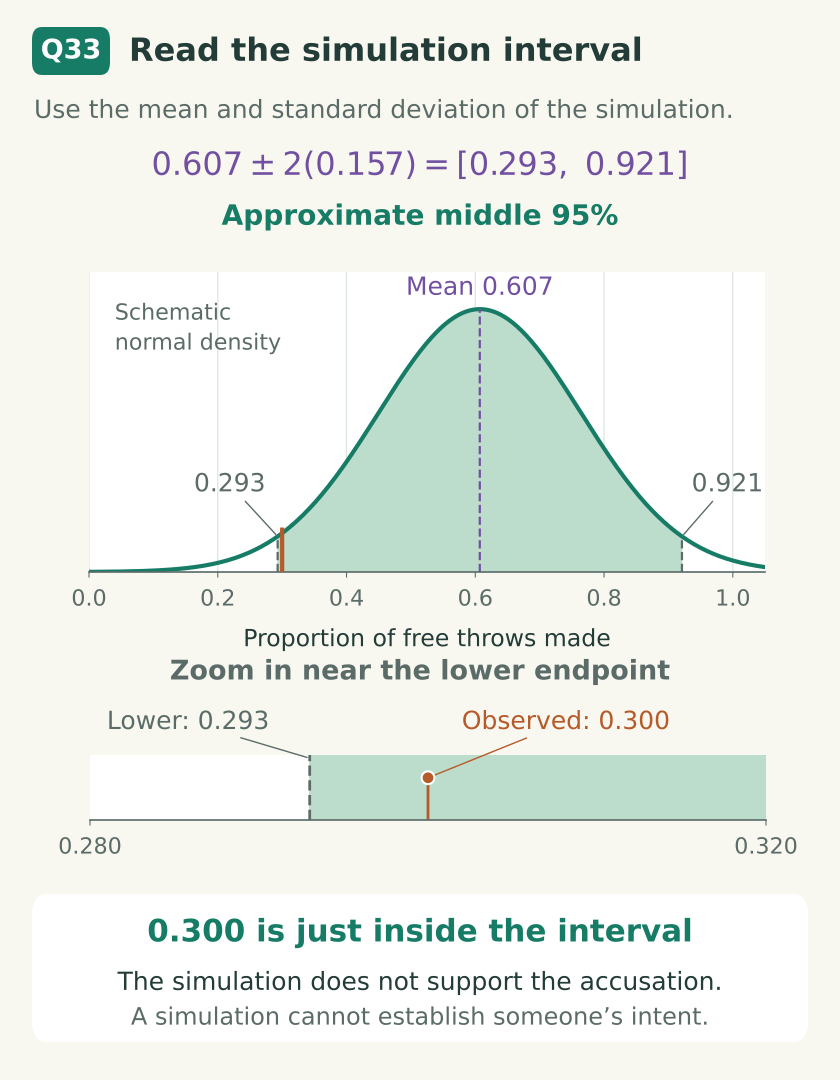
Exam detail: Compare 0.300 with the interval explicitly. Use the simulated mean 0.607 rather than replacing it with the hypothesized 0.600.
Question 34: Graph the decay model and compare the curves
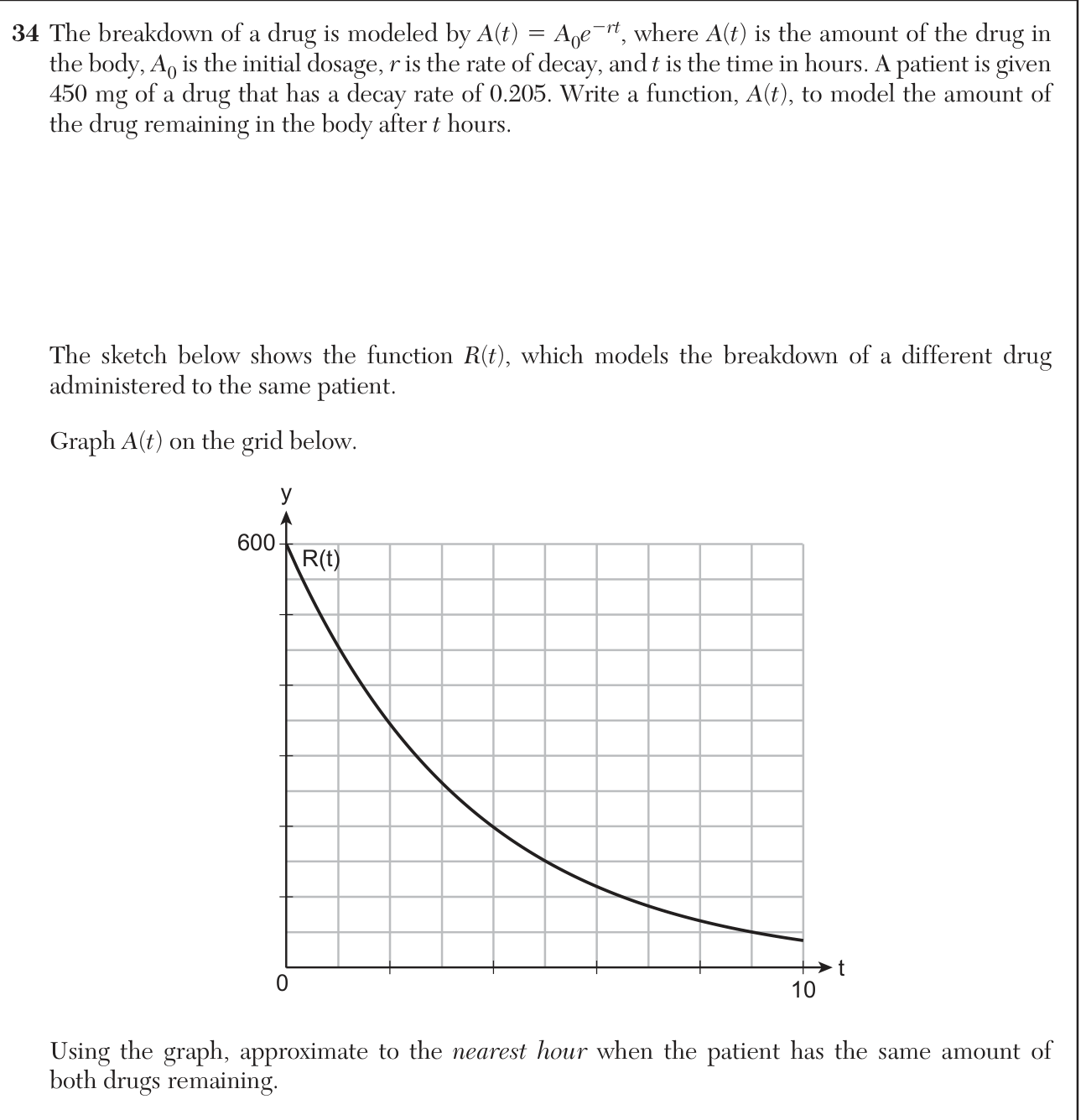
- The initial amount is 450 mg and the model’s decay parameter is 0.205. Substitute into the given continuous exponential model:
- Use nonnegative time. Plot the initial point and additional approximate points , , , , and . The horizontal units are hours and the vertical units are milligrams.
- Draw a smooth decreasing curve through the points on the same axes as the supplied R curve. The model stays positive and approaches zero as time increases.
- Read the intersection of the two curves. It is close to 4 hours, with both drug amounts near 200 mg. To the nearest hour, the amounts are equal after about 4 hours.
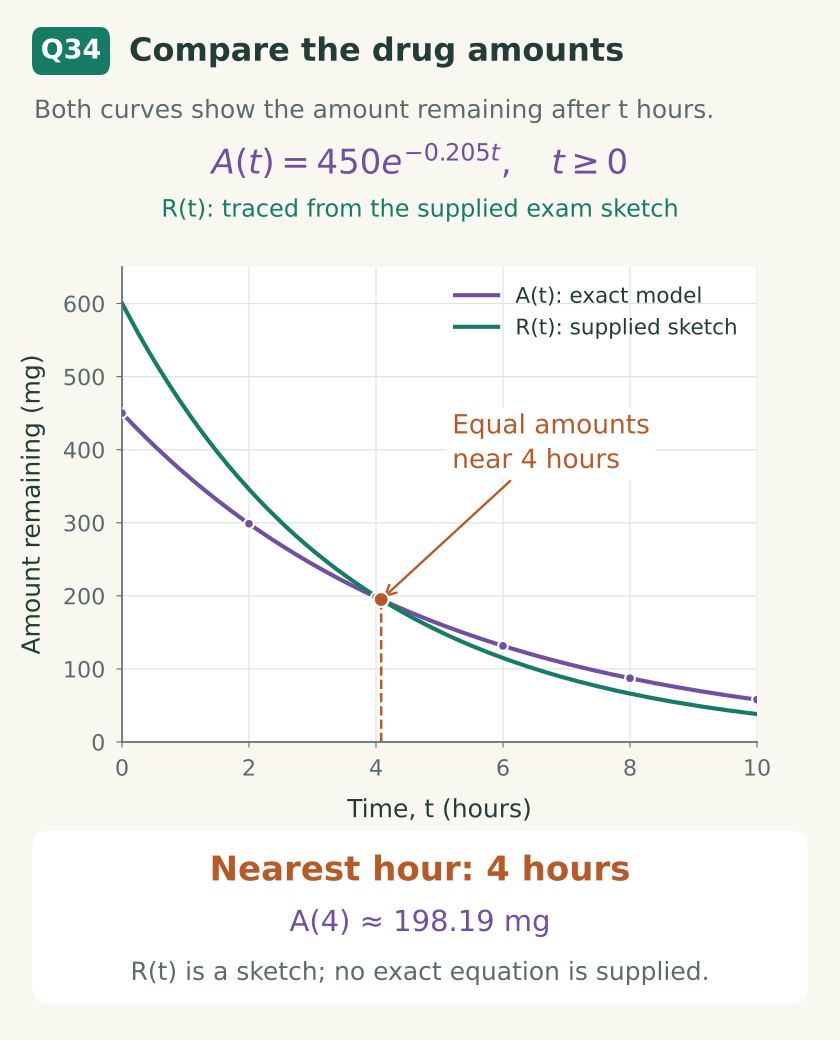
Exam detail: The exam supplies R as a sketch, not an exact formula. The intersection time is a graphical approximation.
Question 35: Find the maximum, period and average rate
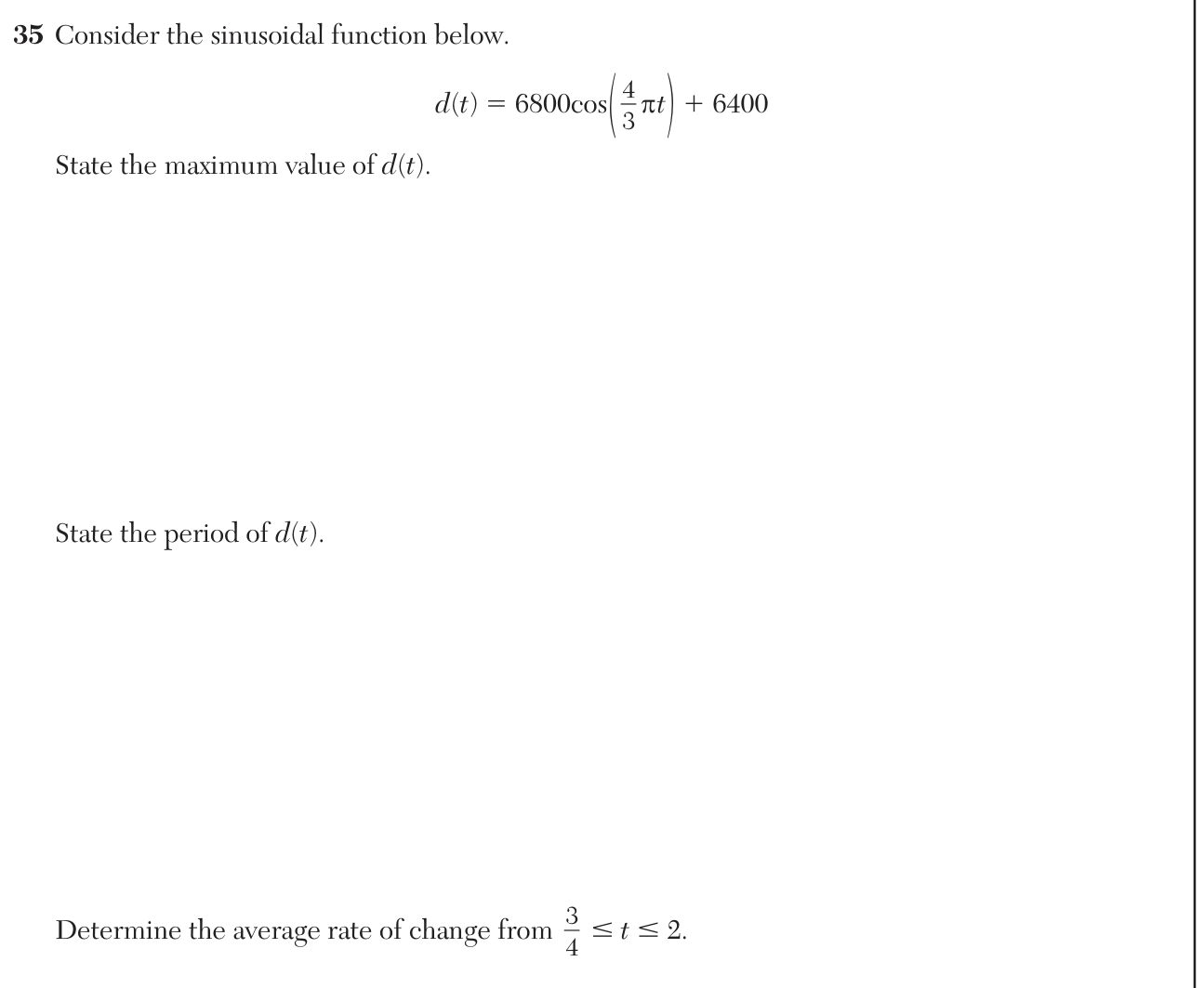
- The cosine factor ranges from −1 to 1. Its largest value is 1, so the maximum is:
- The coefficient of t inside cosine is . Thus the period is:
- Evaluate the function at both endpoints of the stated interval:
- The average rate of change is the secant slope:
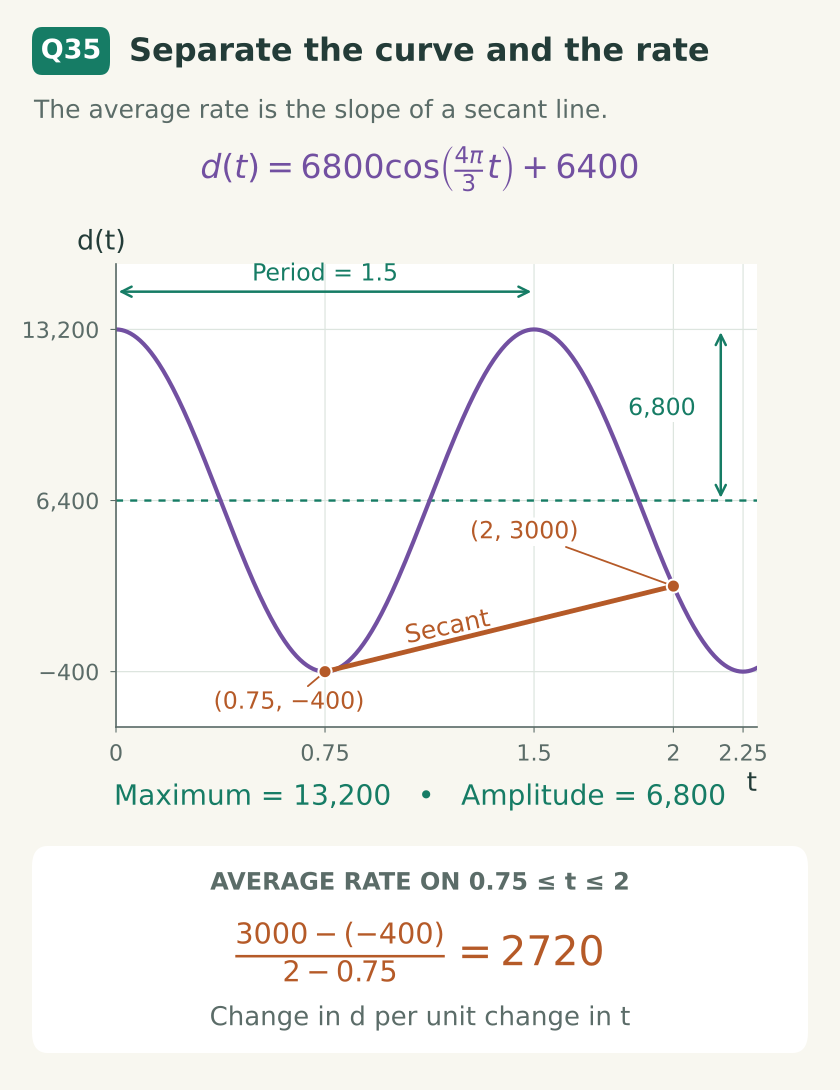
Exam detail: Use the entire function value, including the vertical shift, at each endpoint. The input angles are in radians.
Question 36: Isolate the radical and reject the extraneous root

- Move the radical term to the other side:The right side is nonnegative, so a valid solution must satisfy .
- Square both sides and expand:
- Collect terms and factor:
- Check the candidates in the original equation. For , the left side is , not 3; reject it. For :so it is valid.
Exam detail: Squaring can introduce extraneous candidates. A complete algebraic solution must reject the invalid one.
Part IV: Sequences and growth
Question 37 • 6 credits
Question 37: Compare arithmetic and geometric daily practice
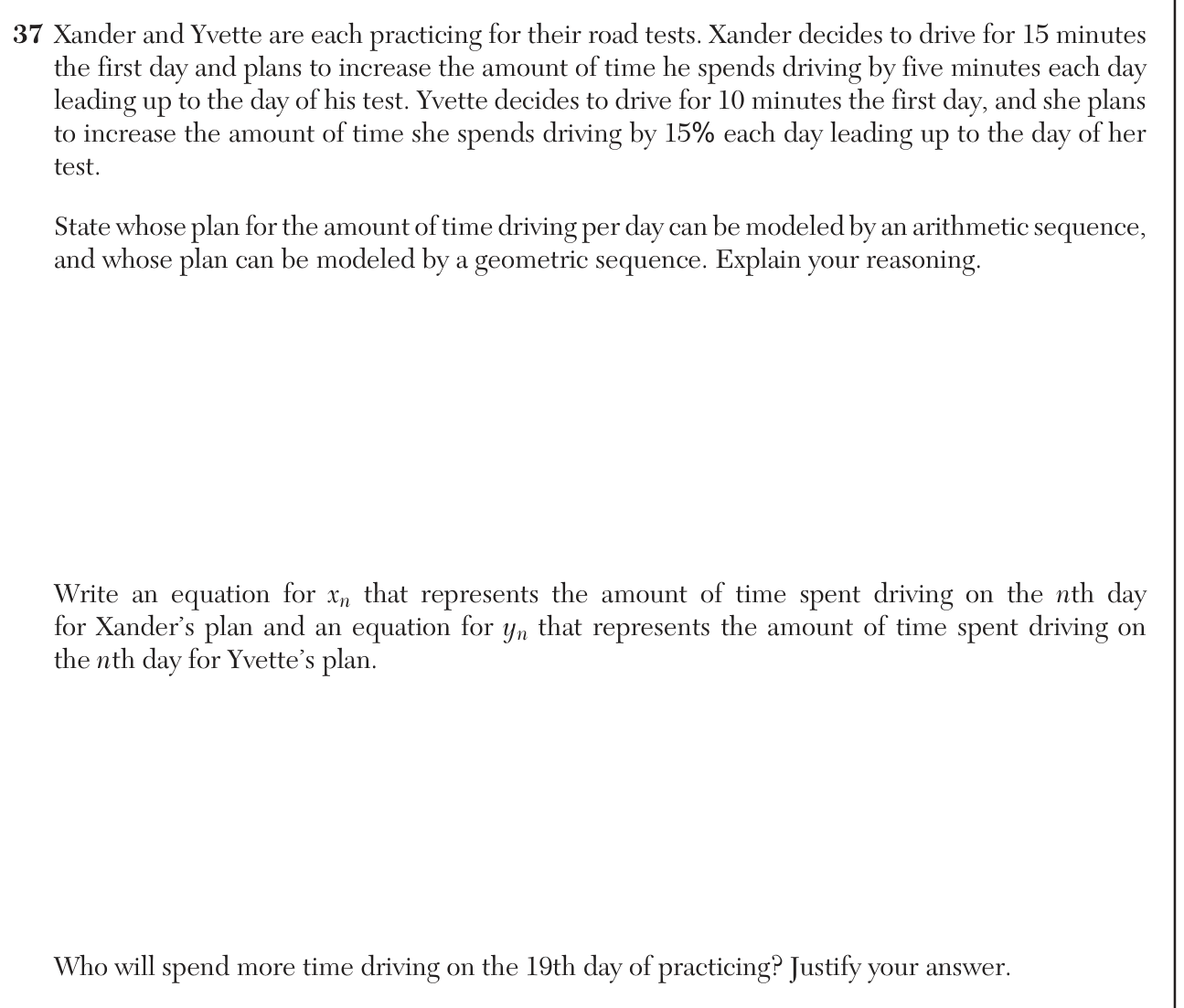
- Classify each plan. Xander adds a constant 5 minutes each day, so his daily times form an arithmetic sequence. Yvette multiplies the previous day’s time by , so her daily times form a geometric sequence.
- Write the equations. With day 1 as the starting day:These formulas apply for positive integers n.
- Compare day 19. Substitute :minutes.
- Yvette practices longer on day 19 because approximately 123.75 minutes is greater than 105 minutes. The difference is about 18.75 minutes.
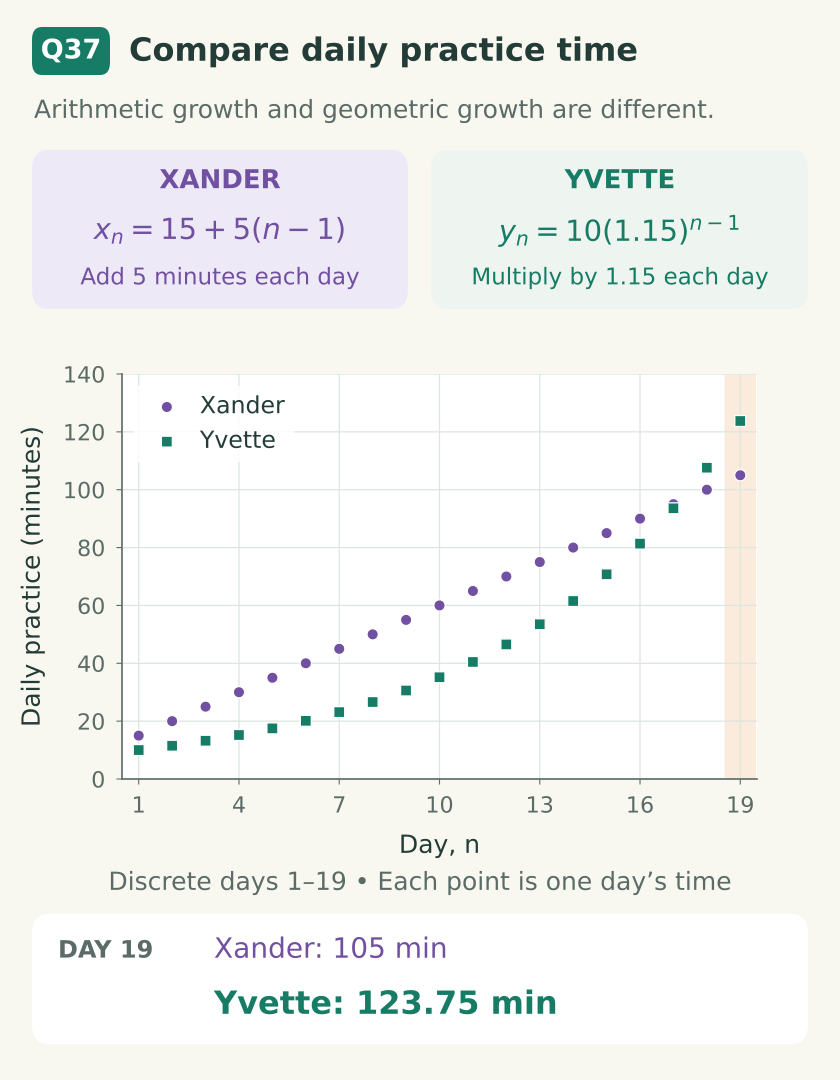
Exam detail: Compare the time on the 19th day, not the total accumulated over 19 days.
Check your score carefully
The maximum raw score is 86. Use the official January 2026 Algebra II conversion chart for the scaled Regents score; another administration’s chart may give a different result. For related practice, see the August 2026 Algebra I Regents solutions.
Sources & References
Official materials accessed October 7, 2026. Question and scoring references use the English edition throughout this page.
- Official January 2026 Algebra II examination (questions; PDF)
- Official January 2026 multiple-choice scoring key (PDF)
- Official January 2026 rating guide (PDF)
- Official January 2026 model response set (PDF)
- Official January 2026 conversion chart (PDF)
- NYSED Algebra II past-examination index
- NYSED terms of use and reproduction conditions
From the New York State Education Department. Regents Examination in Algebra II, January 2026. Internet. Available from the official examination link above; accessed 7 October 2026. Original question images are distinguished from HeLovesMath’s original explanations and solution diagrams.