
Work through every question in the English-language June 2026 Geometry Regents. Each solution explains the method, gives the final answer, and highlights details that matter for a complete written response.
Try the question first, then compare your reasoning with the steps below. Select a question image or diagram to open a larger view. The question numbers and paper-page references follow the official exam. The original paper and NYSED scoring documents are linked in Sources & References.
For Parts II–IV, show your method. A final number on its own can lose substantial credit, and a question that specifies compass-and-straightedge construction or coordinate geometry requires that method.
These are independent HeLovesMath explanations, not an official NYSED publication. Answers and required methods were checked against the official scoring key, rating guide, and model response set. Valid alternative methods can also earn credit unless a question specifies a method.
Quick check: Part I answer choices
- Q1: (4)
- Q2: (1)
- Q3: (3)
- Q4: (2)
- Q5: (4)
- Q6: (1)
- Q7: (2)
- Q8: (1)
- Q9: (2)
- Q10: (3)
- Q11: (4)
- Q12: (4)
- Q13: (1)
- Q14: (2)
- Q15: (3)
- Q16: (3)
- Q17: (4)
- Q18: (3)
- Q19: (3)
- Q20: (2)
- Q21: (2)
- Q22: (3)
- Q23: (4)
- Q24: (1)
Use the worked explanations below to check why each answer is correct.
Part I: Multiple-choice solutions
Questions 1–24 • 2 credits each • 48 credits total
Question 1: Identify a transformation that changes area
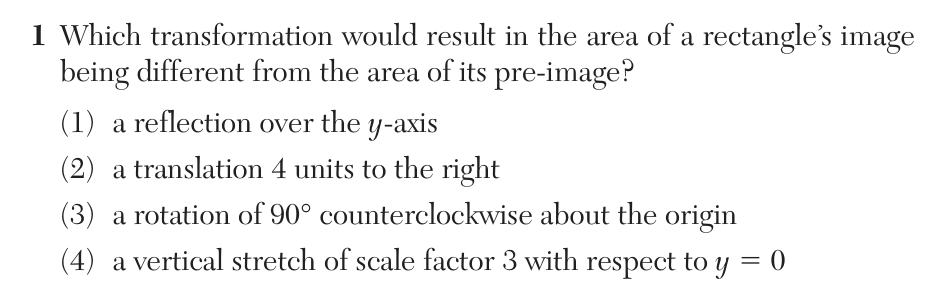
- Reflections, translations and rotations are rigid motions. They preserve lengths and therefore preserve the rectangle’s area.
- A vertical stretch by a factor of 3 changes each point’s distance from the x-axis by that factor. Horizontal lengths remain unchanged while vertical lengths triple.
- Consequently the image area is , so the area changes.
Question 2: Apply the triangle midsegment theorem
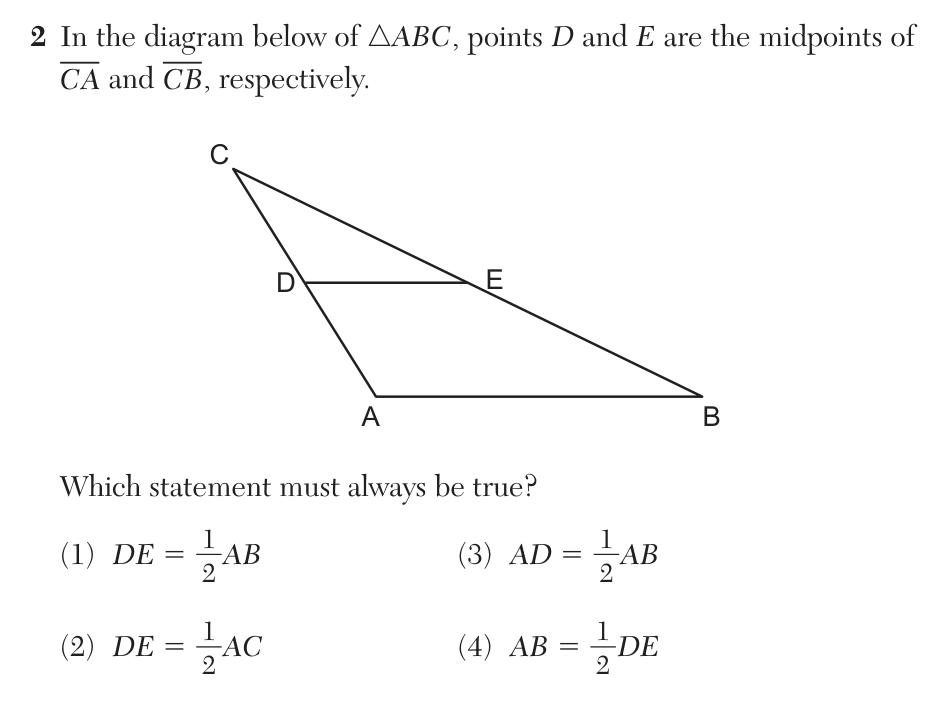
- D and E are the midpoints of two sides of triangle ABC. The segment joining them is a midsegment.
- A triangle’s midsegment is parallel to the third side and half its length. Here the third side is AB:
Question 3: Find the hypotenuse using cosine
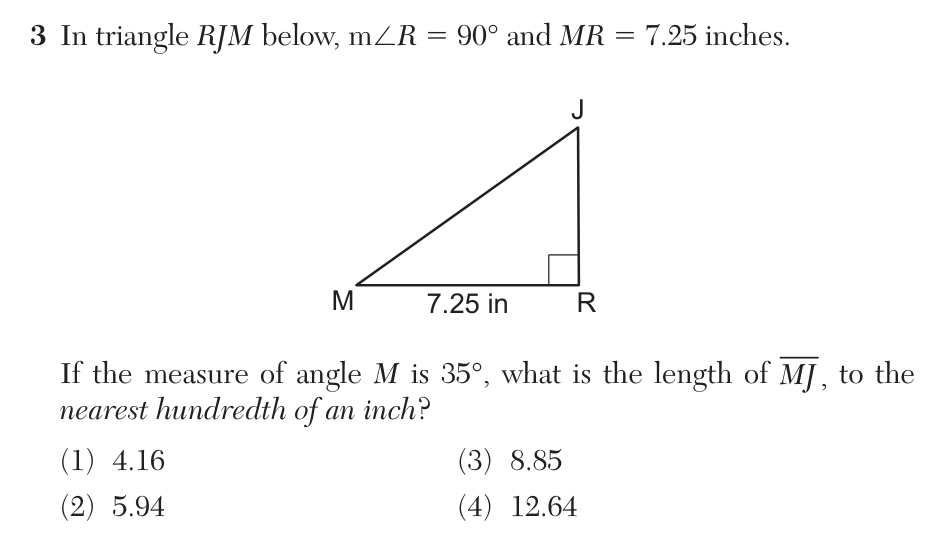
- The right angle is at R, so MJ is the hypotenuse. Relative to the 35° angle at M, MR is the adjacent leg.
- Set up cosine and solve for the hypotenuse:
- Round to the nearest hundredth of an inch.
Exam detail: Use degree mode and divide by cosine when the unknown is the hypotenuse.
Question 4: Convert the water volume to liters
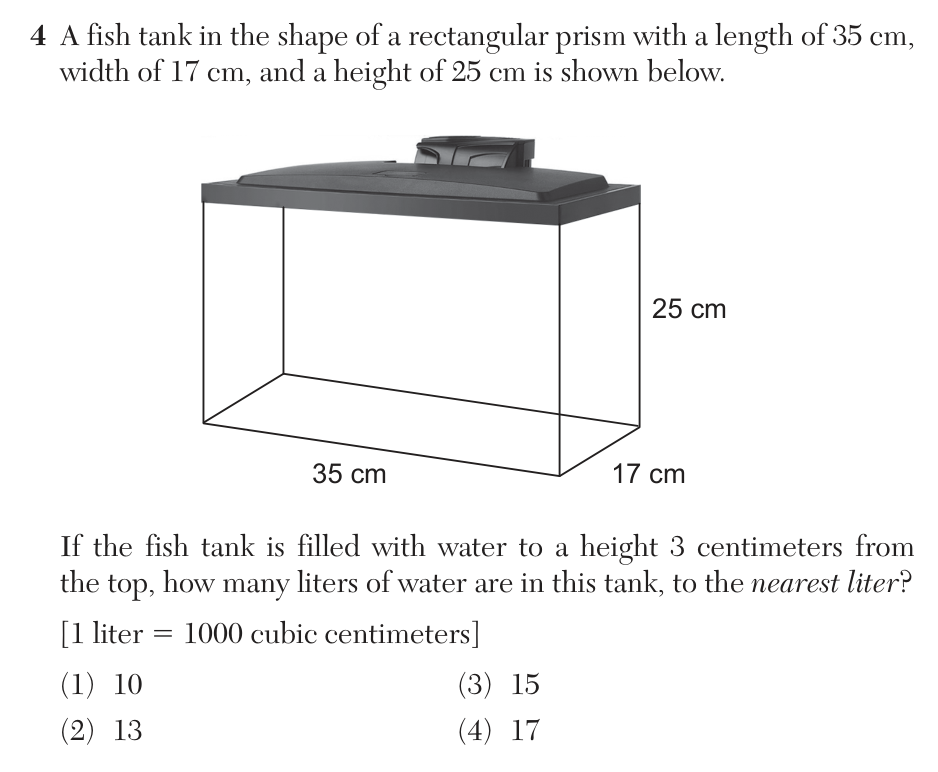
- The water stops 3 cm below the top, so its height is cm.
- Calculate the volume of the water, using this height rather than the tank’s full height:cubic centimeters.
- Since 1 liter is 1,000 cubic centimeters, divide by 1,000:liters. Round to the nearest liter.
Question 5: Track a side through two reflections
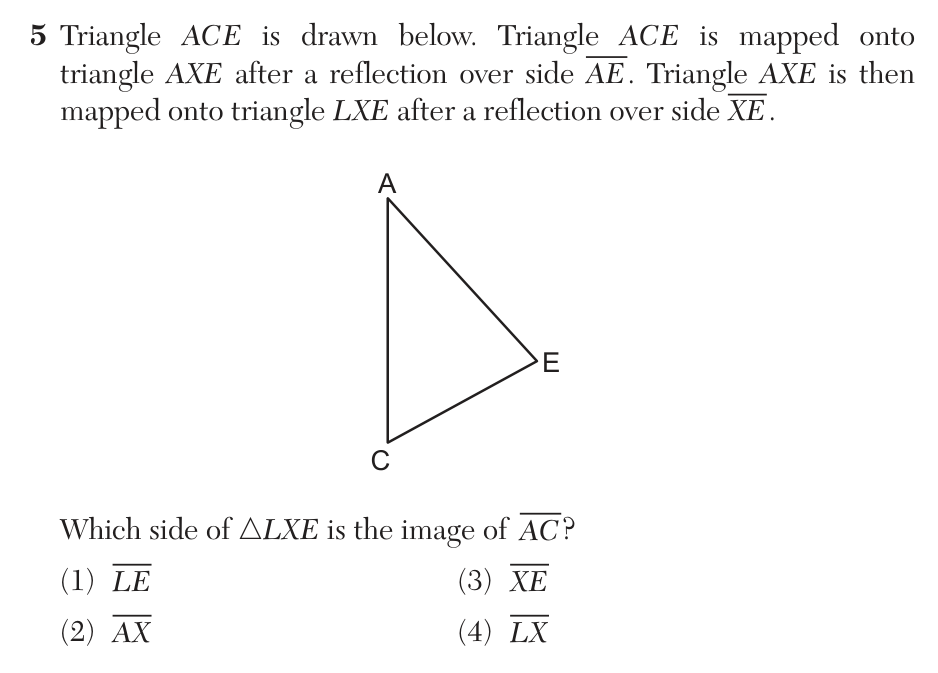
- Under the first reflection, triangle ACE maps to triangle AXE. The vertex correspondence is A to A, C to X, and E to E. Thus side AC maps to side AX.
- Under the second reflection, triangle AXE maps to triangle LXE. A maps to L, while X and E stay fixed on the reflecting line XE.
- Therefore the image of the original side AC is side LX:
Question 6: Compare slopes and intercepts
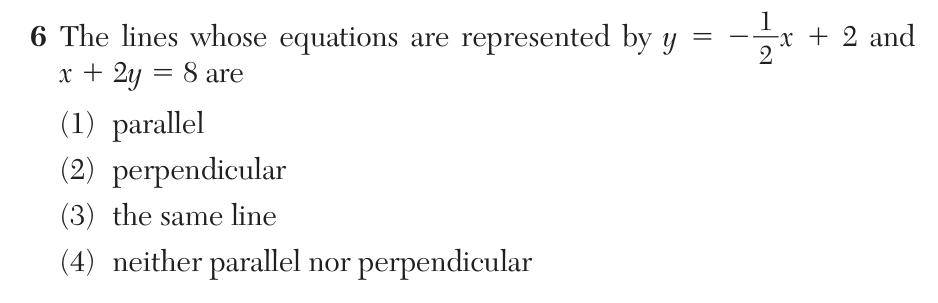
- The first line already has slope-intercept form:
- Rewrite the second equation:
- Both slopes are , but the y-intercepts are different. The lines are distinct and parallel.
Exam detail: Equal slopes alone do not distinguish parallel lines from the same line; compare the intercepts too.
Question 7: Find the cone formed by rotation
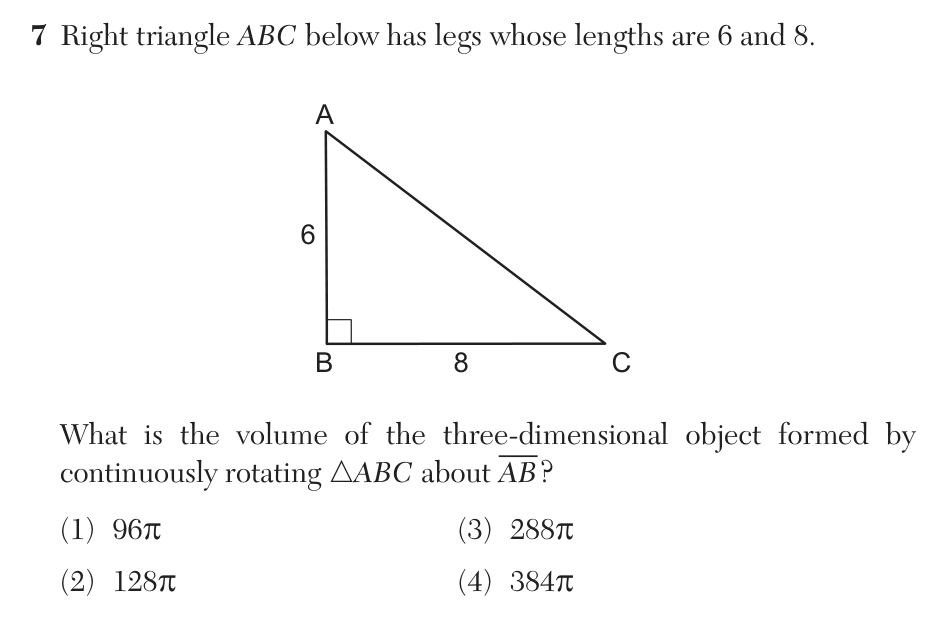
- Side AB is the fixed axis, so it becomes the cone’s height: . The perpendicular leg BC sweeps out the circular base, so .
- Use the cone-volume formula:
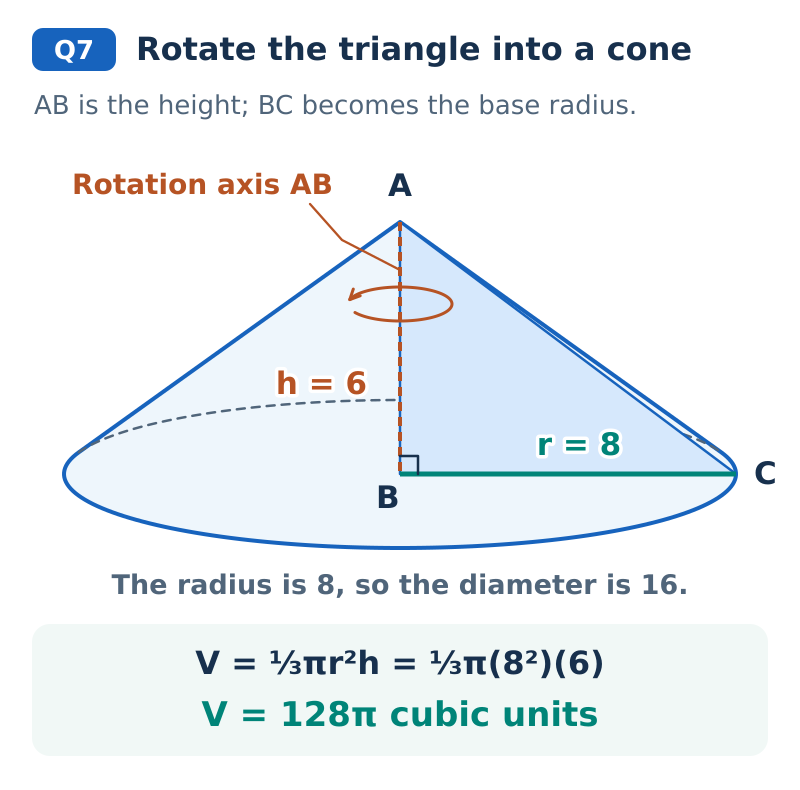
Exam detail: The rotating leg gives the radius, not the diameter.
Question 8: Use the perpendicular-bisector theorem
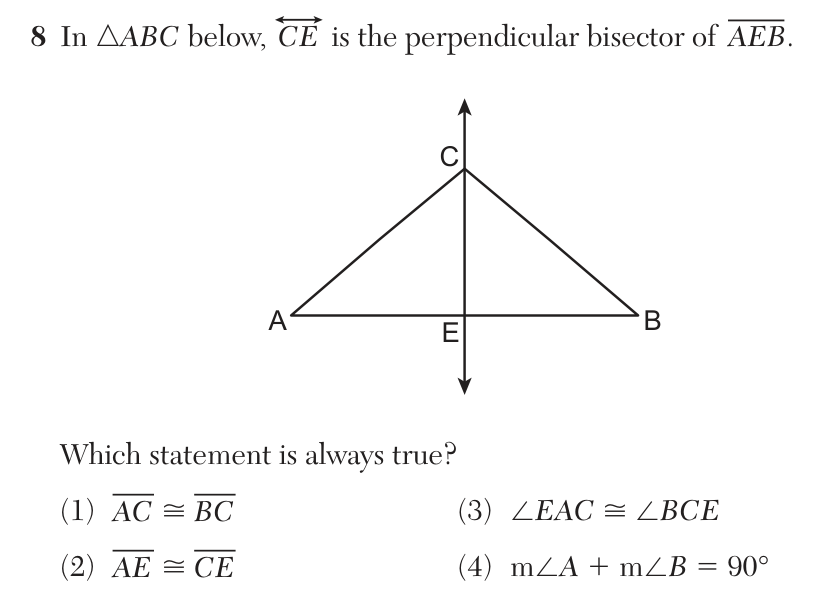
- CE is perpendicular to AB and passes through its midpoint E. Therefore the line CE is the perpendicular bisector of AB.
- Every point on a segment’s perpendicular bisector is the same distance from its endpoints. Since C lies on this line, .
- Equal lengths mean the corresponding segments are congruent.
Question 9: Choose the correct smaller right triangle
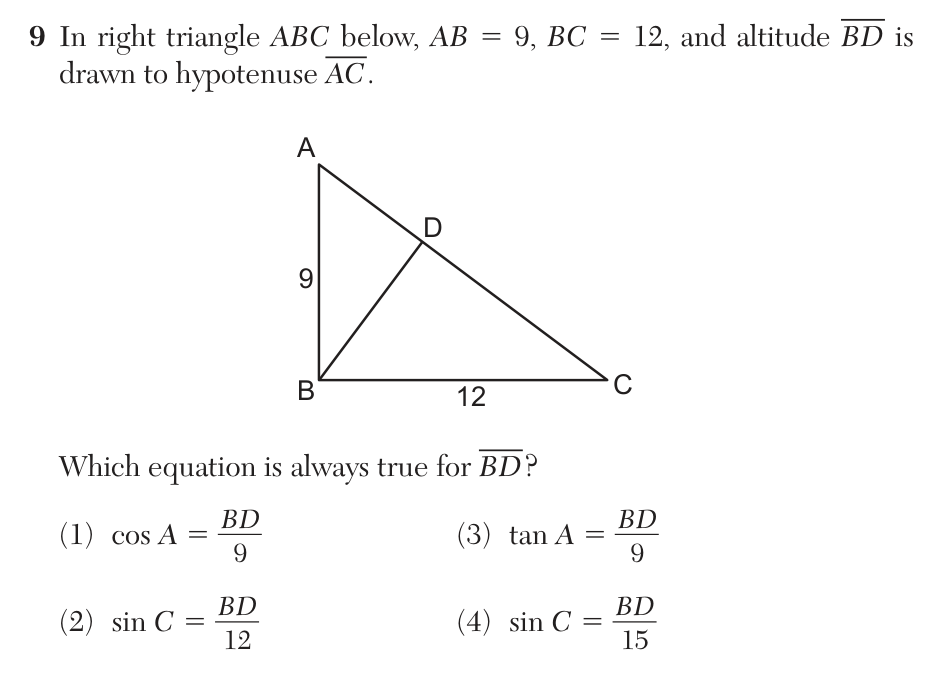
- The altitude BD is perpendicular to AC, so triangle BCD is a right triangle with right angle at D.
- In this smaller triangle, BC is the hypotenuse and has length 12. For the angle at C, BD is the opposite leg.
- Sine is opposite divided by hypotenuse:
Exam detail: Use the hypotenuse of triangle BCD, not the hypotenuse of the original triangle.
Question 10: Test both rotational symmetries
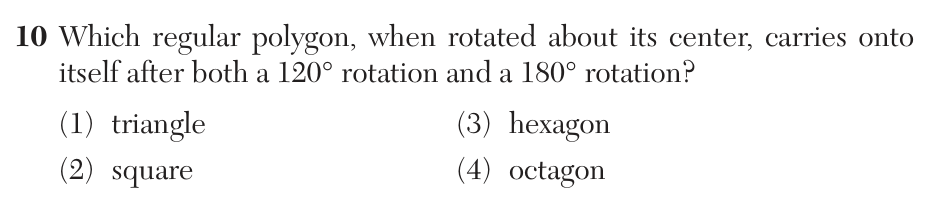
- A regular n-sided polygon has a basic rotational symmetry of . Other symmetry rotations are whole-number multiples of this angle.
- A regular hexagon has a basic rotation of 60°. Both and carry it onto itself.
- A triangle fails the 180° test; a square and an octagon fail the 120° test.
Question 11: Divide a segment into five equal parts
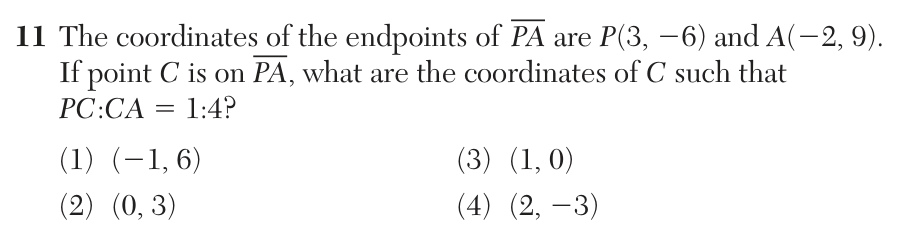
- The ratio means that C lies one-fifth of the way from P to A.
- Apply one-fifth of each coordinate change:
Exam detail: The total number of equal parts is five, not four.
Question 12: Find the scale factor and dilation center
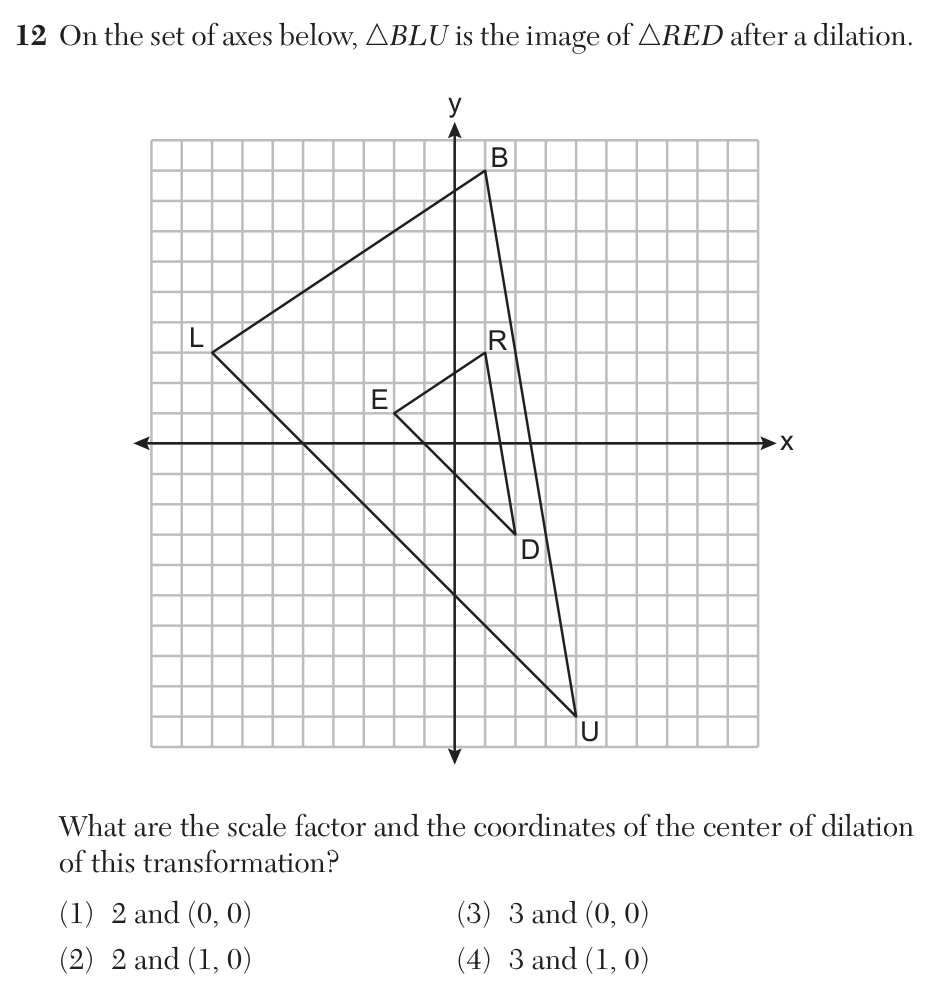
- Read corresponding points from the grid: , , and .
- Test the center . Relative to this center, R is 3 units above it and B is 9 units above it, giving scale factor .
- The resulting rule is . It sends E to and D to , agreeing with the other image vertices.
Exam detail: Measure each displacement from the center of dilation, rather than automatically multiplying coordinates from the origin.
Question 13: Complete the square for a circle
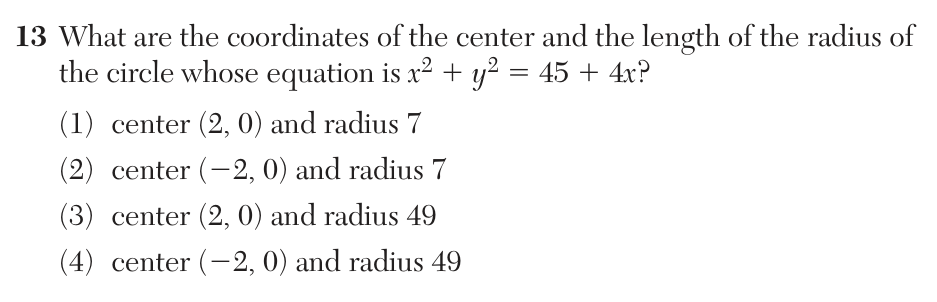
- Move the x-term to the left:
- Complete the square by adding 4 to both sides:
- Compare with . The center is and the radius is .
Question 14: Use the right-triangle leg theorem
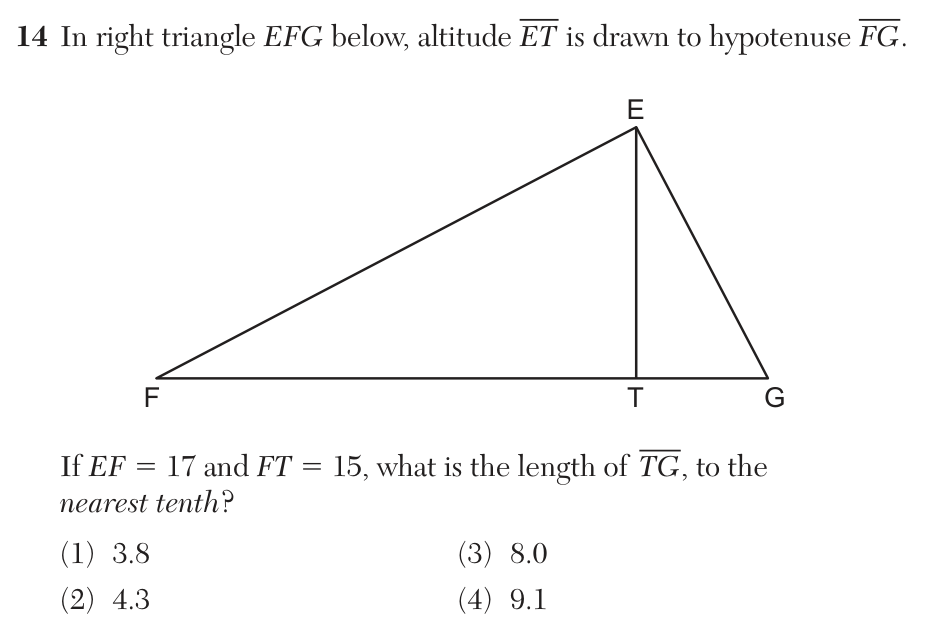
- An altitude to the hypotenuse creates similar right triangles. A leg squared equals the full hypotenuse times the segment of the hypotenuse next to that leg.
- For leg EF, the adjacent hypotenuse segment is FT:
- Subtract FT to obtain only TG:
Exam detail: The intermediate result is the entire hypotenuse FG. The question asks for its remaining segment TG.
Question 15: Use supplementary angles on a trapezoid leg
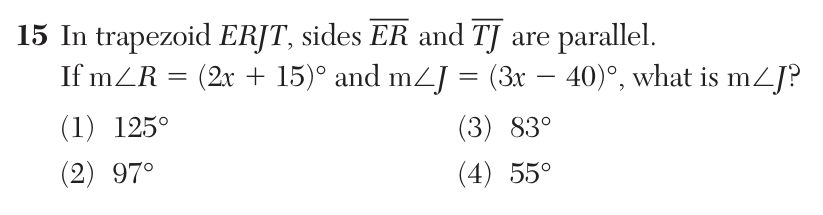
- ER and TJ are parallel, and RJ is a transversal. The interior angles at R and J are on the same side of that transversal, so they add to 180°.
- Solve for x:
- Substitute into the expression for angle J:
Question 16: Find a leg of an isosceles right triangle
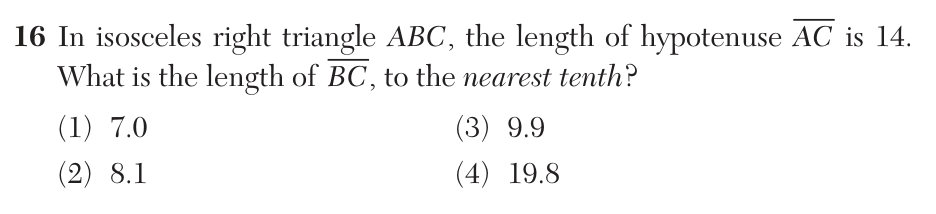
- The two legs have the same length. Let that length be x.
- Apply the Pythagorean theorem:
- Round to the nearest tenth.
Question 17: Apply the tangent-secant theorem
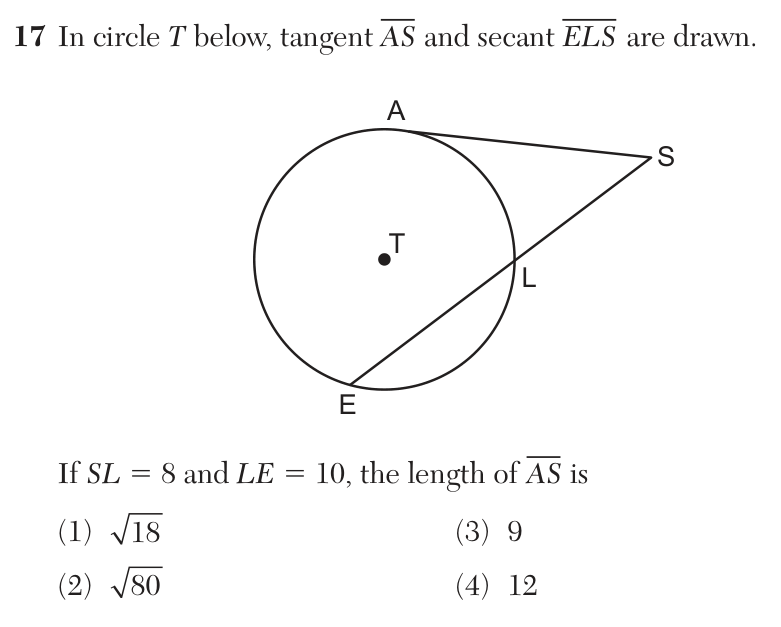
- The full secant from S to E includes both segments:
- The tangent length squared equals the external secant length times the full secant length:
- A length is positive, so .
Exam detail: Use the full secant length 18 in the product, not just the inside portion 10.
Question 18: Recognize the rhombus diagonal condition
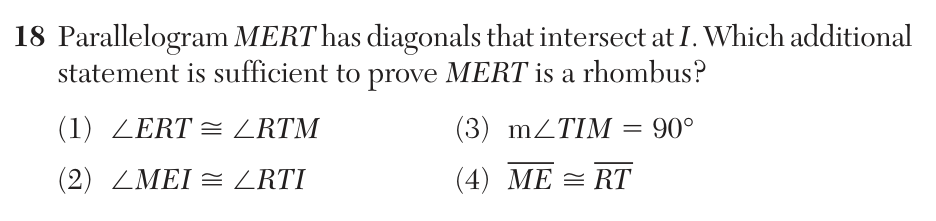
- The vertices T and M lie on different diagonals, and I is their intersection. Thus says the diagonals are perpendicular.
- A parallelogram with perpendicular diagonals is a rhombus. One way to see this is that its diagonals bisect each other, creating right triangles with equal corresponding legs; adjacent sides are therefore equal.
Question 19: Find the smaller complementary angle
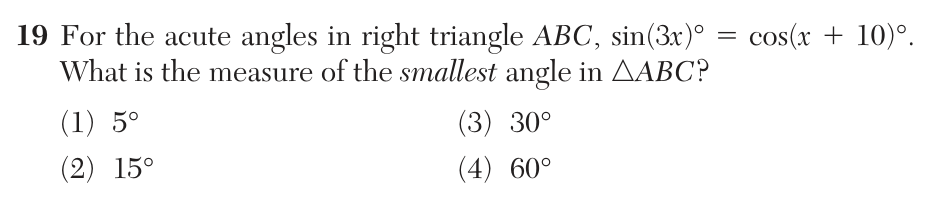
- For acute angles, implies that .
- Set the given angle expressions equal to this sum:
- The acute angles are and . The third angle is 90°, so the smallest is 30°.
Exam detail: The value of x is 20; the question asks for an angle measure, not x itself.
Question 20: Bound the number of sides in a plane section
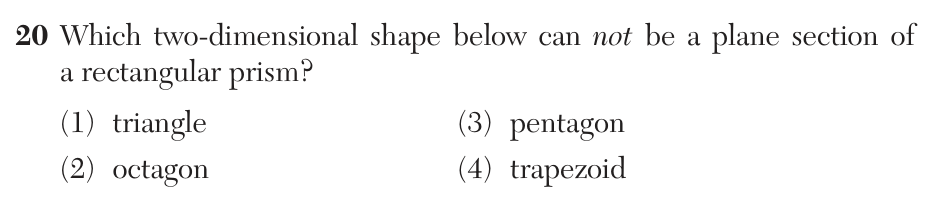
- A rectangular prism has six faces. A slicing plane can contribute at most one straight boundary segment from each face.
- Therefore a nondegenerate polygonal cross-section has at most six sides. An octagon has eight sides, so it cannot occur.
Question 21: Calculate the length of the minor arc
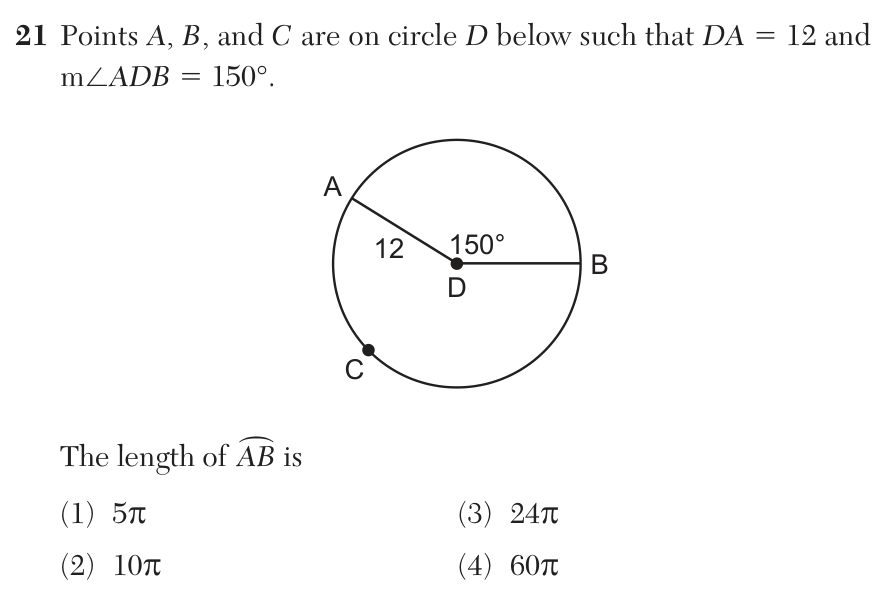
- D is the center, so DA gives radius 12. The 150° central angle subtends the minor arc AB.
- Take the corresponding fraction of the circumference:
Exam detail: The curved arc symbol over AB asks for arc length, not the straight chord length.
Question 22: Apply both triangle inequalities
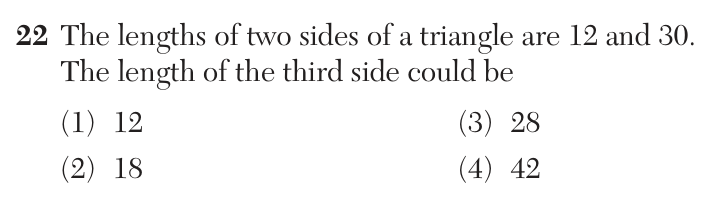
- If the third side has length x, it must be larger than the difference of the known sides and smaller than their sum:
- Among the listed values, only 28 lies strictly inside this interval. Values 18 and 42 would give a straight, degenerate figure rather than a triangle.
Question 23: Use similarity to find the perimeter
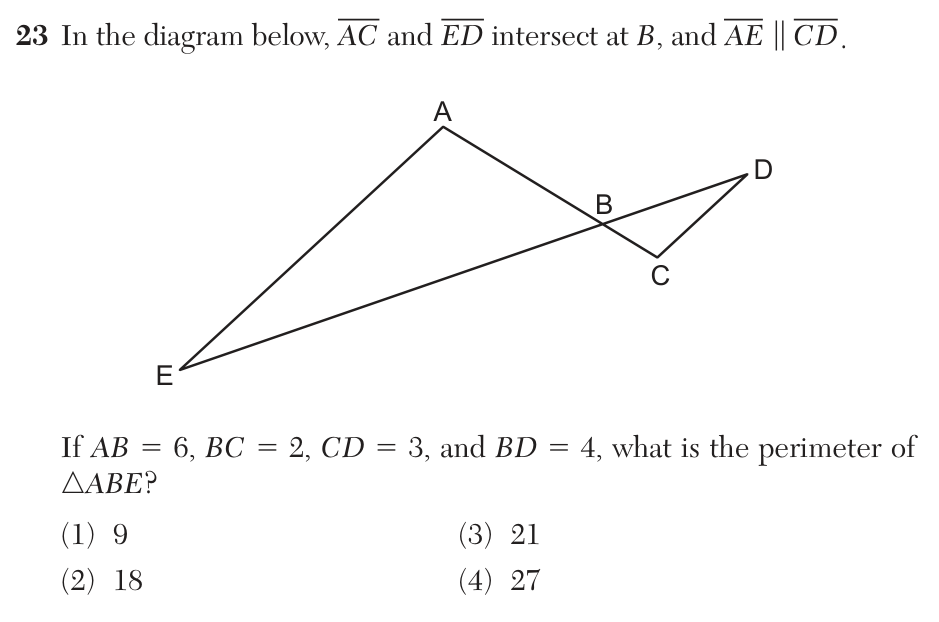
- The angles at B are vertical angles. Since AE is parallel to CD, a second pair of angles is congruent by the alternate-interior-angle theorem. Hence by AA.
- The scale factor from the smaller triangle CBD to ABE is . The corresponding sides give and .
- Add all three sides of triangle ABE:
Exam detail: The correspondence is A to C, B to B, and E to D.
Question 24: Dilate a line through the center
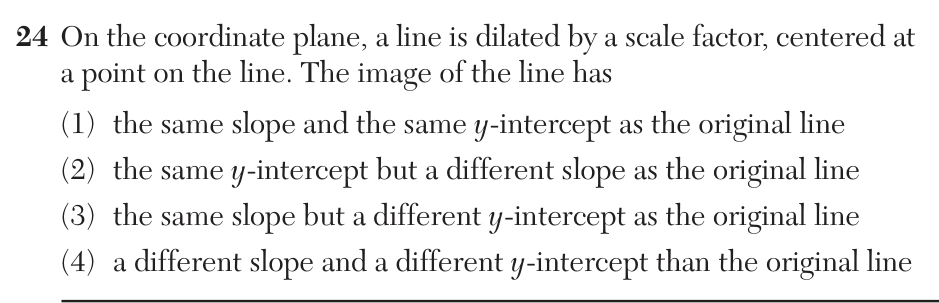
- Under a dilation, a point and its image lie on the same line through the center of dilation.
- Because the center is already on the given line, all its image points remain on that line. The line maps onto itself, so its slope and y-intercept are unchanged.
Part II: Short constructed responses
Questions 25–31 • 2 credits each • 14 credits total
Question 25: Describe and verify two rigid motions
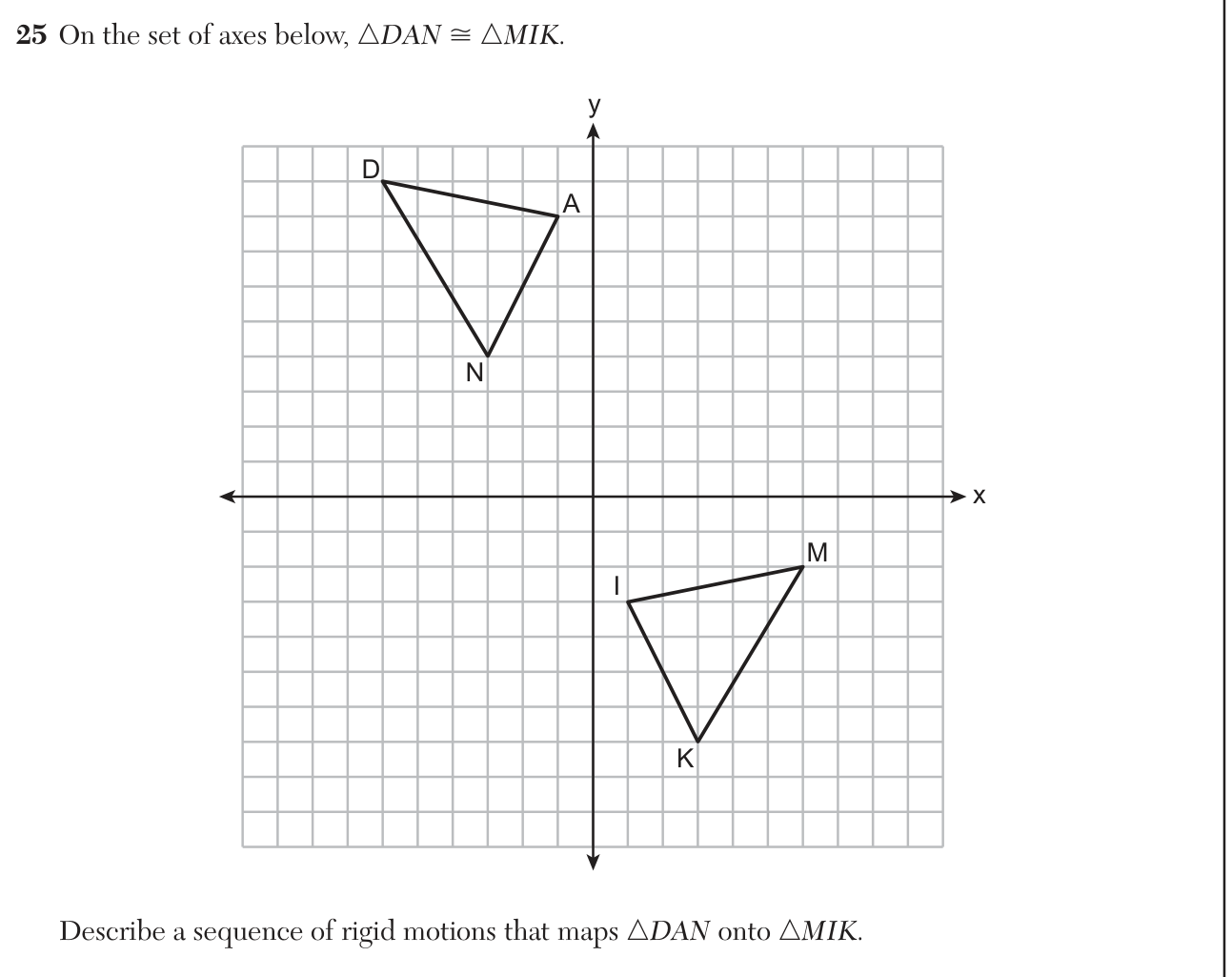
- Read the original vertices as , , and . The target correspondence is D to M, A to I, and N to K.
- First reflect across the y-axis, using . Then translate 11 units downward, using .
- Check every vertex:
Verification of the two motions Original Reflect in y-axis Move 11 down - Both transformations are rigid motions, and the complete rule maps all three original vertices to their required images.
Exam detail: Other valid sequences may also work. State the reflecting line and the translation direction and distance explicitly.
Question 26: Find the obtuse angle beside the perpendicular
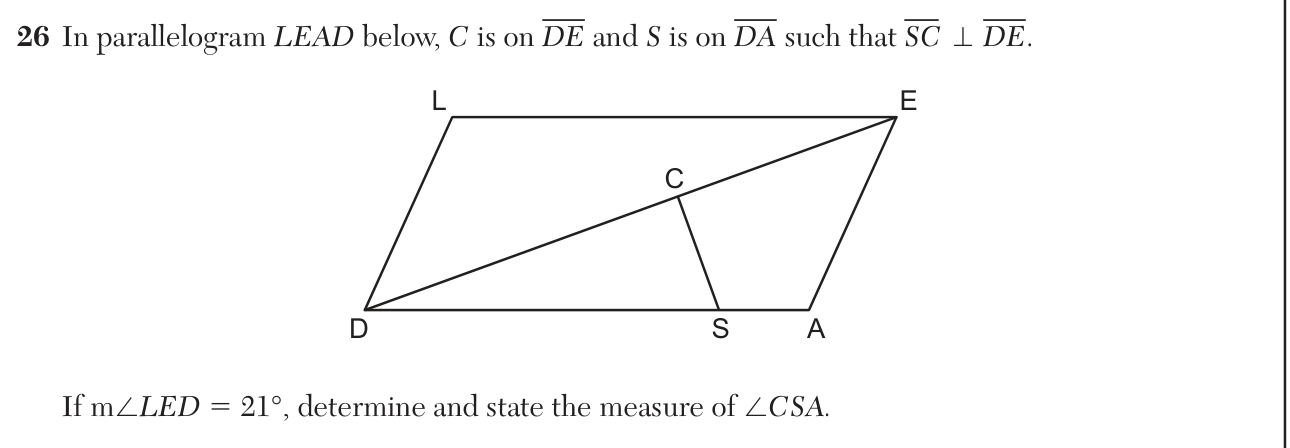
- Opposite sides of a parallelogram are parallel, so . The diagonal DE is a transversal, giving .
- Since SC is perpendicular to DE, triangle DCS has a right angle at C:
- D, S and A are collinear, so the angles CSD and CSA form a linear pair:
Exam detail: The requested angle is CSA, which is obtuse. The 69° angle is the adjacent angle CSD.
Question 27: Find weight from cylindrical volume

- The diameter is 1.5 feet, so the radius is feet.
- Find the cylinder’s volume:cubic feet.
- Multiply by the stated 25 pounds per cubic foot:pounds. Round only the final weight to the nearest pound.
Exam detail: Halve the diameter before using the cylinder-volume formula.
Explore the radius and height relationship with the cylinder calculator.
Question 28: Use the converse of proportional division
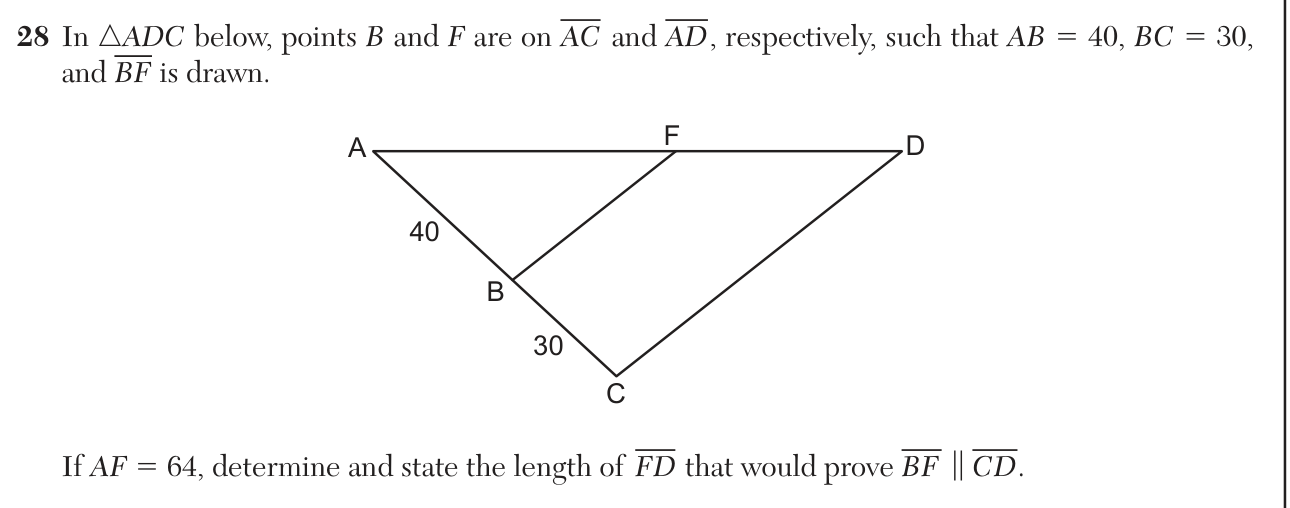
- For BF to be parallel to CD, it must divide sides AC and AD proportionally. Use corresponding parts:
- Substitute and cross-multiply:
- With this length, the two ratios are equal, so the converse of the triangle proportionality theorem establishes .
Exam detail: The requested length is FD, not the full side AD, which would be 112.
Question 29: Use two sides and their included angle for area
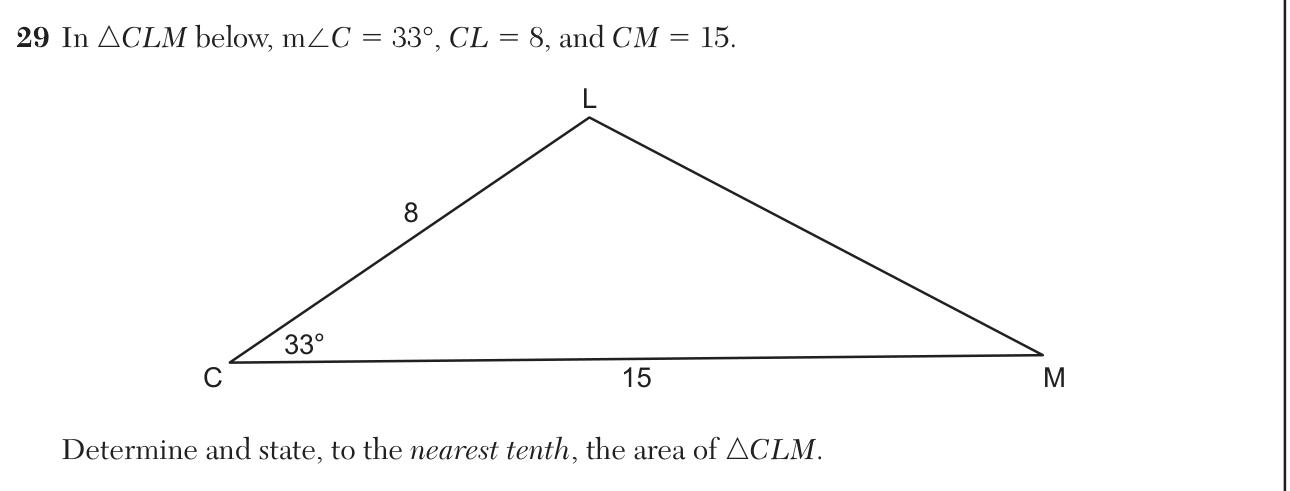
- The 33° angle lies between the sides of lengths 8 and 15. Therefore the triangle area formula is .
- Substitute the two sides and included angle:
- Round to the nearest tenth.
Exam detail: Use degree mode and the angle included between the two known sides.
Question 30: Construct the angle bisector at B
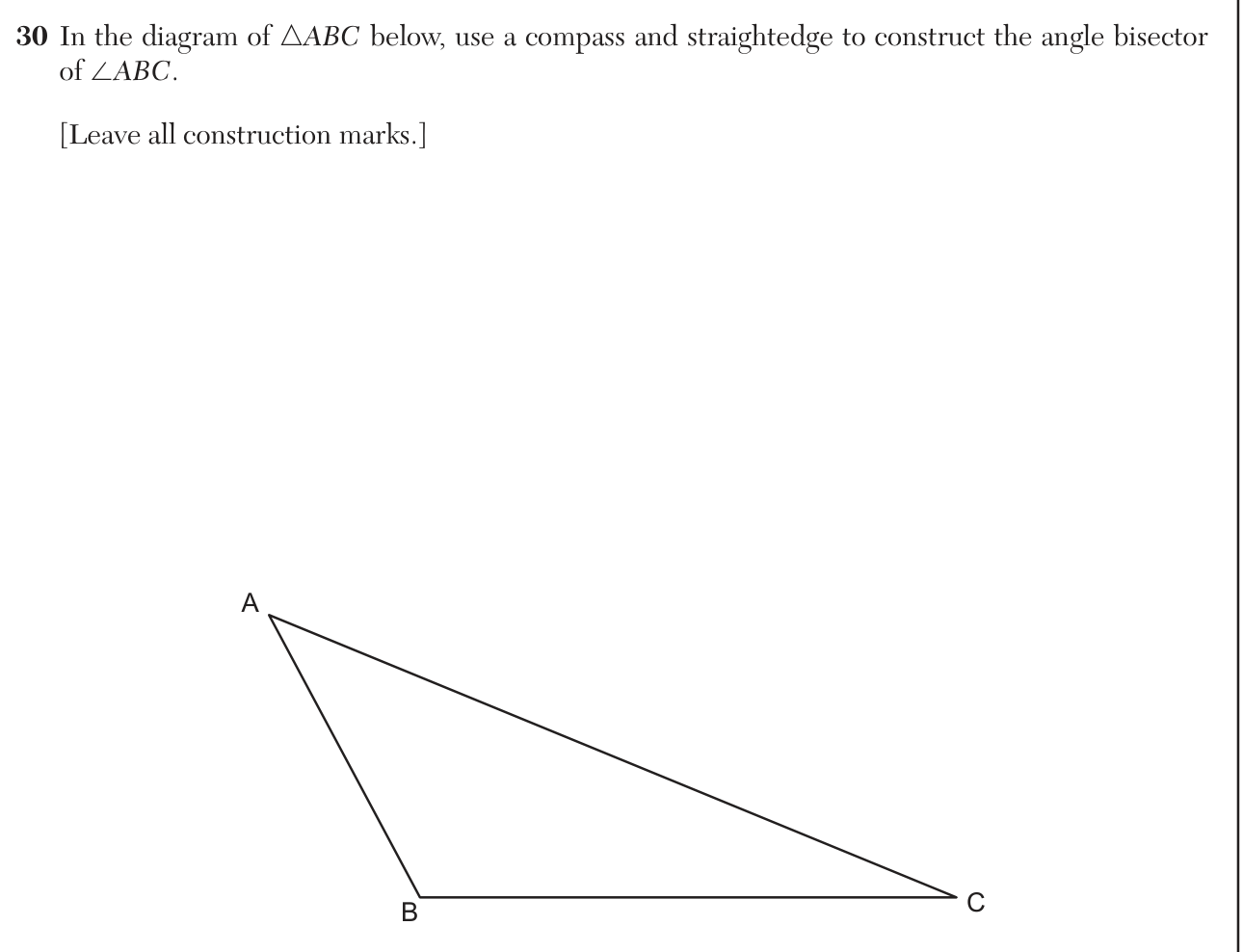
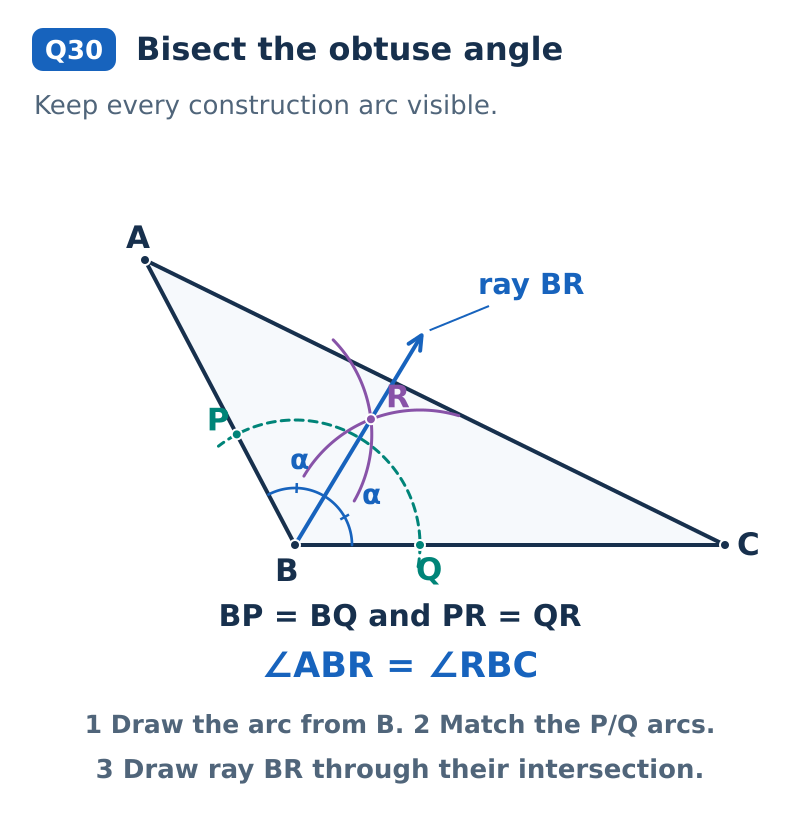
- Place the compass point at B. Draw an arc crossing both rays BA and BC. Label those intersection points P and Q; the single compass setting ensures .
- Choose a compass opening large enough for arcs centered at P and Q to meet inside angle ABC. Draw both arcs with the same opening, and label their interior intersection R.
- Use a straightedge to draw the ray from B through R. Keep the original arc and both intersecting arcs visible.
- Why it works: , , and BR is common. Thus by SSS, so the angles at B are equal and ray BR bisects angle ABC.
Exam detail: A measured or freehand line without the appropriate construction arcs is not an acceptable compass-and-straightedge construction. The bisector must start at B.
Question 31: Use congruent diagonals to prove a rectangle

- The diagonals of parallelogram GRAM are GA and RM. Diagonals of a parallelogram bisect each other, so P is the midpoint of RM.
- Therefore and . Since , the two diagonals are congruent.
- A parallelogram whose diagonals are congruent is a rectangle. Therefore GRAM is a rectangle.
Exam detail: Explain why RM is twice RP; RP is only half a diagonal.
Part III: Extended constructed responses
Questions 32–34 • 4 credits each • 12 credits total
Question 32: Add the heights above and below the observer
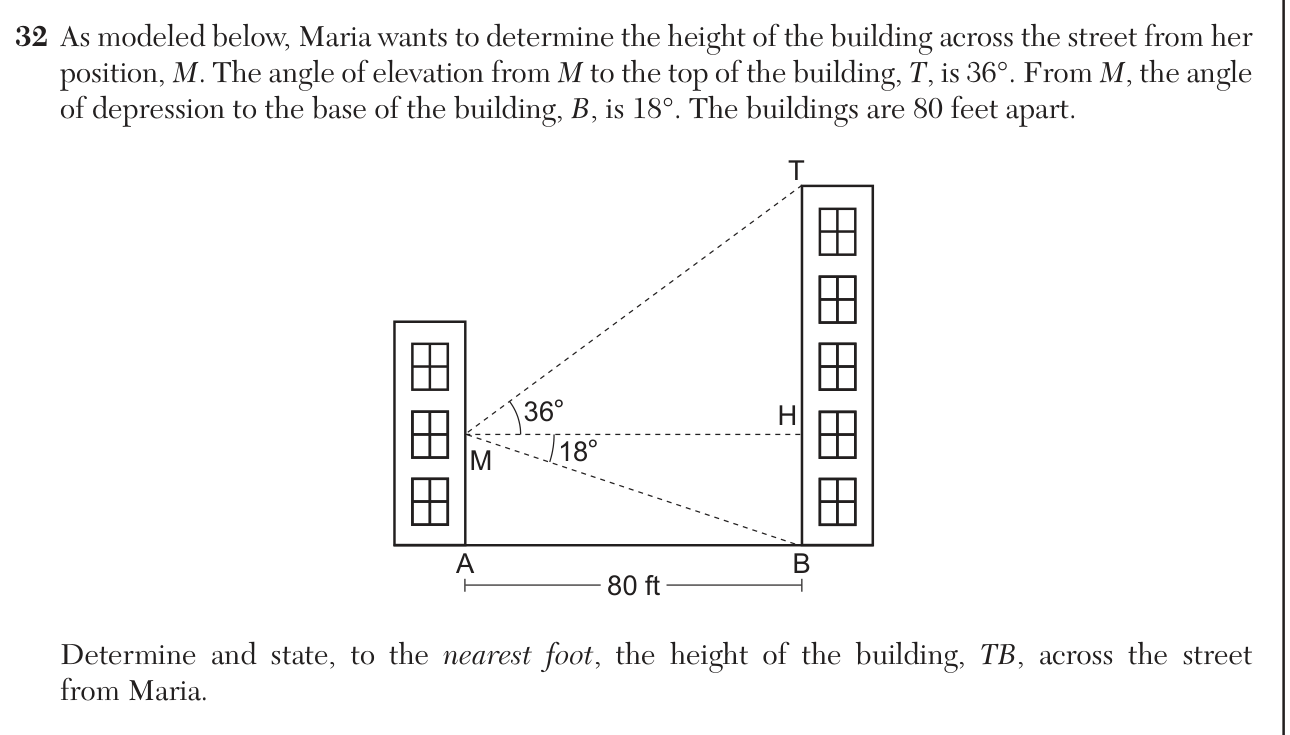
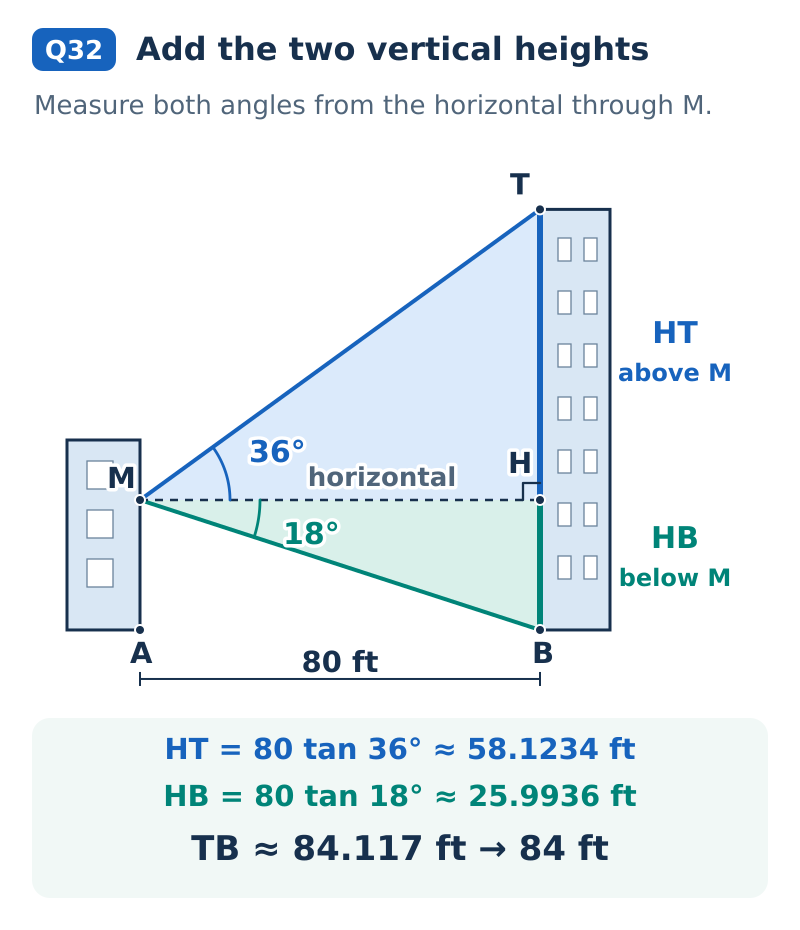
- H is level with M, so the horizontal distance MH is 80 feet. Split the required building height into .
- Use the angle of elevation for the portion above eye level:feet.
- Use the angle of depression for the portion below eye level:feet.
- Add using full calculator precision, then round to the nearest foot:
Exam detail: Finding only the portion above Maria’s eye level does not give the full building height. Add both vertical portions.
Question 33: Determine the maximum number of complete pyramids
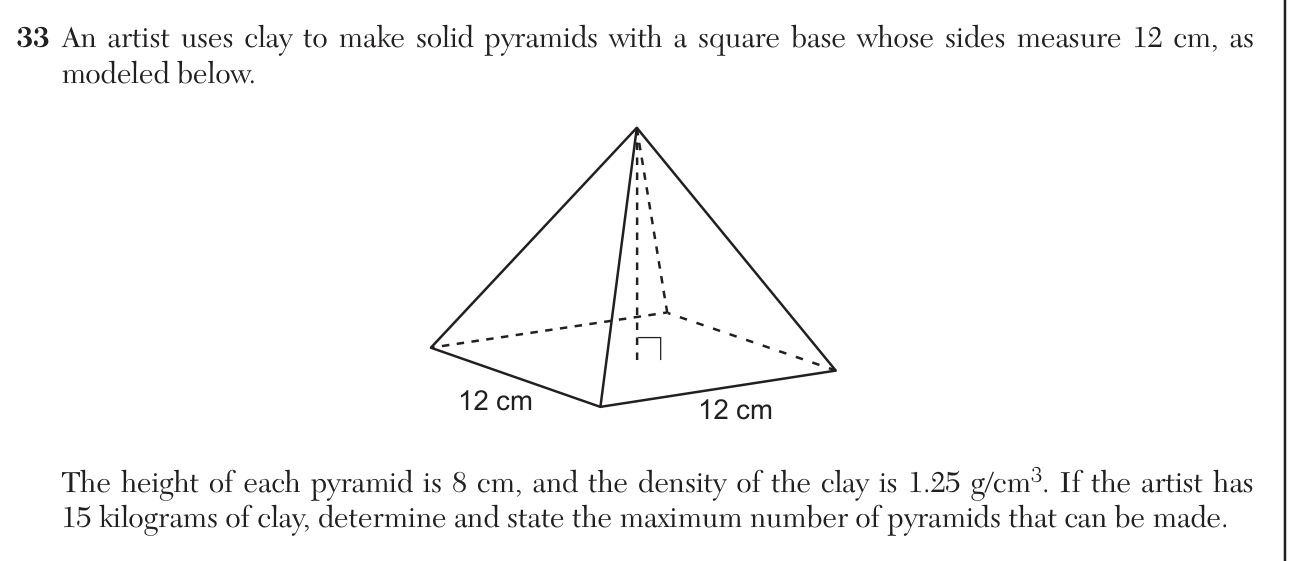
- Each square base has area square centimeters. The volume of one pyramid is:cubic centimeters.
- Multiply volume by density to find the mass of one pyramid:grams.
- Convert the available clay into the same mass unit:grams. Divide by the mass per pyramid:
- Only whole pyramids count, so take the whole-number part: 31. As a check, 31 pyramids use 14,880 grams, leaving 120 grams. Another pyramid needs 480 grams, which exceeds the amount left.
Exam detail: A maximum number of complete objects must be rounded down, even when the division gives a fraction.
Question 34: Prove the ratio using similar right triangles
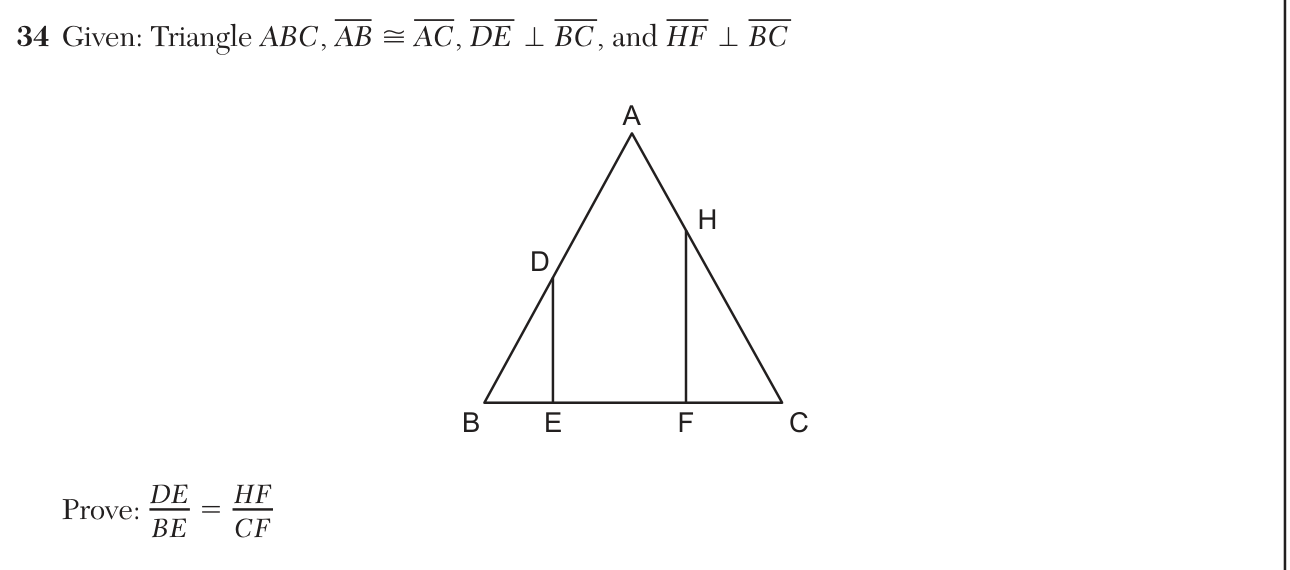
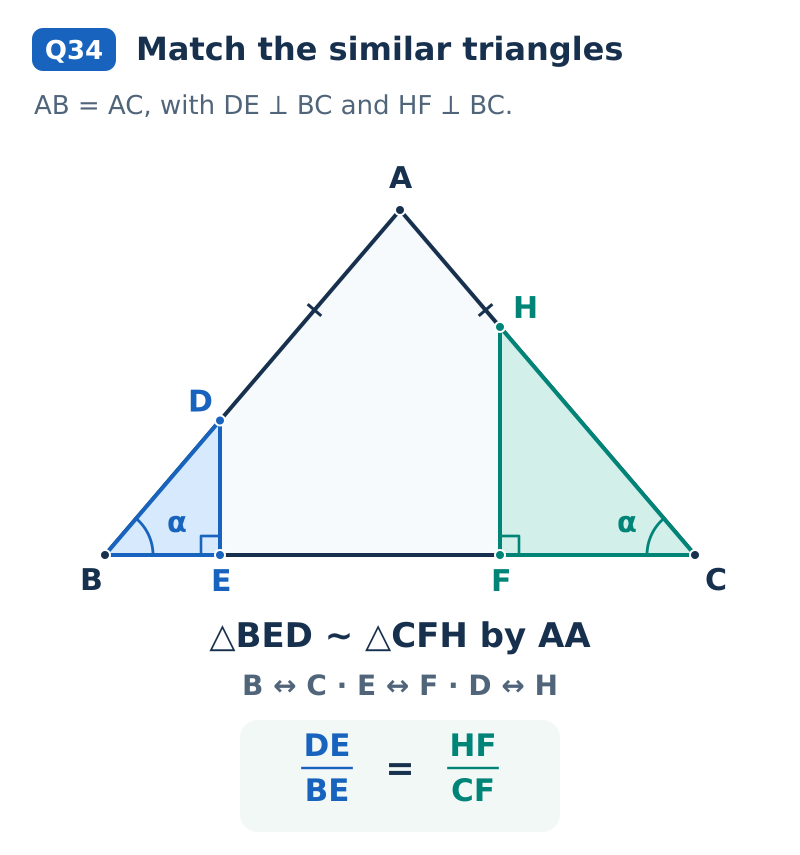
- Because , triangle ABC is isosceles and its base angles at B and C are congruent. With D on AB, H on AC, and E and F on BC, this gives .
- The perpendicular givens make . These right angles are congruent.
- Two angle pairs are congruent, so by AA. The correspondence is B to C, E to F, and D to H.
- Corresponding sides of similar triangles are proportional:Cross-multiply and divide by the positive product of BE and CF:This is the required relationship.
Exam detail: Do not stop after proving similarity. Include the proportional-side step and the requested concluding equation.
Part IV: Coordinate geometry proofs
Question 35 • 6 credits
Question 35: Complete the parallelogram and prove an isosceles triangle
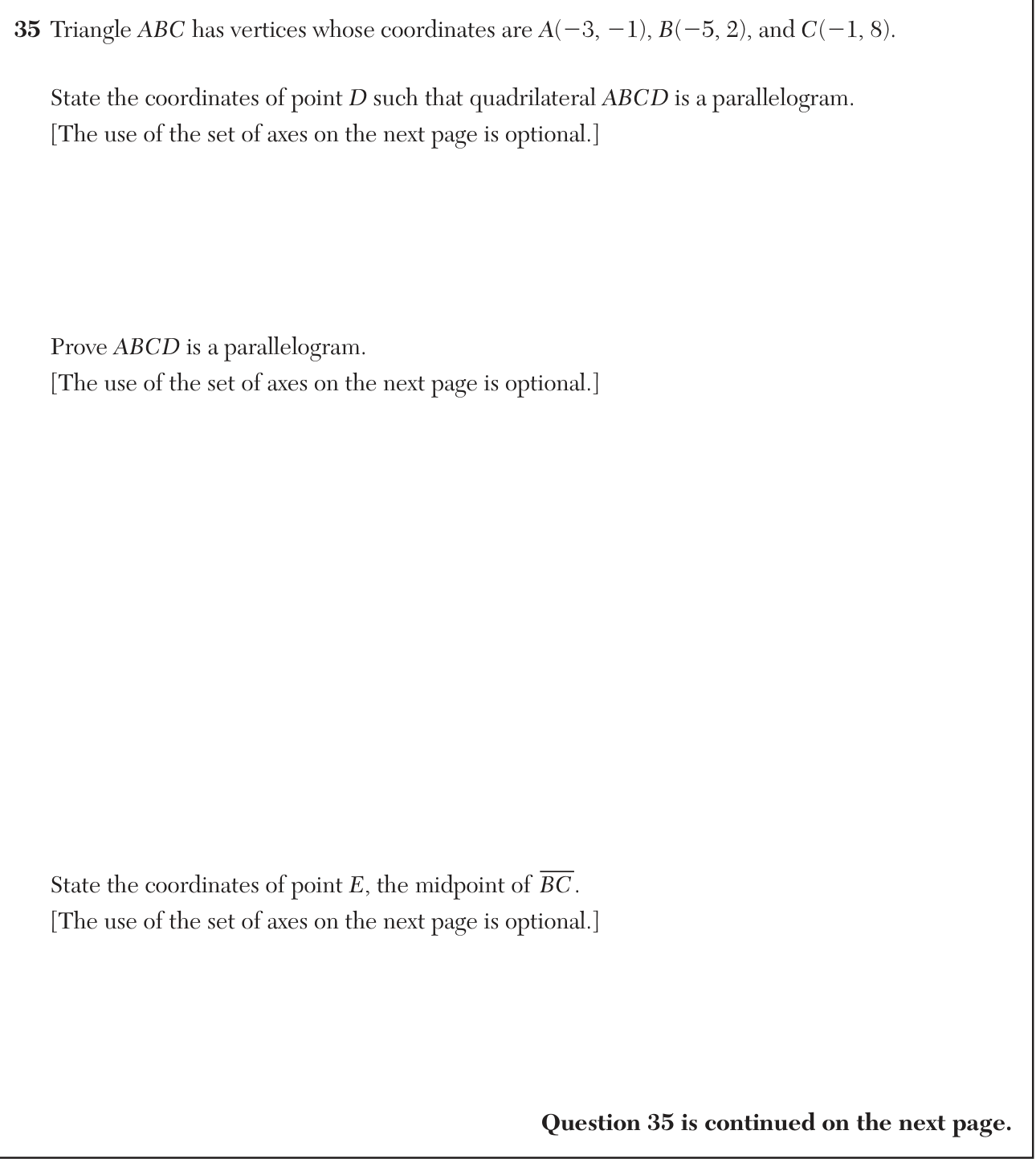
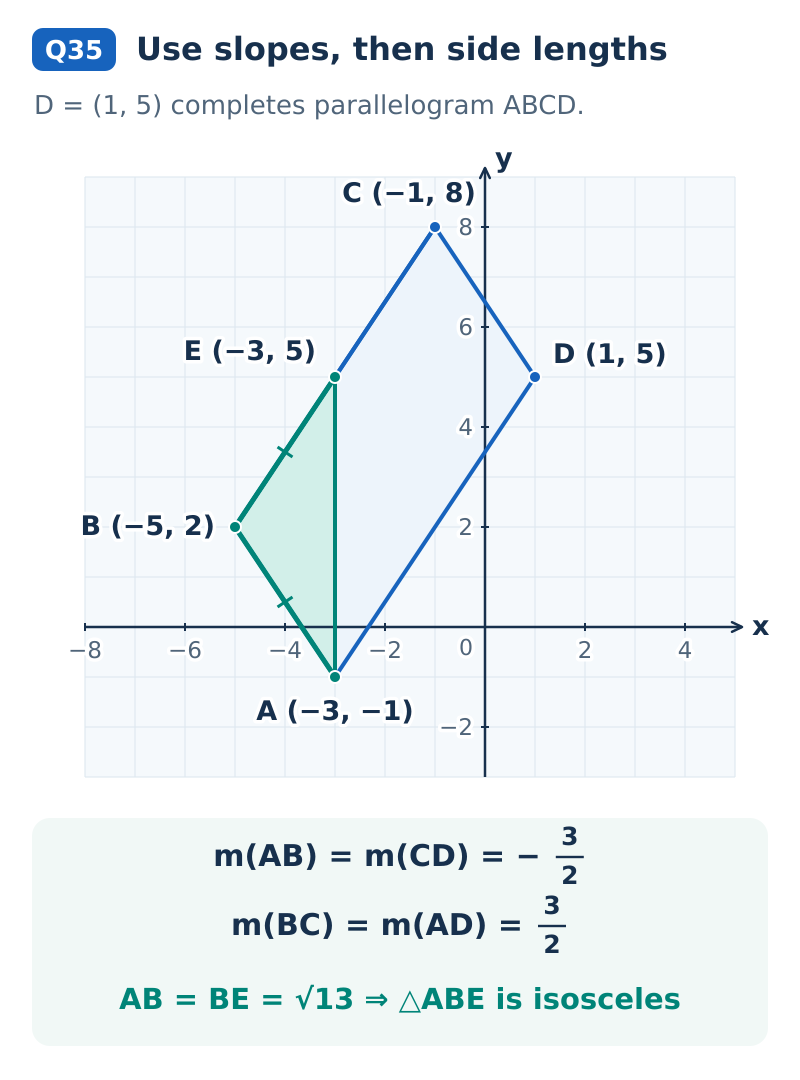
- Find D. The move from B to C is . Opposite sides of a parallelogram have the same directed displacement, so apply this move to A:
- Prove ABCD is a parallelogram by comparing both pairs of opposite slopes:Thus and . Both pairs of opposite sides are parallel, so ABCD is a parallelogram.
- Find the midpoint E of BC by averaging coordinates:
- Prove triangle ABE is isosceles. Calculate two of its side lengths:Since , triangle ABE has two congruent sides and is isosceles.
Exam detail: There are four tasks across pages 22–23. State both coordinate answers and give both proofs with explicit concluding statements. The graph is optional.
Check another coordinate example in the 2D Points mode of the distance calculator.
Check your score carefully
The maximum raw score is 80. Use the official June 2026 Geometry conversion chart for the scaled Regents score; another administration’s chart may give a different result. For related practice, see the January 2026 Geometry Regents solutions.
Sources & References
Official materials accessed October 7, 2026. Question and scoring references use the English edition throughout this page.
- Official June 2026 Geometry examination (questions; PDF)
- Official June 2026 multiple-choice scoring key (PDF)
- Official June 2026 rating guide (PDF)
- Official June 2026 model response set (PDF)
- Official June 2026 conversion chart (PDF)
- NYSED Geometry past-examination index
- NYSED terms of use and reproduction conditions
From the New York State Education Department. Regents Examination in Geometry, June 2026. Internet. Available from the official examination link above; accessed 7 October 2026. Original question images are distinguished from HeLovesMath’s original explanations and solution diagrams.