Pearson Edexcel International A Level · Mechanics M2 · WME02/01
Use these Mechanics 2 past papers to practise choosing a model, setting up equations and explaining the direction of your answer. Start with the current course guide, work through six original examples, then test yourself before opening a paper and its matching mark scheme.
This is an independent HeLovesMath revision guide for Pearson Edexcel International Advanced Level Mathematics. It is not the UK A-level Further Mechanics 2 option, and M2 is one unit rather than a complete A-level qualification. The archive below retains every paper destination from the earlier page, including historical material and clearly flagged labelling issues.
Choose the correct download: match WME02, the session and the paper variant on both covers. Two original links labelled “Oct 2020” actually open the October 2021 paper and mark scheme. Those original destinations remain in the archive, with the mismatch made explicit.
Which course and examination does this page cover?
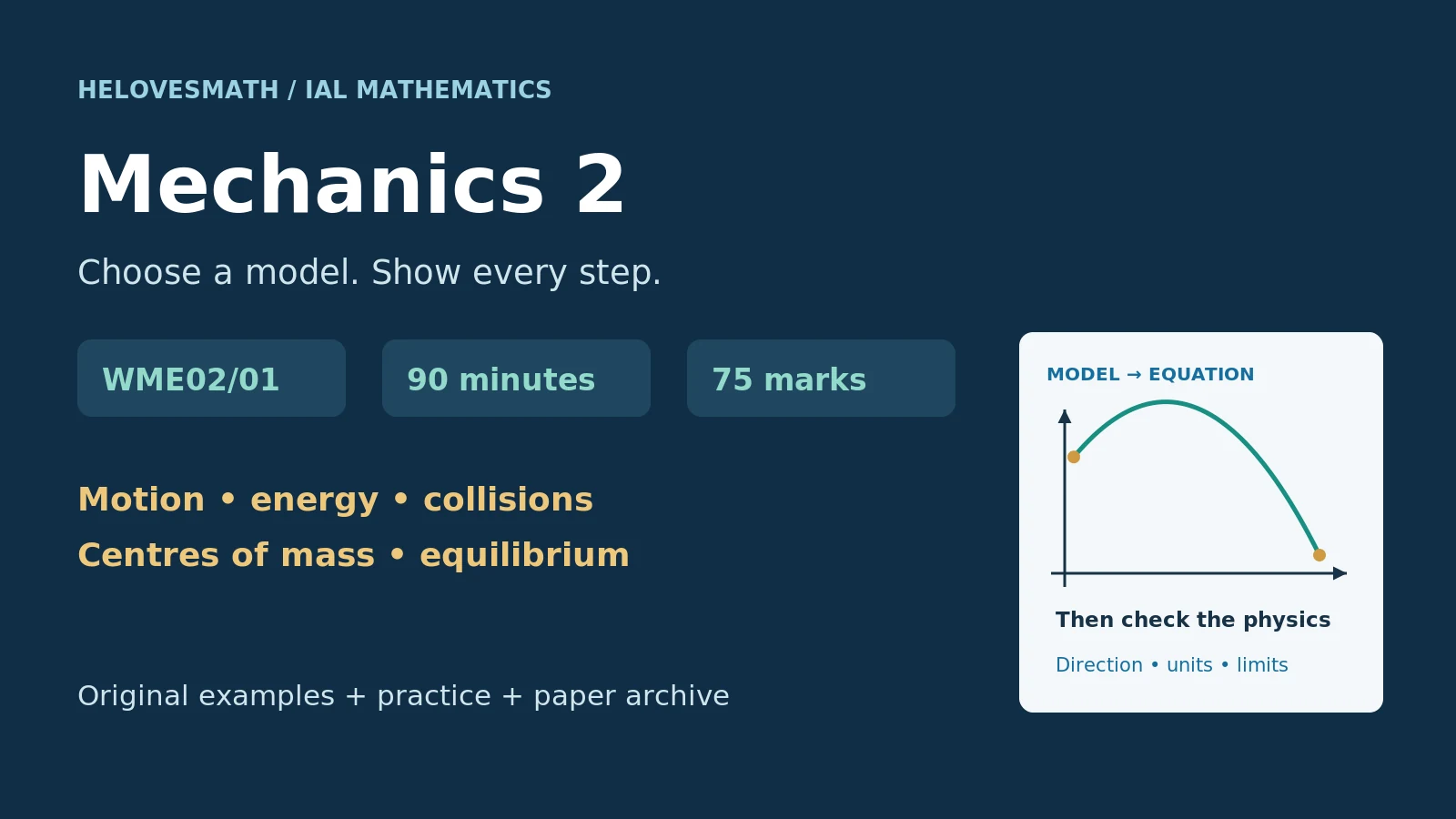
Pearson’s current International Advanced Level Mathematics specification identifies Mechanics M2 as WME02/01. The written examination lasts 1 hour 30 minutes and carries 75 marks, with all questions compulsory. A permitted calculator and the appropriate mathematical formulae and statistical tables booklet are used. Pearson lists January, June and October availability; your school or examination centre should confirm your actual entry and arrangements.
M2 may test knowledge from Pure Mathematics P1–P4 and Mechanics M1. If a question feels difficult before the M2 method even begins, review algebraic rearrangement, differentiation and integration, trigonometry, resolving forces, and consistent sign conventions. The Mechanics 1 paper archive can help you diagnose earlier gaps.
| Area | What you should be able to do | First decision |
|---|---|---|
| Time-based kinematics | Differentiate or integrate a position, velocity or acceleration expression; work with vector components and initial conditions | Is acceleration constant, or do you need calculus? |
| Projectiles | Connect horizontal and vertical motion using a common time; interpret impact, height and range | Where is the origin, and which vertical direction is positive? |
| Centres of mass | Use symmetry and mass-weighted coordinates for particles, rods and plane laminas, including composite shapes | Are the pieces uniform and of the same density? |
| Work, energy and power | Account for kinetic energy, gravitational potential energy, work against resistance and the rate of doing work | Which forces transfer energy over the displacement? |
| Direct collisions | Combine momentum with Newton’s law of restitution; find impulses and energy loss | What signs do the velocities have on one fixed axis? |
| Rigid-body equilibrium | Resolve coplanar forces and take moments, including limiting equilibrium and sliding or toppling | Which pivot removes the most unknown moments? |
Stay within the unit you are revising. Springs and simple harmonic motion, circular motion, and acceleration expressed as a function of displacement are M3 topics in this specification. M2’s collision work concerns direct impacts; oblique impact with a plane wall is excluded. The examples below are a focused diagnostic, not a replacement for the full specification.
How to turn a past paper into useful revision
- Read the situation before reaching for a formula. Draw the bodies, label the distances and decide whether the model is a particle, rod or lamina. Write assumptions such as smooth contact, a light inextensible string, uniform density or negligible air resistance only when the problem gives or requires them.
- Choose axes and define your unknowns. Velocity is signed on your chosen axis. A negative answer can mean motion in the opposite direction; it is not automatically an error. Use a separate clearly labelled diagram before and after a collision.
- State a principle, then substitute. “Conservation of momentum along the line of centres” is more informative than an unexplained string of numbers. In an energy problem, show which change is equal to the work done; in equilibrium, give the point about which moments are taken.
- Keep enough accuracy until the end. Do not round an angle, time or intermediate velocity before using it again. Check the particular paper’s instruction for gravity and final rounding. In the worked examples here, the gravitational acceleration is g = 9.8 m s−2.
- Mark the method and diagnose the loss. Compare your working with the matching mark scheme after finishing the attempt. Record whether each mistake came from the model, sign, algebra, calculus, units or interpretation. Rework that question without the solution in view, then try another of the same type.
For timed work, divide your 90 minutes between all the questions and leave a small checking margin. The ratio of time to available marks is a planning guide rather than a promise that every mark takes the same time. A clear diagram and one correct governing equation can be a better starting point than lengthy, unstructured algebra.
Six worked Mechanics 2 examples
These original revision examples develop the modelling and calculation skills you need before tackling a full paper. Take g = 9.8 m s−2. Keep unrounded values during calculations; numerical answers involving g are shown to three significant figures where appropriate.
1. Variable acceleration: displacement is not distance
Question. A particle moves on a straight line. At time t seconds its acceleration is a = 6t − 6 m s−2. Initially it is at the origin and at rest. Find its velocity and position, the time at which it changes direction, and the distance travelled in the first 3 seconds.
Step 1: integrate acceleration and use the initial velocity
Since v = 0 when t = 0, C = 0.
Step 2: integrate velocity and use the initial position
The condition x(0) = 0 gives D = 0. Here v is measured in m s−1 and x in metres.
Step 3: check the sign of velocity
The particle moves in the negative direction for 0 < t < 2, then in the positive direction for 2 < t ≤ 3. It therefore changes direction at 2 s; starting at rest does not itself mean a reversal.
Step 4: add the distances on the two parts of the journey
Its displacement is 0 m because it finishes where it started. Its distance is 8 m because it has travelled 4 m in each direction.
Avoid this error: constant-acceleration formulae cannot be applied across an interval on which acceleration varies. Integrate first, then split the distance calculation wherever velocity changes sign.
2. A projectile launched above ground level
Question. A ball is projected from a platform 19.6 m above horizontal ground at speed 24.5 m s−1. Its launch angle θ is above the horizontal, with sin θ = 35 and cos θ = 45. Find the flight time, horizontal range, maximum height above the ground, and velocity immediately before impact.
Model. Treat the ball as a particle, neglect air resistance, and take gravitational acceleration as constant. Let x be horizontal distance from the launch point and y be height above the ground; upwards is positive.
Step 1: resolve the initial velocity
Step 2: find the positive time when the ball reaches the ground
The roots are 4 and −1. The negative root is outside the physical flight, so flight time = 4.00 s.
Step 3: use zero vertical velocity at the highest point
Step 4: find both components of the impact velocity
The speed is √19.62 + 24.52 ≈ 31.4 m s−1, at 51.3° below the horizontal.
Avoid this error: the ball lands below its launch height, so flight time is not twice the time to maximum height. Use the correct final vertical position.

3. Centre of mass of a lamina with a cut-out
Question. A uniform rectangular lamina occupies 0 ≤ x ≤ 6 and 0 ≤ y ≤ 4, with coordinates measured in centimetres. A square occupying 4 ≤ x ≤ 6 and 2 ≤ y ≤ 4 is removed. Find the centre of mass of the remainder. The lamina is then freely suspended from the corner O = (0, 0). Find the acute angle its original bottom edge makes with the downward vertical when it rests in equilibrium.
Model. The lamina has constant thickness and uniform density, so each part’s mass is proportional to its area. The removed square contributes negative area and negative first moment.
Step 1: identify each area and its centroid
- Original rectangle: area 24 cm2, centroid (3, 2)
- Removed square: area 4 cm2, centroid (5, 3)
- Remaining area: 20 cm2
Step 2: take moments of area about each coordinate axis
The centre of mass is therefore G = (2.6, 1.8) cm, in the original coordinate system. Removing material from the upper-right corner shifts it left and down, which is a useful reasonableness check.
Step 3: put the centre of mass vertically below the suspension point
When the lamina hangs at rest, the line OG is vertical. Its angle α with the original positive x-axis is fixed within the lamina, so:
Avoid this error: subtract the hole’s moment as well as its area. Measure every centroid from the same origin, and check whether the requested angle is to the horizontal or to the vertical.
4. Work, energy and instantaneous power on a slope
Question. A 5 kg crate is pulled 10 m up a straight rough slope by a constant 50 N force parallel to the slope. It starts with speed 2 m s−1. The slope angle satisfies sin θ = 35 and cos θ = 45. The coefficient of friction is 0.25. Find the final speed and the pulling force’s instantaneous power at that point.
Model. Treat the crate as a particle sliding up the fixed plane. Friction opposes its motion and has magnitude μR; there is no other resistance.
Step 1: find the normal reaction and friction
Step 2: account for every energy transfer
- Work by the pulling force: 50 × 10 = 500 J
- Work against friction: 9.8 × 10 = 98 J
- Vertical rise: 10 × 0.6 = 6 m
- Gain in gravitational potential energy: 5 × 9.8 × 6 = 294 J
Step 3: use the speed at the requested instant
This is the power supplied by the pulling force at the end of the 10 m journey. The net rate of increase of kinetic energy would use the resultant force instead.
Avoid this error: gravitational potential energy uses the vertical height gained, not the distance along the slope. Friction means mechanical energy alone is not conserved.
5. Direct impact: momentum, restitution and energy loss
Question. Two smooth spheres move directly towards each other on a smooth horizontal surface. Sphere A, mass 2 kg, is to the left of sphere B, mass 3 kg. Taking right as positive, their initial velocities are +5 m s−1 and −1 m s−1. Their coefficient of restitution is 0.5. Find their velocities immediately after impact, the impulse on A, and the kinetic energy lost.
Model. Treat the spheres as particles in a one-dimensional direct collision. The external horizontal impulse during the short impact is negligible, so their total horizontal momentum is conserved.
Step 1: write the momentum equation with signed velocities
Step 2: use relative separation speed in the restitution equation
Substitute vB = vA + 3 into the momentum equation.
A rebounds to the left; B moves to the right. Their separation speed is 3 m s−1, so the directions are physically consistent.
Step 3: calculate the change in momentum of A
The impulse on A has magnitude 10.8 N s to the left.
Step 4: subtract final kinetic energy from initial kinetic energy
Avoid this error: restitution relates relative speeds, not the two individual speeds separately. Momentum is conserved here, but kinetic energy is not because the collision is not perfectly elastic.

6. A loaded ladder in limiting equilibrium
Question. A uniform ladder of length 5 m and mass 20 kg rests with its foot on rough horizontal ground and its top against a smooth vertical wall. The foot is 3 m from the wall and the top is 4 m above the ground. A person of mass 30 kg stands 3 m along the ladder from its foot. Find the wall reaction and the minimum coefficient of friction at the ground for equilibrium.
Model. Treat the ladder as a rigid uniform rod and the person as a particle at the stated position. The wall exerts a horizontal normal reaction only. At the foot there is an upward normal reaction N and friction towards the wall.
Step 1: resolve vertically
Step 2: take moments about the foot
The wall reaction H has perpendicular distance 4 m from the foot. The ladder’s weight acts at its midpoint, with horizontal lever arm 1.5 m. The person’s lever arm is 3 × 35 = 1.8 m.
Step 3: resolve horizontally, then apply limiting friction
Horizontal equilibrium gives F = H = 205.8 N. Equilibrium requires F ≤ μN; the smallest possible coefficient occurs at the boundary.
Avoid this error: a moment uses perpendicular distance to a force’s line of action. The 3 m distance along the ladder is not the person’s moment arm. Also, use F = μN only at limiting equilibrium.
Eight practice questions with answers
Try each question before opening its answer. These are original practice questions, not reproduced Pearson exam questions. Use g = 9.8 m s−2, and give numerical answers involving g to three significant figures where appropriate. Unless stated otherwise, use metres, seconds and kilograms. In vector questions, i and j are perpendicular unit vectors.
Practice 1: vector kinematics
A particle has position vector r = (t3 − 3t)i + (2t2 + 1)j m for t ≥ 0. Find its velocity, acceleration and speed at t = 2 s.
Show answer and method
Differentiate the position vector component by component, then differentiate again:
At t = 2, velocity = (9i + 8j) m s−1 and acceleration = (12i + 4j) m s−2.
Speed is the magnitude of the velocity vector, not the sum of its components.
Practice 2: two changes of direction
A particle starts at the origin with velocity 3 m s−1. Its acceleration is a = 2t − 4 m s−2. Find the times when it changes direction and its displacement and total distance travelled between t = 0 and t = 4 s.
Show answer and method
The sign of velocity changes at 1 s and 3 s.
The positions at times 0, 1, 3 and 4 s are respectively 0, 43, 0 and 43 metres.
Displacement = 43 m; distance = 4 m.
Practice 3: a ground-to-ground projectile
A ball is projected from horizontal ground with initial velocity (14i + 19.6j) m s−1, where j is vertically upwards. Neglect air resistance and model the ball as a particle. Find the time until it next reaches the ground, its horizontal range and its maximum height above the ground.
Show answer and method
The non-zero root gives flight time = 4.00 s. The range is 14 × 4 = 56.0 m.
At maximum height, vy = 19.6 − 9.8t = 0, giving t = 2 s. Substituting into y gives maximum height = 19.6 m.
Practice 4: a composite lamina
A uniform lamina consists of a rectangle with vertices (0, 0), (6, 0), (6, 2), (0, 2), joined along its top edge to a triangle with vertices (0, 2), (6, 2), (0, 5). Coordinates are in centimetres. The pieces have the same uniform mass per unit area and overlap only along their shared edge. Find the centre of mass of the complete lamina.
Show answer and method
The rectangle has area 12 cm2 and centroid (3, 1). The triangle has area 9 cm2; averaging the coordinates of its three vertices gives centroid (2, 3).
Centre of mass = (187, 137) cm, approximately (2.57, 1.86) cm.
Practice 5: power and acceleration
A car of mass 800 kg travels up a straight slope with sin θ = 120. Its engine delivers a constant 16 kW to the motion, and resistance other than gravity is a constant 300 N. Find its acceleration when its speed is 20 m s−1, and the steady speed possible under this model.
Show answer and method
Acceleration = 0.135 m s−2 up the slope.
At steady speed the driving force balances the total opposing force, 300 + 392 = 692 N.
Constant power does not imply constant driving force: the driving force is smaller at higher speed.
Practice 6: impact with a stationary sphere
On a smooth horizontal surface, a 0.5 kg sphere A moving at 8 m s−1 collides directly with a stationary 1.5 kg sphere B. Their coefficient of restitution is 0.75. Find both velocities after impact and the kinetic energy lost. Take the initial direction of A as positive and neglect external impulse during impact.
Show answer and method
Solving gives vA = −2.5 m s−1 and vB = 3.5 m s−1.
Practice 7: successive impacts, including a wall
Two identical small smooth spheres move along a smooth horizontal line, with increasing x taken as positive. Initially A is at x = 0 moving at 4 m s−1 and B is at rest at x = 2 m. A smooth fixed wall is at x = 5 m, perpendicular to their line of motion. The coefficient of restitution is 0.5 both between the spheres and between B and the wall. Treat their sizes as negligible. Find the velocities after the first sphere-to-sphere impact, after B hits the wall, and immediately after the next sphere-to-sphere impact.
Show answer and method
For the first impact, equal masses let the common mass cancel:
So A has velocity +1 m s−1 and B has velocity +3 m s−1. At the wall, B rebounds with velocity −1.5 m s−1.
Now use +1 and −1.5 as the velocities before the second sphere-to-sphere collision:
Therefore wA = −0.875 m s−1 and wB = +0.375 m s−1.
Check that the second collision can occur: when B reaches the wall, A is at 3 m. They approach at 2.5 m s−1 and meet 0.8 s later at 3.8 m. Do not conserve the two spheres’ momentum across the wall impact: the wall supplies an external impulse.
Practice 8: equilibrium of a hinged rod
A uniform horizontal rod AB has length 4 m and mass 10 kg. It is hinged at A, with B to the right. A particle of mass 12 kg is attached 3 m from A. A light cable attached at B pulls upwards and to the left at 30° to the horizontal, holding the rod in equilibrium. Find the cable tension and the horizontal and vertical components of the hinge reaction on the rod.
Show answer and method
Taking moments about A eliminates the hinge reaction:
Thus T = 274.4 N ≈ 274 N.
Both force balance and moment balance are needed for rigid-body equilibrium.
Common mistakes and quick checks
- Using constant-acceleration formulae when acceleration varies. Inspect the expression first. If acceleration depends on time, use differentiation or integration with the stated initial condition.
- Treating speed and velocity as interchangeable. Speed is non-negative. Velocity carries direction. To find total distance after a reversal, locate each zero of velocity in the interval and split the journey there.
- Assuming a projectile returns to its launch height. That shortcut fails when it lands on lower ground or a raised platform. Define the vertical displacement to the actual landing point. At the highest point, the vertical velocity is zero but the horizontal velocity generally remains nonzero.
- Confusing mass with weight. Mass is measured in kilograms; weight is a downward force. In the local uniform-field model, W = mg. The mass, weight and gravitational force guide explains that distinction.
- Ignoring the sign of a removed area. A cut-out subtracts both its area and its moment from the whole shape. The remaining area stays positive; check that the centre of mass lies in a physically plausible position, though it need not lie within the material itself.
- Conserving kinetic energy in every collision. Momentum may be conserved for the two-body system when the relevant external impulse is negligible. Kinetic energy is conserved only for a perfectly elastic impact in this model. Calculate the change to check your answer.
- Using the wrong moment arm. The moment uses the perpendicular distance from the pivot to the force’s line of action. A sloping rod’s length is not automatically that distance.
- Assuming friction is always limiting. For a body in equilibrium, the frictional force reaches its limiting value at impending sliding. In an ordinary equilibrium question, it may be smaller. Check the normal reaction and the physical contact conditions.
Units offer another quick check. Work and energy are measured in joules; power in watts; force in newtons; impulse in newton-seconds. A result for power that still has the dimensions of force is missing a velocity factor. A centre-of-mass coordinate must have the same length unit as the coordinates in your table.
Questions about using the M2 archive
Are the older-specification papers still useful?
They can provide extra practice on overlapping mechanics topics. Use the current specification as the boundary of your revision and compare the wording and conventions with newer papers. An old paper’s date does not make every topic or instruction current. The archive keeps separate headings for the material originally labelled new and old specification.
Is WME02 the same as UK A-level Further Mechanics 2?
No. WME02 is the Pearson Edexcel International Advanced Level Mechanics M2 unit. The UK linear A-level Further Mathematics option has different codes and content. Check your entry code with your centre before choosing papers or a textbook.
Should I learn a formula if it appears in the booklet?
Learn what each symbol means, when the formula applies and how to rearrange it. A booklet cannot choose the correct model or sign convention for you. Practise with the official booklet for your qualification so that you can find permitted reference material efficiently.
Why do some examination dates differ from a session label?
A filename may use a release date rather than the sitting date, and some autumn sessions have October or November cover dates. Use the paper’s printed reference and the paired mark scheme’s series label. The identified October 2020 mismatch below is different: those original files are duplicates of the October 2021 pair.
What should I do if a download no longer opens?
Check Pearson’s official past-paper finder in Sources & References and select the qualification, unit and session. Access to some recent papers may be restricted by the publisher; ask your teacher or centre rather than trying to bypass it. The availability checks reported below are point-in-time checks, not a guarantee of future access.
Sources & References
Official qualification guidance and the preserved paper archive. External links open in a new tab. The worked examples and practice problems above are original HeLovesMath teaching material, not copied examination questions.
Official course and assessment guidance
- Pearson: current International Advanced Level Mathematics qualification
- Pearson: specification, Mechanics M2 content and assessment
- Pearson: International A Level mathematical formulae and statistical tables
- Pearson: official past-paper finder
Paper archive: question papers and matching mark schemes
All 38 original links are retained below. On 6 October 2026, all returned HTTP 200 and a PDF file signature, and their first pages could be extracted. Seven representative pairs also had a first-question/mark-scheme match checked. This is not a mathematical audit of every external question or a guarantee of complete file integrity or future availability. Resources remain the property of their publishers; the links include Pearson and third-party mirrors.
Important identity correction: the row originally labelled October 2020 contains byte-identical copies of the October 2021 pair. It is retained and flagged rather than presented as a verified 2020 paper. The specimen pair is from the 2018 sample assessment materials. For new releases and access rules, use Pearson’s official finder above.
Additional official practice: June 2025 standard paper
This newer public pair is for WME02/01, not the regional 01A variant. The question paper is dated 2 June 2025; the mark scheme says Summer 2025. Both share the paper log number P76175A and were checked against each other.
June 2025 · official standard WME02/01 pair
Originally listed as new specification
Jan 2023
Oct 2022
June 2022
Specimen paper
Jan 2022
June 2021
Jan 2021
Oct 2021
Jan 2020
Oct 2020 original row: opens Oct 2021 files
Mismatched original label: both destinations below duplicate the October 2021 pair. October 2020 is not verified by these links.
Originally listed as old specification
Use these historical papers for topic practice after checking the current specification. Their original instructions and session labels are historical.
June 2018
Jan 2018
Oct/Nov 2017
The question paper is dated 15 November 2017; the mark scheme names the October 2017 series.