
Fluid Ounces to mL Converter
Convert US fluid ounces or UK imperial fluid ounces to milliliters instantly. The calculator also converts mL back to fl oz, scales liquid ingredients by serving size, and shows exact formulas, rounded answers, supporting units, and calculation steps.
Convert oz to mL
Enter a fluid-ounce amount and choose the measurement system shown on your recipe, label, or container. US customary fluid ounces are the default. For US Nutrition Facts serving sizes, read the labeling note below.
How many mL are in a fluid ounce?
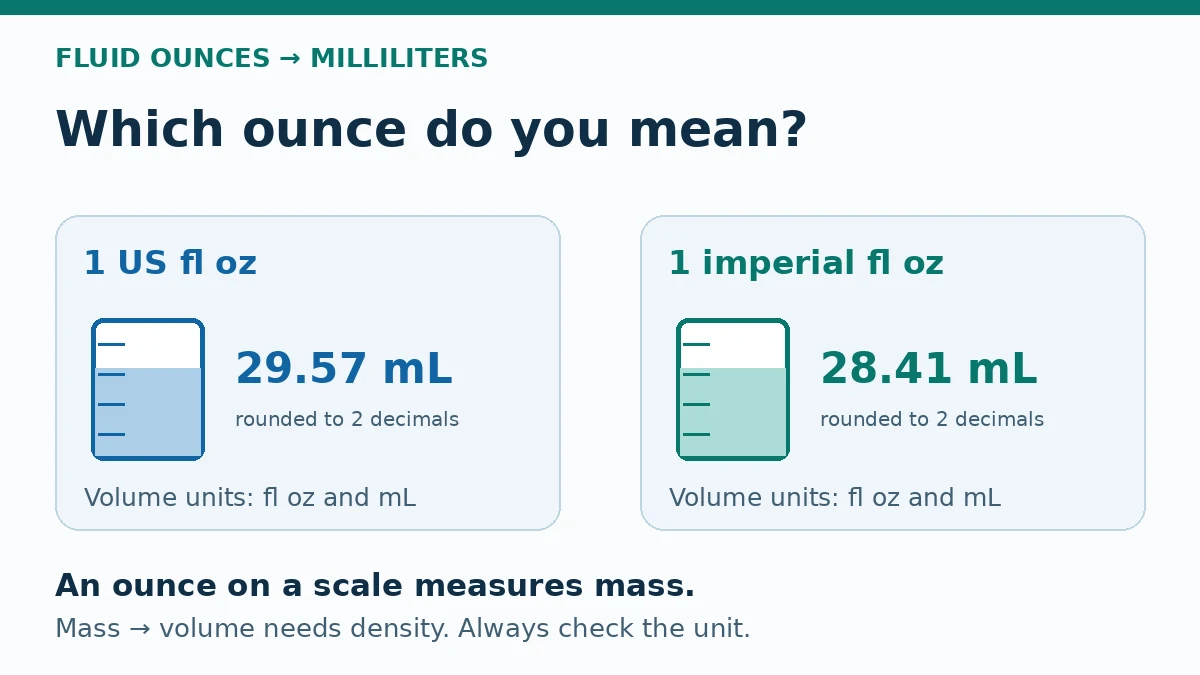
1 US fl oz = 29.5735295625 mL exactly. Multiply US fluid ounces by this factor. For imperial fluid ounces, use 28.4130625 mL per fl oz.
For example, 8 US fl oz ≈ 236.59 mL, while 8 imperial fl oz ≈ 227.30 mL.
“Oz” on a scale means mass; “fl oz” means volume. This calculator converts volume only. Check the original recipe or container before choosing US or imperial. If the system is unclear, use its printed mL amount rather than guessing.
How to use the calculator
- Enter the amount and choose the fluid-ounce system used by your source.
- Choose the displayed decimal places. The full factor is used before rounding.
- Read the answer and calculation steps. Results update as you type, or press Enter or the convert button.
mL to fl oz reverses the conversion. Recipe scale multiplies an original liquid amount by required servings ÷ original servings. All volume units retains the 14-unit converter for cups, spoons, pints, gallons, liters and cubic inches.
Presets supply common fluid-ounce amounts. Use result transfers the calculated value to the reverse mode without using the rounded display; Copy result copies the answer with its units. Reset restores that mode’s example. With a mode tab focused, use the arrow keys, Home or End to change modes.
Enter a finite number, including a decimal or scientific notation such as 1e-6. Amounts may be zero; serving counts must be positive. Blank, negative, nonnumeric or numerically out-of-range results show an error and clear the previous answer.
Exact conversion factors and formulas
US: mL = US fl oz × 29.5735295625
Imperial: mL = imperial fl oz × 28.4130625
Reverse: fl oz = mL ÷ the matching factor
Why these factors are exact
A US liquid gallon is exactly 231 cubic inches and contains 128 US fluid ounces. Since 1 inch = 2.54 cm and 1 cm³ = 1 mL, the factor is:
231 × 2.54³ ÷ 128 = 29.5735295625 mL
The imperial pint is exactly 568.26125 mL and contains 20 imperial fluid ounces:
568.26125 ÷ 20 = 28.4130625 mL
Check the units
For 8 US fl oz, multiply by 29.5735295625 mL per US fl oz. The US fl oz units cancel, leaving 236.5882365 mL. For the reverse question, divide by mL per fl oz so the result is in fluid ounces.
Recipe scaling
Scaled fl oz = original fl oz × (required servings ÷ original servings)
Convert the scaled amount with the same US or imperial factor. Keep the ratio unrounded until the final answer.
US Fluid Ounces vs UK Imperial Fluid Ounces
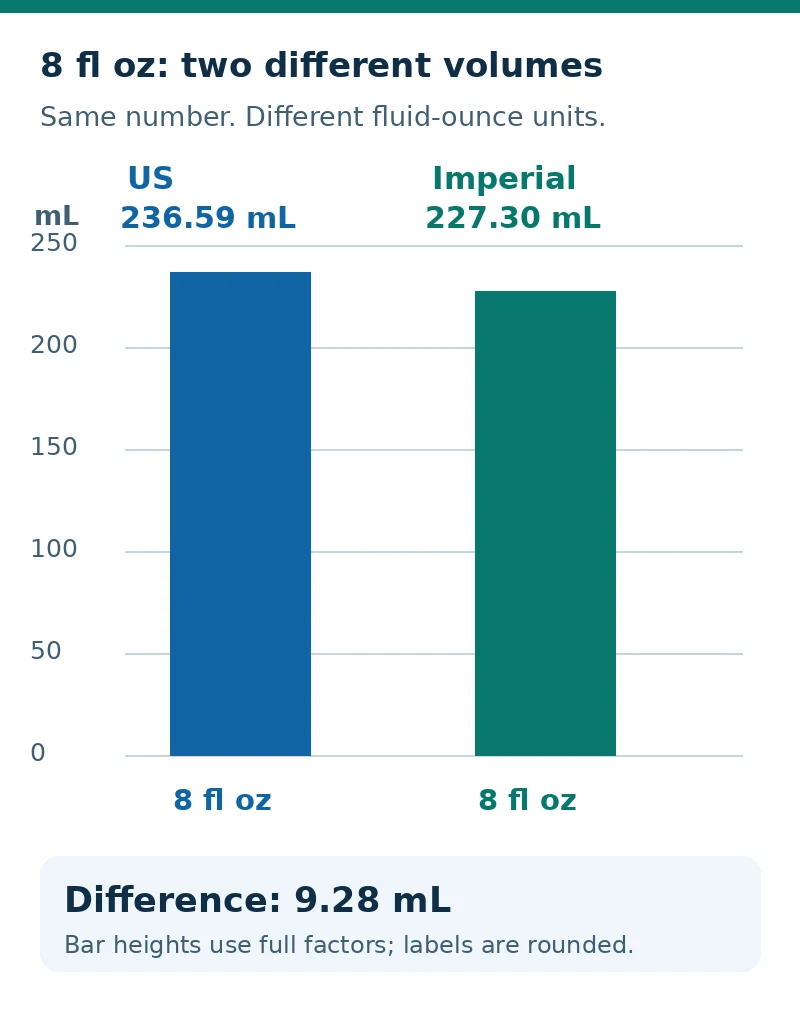
US and UK fluid ounces use the same abbreviation, fl oz, but they are different units. The US fluid ounce is approximately 4.08% larger than the imperial fluid ounce; the imperial unit is approximately 3.92% smaller than the US unit. The percentages use different starting volumes. That difference may look small at one ounce, yet it becomes more noticeable as the volume increases.
| Measurement | Milliliters | Relationship | Typical context |
|---|---|---|---|
| 1 US fluid ounce | 29.5735295625 mL | Larger fluid ounce | US recipes, labels, customary measuring tools |
| 1 UK imperial fluid ounce | 28.4130625 mL | About 3.92% smaller than a US fl oz | Imperial references and some older British recipes |
| 1 US cup | 236.5882365 mL | 8 US fl oz | US cooking measurements |
| 1 imperial pint | 568.26125 mL | 20 UK fl oz | UK imperial pint measure |
| 1 US liquid pint | 473.176473 mL | 16 US fl oz | US liquid measure |
At 1 fl oz, the difference between the two systems is 1.1604670625 mL. At 8 fl oz, the difference is approximately 9.2837365 mL. At 16 fl oz, the difference is approximately 18.567473 mL. At 32 fl oz, the difference is approximately 37.134946 mL. For a casual drink, this may not affect practical use. For a repeated recipe, nutrition calculation, technical process, or calibrated measurement, using the correct system matters.
How to identify the correct system
Look first at the country and context of the source. US package net-volume declarations and American recipes generally use customary US fluid ounces; Nutrition Facts serving sizes use the separate convention explained below. An older British cookbook or a source that explicitly says “imperial” means UK imperial fluid ounces. If a product lists both fl oz and mL, compare the printed pair: 8 US fl oz is usually paired with about 237 mL, while 8 imperial fl oz is about 227 mL.
Do not determine the system from the letters “oz” alone. Packaging may shorten “fluid ounces” to “fl oz,” and casual writing may omit “fl.” When the measurement appears beside a liquid product, the intended meaning is often volume, but the country-specific system still needs confirmation.
Why a US pint and an imperial pint differ
The difference is not limited to the fluid-ounce size. A US liquid pint contains 16 US fluid ounces, while an imperial pint contains 20 imperial fluid ounces. As a result, an imperial pint is about 568.26 mL and a US liquid pint is about 473.18 mL. This is why converting a pint by assuming only the fluid-ounce factor can be misleading unless the pint system is also identified.
Practical rule: Choose the system identified by the source. If it is ambiguous, use the printed metric amount or clarify the unit before converting.
Fluid Ounces to mL Conversion Table
The table below converts common fluid-ounce amounts from both US and imperial fluid ounces into milliliters. The US column applies to customary US liquid measurements. Nutrition Facts serving sizes use the separate 30 mL convention explained below. The UK column applies to imperial fluid ounces. Values are rounded to two decimal places for readability, while the calculator can display additional decimal places when needed.
| Fluid ounces | US fl oz to mL | UK fl oz to mL | US value in liters |
|---|---|---|---|
| 0.25 fl oz | 7.39 mL | 7.10 mL | 0.0074 L |
| 0.5 fl oz | 14.79 mL | 14.21 mL | 0.0148 L |
| 1 fl oz | 29.57 mL | 28.41 mL | 0.0296 L |
| 1.5 fl oz | 44.36 mL | 42.62 mL | 0.0444 L |
| 1.7 fl oz | 50.28 mL | 48.30 mL | 0.0503 L |
| 2 fl oz | 59.15 mL | 56.83 mL | 0.0591 L |
| 2.5 fl oz | 73.93 mL | 71.03 mL | 0.0739 L |
| 3 fl oz | 88.72 mL | 85.24 mL | 0.0887 L |
| 3.4 fl oz | 100.55 mL | 96.60 mL | 0.1006 L |
| 4 fl oz | 118.29 mL | 113.65 mL | 0.1183 L |
| 4.2 fl oz | 124.21 mL | 119.33 mL | 0.1242 L |
| 5 fl oz | 147.87 mL | 142.07 mL | 0.1479 L |
| 6 fl oz | 177.44 mL | 170.48 mL | 0.1774 L |
| 7 fl oz | 207.01 mL | 198.89 mL | 0.2070 L |
| 8 fl oz | 236.59 mL | 227.30 mL | 0.2366 L |
| 9 fl oz | 266.16 mL | 255.72 mL | 0.2662 L |
| 10 fl oz | 295.74 mL | 284.13 mL | 0.2957 L |
| 11 fl oz | 325.31 mL | 312.54 mL | 0.3253 L |
| 12 fl oz | 354.88 mL | 340.96 mL | 0.3549 L |
| 16 fl oz | 473.18 mL | 454.61 mL | 0.4732 L |
| 17 fl oz | 502.75 mL | 483.02 mL | 0.5028 L |
| 18 fl oz | 532.32 mL | 511.44 mL | 0.5323 L |
| 20 fl oz | 591.47 mL | 568.26 mL | 0.5915 L |
| 22 fl oz | 650.62 mL | 625.09 mL | 0.6506 L |
| 24 fl oz | 709.76 mL | 681.91 mL | 0.7098 L |
| 25 fl oz | 739.34 mL | 710.33 mL | 0.7393 L |
| 28 fl oz | 828.06 mL | 795.57 mL | 0.8281 L |
| 30 fl oz | 887.21 mL | 852.39 mL | 0.8872 L |
| 32 fl oz | 946.35 mL | 909.22 mL | 0.9464 L |
| 40 fl oz | 1,182.94 mL | 1,136.52 mL | 1.1829 L |
| 64 fl oz | 1,892.71 mL | 1,818.44 mL | 1.8927 L |
| 128 fl oz | 3,785.41 mL | 3,636.87 mL | 3.7854 L |
How to read the table
Find the fluid-ounce amount in the first column and then use the column that matches the measurement system. For example, 3.4 US fl oz equals approximately 100.55 mL. This value is frequently encountered on travel-size liquid containers because 3.4 US fl oz is close to 100 mL. By contrast, 3.4 imperial fl oz equals approximately 96.60 mL.
8 US fl oz = 1 US customary cup ≈ 236.59 mL. 16 US fl oz = 1 US liquid pint ≈ 473.18 mL. 32 US fl oz = 1 US liquid quart ≈ 946.35 mL. The customary-unit relationships are exact; the mL values here are rounded. These relationships are useful when a recipe or container switches between fluid ounces and larger US customary units.
The table rounds only the displayed answer. The conversion should be performed with the full factor first and rounded after multiplication. This prevents cumulative error. For example, using 29.57 instead of 29.5735295625 for a 128 fl oz gallon produces a small discrepancy. That may be irrelevant in casual use, but there is no reason to introduce the discrepancy when a calculator can retain the full factor.
Milliliters to Fluid Ounces Conversion Table
Use this reverse table when the original amount is printed in milliliters. The US and UK outputs are rounded to three decimal places so that small differences remain visible. For a practical kitchen measurement, one or two decimal places are usually sufficient.
| Milliliters | mL to US fl oz | mL to UK fl oz |
|---|---|---|
| 1 mL | 0.034 US fl oz | 0.035 UK fl oz |
| 5 mL | 0.169 US fl oz | 0.176 UK fl oz |
| 10 mL | 0.338 US fl oz | 0.352 UK fl oz |
| 15 mL | 0.507 US fl oz | 0.528 UK fl oz |
| 30 mL | 1.014 US fl oz | 1.056 UK fl oz |
| 50 mL | 1.691 US fl oz | 1.760 UK fl oz |
| 60 mL | 2.029 US fl oz | 2.112 UK fl oz |
| 100 mL | 3.381 US fl oz | 3.520 UK fl oz |
| 120 mL | 4.058 US fl oz | 4.223 UK fl oz |
| 150 mL | 5.072 US fl oz | 5.279 UK fl oz |
| 200 mL | 6.763 US fl oz | 7.039 UK fl oz |
| 236.59 mL | 8.000 US fl oz | 8.327 UK fl oz |
| 250 mL | 8.454 US fl oz | 8.799 UK fl oz |
| 300 mL | 10.144 US fl oz | 10.559 UK fl oz |
| 330 mL | 11.159 US fl oz | 11.614 UK fl oz |
| 350 mL | 11.835 US fl oz | 12.318 UK fl oz |
| 354.88 mL | 12.000 US fl oz | 12.490 UK fl oz |
| 375 mL | 12.680 US fl oz | 13.198 UK fl oz |
| 473.18 mL | 16.000 US fl oz | 16.654 UK fl oz |
| 500 mL | 16.907 US fl oz | 17.598 UK fl oz |
| 568.26 mL | 19.215 US fl oz | 20.000 UK fl oz |
| 750 mL | 25.361 US fl oz | 26.396 UK fl oz |
| 946.35 mL | 32.000 US fl oz | 33.307 UK fl oz |
| 1,000 mL | 33.814 US fl oz | 35.195 UK fl oz |
Several metric package sizes do not correspond to a whole number of fluid ounces. A 250 mL bottle is approximately 8.45 US fl oz. A 330 mL can is approximately 11.16 US fl oz. A 500 mL bottle is approximately 16.91 US fl oz. A 750 mL bottle is approximately 25.36 US fl oz. A 1 liter container is approximately 33.81 US fl oz.
When comparing products, it is often better to retain the printed metric value instead of forcing it into a rounded fluid-ounce amount. Conversion is helpful for understanding scale, but product labels, recipes, and calibrated tools should be followed in the unit they actually specify whenever possible.
Worked examples: conversion, reverse and scaling
1. A small US measurement: 1.5 fl oz
1.5 × 29.5735295625 = 44.36029434375 mL. To two decimal places, the answer is 44.36 mL.
2. The same number in a different system: 8 fl oz
US: 8 × 29.5735295625 = 236.5882365 mL, or 236.59 mL rounded. Imperial: 8 × 28.4130625 = 227.3045 mL, or 227.30 mL rounded. The difference is 9.2837365 mL.
3. Convert 250 mL back to US fluid ounces
250 ÷ 29.5735295625 ≈ 8.453505675 US fl oz. The two-decimal answer is 8.45 US fl oz. Using the imperial divisor gives approximately 8.80 imperial fl oz.
4. Scale 12 US fl oz from 4 servings to 6
The multiplier is 6 ÷ 4 = 1.5. The new amount is 12 × 1.5 = 18 US fl oz. Then 18 × 29.5735295625 = 532.323532125 mL, or 532.32 mL rounded. This scales a liquid ingredient, not a medication dose.
5. Is 3.4 US fl oz exactly 100 mL?
No: 3.4 × 29.5735295625 = 100.5500005125 mL. Conversely, 100 mL ≈ 3.3814 US fl oz. Familiar rounded package labels are not exact mathematical equalities.
Try it yourself
- Convert 4 US fl oz to mL, to two decimal places.
- Convert 20 imperial fl oz to mL, to two decimal places.
- A recipe uses 6 US fl oz for 2 servings. How many mL are needed for 5 servings?
Show answers and checks
1. 4 × 29.5735295625 = 118.29411825 → 118.29 mL.
2. 20 × 28.4130625 = 568.26125 → 568.26 mL, one imperial pint.
3. 6 × (5 ÷ 2) = 15 US fl oz; 15 × 29.5735295625 = 443.6029434375 → 443.60 mL.
Rounding and numerical precision
Exact units do not make every displayed answer exact. The conversion factors are exact definitions. The interactive calculator uses standard JavaScript floating-point arithmetic, displays a rounded main result, and shows a higher-precision value with up to 14 significant digits. Reverse conversions often have nonterminating decimals.
Decimal places control the displayed rounding, not the precision of the original measurement. Two decimal places are useful for comparing answers; a measuring jug with coarse markings cannot deliver that level of physical accuracy. Keep the full factor during multi-step arithmetic and round at the end.
Very large values and small positive values that would round to zero are displayed in scientific notation. In that format the setting controls digits after the decimal in the coefficient. Calculations beyond the browser’s finite numerical range are rejected rather than showing a misleading answer.
For example, 8 US fl oz is 236.5882365 mL: 237 mL to zero decimals, 236.6 mL to one, and 236.59 mL to two. The US customary approximation of 30 mL per fl oz is about 1.44% high; it is useful for a rough check, not an exact customary conversion.
Cooking: cups, spoons and scaling
Fluid ounces and mL both measure volume, so the conversion is the same for water, milk or oil. Their masses differ; density is needed only when changing between mass and volume.
- 1 US customary cup = 8 US fl oz = 236.5882365 mL.
- 1 US tablespoon = ½ US fl oz = 14.78676478125 mL.
- 1 US teaspoon = ⅙ US fl oz = 4.92892159375 mL.
- The calculator’s metric cup is 250 mL. Do not assume every recipe’s cup or spoon uses the same standard.
For a liquid ingredient, multiply by new servings ÷ original servings. A 5 US fl oz amount scaled from 3 to 8 portions becomes 13⅓ US fl oz, approximately 394.31 mL. Avoid rounding the 8 ÷ 3 ratio before converting.
Use the cooking conversion calculator for other kitchen units. If the recipe gives an ingredient by weight, use a scale, or a grams-to-mL conversion with a suitable density.
Why a label can show a different mL number
A customary 12 US fl oz volume is 354.88235475 mL, which rounds to 355 mL. Similarly, 1.7 US fl oz ≈ 50.28 mL and 3.4 US fl oz ≈ 100.55 mL. Printed pairs may use rounded or nominal amounts; the calculator does not measure a container’s actual fill.
US Nutrition Facts exception: FDA nutrition-label serving sizes use 30 mL per fl oz. This calculator uses customary US fluid ounces, not that labeling convention. For nutrition comparisons, use the serving size in mL printed on the label. Under the labeling convention, 8 fl oz corresponds to 240 mL.
Package size and serving size can differ. Compare nutrients for the same printed serving volume before comparing bottles. For travel, check the current official rules and labeled container capacity; a rounded fl oz conversion is not a guarantee of acceptance.
Fluid ounces vs ounces by weight
Fluid ounce (fl oz): volume. Ounce (oz) on a scale: mass. A kitchen scale cannot supply a fluid-ounce measurement merely by showing “oz.” Even for water, the units are not interchangeable.
One avoirdupois ounce is exactly 28.349523125 grams. To obtain mL from a mass, you also need the substance’s density at the relevant conditions:
Volume (mL) = mass (g) ÷ density (g/mL)
There is no single oz-to-mL factor for flour, honey, oil and other substances. Confirm whether a recipe’s ambiguous “oz” is mass or volume instead of deciding from the ingredient alone.
For mass conversions, use the weight converter or ounces-to-pounds calculator. For a mass–volume relationship, use a density calculator.
Measure the liquid, not just the calculation
- Use a suitable graduated vessel on a level surface and read the liquid at eye level. Follow the vessel’s instructions for reading the meniscus.
- Choose markings fine enough for the amount: a large jug is a poor tool for a tiny volume.
- Foam and liquid left clinging to a vessel can affect the amount transferred.
- Record the system with the number: US fl oz, imperial fl oz or mL.
Medication caution: This is an educational volume converter, not a dosing tool. Follow the medicine label and your clinician or pharmacist’s instructions. Use the recommended calibrated dosing device, not a household spoon.
A quick reasonableness check
For US customary fluid ounces, multiply by about 30: 8 fl oz is roughly 240 mL and 16 fl oz roughly 480 mL. The exact-factor answers, 236.59 mL and 473.18 mL rounded, are slightly lower.
For imperial fluid ounces, use about 28.4: 20 fl oz is roughly 568 mL. For the reverse US estimate, divide mL by 30. An estimate helps catch a misplaced decimal or the wrong unit; use the full factor for the final calculation.
Common conversion mistakes
- Missing “fl”: an ounce from a scale needs density before it can become mL.
- Wrong system: 8 US and 8 imperial fl oz are different volumes.
- Wrong direction: multiply fl oz by mL per fl oz; divide mL by that factor.
- Premature rounding: do not round the factor or serving ratio at each step.
- Wrong cup: US customary, metric and nutrition-label conventions differ.
- False precision: more decimal places cannot improve the original measurement.
- Assuming every 30 mL statement means the same thing: it is an approximation for customary US fl oz but a specified nutrition-label convention.
Frequently asked questions
How many mL are in 1 US fluid ounce?
One US customary fluid ounce equals exactly 29.5735295625 mL, approximately 29.57 mL.
How many mL are in 1 imperial fluid ounce?
One imperial fluid ounce equals exactly 28.4130625 mL, approximately 28.41 mL.
Is 8 oz the same as 250 mL?
If you mean 8 US fl oz, it is approximately 236.59 mL. Eight imperial fl oz is approximately 227.30 mL. A 250 mL metric cup is different from either amount.
Is 1 oz equal to 30 mL?
A customary US fluid ounce is 29.5735295625 mL, so 30 mL is an approximation. Separately, FDA nutrition-label serving sizes use a 30 mL per fl oz convention. An ounce by mass needs density before it can be converted to mL.
How do I convert mL to US fl oz?
Divide mL by 29.5735295625. For example, 250 mL is approximately 8.4535 US fl oz. Choose the mL to fl oz tab for the reverse calculation.
Does the conversion depend on the liquid?
Not for fl oz to mL: both are volume units. Density matters when converting mass, such as grams or ounces by weight, into volume.
Why does a very small result use scientific notation?
Scientific notation preserves a positive value that would otherwise round to zero at the selected decimal setting. For example, 2.96e-7 mL means 0.000000296 mL.
Can I use this to calculate a medicine dose?
No. It explains volume units only. Use the medicine label and the instructions and dosing device recommended by your clinician or pharmacist.
Measurement Note
This converter is intended for general calculation, education, cooking, and product comparison. For medication dosing, laboratory procedures, regulated labeling, manufacturing, or safety-critical work, follow the applicable instructions and use calibrated equipment.
Sources & References
Definitions and conversion conventions checked October 3, 2026. Exact factors are derived from the unit definitions; the live calculator uses floating-point arithmetic.
- NIST Handbook 44 (2026), Appendix C — exact US gallon, fluid-ounce and inch relationships used in the US derivation.
- NIST SP 811, Appendix B.8 — distinguishes US fluid ounces, imperial fluid ounces and mass ounces; listed factors are rounded.
- UK Weights and Measures Act 1985, Schedule 1 — imperial pint and fluid-ounce definitions.
- 21 CFR 101.9(b)(5)(viii) — 30 mL per fl oz convention for US nutrition labeling.
- NIST: SI units for volume — liters, milliliters and cubic units.