Liters to Kilograms Calculator
kg = liters × density in kg/L. Choose a material or enter your own density. For water, 1 L is about 1 kg; oil, milk and honey give different answers. Switch direction to convert kilograms back to liters.
Convert Between Liters and Kilograms
Choose a direction, enter the amount, then select a material or supply its density. Use the density and volume at the same temperature and physical state. Presets are estimates; for a measured product, choose Custom density. The calculator applies the density you enter and does not calculate temperature corrections.
Quick Answer: How Many Kilograms Are in a Liter?
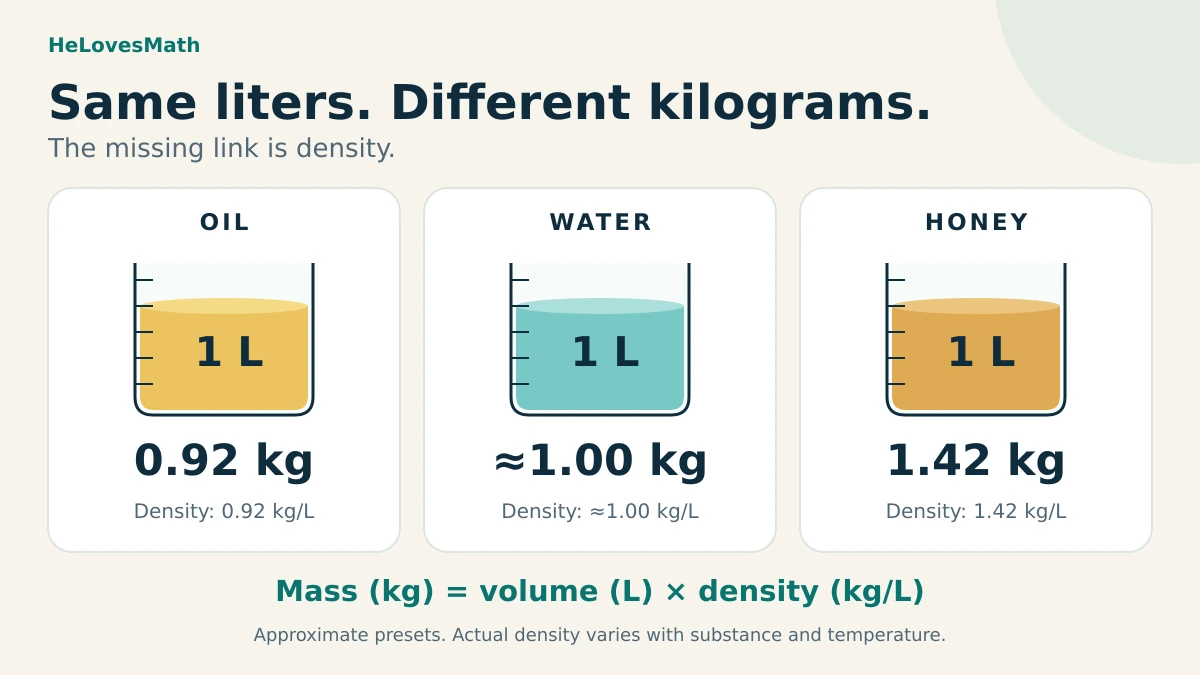
There is no universal number of kilograms in one liter. Convert liters to kilograms by multiplying the volume by the density of the material:
For everyday water calculations, density is commonly approximated as 1 kg/L, so 1 L of water is about 1 kg, 5 L is about 5 kg, and 20 L is about 20 kg. For another material, the result changes. At a density of 0.92 kg/L, 10 L of vegetable oil is about 9.2 kg. At 1.42 kg/L, 10 L of honey is about 14.2 kg.
A liter describes occupied space; a kilogram describes mass. The calculator connects those quantities through density. This distinction is the central idea behind every correct L-to-kg calculation. A direct numerical shortcut is valid only when the material and its density are known. Even water is not exactly 1 kg/L under every condition because temperature, dissolved substances, and pressure can alter density.
The fastest practical method is to choose the material preset, confirm that its approximate density fits your use case, enter the volume, and calculate. For ordinary household estimates, two decimal places are normally sufficient. For laboratory, manufacturing, commercial, or safety-related work, use a measured or documented density for the exact product and condition rather than relying on a broad preset.
How to Use the Liters to Kilograms Calculator
The calculator handles two related operations. In liters-to-kilograms mode, it converts an entered volume to liters, converts the density to kg/L, and multiplies the two values. In kilograms-to-liters mode, it converts an entered mass to kilograms and divides by density. The result updates as you type, and Calculate conversion repeats the calculation. Zero volume or mass is valid; density must be greater than zero.
- Select the direction. Choose liters to kilograms when you know volume and need mass. Choose kilograms to liters when you know mass and need volume.
- Enter the amount. The forward mode accepts liters, milliliters, cubic meters, US gallons, imperial gallons, US quarts, and US cups. The reverse mode accepts kilograms, grams, pounds, and metric tonnes.
- Choose a material. Presets supply a practical reference density and explain why the value may vary. The water presets deliberately distinguish the everyday 1.000 kg/L shortcut from a room-temperature estimate.
- Confirm density. Select custom density when you have data from a product specification, safety data sheet, laboratory measurement, engineering document, or supplier certificate.
- Select the density unit. The tool accepts kg/L, g/mL, kg/m³, g/L, lb/US gal, and lb/ft³, then normalizes the input internally.
- Calculate and review the steps. The result panel displays kilograms, liters, grams, pounds, metric tonnes, the normalized density, and a concise equation trail.
The quick-value buttons set common liter amounts without changing the material. Copy result copies a valid result and its equation. Reset restores 10 L of water at the everyday 1 kg/L approximation. Very small nonzero values use scientific notation when ordinary rounding would hide them; for example, 1e-7 means 0.0000001.
Do not interpret a long decimal output as proof of high accuracy. The result can be no more reliable than the volume and density inputs. For example, displaying six decimal places does not improve a flour conversion based on an uncertain loose bulk-density estimate. The decimal control changes presentation, not the quality of the source data.
Liters and Kilograms Measure Different Physical Quantities
A liter (L) is a unit of volume. It expresses how much three-dimensional space a material occupies. A kilogram (kg) is a unit of mass. It expresses the quantity of matter in the material. These are not interchangeable unit families. Converting between them requires a physical property that connects mass and volume: density.
The distinction becomes obvious when equal-sized containers hold different materials. A one-liter bottle filled with vegetable oil weighs less than the same bottle filled with water. A one-liter container of honey weighs more. The external volume is unchanged, but the amount of mass packed into that volume differs. Density quantifies this difference.
In SI usage, the cubic meter is the derived unit of volume, while the liter is accepted for use with SI and equals one cubic decimeter. Therefore:
The kilogram is the SI unit of mass. A kilogram is not defined as “one liter of water” in the modern SI. The historical association between water, liters, and kilograms helps explain the familiar everyday shortcut, but contemporary unit definitions and precision work do not treat that shortcut as a universal identity.
Another important distinction is between mass and weight. In everyday language, people often say a liquid “weighs 10 kg.” Strictly, kilograms express mass, while weight is a force caused by gravity and is measured in newtons. For normal shopping, cooking, transport, and storage conversations, “weight in kilograms” is commonly understood, but scientific writing should preserve the distinction.
This calculator converts volume and mass; it does not calculate the force of weight under a specified gravitational acceleration. It also does not automatically include packaging. A five-liter container holding water contains roughly five kilograms of water, but the full item may weigh more because the bottle, cap, handle, label, crate, and pallet contribute additional mass.
Liters to Kilograms Formula
Density is defined as mass divided by volume. The standard symbol for density is the Greek letter rho, written as ρ.
Rearranging the equation to solve for mass gives:
When volume is expressed in liters and density is expressed in kilograms per liter, the unit arithmetic produces kilograms directly:
Suppose a tank contains 75 L of a liquid whose density is 0.86 kg/L. The mass is:
If density is supplied in kg/m³, convert it to kg/L first by dividing by 1000. A density of 860 kg/m³ becomes 0.860 kg/L. The same calculation then produces 64.5 kg. Alternatively, convert liters to cubic meters and work entirely in SI base-derived units: 75 L is 0.075 m³, and 0.075 m³ × 860 kg/m³ is again 64.5 kg.
For reverse conversion, solve the density equation for volume:
If 64.5 kg of the same liquid is available, dividing by 0.86 kg/L gives 75 L. Forward and reverse calculations are mathematical inverses as long as the same density and consistent units are used.
Dimensional check: writing units beside each value is one of the best ways to catch mistakes. If the units do not cancel to kg in a forward conversion or L in a reverse conversion, the setup is incomplete or inconsistent.
Density Units and How the Calculator Normalizes Them
Density appears in several units depending on the industry, country, scale, and source document. The calculator converts each supported density input into kg/L before applying the formula. Understanding the relationships helps you audit results and spot factor-of-1000 errors.
kg/L and g/mL
Kilograms per liter and grams per milliliter have the same numerical value. One gram is one-thousandth of a kilogram, and one milliliter is one-thousandth of a liter. Because both numerator and denominator change by the same factor, the ratio remains unchanged.
Therefore, ethanol listed as 0.789 g/mL can be entered as 0.789 kg/L without changing the number.
kg/m³
Kilograms per cubic meter is the coherent SI density unit. Since 1 m³ contains 1000 L, divide kg/m³ by 1000 to obtain kg/L.
For example, 998.2 kg/m³ becomes 0.9982 kg/L. Reversing the conversion, multiply kg/L by 1000.
g/L
Grams per liter is common for some solutions and material data. Divide by 1000 because 1000 g equals 1 kg. A density of 920 g/L is 0.920 kg/L.
Volume-unit conventions: this tool uses the US liquid gallon (3.785411784 L), imperial gallon (4.54609 L), US liquid quart (0.946352946 L) and US customary cup (236.5882365 mL). A 240 mL labeling cup or 250 mL metric cup is different: enter its milliliter volume directly.
lb/US gal
Pounds per US gallon is common in American product and engineering documents. The calculator uses exact unit-conversion constants for the pound and US gallon, resulting in approximately 0.119826427 kg/L for each 1 lb/US gal. A value of 8.34 lb/US gal is therefore close to 1 kg/L.
lb/ft³
Pounds per cubic foot appears in engineering and bulk-material tables. One lb/ft³ is approximately 0.016018463 kg/L. Always confirm whether a source means mass pounds rather than pound-force and whether the gallon is US or imperial.
| Entered density unit | Conversion to kg/L | Example |
|---|---|---|
| kg/L | No change | 0.92 kg/L = 0.92 kg/L |
| g/mL | No numerical change | 0.92 g/mL = 0.92 kg/L |
| kg/m³ | Divide by 1000 | 920 kg/m³ = 0.92 kg/L |
| g/L | Divide by 1000 | 920 g/L = 0.92 kg/L |
| lb/US gal | Multiply by about 0.119826427 | 7.68 lb/US gal ≈ 0.920 kg/L |
| lb/ft³ | Multiply by about 0.016018463 | 57.43 lb/ft³ ≈ 0.920 kg/L |
How to Choose the Correct Density
Selecting density is the most important decision in an L-to-kg conversion. Arithmetic can be flawless while the answer remains unsuitable because the density belongs to the wrong material, temperature, concentration, or physical state. A useful density value should match what is actually inside the container.
Use the exact product specification when available
For a manufactured liquid, chemical, coating, cleaning product, adhesive, lubricant, fuel, food concentrate, or process solution, begin with the supplier’s technical data sheet, certificate of analysis, safety data sheet, or tested batch record. Product-specific information is normally better than a broad internet table because commercial formulations may contain multiple components.
Match temperature and concentration
A density listed at 15 °C should not automatically be treated as identical to density at 40 °C. Likewise, pure ethanol and an ethanol-water mixture do not have the same density. Sugar syrups, brines, acids, dairy products, and concentrates can change considerably as concentration changes.
Distinguish true density from bulk density
For a liquid, density generally describes mass per occupied liquid volume. For flour, rice, salt, pellets, seeds, powders, and granules, a liter includes spaces between particles. A practical container calculation therefore uses bulk density, not the true density of the solid material itself. Bulk density depends on whether the material is loose, tapped, vibrated, compacted, aerated, or settled.
Check the basis of the value
Specific gravity (relative density) is a unitless ratio, not a density unit. For a liquid referenced to water, use material density = specific gravity × reference-water density, with the stated temperatures. For example, a specific gravity of 0.92 relative to water at 20 °C gives approximately 0.92 × 0.9982 = 0.918344 kg/L. Enter that converted density in Custom density; the shortcut 0.92 kg/L assumes reference water is 1 kg/L.
Measure density when documentation is unavailable
A basic practical method is to weigh a known volume. First determine the empty vessel mass. Add a measured volume of material, weigh again, subtract the tare mass, and divide net mass by volume. Keep units consistent. If 500 mL of liquid has a net mass of 460 g, its density is 460 g ÷ 500 mL = 0.92 g/mL, which is also 0.92 kg/L.
For a dedicated calculation of density from measured mass and volume, use the density calculator. Once the density is known, return here to convert any required batch volume or mass.
Liters of Water to Kilograms
Water creates the familiar idea that liters and kilograms are interchangeable. For routine household planning, the approximation is convenient:
Using that approximation, the numerical value does not change: 2 L is about 2 kg, 10 L is about 10 kg, and 1000 L is about 1000 kg or one metric tonne. This is useful for estimating drinking-water containers, aquarium fills, emergency storage, irrigation loads, cleaning water, and tank capacity.
At 20 °C and ordinary atmospheric pressure, pure water is approximately 0.9982 kg/L. NIST water-density calibration data support this rounded value. Select the Water near 20 °C preset: 100 L × 0.9982 kg/L = 99.82 kg. The 0.18 kg difference from the everyday shortcut can matter when you scale up. This preset does not automatically correct for other temperatures.
Dissolved material also changes density. Seawater is denser than fresh water because dissolved salts add mass. A typical seawater estimate of 1.025 kg/L gives 102.5 kg for 100 L. Brine can be denser still, depending on concentration. Above about 4 °C, warming liquid water at ordinary pressure generally lowers its density. Near freezing, water behaves differently, so do not extrapolate a room-temperature trend across all temperatures.
When estimating the load of a water tank, include the tank structure and accessories. A nominal 1000 L tank containing water may hold about one tonne of water, but the supporting floor, frame, trailer, roof, or platform must carry the combined mass of water, tank, pipes, fittings, pumps, and any safety margin required by the design. Structural decisions should not rely solely on a general-purpose calculator.
| Water volume | At 1.000 kg/L | At 0.9982 kg/L | Typical use |
|---|---|---|---|
| 1 L | 1.000 kg | 0.9982 kg | Bottle or measuring jug |
| 5 L | 5.000 kg | 4.991 kg | Household container |
| 10 L | 10.000 kg | 9.982 kg | Bucket or can |
| 20 L | 20.000 kg | 19.964 kg | Large portable container |
| 100 L | 100.000 kg | 99.820 kg | Small storage tank |
| 1000 L | 1000.000 kg | 998.200 kg | Intermediate bulk volume |
Liters to Kilograms for Milk, Oil, Honey, Glycerin, and Other Liquids
Liquid materials are generally easier to convert than loose solids because their volume is less dependent on air gaps and packing. Even so, composition and temperature matter. The presets are practical reference values, not certificates for every product.
Milk
Milk is generally denser than water because of its non-fat solids, including proteins, lactose and minerals; milk fat is less dense than water. The FAO reports normal milk density around 1.028–1.033 g/mL at 15 °C. The preset uses an approximate 1.03 kg/L, giving 10.3 kg for 10 L. Fat content, solids, temperature and formulation change the value, so cream, condensed milk and milk-based drinks need their own density.
Vegetable oil and olive oil
Many cooking oils are less dense than water. Using 0.92 kg/L, 10 L of vegetable oil is 9.2 kg. Using 0.91 kg/L, 10 L of olive oil is 9.1 kg. This difference explains why oil floats on water and why a liter bottle of oil has less liquid mass than a liter bottle of water. Product type and temperature can shift the density, so commercial filling calculations should use the manufacturer’s data.
Honey
Honey contains a high concentration of sugars and is substantially denser than water. At a typical estimate of 1.42 kg/L, 5 L is about 7.1 kg and 20 L is about 28.4 kg. Honey density varies with moisture content and temperature. Warm honey flows more easily and expands, while composition differs between batches and botanical sources. For packaging, the net labeled mass should be verified by weighing rather than inferred only from nominal container volume.
Glycerin
Glycerin-rich material is dense compared with water. Using 1.26 kg/L, a 25 L container contains about 31.5 kg of material before packaging is added. Water content and purity matter, so a diluted glycerin solution needs its own density. Viscosity does not directly determine density: a liquid can be highly viscous without having the same density as another thick liquid.
Ethanol and solvent mixtures
Pure or nearly pure ethanol is less dense than water. At 0.789 kg/L, 10 L is approximately 7.89 kg. An ethanol-water mixture will have a different density, and the relationship is not always captured accurately by a simple weighted average because mixing can change total volume. Use concentration-specific data for laboratory or production calculations.
Syrups, juices, concentrates, and sauces
These products may range from near-water density to much denser formulations. Sugar concentration, suspended solids, pulp, salt, fat, temperature, and entrained air can all affect mass per liter. A generic “syrup density” is not reliable across maple syrup, glucose syrup, fruit concentrate, flavored beverage syrup, and pharmaceutical syrup. Custom density is the correct choice when the label or specification provides a value.
| Liquid | Reference density | 1 L | 10 L | 100 L |
|---|---|---|---|---|
| Water, everyday approximation | 1.000 kg/L | 1.00 kg | 10.00 kg | 100.00 kg |
| Milk, typical | 1.030 kg/L | 1.03 kg | 10.30 kg | 103.00 kg |
| Vegetable oil, typical | 0.920 kg/L | 0.92 kg | 9.20 kg | 92.00 kg |
| Olive oil, typical | 0.910 kg/L | 0.91 kg | 9.10 kg | 91.00 kg |
| Honey, typical | 1.420 kg/L | 1.42 kg | 14.20 kg | 142.00 kg |
| Glycerin, typical | 1.260 kg/L | 1.26 kg | 12.60 kg | 126.00 kg |
| Ethanol, typical | 0.789 kg/L | 0.789 kg | 7.89 kg | 78.90 kg |
Converting Liters of Flour, Sugar, Rice, Salt, Powders, and Grains to Kilograms
A dry material can be measured in liters because liters describe volume, not “liquidness.” However, a liter of powder or grain includes both solid particles and spaces between them. The relevant property is usually bulk density: the mass of a bulk quantity divided by the total volume it occupies, including voids.
Why bulk density changes
Bulk density can change without changing the chemical identity of the material. Sifted flour is aerated and may occupy more volume than settled flour. A bag that has been transported and vibrated may become more compact. Fine salt crystals can pack differently from coarse crystals. Rice varieties have different grain shapes. Moisture adds mass and can alter particle behavior. A scoop can compress powder against the container wall.
This variability means a preset should be treated as a planning estimate. For recipes, a kitchen scale is usually more reliable. For warehousing, hopper design, packaging, pneumatic conveying, silo capacity, or commercial transactions, obtain a tested loose, tapped, or compacted bulk density that matches the actual process.
Flour
The calculator uses 0.53 kg/L as a loose all-purpose flour estimate. At that value, 1 L is about 0.53 kg and 10 L is about 5.3 kg. A tightly packed liter can be heavier, while freshly sifted flour can be lighter. Recipe conventions such as “spoon and level” exist precisely because a volume cup of flour is sensitive to measuring technique.
Granulated sugar
A typical loose estimate of 0.85 kg/L gives 8.5 kg for 10 L. Crystal size, humidity, settling, and whether the sugar is granulated, caster, powdered, or brown all matter. Powdered sugar contains more air and may include anti-caking ingredients; brown sugar is often intentionally packed in recipes. These products should not share one density.
Rice
Using 0.85 kg/L, 20 L of uncooked rice is approximately 17 kg. Grain variety, broken-grain fraction, moisture, and vibration affect the result. Cooked rice is a different material because it absorbs water and expands, so an uncooked-rice density cannot be used for cooked volume.
Salt
A typical loose table-salt estimate of 1.20 kg/L gives 12 kg for 10 L. Fine table salt, coarse sea salt, rock salt, and industrial salts pack differently. Dissolved salt is no longer a dry bulk material; a brine conversion requires the density of the complete solution at its concentration and temperature.
Pellets, seeds, cement, sand, and soil
The same principles apply beyond food. Wood pellets, plastic resin pellets, animal feed, seeds, cement powder, sand, gravel, soil, fertilizer, and pharmaceutical powders have process-specific bulk densities. Moisture and compaction can cause large variations. Never substitute true mineral density for bulk density when estimating how many kilograms fit in a bin or container.
Practical method: weigh an empty container, fill it to a known volume using the same handling method used in practice, weigh again, and divide net mass by volume. Repeat several times and use an appropriate average if the material is variable.
Fuel, Solvent, Lubricant, and Industrial Liters-to-Kilograms Calculations
Volume-to-mass conversion is common in fuel handling, chemical processing, coatings, agriculture, transport, and storage. The stakes can be higher than in household use because a small density difference multiplied by thousands of liters can create a substantial mass difference.
Gasoline
The 0.74 kg/L gasoline preset is a broad planning estimate. At that value, 100 L is 74 kg and 1000 L is 740 kg. Actual density varies with hydrocarbon composition, octane grade, oxygenates, seasonal formulation, and temperature. Commercial transactions and transport documents should use the applicable measured or standardized value.
Diesel fuel
Using 0.84 kg/L, 100 L is approximately 84 kg and 1000 L is approximately 840 kg. Different diesel grades, biodiesel blends, and temperatures can produce different results. A supplier density at a stated reference temperature is preferable to a generic table.
Lubricants and hydraulic fluids
Lubricating oils often have densities below water, but viscosity grade does not uniquely determine density. Two oils with similar viscosity can have different composition and density. Use the product technical data sheet. When calculating drum or tote gross mass, add the tare mass. Include a residual heel only if that material was not already included in the measured volume, so it is not counted twice.
Paints, coatings, adhesives, and slurries
These materials can be denser than water because of pigments, minerals, fillers, or suspended solids. They may also trap air, settle, or separate. Density can vary between wet product, mixed product, and cured film. For a production batch, use the density for the mixed material at the relevant stage.
Large-volume sensitivity
Consider a 10,000 L tank. If estimated density is 0.90 kg/L but actual density is 0.95 kg/L, the mass estimate is low by 500 kg:
This is why engineering, lifting, structural, shipping, and regulated calculations need verified data, suitable safety factors, and professional review where required.
How Temperature, Pressure, Concentration, and Composition Affect Density
Density is not always a fixed property independent of conditions. Most materials change volume as temperature changes, while mass remains nearly constant in a closed system. When a liquid expands on heating, the same mass occupies more liters, so density decreases. Cooling often has the opposite effect, although water has unusual behavior near its maximum-density temperature.
Temperature
For a small household container, temperature effects may be negligible relative to measuring error. For fuel custody transfer, process tanks, laboratory calibration, or large inventories, they can matter. If a data sheet gives density at 15 °C and the material is measured at 35 °C, a temperature correction may be required. The simple calculator does not estimate thermal expansion because the necessary coefficient and product behavior are substance-specific.
Pressure
Liquids are relatively incompressible under ordinary conditions, so moderate pressure changes often have a smaller effect than temperature. Gases are very different: their density depends strongly on both pressure and temperature. A general liters-to-kilograms calculator is not enough for compressed gas unless density at the actual state is already known.
Concentration
Solutions change density as dissolved material changes. Salt water is denser than fresh water; concentrated sugar solution is denser than dilute solution; an ethanol-water blend differs from pure ethanol and pure water. Concentration may be expressed as mass fraction, volume fraction, molarity, molality, or another basis, and each describes a different relationship.
If your task concerns moles per liter, use the molarity calculator. If it concerns the amount of solute in a solution, the solution concentration calculator may be more appropriate. Density still matters when converting between solution volume and total solution mass, but it should not be confused with chemical concentration.
Composition and batch variation
Natural products and commercial mixtures vary. Milk composition, honey moisture, crude oil fractions, fuel blend, juice solids, paint pigment loading, and detergent formulation can all change density. A generic value answers an estimate question; a batch certificate answers a batch-specific question.
Measurement Accuracy, Significant Figures, and Rounding
A correct formula does not guarantee an accurate answer. Accuracy depends on the volume measurement, density value, unit conversion, temperature match, material homogeneity, and weighing method. Precision shown on screen should reflect these limitations.
Volume measurement
Graduated cylinders, volumetric flasks, calibrated tanks, measuring jugs, flow meters, and nominal package sizes have different uncertainty. A container labeled 20 L may describe nominal capacity rather than the exact filled volume. Meniscus reading, foam, air bubbles, vessel tilt, and temperature can affect observed liquid volume.
Density uncertainty
A density copied from a broad table may represent a range rather than an exact product value. If oil is somewhere between 0.91 and 0.93 kg/L, then 100 L is between 91 and 93 kg. Reporting 92.000000 kg would imply certainty that the inputs do not support.
Significant figures
When multiplying measured quantities, the result is generally reported with a precision consistent with the least precise meaningful input. If volume is known only to the nearest liter and density to two significant figures, six decimal places in the result are not useful. The calculator offers decimal-place controls for display convenience, but the user must decide which digits are defensible.
Net, tare, and gross mass
- Net mass is the material mass calculated from volume and density.
- Tare mass is the empty container or packaging mass.
- Gross mass is net mass plus tare mass and any additional packaging or equipment included in the weighed item.
For shipping, lifting, and storage, use gross mass. For formulation and ingredient quantity, net mass is usually the relevant result. A palletized load may also require pallet, wrapping, separators, and residual container mass.
Reasonableness checks
Compare the density with water. A density below 1 kg/L should produce fewer kilograms than liters; a density above 1 kg/L should produce more kilograms than liters. If 10 L of oil produces 9200 kg, a factor-of-1000 unit error is likely. If 10 L of honey produces 1.42 kg, the volume or multiplication step is missing.
Worked Liters-to-Kilograms Examples
These examples show the complete reasoning process. Each one identifies the input quantity, normalizes the units, applies density, and interprets the result.
1 L of water
Using the everyday approximation ρ = 1.000 kg/L:
The liquid mass is approximately 1 kg, excluding the container.
10 L of water at 20 °C
Using ρ = 0.9982 kg/L:
This estimate is slightly below the everyday 10 kg shortcut; its reliability still depends on temperature and water purity.
25 L of milk
Using a typical density of 1.03 kg/L:
Add the can, bag, or tank tare mass for gross weight.
18 L of vegetable oil
Using ρ = 0.92 kg/L:
The mass is lower than 18 kg because the oil is less dense than water.
12.5 L of honey
Using ρ = 1.42 kg/L:
The mass is greater than the volume number because honey is denser than water.
40 L of ethanol
Using ρ = 0.789 kg/L:
A water-containing blend requires a concentration-specific density.
2500 mL of glycerin
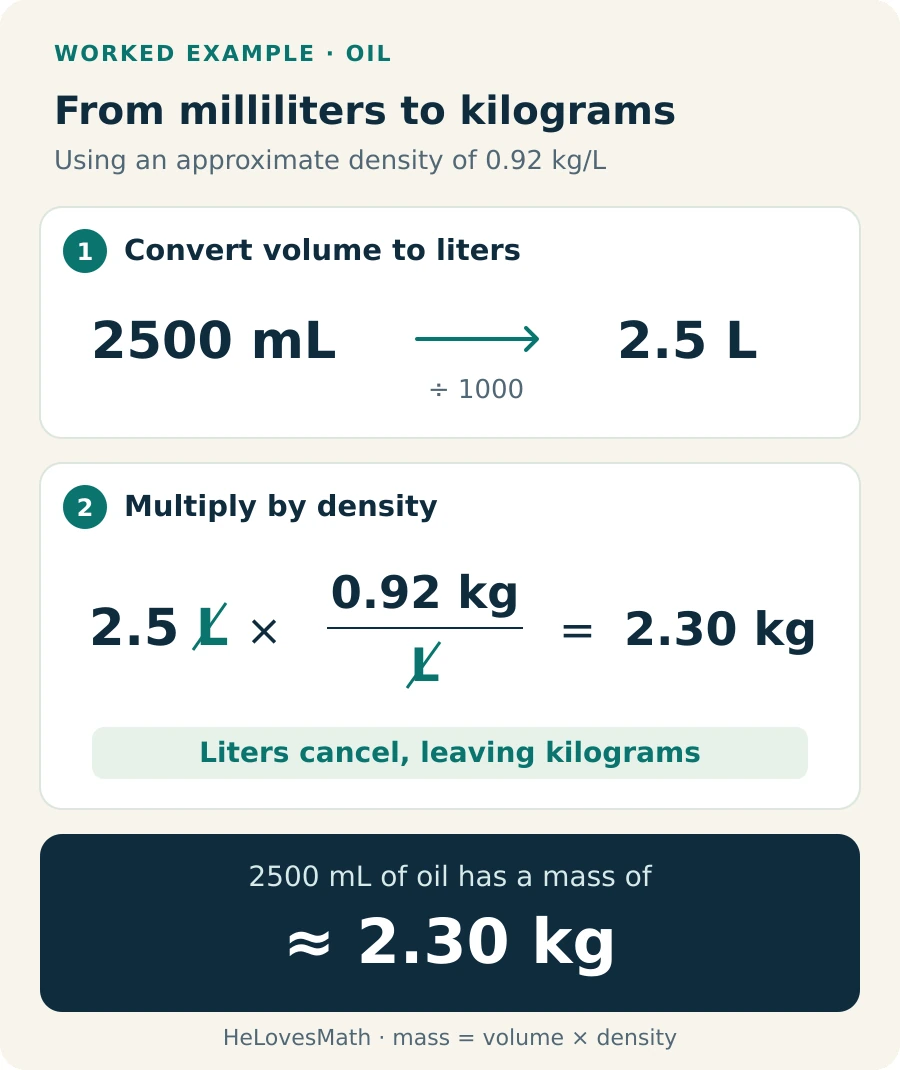
First convert 2500 mL to 2.5 L, then use 1.26 kg/L:
Normalization prevents confusing milliliters with liters.
0.75 m³ of seawater
Convert 0.75 m³ to 750 L. At 1.025 kg/L:
The result excludes the tank or vessel.
100 US gal of diesel
100 US gal is 378.5411784 L. At 0.84 kg/L:
Use actual fuel density for commercial documentation.
50 imperial gal of water
50 imperial gal is 227.3045 L. At 1.000 kg/L:
US and imperial gallons are different volumes.
30 L of loose flour
Using a loose bulk estimate of 0.53 kg/L:
Actual mass can differ because flour packing is variable.
45 L of granulated sugar
Using a typical bulk density of 0.85 kg/L:
Powdered or brown sugar needs a different bulk density.
Density entered as 920 kg/m³
Convert density first: 920 ÷ 1000 = 0.92 kg/L. For 60 L:
This demonstrates the common kg/m³ normalization.
Density entered as 7.68 lb/US gal
The calculator converts the density to approximately 0.920 kg/L. For 10 L:
Do not confuse US gallons with imperial gallons.
Reverse: 50 kg of oil
At 0.92 kg/L, divide mass by density:
The same mass occupies more liters than water would.
Reverse: 100 lb of honey
First convert 100 lb to 45.359237 kg, then divide by 1.42 kg/L:
The calculator performs both normalization steps automatically.
Common Liters-to-Kilograms Conversion Tables
These tables provide quick reference values for typical densities used by the calculator. They are estimates. Select custom density when your product data differs.
Water, milk, and oil
| Volume | Water at 1.000 kg/L | Milk at 1.030 kg/L | Vegetable oil at 0.920 kg/L |
|---|---|---|---|
| 1 L | 1.00 kg | 1.03 kg | 0.92 kg |
| 2 L | 2.00 kg | 2.06 kg | 1.84 kg |
| 5 L | 5.00 kg | 5.15 kg | 4.60 kg |
| 10 L | 10.00 kg | 10.30 kg | 9.20 kg |
| 20 L | 20.00 kg | 20.60 kg | 18.40 kg |
| 50 L | 50.00 kg | 51.50 kg | 46.00 kg |
| 100 L | 100.00 kg | 103.00 kg | 92.00 kg |
Honey, ethanol, gasoline, and diesel
| Volume | Honey at 1.420 kg/L | Ethanol at 0.789 kg/L | Gasoline at 0.740 kg/L | Diesel at 0.840 kg/L |
|---|---|---|---|---|
| 1 L | 1.42 kg | 0.789 kg | 0.74 kg | 0.84 kg |
| 5 L | 7.10 kg | 3.945 kg | 3.70 kg | 4.20 kg |
| 10 L | 14.20 kg | 7.890 kg | 7.40 kg | 8.40 kg |
| 20 L | 28.40 kg | 15.780 kg | 14.80 kg | 16.80 kg |
| 50 L | 71.00 kg | 39.450 kg | 37.00 kg | 42.00 kg |
| 100 L | 142.00 kg | 78.900 kg | 74.00 kg | 84.00 kg |
Loose flour, sugar, rice, and salt
| Volume | Flour at 0.530 kg/L | Sugar at 0.850 kg/L | Rice at 0.850 kg/L | Salt at 1.200 kg/L |
|---|---|---|---|---|
| 1 L | 0.53 kg | 0.85 kg | 0.85 kg | 1.20 kg |
| 5 L | 2.65 kg | 4.25 kg | 4.25 kg | 6.00 kg |
| 10 L | 5.30 kg | 8.50 kg | 8.50 kg | 12.00 kg |
| 20 L | 10.60 kg | 17.00 kg | 17.00 kg | 24.00 kg |
| 50 L | 26.50 kg | 42.50 kg | 42.50 kg | 60.00 kg |
| 100 L | 53.00 kg | 85.00 kg | 85.00 kg | 120.00 kg |
How to Convert Kilograms to Liters
The reverse operation answers questions such as “What volume does 25 kg of milk occupy?” or “What volume of oil corresponds to 500 kg?” Divide mass in kilograms by density in kilograms per liter.
For 25 kg of milk at 1.03 kg/L:
For 25 kg of vegetable oil at 0.92 kg/L:
Although both materials have the same mass, the oil occupies more volume because it is less dense. Honey at 1.42 kg/L would occupy only about 17.61 L for the same 25 kg mass.
The reverse mode accepts grams, pounds, and metric tonnes as well as kilograms. It converts the input to kilograms before dividing. For a broad mass-only conversion that does not involve density or volume, use the weight converter. For a direct kilograms-to-pounds calculation, the kg-to-lbs converter focuses on that unit pair.
Container sizing should include headspace, fill limits, thermal expansion allowance, foaming, and operational requirements. A calculated liquid volume equal to the nominal vessel capacity may not be a safe or usable fill volume.
Practical Uses for a Liters-to-Kilograms Conversion
Cooking and food production
Home cooks may use the conversion to understand large liquid quantities, while bakeries and food producers use mass for repeatability and inventory control. The density of water, milk, oil, syrup, and honey allows a volume recipe to be estimated in kilograms. Dry ingredients require more caution because bulk density is sensitive to handling. The cooking conversion calculator is better when the task is converting kitchen units such as cups, spoons, and common recipe measures rather than converting volume to mass through density.
Shipping and logistics
Freight limits, vehicle payload, lifting equipment, pallet design, and manual-handling decisions depend on mass. Container capacity is often stated in liters, so density provides the missing connection. Always add packaging tare, pallets, and accessories, and use verified product density for regulated or high-value shipments.
Tank and storage planning
A tank volume indicates capacity, but foundations, platforms, trailers, shelves, and support structures must carry mass. Water provides an easy benchmark of approximately one tonne per 1000 L. Oils are lighter; concentrated solutions and slurries may be heavier. Engineering design requires more than a calculator, including load distribution, dynamic effects, safety factors, codes, and material compatibility.
Procurement and inventory
Suppliers may quote a product by kilogram while storage is tracked by liters, or vice versa. Converting with density helps estimate how many drums, totes, or tanks are needed. Batch-specific density and temperature basis should be documented so purchasing and production use the same assumptions.
Laboratory and formulation work
Density enables movement between measured volume and total mass. This can support solution preparation, solvent handling, and yield checks. It does not replace analytical concentration calculations. When a task asks how many milligrams are present in a milliliter, concentration and density must be distinguished; the mg-to-mL conversion calculator explains the information required. For ingredient mass and volume with a known material density, the grams-to-milliliters calculator handles the smaller metric scale.
Agriculture and bulk handling
Seeds, feed, fertilizer, grain, water, fuel, and treatment solutions may be stored by volume but purchased or applied by mass. Bulk density and moisture are especially important for grains and feed. Use representative field measurements rather than a generic density when financial, application-rate, or equipment-capacity decisions depend on the result.
Education
The calculation demonstrates dimensional analysis, formula rearrangement, SI prefixes, significant figures, and the difference between physical quantities. Students can compare equal volumes of different materials and predict whether the mass will be above or below the water benchmark.
Common Liters-to-Kilograms Mistakes
Assuming every liter equals one kilogram
This is the most common error. The shortcut applies approximately to water, not to all materials. Multiplying by the actual density is essential.
Using the wrong kind of density
True particle density and loose bulk density answer different questions. A bin of powder contains air spaces, so true solid density can dramatically overestimate the kilograms that fit in one liter of bulk material.
Ignoring units
Entering 920 kg/m³ as though it were 920 kg/L makes the answer one thousand times too large. Select the correct density unit or convert before calculating.
Confusing US and imperial gallons
An imperial gallon is larger than a US gallon. The calculator treats them separately. A source that says only “gal” is ambiguous and should be clarified.
Using concentration instead of density
A label stating 50 g/L may describe solute concentration, not the density of the entire solution. Density is total solution mass per total solution volume. The two values are not interchangeable.
Forgetting tare weight
The equation produces net material mass. Gross shipment or lifting mass requires packaging and equipment tare to be added.
Using a room-temperature density at a different process temperature
For small casual conversions this may be acceptable, but large-volume or precise calculations may need a temperature correction or a density measured at the actual condition.
Reporting unjustified decimals
More digits do not create better source data. Match the result precision to the reliability of the volume and density inputs.
Treating a nominal capacity as an exact filled volume
A “20 L container” may not contain exactly 20.000 L. Fill line, headspace, manufacturing tolerance, foaming, and product expansion can change usable volume.
Applying a preset to a different product
Olive oil, motor oil, hydraulic fluid, and essential oil are all called oil but do not share one density. Likewise, pure ethanol, spirits, and sanitizer mixtures differ. Use custom density when the material is not the preset described.
Choose the Right Conversion for the Quantity You Have
Use this calculator when one side of the calculation is volume, the other side is mass, and density is known or can be estimated. It is intentionally focused on density-based L-to-kg and kg-to-L conversion so it does not duplicate a pure volume converter.
When both the starting and target units measure volume—such as liters to gallons, milliliters to cups, or cubic meters to liters—density is unnecessary. Use the volume converter for that task. When both units measure mass—such as kilograms to pounds or grams to ounces—use the weight converter.
Use the density calculator when mass and volume are known but density is missing. Use this page afterward when you want to apply that density to a different quantity. For cooking-unit substitutions and household measures, use the cooking conversion calculator.
This separation matters because similar-looking searches can represent different mathematics. “Liters to milliliters” is a unit scaling problem. “Liters to kilograms” is a physical-property problem. “Milligrams to milliliters” may be a concentration or density problem. Choosing the correct calculator avoids plausible-looking but dimensionally invalid answers.
Liters to Kilograms Frequently Asked Questions
How do I convert liters to kilograms?
Multiply the volume in liters by the material density in kilograms per liter. In symbols, mass equals volume multiplied by density: m = V × ρ. The density must describe the same substance and should reflect the relevant temperature, concentration, and packing condition.
Is 1 liter always equal to 1 kilogram?
No. Liters measure volume and kilograms measure mass. One liter is approximately one kilogram only for water under common everyday assumptions. A liter of oil is lighter, while a liter of honey is heavier, because their densities differ.
How many kilograms is 1 liter of water?
Using the convenient everyday density of 1.000 kg/L, 1 liter of water is approximately 1 kilogram. At room temperature, a more precise reference density is slightly below 1 kg/L, so the exact mass depends on temperature and purity.
How many kilograms is 5 liters of water?
Using the everyday approximation of 1.000 kg/L, 5 liters of water is approximately 5 kilograms. The container weight is separate and must be added when calculating gross shipping or handling weight.
How many kilograms is 10 liters of water?
Using the standard practical approximation, 10 liters of water is about 10 kilograms. With a room-temperature density of about 0.9982 kg/L, the liquid mass would be about 9.982 kilograms.
How many kilograms is 20 liters of water?
At 1.000 kg/L, 20 liters of water is approximately 20 kilograms. For a more precise result, select the room-temperature water preset or enter the density supplied by your process data.
How many kilograms is 1 liter of milk?
A typical estimate for milk is about 1.03 kg/L, so 1 liter weighs approximately 1.03 kilograms. Actual density varies with fat content, solids, temperature, and product formulation.
How many kilograms is 1 liter of cooking oil?
Many vegetable oils are roughly 0.91 to 0.93 kg/L near room temperature. Using 0.92 kg/L, 1 liter of oil is approximately 0.92 kilograms and 10 liters is approximately 9.2 kilograms.
How many kilograms is 1 liter of honey?
Honey is considerably denser than water. Using a typical estimate of 1.42 kg/L, 1 liter of honey weighs about 1.42 kilograms. Moisture content and temperature can change the actual value.
Can I convert liters of flour directly to kilograms?
You can estimate it only by using bulk density. Flour contains air spaces, and its bulk density changes with sifting, settling, humidity, compaction, and measuring technique. For baking or trade, weighing flour directly is more reliable.
What density unit should I use?
kg/L is the most direct unit for this calculator. g/mL has the same numerical value as kg/L. Values in kg/m³ or g/L are divided by 1000 to obtain kg/L. The calculator can also normalize lb/US gal and lb/ft³.
Is 1 g/mL the same as 1 kg/L?
Yes. Because 1 gram is 0.001 kilogram and 1 milliliter is 0.001 liter, the factors cancel. Therefore, 1 g/mL is numerically equal to 1 kg/L.
How do I convert kg/m³ to kg/L?
Divide by 1000. For example, 998.2 kg/m³ equals 0.9982 kg/L. This works because 1 cubic meter contains exactly 1000 liters.
How do I convert kilograms back to liters?
Divide mass by density: volume in liters equals mass in kilograms divided by density in kilograms per liter. For example, 25 kg of a liquid with density 0.80 kg/L occupies 31.25 L.
Does temperature affect liters-to-kilograms conversion?
Yes. Temperature can change density because most materials expand or contract. The effect is modest for many liquids in everyday use but can matter in laboratory, fuel, food-production, custody-transfer, and large-tank calculations.
Should I include the container weight?
Not in the liquid conversion itself. The calculator gives net material mass. To obtain gross weight, add the empty container, cap, pallet, drum, tote, or tank tare weight separately.
Can this calculator be used for gasoline or diesel?
It can provide an estimate when you use a density appropriate to the exact fuel and temperature. Fuel density varies by grade, seasonal blend, composition, and temperature, so commercial or safety-critical calculations should use supplier or test data.
Can this calculator be used for chemistry solutions?
Yes, provided you know the solution density. Do not confuse mass density with molarity or mass concentration. A solution may have a density in kg/L as well as a concentration in mol/L, g/L, or percent; these quantities answer different questions.
Why do powder results vary more than liquid results?
Powders and grains have bulk density rather than a single simple liquid density. Air gaps, particle shape, moisture, vibration, settling, and compaction can substantially change the mass occupying one liter.
How many decimal places should I use?
Use only as many digits as your input data justify. Two decimals are usually adequate for household estimates. Laboratory or industrial work may require more digits, but extra displayed decimals do not compensate for an uncertain density or imprecise volume measurement.
Measurement Note
This calculator provides mathematical conversions from the values entered. Preset densities are approximate reference values and can vary with temperature, pressure, composition, concentration, moisture, packing, and product formulation. Use verified product or laboratory data for engineering, medical, legal, regulated, commercial, structural, transport, or safety-critical work. The liter is a volume unit accepted for use with SI and is equal to a cubic decimeter; density is mass divided by volume.
Sources & References
Sources explain the unit definitions and the conditions behind density values. Presets are rounded learning and planning estimates, not specifications for every product or batch. Water at 20 °C and the milk example have specific reference conditions; dry-food values are bulk-density estimates. Use supplier data or measurements for the actual material.
- NIST: SI units of volume — liter, cubic decimeter and milliliter relationships.
- NIST Guide to the SI, Appendix B.8 — unit-conversion factors, including pounds and US and imperial gallons.
- NIST Guide to the SI, Chapter 8 — mass, weight, density and relative density terminology.
- NISTIR 7383: Selected Procedures for Volumetric Calibrations (PDF) — water density and measurement conditions, including the 20 °C reference.
- FAO: Milk Producer Group Resource Book — milk-density range and temperature basis.
- FAO: Value-added Products from Beekeeping, Chapter 2 — honey density, specific gravity and moisture dependence.
- FAO/INFOODS Density Database, version 2 (PDF) — food-specific mass and bulk-density data; descriptions and measurement bases matter.