
Long Division Calculator with Steps
Enter a whole-number dividend and divisor to see the quotient, remainder, decimal form, check equation, and the whole-number and decimal steps. Use the worked examples to understand quotient placement, zero placeholders, exact remainders, and repeating decimals.
Solve long division step by step
Enter non-negative whole numbers up to 60 digits each. Commas must group thousands, as in 9,876. The decimal-place menu controls the continuation; unfinished digits and rounded approximations are labeled separately. For decimal or signed inputs, see the guides below.
Long division is the reliable written method for dividing when mental math is no longer enough. It works for one-digit divisors, two-digit divisors, large dividends, division that leaves a remainder, and decimal answers. A result-only tool can tell you that \(9876\div24=411.5\). Long division explains how the integer quotient \(411\), remainder \(12\), and decimal \(0.5\) are connected.
If you are first building the underlying skills, review the meanings of division, multiplication, and subtraction. Long division is not a separate collection of rules. It is a compact way to repeat those three operations by place value.
What long division is actually doing
Division answers a grouping question: how many equal groups of the divisor fit into the dividend? In \(84\div7\), the question is “How many groups of 7 make 84?” The answer is 12 because \(7\times12=84\). For a simple fact such as this, writing the full algorithm would be unnecessary. But for \(9876\div24\), the same question is too large to answer in one mental step. Long division breaks it into manageable questions about hundreds, tens, and ones.
The standard notation has three important terms. The dividend is the number being divided. The divisor is the number you divide by. The whole-number quotient is the number of complete groups that fit. The full quotient can also include a fractional part. If anything is left after forming as many whole groups as possible, that amount is the remainder. In \(125\div4\), 4 fits into 125 thirty-one times and one is left, so the quotient is 31 and the remainder is 1.
For whole-number division, the remainder is always at least 0 and smaller than the divisor.
That relationship is more than a definition. It is your best accuracy check. For \(125\div4=31\text{ R }1\), calculate \(4\times31+1\). The result is \(124+1=125\), exactly the original dividend. If the check does not return the dividend, at least one digit in the quotient, multiplication, or subtraction is incorrect.
Long division exposes this relationship a digit at a time. You decide how many times the divisor fits into the current part of the dividend, write that quotient digit above the division bar, multiply to find the amount used, subtract to find what remains, and bring down the next digit. Each new line represents the next place-value question. That structure is why the method works just as well for 4-digit numbers as for 40-digit numbers.
How to use this long division calculator
- Type the number being divided in the Dividend field. For example, enter 9876 for \(9876\div24\).
- Type a positive whole number in the Divisor field. A divisor of 0 is not allowed because division by zero is undefined.
- Choose the number of decimal places you want to see. Select “No decimals” when you only need quotient and remainder.
- Select Calculate with steps. The top line gives the result; below it, every stage states the current number, the quotient digit, the multiplication, and the subtraction.
- Read the check equation before moving on. It verifies that \(\text{divisor}\times\text{quotient}+\text{remainder}\) equals the original dividend.
The tool accepts whole-number inputs because that is the usual school form of long division. If the dividend starts with zeros, such as 00084, those zeros do not change its value; the calculator treats it as 84. To enter a decimal problem in this whole-number tool, multiply both inputs by the same power of 10 until both are integers. For example, 1.25 ÷ 0.5 becomes 125 ÷ 50; the quotient is unchanged. On paper it is enough to make the divisor whole, so 12.5 ÷ 5 is also a valid written setup.
The five moves of long division: divide, multiply, subtract, bring down, repeat
Many students remember the process with the phrase “divide, multiply, subtract, bring down.” It is useful, but only when each word has a precise meaning. The final instruction—repeat—is equally important. You repeat the cycle for every remaining digit in the dividend. Do not rush to write a quotient digit just because you see a digit below the bracket; first decide what number you are currently dividing.
1. Divide
Look at the leftmost part of the dividend that is at least as large as the divisor. If the entire dividend is smaller, the whole-number quotient is 0. Otherwise, estimate how many whole times the divisor fits. Write that one-digit answer in the quotient position directly above the last digit you used.
2. Multiply
Multiply the divisor by the quotient digit you just wrote. Put that product under the current number. This shows the amount that has been placed into complete groups.
3. Subtract
Subtract the product from the current number. The difference is the amount that could not yet be grouped. It must be smaller than the divisor before you bring down another digit.
4. Bring down
Bring down exactly one unused digit from the dividend and write it beside the remainder. The new combined number becomes the next value to divide.
Suppose you are dividing \(846\div6\). Six fits into 8 once because \(6\times1=6\), leaving 2. Bring down the 4 to make 24. Now \(24\div6=4\), with no remainder; bring down the 6, and \(6\div6=1\). The quotient is 141. Notice that you never “divide the 4” on its own. You divide the 24 created by the remainder 2 and the next digit 4. This is a place-value operation: 2 hundreds left from the first stage are regrouped as 20 tens, then combined with the next 4 tens.
At every stage, the subtraction result must be less than the divisor. If it is equal to or greater than the divisor, the quotient digit was too small. If your multiplication product is greater than the current number, the quotient digit was too large. These two quick checks catch most errors before they travel to later lines.
Worked example: \(9876\div24\)
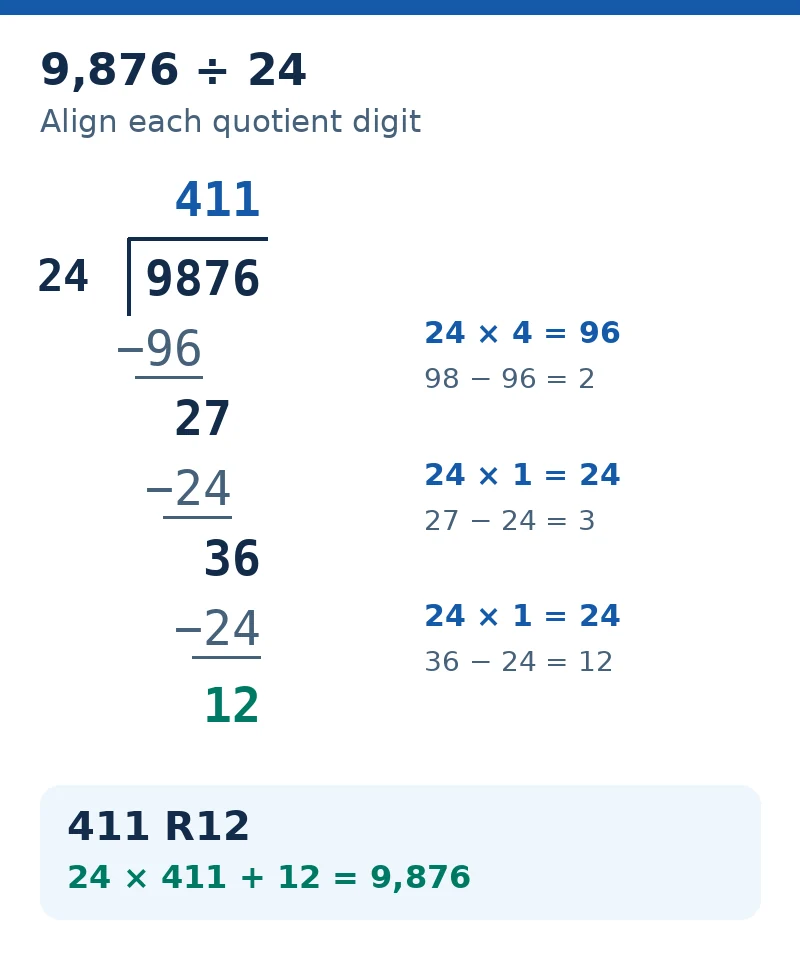
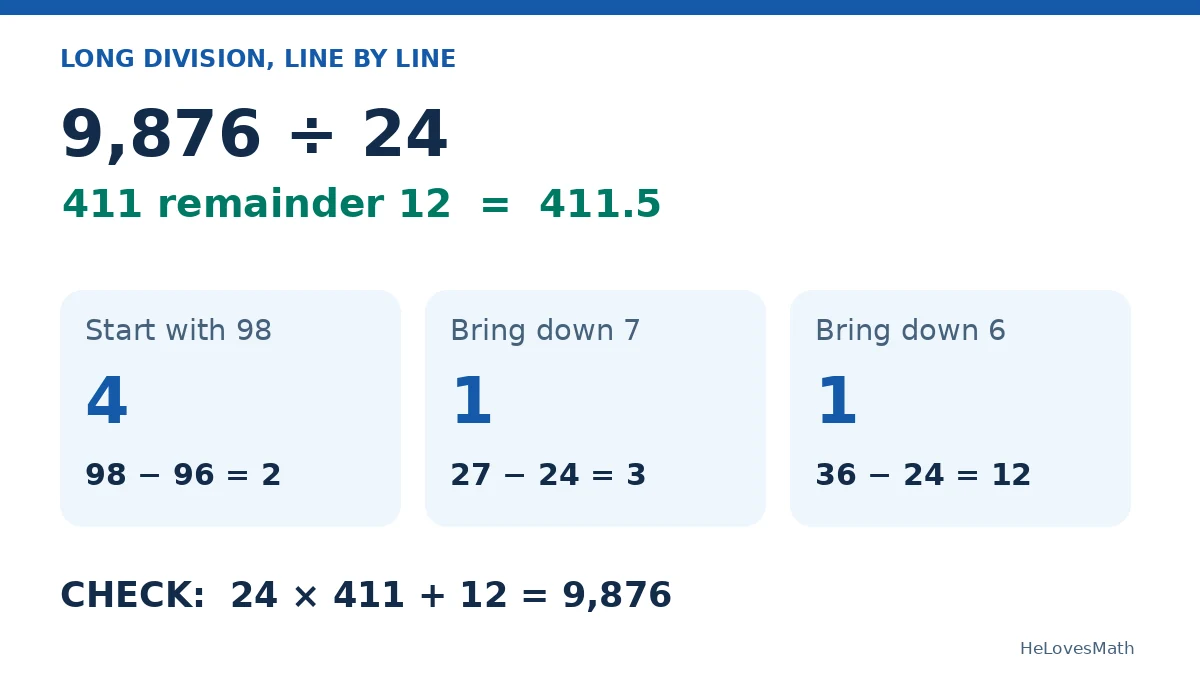
This example has a two-digit divisor, so estimation matters. We are asking how many groups of 24 are contained in 9,876. The calculator gives \(411\) remainder \(12\), or \(411.5\). Here is the same result as a manual long-division process.
Step 1: Start with 98
Twenty-four does not fit into 9, so use the first two digits, 98. Since \(24\times4=96\) and \(24\times5=120\), 24 fits into 98 four times. Write 4 in the hundreds place of the quotient.
\[ 98-96=2 \]
The remainder is 2. It is smaller than 24, so it is valid.
Step 2: Bring down 7 to make 27
Bring down the next digit, 7. The remainder 2 becomes 27 when combined with the 7. Twenty-four fits into 27 once. Write 1 in the tens place of the quotient.
\[ 27-(24\times1)=27-24=3 \]
Step 3: Bring down 6 to make 36
Bring down the final digit, 6, to make 36. Twenty-four fits into 36 once. Write 1 in the ones place of the quotient.
\[ 36-(24\times1)=36-24=12 \]
Step 4: State the result and check it
There are no more whole-number digits to bring down, so the integer answer is \(411\text{ R }12\). Check it:
\[ 24\times411+12=9864+12=9876 \]
The remainder can be written in several equivalent forms. As a mixed number, the answer is \(411\frac{12}{24}\), which simplifies to \(411\frac12\). As a decimal, \(12\div24=0.5\), giving \(411.5\). The value of the division did not change; its representation changed from a whole-number quotient with a remainder to a mixed number or decimal. If simplifying fractions is unfamiliar, the fractions guide is a useful companion.
| Current number | How many times does 24 fit? | Multiply | Subtract | Quotient so far |
|---|---|---|---|---|
| 98 | 4 times | \(24\times4=96\) | \(98-96=2\) | 4 |
| 27 | 1 time | \(24\times1=24\) | \(27-24=3\) | 41 |
| 36 | 1 time | \(24\times1=24\) | \(36-24=12\) | 411 |
Where each quotient digit belongs
Correct placement is as important as correct arithmetic. The digit you write in the quotient must stand above the final digit of the part of the dividend you divided. In \(9876\div24\), the first calculation uses 98, which occupies the thousands and hundreds positions. The 4 belongs over the 8 because it represents 4 hundreds in the final quotient. The next calculation uses 27, ending at the tens digit 7, so the 1 goes over that 7. The final calculation uses 36, ending at the ones digit 6, so the last 1 goes over 6.
This alignment prevents a common error: obtaining the correct digits but writing them as 41.1, 4,111, or 4110. Long division is based on place value, so a quotient digit has a value determined by its position. After the quotient has started, a zero can also be a necessary placeholder. If the divisor fits zero times at a particular stage, write 0 in that quotient place before bringing down the next digit. Skipping it changes the quotient’s place values.
Example: \(1005\div5\)
Five fits into 10 two times, so write 2. Subtract 10 to leave 0, then bring down the next 0. Five fits into 0 zero times, so write 0 in the quotient. Bring down the next digit 5; \(5\div5=1\). The answer is 201, not 21.
\[ 1005\div5=201 \]
The middle zero has a job: it holds the tens place. A quick check confirms it: \(5\times201=1005\).
How to estimate a quotient before you divide
Estimation makes long division faster and safer. Before dividing \(9876\div24\), use the nearby compatible number 9,600 and keep the divisor 24. Since \(9600\div24=400\), the final answer should be near 400. A result such as 41 or 4,110 would immediately look unreasonable. Estimation is not a replacement for the written algorithm; it is a sense-check that tells you the likely size of the quotient.
For a two-digit divisor, use nearby multiplication facts. When deciding how many times 24 fits into 98, list useful multiples: \(24,48,72,96,120\). The best product that does not exceed 98 is 96, so the quotient digit is 4. You do not need to memorize every two-digit multiplication table. Build the needed multiples by splitting 24 into 20 and 4: \(24\times4=20\times4+4\times4=80+16=96\).
For a divisor such as 37, round it to 40 for an early estimate, then correct with exact multiples. For instance, \(1480\div37\) is near \(1600\div40=40\). Testing 40 gives \(37\times40=1480\), so the estimate becomes the exact quotient. The more you estimate, the easier it becomes to detect a product that is too high before you write it down.
Remainders: four correct ways to write what is left
A remainder is not a mistake or an incomplete answer. It tells you the dividend is not an exact multiple of the divisor. What you do with it depends on the question. A teacher may ask for a quotient and remainder. A measurement problem may require a decimal approximation. A recipe or algebra problem may prefer a fraction. A real-world grouping problem may require rounding up or down. The long-division work is the same; interpretation changes at the end.
Remainder notation
\(37\div6=6\text{ R }1\). Use this when the problem explicitly asks for quotient and remainder, or when only whole groups count.
Fraction form
The remainder becomes the numerator and the divisor becomes the denominator: \(37\div6=6\frac16\). Simplify when possible.
Decimal form
Continue division after adding a decimal point and zeros: \(37\div6=6.1666\ldots\). Round only when the question gives a requested precision.
Contextual whole number
If 37 students need vans that hold 6 students, \(6\text{ R }1\) means 7 vans are needed. You must round up because one student cannot be left behind.
To convert a remainder to a fraction, use this rule:
Here \(q\) is the whole-number quotient and \(d\) is the divisor.
For \(125\div4\), long division gives \(31\text{ R }1\). The fraction form is \(31\frac14\). Since \(\frac14=0.25\), the decimal form is 31.25. A fractions-to-decimals calculator is useful when your long-division remainder has already been converted to a fraction and you need to compare or round decimal values. This page remains the better choice when your goal is to see how the remainder arose in the first place.
Continuing long division into decimal places
When you want a decimal answer rather than a remainder, add a decimal point to the quotient and attach a decimal point to the dividend. Then bring down a zero. Appending a zero after the decimal does not change the value: \(125=125.0=125.00\). It simply allows you to divide the remainder into tenths, hundredths, and thousandths.
Example: \(125\div4\)
First divide normally. Four fits into 12 three times; subtract 12. Bring down 5. Four fits into 5 once; subtract 4. The whole-number quotient is 31 with remainder 1.
Now add a decimal point after 31 and bring down a zero, making 10. Four fits into 10 twice, leaving 2. Bring down another zero, making 20. Four fits into 20 five times, leaving 0.
\[ 125\div4=31.25 \]
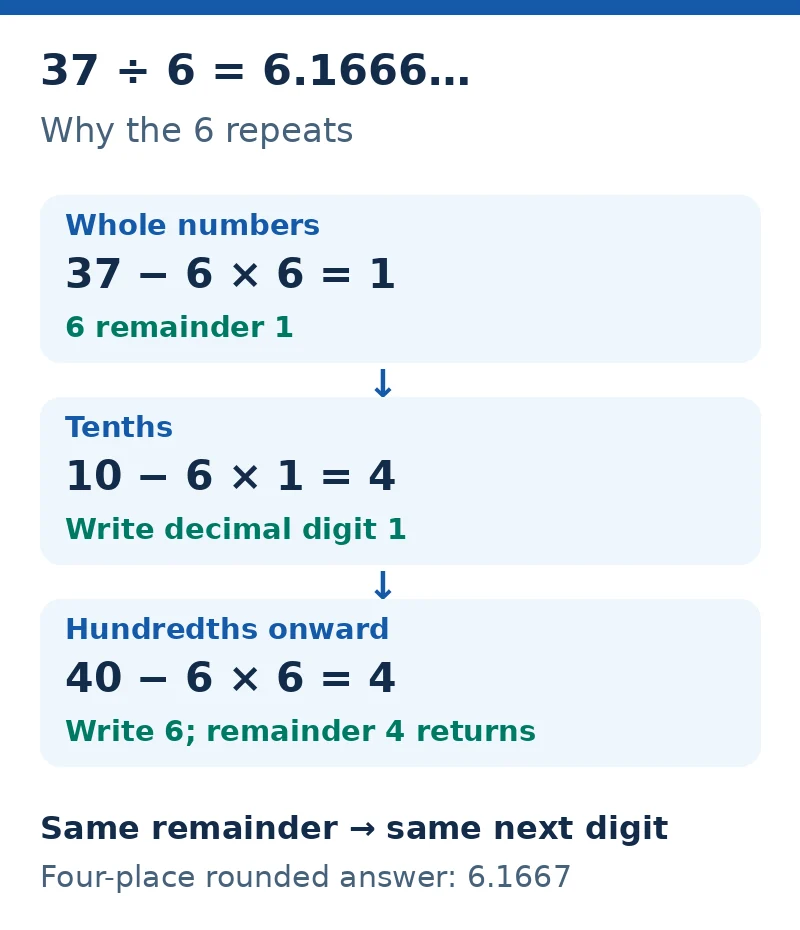
Some decimals terminate, meaning the remainder eventually becomes 0. Others repeat forever. For \(37\div6\), the first stage gives \(6\text{ R }1\). Add a decimal and bring down 0: \(10\div6=1\) remainder 4. Bring down 0: \(40\div6=6\) remainder 4. The same remainder 4 will now repeat, so the digit 6 repeats:
Do not assume a displayed calculator decimal is exact if the remainder has not reached 0. This tool shows the decimal continuation \(6.1666\ldots\) and separately gives the four-place rounded approximation \(6.1667\). In a test, follow the stated rounding instruction. If none is given, use an ellipsis or repeating-bar notation when that notation is appropriate.
Long division when the divisor contains a decimal
The standard long-division setup works most cleanly when the divisor is a whole number. If the divisor has a decimal, multiply both numbers by the same power of 10 until the divisor becomes whole. This does not change the quotient because you are scaling the dividend and divisor equally.
Example: \(7.56\div0.12\)
Move the decimal point two places right in both numbers. The problem becomes \(756\div12\). Now divide: 12 fits into 75 six times, leaving 3; bring down 6 to make 36; 12 fits three times. Therefore:
\[ 7.56\div0.12=756\div12=63 \]
The key is to move the decimal in both values by the same number of places. Moving it only in the divisor changes the problem. If a divisor has three digits after the decimal, move each decimal point three places. For example, \(4.32\div0.008\) becomes \(4320\div8\), which equals 540.
When the dividend has a decimal but the divisor is whole, place the decimal point in the quotient directly above the decimal point in the dividend as you reach it. For \(15.75\div3\), divide 15 first to get 5; place the decimal point; then divide 7 tenths by 3 to get 2 tenths with 1 tenth left; bring down 5 hundredths to make 15 hundredths and divide by 3 to get 5 hundredths. The answer is 5.25. Understanding decimal place value makes this placement much less mysterious.
Why place value matters at every line
Long division can look like a sequence of tiny arithmetic facts, but place value is what connects them. In \(846\div6\), the first quotient digit 1 represents 100 groups of 6, using 600 of the 800 represented by the first dividend digit. The remainder 2 represents 2 hundreds. Bringing down the 4 tens turns those 2 hundreds into 20 tens, then combines them with 4 tens to make 24 tens. When you write a quotient digit, you are recording how many groups fit at that specific place-value level.
This explanation also clarifies why you bring down one digit at a time. A digit is not merely a symbol waiting to be used; it represents a particular number of ones, tens, hundreds, or other powers of ten. Bringing down one digit moves the remainder to the next smaller place and combines it with the next part of the dividend. Bringing down two digits by accident skips a place-value stage and changes the problem.
For extra practice with this idea, use a place value calculator to decompose a large number before dividing it. For example, 9,876 is \(9,000+800+70+6\). Long division does not divide each expanded part separately, but seeing the value of each digit helps explain why quotient digits line up where they do.
How to check a long-division answer
Never treat a completed quotient as automatically correct. A dependable check takes only one multiplication and one addition. Multiply the divisor by the whole-number quotient, then add the remainder. The result must equal the dividend exactly.
In this equation, \(a\) is the dividend, \(b\) is the divisor, \(q\) is the quotient, and \(r\) is the remainder.
Suppose you claim \(548\div13=41\text{ R }15\). Multiply: \(13\times41=533\), and \(533+15=548\), so the first part of the check appears to work. However, the remainder 15 is greater than the divisor 13. This is not valid final remainder notation. One more group of 13 can be taken from 15, producing \(42\text{ R }2\). The condition \(0\le r\lt b\) prevents this incomplete simplification.
For a decimal answer, reverse the operation by multiplication. If \(125\div4=31.25\), calculate \(31.25\times4=125\). If you rounded a repeating decimal, the reverse check will be close rather than exact. For example, \(37\div6\approx6.167\) to three decimal places; \(6.167\times6=37.002\), a small difference caused by rounding.
A scientific calculator is convenient for this reverse-operation check on complex arithmetic. Its job is fast evaluation. This long-division page has a different job: showing the written structure needed to learn, explain, or verify the algorithm.
Common long-division mistakes and how to correct them
| Mistake | Why it happens | Reliable correction |
|---|---|---|
| Starting with a part of the dividend smaller than the divisor | The first digit looks tempting to use immediately. | Use enough leading digits to reach the divisor. For \(9876\div24\), start with 98. If the entire dividend is smaller, write whole-number quotient 0 and use the dividend as the remainder. |
| Writing a product larger than the current number | The quotient digit was guessed too high. | Multiply before subtracting. If the product exceeds the current number, reduce the quotient digit by 1 and test again. |
| Forgetting a zero in the quotient | A stage gives zero groups, so it feels like “nothing happened.” | After the quotient has started, write 0 whenever the divisor fits zero times at that place, including the final whole-number digit. |
| Bringing down the wrong digit or two digits | The written work becomes crowded. | Cross off or lightly mark each dividend digit after using it. Bring down one unused digit only after subtracting. |
| Leaving a remainder greater than the divisor | The final quotient digit was too small or the process stopped early. | Check that the remainder is less than the divisor. If it is not, divide one more time. |
| Moving one decimal point but not the other | The goal of making the divisor whole is remembered incompletely. | Multiply dividend and divisor by the same 10, 100, 1,000, or other power of 10. |
Another frequent issue is using subtraction inaccurately after the multiplication is correct. Keep the subtraction aligned by place value, just as you would in ordinary column subtraction. If borrowing causes difficulty, pause and check the subtraction separately before bringing down another digit. A small subtraction error creates a different current number, so every later quotient digit can become wrong.
More worked examples
Example 1: Exact division, \(864\div12\)
Twelve fits into 86 seven times because \(12\times7=84\). Subtract to get 2; bring down 4 to make 24. Twelve fits into 24 two times. The answer is 72.
\[ 864\div12=72,\qquad12\times72=864 \]
Estimate first: \(864\div12\) should be a little more than \(840\div12=70\), so 72 is reasonable.
Example 2: A zero in the quotient, \(4020\div6\)
Six fits into 40 six times, leaving 4. Bring down 2 to make 42; six fits seven times, leaving 0. Bring down the final 0. Six fits into 0 zero times, so write 0. The quotient is 670.
\[ 4020\div6=670 \]
The zero is not optional. Without it, the displayed answer 67 would represent \(6\times67=402\), not 4,020.
Example 3: A remainder, \(562\div9\)
Nine fits into 56 six times because \(9\times6=54\); subtract to leave 2. Bring down 2 to make 22. Nine fits twice; subtract 18 to leave 4. Therefore \(562\div9=62\text{ R }4\).
\[ 9\times62+4=558+4=562 \]
As a mixed number, the result is \(62\frac49\). As a decimal, it is \(62.4444\ldots\).
Example 4: The divisor is larger than the dividend, \(17\div25\)
Twenty-five fits into 17 zero whole times, so the whole-number quotient is 0 and the remainder is 17. To make a decimal, write \(0.\), bring down a zero to make 170, and divide. Twenty-five fits into 170 six times, leaving 20; bring down another 0 to make 200; 25 fits eight times. The answer is 0.68.
\[ 17\div25=0.68 \]
Example 5: A repeating decimal, \(7\div12\)
Twelve fits into 7 zero times. Add a decimal point and bring down zero: \(70\div12=5\), remainder 10. Bring down zero: \(100\div12=8\), remainder 4. Bring down zero: \(40\div12=3\), remainder 4 again. The 3 repeats from this point.
\[ 7\div12=0.58333\ldots=0.58\overline{3} \]
Division in word problems: decide what the remainder means
Long division becomes especially valuable in word problems because an answer format must match the situation. The arithmetic may be identical while the final answer is different. Consider 125 items packed into boxes of 4. Long division gives \(125\div4=31\text{ R }1\). If the question asks how many full boxes can be packed, the answer is 31 full boxes with 1 item left over. If the question asks how many boxes are needed to hold all items, the answer is 32 boxes because a partial box is still required. For a different sharing situation, 125 litres divided equally among 4 tanks gives 31.25 litres per tank. That decimal is meaningful because a litre can be divided into smaller units.
Before writing the final sentence, ask three questions: Can the object be divided into parts? Can a partial group exist? Is the question asking for capacity, completed groups, an average, a measurement, or an exact mathematical value? These questions determine whether you report a remainder, a fraction, a decimal, round down, or round up.
For example, \(53\div8=6\text{ R }5\). Six buses hold 48 passengers, but if all 53 passengers must travel, you need 7 buses. Conversely, in 53 minutes, six complete 8-minute activities fit, with 5 minutes remaining. The arithmetic did not change; the interpretation did.
Long division with negative numbers
The traditional written steps are usually performed using absolute values first. Then determine the sign of the quotient using the same rule as multiplication: dividing numbers with the same sign gives a positive quotient, while dividing numbers with different signs gives a negative quotient.
For example, \(-144\div12=-12\). Work out \(144\div12=12\) using standard long division, then attach the negative sign because one number is negative. Likewise, \(-144\div-12=12\) because the two negative signs cancel in the quotient. In elementary classes, remainder notation with negative dividends can be defined in different conventions, so use the convention required by your course. For ordinary positive-number long division, the remainder rule \(0\le r<d\) is straightforward and is the convention used by this calculator.
A practical study routine for mastering long division
Long division becomes reliable through short, focused practice rather than one exhausting worksheet. Start with exact division using one-digit divisors. Then use two-digit divisors whose multiplication facts are manageable, such as 12, 15, 20, 24, and 25. Add remainders only after your quotient placement and subtraction are consistent. Finally, extend remainders to decimals and work with decimal divisors.
- Estimate first. Write a rough expected quotient range before starting. This trains number sense and provides an immediate final check.
- Say each move aloud. “24 goes into 98 four times; four times 24 is 96; subtract to get 2; bring down 7.” Speaking makes skipped steps easier to notice.
- Keep columns neat. Use graph paper or draw light vertical guides. Neat columns help prevent place-value and copying errors.
- Check every answer. Multiply the quotient by the divisor and add any remainder. Checking is part of the algorithm, not an optional extra.
- Use the calculator last. Complete the paper work first, then enter the problem above to compare the process line by line.
If you teach younger learners, begin with sharing and grouping visuals before presenting the bracket notation. Equal groups, arrays, and multiplication facts give meaning to division. The primary multiplication and division resources can help build that foundation. Once students understand why the divisor must be multiplied and subtracted, the long-division procedure is far easier to remember.
Which calculator should you use?
Choose a tool based on the question you need answered. This page is designed for the written algorithm: it displays each division stage, quotient digit, product, subtraction, and remainder. Use it when homework asks you to show work, when you are learning the procedure, or when you need to locate a mistake in a paper solution.
A general scientific calculator is better for a quick numerical evaluation inside a larger calculation. A fractions calculator is better when the main task is adding, subtracting, multiplying, dividing, or simplifying fractions. An improper fraction to mixed number calculator is useful after division when you specifically need to rewrite a fractional result such as \(\frac{137}{12}\) as \(11\frac5{12}\).
These tools serve different search and learning intentions. A fast calculator answers “what is the value?” Long division answers “how do I produce and explain the value by hand?” Keeping those goals separate helps you choose the right method in classwork, exams, and daily calculations.
Long division practice questions
Try these without the calculator first. Estimate each answer, write the long-division setup, complete the cycles, and check using multiplication. For remainder questions, write the answer in both remainder and fraction or decimal form when possible.
- \(672\div8\)
- \(945\div15\)
- \(1,428\div21\)
- \(3,024\div18\)
- \(5,005\div5\)
- \(1,000\div16\)
- \(257\div12\)
- \(83\div20\)
- \(7.56\div0.12\)
- \(4,389\div27\)
Show practice answers
Frequently asked questions
What is the long-division formula?
The fundamental division relationship is \(\text{dividend}=(\text{divisor}\times\text{quotient})+\text{remainder}\). In symbols, \(a=bq+r\), where \(0\le r<b\) for a positive divisor. It is both the definition of quotient and remainder and the quickest way to check completed work.
What do I do when the divisor does not fit into the first digit?
Use the first two digits, or more digits if necessary, until the part of the dividend is at least as large as the divisor. In \(9876\div24\), 24 does not fit into 9, so start with 98. The first quotient digit is written above the last digit used, which is 8. If the whole dividend is smaller than the divisor, the whole-number quotient is 0 and the remainder equals the dividend.
Why is there sometimes a zero in the quotient?
After the quotient has started, a zero is required whenever the divisor fits zero times at a particular place value, including the final digit. It holds that place. For example, \(1005\div5=201\), not 21. Omitting it changes the place values and gives an incorrect quotient. A final zero also matters: 4,020 ÷ 6 = 670.
How do I turn a remainder into a decimal?
Place a decimal point in the quotient, append a zero to the dividend, and continue the divide–multiply–subtract–bring-down cycle. For \(125\div4\), the remainder 1 becomes 10 tenths; \(10\div4=2\) remainder 2. Bring down another zero, and \(20\div4=5\), giving 31.25.
How do I divide when the divisor is a decimal?
Move the decimal point in both dividend and divisor the same number of places until the divisor is a whole number. For \(7.56\div0.12\), move both points two places right to get \(756\div12\). Then complete standard long division.
Can a remainder be larger than the divisor?
No. A final remainder must be smaller than the divisor. If it is equal to or larger than the divisor, another whole group can still be formed, so the quotient is incomplete. Recheck the final quotient digit and subtraction.
What is the difference between short division and long division?
Short division compresses some multiplication and subtraction steps mentally, usually for simple one-digit divisors. Long division writes those stages explicitly and is more dependable for larger divisors, decimal work, learning, and showing method marks.
How can I tell if my quotient is reasonable?
Estimate before beginning. Round the dividend and divisor to friendly values and compare your final answer with that rough estimate. Then perform the exact check: multiply divisor by quotient and add the remainder. Both estimation and the check equation should support your answer.
Why do repeating decimals happen in long division?
A repeating decimal occurs when the same nonzero remainder appears again. From that point onward, the same multiplication by 10 and division by the same divisor repeat, so the decimal digits repeat. For example, \(1\div3=0.333\ldots\) because remainder 1 returns after every step.
Does this calculator show the same steps I should write on paper?
Yes. It lists the same logical stages: current number, quotient digit, multiplication, subtraction, and new remainder. On paper, you place these vertically under the division bracket; in the calculator, they are written in readable sentences so you can check each stage.
Should I use a fraction or a decimal for a remainder?
Use the form the question requests. Fractions are exact and often preferred in algebra, measurement, and recipe contexts. Decimals are useful for approximations, money, and comparisons. Remainder notation is appropriate when only whole groups matter. All forms describe the same leftover amount.
What is the best way to avoid long-division mistakes?
Work one cycle at a time, align digits carefully, estimate before each quotient digit, and check every subtraction before bringing down the next digit. At the end, verify with \(\text{divisor}\times\text{quotient}+\text{remainder}\). Accuracy comes from a consistent routine, not from rushing.
Calculator accuracy, limits, and answer checks
This calculator uses exact integer arithmetic for inputs of up to 60 digits, rather than converting them to ordinary floating-point numbers. Quotient digits, products, subtraction results, and the original remainder are exact within that limit. The limit keeps the written explanation manageable; it is not a claim that paper long division stops working for larger numbers.
The calculator accepts non-negative whole numbers only. It rejects decimals, plus or minus signs, fractions, scientific notation, empty entries, and incorrectly placed commas instead of silently changing their meaning. Leading zeros are ignored. A divisor of zero is always rejected. The calculations happen in your browser.
The exact whole-number check is dividend = divisor × whole-number quotient + remainder, with 0 ≤ remainder < divisor. An exact decimal quotient uses a different check: divisor × decimal quotient = dividend. Do not add the original remainder to the completed decimal quotient: 4 × 31 + 1 = 125, while 4 × 31.25 = 125.
The menu displays up to 2, 3, 4, or 6 decimal places. If the remainder reaches zero, the decimal is labeled exact. Otherwise, the digit sequence is an unfinished continuation and a separately labeled rounded approximation is shown. Positive halfway cases round upward: 1 ÷ 8 is exactly 0.125, which rounds to 0.13 at two decimal places. A carry can change the whole-number part: 999 ÷ 1,000 rounds to 1.00 at two places.
A repeating block is reported only when a nonzero remainder returns within the displayed steps. No detected cycle does not mean the decimal terminates: its repeat might begin later, or its period might exceed the chosen limit. For example, 1 ÷ 128 shows 0.007812… at six places but terminates at 0.0078125. Keep the fraction form when an exact answer matters.
Zero and negative-number questions
What is zero divided by a nonzero number?
0 ÷ 7 = 0 because 7 × 0 = 0. The remainder is also zero. In contrast, 7 ÷ 0 is undefined: no number multiplied by zero gives 7. The expression 0 ÷ 0 is undefined too, because every number multiplied by zero gives zero, so it does not determine a unique quotient.
Can I put negative numbers in this tool?
No. Use absolute values in the calculator, then apply the quotient sign separately. For example, 144 ÷ 12 = 12, so −144 ÷ 12 = −12 and −144 ÷ −12 = 12. For division with a nonzero remainder, do not merely attach a minus sign to an R answer; signed integer division uses different conventions.
For example, −17 = 5 × (−3) + (−2) uses a quotient truncated toward zero, while −17 = 5 × (−4) + 3 uses a non-negative remainder. Both identities are true, but they follow different remainder conventions. The exact quotient is unambiguously −3.4. This page’s calculator uses only the non-negative-input convention explained above.
Sources & References
The method and terminology were checked against these education sources. The worked examples and diagrams on this page are original.
- OpenStax: Divide Whole Numbers — written division, zero placeholders, and remainder checks.
- OpenStax: Decimal Operations — decimal placement, equivalent division problems, and rounding.
- OpenStax: Decimals and Fractions — terminating and repeating decimals.
- University of Cambridge NRICH: Repetitiously — exploring recurring decimal patterns and exact fractions.