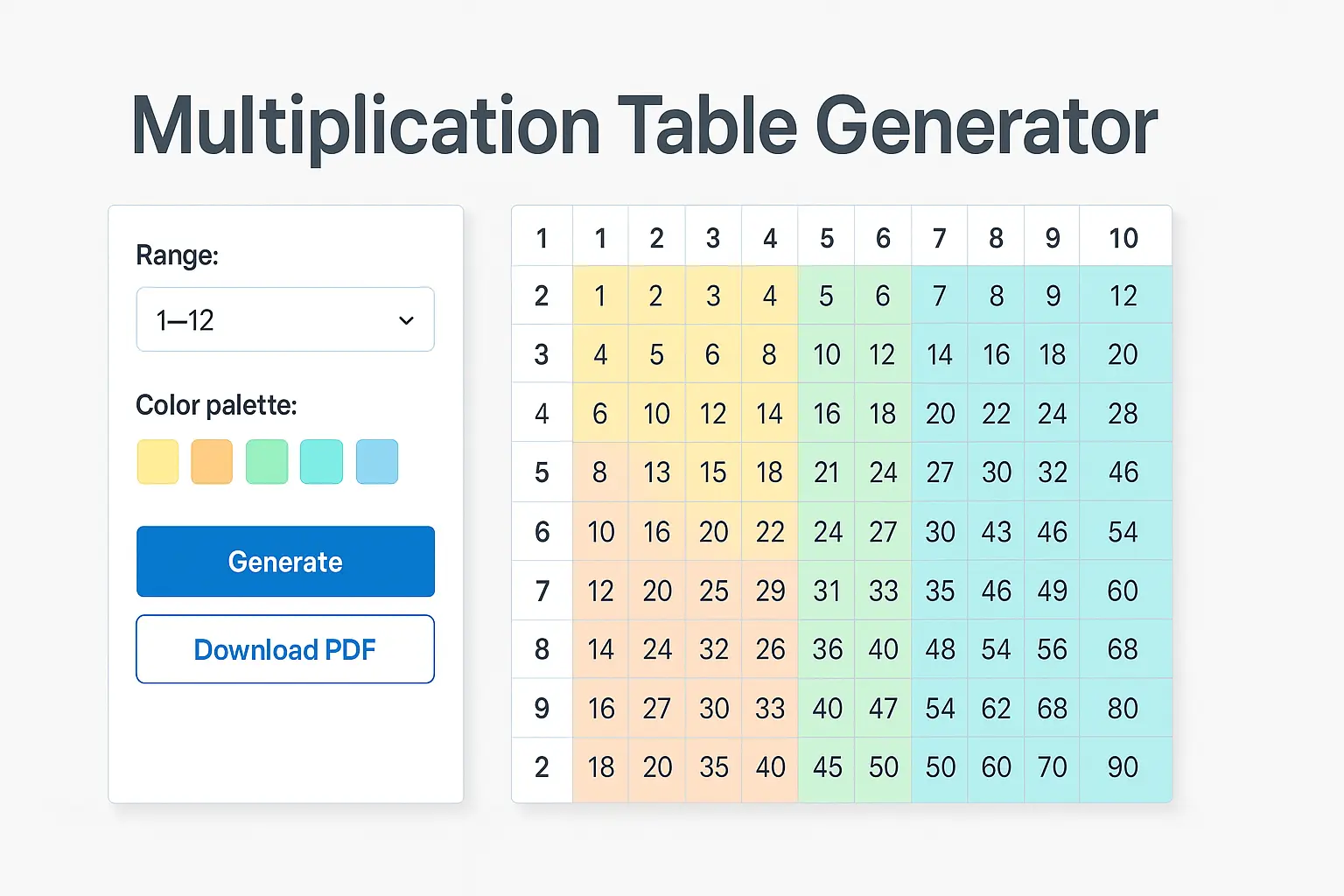
Multiplication Table Generator, Cheatsheet & Flashcards
Generate printable multiplication tables, focused times-table cheatsheets, skip-counting rows, square-number highlights, factor patterns, arrays, flashcards, practice quizzes, and downloadable answer keys for classroom, homeschool, tutoring, and self-study.
1. Generate Table
Multiplication Table
2. Cheatsheet Summary
Use the focus number to study skip counting, factors, square facts, and related division facts.
Array Model
Learning Summary
3. Cheatsheet and Fact Patterns
Focus Times Table
| Fact | Product | Related Division |
|---|
Skip Counting and Patterns
| Pattern | Output | Meaning |
|---|
Batch Facts / Answer Key
| # | Fact | Answer | Related Facts |
|---|
4. Flashcards and Practice
Click New Card, type the answer, then check.
Multiplication Table Formulas
A multiplication table is built from products. If the row number is \(a\) and the column number is \(b\), the table cell is:
Multiplication is repeated addition:
The commutative property explains why mirrored facts have the same product:
The distributive property helps break harder facts into easier facts:
Related division facts reverse multiplication:
Square facts sit on the main diagonal of a multiplication table:
Complete Guide to Multiplication Tables, Cheatsheets, and Flashcards
A multiplication table is a structured chart that shows products of whole numbers. The row number and column number multiply to create the value in each cell. A standard classroom multiplication chart often shows facts from 1 through 10 or 1 through 12. Some classrooms extend to 15, 20, or beyond, especially when students need stronger mental math fluency.
Multiplication tables are useful because they organize many facts into one pattern-rich display. Students can see rows, columns, diagonals, repeated patterns, mirrored facts, square numbers, skip-counting sequences, and related division facts. A table is more than a list of answers. It is a visual model of multiplication structure.
The first idea behind multiplication is equal groups. The fact \(4\times6=24\) can mean 4 groups of 6, 6 groups of 4, an array with 4 rows and 6 columns, or a rectangle with side lengths 4 and 6. These meanings are connected. The product tells the total number of objects, boxes, tiles, dots, or units.
Repeated addition is one way to understand multiplication. For example, \(5\times3\) can be written as \(3+3+3+3+3=15\). This is helpful when students are first learning. However, multiplication fluency means students eventually know facts quickly without counting every group. The table supports that transition from counting to recognizing.
Skip counting is another bridge. The 7 times table is 7, 14, 21, 28, 35, 42, 49, 56, 63, 70, 77, 84. When students skip count by a number, they are listing multiples of that number. Skip counting helps with rhythm, memory, and number pattern recognition. It also prepares students for division, factors, multiples, and least common multiples.
The commutative property reduces the number of facts students must memorize. Since \(a\times b=b\times a\), knowing \(6\times7=42\) also gives \(7\times6=42\). On a multiplication table, these facts appear as mirror images across the square-number diagonal. Students who understand this property can learn facts more efficiently.
Square facts are the diagonal facts: \(1\times1\), \(2\times2\), \(3\times3\), and so on. These facts produce square numbers: 1, 4, 9, 16, 25, 36, 49, 64, 81, 100, 121, 144. Square facts are important because they connect multiplication to area, geometry, exponents, and algebra.
The distributive property helps students solve harder facts by breaking them into easier parts. For example, \(8\times7\) can be seen as \(8\times(5+2)\). That becomes \(8\times5+8\times2=40+16=56\). This is more powerful than memorization alone because it gives students a fallback strategy when they forget a fact.
The 9 times table has several visible patterns. The products are 9, 18, 27, 36, 45, 54, 63, 72, 81, 90, 99, 108. For the facts 1 through 10, the tens digit increases while the ones digit decreases. The digit sum is often 9 for the first several products. These patterns are useful, but students should still understand that the facts come from groups of 9.
The 5 times table connects to clocks and money. Counting by 5 gives 5, 10, 15, 20, 25, 30, and so on. Many students learn it quickly because it has a strong rhythm and real-world links. The 10 times table also supports place value: multiplying by 10 shifts a whole-number value into the tens place.
The 2 times table connects to doubles. The 4 times table can be seen as double the 2 times table. The 8 times table can be seen as double the 4 times table. These doubling relationships make facts easier to build. For example, if \(7\times4=28\), then \(7\times8=56\).
Flashcards help retrieval practice. Looking at a fact, attempting the answer, receiving immediate feedback, and repeating the process strengthens recall. Flashcards are most effective when students do not only flip quickly but also think about strategies when they miss an answer. If a student misses \(8\times7\), the tool can connect it to \(8\times5+8\times2\).
A multiplication cheatsheet should not merely show answers. It should show relationships. The most useful cheatsheets include skip-counting rows, square facts, commutative pairs, related division facts, and common strategies. A student who understands relationships can recover facts even when memory is incomplete.
Printable multiplication tables are still valuable. Some students benefit from seeing the full chart repeatedly. Others need focused practice on a single row such as the 6s, 7s, 8s, or 9s. This tool supports both approaches: full grid generation and focus-table generation.
Blank worksheet mode is useful for practice. Instead of giving every product, the chart can hide answers. Students fill in the cells, then check with the generated answer key. This turns the same table into a worksheet, a self-test, and a classroom activity.
Multiplication table learning also supports division. If a student knows \(8\times7=56\), then the student can reason that \(56\div8=7\) and \(56\div7=8\). This connection is part of fact-family thinking. Multiplication and division should be learned together as related operations.
The array model is a concrete visual. A 4 by 6 array has 4 rows and 6 columns. Counting all dots gives 24. Rotating the array shows 6 rows and 4 columns, still 24. This makes the commutative property visible. Arrays also prepare students for area models, rectangle area, distributive property, and multi-digit multiplication.
Multiplication fluency takes time. Some students memorize quickly, while others need visual models, rhythm, games, repeated practice, and strategy lessons. Speed matters only after understanding. A student who can explain why \(7\times8=56\) is building stronger math sense than a student who only guesses quickly.
This page is not an official exam score calculator. There is no universal score guideline, score table, or next exam timetable for multiplication tables. It is a learning and practice tool. It supports Grade 3 multiplication fluency, classroom review, tutoring, homeschool practice, and independent learning. For official exam schedules, students should use their school, district, state, or exam-board calendar.
Reference Links
Useful curriculum references: Common Core Grade 3 Operations & Algebraic Thinking, Common Core 3.OA.C.7 Multiply and Divide Within 100, Common Core 3.OA.D.9 Arithmetic Patterns.
How to Use This Multiplication Tool
- Choose the range. Set row and column start/end values for the table.
- Select a focus number. Use it to generate a focused times-table cheatsheet.
- Pick a table style. Choose full grid, triangle facts, focus table, or blank worksheet mode.
- Generate the table. Review products, square facts, row patterns, and related division facts.
- Use flashcards. Generate a card, type the product, check your answer, and track accuracy.
- Print or export. Copy the table, copy the cheatsheet, download CSV, or print a worksheet.
| Tool Feature | What It Helps With | Best Use |
|---|---|---|
| Full multiplication grid | Seeing all products in a structured table. | Classroom reference and printable wall chart. |
| Focus times table | Practicing one number at a time. | Targeted review of 6s, 7s, 8s, or 9s. |
| Triangle facts | Reducing duplicate facts using commutativity. | Efficient memorization and pattern study. |
| Blank worksheet | Self-testing without visible answers. | Homework, tutoring, and timed practice. |
| Flashcards | Retrieval practice and quick recall. | Daily fluency practice. |
| Array model | Understanding products as rows and columns. | Visual learners and early multiplication lessons. |
Score, Course, and Exam Table Note
| Requested Item | Status for This Learning Tool | Correct Guidance |
|---|---|---|
| Score guidelines | Not applicable | This is a multiplication learning and practice tool, not an official score calculator. |
| Score table | Not applicable | There is no universal score table for multiplication table practice. |
| Next exam timetable | Not applicable | Use official school, district, state, or exam-board sources for course-specific exam dates. |
| Course relevance | Highly relevant for Grade 3 multiplication fluency | Supports equal groups, arrays, multiplication facts, division facts, patterns, and arithmetic fluency. |
Multiplication Table FAQ
What is a multiplication table?
A multiplication table is a chart that shows products. The row number and column number multiply to create the value inside each cell.
What is the best way to memorize multiplication facts?
Use a mix of understanding and recall practice: arrays, skip counting, commutative pairs, square facts, distributive strategies, flashcards, and short daily review.
Why do mirrored facts match?
Mirrored facts match because multiplication is commutative: \(a\times b=b\times a\). For example, \(6\times7=7\times6=42\).
What are square facts?
Square facts are facts where the two factors are the same, such as \(5\times5=25\). They form the diagonal of a multiplication table.
How are multiplication and division related?
If \(a\times b=c\), then \(c\div a=b\) and \(c\div b=a\). These are related facts in the same fact family.
What grade level learns multiplication tables?
Multiplication facts are commonly developed in Grade 3, with fluency in products of one-digit numbers expected by the end of Grade 3 in Common Core-aligned instruction.
Can this tool make printable worksheets?
Yes. Use blank worksheet mode, then print or save the page as a PDF. You can also download the answer key as CSV.