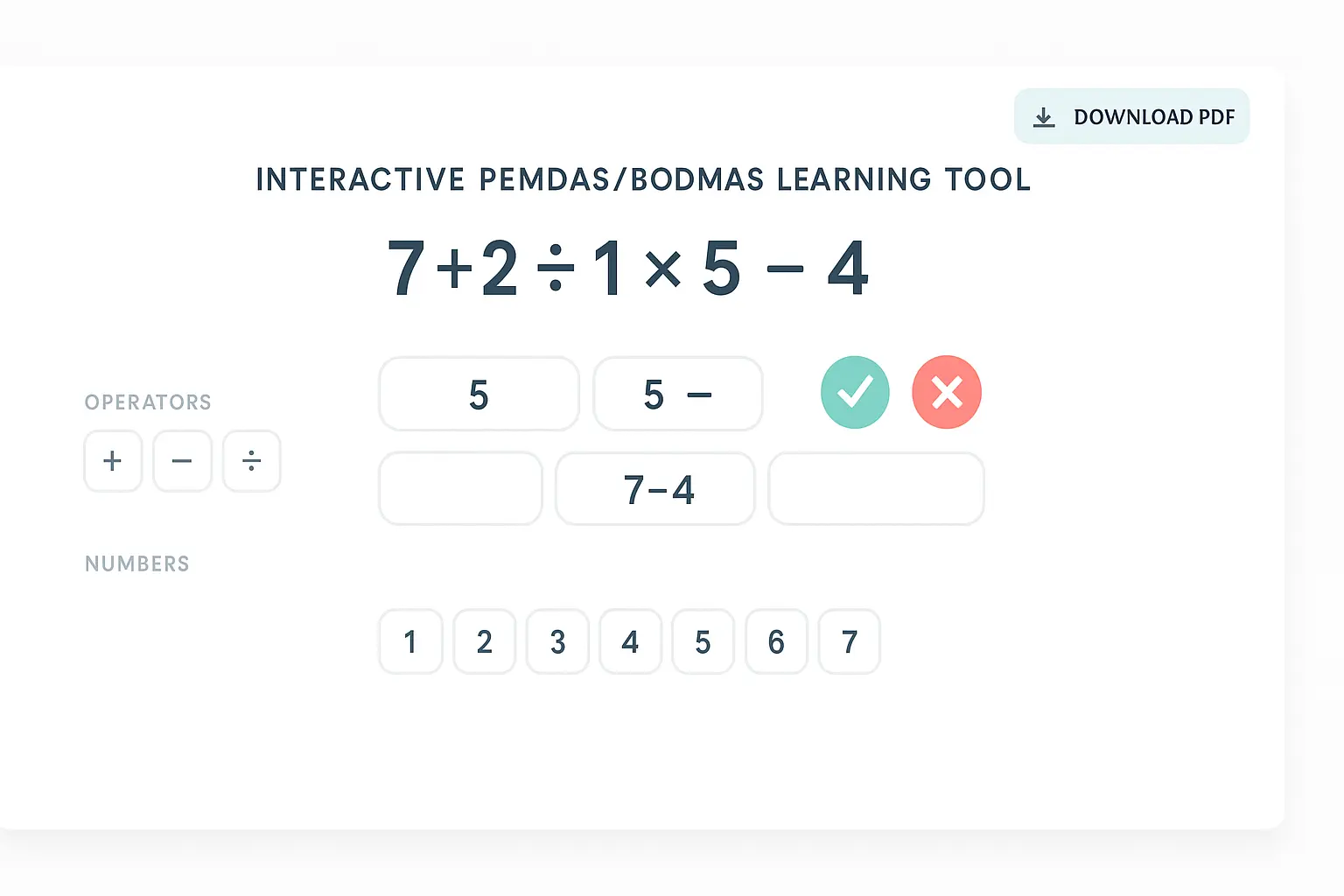
PEMDAS & BODMAS Learning Tool
Learn the order of operations with a safe step-by-step expression solver. Use PEMDAS, BODMAS, BIDMAS, or GEMA language, evaluate parentheses, brackets, braces, exponents, multiplication, division, addition, and subtraction, then practice with instant feedback.
1. Enter an Expression
Supported symbols: +, -, ×, *, ÷, /, ^, parentheses (), brackets [], and braces {}.
Batch Solver
2. Answer
The expression is evaluated using grouping, exponents, multiplication/division, then addition/subtraction.
Order Ladder
Expression Summary
3. Step-by-Step Work
| Step | Rule Used | Before | Operation | After |
|---|
Batch Results
| Expression | Answer | Steps | Status |
|---|
4. Practice Generator
Solve using order of operations, then check your answer.
PEMDAS and BODMAS Formulas
PEMDAS, BODMAS, BIDMAS, and GEMA are memory tools for the same central idea: evaluate mathematical expressions in a conventional order so that everyone gets the same result.
Multiplication and division share the same priority:
Addition and subtraction also share the same priority:
Exponents are usually evaluated before multiplication and division:
Grouping symbols override the normal order:
Complete Guide to PEMDAS and BODMAS
PEMDAS and BODMAS are memory devices for the order of operations. They help students decide which operation to perform first when an expression contains more than one operation. Without an agreed order, an expression such as \(6+3\times4\) could be misunderstood. One person might add first and get 36. Another person might multiply first and get 18. The conventional order tells us to multiply before adding, so the correct value is 18.
PEMDAS stands for Parentheses, Exponents, Multiplication, Division, Addition, and Subtraction. BODMAS stands for Brackets, Orders, Division, Multiplication, Addition, and Subtraction. BIDMAS uses Indices instead of Orders. GEMA uses Grouping, Exponents, Multiplication/Division, and Addition/Subtraction. These names look different, but they describe the same practical structure. Grouping comes first, powers come next, multiplication and division are handled together from left to right, and addition and subtraction are handled together from left to right.
The most important teaching point is that multiplication does not always come before division. They have the same priority. The same is true for addition and subtraction. Students who treat PEMDAS as six separate steps sometimes make mistakes. For example, \(18\div3\times2\) should be evaluated from left to right. First \(18\div3=6\), then \(6\times2=12\). It is not \(18\div(3\times2)=3\).
Addition and subtraction also move left to right. For example, \(10-4+2\) becomes \(6+2=8\). It is not \(10-(4+2)=4\). This is why many teachers prefer phrasing the rule as “grouping, exponents, multiplication/division left to right, addition/subtraction left to right.” That version is longer than PEMDAS, but it is harder to misread.
Grouping symbols include parentheses, brackets, braces, and sometimes fraction bars or radicals. Parentheses are the most familiar, but brackets and braces work the same way in arithmetic expressions. A grouped expression must be evaluated before it is used by the outside expression. In \(5+[12\div(3+1)]\times2\), the \(3+1\) must be evaluated first because it is inside parentheses.
Exponents are repeated multiplication. In \(3^2\), the base is 3 and the exponent is 2, so the value is \(3\times3=9\). Exponents are evaluated before multiplication, division, addition, and subtraction unless grouping says otherwise. That is why \(2+3^2=11\), while \((2+3)^2=25\). The grouping changes what the exponent applies to.
Expressions with nested grouping are solved from the inside out. If an expression has parentheses inside brackets, evaluate the innermost grouping first. For example, in \(5+[12\div(3+1)]\times2\), calculate \(3+1=4\), then \(12\div4=3\), then \(3\times2=6\), and finally \(5+6=11\). The visual steps in this tool are designed to show that chain clearly.
A common confusion appears with calculators and typed expressions. Some calculators support implicit multiplication, so \(2(3+4)\) means \(2\times(3+4)\). Other systems require the multiplication sign. This tool can allow implicit multiplication, but students should understand that the multiplication is still present. Writing \(2(3+4)\) means two groups of the quantity \(3+4\).
Another common issue is exponent association. Many mathematical systems treat exponent towers as right-associative, so \(2^3^2\) means \(2^{(3^2)}=2^9=512\). Some learners expect \((2^3)^2=64\). This tool includes an exponent rule option so teachers can demonstrate the difference. In early classroom work, grouping can remove ambiguity: write \(2^{(3^2)}\) or \((2^3)^2\).
Order of operations is not just a trick. It is a convention that makes mathematical communication precise. Algebra, computer science, spreadsheets, physics formulas, chemistry calculations, finance formulas, coding expressions, and graphing tools all rely on expression structure. A small change in grouping can completely change the result.
Students should learn to read an expression before calculating. First find grouping. Next identify exponents. Then scan for multiplication and division from left to right. Finally scan for addition and subtraction from left to right. This process is slower at first, but it builds accuracy. Rushing straight into computation often creates avoidable mistakes.
Word problems can also involve order of operations. A question might say: “A ticket costs $8. A service fee of $3 is added to each order. How much do 5 tickets plus the service fee cost?” If the fee is per order, the expression is \(5\times8+3\). If the fee is per ticket, the expression is \(5\times(8+3)\). These expressions have different values. The order of operations helps evaluate them, but understanding the context helps write them correctly.
In algebra, order of operations becomes even more important. An expression such as \(2x+5\) means multiply \(x\) by 2, then add 5. The expression \(2(x+5)\) means add first, then multiply the entire group by 2. These are not equivalent in general. Understanding PEMDAS and BODMAS prepares students for simplifying expressions, solving equations, factoring, expanding, and evaluating formulas.
In spreadsheets, order of operations appears in formulas such as =A1+B1*C1. The multiplication happens before addition. If the user wants addition first, the formula must be written as =(A1+B1)*C1. In programming languages, expressions follow precedence rules too. The exact rules may vary by language, so grouping is often the safest way to make intent clear.
This learning tool does not use unsafe code evaluation. It tokenizes the expression, normalizes symbols such as \(×\) and \(÷\), handles grouping, and then applies the order rules step by step. This makes the tool suitable for teaching because students can see each operation rather than receiving only a final answer.
The tool also includes a batch solver. Teachers can paste several expressions and quickly create answer keys. Students can compare similar expressions that differ only by grouping. For example, \(6+3\times4\), \((6+3)\times4\), and \(6+(3\times4)\) are useful comparison problems because they show exactly why grouping matters.
The practice generator gives students immediate feedback. Easy problems focus on the left-to-right rule for multiplication, division, addition, and subtraction. Medium problems add grouping. Challenge problems add exponents and nested structure. Students should write their steps on paper before checking the answer.
This page is not an official exam score calculator. There is no universal score guideline, score table, or next exam timetable for PEMDAS and BODMAS. This is a learning and practice page. It supports classroom instruction, tutoring, homework review, parent support, homeschool practice, and independent learning. For official exam dates and scoring rules, students must check their school, district, state, or exam-board sources.
Reference Links
Useful curriculum references: Common Core Grade 5 Operations & Algebraic Thinking, Common Core Grade 6 Expression Evaluation.
How to Use This PEMDAS & BODMAS Tool
- Enter an expression. Use numbers, parentheses, brackets, braces, exponents, multiplication, division, addition, and subtraction.
- Choose the learning name. Select PEMDAS, BODMAS, BIDMAS, GEMA, or plain order of operations.
- Set options. Choose decimal precision, implicit multiplication, exponent rule, and whether to show work.
- Click Solve Expression. The tool evaluates grouping, exponents, multiplication/division, and addition/subtraction.
- Study the steps. Each row shows the expression before the step, the operation performed, and the expression after the step.
- Use practice mode. Generate a new expression, solve it yourself, and check your answer.
- Export results. Copy the solution, download CSV, or print the page for a worksheet or classroom note.
| Rule | What It Means | Common Mistake |
|---|---|---|
| Grouping | Evaluate parentheses, brackets, braces, fraction bars, and other grouped parts first. | Ignoring parentheses and doing multiplication first. |
| Exponents / Orders | Evaluate powers before multiplication/division and addition/subtraction. | Adding before applying the exponent. |
| Multiplication and Division | Same priority. Work from left to right. | Always multiplying before dividing. |
| Addition and Subtraction | Same priority. Work from left to right. | Always adding before subtracting. |
| Grouping for clarity | Use parentheses when an expression could be misunderstood. | Writing ambiguous expressions without grouping. |
Score, Course, and Exam Table Note
| Requested Item | Status for This Learning Tool | Correct Guidance |
|---|---|---|
| Score guidelines | Not applicable | This is a math learning and practice tool, not an official score calculator. |
| Score table | Not applicable | There is no universal score table for PEMDAS or BODMAS practice. |
| Next exam timetable | Not applicable | Use official school, district, state, or exam-board sources for course-specific exam dates. |
| Course relevance | Highly relevant for upper elementary, middle school, and pre-algebra | Supports numerical expressions, grouping symbols, exponents, algebra readiness, and expression evaluation. |
PEMDAS & BODMAS FAQ
What is PEMDAS?
PEMDAS stands for Parentheses, Exponents, Multiplication, Division, Addition, and Subtraction. It is a memory aid for the order of operations.
What is BODMAS?
BODMAS stands for Brackets, Orders, Division, Multiplication, Addition, and Subtraction. It describes the same core order as PEMDAS.
Do you multiply before dividing?
Not always. Multiplication and division have the same priority, so solve them from left to right.
Do you add before subtracting?
Not always. Addition and subtraction have the same priority, so solve them from left to right.
What comes first: parentheses or exponents?
Grouping comes first. Evaluate the expression inside parentheses, brackets, or braces before applying outside operations.
Why can two expressions with the same numbers have different answers?
Grouping and operation order can change the structure. For example, \(6+3\times4=18\), but \((6+3)\times4=36\).
What grade level learns PEMDAS or BODMAS?
Students commonly begin formal expression evaluation with grouping symbols around Grade 5 and extend the skill with exponents and algebraic expressions in Grade 6 and beyond.