
WJEC GCSE Maths: Past Papers
Match each WJEC mathematics paper with its tier, unit and marking information.
Quick Answer
Use this WJEC GCSE Maths archive to practise the right tier and check which paper allows a calculator. Pair the question paper with the same unit, tier and session, then compare written methods as well as final answers.
Work backwards from a reduced price
A price is £51 after a 15 percent reduction. The sale price represents 85 percent of the original, so divide 51 by 0.85 to recover £60. Verify by taking £9 off £60. Adding 15 percent to £51 gives £58.65 because it uses a different base. In a practice log, write down which quantity represents the whole before recording the calculation.
Translate and Solve Basic Percent Equations
We will solve percent equations by using the methods we used to solve equations with fractions or decimals. In the past, you may have solved percent problems by setting them up as proportions. That was the best method available when you did not have the tools of algebra. Now as a prealgebra student, you can translate word sentences into algebraic equations, and then solve the equations.
We'll look at a common application of percent—tips to a server at a restaurant—to see how to set up a basic percent application.
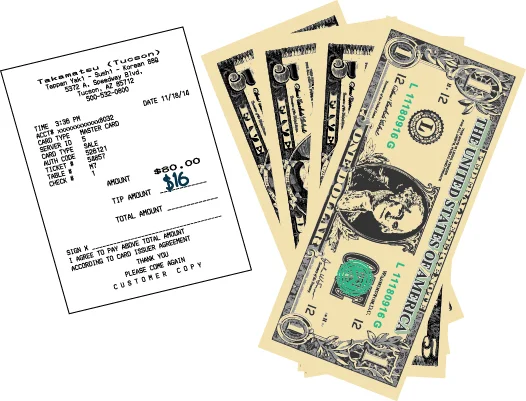
When Aolani and her friends ate dinner at a restaurant, the bill came to They wanted to leave a tip. What amount would the tip be?
To solve this, we want to find what amount is of The is called the base. The amount of the tip would be or See diagram. To find the amount of the tip, we multiplied the percent by the base.
In the next examples, we will find the amount. We must be sure to change the given percent to a decimal when we translate the words into an equation.
What number is of
Solution
Solution
| Translate into algebra. Let the number. | 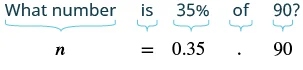 |
| Multiply. |  |
| is of |
of is what number?
Solution
Solution
| Translate into algebra. Let the number. | 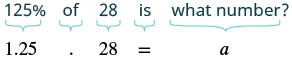 |
| Multiply. |  |
| of is . |
Remember that a percent over is a number greater than We found that of is which is greater than
In the next examples, we are asked to find the base.
Translate and solve: is of what number?
Solution
Solution
| Translate. Let the number. | 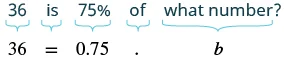 |
| Divide both sides by 0.75. |  |
| Simplify. |  |
of what number is
Solution
Solution
| Translate. Let the number. |  |
| Divide both sides by 0.065. |  |
| Simplify. |  |
In the next examples, we will solve for the percent.
What percent of is
Solution
Solution
| Translate into algebra. Let the percent. | 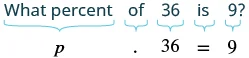 |
| Divide by 36. |  |
| Simplify. |  |
| Convert to decimal form. |  |
| Convert to percent. |  |
is what percent of
Solution
Solution
| Translate into algebra. Let the percent. | 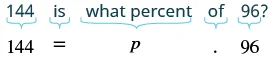 |
| Divide by 96. |  |
| Simplify. |  |
| Convert to percent. | 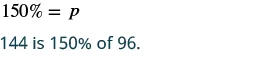 |
Solve Applications of Percent
Many applications of percent occur in our daily lives, such as tips, sales tax, discount, and interest. To solve these applications we'll translate to a basic percent equation, just like those we solved in the previous examples in this section. Once you translate the sentence into a percent equation, you know how to solve it.
We will update the strategy we used in our earlier applications to include equations now. Notice that we will translate a sentence into an equation.
Now that we have the strategy to refer to, and have practiced solving basic percent equations, we are ready to solve percent applications. Be sure to ask yourself if your final answer makes sense—since many of the applications we'll solve involve everyday situations, you can rely on your own experience.
Dezohn and his girlfriend enjoyed a dinner at a restaurant, and the bill was They want to leave an tip. If the tip will be of the total bill, how much should the tip be?
Solution
Solution
| What are you asked to find? | the amount of the tip |
| Choose a variable to represent it. | Let amount of tip. |
| Write a sentence that give the information to find it. | The tip is 18% of the total bill. |
| Translate the sentence into an equation. | 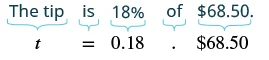
|
| Multiply. |  |
| Check. Is this answer reasonable? | |
| If we approximate the bill to $70 and the percent to 20%, we would have a tip of $14. So a tip of $12.33 seems reasonable. | |
| Write a complete sentence that answers the question. | The couple should leave a tip of $12.33. |
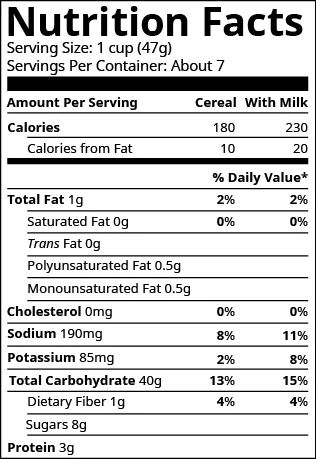
The label on Masao's breakfast cereal said that one serving of cereal provides milligrams (mg) of potassium, which is of the recommended daily amount. What is the total recommended daily amount of potassium?
Solution
Solution
| What are you asked to find? | the total amount of potassium recommended |
| Choose a variable to represent it. | Let total amount of potassium. |
| Write a sentence that gives the information to find it. | 85 mg is 2% of the total amount. |
| Translate the sentence into an equation. | 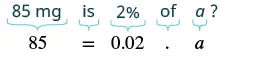
|
| Divide both sides by 0.02. |  |
| Simplify. |  |
| Check: Is this answer reasonable? | |
| Yes. 2% is a small percent and 85 is a small part of 4,250. | |
| Write a complete sentence that answers the question. | The amount of potassium that is recommended is 4250 mg. |
Mitzi received some gourmet brownies as a gift. The wrapper said each brownie was calories, and had calories of fat. What percent of the total calories in each brownie comes from fat?
Solution
Solution
| What are you asked to find? | the percent of the total calories from fat |
| Choose a variable to represent it. | Let percent from fat. |
| Write a sentence that gives the information to find it. | What percent of 480 is 240? |
| Translate the sentence into an equation. | 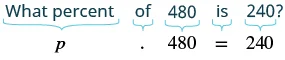
|
| Divide both sides by 480. |  |
| Simplify. |  |
| Convert to percent form. |  |
| Check. Is this answer reasonable? | |
| Yes. 240 is half of 480, so 50% makes sense. | |
| Write a complete sentence that answers the question. | Of the total calories in each brownie, 50% is fat. |
Find Percent Increase and Percent Decrease
People in the media often talk about how much an amount has increased or decreased over a certain period of time. They usually express this increase or decrease as a percent.
To find the percent increase, first we find the amount of increase, which is the difference between the new amount and the original amount. Then we find what percent the amount of increase is of the original amount.
In the California governor proposed raising community college fees from per unit to per unit. Find the percent increase. (Round to the nearest tenth of a percent.)
Solution
Solution
| What are you asked to find? | the percent increase |
| Choose a variable to represent it. | Let percent. |
| Find the amount of increase. | 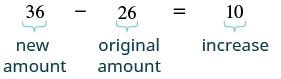 |
| Find the percent increase. | The increase is what percent of the original amount? |
| Translate to an equation. |  |
| Divide both sides by 26. |  |
| Round to the nearest thousandth. |  |
| Convert to percent form. | 
|
| Write a complete sentence. | The new fees represent a 38.5% increase over the old fees. |
Finding the percent decrease is very similar to finding the percent increase, but now the amount of decrease is the difference between the original amount and the final amount. Then we find what percent the amount of decrease is of the original amount.
The average price of a gallon of gas in one city in June was The average price in that city in July was Find the percent decrease.
Solution
Solution
| What are you asked to find? | the percent decrease |
| Choose a variable to represent it. | Let percent. |
| Find the amount of decrease. | 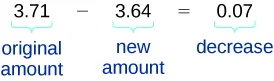 |
| Find the percent of decrease. | The decrease is what percent of the original amount? |
| Translate to an equation. |  |
| Divide both sides by 3.71. |  |
| Round to the nearest thousandth. |  |
| Convert to percent form. |  |
| Write a complete sentence. | The price of gas decreased 1.9%. |
Linear Equations and Applications
Solving any equation is like discovering the answer to a puzzle. The purpose of solving an equation is to find the value or values of the variable that makes the equation a true statement. Any value of the variable that makes the equation true is called a solution to the equation. It is the answer to the puzzle! There are many types of equations that we will learn to solve. In this section, we will focus on a linear equation, which is an equation in one variable that can be written as
where and are real numbers and , such that is the coefficient of and is the constant.
To solve a linear equation, it is a good idea to have an overall strategy that can be used to solve any linear equation. In the Example 5.12, we will give the steps of a general strategy for solving any linear equation. Simplifying each side of the equation as much as possible first makes the rest of the steps easier.
Solving a Linear Equation Using a General Strategy
Solve
Solution
| Step 1: Simplify each side of the equation as much as possible. | Use the Distributive Property. Notice that each side of the equation is now simplified as much as possible. | |
| Step 2: Collect all variable terms on one side of the equation. | Nothing to do; all -terms are on the left side. | |
| Step 3: Collect constant terms on the other side of the equation. | To get constants only on the right, add 29 to each side.
Simplify. |
|
| Step 4: Make the coefficient of the variable term equal to 1. | Divide each side by 7.
Simplify. |
|
| Step 5: Check the solution. | Let Subtract. |
Check: |
In worked example, we used both the addition and division property of equations. All the properties of equations are summarized in table below. Basically, what you do to one side of the equation, you must do to the other side of the equation to preserve equality.
| Operation | Property | Example |
| Addition | If
Then |
|
| Subtraction | If
Then |
|
| Multiplication | If
Then |
|
| Division | If
Then for
|
Solving a Linear Equation Using Properties of Equations
Solve .
Solution
Step 1: Simplify each side.
Step 2: Collect all variables on one side.
Step 3: Collect constant terms on one side.
Step 4: Make the coefficient of the variable 1. Already done!
Step 5: Check.
In Algebraic Expressions, you translated an English sentence into an equation. In this section, we take that one step further and translate an English paragraph into an equation, and then we solve the equation. We can go back to the opening question in this section: If you join your local gym at $10 per month and pay $5 per class, how many classes can you take if your gym budget is $75 per month? We can create an equation for this scenario and then solve the equation (see worked example).
Constructing a Linear Equation to Solve an Application
The Beaudrie family has two cats, Basil and Max. Together, they weigh 23 pounds. Basil weighs 16 pounds. How much does Max weigh?
Solution
Let = Basil’s weight and = Max’s weight.
We also know that Basil weighs 16 pounds so:
Steps 1 and 2:
Since both sides are simplified, the variable is on one side of the equation, we start in Step 3 and collect the constants on one side:
Step 3:
Step 4: is already done so we go to Step 5:
Step 5:
Basil weighs 16 pounds and Max weighs 7 pounds.
Constructing a Linear Equation to Solve Another Application
If you join your local gym at $10 per month and pay $5 per class, how many classes can you take if your gym budget is $75 per month?
Solution
If we let = number of classes, the expression would represent what you pay per month if each class is $5 and there’s a $10 monthly fee per class. $10 is your constant. If you want to know how many classes you can take if you have a $75 monthly gym budget, set the equation equal to 75. Then solve the equation for .
Steps 1 and 2:
Step 3:
Step 4:
Step 5:
The solution is 13 classes. You can take 13 classes on a $75 monthly gym budget.
Constructing an Application from a Linear Equation
Write an application that can be solved using the equation . Then solve your application.
Solution
Answers will vary. Let’s say you want to rent a snowblower for a huge winter storm coming up. If = the number of days you rent a snowblower, then the expression represents what you pay if, for each day, it costs $50 to rent the snowblower and there is a $35 flat rental fee. $35 is the constant. To find out how many days you can rent a snowblower for $185, set the expression equal to 185. Then solve the equation for .
Steps 1 and 2:
Step 3:
Step 4:
Step 5:
The equation is and the solution is 3 days. You can rent a snowblower for 3 days on a $185 budget.
Linear Equations with No Solutions or Infinitely Many Solutions
Every linear equation we have solved thus far has given us one numerical solution. Now we'll look at linear equations for which there are no solutions or infinitely many solutions.
Solving a Linear Equation with No Solution
Solve .
Solution
Step 1: Simplify each side.
Step 2: Collect all variables to one side.
The variable disappeared! When this happens, you need to examine what remains. In this particular case, we have , which is not a true statement. When you have a false statement, then you know the equation has no solution; there does not exist a value for that can be put into the equation that will make it true.
Solving a Linear Equation with Infinitely Many Solutions
Solve .
Solution
Step 1:
Step 2:
As with the previous example, the variable disappeared. In this case, however, we have a true statement (). When this occurs we say there are infinitely many solutions; any value for will make this statement true.
Solving a Formula for a Given Variable
You are probably familiar with some geometry formulas. A formula is a mathematical description of the relationship between variables. Formulas are also used in the sciences, such as chemistry, physics, and biology. In medicine they are used for calculations for dispensing medicine or determining body mass index. Spreadsheet programs rely on formulas to make calculations. It is important to be able to manipulate formulas and solve for specific variables.
To solve a formula for a specific variable means to isolate that variable on one side of the equal sign with a coefficient of 1. All other variables and constants are on the other side of the equal sign. To see how to solve a formula for a specific variable, we will start with the distance, rate, and time formula.
Solving for a Given Variable with Distance, Rate, and Time
Solve the formula for . This is the distance formula where = distance, = rate, and = time.
Solution
Divide both sides by :
Solving for a Given Variable in the Area Formula for a Triangle
Solve the formula for . This is the area formula of a triangle where = area, = base, and = height.
Solution
Step 1: Multiply both sides by 2.
Step 2: Divide both sides by .
Check Your Understanding
Videos
- Solving for a Variable in an Equation
Identifying Polygons
A polygon is a closed, two-dimensional shape classified by the number of straight-line sides. See diagram for some examples. We show only up to eight-sided polygons, but there are many, many more.
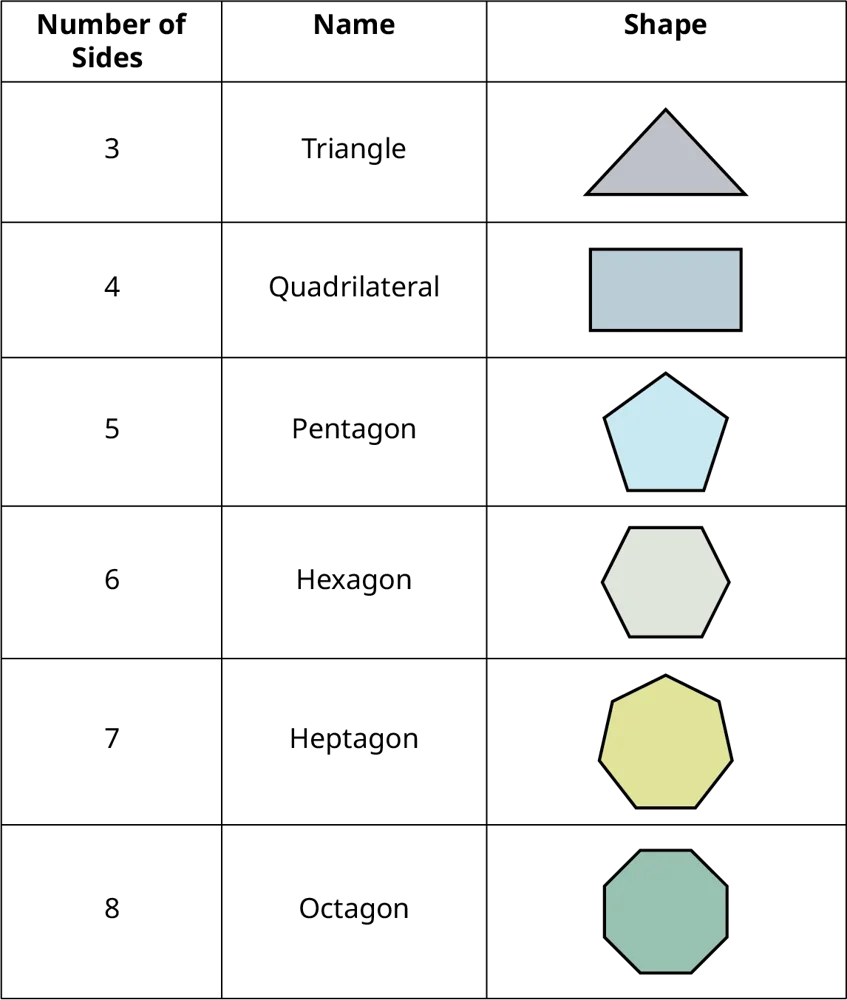
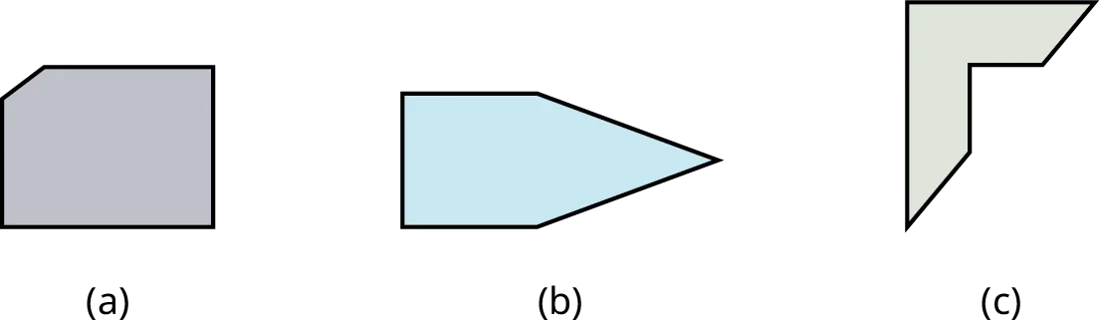
If all the sides of a polygon have equal lengths and all the angles are equal, they are called regular polygons. However, any shape with sides that are line segments can classify as a polygon. For example, the first two shapes, shown in diagram and diagram, are both pentagons because they each have five sides and five vertices. The third shape diagram is a hexagon because it has six sides and six vertices. We should note here that the hexagon in diagram is a concave hexagon, as opposed to the first two shapes, which are convex pentagons. Technically, what makes a polygon concave is having an interior angle that measures greater than . They are hollowed out, or cave in, so to speak. Convex refers to the opposite effect where the shape is rounded out or pushed out.
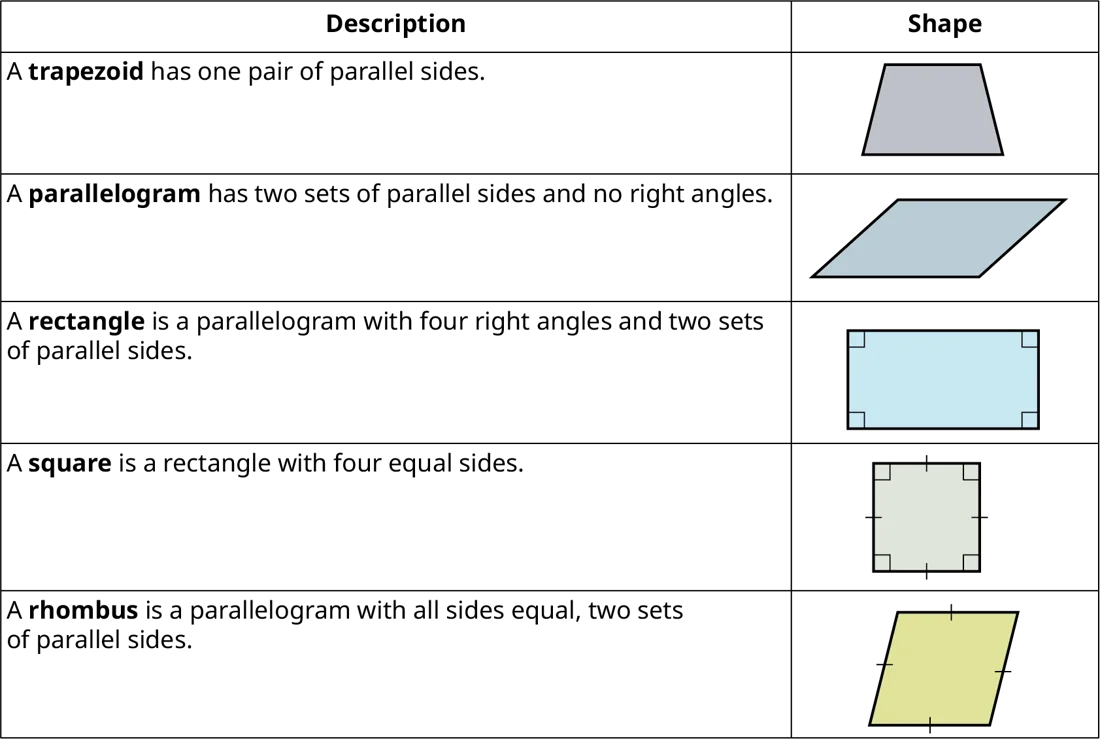
While there are variations of all polygons, quadrilaterals contain an additional set of figures classified by angles and whether there are one or more pairs of parallel sides. See diagram.
Identifying Polygons
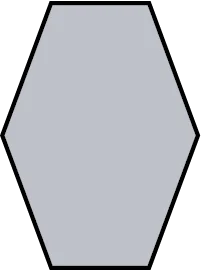
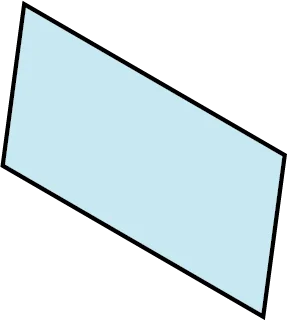
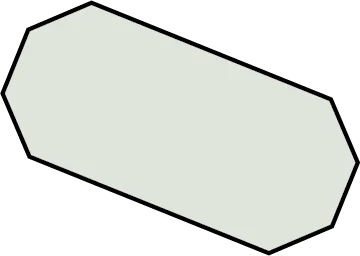
Identify each polygon.
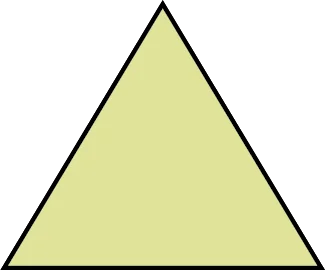
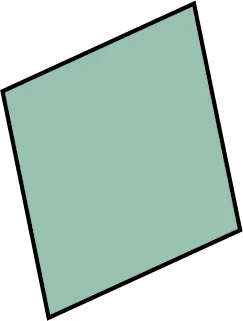
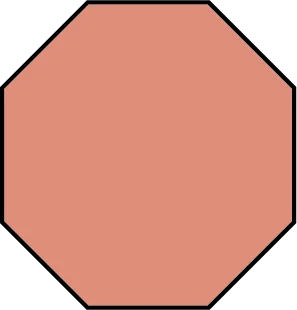
Solution
- This shape has six sides. Therefore, it is a hexagon.
- This shape has four sides, so it is a quadrilateral. It has two pairs of parallel sides making it a parallelogram.
- This shape has eight sides making it an octagon.
- This is an equilateral triangle, as all three sides are equal.
- This is a rhombus; all four sides are equal.
- This is a regular octagon, eight sides of equal length and equal angles.
Determining Multiple Polygons
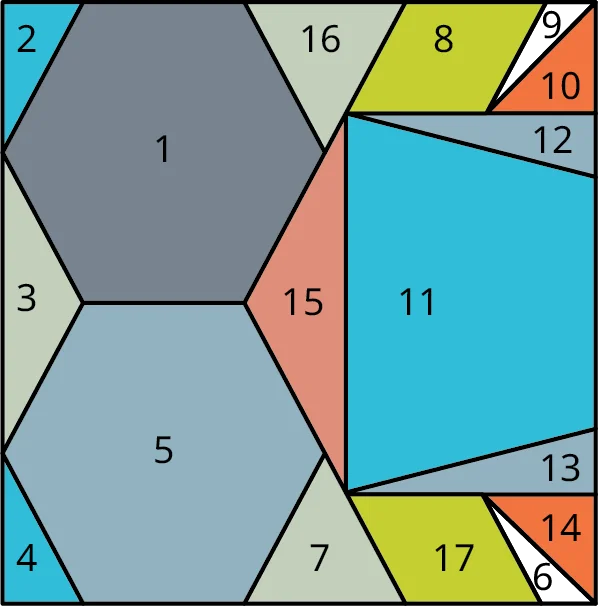
What polygons make up diagram?
Solution
Shapes 1 and 5 are hexagons; shapes 2, 3, 4, 6, 7, 9, 10, 12, 13, 14, 15, and 16 are triangles; shapes 8 and 17 are parallelograms; and shape 11 is a trapezoid.
Perimeter
Perimeter refers to the outside measurements of some area or region given in linear units. For example, to find out how much fencing you would need to enclose your backyard, you will need the perimeter. The general definition of perimeter is the sum of the lengths of the sides of an enclosed region. For some geometric shapes, such as rectangles and circles, we have formulas. For other shapes, it is a matter of just adding up the side lengths.
A rectangle is defined as part of the group known as quadrilaterals, or shapes with four sides. A rectangle has two sets of parallel sides with four angles. To find the perimeter of a rectangle, we use the following formula:
For example, to find the length of a rectangle that has a perimeter of 24 inches and a width of 4 inches, we use the formula. Thus,
The length is 8 units.
The perimeter of a regular polygon with sides is given as . For example, the perimeter of an equilateral triangle, a triangle with three equal sides, and a side length of 7 cm is .
Finding the Perimeter of a Pentagon
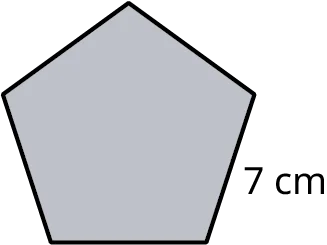
Find the perimeter of a regular pentagon with a side length of 7 cm (diagram).
Solution
A regular pentagon has five equal sides. Therefore, the perimeter is equal to .
Finding the Perimeter of an Octagon
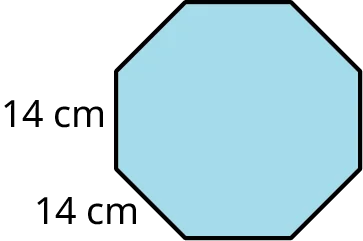
Find the perimeter of a regular octagon with a side length of 14 cm (diagram).
Solution
A regular octagon has eight sides of equal length. Therefore, the perimeter of a regular octagon with a side length of 14 cm is .
Sum of Interior and Exterior Angles
To find the sum of the measurements of interior angles of a regular polygon, we have the following formula.
For example, if we want to find the sum of the interior angles in a parallelogram, we have
Similarly, to find the sum of the interior angles inside a regular heptagon, we have
To find the measure of each interior angle of a regular polygon with sides, we have the following formula.
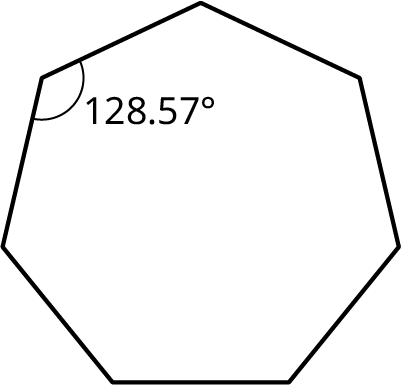
For example, find the measure of an interior angle of a regular heptagon, as shown in diagram. We have
Calculating the Sum of Interior Angles
Find the measure of an interior angle in a regular octagon using the formula, and then find the sum of all the interior angles using the sum formula.
Solution
An octagon has eight sides, so .
Step 1: Using the formula :
So, the measure of each interior angle in a regular octagon is .
Step 2: The sum of the angles inside an octagon, so using the formula:
Step 3: We can test this, as we already know the measure of each angle is . Thus, .
Calculating Interior Angles
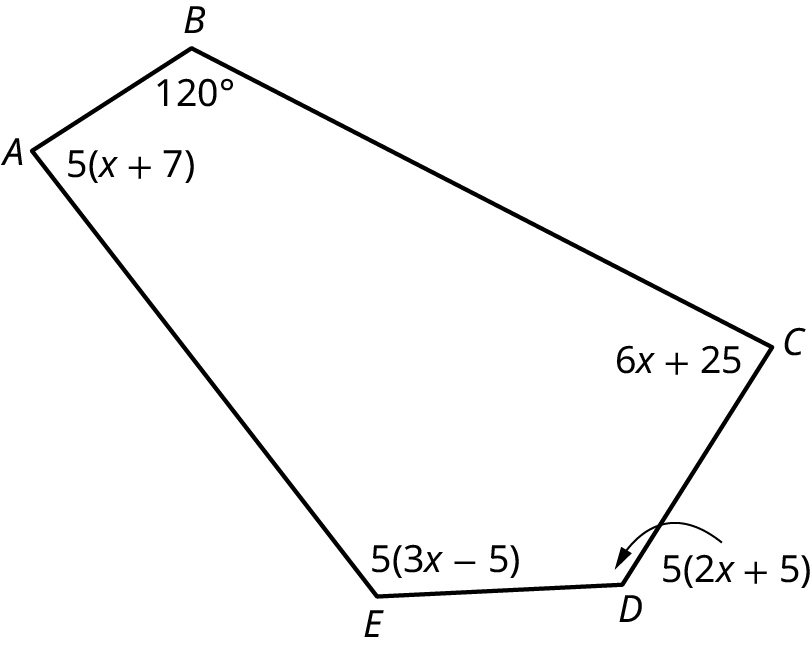
Use algebra to calculate the measure of each interior angle of the five-sided polygon (diagram).
Solution
Step 1: Let us find out what the total of the sum of the interior angles should be. Use the formula for the sum of the angles in a polygon with sides: . So, .
Step 2: We add up all the angles and solve for :
Step 3: We can then find the measure of each interior angle:
An exterior angle of a regular polygon is an angle formed by extending a side length beyond the closed figure. The measure of an exterior angle of a regular polygon with sides is found using the following formula:
In diagram, we have a regular hexagon . By extending the lines of each side, an angle is formed on the exterior of the hexagon at each vertex. The measure of each exterior angle is found using the formula, .
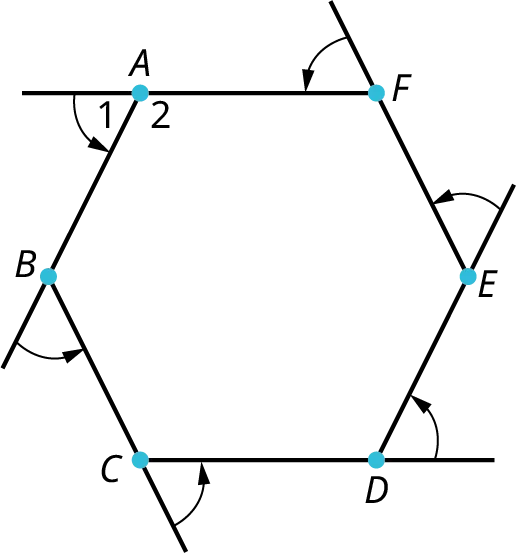
Now, an important point is that the sum of the exterior angles of a regular polygon with sides equals This implies that when we multiply the measure of one exterior angle by the number of sides of the regular polygon, we should get For the example in diagram, we multiply the measure of each exterior angle, , by the number of sides, six. Thus, the sum of the exterior angles is
Calculating the Sum of Exterior Angles
Find the sum of the measure of the exterior angles of the pentagon (diagram).
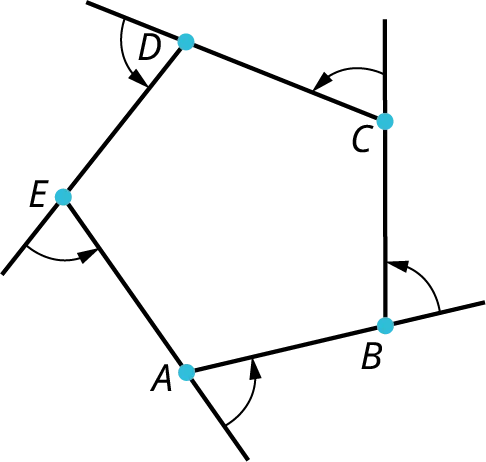
Solution
Each individual angle measures Then, the sum of the exterior angles is
Circles and Circumference
The perimeter of a circle is called the circumference. To find the circumference, we use the formula where is the diameter, the distance across the center, or where is the radius.
The radius is ½ of the diameter of a circle. The symbol is the ratio of the circumference to the diameter. Because this ratio is constant, our formula is accurate for any size circle. See diagram.
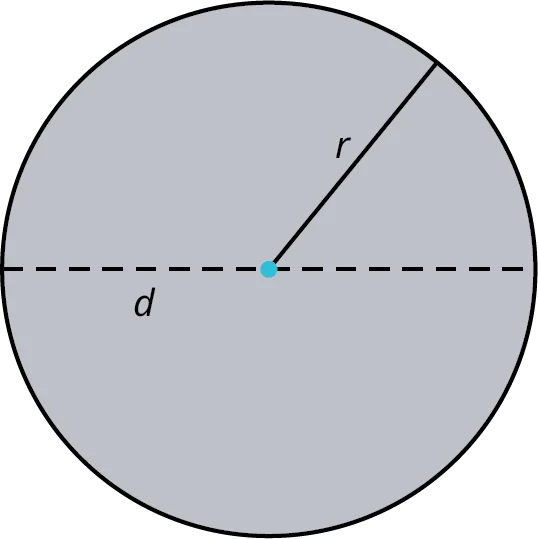
Let the radius be equal to 3.5 inches. Then, the circumference is
Finding Circumference with Diameter
Find the circumference of a circle with diameter 10 cm.
Solution
If the diameter is 10 cm, the circumference is
Finding Circumference with Radius
Find the radius of a circle with a circumference of 12 in.
Solution
If the circumference is 12 in, then the radius is
Calculating Circumference for the Real World
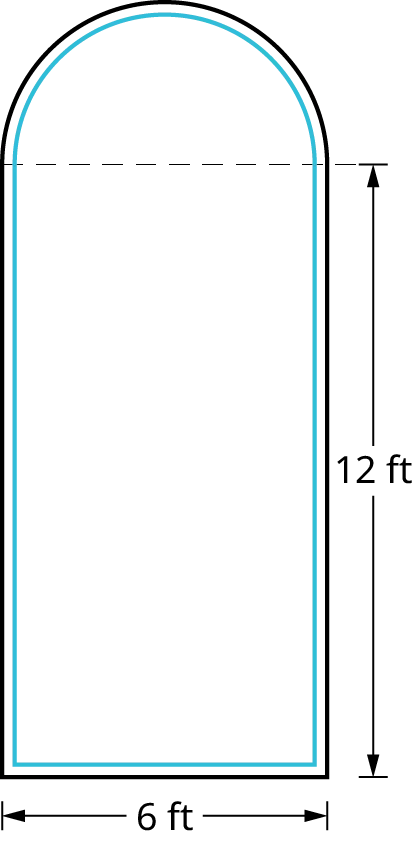
You decide to make a trim for the window in diagram. How many feet of trim do you need to buy?
Solution
The trim will cover the 6 feet along the bottom and the two 12-ft sides plus the half circle on top. The circumference of a semicircle is ½ the circumference of a circle. The diameter of the semicircle is 6 ft. Then, the circumference of the semicircle would be
Therefore, the total perimeter of the window is You need to buy 39.4 ft of trim.