
Quadratic Equation Calculator: Formula, Methods, and Worked Examples
What does this calculator solve?
A quadratic equation has the form ax2 + bx + c = 0, with a ≠ 0. Enter its three coefficients to explore the roots, discriminant, vertex, factored form, table of values, domain, range, and other features of the parabola.
The roots are the values that make the equation true. Real roots give the horizontal coordinates of the graph’s x-intercepts; complex roots do not appear as intercepts on the real coordinate plane.
How to use the quadratic equation calculator
- Put zero on one side. For example, 2x2 + 7 = 3x becomes 2x2 − 3x + 7 = 0.
- Enter the coefficients with their signs. For that equation, a = 2, b = −3, and c = 7. A missing term has coefficient zero: x2 − 9 = 0 uses 1, 0, −9.
- Choose the analysis and select Calculate. The solving mode finds roots; the other modes focus on features such as the vertex, discriminant, transformations, or sign intervals.
- Read the interpretation and check the result. Substitute each root into the original equation. Use exact values when possible and round only at the end.
A quadratic expression is ax2 + bx + c; an equation sets expressions equal; a function, such as f(x) = ax2 + bx + c, assigns an output to each input. In each quadratic, the highest power of the variable is two.
The quadratic formula and discriminant
For real coefficients and a ≠ 0, the quadratic formula finds every real or complex solution:
Here a is the squared-term coefficient, b is the linear-term coefficient, and c is the constant. The entire numerator is divided by 2a. The symbol ± means to calculate both the plus branch and the minus branch.
The discriminant Δ tells you what kind of roots to expect:
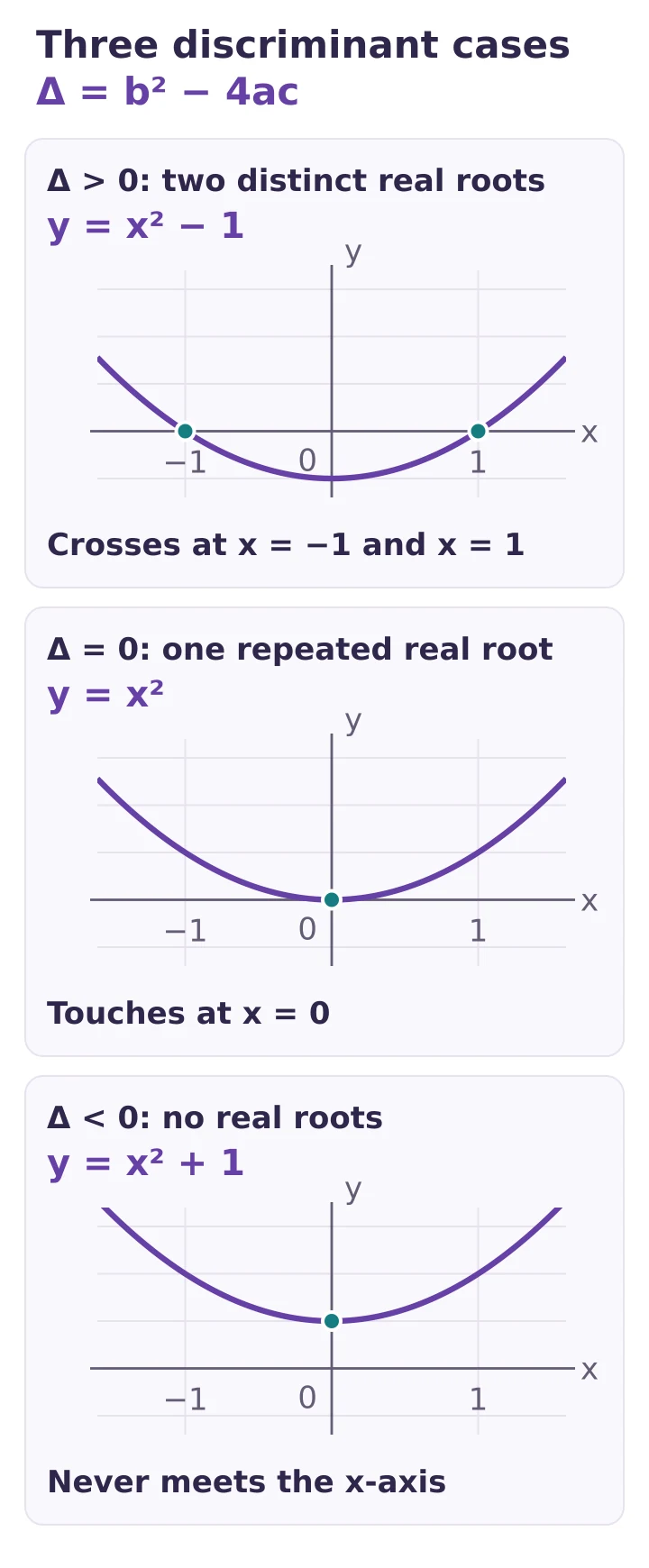
- Δ > 0: two distinct real roots. The parabola crosses the x-axis twice.
- Δ = 0: one repeated real root. Both branches give the same value. The vertex touches the x-axis.
- Δ < 0: two nonreal complex conjugate roots. The parabola has no real x-intercepts.
With integer coefficients, a positive perfect-square discriminant gives rational roots. A positive discriminant that is not a perfect square gives irrational roots. Its sign predicts the root type; you still need the full formula to find the roots.
Worked example: two distinct real roots
Solve 2x2 − 5x − 3 = 0. Use a = 2, b = −5, and c = −3.
The plus branch gives x = 3; the minus branch gives x = −. Both make the original expression zero:
Worked example: one repeated root
Solve x2 − 6x + 9 = 0. The discriminant is 36 − 36 = 0, so:
There is one distinct solution, 3, with multiplicity two. The graph touches the axis at (3, 0) and turns back upward; it does not cross there.
Worked example: complex roots
For 3x2 − 4x + 2 = 0, enter a = 3, b = −4, and c = 2. The discriminant is negative:
The imaginary unit satisfies i2 = −1. Because √8 = 2√2, the imaginary coefficient simplifies to , approximately 0.471405. The real part is approximately 0.666667.
These conjugate roots have sum and product + = , agreeing with the original coefficients. The graph’s vertex is (, ); the upward-opening parabola stays above the x-axis.
Choose a solving method
Graphing provides a visual interpretation and estimates of real roots. A graph alone generally cannot establish an exact root, and it cannot display nonreal roots as real-axis intercepts.
Factoring, including the correct grouping method
First move all terms to one side and factor out any common factor. Solving a product equal to zero relies on the zero-product property: at least one factor must be zero.
When the leading coefficient is one
To factor x2 + bx + c, look for numbers p and q whose sum is b and product is c. Then:
For example, −1 and −3 add to −4 and multiply to 3. So x2 − 4x + 3 = (x − 1)(x − 3); setting the product equal to zero gives x = 1 or x = 3.
When the leading coefficient is not one
- Look for two numbers with product ac and sum b.
- Use them to split the middle term into two terms.
- Factor each pair of terms, taking out a negative factor if needed. The binomials left inside the brackets must match.
- Factor out that common binomial. Check by multiplying the factors back together, then set each factor equal to zero.
For 2x2 − 5x − 3, the product is ac = −6. The numbers −6 and 1 have sum −5:
Thus 2x + 1 = 0 or x − 3 = 0, recovering − and 3. Do not assume the grouped factors always have a fixed pattern involving ax + p; use the actual common factors. If no convenient integer pair exists, switch to completing the square or the formula.
The square-root method
Isolate the squared expression before taking square roots. For example:
For a negative right-hand side, there are no real solutions, but complex solutions are possible: x2 = −9 gives x = ±3i. For zero, both branches coincide at zero.
Completing the square
Divide the whole equation by a first so the squared term has coefficient one. Move the constant to the other side, take half the new linear coefficient, square it, and add that same number to both sides.
For example, solve x2 − 4x + 1 = 0:
The same operation rewrites the function as f(x) = (x − 2)2 − 3, exposing its vertex (2, −3). Applied to general coefficients, completing the square gives:
Taking both square-root branches and isolating x produces the quadratic formula above.
Graph, vertex, axis, and intercepts
The graph of a quadratic function is a parabola. Standard form and vertex form describe the same function:
- Vertex: (h, k), where h = and k = f(h).
- Axis of symmetry: the vertical line x = h. Points equally far left and right of this line have equal heights.
- Opening: a > 0 gives a minimum and an upward-opening graph; a < 0 gives a maximum and a downward-opening graph.
- Intercepts: the y-intercept is (0, c). Real solutions of f(x) = 0 give the x-intercepts, where the graph crosses or touches the axis.
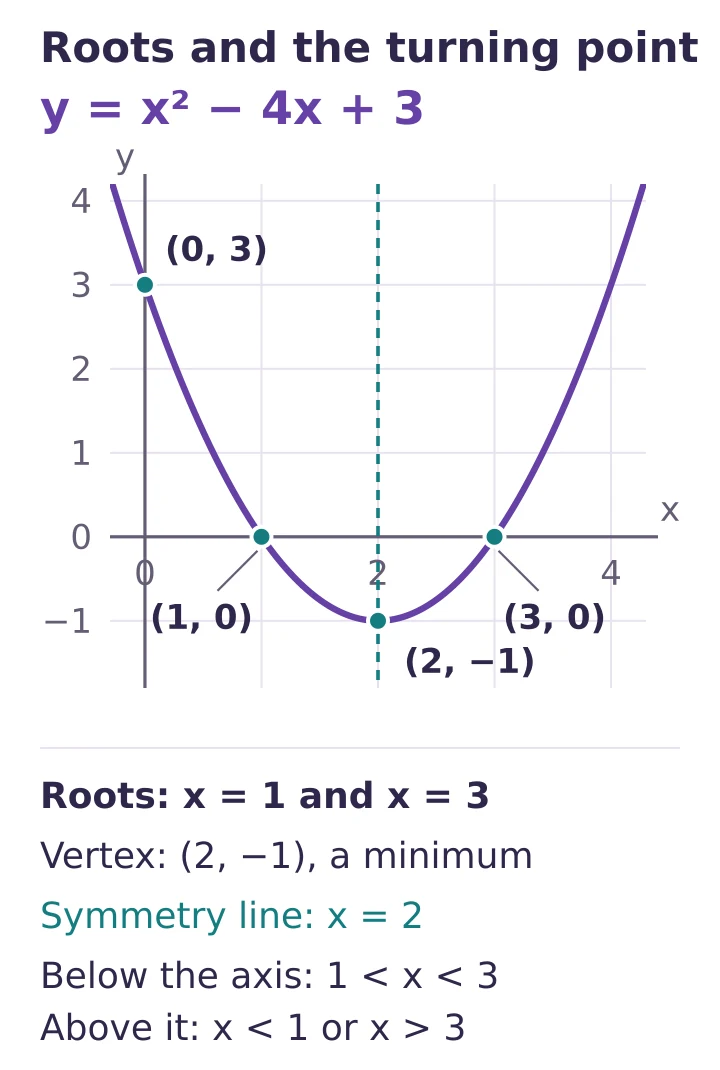
To sketch a parabola, plot its vertex and intercepts, add a pair of symmetric points, and draw a smooth curve. For f(x) = x2 − 4x + 3, the vertex is (2, −1), the roots are 1 and 3, and the y-intercept is (0, 3).
Transformations and width
In a(x − h)2 + k, h shifts the vertex horizontally and k shifts it vertically. For example, (x + 3)2 has horizontal vertex coordinate −3. A negative a reflects the parent parabola across the x-axis. Holding the vertex fixed, increasing |a| makes the graph narrower; values between zero and one make it wider.
Domain and range
For a real quadratic function with no restriction from a word problem, the domain is all real numbers: (−∞, ∞). Its range is determined by the vertex height k:
- When a > 0, f(x) ≥ k, so the range is [k, ∞).
- When a < 0, f(x) ≤ k, so the range is (−∞, k].
For the graphed example, the domain is all real numbers and the range is [−1, ∞). In a physical model, a restriction such as nonnegative time can change the relevant domain and range.
Convert between standard, vertex, and factored form
Each form highlights different information. Standard form shows the coefficients and y-intercept; vertex form shows the turning point; factored form shows the roots.
So b = −2ah and c = ah2 + k. If the roots are r1 and r2, including a repeated root, then:
For example, (x − 1)(x − 3), x2 − 4x + 3, and (x − 2)2 − 1 all represent the same function. If there are no real roots, there is no factorization into real linear factors, although complex factors exist.
Find a quadratic equation from a graph
If the vertex (h, k) is known, use y = a(x − h)2 + k. Substitute one other point whose x-coordinate differs from h and solve for a.
For a vertex at (2, −1) and a point at (0, 3):
Alternatively, use two known roots in y = a(x − r1)(x − r2) and substitute a point that is not one of the roots. With three points having distinct x-coordinates, substitute each into y = ax2 + bx + c and solve the three simultaneous equations. Check that the resulting a is nonzero; three collinear points describe a line instead.
Quadratic inequalities and sign intervals
To solve a quadratic inequality, move everything to one side, find the real roots, and use them to divide the number line into intervals. Test one input in each interval, or read whether the graph lies above or below the axis.
For x2 − 4x + 3 = (x − 1)(x − 3):
- x < 1: both factors are negative, so their product is positive.
- 1 < x < 3: the factors have opposite signs, so their product is negative.
- x > 3: both factors are positive, so their product is positive.
Therefore x2 − 4x + 3 < 0 has solution (1, 3), while x2 − 4x + 3 ≥ 0 has solution (−∞, 1] ∪ [3, ∞). Strict inequalities exclude the roots; inclusive inequalities include them.
For two distinct roots, an upward-opening parabola is positive outside the roots and negative between them; a downward-opening one has the reverse signs. With a repeated root, the sign does not change at that root. With no real roots, the expression always has the sign of a.
Check answers and avoid common mistakes
- Check the input signs. For x2 − 4x − 5 = 0, enter 1, −4, −5, not 1, 4, 5.
- Keep the entire denominator. The quadratic formula divides the full numerator by 2a.
- Keep both branches. A positive discriminant gives two distinct roots; zero gives one repeated root.
- Distinguish a root from a vertex. Roots make y = 0; the vertex is the turning point.
- Substitute and expand. Each exact root must make ax2 + bx + c equal zero; multiplying factors must recover the original expression.
- Treat decimals as approximations. A rounded root can leave a small residual. Its size depends on coefficient scale and precision, so one fixed cutoff is not a universal accuracy test.
Vieta’s relationships provide a second check, including for repeated or complex roots:
What if a = 0? The equation is not quadratic. If b ≠ 0, solve the linear equation to get x = . If both a and b are zero, there are no solutions when c ≠ 0, and every value is a solution when c = 0.
Practice with worked answers
Try each problem before opening its solution. These questions connect algebraic calculations to the meaning of the graph.
1. Solve x2 + 2x − 15 = 0 by factoring.
The numbers 5 and −3 multiply to −15 and add to 2. Thus (x + 5)(x − 3) = 0, giving x = −5 or x = 3. Their sum is −2 and product is −15, as required.
2. Find the roots and vertex of 4x2 − 12x + 9.
The discriminant is 144 − 144 = 0. Factoring gives (2x − 3)2, so the repeated root is . The vertex is (, 0), and the graph touches the axis there.
3. Solve 2x2 + 4x + 5 = 0.
Here Δ = 16 − 40 = −24, so there are no real roots. The quadratic formula simplifies to:
The roots are a complex conjugate pair.
4. Find the vertex, intercepts, and range of f(x) = −2(x − 1)2 + 8.
The vertex is (1, 8) and the graph opens downward. Setting the function to zero gives (x − 1)2 = 4, so the roots are −1 and 3. The y-intercept is (0, 6). With all real inputs allowed, the range is (−∞, 8].
5. Solve x2 + x − 6 ≤ 0.
Factor to obtain (x + 3)(x − 2) ≤ 0. The upward-opening graph is below the axis between its roots −3 and 2. Include the roots because equality is allowed. The solution is [−3, 2].
Continue learning
Build on this lesson with the quadratic equation study guide, practise exam-style techniques in solving quadratics for GCSE algebra, or explore broader equation skills with the algebra calculator with steps.
Sources & References
The methods and terminology were checked against OpenStax’s College Algebra 2e. Explanations, worked calculations, practice, and diagrams here are presented for this lesson. Calculator output is a mathematical aid, not official exam-board marking guidance; retain exact values when an exact answer is requested.
- OpenStax, College Algebra 2e, §2.5: Quadratic Equations — factoring, square roots, completing the square, the quadratic formula, and discriminants.
- OpenStax, College Algebra 2e, §5.1: Quadratic Functions — vertex form, transformations, intercepts, domain, and range.