NUMBER SKILLS · EXPLANATION + PRACTICE
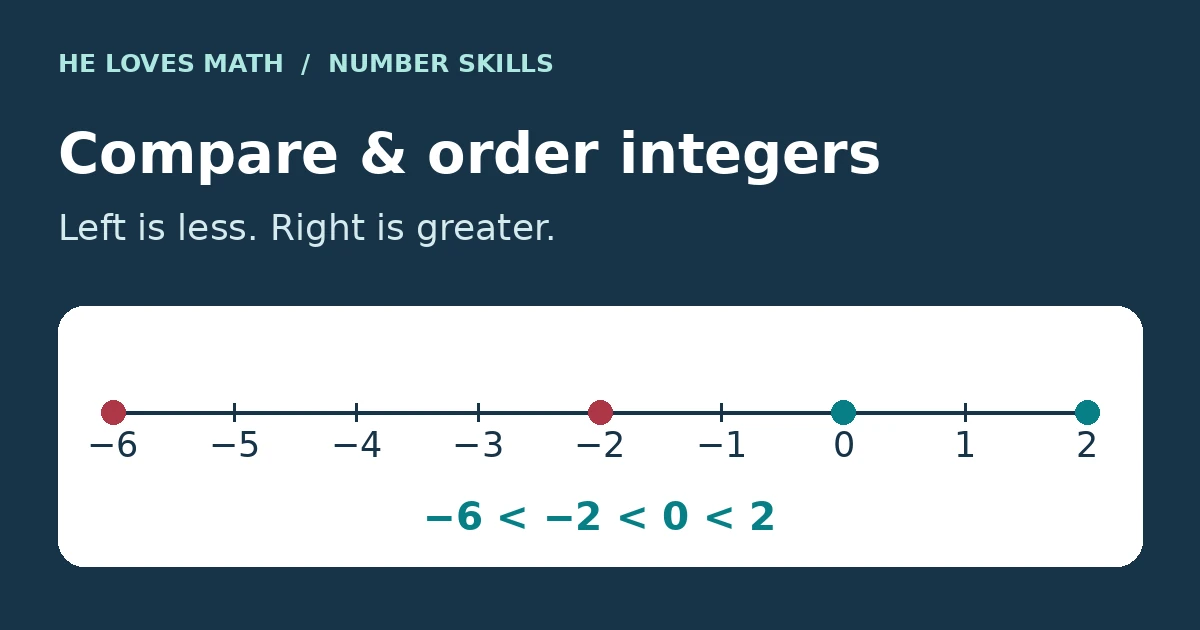
Left is less. Right is greater.
To compare integers, choose the number farther right on a number line: it is greater. To order integers, read their positions from left to right for least to greatest, or from right to left for greatest to least. For example, −8 < −3 < 0 < 5.
Zero is neither positive nor negative. With two negative integers, the one closer to zero is greater: −3 > −8.
Interactive integer ordering practice
Try the order yourself, then check it here. Separate numbers with commas, spaces, new lines or semicolons. Repeated values stay in your list. Press Enter to sort, or Shift + Enter to add a new line.
Use up to 50 integers, each from −9007199254740991 to 9007199254740991. Write plain digits with an optional + or − sign; no fractions, decimal points, exponents or thousands separators. For example, write 1000 rather than 1,000.
Enable JavaScript to use the interactive tool. The lesson and worked answers below remain available.
Sorted result
The drawing includes zero and uses equally spaced unit marks. Scroll it sideways on a narrow screen. Spans wider than 40 units, including zero, use the exact ordered list instead of a crowded diagram; ×2 above a point means that value appears twice.
What are integers?
Integers are the whole-number values and their negatives: …, −3, −2, −1, 0, 1, 2, 3, …. They continue without a greatest or least integer. Values such as ½, 2.7 and −3.4 are not integers. A value such as 3.0 equals the integer 3, although this tool asks you to enter it as 3.
Comparing asks whether one value is less than, equal to or greater than another. Ordering arranges an entire list. Keep each original entry, including repeats. If signed numbers are new to you, begin with the negative numbers guide.
The number-line rule
On a horizontal number line, values increase to the right. Thus −7 is less than −3, 5 is greater than 0, and −1 is greater than −8. The same rule works on both sides of zero.
| Comparison | Rule | Example |
|---|---|---|
| Two positives | Use counting order | 9 > 4 |
| Positive and zero | Positive is greater | 3 > 0 |
| Zero and negative | Zero is greater | 0 > −12 |
| Positive and negative | Positive is greater | 1 > −100 |
| Two negatives | Closer to zero is greater | −2 > −9 |
How to read <, >, =, ≤ and ≥
The open side of < or > faces the greater value. Read the statement from left to right: −6 < 2 says “negative six is less than two.” Reversing the written order also reverses the symbol: 2 > −6. Equal values use =, as in −4 = −4.
The symbol ≤ means “less than or equal to”; ≥ means “greater than or equal to.” For example, x ≤ 3 means x is at most 3, and x ≥ −2 means x is at least −2. A symbol mnemonic helps you write an answer, but the number line explains why it is true.
How to order a mixed list
- Group by sign: negatives, zero if present, then positives.
- Order the negatives: for least to greatest, the most negative comes first. For −1, −12 and −4, write −12, −4, −1.
- Order the positives: use ordinary increasing order.
- Combine and check: keep every repeated entry. Reverse the completed list for greatest to least.
For −1, −12, 6, −4, 2, 0, least to greatest is −12, −4, −1, 0, 2, 6. Greatest to least is 6, 2, 0, −1, −4, −12. Do not insert zero if it was not in the original list.
For a longer example, 14, −3, −18, 0, 6, −1, 11, −9 becomes −18, −9, −3, −1, 0, 6, 11, 14. Here −18 is the least value. The phrase “least negative” instead describes −1, the negative value closest to zero.
Absolute value, opposites and order
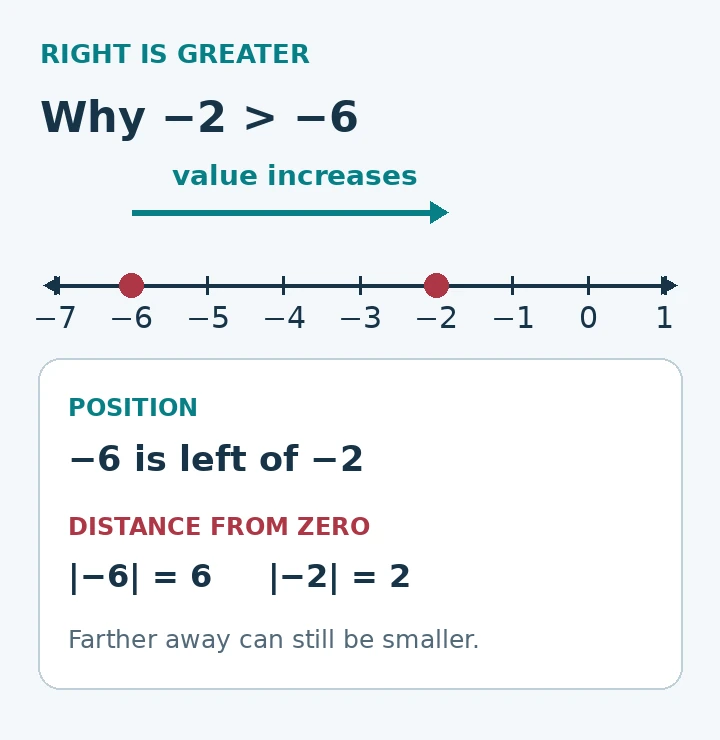
Absolute value is distance from zero, so it is never negative: |−6| = 6, |6| = 6 and |0| = 0. Although |−9| > |−3|, the integer comparison is −9 < −3. A larger distance does not automatically mean a greater value.
Opposites are equally far from zero on opposite sides: 5 and −5 both have absolute value 5, but 5 > −5. Zero is its own opposite; −0 and 0 represent the same integer. Use the absolute value calculator for distance expressions, then compare the resulting values.
Worked examples
1. Compare −4 and 6
6 is positive and −4 is negative. Every positive integer is greater than every negative integer, so −4 < 6.
2. Compare −11 and −3
Both are negative. −3 is closer to zero and farther right, so −11 < −3. It is incorrect to compare only the digit sizes 11 and 3.
3. Order 8, −2, −9, 0, 5, −1 from least to greatest
The negatives are −9, −2, −1 in increasing order. Then come zero and the positives 5, 8. The result is −9, −2, −1, 0, 5, 8.
4. Order −6, 10, −12, 3, 0, −4 from greatest to least
Start with 10 and 3, then 0. Among the negatives, −4 is greatest and −12 is least. The answer is 10, 3, 0, −4, −6, −12.
5. Compare larger negative integers
For −326 and −329, first note that 326 < 329. Their negatives lie on the opposite side of zero, giving −326 > −329. −326 is closer to zero. The place value calculator can help with digit positions.
6. Simplify before ordering
Order −|6|, −2, |−4|, 0 from least to greatest. Since −|6| = −6 and |−4| = 4, the values are −6, −2, 0, 4. The minus sign outside absolute-value bars stays outside the distance calculation.
Repeated integers and inequality chains
Order −4, −4, 2, 0, −1 by keeping both copies of −4: −4, −4, −1, 0, 2. Equal values share a number-line position; sorting a list does not remove duplicates.
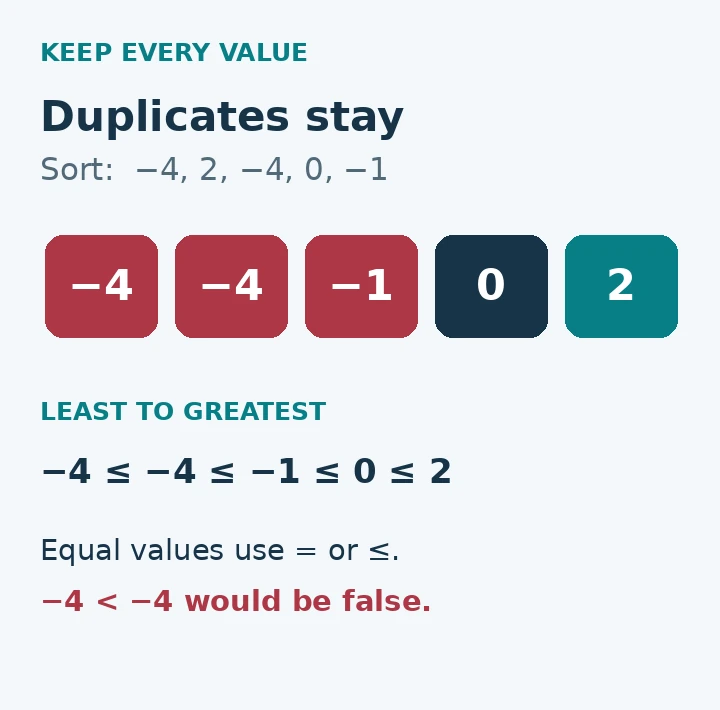
For an increasing list, each neighboring pair must satisfy a ≤ b; for a decreasing list, a ≥ b. If all entries differ, you may use < or > instead. The statement −4 < −4 is false.
To spot an error, check the chain −10 < −4 < −7 < 2. The middle comparison is false. Correct it to −10 < −7 < −4 < 2. Finally, count the entries to confirm none was lost.
Temperature, elevation and other word problems
- Temperature: −6 °C, −2 °C and 3 °C run from coldest to warmest. Use the same temperature scale for every reading.
- Elevation: relative to the same sea-level reference, −120 m, −18 m and 90 m run from lowest to highest. A diver at −18 m is higher than a submarine at −120 m.
- Money: model balances in whole dollars. A balance of −15 dollars is less than −3 dollars; 0 is greater than either. Decimal currency amounts follow the same ordering rule but are outside this integer-only input tool.
- Game scores: “greatest” and “best” are different questions. In golf, −4 relative to par beats −1, even though −4 < −1 mathematically.
Identify the reference point, translate the context into signed values, and then decide which direction the question requests.
Common mistakes and quick fixes
- “−9 > −2 because 9 > 2.” The sign matters. −9 lies farther left, so −9 < −2.
- “Closer to zero always means greater.” This shortcut applies when both values are negative. For positives, 2 is closer to zero than 9 but is smaller.
- “Zero is negative.” Zero is neither positive nor negative.
- “Absolute value gives the order.” It gives distance. Check the sign and position too.
- “Increasing means every step must be strictly larger.” An ordered list may include ties; use ≤ or an equals sign where needed.
Practice problems with explained answers
Insert <, > or = in questions 1–5. For the remaining questions, follow the stated instructions. Try these before opening the answer panel.
- −6 □ 1
- −3 □ −9
- 0 □ −12
- |−10| □ |−6|
- −10 □ −6
- Order −4, 7, −8, 0, 2 from least to greatest.
- Order 5, −1, −6, 9, 0 from greatest to least.
- Order −2, 4, −2, 0, −7 from least to greatest.
- Order −8 °C, 3 °C, −1 °C, 0 °C, 6 °C from coldest to warmest.
- If a < 0 and |a| = 8, what is a?
- List every integer x satisfying −3 < x ≤ 2.
- Which is greater: −1001 or −999? Explain without a long number line.
Show all 12 answers and reasons
- −6 < 1. A negative is less than a positive.
- −3 > −9. −3 is farther right.
- 0 > −12. Every negative is below zero.
- |−10| > |−6|. Compare the distances 10 and 6.
- −10 < −6. Compare positions, not just distances.
- −8, −4, 0, 2, 7. Negatives first, then zero, then positives.
- 9, 5, 0, −1, −6. Read right to left.
- −7, −2, −2, 0, 4. Keep both copies of −2.
- −8 °C, −1 °C, 0 °C, 3 °C, 6 °C. Colder means a smaller reading on this scale.
- a = −8. The distance is 8 and the value is negative.
- −2, −1, 0, 1, 2. Exclude −3 because the first inequality is strict; include 2 because ≤ allows equality.
- −999 > −1001. Both are negative; −999 is closer to zero.
Teaching ideas and a short assessment
A suggested 38-minute lesson keeps the model and reasoning connected:
- 5 minutes: compare temperatures, including zero.
- 8 minutes: build a human or drawn number line. Start within −5 to 5 for beginners.
- 10 minutes: compare pairs and explain the symbols aloud.
- 10 minutes: sort integer cards in both directions, including duplicates. Ask learners to reverse the order without starting again.
- 5 minutes: complete an exit check: compare −8 and −3, then sort −4, 2, −4, 0, −1. Require a sentence explaining the negatives.
Look for five skills: identifying signs, placing values, comparing two negatives, retaining repeated entries and distinguishing distance from value. If pairwise comparisons work but lists do not, practise grouping by sign. If negative comparisons fail, return to the number line before increasing list length. Extend confident learners with absolute-value expressions and integer inequalities such as question 11.
Beyond integers
The position rule also compares rational numbers: −¾ = −0.75, which lies to the right of −0.8, so −¾ > −0.8. These non-integer values need finer positions between the whole-number marks. Continue with fractions, decimals and percentages, decimal place value, fraction foundations, or ordering and comparing numbers.
Integer order also supports later arithmetic: moving from −8 to −3 increases the value by 5; moving from 4 to −3 decreases it by 7. Inequalities such as x > −4 describe positions to the right of −4.
Frequently asked questions
Why is −2 greater than −7?
−2 lies to the right of −7. Among two negative numbers, the one closer to zero is greater.
Is 0 an integer? What about −0?
Yes, 0 is an integer, and it is neither positive nor negative. −0 and 0 have the same value.
How do I order integers greatest to least?
Read their number-line positions from right to left. Include only values in your original list and keep repeats. For −5, 3, −1, the result is 3, −1, −5.
Can the tool order fractions and decimals?
No. It accepts integer notation only and reports invalid entries rather than silently discarding them. Simplify an expression yourself first, then enter its integer value if applicable.
Do integers have a smallest or largest value?
No. Given any integer n, n − 1 is smaller and n + 1 is larger. The input limit here is a software precision limit, not a limit on the integers.
Sources & References
Original explanations, examples and diagrams above were checked against these references. Curriculum references describe the learning content; this page is not an official assessment resource.
- OpenStax, Prealgebra 2e: Introduction to Integers — order, opposites and absolute value.
- Department for Education: Mathematics programme of study, Key Stage 3 — ordering integers and using inequality notation.
- NCETM: Ordering and comparing (PDF) — teaching guidance for comparison and number-line reasoning.