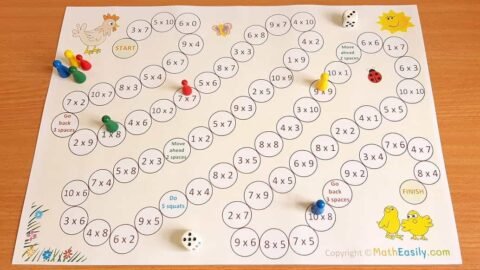
Multiplication Table Game for Grade 3 Kids
Play a fast, kid-friendly multiplication table game built for Grade 3 practice. Students answer times table facts, build streaks, use a 50/50 hint, track lives, and review missed facts after the round. The game is designed for meaningful multiplication fluency, not random guessing: it supports equal groups, arrays, fact families, commutative pairs, and short daily practice.
Play the Multiplication Game
Choose a mode, then answer the multiplication facts. For the strongest learning, play one short round, review missed facts, and replay only the table that caused trouble.
Question 1 of 10
Round Complete
Great practice. Review your missed facts and play again.
What This Multiplication Table Game Is Designed to Do
This multiplication table game is built for Grade 3 kids who are learning to move from repeated addition and skip-counting toward confident multiplication fact recall. It gives students short rounds, immediate feedback, a friendly score, a streak counter, a small number of lives, and a 50/50 hint that removes two wrong choices. Those features make practice feel active, but the purpose is still academic: the student should understand what each fact means, see patterns in the times tables, and gradually answer common facts without counting from the beginning every time.
Grade 3 multiplication can be a turning point. Before multiplication, many students solve arithmetic by counting all or counting on. That works for small addition problems, but it becomes slow when the problem is "7 groups of 8," "6 rows of 9," or "4 boxes with 12 crayons in each box." Multiplication gives students a compact way to describe equal groups. The expression \(7 \times 8 = 56\) is not just a number sentence to memorize; it means seven equal groups of eight, eight equal groups of seven, an array with seven rows and eight columns, or a rectangle with side lengths 7 and 8. When the game asks for a product, it is asking the student to connect those meanings quickly.
The game should be used differently from a chart, worksheet, or explanation page. A chart such as the multiplication chart helps students see structure. A guide such as Learn Multiplication Tables Fast explains strategies and tricks. This game is for retrieval practice after the student has had a chance to learn or review a pattern. It is a practice tool, not a replacement for teaching. The strongest routine is simple: learn a strategy, play one short round, review missed facts, then replay only the facts that need more attention.
A parent or teacher who opens this page should be able to start practice immediately, then use the guide below to make the game more effective. The article supports the playable round with practical advice: how to choose a mode, which facts to practice first, how to explain multiplication to a Grade 3 learner, how to use the score without creating pressure, and how to connect the game to arrays, equal groups, fact families, division, and future math.
How to Play the Game
- Choose a practice level. Warm-up mode uses facts from 0 to 5. Grade 3 core mode uses facts from 0 to 10. Challenge mode extends to 12 for students who are ready.
- Choose mixed or focus practice. Mixed facts are useful for review. A focus table is better when a child keeps missing the same row, such as the 6s, 7s, or 8s.
- Set the round length and timer. Ten questions with regular time is a good first round. Use gentle time when accuracy matters more than speed.
- Answer each multiplication fact. Read the expression, think of the product, and choose the answer. The correct answer is highlighted after each response.
- Use the 50/50 hint carefully. The hint removes two incorrect choices. It is useful when a fact is almost known but the student needs support.
- Review missed facts after the round. Do not rush to replay. Ask, "How could we figure this one out without guessing?" Then use arrays, doubles, five facts, or ten facts.
The game rewards speed, but speed should not be the only goal. For many Grade 3 students, the first goal is accurate reasoning. If a learner is anxious, choose gentle time or use focus mode with easier facts. A student who can explain \(4 \times 7\) as \(2 \times 7 + 2 \times 7\) is building a stronger foundation than a student who guesses quickly. Fast recall becomes valuable after the meaning is secure.
If the student misses many facts in one round, reduce the difficulty. Warm-up mode is not a punishment. It gives the brain a chance to experience success and notice patterns. If the student misses only one or two facts, replay those focus facts. If the student answers almost everything correctly, move to challenge mode or shorten the timer. The right level is the one that creates effort without panic.
The Grade 3 Multiplication Meaning Behind the Game
Multiplication begins with equal groups. The expression \(a \times b\) can be read as \(a\) groups of \(b\). For example, \(3 \times 4\) means 3 groups of 4:
Students also need to see multiplication as an array. An array is an organized set of rows and columns. If there are 3 rows with 4 dots in each row, the total is \(3 \times 4 = 12\). If the same dots are viewed as 4 columns with 3 dots in each column, the total is \(4 \times 3 = 12\). This is the commutative property of multiplication:
The commutative property is a major confidence builder. It means the student does not need to learn \(6 \times 8\) and \(8 \times 6\) as two unrelated facts. They are the same product viewed in two directions. If a child knows \(5 \times 7 = 35\), then \(7 \times 5 = 35\) is already known. When the game presents a fact in either order, remind the learner to flip it mentally if one direction is easier.
Area models add another layer. A rectangle that is 6 units by 8 units has area \(6 \times 8 = 48\) square units. This matters because multiplication is not only a fact list. It becomes the foundation for area, multi-digit multiplication, distributive property, fractions, and algebra. The visual explanation in multiplication from area models is a useful companion when a student needs to see why rows and columns produce a product.
Why Games Help Multiplication Fluency
Fluency is the ability to answer accurately, efficiently, and flexibly. A fluent student can answer \(8 \times 7\), explain why it is 56, recognize that \(7 \times 8\) is the same fact, and use \(56 \div 7 = 8\) later in division. A student who can chant the 8 row but freezes when asked \(8 \times 7\) out of order is not fully fluent yet. Games help because they present facts out of order, require retrieval, and provide immediate feedback.
Retrieval practice is different from rereading a chart. Looking at \(6 \times 7 = 42\) shows the fact, but trying to recall \(6 \times 7\) forces the brain to retrieve it. That retrieval effort strengthens memory. The feedback then confirms or corrects the answer. This is why a short game round can be more useful than staring at a full table for ten minutes.
Games also create repetition without making every problem feel identical. The student sees a question, chooses an answer, receives feedback, and moves to the next fact. Streaks add a small challenge. Hints provide support. Lives make the round finite. The key is to keep the emotional tone healthy. If the game becomes stressful, slow it down, shorten it, or focus on an easier row. Multiplication confidence grows when students experience productive practice, not constant failure.
Parents and teachers should watch for guessing. Multiple-choice practice is efficient, but it can encourage random clicking if the child does not think first. Ask the student to say the product quietly before looking at the answer choices. Another option is to cover the answer choices for two seconds, ask for the product, and then reveal the choices. The goal is recall, not recognition alone.
Which Times Tables Should Grade 3 Kids Practice First?
Most Grade 3 learners do best when the tables are introduced in a strategic order. The easiest rows create anchors for harder rows. A useful order is 0s and 1s, then 2s, 5s, and 10s, then 3s and 4s, then 6s, 7s, 8s, and 9s. The 11s and 12s can be added when the learner is ready or when the local curriculum expects them. The game includes a challenge mode up to 12, but the Grade 3 core mode up to 10 is enough for many students.
| Practice stage | Facts | Why this stage helps | Best game setting |
|---|---|---|---|
| Foundation | 0s, 1s, 2s, 5s, 10s | These facts use clear patterns: zero, identity, doubles, fives, and tens. | Warm-up mode or focus table. |
| Early fluency | 3s and 4s | These facts connect to skip-counting, doubles, and repeated addition. | Grade 3 core with focus rows. |
| Harder core | 6s, 7s, 8s, 9s | These often require anchor strategies instead of simple counting. | Focus row, then mixed review. |
| Extension | 11s and 12s | These extend patterns and prepare students for larger products. | Challenge mode after core facts are stable. |
For reference practice outside the game, students can study the multiplication table to see the full structure. For printable work, use printable multiplication charts. For custom rows, use the free multiplication table generator. Those pages are useful when the learner needs a visual table or worksheet; this page is useful when the learner is ready for an interactive recall round.
Strategies for Each Times Table
0 and 1 Times Tables
The 0 and 1 tables should be meaningful, not just memorized. Zero groups or groups of zero produce zero: \(0 \times n = 0\) and \(n \times 0 = 0\). One group keeps the number the same: \(1 \times n = n\). These facts help students understand the role of multiplication symbols. If a child says \(0 \times 8 = 8\), use equal groups: zero groups of eight means there are no groups, so the total is zero.
2 Times Table
The 2 table is doubles. If a student knows addition doubles, then \(2 \times 6\) is the same as \(6+6=12\). This row is a bridge between addition fluency and multiplication fluency. The focused 2 times table with games page can support extra practice when a student needs more repetition with doubles.
3 Times Table
The 3 table can start with skip-counting, but students should not stay dependent on counting from 3 every time. Connect 3s to one more group than 2s: \(3 \times 7 = 2 \times 7 + 1 \times 7 = 14 + 7 = 21\). This builds the distributive property informally. The 3 times table with games page gives focused review when that row needs practice.
4 Times Table
The 4 table is double the doubles. To find \(4 \times 8\), double 8 to get 16, then double 16 to get 32. This is often faster and more meaningful than counting 4, 8, 12, 16, 20, 24, 28, 32. The strategy also prepares students for powers of two and mental multiplication later.
5 and 10 Times Tables
The 5 and 10 tables are anchor rows. Products in the 10 table end in 0. Products in the 5 table end in 0 or 5. If a student knows \(10 \times 8 = 80\), then \(5 \times 8\) is half of 80, which is 40. The 5 times table with games page can reinforce that pattern.
6 Times Table
The 6 table becomes easier when students use 5s plus one more group. For example, \(6 \times 7 = 5 \times 7 + 1 \times 7 = 35 + 7 = 42\). This works because six groups can be split into five groups and one group. Students can practice this row on the 6 times table with games page after learning the anchor strategy.
7 Times Table
The 7 table is often one of the hardest because it has fewer obvious patterns. Use known facts, commutative pairs, and five-plus-two. For \(7 \times 8\), think \(5 \times 8 + 2 \times 8 = 40 + 16 = 56\). For \(7 \times 6\), think \(6 \times 7\) or \(5 \times 7 + 1 \times 7 = 42\). The 7 times table with games page is useful for focused review after the strategy is clear.
8 Times Table
The 8 table can use doubling. Since 8 is \(2 \times 2 \times 2\), the product \(8 \times 6\) can be found by doubling 6 to 12, doubling again to 24, and doubling again to 48. Some students prefer five-plus-three: \(8 \times 7 = 5 \times 7 + 3 \times 7 = 35 + 21 = 56\). The 8 times table with games page can help students practice that row in isolation.
9 Times Table
The 9 table is best taught as ten minus one group. For \(9 \times 7\), use \(10 \times 7 - 1 \times 7 = 70 - 7 = 63\). This strategy is more reliable than a hand trick because it also supports mental math beyond the table. The 9 times table page can be used for extra pattern practice.
11 and 12 Times Tables
The 11 table has a strong pattern for one-digit factors: \(11 \times 6 = 66\). The 12 table can be built as 10 plus 2 groups: \(12 \times 8 = 10 \times 8 + 2 \times 8 = 80 + 16 = 96\). These rows are extension facts for many Grade 3 learners, but they are useful when the student is ready for challenge mode. The 11 times table page can support the next step.
How to Use the Score Without Creating Pressure
The score is meant to motivate, not label the child. A score can show progress over time, but it should not become the main measure of math ability. Some students think carefully and answer accurately but slowly. Others answer fast and make careless mistakes. The best conversation after a round is not "Why was your score low?" but "Which facts are stronger now, and which facts should we practice next?"
The streak counter is useful because it rewards consistency. A learner who gets five in a row is building confidence. However, a broken streak should be treated as information, not failure. If the streak breaks on \(7 \times 8\), write that fact down, draw an array, and connect it to \(5 \times 8 + 2 \times 8\). Then play a short focus round on 7s or 8s. A missed fact is a map to the next lesson.
Lives are included to make the round finite. They should not be used to shame a child. If a learner loses all lives quickly, the level is probably too hard, the timer is too short, or the student needs a strategy lesson before more retrieval practice. Restart in warm-up mode or choose a focus table with no more than one new row. Success matters because confidence affects willingness to practice.
High scores can be fun, especially when one child plays on the same device over several days. In a classroom, avoid comparing high scores publicly unless every student has consent and the activity is framed carefully. For many classrooms, a better goal is personal improvement: "Can you improve your accuracy on the 6s?" or "Can you reduce missed 7s from four to two?"
Daily Practice Routine for Parents
A good home routine is short, predictable, and calm. Start with one minute of review. Ask the child to explain two facts using equal groups or arrays. Then play a 10-question game round. After the round, review missed facts without rushing. Finally, end with one fact the child can answer confidently. This routine can fit into five to ten minutes and avoids turning multiplication into a long evening battle.
Here is a simple routine:
- Warm up with meaning. Ask, "What does \(4 \times 6\) mean?" Accept "four groups of six," "six plus six plus six plus six," or "four rows of six."
- Play one short round. Use Grade 3 core mode if the child is ready, or warm-up mode if the child is still building early facts.
- Pick one missed fact. Do not reteach every mistake at once. Choose one fact and explain it with a strategy.
- Replay a focus row. If the missed fact was \(7 \times 8\), play a focus round on 7s or 8s with gentle time.
- End with a win. Ask three facts the child knows. Ending successfully makes the next session easier to start.
If a child resists multiplication practice, reduce the number of questions and remove the timer pressure. Let the student choose the focus row. Use physical objects: coins, blocks, pasta, toy cars, or drawings. Multiplication facts become easier when they are attached to real groups. For example, 4 toy cars with 4 wheels each gives \(4 \times 4 = 16\). Three plates with 5 crackers each gives \(3 \times 5 = 15\).
Parents should also watch the language they use. Instead of saying "You should know this by now," ask "Which fact can help us figure this out?" This moves the child from embarrassment to strategy. A child who forgets \(8 \times 7\) can use \(7 \times 8\), \(5 \times 8 + 2 \times 8\), or \(8 \times 8 - 8\). Every strategy keeps the learner in the problem.
Classroom Routine for Teachers
In a classroom, this game works well as a station, warm-up, intervention activity, or early-finisher task. The teacher can assign focus rows based on recent exit tickets. One group might practice 2s and 5s, another group might practice 6s, and a more advanced group might use mixed challenge mode. Because the game gives immediate feedback, students can practice independently while the teacher works with a small group.
For whole-class use, project a few questions without starting a full round. Ask students to show the answer on fingers, mini-whiteboards, or paper. Then discuss the strategy. "Who used ten minus one for \(9 \times 6\)?" "Who used doubles for \(4 \times 8\)?" "Who flipped \(8 \times 3\) into \(3 \times 8\)?" This keeps the activity mathematical rather than only competitive.
Teachers can connect the game to notebooks. After a round, students write three missed facts and one strategy for each. A sample response might be: "\(6 \times 7 = 42\). I can use \(5 \times 7 = 35\), then add 7." This written reflection turns the game into evidence of learning. It also gives the teacher a quick view of which facts need reteaching.
For printable or offline support, pair the game with free multiplication charts and worksheets. For broader lesson planning, the guide to multiplication tables can help sequence practice. The game is most effective when it is one part of a balanced routine that includes modeling, discussion, drawing, practice, and review.
Understanding Mistakes in Multiplication Games
Mistakes are useful when they reveal thinking. A child who answers \(7 \times 8 = 54\) may be mixing it with \(6 \times 9 = 54\). A child who answers \(6 \times 7 = 49\) may be confusing it with \(7 \times 7\). A child who answers \(8 \times 4 = 24\) may be skip-counting but stopping too early. Each mistake points to a different response.
When reviewing missed facts, ask the child to explain the answer choice. If the student says, "I guessed," slow down and rebuild the fact. If the student says, "I counted by sevens," ask where the count may have gone wrong. If the student used a related fact, praise the strategy and correct the final step. The goal is to make thinking visible.
Use a small missed-fact list. A long list can overwhelm a Grade 3 learner. Pick the top three facts that appeared more than once or caused the most hesitation. Practice those facts with arrays, then with oral questions, then with the game. When the child can answer them in mixed order, move on. This is more efficient than drilling the whole table every day.
It is also important to separate fact errors from attention errors. If a student knows \(5 \times 6 = 30\) but clicks 35, the issue may be rushing. Use regular or gentle time and ask the student to say the answer before clicking. If a student repeatedly cannot find \(7 \times 8\), the issue is likely a fact gap. Use a strategy lesson before replaying.
Multiplication and Division Fact Families
Multiplication facts support division. A fact family connects two multiplication facts and two division facts. For the numbers 6, 7, and 42, the family is:
When a student knows the multiplication fact, division becomes less mysterious. If the problem is \(42 \div 7\), the student can ask, "Seven times what equals 42?" This is why multiplication fluency matters beyond the times table unit. It prepares students for division, fractions, factors, multiples, area, and multi-step word problems.
After students are comfortable with multiplication facts, connect this game to the explanation in division meaning, steps, and examples. Do not introduce division as a completely separate operation. Show it as the inverse of multiplication. If \(8 \times 5 = 40\), then \(40 \div 8 = 5\) and \(40 \div 5 = 8\). This connection saves time and reduces confusion.
Fact families also help with checking. If a child says \(48 \div 6 = 7\), ask what multiplication fact would prove it. Since \(6 \times 7 = 42\), the quotient cannot be 7. The correct fact is \(6 \times 8 = 48\), so \(48 \div 6 = 8\). This turns checking into reasoning instead of answer hunting.
Using Arrays and Area Models Before Speed Rounds
Some children are pushed into speed drills before they understand multiplication. That can make the subject feel arbitrary. Arrays prevent this. Draw 4 rows of 6 dots and count by rows: 6, 12, 18, 24. Then rotate the paper and see 6 rows of 4 dots. The total stays 24. This visual model explains both multiplication and the commutative property. It also helps students understand why a product does not change when factors switch order.
Area models extend arrays into rectangles. A rectangle with 4 rows and 6 columns has 24 square units. Later, students will use the same structure for \(14 \times 6\), \(23 \times 15\), and algebraic multiplication. The area model is not a side topic; it is one of the best bridges from Grade 3 multiplication facts to upper elementary and middle school math.
Before a speed round, ask the student to draw one hard fact as an array. If \(7 \times 8\) is hard, draw 7 rows of 8. Then split it into 5 rows of 8 and 2 rows of 8. The calculation becomes:
Now the game question is no longer isolated. When the student sees \(7 \times 8\), the brain has a strategy path. Over time, the fact becomes automatic, but the understanding remains available if memory slips.
When to Use a Chart, Worksheet, Generator, or Game
Different tools serve different purposes. A chart is best for seeing patterns. A worksheet is best for written practice and teacher review. A generator is best for creating a custom set of facts. A game is best for retrieval practice and motivation. The tools should support one another rather than compete.
Use the multiplication table when the student needs to study the whole grid. Use printable multiplication charts when the learner needs paper practice or a reference sheet. Use the multiplication table generator when you want a custom row or range. Use times table practice when the student needs more focused drill. Use this game when the student is ready to answer facts in a playful, timed round with feedback.
A balanced week might include one chart activity, two short game sessions, one written practice page, and one oral review. The chart activity builds structure. The game builds recall. The written page supports accuracy and accountability. The oral review helps the student explain strategies. No single tool has to do everything.
Helping Students Who Count Every Fact
Counting is a normal entry point, but it should not be the final strategy for every multiplication fact. A student who solves \(8 \times 7\) by counting 7, 14, 21, 28, 35, 42, 49, 56 is doing real math, but the process uses too much working memory. If the student loses track, the answer is wrong. If the student faces a word problem, all attention goes to counting instead of understanding the situation.
Move the child from counting to anchors. For \(8 \times 7\), use \(4 \times 7\) doubled, \(7 \times 8\) from a known row, \(5 \times 8 + 3 \times 8\), or \(8 \times 8 - 8\). For \(9 \times 6\), use \(10 \times 6 - 6\). For \(6 \times 8\), use \(5 \times 8 + 8\). Each anchor shortens the thinking path.
During the game, counting every fact may be too slow for regular time. That is not a reason to quit. Choose gentle time, focus on one row, and practice the anchor strategy between rounds. As facts become familiar, reduce the time or return to mixed mode. The timer should reveal fluency, not block learning.
Supporting Students Who Guess
Guessing often happens when a student is overwhelmed by choices. Multiple-choice games can accidentally train recognition instead of recall if the child looks at the options first and picks the one that "feels right." To prevent this, ask the student to cover the answer choices with a hand, say the product, then choose the matching option. Another method is to pause the game after each missed answer and ask for a strategy before moving on.
The 50/50 hint is not a guessing button. It should be used when the student has narrowed the fact but is uncertain. For example, if the child knows \(7 \times 8\) is in the 50s but cannot decide between 54 and 56, the hint can reduce overload. After the answer appears, review why 56 is correct. If the hint becomes the main strategy, lower the difficulty.
Some guessing is caused by weak number sense. If a child chooses 86 for \(8 \times 7\), ask for an estimate. Since \(8 \times 10 = 80\), \(8 \times 7\) must be less than 80. Since \(8 \times 5 = 40\), it must be more than 40. Products should make approximate sense. Estimation is not only for large numbers; it helps students reject unreasonable times table answers.
How Multiplication Games Prepare Students for Fractions
Multiplication facts become especially important when students learn fractions. Equivalent fractions depend on multiplying numerator and denominator by the same number. For example:
Simplifying fractions depends on recognizing factors. If a student knows \(6 \times 8 = 48\), it is easier to see that 6 and 8 are factors of 48. Multiplying fractions also uses products directly:
Grade 3 students may not be ready for all fraction operations yet, but multiplication fluency prepares them for that future work. When basic products are automatic, the learner can focus on the fraction idea instead of spending all energy computing \(6 \times 7\) or \(8 \times 9\). Later, students can continue with multiplying fractions or the multiply fractions and whole numbers tool.
Common Grade 3 Multiplication Problems and Fixes
| Problem | What it may mean | Helpful response | Game adjustment |
|---|---|---|---|
| Student counts from the beginning every time. | The fact is not connected to an anchor. | Teach doubles, five-plus, ten-minus, or arrays. | Use gentle time and focus rows. |
| Student knows rows in order but not mixed facts. | Sequence memory is stronger than retrieval. | Ask facts out of order and use commutative pairs. | Use mixed Grade 3 core mode. |
| Student guesses from answer choices. | The choices are driving recognition. | Ask for the answer before looking at options. | Use 10-question rounds and review missed facts. |
| Student misses 6s, 7s, and 8s repeatedly. | Harder facts need explicit strategies. | Use five-plus, double-double, and near-square facts. | Use focus row before mixed review. |
| Student gets anxious with the timer. | The speed demand is too high. | Remove pressure and praise strategies. | Use gentle time or oral untimed practice first. |
The best fix depends on the cause. More drilling is not always the answer. If the child lacks a strategy, teach the strategy. If the child lacks recall, use short retrieval practice. If the child is anxious, reduce pressure. If the child is careless, slow down and require the answer to be spoken before clicking. The game provides feedback, but adults turn that feedback into instruction.
Word Problems That Match the Game Facts
Multiplication fluency should connect to real problem situations. After a game round, choose one fact and turn it into a word problem. If the fact is \(6 \times 4\), ask, "There are 6 bags with 4 apples in each bag. How many apples are there?" If the fact is \(8 \times 7\), ask, "There are 8 tables with 7 students at each table. How many students are seated?" These problems help students see why the fact matters.
Students should learn to recognize multiplication situations: equal groups, arrays, area, combinations, and scaling. Equal groups use repeated sets. Arrays use rows and columns. Area uses length and width. Combinations ask for possible pairs, such as 3 shirts and 4 hats. Scaling asks for a quantity to be made several times as large. In Grade 3, equal groups and arrays are usually the main focus, but early exposure to different meanings builds flexibility.
After playing, ask the learner to write one word problem for a missed fact. If the missed fact was \(7 \times 6\), the student might write, "There are 7 teams with 6 players on each team." Then solve it with a drawing. Creating a problem shows deeper understanding than simply answering a fact.
How to Know When a Multiplication Fact Is Fluent
A fact is fluent when the student can answer it correctly, reasonably quickly, and in more than one context. Reasonably quickly does not mean every child must answer instantly under pressure. It means the child does not need to count from the start every time. A fluent learner can answer \(7 \times 8\), recognize \(8 \times 7\), explain seven groups of eight, and use the fact to solve \(56 \div 7\).
Use three checks. First, ask the fact in isolation: \(7 \times 8\). Second, ask it in a word problem. Third, ask the related division fact. If the student can handle all three, the fact is becoming secure. If the student can only answer in order during skip-counting, more mixed retrieval is needed. If the student can answer but cannot explain, revisit arrays and equal groups.
Fluency grows gradually. A student may know the 2s, 5s, and 10s fluently before the 7s and 8s. That is normal. Track progress by row and by strategy. Celebrate when the student moves from counting to using an anchor, and again when the anchor becomes automatic recall.
A Four-Week Grade 3 Multiplication Game Plan
A simple four-week plan can keep practice organized without turning multiplication into a daily struggle. The plan below assumes a student practices five days per week for about ten minutes at a time. If the learner is younger, anxious, or still building equal-groups meaning, stretch the plan over six or eight weeks. If the learner is already accurate with most facts, shorten the plan and spend more time on mixed review, word problems, and division fact families.
| Week | Main goal | Game setting | Adult support |
|---|---|---|---|
| Week 1 | Meaning, 0s, 1s, 2s, 5s, and 10s | Warm-up mode with focus rows | Use objects, arrays, doubles, and skip-counting patterns. |
| Week 2 | 3s and 4s | Grade 3 core with focus rows | Connect 3s to 2s plus one group and 4s to double-doubles. |
| Week 3 | 6s, 7s, and 8s | Focus rows with gentle or regular time | Teach five-plus, near-square, and flip-the-factors strategies. |
| Week 4 | 9s, mixed facts, and division links | Mixed Grade 3 core, then challenge mode if ready | Use ten-minus-one, fact families, and short written explanations. |
Each week should include both understanding and recall. For example, Week 3 should not be only repeated rounds of 7s and 8s. Start by drawing \(7 \times 8\), splitting it into \(5 \times 8 + 2 \times 8\), and explaining why the total is 56. Then play a focus round. After the round, write the missed facts and explain one of them. That rhythm keeps the game connected to math reasoning.
The plan also helps adults avoid over-practicing facts the student already knows. If the child is fluent with 2s, 5s, and 10s, those facts can appear in mixed review, but they do not need the whole session. Spend the limited practice time on the smallest set of facts that still needs work. A student who only misses \(6 \times 7\), \(7 \times 8\), and \(8 \times 9\) does not need to restart the entire multiplication table every day.
For variety, occasionally replace a game round with a different format. Students can write facts on cards, build arrays with counters, complete a short printed chart, or play a class review activity such as Math Bingo. Variety prevents boredom, but the mathematical target should stay clear. If the week's target is the 7 table, the activity should still return to the 7 table.
Supporting Different Learners
Not every Grade 3 student learns multiplication facts at the same pace. Some students memorize quickly but need help explaining their thinking. Some understand arrays well but need more retrieval practice. Some have working-memory challenges and lose track during skip-counting. Some become anxious when a timer appears. A useful game should be adjustable enough to support all of those learners, which is why this page includes warm-up mode, focus rows, gentle timing, hints, and short rounds.
For a student who needs more time, choose gentle timing and a 10-question round. Ask the student to say the answer before clicking. If the answer is wrong, pause after the feedback and rebuild the fact with a drawing. For a student who rushes, require a quiet check before clicking. The child can ask, "Is my answer reasonable?" For \(9 \times 8\), an answer near 72 makes sense because \(10 \times 8 = 80\) and one group of 8 less is 72.
For a student who needs enrichment, use challenge mode and ask for multiple strategies. If the game shows \(12 \times 7\), the student might explain \(10 \times 7 + 2 \times 7 = 70 + 14 = 84\). If it shows \(8 \times 9\), the student might explain \(9 \times 8 = 10 \times 8 - 8 = 72\). Enrichment is not only bigger numbers; it is also more flexible reasoning.
For multilingual learners, pair symbols with spoken language and visuals. Say "six groups of seven" while pointing to six rows. Write \(6 \times 7\), draw the array, and say "42 total." Mathematical language becomes easier when the symbol, picture, and words appear together. For students with attention difficulties, shorten the round, remove distractions, and use focus mode. A clean 10-question round on one table can be more productive than a long mixed session.
For students with math anxiety, protect confidence. Avoid public comparisons and avoid using the timer as a threat. Let the student replay a row after a strategy lesson so improvement is visible. Praise specific actions: "You used the ten-minus-one strategy," "You flipped the factors," or "You corrected the missed fact with an array." Specific feedback teaches students what to repeat.
Frequently Asked Questions
Is this multiplication game appropriate for Grade 3?
Yes. The default mode focuses on facts from 0 to 10, which fits common Grade 3 multiplication practice. Warm-up mode supports early learners, and challenge mode extends to 12 for students who are ready.
Should kids use the timer?
Use the timer only when it supports focus. If the student is anxious or still building meaning, choose gentle time or practice orally before playing. Accuracy and strategy should come before speed.
What should we do after a wrong answer?
Review the missed fact with a strategy. Draw an array, use a known fact, flip the factors, or split the problem into easier parts. Then replay a short focus round.
How many questions should a Grade 3 student do?
Ten questions is a good starting point. Increase to 15 or 20 only when the learner stays accurate and calm. Short daily practice usually works better than one long session.
Are multiplication games enough by themselves?
No. Games are useful for retrieval practice, but students also need explanations, drawings, arrays, word problems, charts, and discussion. Use the game after teaching the strategy.
Which facts should we practice if my child struggles?
Start with the facts the child misses most often. Many Grade 3 students need extra support with 6s, 7s, 8s, and 9s. Use focus mode before mixed practice.
How does multiplication connect to division?
Division reverses multiplication. If \(7 \times 8 = 56\), then \(56 \div 7 = 8\) and \(56 \div 8 = 7\). Learning multiplication facts makes division facts easier.
What if my child memorizes but does not understand?
Use equal groups, arrays, and word problems. Ask what the fact means. Memorized facts are helpful, but understanding makes them flexible and easier to apply.
What if my child understands but answers slowly?
That is common. Keep the meaning work, then add short retrieval practice. Use familiar facts first, mix gradually, and reduce the timer pressure until recall improves.
Can this game be used in class?
Yes. It works as a station, warm-up, small-group practice tool, or early-finisher activity. Teachers can assign focus rows based on recent student errors.
This game is for educational practice. It stores only the player name and high score in the browser on the current device when local storage is available. Clear or reset the high score if the device is shared. For best learning, pair game rounds with strategy discussion, written work, arrays, and real word problems.