Past Papers

Edexcel GCSE Maths Past Papers

Find Edexcel GCSE Maths papers and mark schemes by tier and series. Check 1MA1 exam rules, avoid mismatched schemes, and practise with worked answers.
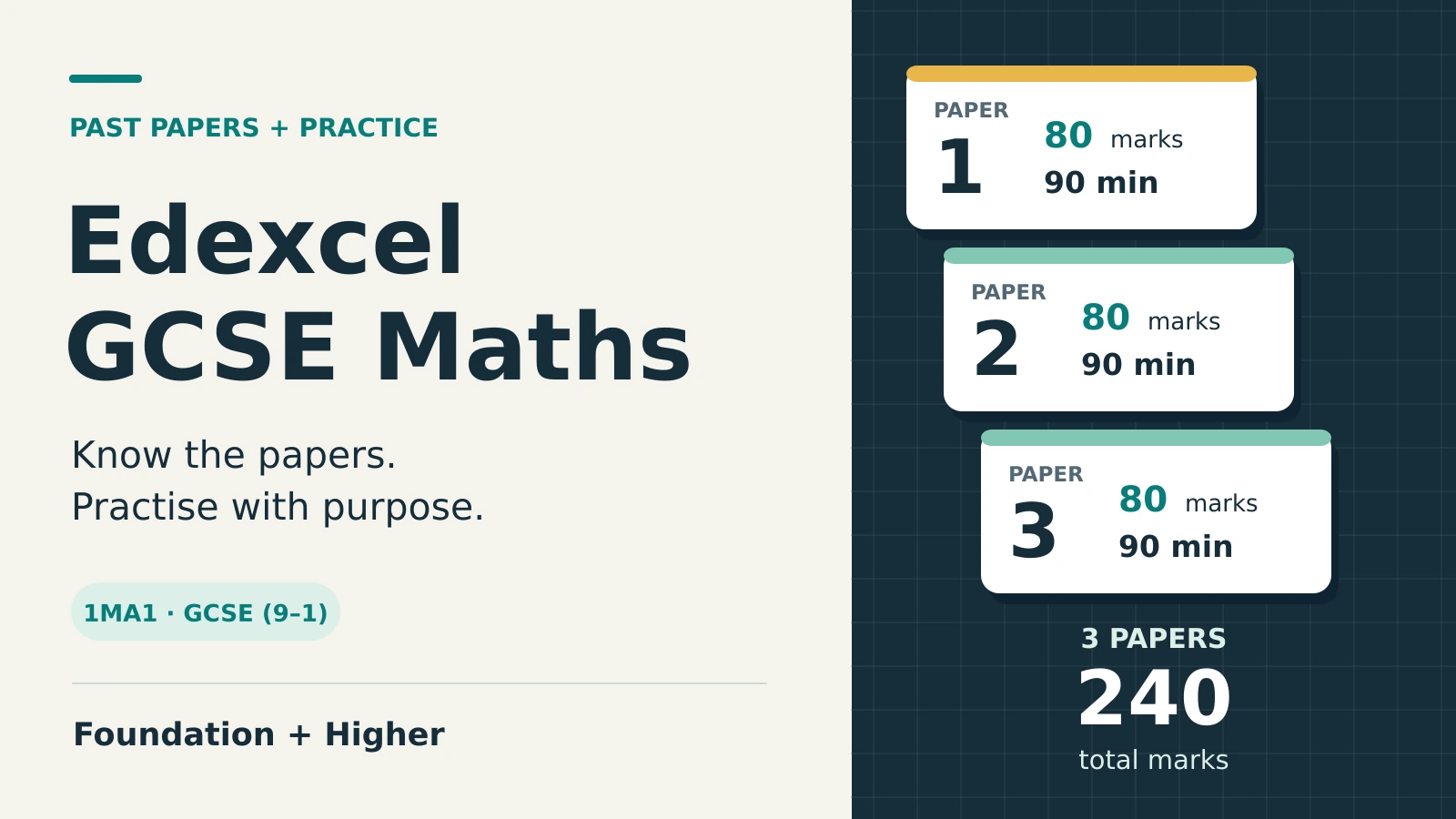
Edexcel GCSE Maths past papers and practice: Foundation and Higher 1MA1, with three papers of 80 marks and 90 minutes each, totalling 240 marks.

PEARSON EDEXCEL · GCSE MATHEMATICS · 1MA1

Choose the right paper. Learn from every mark.

Use this collection of Edexcel GCSE Maths past papers and mark schemes to practise a complete exam, diagnose a weak topic or check a method. Start with the 1MA1 GCSE (9–1) papers at your entered tier. Older specifications are retained in a separate archive: they can supply extra topic practice, but their paper structure and grading do not match the current qualification.

Go straight to the paper and mark-scheme directory. You can also study six worked examples or try the eight-question diagnostic before choosing a full paper.

Independent HeLovesMath guidance, checked 5 October 2026. Exam papers and mark schemes belong to their respective copyright owners. Pearson publishes the qualification; some retained downloads are hosted by Save My Exams. This page is not an official Pearson service.

Which Edexcel Maths exam is this?

This guide concerns Pearson Edexcel GCSE (9–1) Mathematics, code 1MA1. Check the qualification code on your timetable or ask your teacher. GCSE 1MA1 is different from International GCSE Mathematics A (4MA1), International GCSE modular papers and legacy GCSE specifications. Similar-looking names do not make papers interchangeable.

3 papersAll at the same tier
80 marks each240 marks across the qualification
90 minutes eachPaper 1: no calculator
Paper 2 and 3: calculator

Foundation papers have F in the code and assess grades 1–5. Higher papers have H and assess grades 4–9, with an allowed grade 3 outcome. An ungraded outcome is also possible. Foundation and Higher contain overlapping content, but they are different papers with different demands; a percentage from one tier should not be treated as the same grade on the other.

The papers draw on number; algebra; ratio, proportion and rates of change; geometry and measures; probability; and statistics. Topics are not reserved neatly for Paper 1, 2 or 3. Prepare the whole specification and practise choosing methods without a calculator as well as using one accurately.

Edexcel GCSE Maths 1MA1 has three 80-mark, 90-minute papers, totalling 240 marks. Paper 1 is non-calculator; Papers 2 and 3 allow a calculator. Foundation papers are 1F, 2F and 3F; Higher papers are 1H, 2H and 3H. Take all three at the same tier.
Edexcel 1MA1 three-paper structure. Original HeLovesMath illustration.

Formula sheets and calculator preparation

Pearson provides separate Foundation and Higher exam-aid sheets. Use the sheet for your tier and exam series during realistic practice, and read any formulae supplied in the question. A formula sheet does not decide which formula applies, rearrange it or convert units for you.

Ofqual confirmed formula-sheet support for GCSE maths in 2025, 2026 and 2027, then announced on 5 May 2026 that it will continue from 2028 for the remaining lifetime of the current specifications. This does not mean that a future revised qualification must use an identical sheet. Pearson's current instructions and your exam centre remain the place to check the permitted materials for your own sitting. Official sources and tier-specific 2026 sheets are listed below.

Practise entering negative values with brackets, selecting the right angle mode and keeping intermediate results unrounded. Our scientific calculator guide can help you understand operations, but it is not a statement that any online calculator is permitted in an exam.

How to use the older archive

Use current 1MA1 papers first for timed practice. A legacy 1MA0 paper or an older Paper 3/4 may still contain useful arithmetic, algebra or geometry questions, but treat it as a topic bank. Do not use its time allowance, total marks or old letter-grade boundaries as a current 1MA1 mock.

Check the cover of every downloaded file for its qualification, tier, paper number and exam series. Match it to the corresponding mark scheme. Hosting filenames can be misleading, so a PDF's cover is stronger evidence than its URL alone. The directory notes any verified mismatch or access problem.

A useful revision cycle with past papers

  1. Choose a purpose. For an exam rehearsal, use a complete current-specification paper at your tier, with the correct calculator conditions. For a topic check, choose a few questions without pretending the partial score is a full-paper grade.
  2. Attempt before looking. Set out a calculation, a labelled diagram or a reason for each step. If you get stuck, note where the method stopped. A blank page and a nearly correct solution require different revision.
  3. Mark the method, not only the final number. Read the exact mark scheme and its general instructions. Method marks, accuracy marks and independent marks are not interchangeable; follow any dependencies and acceptable alternatives in that scheme. Do not award yourself marks merely because your working resembles the answer.
  4. Classify the error. Was it a missing fact, a wrong model, a sign or arithmetic slip, a unit error, a calculator entry, or incomplete justification? Write a one-sentence correction and redo the question without copying the solution.
  5. Retest with a fresh question. First try a similar question while the idea is clear. Then return to it later without the worked solution. Correcting one remembered answer is weaker evidence than solving a new example.

For targeted follow-up, use the GCSE algebra worksheets, probability worksheets and statistics worksheets. Pick the topic your attempted paper exposed rather than completing resources at random.

Track marks without inventing a grade

A practice score of 52/80 is 65%, because 52 ÷ 80 × 100 = 65. That arithmetic does not by itself identify a GCSE grade. For a full series, add the marks on all three papers at the same tier and use that series' official qualification grade boundaries as a historical comparison. Boundaries can change between series; a past boundary is not a promise for a future exam.

For time management, 90 ÷ 80 = 1.125 minutes per mark, or 67.5 seconds. This is a rough planning average, not a rule for every question. Some short questions can be completed quickly; multi-step reasoning needs longer. Leave time to check signs, units and whether you answered the question actually asked.

Six worked examples to sharpen your methods

Original HeLovesMath practice, not Pearson past-paper questions or an official mark scheme. Calculator labels describe how to practise these examples, not which numbered exam paper will contain a topic.

1: subtracting fractions

Topic: Number. Suitable for: Foundation and Higher. Method: Non-calculator.

Question: Work out 5/6 − 3/8. Give your answer as a fraction in its simplest form.

Solution:

  1. The lowest common denominator of 6 and 8 is 24.
  2. Rewrite each fraction: 5/6 = 20/24 and 3/8 = 9/24.
  3. Subtract the numerators: 20/24 − 9/24 = 11/24.
  4. Since 11 and 24 have no common factor greater than 1, this is already simplest form.

Check: 5/6 is about 0.83 and 3/8 is 0.375, so the result should be just under 0.5. The fraction 11/24 has that size.

Common mistake: Subtracting the denominators. Equivalent fractions must share a denominator before adding or subtracting.

2: reversing a percentage decrease

Topic: Ratio, proportion and rates of change. Suitable for: Foundation and Higher. Method: Either paper style.

Question: A jacket costs £68 after a 15% reduction. What was its original price?

Solution:

  1. After the reduction, the jacket costs 100% − 15% = 85% of its original price.
  2. Write an equation: 0.85 × original price = 68.
  3. Divide by the multiplier: original price = 68 ÷ 0.85 = £80.

Check: 15% of £80 is £12, and £80 − £12 = £68.

Common mistake: Adding 15% of £68. The discount was calculated from the unknown original price, not from £68.

3: using the quadratic formula

Topic: Algebra. Suitable for: Higher. Method: Calculator for the decimal answers.

Question: Solve 2x² + 5x − 4 = 0. Give both solutions to 3 significant figures.

Solution:

  1. Identify a = 2, b = 5 and c = −4.
  2. Use x = (−b ± √(b² − 4ac)) / (2a).
  3. Substitute carefully: x = (−5 ± √(25 − 4 × 2 × (−4))) / 4.
  4. The discriminant is 25 + 32 = 57, so x = (−5 ± √57) / 4.
  5. The two calculator values are 0.6374586… and −3.1374586… .
  6. To 3 significant figures: x = 0.637 or x = −3.14.

Check: The exact roots have sum −5/2 and product −2, matching −b/a and c/a. Substituting the unrounded roots also returns zero.

Common mistakes: Using c = 4 instead of −4, losing the plus/minus branch, or dividing only the square-root term by 4. Keep the whole numerator in brackets when entering the expression.

4: choosing the cosine rule

Topic: Geometry and measures. Suitable for: Higher. Method: Calculator in degree mode.

Question: Two sides of a triangle are 7 cm and 10 cm. The angle between them is 48°. Find the length of the third side to 3 significant figures.

Solution:

  1. The known information is two sides and their included angle, so use the cosine rule.
  2. Let a be the side opposite 48°: a² = 7² + 10² − 2 × 7 × 10 × cos 48°.
  3. Evaluate without rounding the cosine first: a² = 149 − 140 cos 48° = 55.321715… .
  4. Take the positive square root: a = 7.437856… .
  5. The third side is 7.44 cm to 3 significant figures.

Check: A triangle with sides 7 and 10 must have its third side between 3 and 17. The answer satisfies this; the cosine calculation is also positive.

Common mistakes: Using Pythagoras when the angle is not 90°, using radians, or forgetting to take the square root.

5: probability without replacement

Topic: Probability. Suitable for: Higher practice. Method: Exact fractions; non-calculator friendly.

Question: A bag contains 5 red counters and 3 blue counters. Two counters are selected at random without replacement. Find the probability of selecting exactly one blue counter.

Solution:

  1. Exactly one blue can happen in two orders: blue then red, or red then blue.
  2. P(blue then red) = (3/8) × (5/7) = 15/56.
  3. P(red then blue) = (5/8) × (3/7) = 15/56.
  4. The two orders cannot both happen in one trial, so add their probabilities: 15/56 + 15/56 = 30/56 = 15/28.

Check: The complementary events are two red and two blue. Their probabilities total (5/8 × 4/7) + (3/8 × 2/7) = 26/56. Then 1 − 26/56 = 30/56, agreeing with the answer.

Common mistakes: Leaving 8 in the second denominator despite removing a counter, or counting only one order.

6: mean from a frequency table

Topic: Statistics. Suitable for: Foundation and Higher. Method: Either paper style.

Question: Ten students report how many books they finished in one month. Two students read 0 books; four read 1; three read 2; one read 3. Find the mean number of books.

Solution:

  1. Multiply each number of books by its frequency: 0 × 2 = 0, 1 × 4 = 4, 2 × 3 = 6, 3 × 1 = 3.
  2. Total books = 0 + 4 + 6 + 3 = 13.
  3. Total students = 2 + 4 + 3 + 1 = 10.
  4. Mean = total books ÷ total students = 13/10 = 1.3 books per student.

Check: The mean is between 0 and 3. It does not have to be a whole number, even though each individual count is a whole number.

Common mistake: Dividing by 4 because there are four categories. Divide by the total frequency, 10.

Eight questions: try first, then check

Questions 1–6 cover skills useful to both tiers. Questions 7–8 extend into Higher material. Show your working before opening each solution. This is a diagnostic exercise, not a mini-paper or grade predictor.

1. Fractions — Foundation/Higher, non-calculator

Calculate (3/4 + 2/5) ÷ (3/2). Give your answer in simplest form.

Show answer 1

First add the fractions using denominator 20: 3/4 + 2/5 = 15/20 + 8/20 = 23/20. Dividing by 3/2 means multiplying by 2/3: (23/20) × (2/3) = 46/60 = 23/30. The brackets require the addition before the division.

2. Standard form — Foundation/Higher, non-calculator

Calculate (4.8 × 10⁵) ÷ (1.6 × 10²). Give your answer in standard form.

Show answer 2

Divide the coefficients and subtract the powers: (4.8 ÷ 1.6) × 10^(5 − 2) = 3 × 10³. The coefficient 3 is at least 1 and less than 10, so the result is in standard form.

3. Sharing in a ratio — Foundation/Higher, non-calculator

£126 is shared between Alex, Bea and Chen in the ratio 2 : 5 : 7. How much does each person receive?

Show answer 3

There are 2 + 5 + 7 = 14 equal parts. One part is £126 ÷ 14 = £9. Alex receives £18, Bea £45, and Chen £63. Check: 18 + 45 + 63 = 126.

4. Linear equation — Foundation/Higher, non-calculator

Solve 4(2x − 3) = 5x + 9.

Show answer 4

Expand: 8x − 12 = 5x + 9. Subtract 5x and add 12: 3x = 21. Hence x = 7. Check: 4(14 − 3) = 44 and 35 + 9 = 44.

5. Pythagoras — Foundation/Higher, non-calculator friendly

A right-angled triangle has hypotenuse 13 cm and one shorter side 5 cm. Find the other shorter side.

Show answer 5

Let the missing shorter side be b. Pythagoras gives 5² + b² = 13², so b² = 169 − 25 = 144. Take the positive root because b is a length: b = 12 cm. Subtract the known square from the hypotenuse square; do not add them when finding a shorter side.

6. Interpreting data — Foundation/Higher, non-calculator

The six values in a data set are 4, 7, 7, 9, 13 and 14. Find the median and the range.

Show answer 6

The values are already ordered. With six values the middle positions are third and fourth: median = (7 + 9) ÷ 2 = 8. Range = largest − smallest = 14 − 4 = 10. The repeated 7 still occupies two separate positions.

7. Linear–quadratic simultaneous equations — Higher

Solve the equations y = x + 1 and x² + y² = 25. Give both ordered pairs (x, y).

Show answer 7

Substitute y = x + 1 into the second equation: x² + (x + 1)² = 25. Expand and simplify: 2x² + 2x + 1 = 25, then 2x² + 2x − 24 = 0. Divide by 2: x² + x − 12 = 0. Factorise: (x + 4)(x − 3) = 0. Thus x = −4 or x = 3. Substituting into y = x + 1 gives (−4, −3) and (3, 4). Both pairs satisfy x² + y² = 25.

8. Histogram frequency density — Higher

A grouped table records waiting time t in minutes for 28 customers:

0 ≤ t < 10: frequency 6; 10 ≤ t < 25: frequency 12; 25 ≤ t ≤ 45: frequency 10.

Find the frequency density for each interval and state which histogram bar would be tallest.

Show answer 8

The class widths are 10, 15 and 20 minutes. Frequency density = frequency ÷ class width, so the densities are 0.6, 0.8 and 0.5 customers per minute, respectively. The 10 ≤ t < 25 bar is tallest because its density is greatest. In a histogram, bar area represents frequency; height alone represents density. Check: 0.6 × 10 + 0.8 × 15 + 0.5 × 20 = 28 customers.

See why the missing side matters

The diagram below finds the hypotenuse from two perpendicular sides. Question 5 reverses the process: because 13 cm is already the hypotenuse, subtract 5² from 13² to find the missing shorter side squared. Pythagoras applies to a right-angled triangle, not every triangle.

A right-angled triangle has perpendicular sides of 5 cm and 12 cm and unknown hypotenuse c. Pythagoras gives c squared = 5 squared + 12 squared = 25 + 144 = 169, so c = square root of 169 = 13 cm. The hypotenuse is opposite the right angle.
Pythagoras worked example: 5, 12 and 13. Original HeLovesMath illustration.

Sources & References

The official sources below support the qualification, formula-sheet and grading guidance. The paper directory follows them. External links open in a new tab. Downloads remain on their original hosts; no third-party papers have been rehosted.

Past-paper and mark-scheme directory

Choose your qualification and tier, then search for a session such as June 2023. The archive retains all 250 original download destinations. Some series are incomplete: June 2019 Foundation Paper 2 and its scheme are not present, and the current-specification June 2017 subset contains Paper 3 only. Check Pearson’s course-materials hub above for newer releases and additional official papers.

Important pairing correction: two retained June 2016 Foundation mark-scheme URLs lead to International GCSE 4MA0 documents, whereas the question papers are GCSE 1MA0. Those links are visibly labelled as mismatched and must not be used to mark the adjacent question paper. The June 2017 Paper 3 downloads are correctly grouped as current 1MA1.

125 paper entries, each retaining its original question and reference-scheme links.

Current 1MA1 · June 2023 · 6 paper entries

June 2023: Paper 1 · Foundation

Question paperMark scheme

June 2023: Paper 1 · Higher

Question paperMark scheme

June 2023: Paper 2 · Foundation

Question paperMark scheme

June 2023: Paper 2 · Higher

Question paperMark scheme

June 2023: Paper 3 · Foundation

Question paperMark scheme

June 2023: Paper 3 · Higher

Question paperMark scheme
Current 1MA1 · Nov 2022 · 6 paper entries

Nov 2022: Paper 1 · Foundation

Question paperMark scheme

Nov 2022: Paper 1 · Higher

Question paperMark scheme

Nov 2022: Paper 2 · Foundation

Question paperMark scheme

Nov 2022: Paper 2 · Higher

Question paperMark scheme

Nov 2022: Paper 3 · Foundation

Question paperMark scheme

Nov 2022: Paper 3 · Higher

Question paperMark scheme
Current 1MA1 · June 2022 · 6 paper entries

June 2022: Paper 1 · Foundation

Question paperMark scheme

June 2022: Paper 1 · Higher

Question paperMark scheme

June 2022: Paper 2 · Foundation

Question paperMark scheme

June 2022: Paper 2 · Higher

Question paperMark scheme

June 2022: Paper 3 · Foundation

Question paperMark scheme

June 2022: Paper 3 · Higher

Question paperMark scheme
Current 1MA1 · Nov 2021 · 6 paper entries

Nov 2021: Paper 1 · Foundation

Question paperMark scheme

Nov 2021: Paper 1 · Higher

Question paperMark scheme

Nov 2021: Paper 2 · Foundation

Question paperMark scheme

Nov 2021: Paper 2 · Higher

Question paperMark scheme

Nov 2021: Paper 3 · Foundation

Question paperMark scheme

Nov 2021: Paper 3 · Higher

Question paperMark scheme
Current 1MA1 · Nov 2020 · 6 paper entries

Nov 2020: Paper 1 · Foundation

Question paperMark scheme

Nov 2020: Paper 1 · Higher

Question paperMark scheme

Nov 2020: Paper 2 · Foundation

Question paperMark scheme

Nov 2020: Paper 2 · Higher

Question paperMark scheme

Nov 2020: Paper 3 · Foundation

Question paperMark scheme

Nov 2020: Paper 3 · Higher

Question paperMark scheme
Current 1MA1 · Nov 2019 · 6 paper entries

Nov 2019: Paper 1 · Foundation

Question paperMark scheme

Nov 2019: Paper 1 · Higher

Question paperMark scheme

Nov 2019: Paper 2 · Foundation

Question paperMark scheme

Nov 2019: Paper 2 · Higher

Question paperMark scheme

Nov 2019: Paper 3 · Foundation

Question paperMark scheme

Nov 2019: Paper 3 · Higher

Question paperMark scheme
Current 1MA1 · June 2019 · 5 paper entries

June 2019: Paper 1 · Foundation

Question paperMark scheme

June 2019: Paper 1 · Higher

Question paperMark scheme

June 2019: Paper 2 · Higher

Question paperMark scheme

June 2019: Paper 3 · Foundation

Question paperMark scheme

June 2019: Paper 3 · Higher

Question paperMark scheme
Current 1MA1 · Nov 2018 · 6 paper entries

Nov 2018: Paper 1 · Foundation

Question paperMark scheme

Nov 2018: Paper 1 · Higher

Question paperMark scheme

Nov 2018: Paper 2 · Foundation

Question paperMark scheme

Nov 2018: Paper 2 · Higher

Question paperMark scheme

Nov 2018: Paper 3 · Foundation

Question paperMark scheme

Nov 2018: Paper 3 · Higher

Question paperMark scheme
Current 1MA1 · June 2018 · 6 paper entries

June 2018: Paper 1 · Foundation

Question paperMark scheme

June 2018: Paper 1 · Higher

Question paperMark scheme

June 2018: Paper 2 · Foundation

Question paperMark scheme

June 2018: Paper 2 · Higher

Question paperMark scheme

June 2018: Paper 3 · Foundation

Question paperMark scheme

June 2018: Paper 3 · Higher

Question paperMark scheme
Current 1MA1 · Nov 2017 · 6 paper entries

Nov 2017: Paper 1 · Foundation

Question paperMark scheme

Nov 2017: Paper 1 · Higher

Question paperMark scheme

Nov 2017: Paper 2 · Foundation

Question paperMark scheme

Nov 2017: Paper 2 · Higher

Question paperMark scheme

Nov 2017: Paper 3 · Foundation

Question paperMark scheme

Nov 2017: Paper 3 · Higher

Question paperMark scheme
Current 1MA1 · June 2017 · 2 paper entries

June 2017: Paper 3 · Foundation

Question paperMark schemeThis is a current 1MA1 paper, moved from the original legacy heading after checking the document.

June 2017: Paper 3 · Higher

Question paperMark schemeThis is a current 1MA1 paper, moved from the original legacy heading after checking the document.
1MA1 specimen · Specimen papers · 6 paper entries

Specimen papers: Paper 1 · Foundation

Question paperMark scheme

Specimen papers: Paper 1 · Higher

Question paperMark scheme

Specimen papers: Paper 2 · Foundation

Question paperMark scheme

Specimen papers: Paper 2 · Higher

Question paperMark scheme

Specimen papers: Paper 3 · Foundation

Question paperMark scheme

Specimen papers: Paper 3 · Higher

Question paperMark scheme
Legacy archive · June 2017 · 4 paper entries

June 2017: Paper 1 · Foundation

Question paperMark scheme

June 2017: Paper 1 · Higher

Question paperMark scheme

June 2017: Paper 2 · Foundation

Question paperMark scheme

June 2017: Paper 2 · Higher

Question paperMark scheme
Legacy archive · Nov 2016 · 4 paper entries

Nov 2016: Paper 1 · Foundation

Question paperMark scheme

Nov 2016: Paper 1 · Higher

Question paperMark scheme

Nov 2016: Paper 2 · Foundation

Question paperMark scheme

Nov 2016: Paper 2 · Higher

Question paperMark scheme
Legacy archive · June 2016 · 4 paper entries

June 2016: Paper 1 · Foundation

Question paperMismatched 4MA0 schemeOriginal mark-scheme link is International GCSE 4MA0, not a matching GCSE 1MA0 scheme. Retained for transparency; do not use it to mark this question paper.

June 2016: Paper 1 · Higher

Question paperMark scheme

June 2016: Paper 2 · Foundation

Question paperMismatched 4MA0 schemeOriginal mark-scheme link is International GCSE 4MA0, not a matching GCSE 1MA0 scheme. Retained for transparency; do not use it to mark this question paper.

June 2016: Paper 2 · Higher

Question paperMark scheme
Legacy archive · Nov 2015 · 4 paper entries

Nov 2015: Paper 1 · Foundation

Question paperMark scheme

Nov 2015: Paper 1 · Higher

Question paperMark scheme

Nov 2015: Paper 2 · Foundation

Question paperMark scheme

Nov 2015: Paper 2 · Higher

Question paperMark scheme
Legacy archive · June 2015 · 4 paper entries

June 2015: Paper 1 · Foundation

Question paperMark scheme

June 2015: Paper 1 · Higher

Question paperMark scheme

June 2015: Paper 2 · Foundation

Question paperMark scheme

June 2015: Paper 2 · Higher

Question paperMark scheme
Legacy archive · Nov 2014 · 4 paper entries

Nov 2014: Paper 1 · Foundation

Question paperMark scheme

Nov 2014: Paper 1 · Higher

Question paperMark scheme

Nov 2014: Paper 2 · Foundation

Question paperMark scheme

Nov 2014: Paper 2 · Higher

Question paperMark scheme
Legacy archive · June 2014 · 4 paper entries

June 2014: Paper 1 · Foundation

Question paperMark scheme

June 2014: Paper 1 · Higher

Question paperMark scheme

June 2014: Paper 2 · Foundation

Question paperMark scheme

June 2014: Paper 2 · Higher

Question paperMark scheme
Legacy archive · Nov 2013 · 4 paper entries

Nov 2013: Paper 1 · Foundation

Question paperMark scheme

Nov 2013: Paper 1 · Higher

Question paperMark scheme

Nov 2013: Paper 2 · Foundation

Question paperMark scheme

Nov 2013: Paper 2 · Higher

Question paperMark scheme
Legacy archive · June 2013 · 4 paper entries

June 2013: Paper 1 · Foundation

Question paperMark scheme

June 2013: Paper 1 · Higher

Question paperMark scheme

June 2013: Paper 2 · Foundation

Question paperMark scheme

June 2013: Paper 2 · Higher

Question paperMark scheme
Legacy archive · March 2013 · 4 paper entries

March 2013: Paper 1 · Foundation

Question paperMark scheme

March 2013: Paper 1 · Higher

Question paperMark scheme

March 2013: Paper 2 · Foundation

Question paperMark scheme

March 2013: Paper 2 · Higher

Question paperMark scheme
Legacy archive · Nov 2012 · 4 paper entries

Nov 2012: Paper 1 · Foundation

Question paperMark scheme

Nov 2012: Paper 1 · Higher

Question paperMark scheme

Nov 2012: Paper 2 · Foundation

Question paperMark scheme

Nov 2012: Paper 2 · Higher

Question paperMark scheme
Legacy archive · June 2012 · 4 paper entries

June 2012: Paper 1 · Foundation

Question paperMark scheme

June 2012: Paper 1 · Higher

Question paperMark scheme

June 2012: Paper 2 · Foundation

Question paperMark scheme

June 2012: Paper 2 · Higher

Question paperMark scheme
Legacy archive · Nov 2011 · 2 paper entries

Nov 2011: Paper 3 · Higher

Question paperMark scheme

Nov 2011: Paper 4 · Higher

Question paperMark scheme
Legacy archive · June 2011 · 2 paper entries

June 2011: Paper 3 · Higher

Question paperMark scheme

June 2011: Paper 4 · Higher

Question paperMark scheme
Legacy archive · Nov 2010 · 2 paper entries

Nov 2010: Paper 3 · Higher

Question paperMark scheme

Nov 2010: Paper 4 · Higher

Question paperMark scheme
Legacy archive · June 2010 · 2 paper entries

June 2010: Paper 3 · Higher

Question paperMark scheme

June 2010: Paper 4 · Higher

Question paperMark scheme
Legacy archive · Nov 2009 · 2 paper entries

Nov 2009: Paper 3 · Higher

Question paperMark scheme

Nov 2009: Paper 4 · Higher

Question paperMark scheme
Shares:

Related Posts

Past Papers

AQA AS Maths – Statistics: Past Papers

Maths Statistics (7356)Exam PapersMark SchemesJune 2023: Paper 1Mark SchemePaper 2Mark Scheme  June 2022: Paper 1Mark SchemePaper 2Mark Scheme  November 2021: Paper 1Mark SchemePaper 2Mark Scheme  November 2020: Paper 1Mark SchemePaper 2Mark Scheme  Specimen: Paper 2Mark Scheme  June 2019: Paper 1Mark SchemePaper

Edexcel GCSE Maths Past Papers (1MA1) — Complete Guide, Formulas & Free Downloads

Edexcel GCSE Maths Past Papers (1MA1) — Complete Guide, Formulas & Free Downloads

This is the most complete free archive of Edexcel GCSE Maths (1MA1) past papers available — covering every session from 2009 to 2022, both Foundation and Higher tiers, New Spec and Old Spec. Use the interactive filter below, download papers instantly, and revise smarter with our full formula reference and topic-by-topic study guide.

📐 Syllabus 1MA1 🟢 Foundation Tier 🔴 Higher Tier 📄 3 Papers ⏱ 4h 30m Total 🏆 Grades 1–9

📚 Table of Contents

  1. What Is Edexcel GCSE Maths (1MA1)?
  2. Exam Structure & Paper Breakdown
  3. Foundation vs Higher Tier
  4. Topic 1 — Number
  5. Topic 2 — Algebra
  6. Topic 3 — Geometry & Measures
  7. Topic 4 — Statistics & Probability
  8. Key Formulas Reference Sheet
  9. Exam Strategies & Revision Tips
  10. Past Papers Archive (2009–2022)

1. What Is Edexcel GCSE Maths (1MA1)?

The Edexcel GCSE Mathematics qualification (syllabus code 1MA1) is one of the most widely-taken qualifications in England, with hundreds of thousands of students sitting it each year. It is administered by Pearson Edexcel, part of the Pearson group, and is accredited by Ofqual for students in England. The qualification was significantly reformed in 2015 and the new specification (commonly called New Spec or 9–1 spec) was first examined in June 2017. Before that, the Old Spec (1MA0) was in use from around 2010.

The 9–1 grading system replaced the old A*–G grades. Grade 9 is the highest achievement (awarded to approximately the top 3% of students), while Grade 4 is considered the equivalent of the old Grade C — a standard pass — and Grade 5 is regarded as a strong pass. Universities, colleges, and employers typically require at least a Grade 4, with many sixth forms requiring a Grade 5 or above for A-Level Mathematics entry.

The new specification placed a stronger emphasis on problem solving, mathematical reasoning, and communicating mathematics. Approximately 30% of marks on each paper require problem-solving skills, and students at Higher tier also encounter more extended, multi-step questions that require the application of multiple topics simultaneously.

The Old Spec (1MA0) papers from 2009–2017 remain extremely valuable for practice — core topics like Pythagoras, algebra, and statistics remain largely unchanged across both specifications.

2. Exam Structure & Paper Breakdown

The 1MA1 examination consists of three papers, all sat in the same exam series (typically May/June for the main cohort, with a November resit series available). The three papers together make up 100% of the final GCSE grade — there is no coursework or controlled assessment component.

PaperNameCalculator?DurationMarksWeighting
Paper 1Non-Calculator❌ Not allowed1 hr 30 min8033⅓%
Paper 2Calculator✅ Allowed1 hr 30 min8033⅓%
Paper 3Calculator✅ Allowed1 hr 30 min8033⅓%

All three papers contain a mix of question types: short single-mark questions, multi-step structured questions, and extended problem-solving questions worth 3–5 marks. Questions are not grouped strictly by topic — a single question may draw on algebra, geometry, and number simultaneously. A formula sheet is provided in the exam for certain Higher-only formulae (such as the quadratic formula, volume of a cone and sphere, and the sine/cosine rules), but many essential formulae must be memorised by the student.

Paper 1 is the non-calculator paper — practise mental arithmetic, long multiplication and division, and fraction/percentage calculations without a calculator. Students often lose marks on Paper 1 through avoidable arithmetic errors.

3. Foundation vs Higher Tier

Students sit either Foundation Tier (targeting grades 1–5) or Higher Tier (targeting grades 4–9). The decision is made by the school or teacher, usually based on mock exam performance during Year 10 and Year 11. There is a significant overlap of content — approximately 60% of the Higher tier content also appears on Foundation. The key differences are:

FeatureFoundation TierHigher Tier
Grade range1 – 5 (max grade 5)4 – 9
Higher-only topicsNot includedIncludes quadratic formula, circle theorems, vectors, surds, function notation, proof, and more
Problem-solving demandModerateHigh — multi-step, unfamiliar contexts
Question languageMore scaffolded, step-by-stepMore open-ended, fewer hints
Formula sheet provided?Yes (basic shapes)Yes (more formulae included)

Higher-only content includes: the quadratic formula, completing the square, algebraic proof, function notation and composite/inverse functions, upper and lower bounds with error intervals, direct and inverse proportion with non-linear relationships, the sine rule and cosine rule, circle theorems, vector geometry, conditional probability, histograms with unequal class widths, cumulative frequency and box plots, and 3D trigonometry.

4. Topic 1 — Number

Number forms the bedrock of GCSE Mathematics and underpins almost every other topic. It accounts for roughly 22–28% of marks across Foundation papers and slightly less at Higher. A thorough command of number work is essential — a weak foundation in arithmetic will cost marks even in algebra and geometry questions.

4.1 Fractions, Decimals & Percentages

Converting fluently between fractions, decimals, and percentages is a core skill. Students must be able to add, subtract, multiply, and divide fractions without a calculator, and apply percentage calculations to real-world contexts such as tax, discount, and interest.

Percentage Change & Reverse Percentage
\[ \text{Percentage Change} = \frac{\text{New Value} - \text{Original Value}}{\text{Original Value}} \times 100\% \] \[ \text{Original Value} = \frac{\text{New Value}}{\text{Multiplier}} \]

e.g., a 20% increase has multiplier 1.20; to reverse: Original = New ÷ 1.20

4.2 Compound Interest & Depreciation

Compound interest applies a percentage change repeatedly over multiple time periods. This is tested in both financial contexts (savings accounts, loans) and growth/decay problems in science.

Compound Interest Formula
\[ A = P\left(1 + \frac{r}{100}\right)^n \] \[ A = P\left(1 - \frac{r}{100}\right)^n \quad \text{(depreciation / decay)} \]

where \( A \) = final amount, \( P \) = principal (starting value), \( r \) = rate (%), \( n \) = number of time periods.

4.3 Standard Form

Standard form (scientific notation) is used to express very large or very small numbers concisely. It is essential in science and appears on Paper 2 and Paper 3 (calculator papers).

Standard Form
\[ A \times 10^n \quad \text{where } 1 \leq A < 10 \text{ and } n \in \mathbb{Z} \]

e.g., \(6.02 \times 10^{23}\) (Avogadro's number); \(3.5 \times 10^{-4} = 0.00035\)

4.4 Indices, Surds & Bounds (Higher)

Index laws govern the manipulation of powers and are essential throughout algebra. Surds (irrational square roots such as \(\sqrt{2}\), \(\sqrt{3}\), \(\sqrt{5}\)) appear frequently at Higher tier and must be simplified and manipulated exactly, without a calculator.

Index Laws & Surd Rules
\[ a^m \times a^n = a^{m+n} \qquad a^m \div a^n = a^{m-n} \qquad (a^m)^n = a^{mn} \] \[ a^0 = 1 \qquad a^{-n} = \frac{1}{a^n} \qquad a^{\frac{1}{n}} = \sqrt[n]{a} \qquad a^{\frac{m}{n}} = \left(\sqrt[n]{a}\right)^m \] \[ \sqrt{a} \times \sqrt{b} = \sqrt{ab} \qquad \frac{\sqrt{a}}{\sqrt{b}} = \sqrt{\frac{a}{b}} \] \[ \text{Rationalise: } \frac{1}{\sqrt{a}} = \frac{\sqrt{a}}{a} \qquad \frac{1}{a+\sqrt{b}} = \frac{a-\sqrt{b}}{a^2-b} \]
On Paper 1 (non-calculator), questions involving surds and indices reward exact answers. Leave answers in surd form (e.g., \(3\sqrt{2}\)) unless asked to evaluate — never round a surd on a non-calculator paper.

5. Topic 2 — Algebra

Algebra accounts for approximately 30–36% of marks on Higher papers, making it the single largest topic area. Foundation students also encounter substantial algebra — it appears in equations, graphs, sequences, and many geometry problems.

5.1 Expanding, Factorising & Solving Equations

Students must be able to expand single and double brackets, factorise expressions (including quadratics), and solve linear and quadratic equations. At Higher tier, this extends to completing the square, the quadratic formula, and algebraic proof.

Quadratic Formula (Higher — provided on formula sheet)
\[ \text{For } ax^2 + bx + c = 0: \qquad x = \frac{-b \pm \sqrt{b^2 - 4ac}}{2a} \] \[ \text{Discriminant: } \Delta = b^2 - 4ac \]

If \(\Delta > 0\): two distinct real roots. If \(\Delta = 0\): one repeated root. If \(\Delta < 0\): no real roots.

Completing the Square (Higher)
\[ ax^2 + bx + c = a\!\left(x + \frac{b}{2a}\right)^2 - \frac{b^2}{4a} + c \]

The vertex of the parabola \(y = ax^2+bx+c\) is at \(\left(-\dfrac{b}{2a},\; c - \dfrac{b^2}{4a}\right)\).

5.2 Straight-Line Graphs

Linear graphs in the form \(y = mx + c\) are tested extensively across both tiers. Students must find the gradient and y-intercept, write the equation of a line given two points, and identify parallel or perpendicular lines.

Straight-Line Equations
\[ y = mx + c \quad \text{(gradient-intercept form)} \] \[ m = \frac{y_2 - y_1}{x_2 - x_1} \quad \text{(gradient between two points)} \] \[ m_{\perp} = -\frac{1}{m} \quad \text{(perpendicular gradient)} \] \[ \text{Midpoint} = \left(\frac{x_1+x_2}{2},\; \frac{y_1+y_2}{2}\right) \qquad \text{Distance} = \sqrt{(x_2-x_1)^2+(y_2-y_1)^2} \]

5.3 Sequences & the nth Term

Both arithmetic (linear) and geometric sequences appear in the specification. At Higher tier, quadratic sequences (where second differences are constant) and sequences involving surds or surds are also assessed.

Sequences
\[ \text{Arithmetic nth term: } u_n = a + (n-1)d \] \[ \text{Geometric nth term: } u_n = ar^{n-1} \] \[ \text{Quadratic nth term: } u_n = An^2 + Bn + C \quad \text{(find using second differences)} \]

where \( a \) = first term, \( d \) = common difference, \( r \) = common ratio.

5.4 Inequalities

Linear inequalities can be solved algebraically (remembering to flip the inequality sign when multiplying or dividing by a negative number) and represented on a number line. At Higher tier, quadratic inequalities and graphical inequalities (shading regions) are also tested.

Solving Inequalities
\[ 3x - 5 > 7 \;\Rightarrow\; 3x > 12 \;\Rightarrow\; x > 4 \] \[ -2x > 6 \;\Rightarrow\; x < -3 \quad \text{⚠ flip sign when dividing by negative!} \]

5.5 Functions (Higher Only)

Function notation, composite functions, and inverse functions are Higher-only topics introduced in the new specification. Students must evaluate \(f(x)\), find \(fg(x)\), and determine \(f^{-1}(x)\).

Function Notation (Higher)
\[ \text{Composite: } fg(x) = f\!\left(g(x)\right) \] \[ \text{Inverse: if } f(x)=y, \text{ then } f^{-1}(y)=x \] \[ \text{e.g., } f(x)=2x+3 \;\Rightarrow\; f^{-1}(x) = \frac{x-3}{2} \]

6. Topic 3 — Geometry & Measures

Geometry and Measures accounts for approximately 25–30% of marks and covers areas, perimeters, volumes, angles, transformations, trigonometry, and vectors. It is the topic where the formula sheet is most helpful — but only for Higher formulae; Foundation students must memorise all area and perimeter formulae.

6.1 Area, Perimeter & Volume

Area Formulae
\[ A_{\text{rectangle}} = lw \qquad A_{\text{triangle}} = \tfrac{1}{2}bh \qquad A_{\text{parallelogram}} = bh \] \[ A_{\text{trapezium}} = \tfrac{1}{2}(a+b)h \qquad A_{\text{circle}} = \pi r^2 \qquad C_{\text{circle}} = 2\pi r = \pi d \] \[ \text{Arc length} = \frac{\theta}{360} \times 2\pi r \qquad \text{Sector area} = \frac{\theta}{360} \times \pi r^2 \]
Volume Formulae
\[ V_{\text{prism}} = A_{\text{cross-section}} \times l \qquad V_{\text{cylinder}} = \pi r^2 h \] \[ V_{\text{pyramid}} = \tfrac{1}{3}Ah \qquad V_{\text{cone}} = \tfrac{1}{3}\pi r^2 h \qquad V_{\text{sphere}} = \tfrac{4}{3}\pi r^3 \] \[ SA_{\text{sphere}} = 4\pi r^2 \qquad SA_{\text{cone}} = \pi r l + \pi r^2 \quad \text{(where } l = \text{slant height)} \]

6.2 Pythagoras' Theorem & Trigonometry

Pythagoras & SOHCAHTOA
\[ a^2 + b^2 = c^2 \quad \text{(Pythagoras — right-angled triangle)} \] \[ \sin\theta = \frac{\text{Opposite}}{\text{Hypotenuse}} \qquad \cos\theta = \frac{\text{Adjacent}}{\text{Hypotenuse}} \qquad \tan\theta = \frac{\text{Opposite}}{\text{Adjacent}} \] \[ \text{Exact values: } \sin 30° = \tfrac{1}{2},\; \sin 45° = \tfrac{\sqrt{2}}{2},\; \sin 60° = \tfrac{\sqrt{3}}{2} \] \[ \cos 30° = \tfrac{\sqrt{3}}{2},\; \cos 45° = \tfrac{\sqrt{2}}{2},\; \cos 60° = \tfrac{1}{2} \] \[ \tan 30° = \tfrac{1}{\sqrt{3}},\; \tan 45° = 1,\; \tan 60° = \sqrt{3} \]
Sine Rule, Cosine Rule & Area of Any Triangle (Higher — on formula sheet)
\[ \frac{a}{\sin A} = \frac{b}{\sin B} = \frac{c}{\sin C} \quad \text{(Sine Rule)} \] \[ a^2 = b^2 + c^2 - 2bc\cos A \quad \text{(Cosine Rule)} \] \[ \text{Area of triangle} = \tfrac{1}{2}ab\sin C \]

6.3 Circle Theorems (Higher)

Circle theorems are a purely Higher topic. Students must recognise and apply up to eight key theorems, often providing reasons/justifications for angle calculations. The most commonly tested are: the angle at the centre is twice the angle at the circumference; angles in the same segment are equal; opposite angles in a cyclic quadrilateral sum to 180°; the angle in a semicircle is 90°; and the tangent-radius theorem (tangent ⊥ radius at point of contact).

6.4 Vectors (Higher)

Vector geometry tests the ability to describe translations using column vectors and to prove geometric properties (e.g., that a line is parallel to another, or that three points are collinear).

Vector Operations
\[ \vec{AB} = \vec{OB} - \vec{OA} = \mathbf{b} - \mathbf{a} \] \[ |\mathbf{v}| = \sqrt{v_x^2 + v_y^2} \quad \text{(magnitude of vector)} \] \[ \text{Midpoint } M: \overrightarrow{OM} = \tfrac{1}{2}(\mathbf{a}+\mathbf{b}) \]

7. Topic 4 — Statistics & Probability

Statistics and Probability accounts for around 15–20% of marks. This topic covers data handling, averages, charts, and probability. At Higher tier, it extends to histograms, cumulative frequency, box plots, and conditional probability using Venn diagrams and tree diagrams.

7.1 Averages & Spread

Measures of Central Tendency & Spread
\[ \bar{x} = \frac{\sum fx}{\sum f} \quad \text{(mean from frequency table)} \] \[ \text{Interquartile Range (IQR)} = Q_3 - Q_1 \] \[ \text{Range} = \text{Max} - \text{Min} \]

7.2 Probability

Probability Rules
\[ P(A) = \frac{\text{Number of favourable outcomes}}{\text{Total number of outcomes}} \] \[ P(A \cup B) = P(A) + P(B) - P(A \cap B) \quad \text{(Addition Rule)} \] \[ P(A \cap B) = P(A) \times P(B|A) \quad \text{(Multiplication Rule)} \] \[ P(B|A) = \frac{P(A \cap B)}{P(A)} \quad \text{(Conditional Probability — Higher)} \] \[ \sum P(\text{all outcomes}) = 1 \]

7.3 Histograms (Higher Only)

Histograms use frequency density on the y-axis (not frequency), so that the area of each bar represents the frequency. This allows bars of unequal width to represent data fairly.

Frequency Density
\[ \text{Frequency Density} = \frac{\text{Frequency}}{\text{Class Width}} \] \[ \text{Frequency} = \text{Frequency Density} \times \text{Class Width} \]

8. Key Formulas Reference Sheet

The table below lists which formulas are provided on the exam formula sheet and which must be memorised. Being clear about this distinction saves valuable revision time.

FormulaFoundationHigherProvided?
Area of rectangle, parallelogram, triangle, trapezium✅✅❌ Memorise
Circumference and area of circle✅✅❌ Memorise
Pythagoras' theorem✅✅❌ Memorise
SOHCAHTOA (sin, cos, tan)✅✅❌ Memorise
Volume of prism, cylinder✅✅❌ Memorise
Compound interest formula✅✅❌ Memorise
Quadratic formula—✅✅ On sheet
Sine rule & Cosine rule—✅✅ On sheet
Area = ½ab sin C—✅✅ On sheet
Volume of pyramid, cone, sphere—✅✅ On sheet
Surface area of sphere, cone—✅✅ On sheet

9. Exam Strategies & Revision Tips

9.1 Using Past Papers Effectively

Past papers are the single most effective revision tool — but only if used correctly. Rather than simply completing a paper and checking the total score, analyse every mark you lose: classify each lost mark by topic (Number, Algebra, Geometry, Stats), note whether it was a knowledge gap, a method error, or a careless arithmetic mistake, then target each weakness individually before your next timed practice.

9.2 Paper 1 Strategy (Non-Calculator)

  1. Show all working even for mental calculations — method marks can be awarded independently of the final answer.
  2. Practise multiplying and dividing by decimals and fractions without a calculator.
  3. Memorise all trigonometric exact values (\(\sin 30°, \cos 45°\), etc.) — they appear in Paper 1 and a calculator cannot be used.
  4. Estimate answers first to check your final answer is reasonable.
  5. For surds questions, do not use a decimal approximation — leave answers in exact form.

9.3 Papers 2 & 3 Strategy (Calculator)

  1. Still show all working — a correct answer with no working scores zero if the answer is wrong, but shown working can still earn method marks.
  2. Use your calculator's fraction button to avoid rounding errors mid-calculation.
  3. For trigonometry, ensure your calculator is in Degree mode (not Radians) for GCSE.
  4. Round only at the final step — carrying unrounded values through a multi-step calculation reduces rounding errors.
  5. Check your answer makes sense in context (e.g., a probability must be between 0 and 1; a length must be positive).

9.4 Grade Boundary Insight

Grade boundaries vary each year depending on overall cohort performance and paper difficulty. Typically, a Grade 4 at Foundation requires roughly 50–60% of marks, while a Grade 7 at Higher requires approximately 55–65%. A Grade 9 at Higher requires approximately 75–85% — it is never a fixed mark, so consistent performance across all three papers is key.

Focus your final week of revision on topics that appear in all three papers (algebra, number, and geometry basics) rather than highly specific Higher-only topics — maximising your marks on the 60% of content common to every paper is the most efficient strategy.

10. Past Papers Archive (2009–2022)

All Edexcel GCSE Maths past papers and mark schemes below are free to download. Use the filters to find papers by year, session, or tier. 🟢 F = Foundation  |  🔴 H = Higher.

📅 Year:
📋 Spec:

SessionYearPaperFoundation QPFoundation MSHigher QPHigher MS
Shares:

Related Posts