
Work through every question in the English-language June 2026 Algebra II Regents. Each solution explains the method, gives the final answer, and highlights details that matter for a complete written response.
Try the question first, then compare your reasoning with the steps below. Select a question image or diagram to open a larger view. The question numbers and paper-page references follow the official exam. The original paper and NYSED scoring documents are linked in Sources & References.
For Parts II–IV, show your method. A final number on its own can lose substantial credit, and a question that specifies algebraic solution or a graph requires that method.
Scoring notice: Question 26 has an official clarification about calculator display precision. Read the Question 26 scoring note.
These are independent HeLovesMath explanations, not an official NYSED publication. Answers and required methods were checked against the official scoring key, rating guide, and model response set. Valid alternative methods can also earn credit unless a question specifies a method.
Quick check: Part I answer choices
- Q1: (2)
- Q2: (4)
- Q3: (3)
- Q4: (4)
- Q5: (1)
- Q6: (2)
- Q7: (3)
- Q8: (4)
- Q9: (3)
- Q10: (2)
- Q11: (1)
- Q12: (2)
- Q13: (2)
- Q14: (3)
- Q15: (1)
- Q16: (4)
- Q17: (4)
- Q18: (1)
- Q19: (1)
- Q20: (3)
- Q21: (1)
- Q22: (1)
- Q23: (4)
- Q24: (2)
Use the worked explanations below to check why each answer is correct.
Part I: Multiple-choice solutions
Questions 1–24 • 2 credits each • 48 credits total
Question 1: Find a zero by factoring in groups
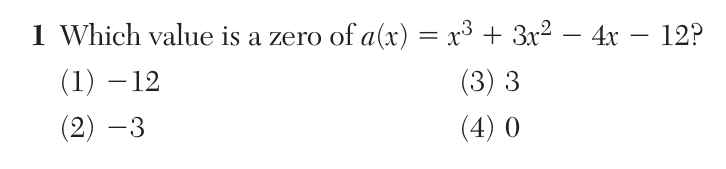
- Group the polynomial into two pairs:
- Factor out the repeated expression and then use the difference of squares:
- A zero makes at least one factor equal to zero. The zeros are , and . Of these, −3 is listed.
Question 2: Take the complement within the given set
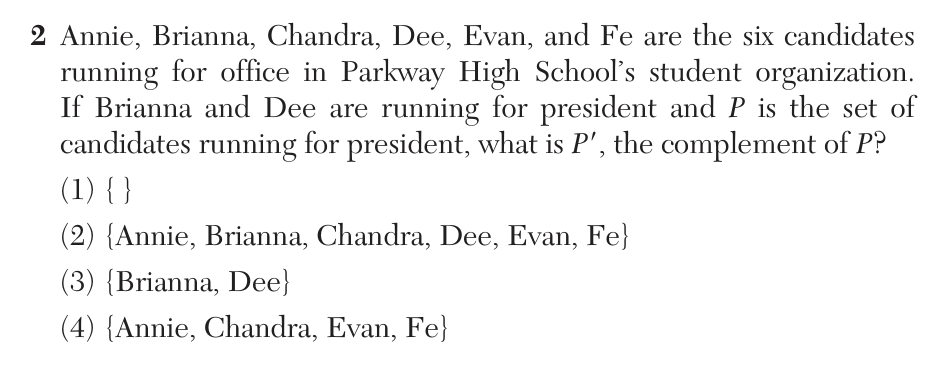
- The universal set consists of all six named candidates. The set P contains Brianna and Dee.
- The complement contains every candidate in the universal set who is not in P. Remove Brianna and Dee.
- The remaining candidates are Annie, Chandra, Evan and Fe.
Question 3: Translate the budget into an inequality
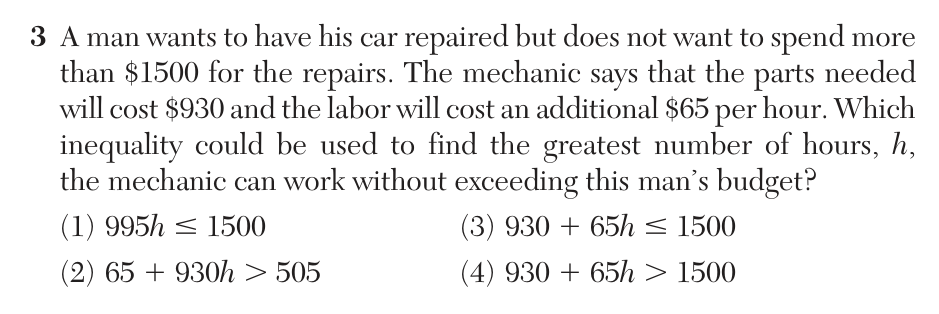
- The parts cost is fixed at $930. Labor for h hours costs dollars.
- Add the two costs:
- “Does not want to spend more than $1,500” permits equality and excludes larger totals:
Exam detail: The fixed parts cost is not multiplied by the number of hours.
Question 4: Divide the polynomial and keep the remainder
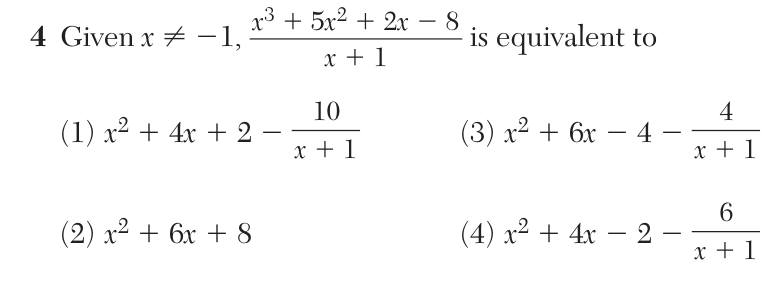
- Divide the leading term by x to get . Subtract from the numerator, leaving .
- The next quotient term is . Subtract to leave .
- The final quotient term is −2. Subtract to get remainder −6. Therefore:
Exam detail: Keep the given restriction .
Question 5: Combine a cube root and an integer power
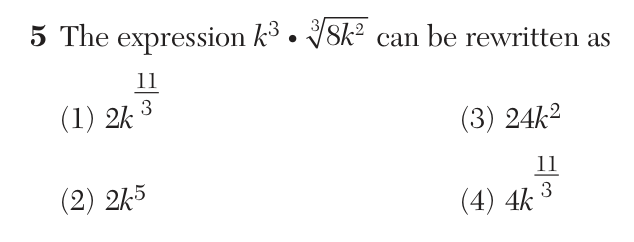
- Separate the perfect cube 8:
- When multiplying powers of the same base, add the exponents:
- Write 3 as nine thirds:
Exam detail: The denominator 3 represents a real cube root, including for negative inputs.
Question 6: Shift the graph left and down
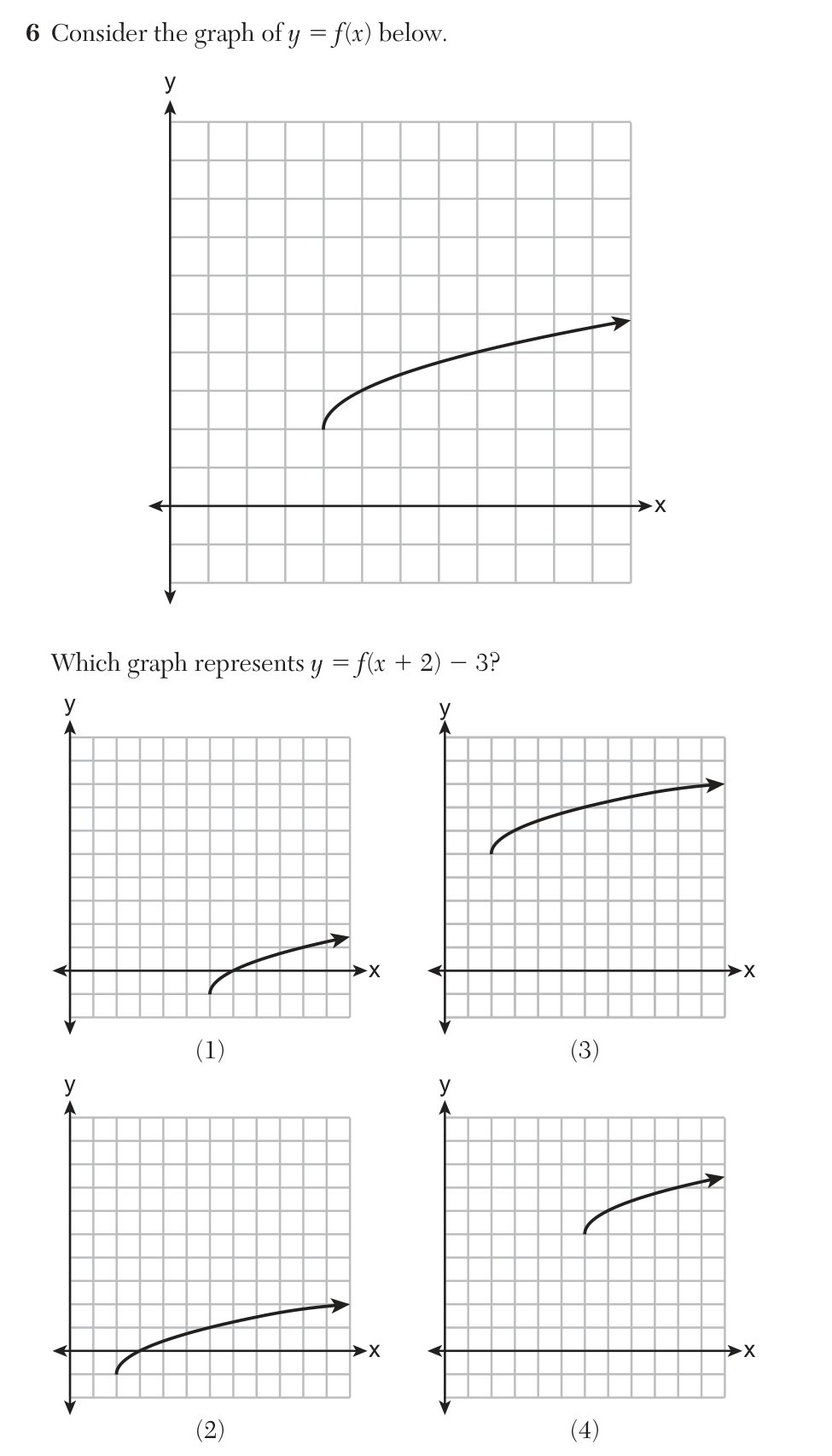
- Replacing x by shifts every point 2 units to the left. Subtracting 3 outside f shifts every point 3 units down.
- The original endpoint is . Its new location is:
- Keep the original increasing curve’s shape and select the graph with endpoint . That is graph (2).
Exam detail: The positive number inside the function produces a shift to the left.
Question 7: Separate the growth factor from the rate
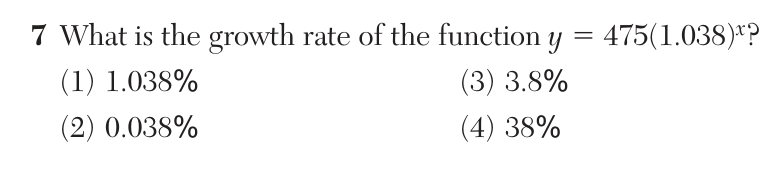
- An exponential growth model has the form . Here the growth factor is 1.038.
- Subtract 1 to find the decimal rate:
- Convert the decimal to a percentage:
Question 8: Solve the circle and line together
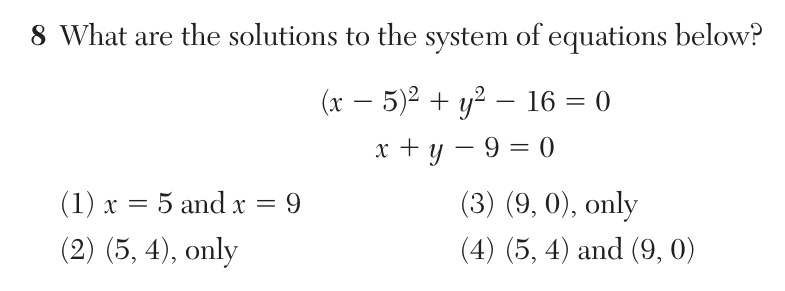
- Solve the linear equation for y:
- Substitute into the circle equation and expand:
- Divide by 2 and factor:
- If x is 5, y is 4. If x is 9, y is 0. Both ordered pairs satisfy both original equations.
Exam detail: A solution of a two-variable system is an ordered pair, not only an x-value.
Question 9: Add the first five geometric terms
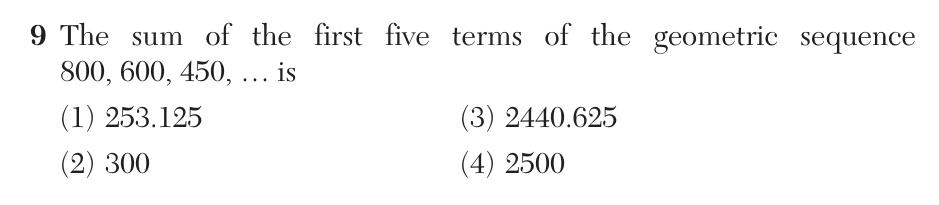
- Find the common ratio:
- Continue the sequence: the fourth term is and the fifth is .
- Add all five terms:
Exam detail: The fifth term alone is not the requested sum.
Question 10: Turn a normal-tail probability into a count
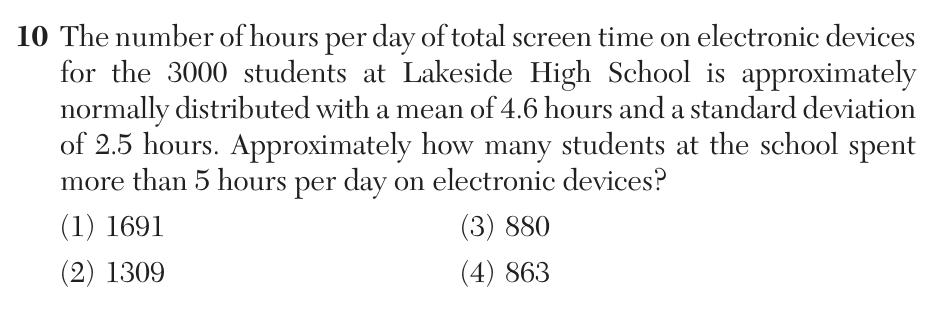
- Use mean 4.6 hours and standard deviation 2.5 hours. The standardized value for 5 hours is:
- Find the area to the right of . A normal cumulative-distribution calculator gives approximately 0.4364405.
- Multiply this proportion by the 3,000 students:The closest whole-student count is 1,309.
Exam detail: “More than” requires the right tail, not the area to the left of 5 hours.
Question 11: Clear denominators and reject an excluded root
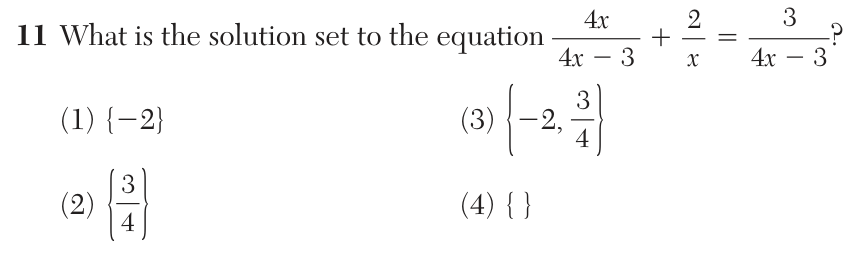
- The denominators require and . Multiply every term by :
- Collect terms and factor:
- The candidates are and −2. The first makes an original denominator zero, so reject it. The remaining solution is −2.
Question 12: Recognize a repeated root from a graph
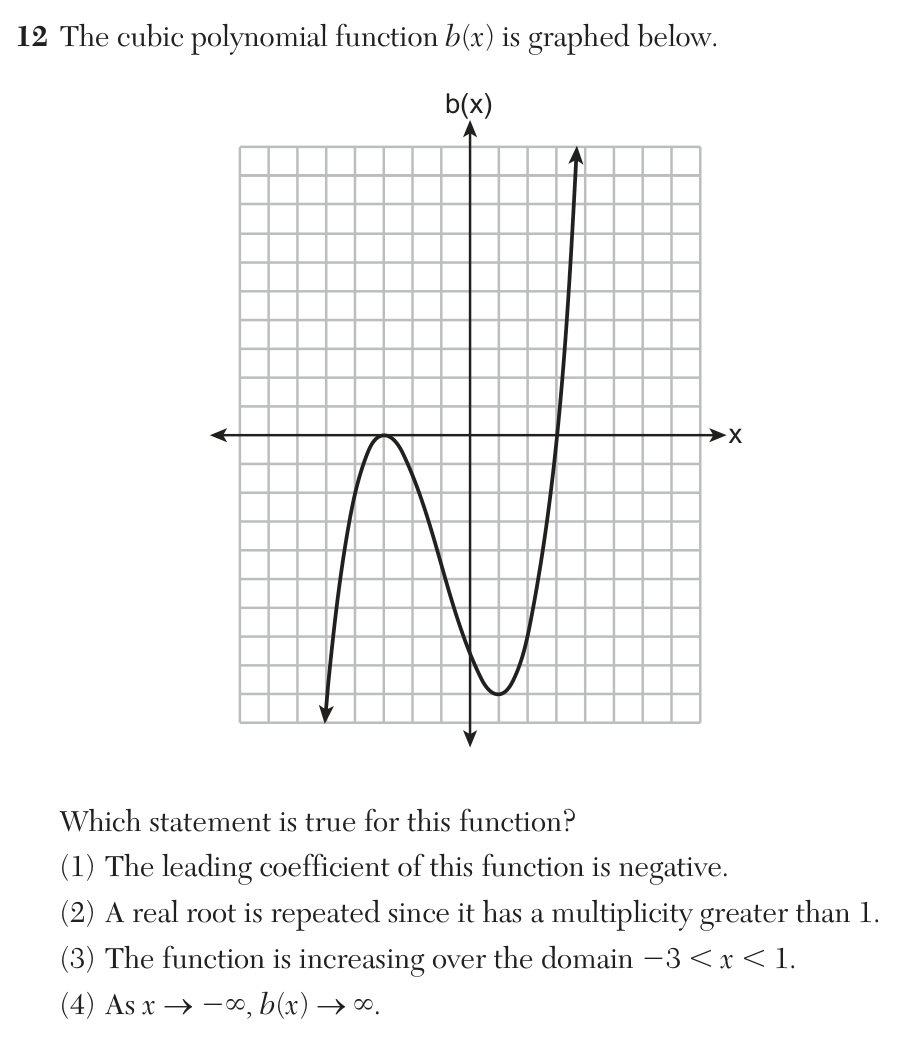
- At , the curve touches the x-axis and turns back down instead of crossing it.
- A polynomial root where the graph touches and turns has even multiplicity. Thus this real root is repeated.
- The graph’s left end points down and its right end points up, so its leading coefficient is positive. It decreases between the local maximum and minimum.
Question 13: Choose the positive angle in Quadrant IV
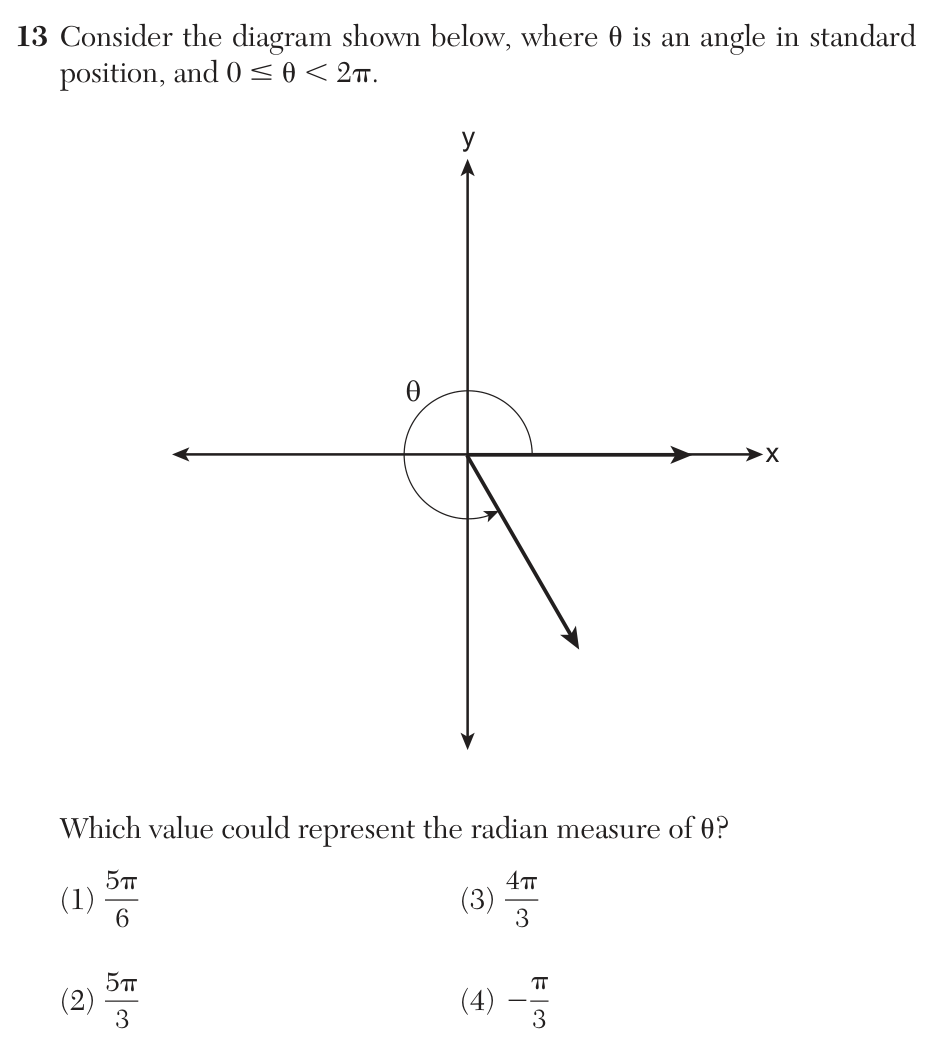
- The terminal side lies in Quadrant IV, where an angle in the required interval is between and .
- The value equals 300 degrees and lies in that quadrant.
- Although has the same terminal side, it is negative and does not satisfy .
Question 14: Compare maximum values and frequencies
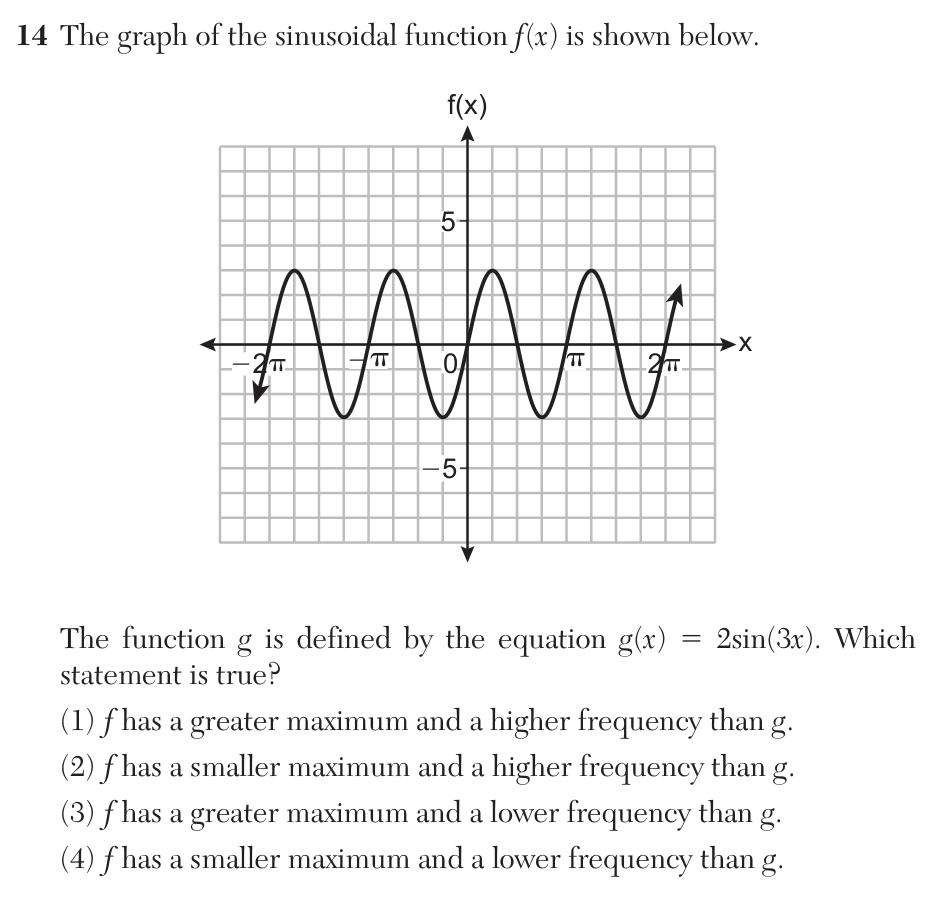
- The graph of f peaks at 3. The function peaks at 2. Therefore f has the greater maximum.
- The f graph completes two cycles over a horizontal interval of , so its period is π. For g, the period is:
- A shorter period means more cycles over the same interval. Function g completes three cycles per , so f has the lower frequency.
Question 15: Rewrite a negative fractional exponent
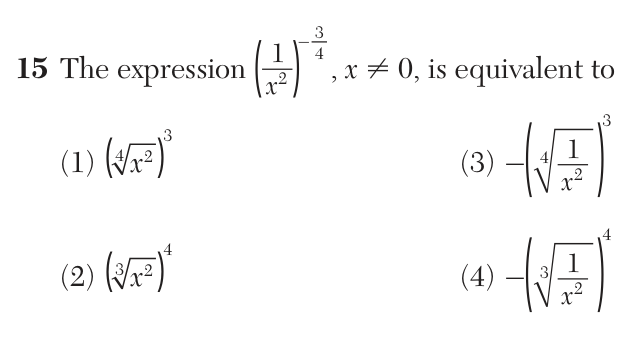
- Because , the base is positive. A negative exponent reciprocates the base:
- The denominator 4 means fourth root; the numerator 3 means third power:
Exam detail: A negative exponent does not place a minus sign in front of the value. Keeping the squared base also preserves the expression for negative x.
Question 16: Factor out the common factor first
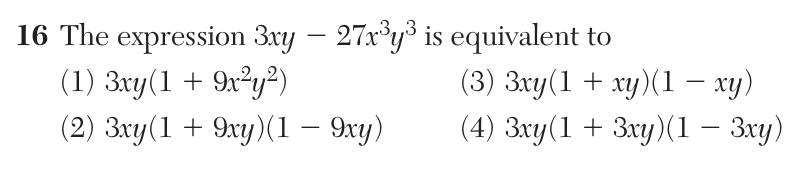
- The greatest common factor of both terms is :
- Inside the parentheses, use the difference of squares:
- Combine the factors:
Question 17: Multiply and collect like powers
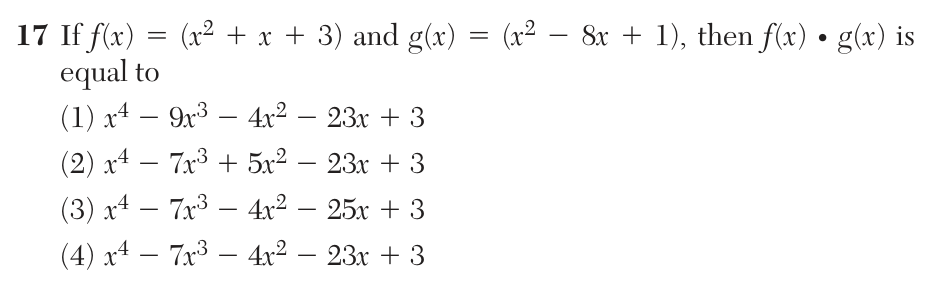
- Distribute each term of the first polynomial over the second:
- Expand the three products:
- Combine coefficients with the same power:
Question 18: Identify an imposed treatment
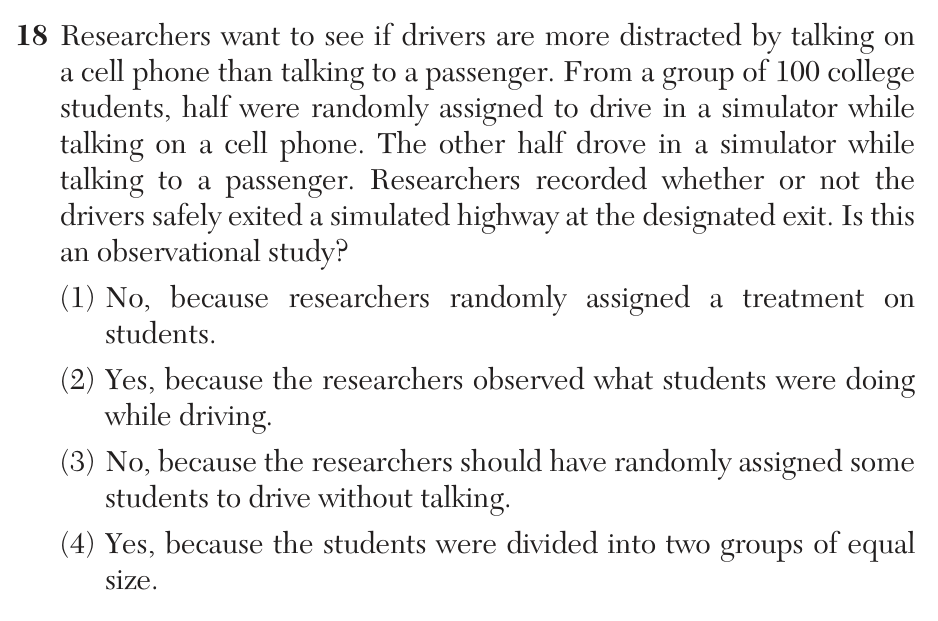
- Researchers assigned the students to a cell-phone conversation or a passenger conversation during the simulator task.
- The treatment was actively imposed, and its assignment was random. That makes this an experiment.
- Watching and recording outcomes occurs in both experiments and observational studies. The assigned treatment is the deciding distinction here.
Question 19: Undo an exponential with a logarithm
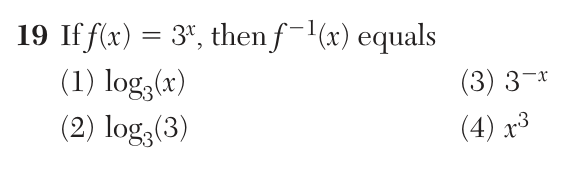
- Start with . Swap x and y to find the inverse:
- Rewrite the exponential equation in logarithmic form:
- Therefore the inverse is , with .
Exam detail: Inverse-function notation is different from the reciprocal of a function.
Question 20: Solve both absolute-value branches
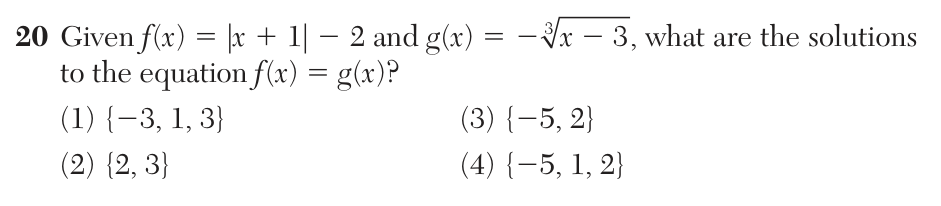
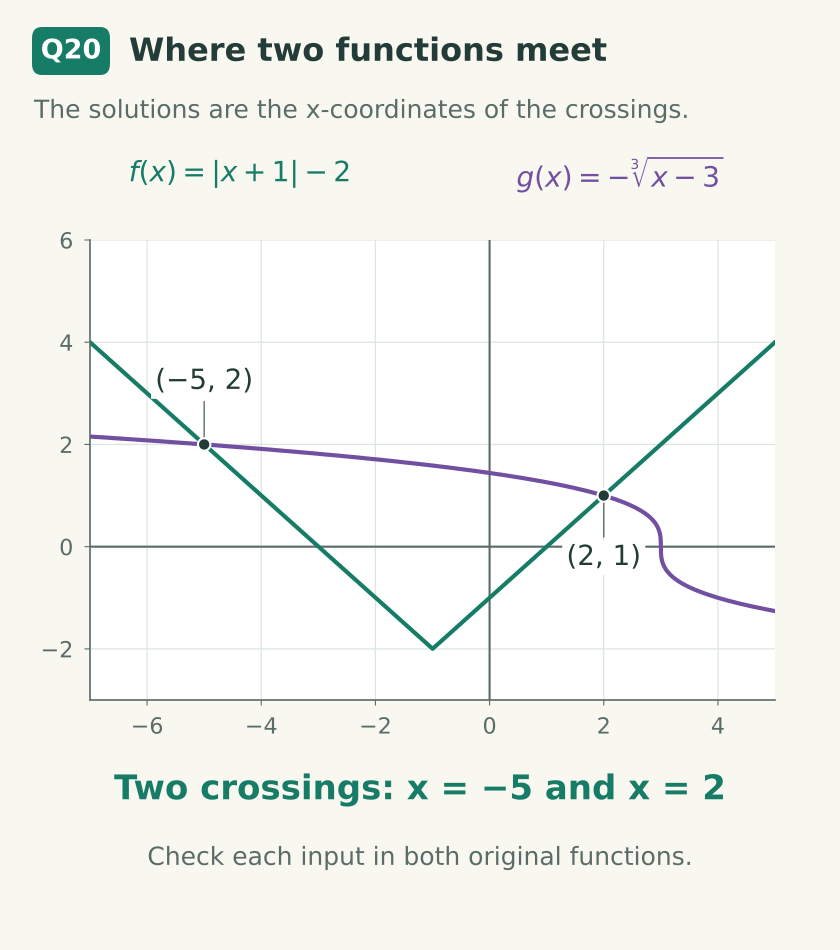
- For , the absolute value becomes . Thus:Cube both sides and collect terms:The quadratic discriminant is , leaving the real candidate .
- For , the absolute value becomes . Thus:The quadratic discriminant is , leaving .
- Both candidates satisfy their branch conditions. Substitution gives and . The graph shows the same two intersections.
Exam detail: Cubing is reversible for real values, but the absolute-value branch conditions still need checking.
Question 21: Reduce the powers of the imaginary unit

- Use the repeating cycle , , . It follows that and .
- Replace each power in the expression:
- Combine real and imaginary terms:
Question 22: Apply the definition of an odd function
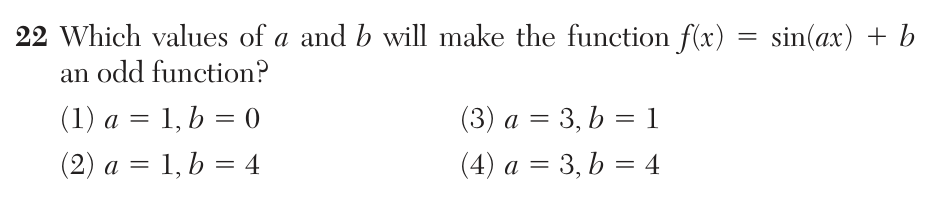
- An odd function satisfies . Sine already has this property: .
- A nonzero vertical shift breaks this symmetry. In particular, an odd function defined at zero must have , while the given function has .
- The only listed pair with is , .
Question 23: Isolate the exponential before taking logs
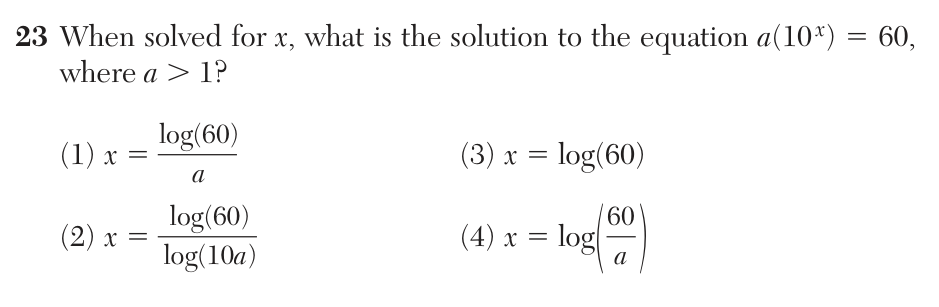
- Divide both sides by a, which is positive:
- Take common logarithms, whose base is 10:
- Since , the solution is:
Question 24: Convert a half-life into an hourly factor
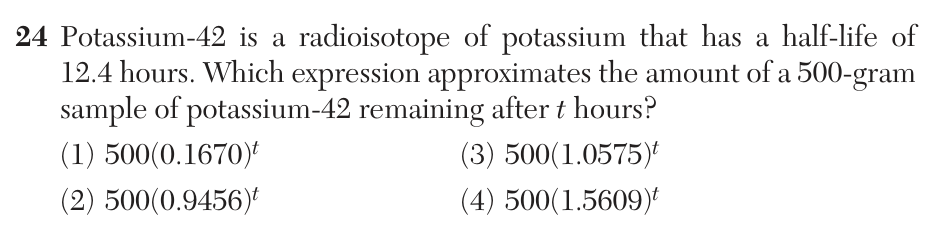
- After every 12.4 hours, half of the material remains. The model is:
- Rewrite with t as the exponent:
- Evaluate the hourly factor:Its four-decimal approximation is 0.9456.
Exam detail: A decay factor lies between 0 and 1.
Part II: Short constructed responses
Questions 25–32 • 2 credits each • 16 credits total
Question 25: Apply the recurrence twice

- Start from the supplied first term . To obtain each next term, square the previous term and add 4.
- Find the second term:
- Use 29, not 5, to find the third term:
Question 26: Write the exponential regression equation
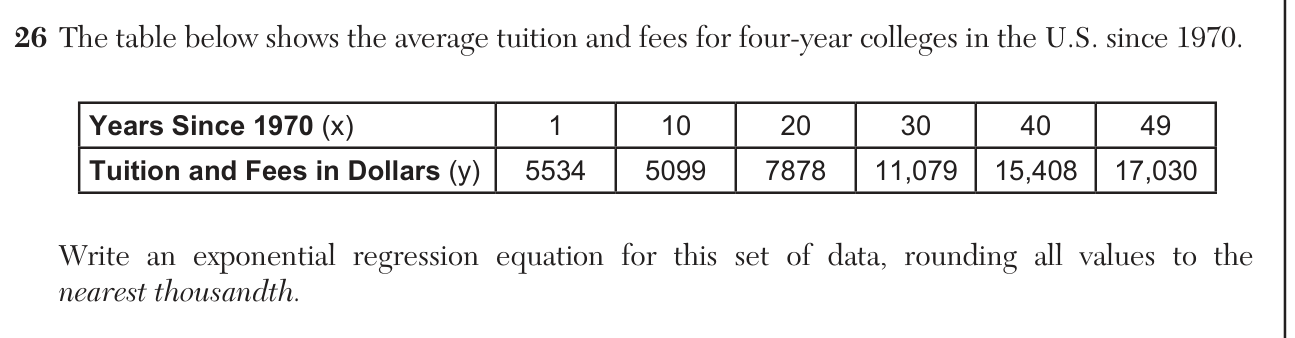
- Enter the six years-since-1970 values in one calculator list and the matching tuition-and-fee amounts in a second list. Preserve the pairing of each x and y value.
- Choose exponential regression in the form . The fitted coefficients are approximately:
- Round each coefficient to the nearest thousandth and write the complete equation:
Exam detail: Official scoring clarification: NYSED permits full credit when a calculator model truncates the correctly found coefficient to two decimal places. The base must still be correctly rounded to the thousandth. The notice is linked in Sources & References.
Question 27: Use the remainder theorem

- When a polynomial is divided by , its remainder is . Here .
- Evaluate the polynomial at 2:
- Calculate:
Question 28: Label the normal curve and its central interval
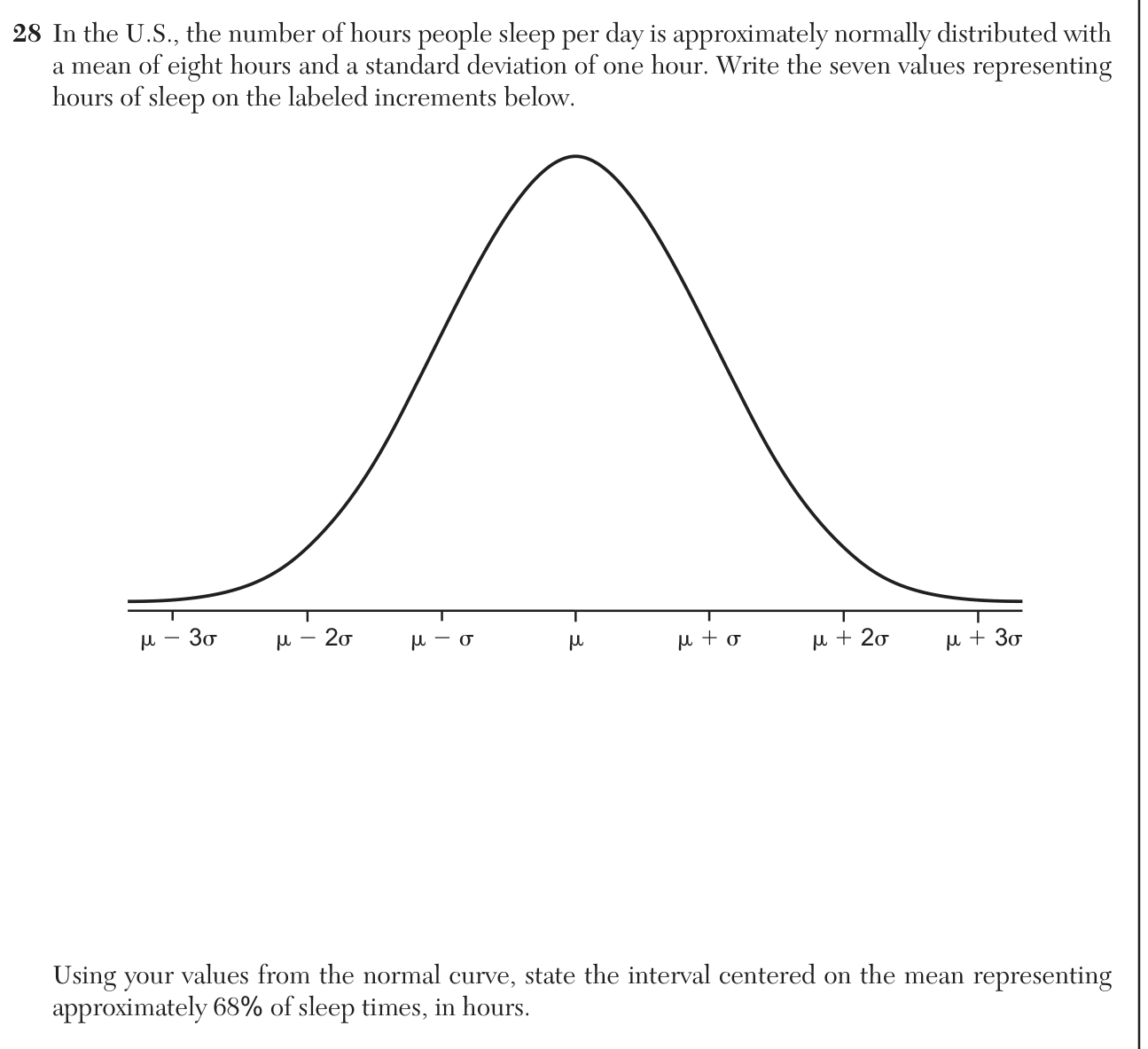
- The mean is hours and the standard deviation is hour.
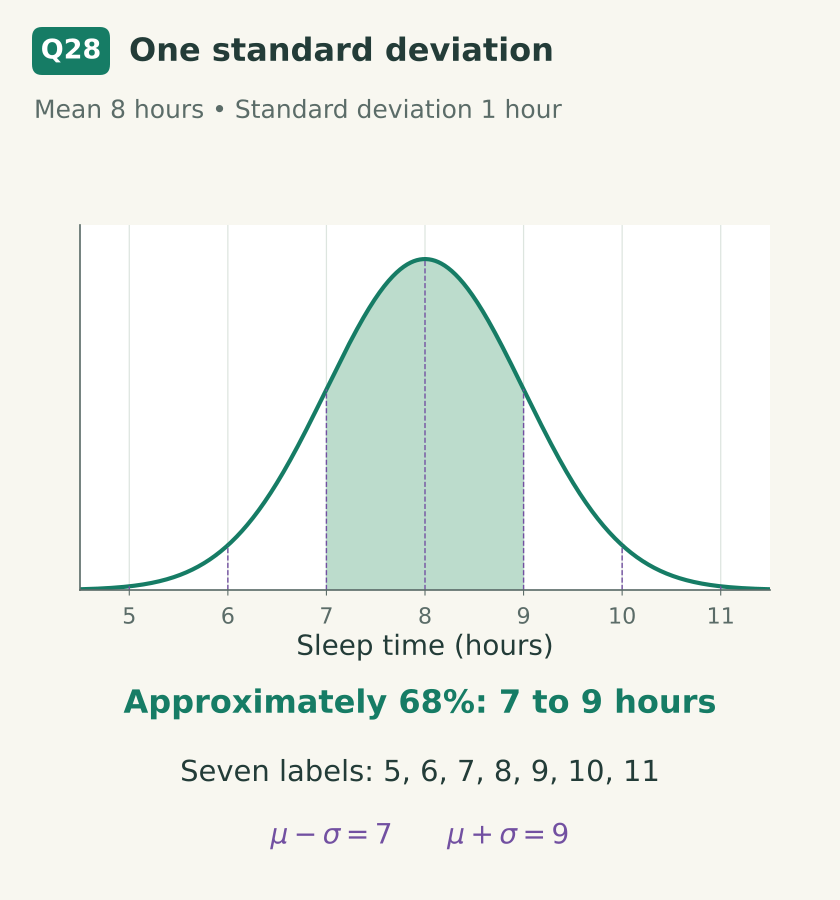
- Move one standard deviation at a time from the mean. From left to right, the seven values are 5, 6, 7, 8, 9, 10 and 11 hours.
- About 68% of a normal distribution is within one standard deviation of the mean:The centered interval is 7 to 9 hours.
Exam detail: For this continuous model, including or excluding the endpoints does not change the probability.
Question 29: Sketch a cubic from its zeros and maximum
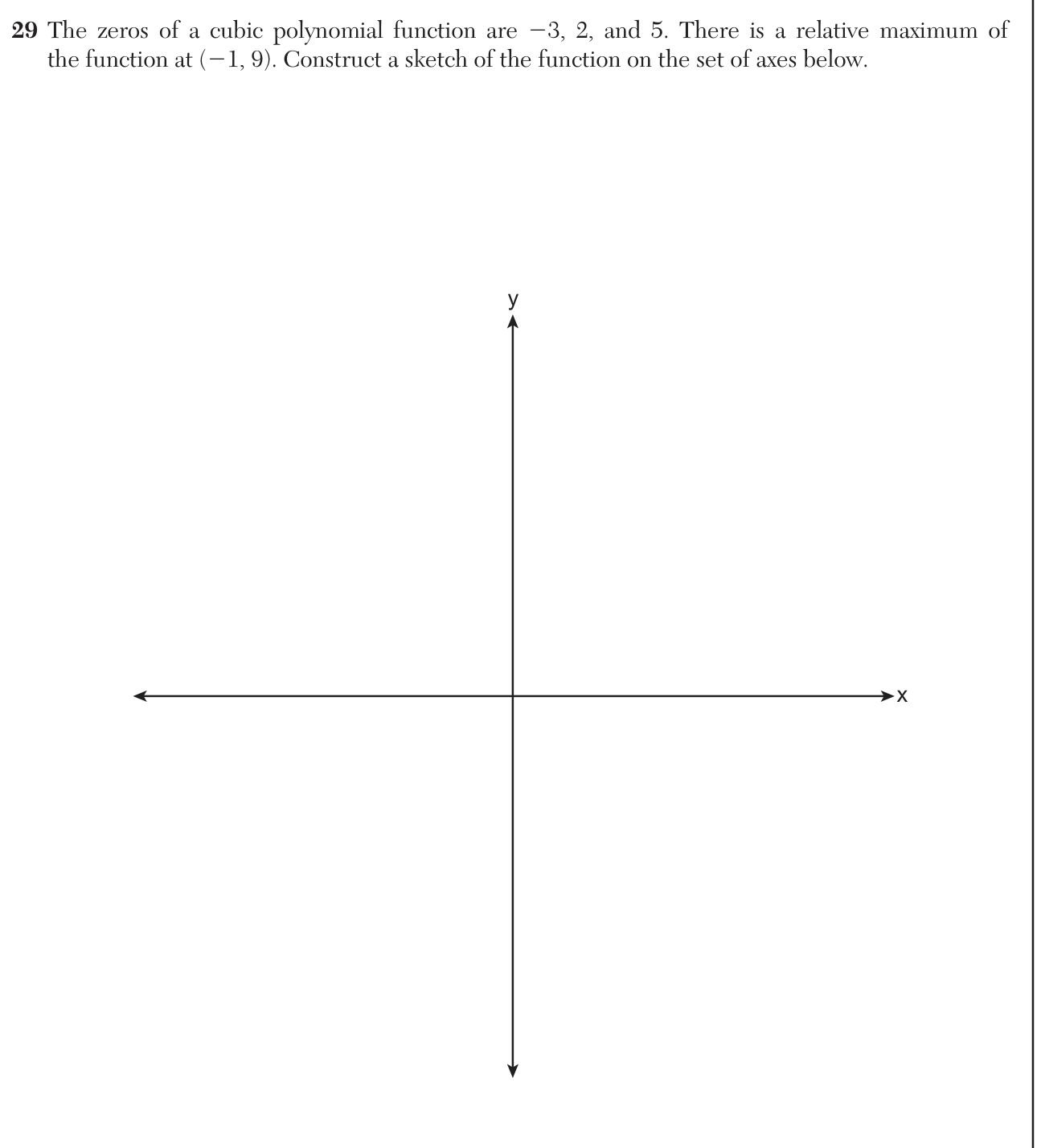
- Mark the three x-intercepts , and . Also mark the given relative maximum .
- Draw a smooth cubic that rises through the first intercept to the maximum, falls through the second intercept to a minimum below the axis, then rises through the third intercept. The left end goes down and the right end goes up.
- To plot an exact curve with those features, use . Substituting the maximum point gives , so one matching model is:
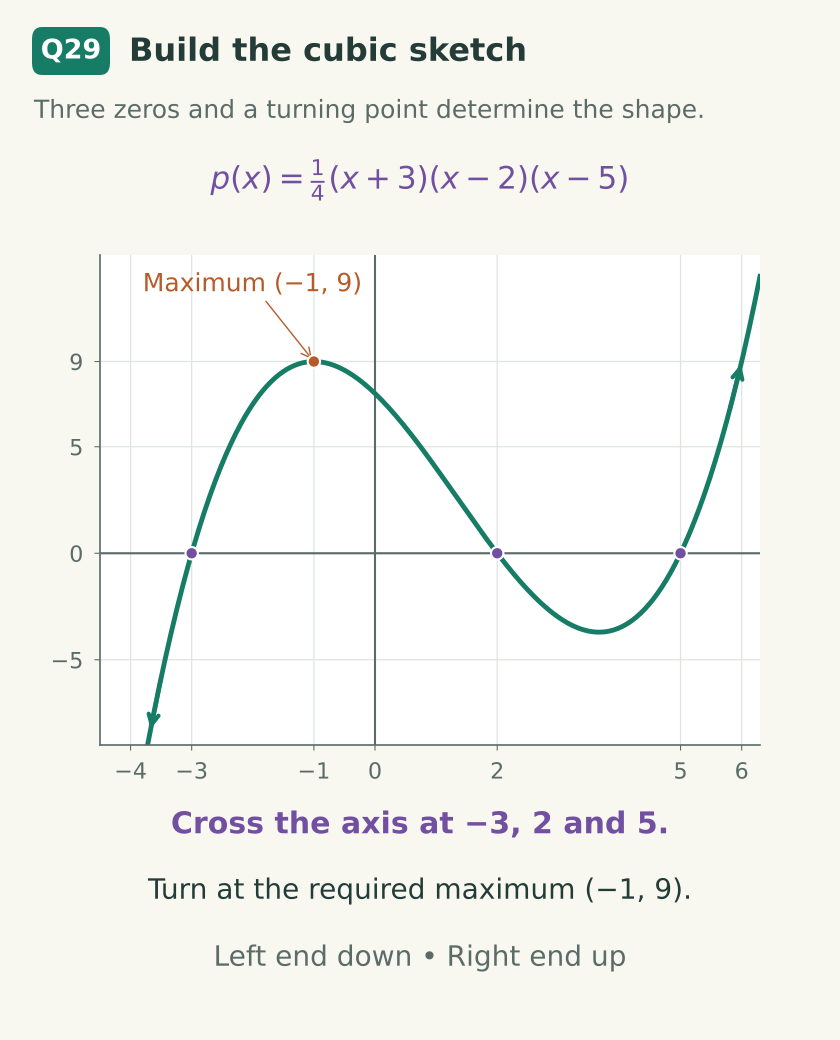
Exam detail: The question requires a sketch. An equation or a list of intercepts alone does not replace the graph.
Question 30: Find the missing trigonometric ratio

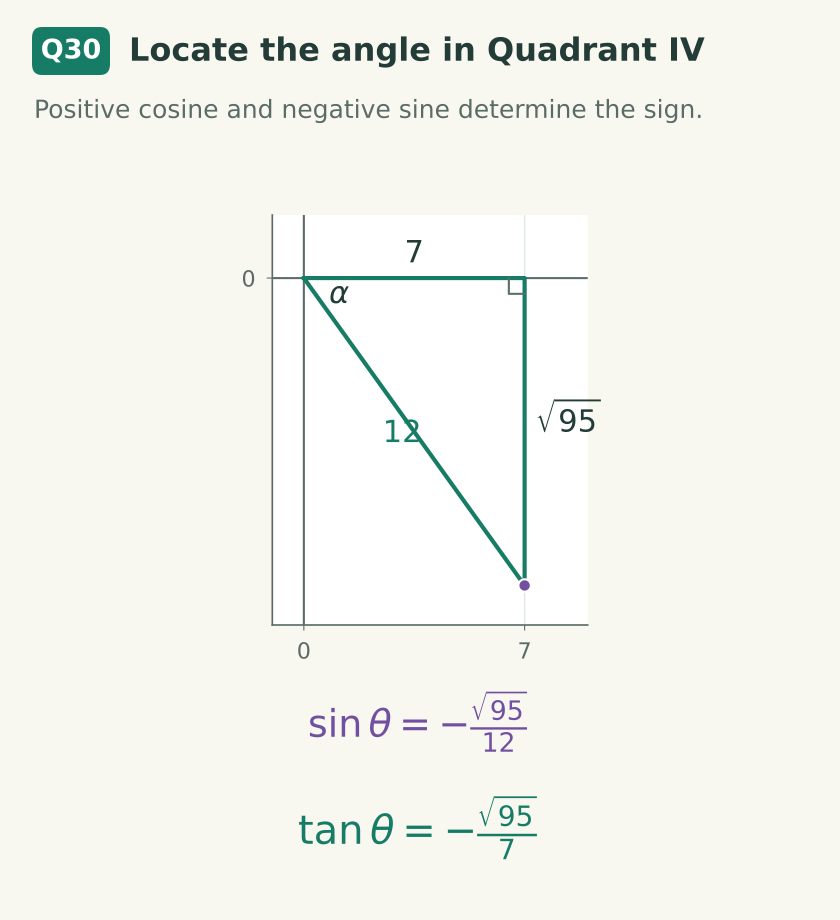
- Cosine is positive and sine is negative, so θ is in Quadrant IV. Use .
- Substitute the cosine and take the negative square root:
- Tangent is sine divided by cosine:
Exam detail: The square root of 95 does not simplify, since 95 has no perfect-square factor greater than 1.
Question 31: Find both complex roots

- Subtract 50 and divide by 6:
- Take both square roots, using :
- Simplify the radical:
Exam detail: Both signs are required when solving a squared equation.
Question 32: Cancel a common factor while preserving the domain

- Use the sum-of-cubes identity in the numerator:
- Factor the denominator:
- Cancel the common factor only where the original expression is defined:
Exam detail: Cancel factors, not individual terms. The removed factor still determines an original domain restriction.
Part III: Extended constructed responses
Questions 33–35 • 4 credits each • 12 credits total
Question 33: Compare an overall and conditional probability
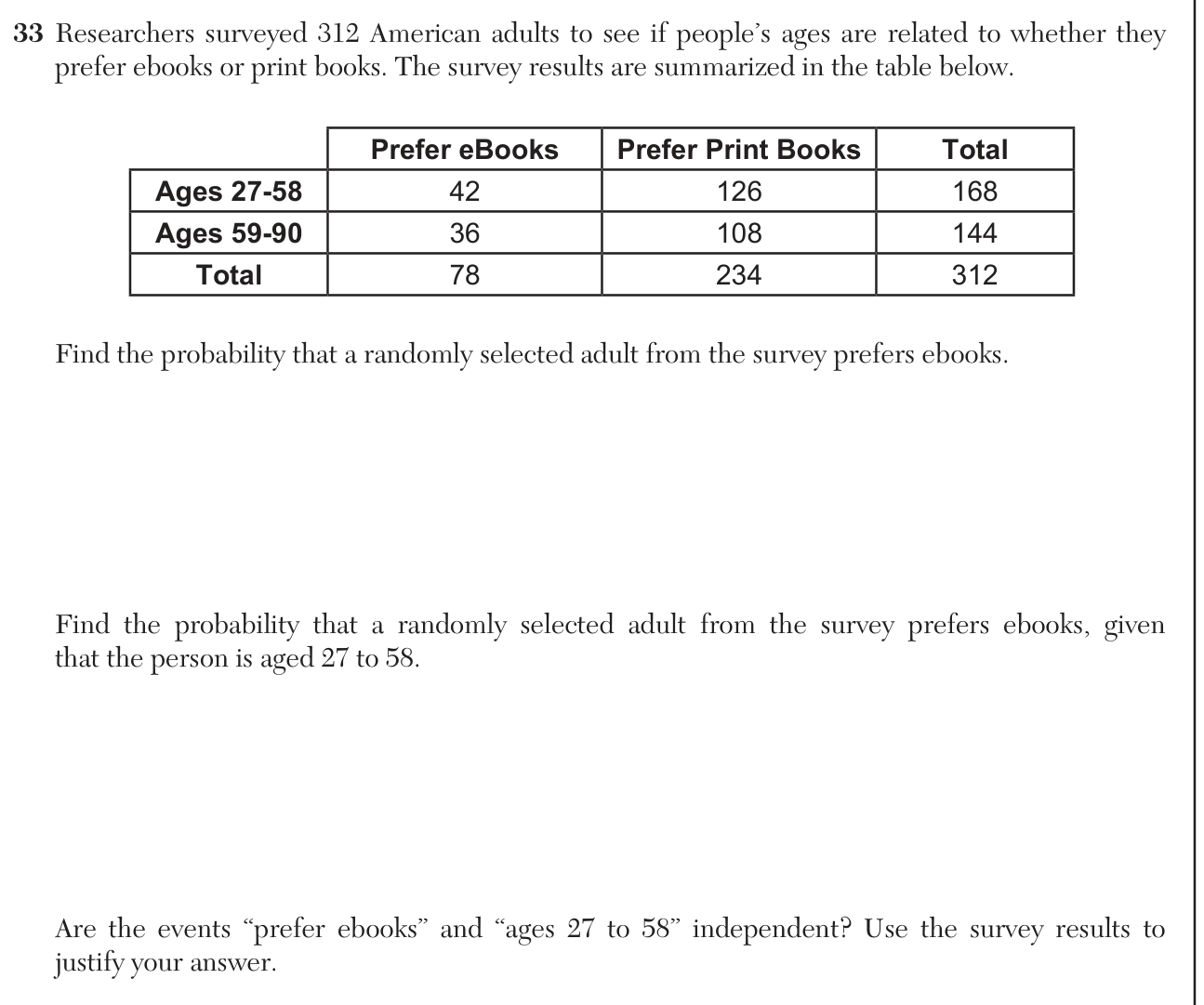
- Let E mean “prefers ebooks” and A mean “ages 27–58.” Among all 312 surveyed adults, 78 prefer ebooks:
- Once the age group is specified, the relevant total is 168 adults. Of them, 42 prefer ebooks:
- These two probabilities are equal. Knowing that a selected adult is ages 27–58 does not change the probability of preferring ebooks, so the events are independent.
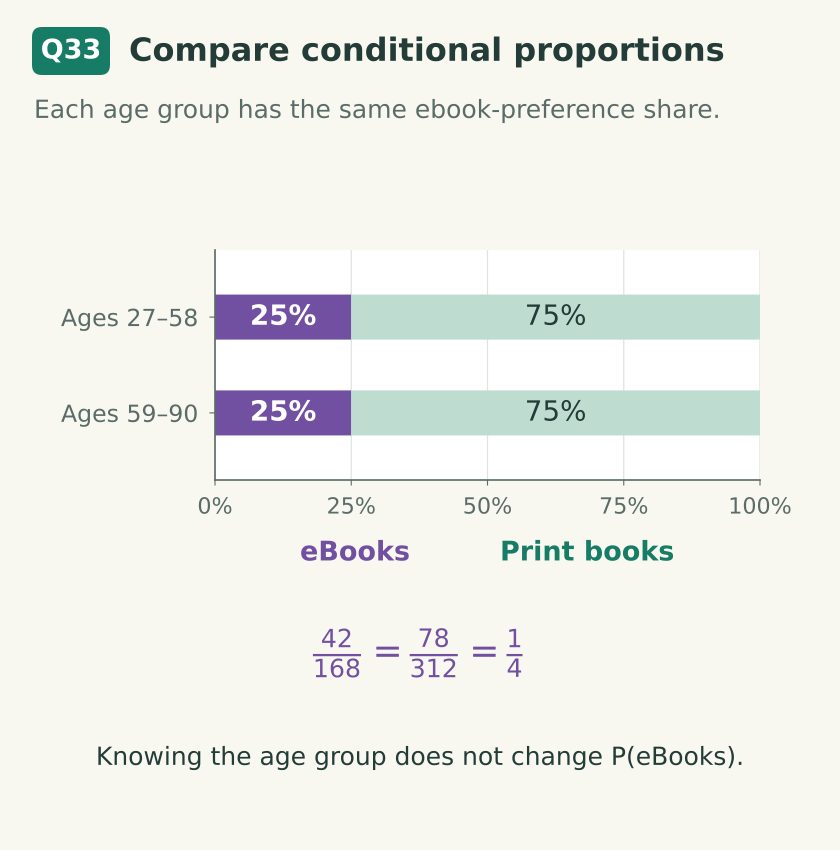
Exam detail: Just saying “independent” is not a justification. Compare the appropriate probabilities using the table.
Question 34: Model monthly compounding and solve with logarithms
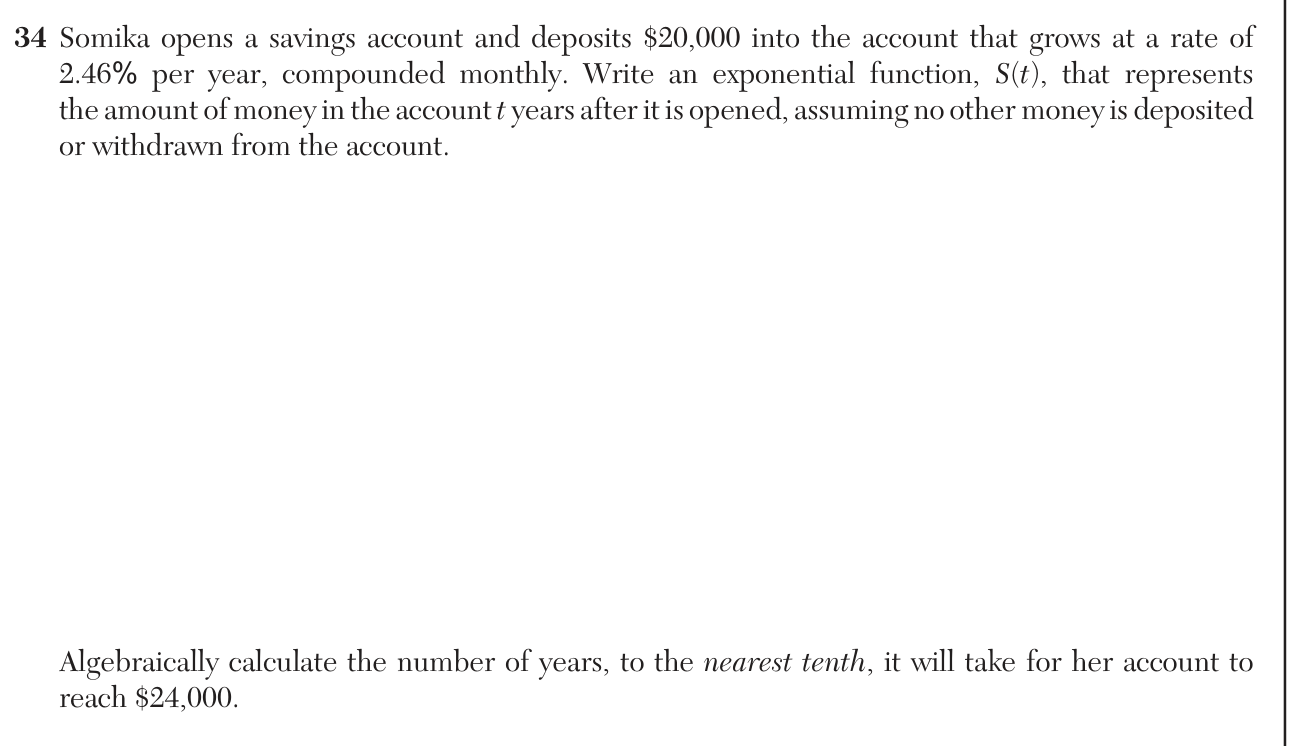
- Convert the annual rate to a decimal, . Monthly compounding gives 12 periods per year, so:
- Set the balance equal to $24,000 and divide by $20,000:
- Take logarithms and solve algebraically:
- Round only the final time to the nearest tenth: 7.4 years.
Exam detail: The question specifies algebraic work. Retain the monthly factor’s precision until the final rounding.
Question 35: Square carefully and check both candidates

- Isolate one radical:
- Square both sides and simplify:
- Square again, then factor:The candidates are 0 and 12.
- Check the original equation. At 0, the left side is , not −2, so reject 0. At 12:Thus 12 is valid.
Exam detail: The subtraction in the squared binomial creates a cross term. Omitting that term changes the equation.
Part IV: Modeling a breathing cycle
Question 36 • 6 credits
Question 36: Graph the sinusoid and interpret its change
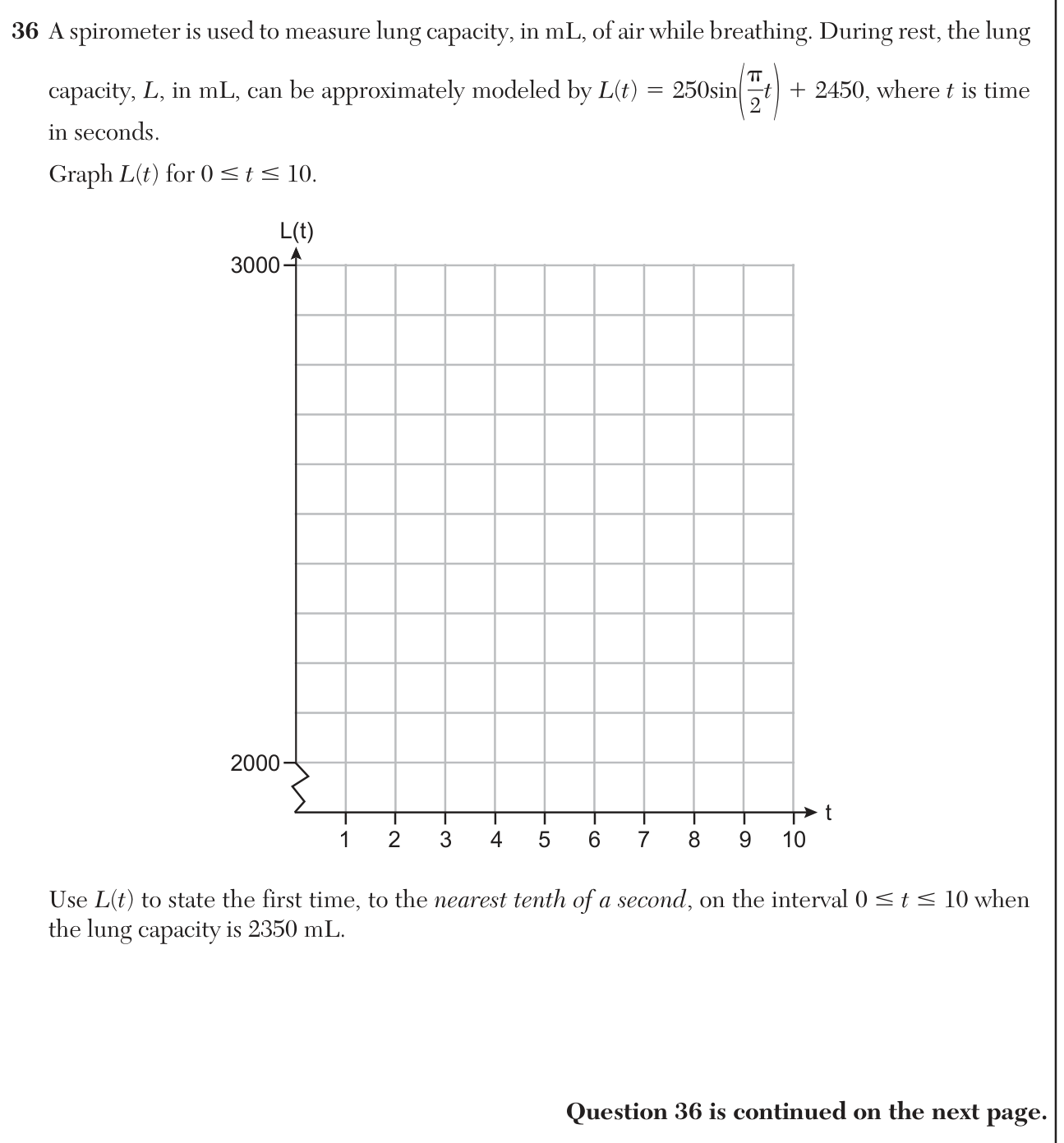
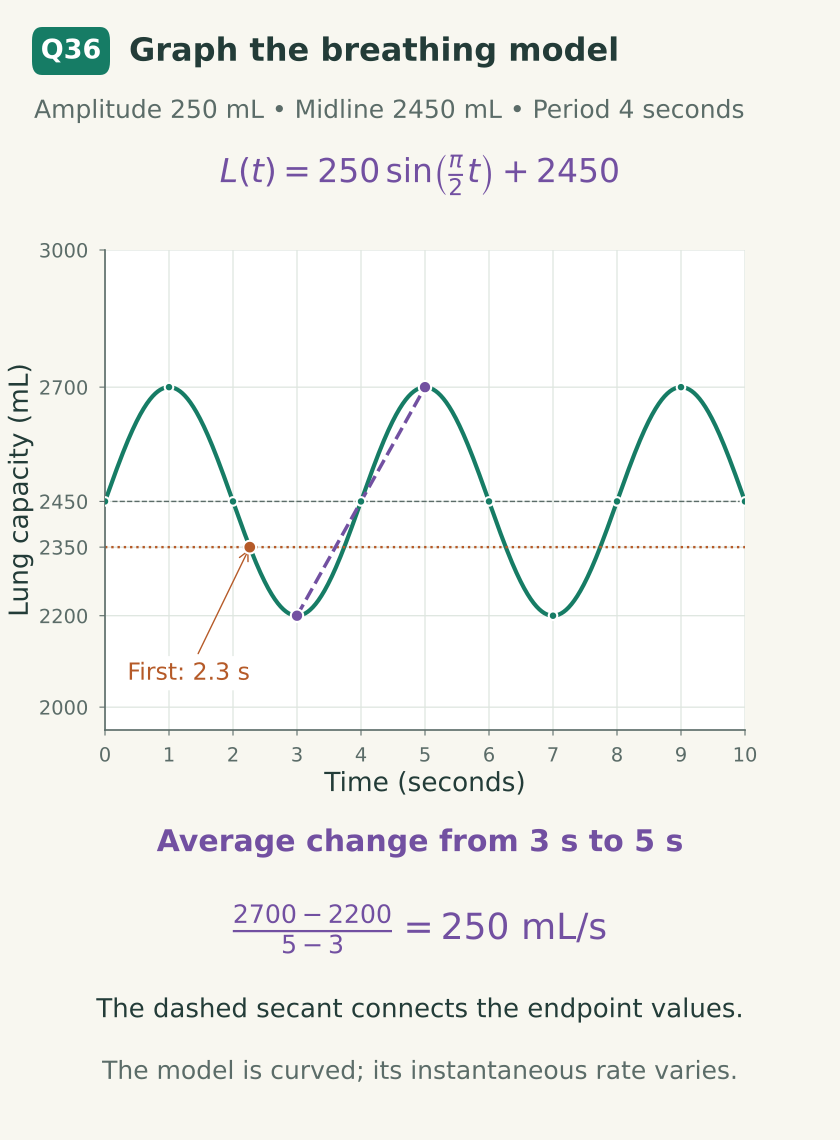
- Graph the model. The amplitude is 250 mL, the midline is 2,450 mL, and the period is:seconds. Plot the smooth curve from 0 to 10 seconds. It starts at , peaks at , and , and reaches minima at and .
- Find the first 2,350 mL crossing. Substitute the required capacity:The first crossing is after 2 seconds, on the decreasing portion of the curve. In radians:To the nearest tenth, this is 2.3 seconds.
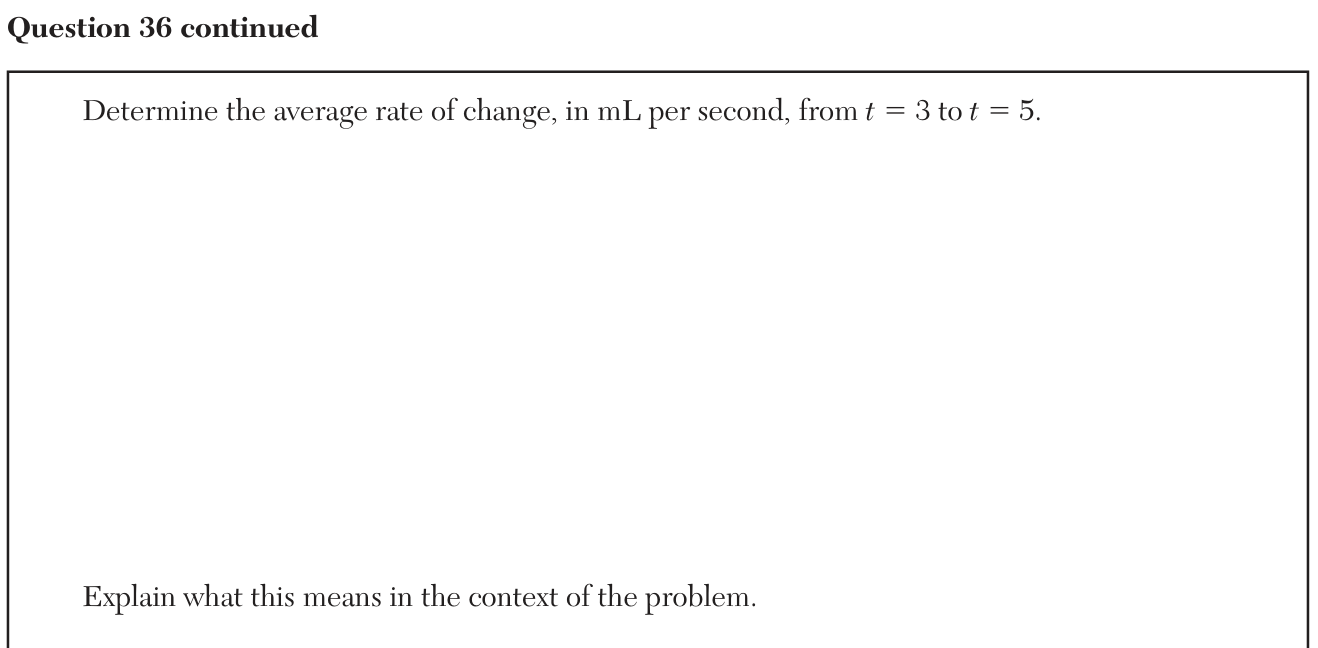
- Calculate the average rate from 3 to 5 seconds. The endpoint capacities are and mL. Therefore:
- Interpret the rate. Between 3 and 5 seconds, the modeled lung capacity increases by an average of 250 mL per second. This is the secant slope over that interval, not a claim that the instantaneous rate is constant.
Exam detail: This question continues onto exam page 25. Include the graph, crossing time, average-rate calculation and contextual explanation.
Check your score carefully
The maximum raw score is 82. Use the official June 2026 Algebra II conversion chart for the scaled Regents score; another administration’s chart may give a different result. For related practice, see the January 2026 Algebra II Regents solutions.
Sources & References
Official materials accessed October 7, 2026. Question and scoring references use the English edition throughout this page.
- Official June 2026 Algebra II examination (questions; PDF)
- Official June 2026 multiple-choice scoring key (PDF)
- Official June 2026 rating guide (PDF)
- Official June 2026 model response set (PDF)
- Official June 2026 conversion chart (PDF)
- Official June 2026 Question 26 scoring clarification (PDF)
- NYSED Algebra II past-examination index
- NYSED terms of use and reproduction conditions
From the New York State Education Department. Regents Examination in Algebra II, June 2026. Internet. Available from the official examination link above; accessed 7 October 2026. Original question images are distinguished from HeLovesMath’s original explanations and solution diagrams.