
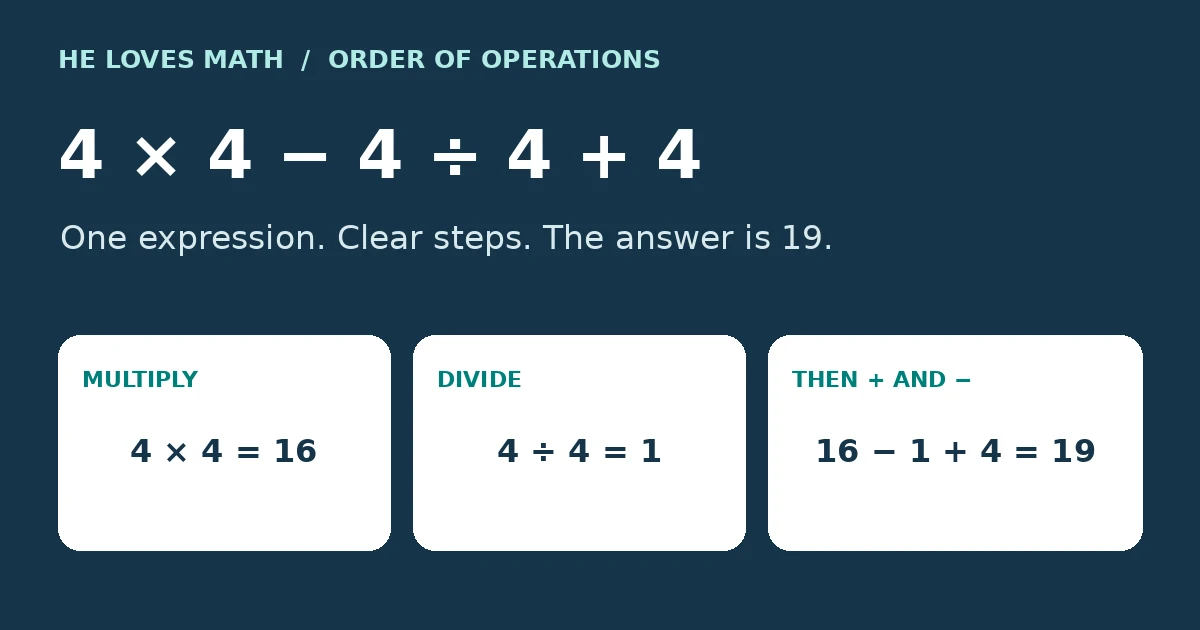
Order of operations • worked answer
The answer to 4 × 4 − 4 ÷ 4 + 4 is 19
4 × 4 − 4 ÷ 4 + 4= 16 − 1 + 4= 15 + 4 = 19
Calculate the multiplication and division first. Then do the subtraction and addition from left to right. There are five 4s and four operation signs in this expression.
This short puzzle is a useful test of how you read an expression. The arithmetic is simple; the important step is deciding which numbers belong together. Below, compare the correct method with the routes that produce 7 or 11, see how brackets change the question, and try 12 practice questions with worked answers.
What does 4×4−4÷4+4 mean?
The standard grouping is (4 × 4) − (4 ÷ 4) + 4. The product 4 × 4 and the quotient 4 ÷ 4 are separate parts of the calculation. The final +4 is outside the quotient.
The expression has no brackets or powers to evaluate. In the informal version “4x4-4/4+4”, x usually means multiplication and / means division. In algebra, x can be a variable, so × is clearer for this numerical question.
If an individual operation is unfamiliar, use our explanations of multiplication, division, subtraction and addition.
Solve the challenge step by step
- Multiply 4 by 4. Replace 4 × 4 with 16. The expression becomes 16 − 4 ÷ 4 + 4.
- Divide 4 by 4. Replace 4 ÷ 4 with 1. The expression becomes 16 − 1 + 4.
- Subtract, then add. At this level, read from left to right: 16 − 1 = 15, then 15 + 4 = 19.
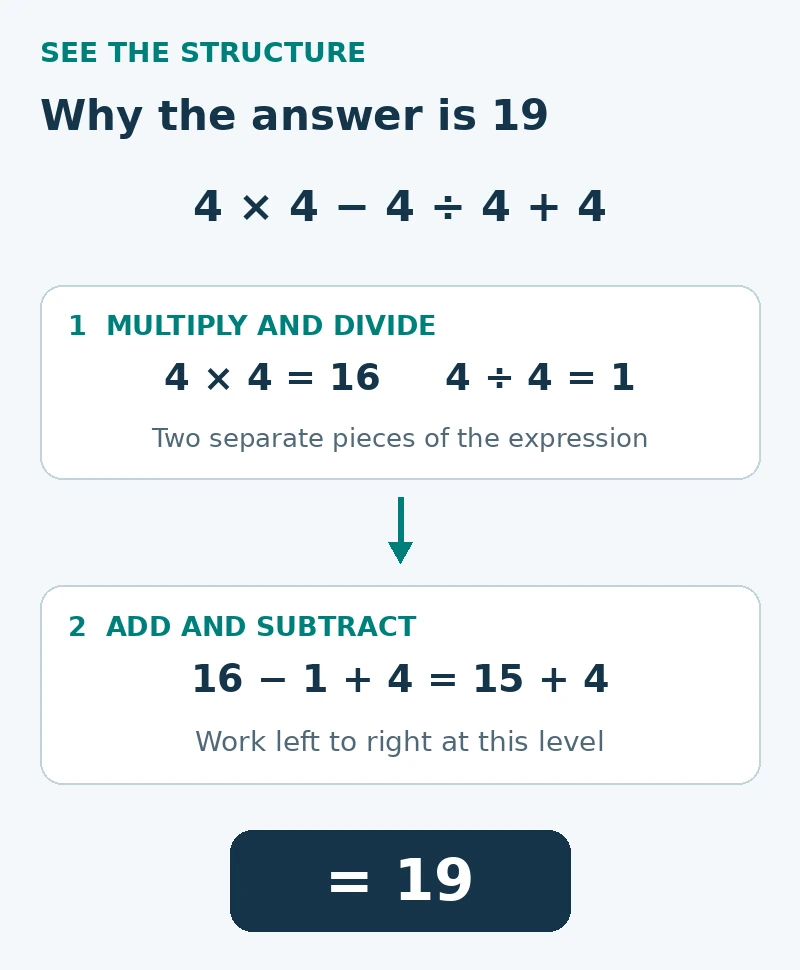
Check the scale: start with 16, remove 1, then add 4. The result should be 3 more than 16, so 19 is sensible. This checks the arithmetic after you have identified the grouping.
PEMDAS and BODMAS use the same priorities
Read either acronym as four levels, not six separate commands. PEMDAS uses “parentheses” and “exponents”; BODMAS uses “brackets” and “orders”; BIDMAS uses “indices” for powers.
- Grouping: work inside the innermost brackets first.
- Powers: evaluate exponents.
- Multiplication and division: share a level; work from left to right.
- Addition and subtraction: share a level; work from left to right.
The rule applies inside brackets too. A bracket around 2 + 3 × 4 does not make the addition happen first: the value inside is 2 + 12 = 14.
Division can come before multiplication
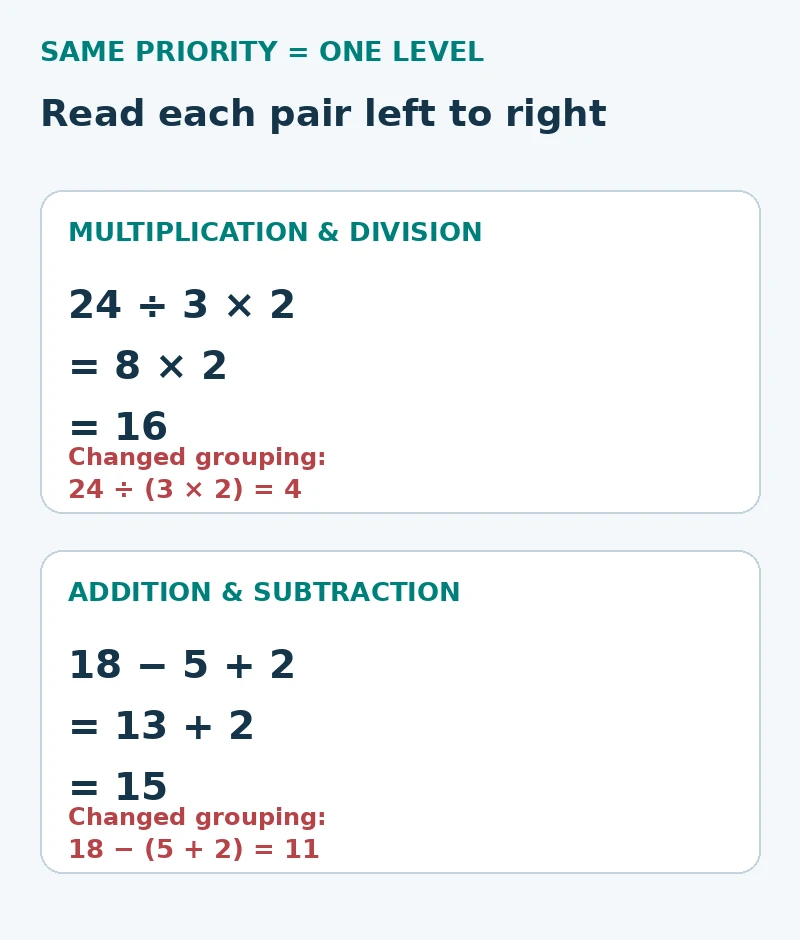
24 ÷ 3 × 2 = 8 × 2 = 16
The division is first because it is farther left at the same priority level. Calculating 3 × 2 first would silently change the expression into 24 ÷ (3 × 2), which equals 4.
Subtraction can come before addition
18 − 5 + 2 = 13 + 2 = 15
It is not 18 − (5 + 2). That bracketed expression equals 11 and asks a different question.
Why do some methods give 7 or 11?
7: doing every operation strictly left to right
A sequential calculation goes 4 × 4 = 16, then 16 − 4 = 12, then 12 ÷ 4 = 3, then 3 + 4 = 7. The arithmetic in each small step is correct, but the subtraction was done before the division.
This method actually evaluates ((4 × 4 − 4) ÷ 4) + 4, not the unbracketed original.
11: treating addition as higher priority than subtraction
After reaching 16 − 1 + 4, adding 1 + 4 and then subtracting 5 gives 11. That changes the expression into 16 − (1 + 4). The +4 has been turned into part of the amount subtracted.
A useful nuance: you may rewrite 16 − 1 + 4 as 16 + 4 − 1, because the −1 keeps its sign. Both equal 19. Reordering signed terms correctly is different from inventing 16 − (1 + 4).
Different brackets legitimately give different answers
These are valid new questions. They do not make the answer to the original expression uncertain.
| Expression | Working | Answer |
|---|---|---|
| 4 × 4 − 4 ÷ 4 + 4 | 16 − 1 + 4 | 19 |
| 4 × (4 − 4) ÷ 4 + 4 | 4 × 0 ÷ 4 + 4 | 4 |
| 4 × 4 − 4 ÷ (4 + 4) | 16 − 4 ÷ 8 | 15.5 |
| (4 × 4 − 4) ÷ 4 + 4 | 12 ÷ 4 + 4 | 7 |
| 4 × (4 − 4 ÷ 4) + 4 | 4 × 3 + 4 | 16 |
Why might a calculator show a different result?
Check its calculation mode and the exact input. A calculator using chain or immediate execution evaluates operations as they are entered. A calculator using an algebraic precedence mode follows a hierarchy. Texas Instruments documents both methods for the BA II Plus, so “calculator” alone does not tell you which method is active.
In chain mode, the ungrouped key sequence can produce the 7 route above. In an algebraic mode, entering the original expression should produce 19. A full-expression display can help you inspect your input, but the display alone does not establish the evaluation rule.
- Check that the third operation is division, not addition.
- Check that no brackets were added or omitted.
- Look up the device's calculation mode if results disagree.
- As a simple cross-check, calculate 4 × 4 and 4 ÷ 4 separately, then enter 16 − 1 + 4.
For longer calculations, the site's scientific calculator is a companion tool. Keep your written working so that you can compare the input with the expression you intended.
Use brackets and fraction bars to show grouping
Writing (4 × 4) − (4 ÷ 4) + 4 makes the original structure explicit without changing its value. Writing 4 × 4 − 4 ÷ (4 + 4) changes the divisor from 4 to 8.
A horizontal fraction bar groups the whole numerator and the whole denominator. Compare:
Sixteen minus the fraction four over four, plus four, equals nineteen.
Sixteen minus four divided by the quantity four plus four equals fifteen point five.
In one-line input, write the second fraction as 4/(4+4). For more on what a numerator and denominator represent, review fractions.
A reliable method for a longer expression
Copy every sign, mark the groups, and change only one part of the expression at a time. Keep the untouched parts on the next line.
18 − 3 × (2 + 4) ÷ 2 + 5= 18 − 3 × 6 ÷ 2 + 5= 18 − 18 ÷ 2 + 5= 18 − 9 + 5= 9 + 5 = 14
The brackets are first. Next, multiplication and division are read left to right. The remaining subtraction and addition are also read left to right. In algebra, 3(2 + 4) means the same as 3 × (2 + 4); our linear expressions guide develops that notation further.
Three checks that catch common errors
- Preserve the problem. Copy five 4s, one ×, one −, one ÷ and one +. A changed symbol creates a different puzzle.
- Keep equality true. Write 4 × 4 − 4 ÷ 4 + 4 = 16 − 1 + 4. Do not write “4 × 4 = 16 − 1 + 4”; those two sides have different values.
- Keep a negative sign with its term. Subtracting 1 and adding 4 is not subtracting both 1 and 4.
A grouping check outside the puzzle
Four notebooks cost £4 each. A £1 voucher reduces the order total, and delivery costs £4. The total is 4 × £4 − £1 + £4 = £19. Multiplication finds the notebook subtotal before the one-off adjustment and delivery charge are applied.
If instead the voucher were £1 per notebook, the calculation would be 4 × (£4 − £1) + £4 = £16. The words decide what is grouped. The arithmetic notation must communicate that decision.
Practice: 12 questions with worked answers
Try each question on paper first. Open the answer to compare the steps, not just the final number. The later questions add powers, nested grouping and negative signs.
1. 7 + 3 × 4 − 8 ÷ 2
Show worked answer 1
7 + 12 − 4 = 19 − 4 = 15
Multiply and divide before subtracting or adding.
2. (18 − 6) ÷ 3 + 22
Show worked answer 2
12 ÷ 3 + 4 = 4 + 4 = 8
Evaluate the bracket and the power before combining the results.
3. 24 ÷ 4 × 3 − 5
Show worked answer 3
6 × 3 − 5 = 18 − 5 = 13
Division and multiplication share a priority, so begin with 24 ÷ 4.
4. Which is larger: 6 + 2 × 5 or (6 + 2) × 5?
Show worked answer 4
6 + 2 × 5 = 6 + 10 = 16
(6 + 2) × 5 = 8 × 5 = 40
The bracketed expression is larger. Its addition must happen first.
5. Insert brackets into 4 × 4 − 4 ÷ 4 + 4 to change its value.
Show worked answer 5
One answer: 4 × (4 − 4) ÷ 4 + 4
= 4 × 0 ÷ 4 + 4 = 4
There are other valid answers. Keep the five numbers and their operation signs in their original order.
6. 30 ÷ 5 × 2
Show worked answer 6
6 × 2 = 12
Do not replace the divisor with 5 × 2; that would insert new brackets.
7. 20 − 6 + 3
Show worked answer 7
14 + 3 = 17
Subtract 6, then add 3. Do not subtract the sum 6 + 3.
8. 6 + 23 × 3
Show worked answer 8
6 + 8 × 3 = 6 + 24 = 30
The exponent applies to 2, so 2³ = 8. Then multiply before adding.
9. (14 − 6) ÷ (3 + 1)
Show worked answer 9
8 ÷ 4 = 2
The two brackets are independent groups. Complete both before the division.
10. −32 + 4 × 3
Show worked answer 10
−9 + 12 = 3
The unbracketed −3² means −(3²), which is −9. In contrast, (−3)² + 4 × 3 = 9 + 12 = 21.
11. 3 × (2 + 4) − 18 ÷ 3
Show worked answer 11
3 × 6 − 6 = 18 − 6 = 12
Complete the bracket, then the product and quotient, then subtract.
12. 12 − [2 × (3 + 1)] + 5
Show worked answer 12
12 − [2 × 4] + 5
= 12 − 8 + 5 = 4 + 5 = 9
Begin with the innermost bracket. The subtraction and final addition happen after the outer group is simplified.
How to use this with a learner
Ask “Which part will you calculate next, and why?” before asking for the final answer. If a learner gives 7, discuss the operation priority; if they give 11, inspect the last subtraction and addition. Then use a fresh example to check the reasoning transferred.
A short lesson can have three stages: explain the original answer, compare one bracketed variation, and solve one unseen practice question. For an extension, ask learners to insert brackets into the five-4 expression and show why their new answer changes. No speed target is needed to assess this skill.
Frequently asked questions
Is the answer 19 or 7?
It is 19 for 4 × 4 − 4 ÷ 4 + 4. The answer 7 belongs to the different grouping (4 × 4 − 4) ÷ 4 + 4, or to a chain calculation that evaluates every operation in input order.
Does BODMAS give a different answer from PEMDAS?
No. For this expression, both give 19. Both place multiplication and division together, above addition and subtraction. Their letter order is not an instruction to separate equal-priority operations.
Can I calculate 4 ÷ 4 before 4 × 4 here?
Yes. They are independent parts: (4 × 4) − (4 ÷ 4) + 4. Calculating either part first preserves that structure. This does not let you regroup a chain such as 24 ÷ 3 × 2.
Do brackets always change the answer?
No. Brackets that make the existing grouping explicit, such as (4 × 4) − (4 ÷ 4) + 4, keep the answer 19. Brackets that change what an operation acts on can change the answer.
Is this the classic “four fours” puzzle?
No. This expression contains five occurrences of 4. “Four fours” usually describes a different kind of puzzle: constructing values with exactly four 4s and a specified set of permitted operations.
What is the quickest way to check my result?
Identify the two higher-priority pieces: 4 × 4 = 16 and 4 ÷ 4 = 1. Then the remaining calculation is 16 − 1 + 4 = 19. Explain that grouping before relying on a calculator display.
Sources & References
The explanations, diagrams and worked practice on this page are original. These references support the operation-priority convention, its curriculum context and the calculator-mode distinction.
- OpenStax, Prealgebra 2e: Use the Language of Algebra — grouping, exponents and the paired operation priorities.
- Department for Education: National curriculum in England, mathematics — Year 6 work on order of operations and the effect of brackets.
- Texas Instruments BA II Plus guide: Choosing Calculation Methods — the difference between chain (Chn) and algebraic (AOS) modes.
References checked 3 October 2026.