Math notation reference
Find a symbol. Read it in context.
Names, meanings, worked examples and LaTeX for 233 symbol entries, from arithmetic to calculus and proof writing. Some symbols appear more than once because their meanings change across subjects.
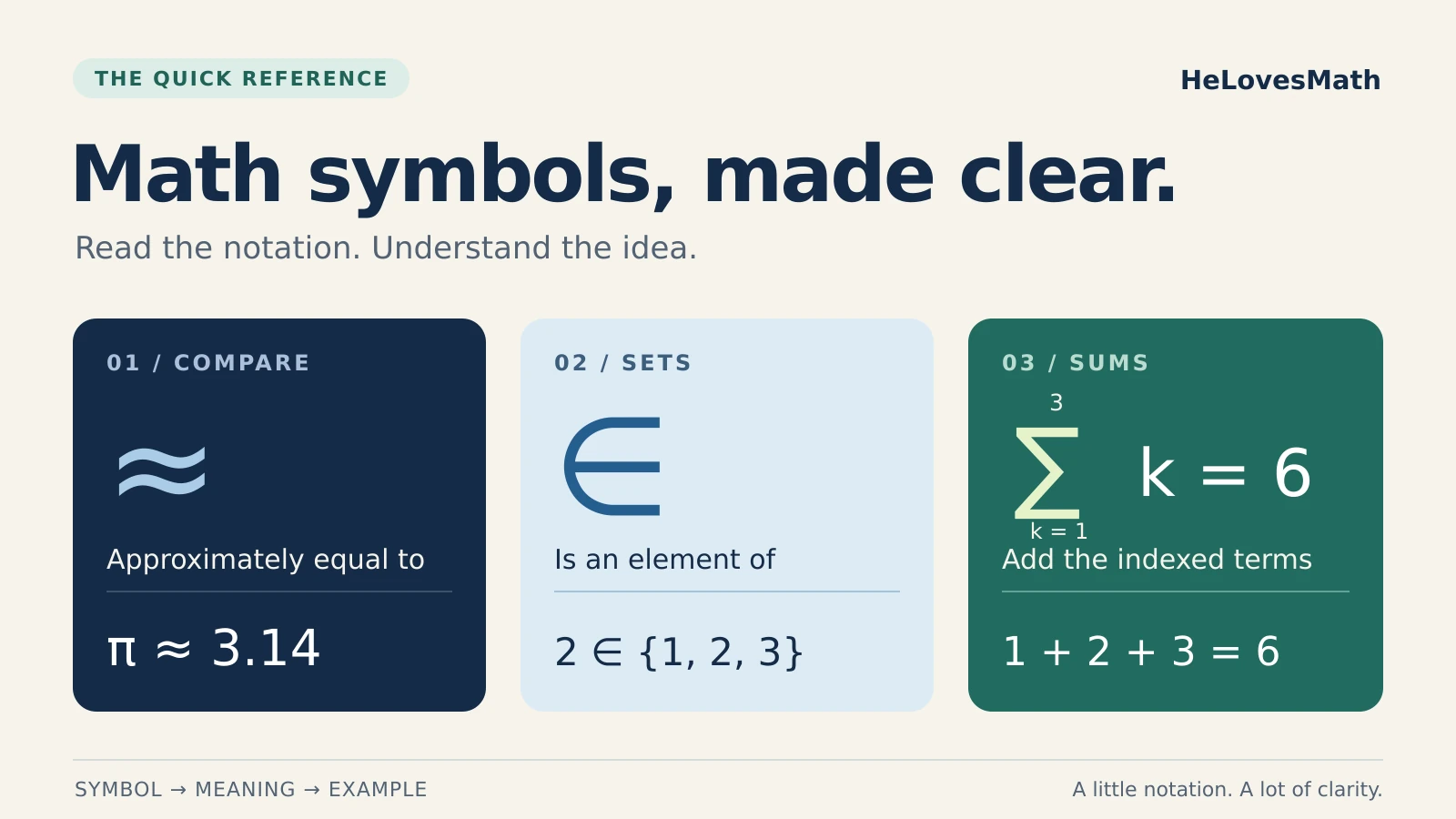
A mathematical symbol is shorthand for an operation, relationship or object. For example, ≤ means “less than or equal to,” ∈ means “is an element of,” and ∑ tells you to add indexed terms. Letters such as θ and μ represent quantities whose meanings must be defined in the problem.
The entire reference below is readable without JavaScript. When JavaScript is available, use search, category filters and Copy buttons. Otherwise, browse the categories or use your browser’s Find command.
200+ mathematical symbols: meanings and examples
Choose a category to jump to its entries. A definition describes a common convention; follow your textbook when notation differs.
Search matches the symbol, name, category, meaning, LaTeX or example. Category and search filters work together.
233 of 233 entries shown
No matching symbols. Clear the search or choose All categories.
| Symbol | Name | Category | Meaning and common use | LaTeX | Example |
|---|---|---|---|---|---|
| + | Plus / addition | Arithmetic | Adds quantities or indicates a positive quantity. | + | 3 + 2 = 5 |
| − | Minus / subtraction | Arithmetic | Subtracts a quantity or indicates a negative value. | - | 8 − 3 = 5 |
| ± | Plus or minus | Arithmetic | Indicates two possible signs or a tolerance. | \pm | x = 4 ± 1 |
| ∓ | Minus or plus | Arithmetic | Paired sign used with plus or minus expressions. | \mp | a ± b, c ∓ d |
| × | Multiplication sign | Arithmetic | Multiplies two quantities. | \times | 4 × 6 = 24 |
| · | Multiplication dot | Arithmetic | Multiplies quantities, often variables or vectors. | \cdot | a · b |
| ÷ | Division sign | Arithmetic | Divides one quantity by another. | \div | 12 ÷ 3 = 4 |
| / | Slash / division bar | Arithmetic | Represents division in linear text. | / | a / b |
| ⁄ | Fraction slash | Arithmetic | Slash separating an inline numerator and denominator; a stacked fraction uses \frac{a}{b}. | \text{\textfractionsolidus} | 3⁄4 |
| % | Percent | Arithmetic | Means per hundred. | \% | 25% = 25/100 |
| ‰ | Per mille | Arithmetic | Means per thousand. | \text{\textperthousand} | 4‰ = 4/1000 |
| √ | Square root | Arithmetic | For a non-negative real x, the non-negative number whose square is x. | \sqrt{x} | √9 = 3 |
| ∛ | Cube root | Arithmetic | For real x, the unique real number whose cube is x. | \sqrt[3]{x} | ∛(−8) = −2 |
| ∜ | Fourth root | Arithmetic | For a non-negative real x, the non-negative number whose fourth power is x. | \sqrt[4]{x} | ∜16 = 2 |
| ^ | Exponent marker | Arithmetic | Plain-text power marker; LaTeX uses ^ followed by an exponent. | x^{2} | x^2 |
| ! | Factorial | Arithmetic | For positive integer n, n! = 1 × 2 × … × n; by definition, 0! = 1. | ! | 5! = 120; 0! = 1 |
| ‖ | Double vertical bar | Arithmetic | Paired bars commonly denote a norm; the parallel relation is written ∥. | \| | ‖v‖ |
| | | Vertical bar | Arithmetic | May mean absolute value, divides, or such that. | | | |x| |
| ⌊ ⌋ | Floor brackets | Arithmetic | Greatest integer less than or equal to a value. | \lfloor x \rfloor | ⌊3.8⌋ = 3 |
| ⌈ ⌉ | Ceiling brackets | Arithmetic | Least integer greater than or equal to a value. | \lceil x \rceil | ⌈3.2⌉ = 4 |
| = | Equal to | Relations | States that two expressions have the same value. | = | 2 + 3 = 5 |
| ≠ | Not equal to | Relations | States that two expressions are not equal. | \neq | x ≠ 0 |
| < | Less than | Relations | Left quantity is smaller than right quantity. | < | 2 < 7 |
| > | Greater than | Relations | Left quantity is larger than right quantity. | > | 9 > 4 |
| ≤ | Less than or equal to | Relations | Left quantity is smaller than or equal to right. | \leq | x ≤ 5 |
| ≥ | Greater than or equal to | Relations | Left quantity is larger than or equal to right. | \geq | x ≥ 0 |
| ≪ | Much less than | Relations | Left quantity is far smaller than right. | \ll | ε ≪ 1 |
| ≫ | Much greater than | Relations | Left quantity is far larger than right. | \gg | n ≫ 1 |
| ≈ | Approximately equal to | Relations | Values are equal to the stated or intended level of approximation. | \approx | π ≈ 3.14 |
| ≅ | Congruent to / approximately equal | Relations | Often means congruent in geometry. | \cong | △ABC ≅ △DEF |
| ≡ | Identically equal / congruent | Relations | Identity or modular congruence by context. | \equiv | (x+1)^2 ≡ x²+2x+1 |
| ∝ | Proportional to | Relations | One quantity varies in proportion to another. | \propto | y ∝ x |
| ∼ | Similar to / distributed as | Relations | Similarity or distribution relationship by context. | \sim | X ∼ N(0,1) |
| ≃ | Approximately equal / equivalent | Relations | Context-dependent approximation or equivalence; define its use. Asymptotic ratio equivalence is commonly written ∼. | \simeq | f(x) ≃ g(x) |
| ≺ | Precedes | Relations | Ordering relation, often in logic or algebra. | \prec | a ≺ b |
| ≻ | Succeeds | Relations | Reverse ordering relation. | \succ | b ≻ a |
| ⊢ | Provable from / syntactic consequence | Relations | A conclusion can be derived from assumptions using a specified proof system. | \vdash | P, P ⇒ Q ⊢ Q |
| ⊨ | Models / satisfies | Relations | A structure satisfies a formula, or assumptions semantically entail a conclusion. | \models | M ⊨ φ; P ⊨ Q |
| ⊥ | Perpendicular / contradiction | Relations | Perpendicular lines or false statement by context. | \perp | AB ⊥ CD |
| ∥ | Parallel | Relations | Lines or vectors are parallel. | \parallel | l₁ ∥ l₂ |
| { } | Set braces | Sets | Encloses elements of a set. | \{ \} | A = {1,2,3} |
| ∅ | Empty set | Sets | Set containing no elements. | \varnothing | A ∩ B = ∅ |
| ∈ | Element of | Sets | Belongs to a set. | \in | 3 ∈ ℕ |
| ∉ | Not an element of | Sets | Does not belong to a set. | \notin | −1 ∉ ℕ |
| ∋ | Contains as member | Sets | Reverse membership symbol. | \ni | A ∋ 3 |
| ⊂ | Subset (convention varies) | Sets | Often a proper subset, but some authors allow equality; ⊊ unambiguously excludes equality. | \subset | {1} ⊂ {1,2} |
| ⊆ | Subset or equal to | Sets | Every element belongs to the other set. | \subseteq | A ⊆ B |
| ⊃ | Superset (convention varies) | Sets | Often a proper superset, but some authors allow equality; ⊋ unambiguously excludes equality. | \supset | {1,2} ⊃ {1} |
| ⊇ | Superset or equal to | Sets | Contains every element of another set. | \supseteq | B ⊇ A |
| ∪ | Union | Sets | Elements in at least one of the sets, including elements in both. | \cup | A ∪ B |
| ∩ | Intersection | Sets | Elements shared by both sets. | \cap | A ∩ B |
| ∖ | Set difference | Sets | Elements in first set but not second. | \setminus | A ∖ B |
| △ | Symmetric difference | Sets | Elements in exactly one of two sets. | \triangle | A △ B |
| ᶜ | Complement | Sets | Elements outside a set relative to universe. | A^{c} | Aᶜ |
| ℘ | Power set | Sets | One notation for the set of all subsets of A; 𝒫(A) is another common notation. | \wp | ℘(A) |
| × | Cartesian product | Sets | Ordered pairs from two sets. | \times | A × B |
| ∣ | Such that / divides | Sets | Defines a condition or divisibility relation. | \mid | {x ∈ ℝ ∣ x > 0} |
| ℕ | Natural numbers | Sets | Counting numbers; zero convention varies. | \mathbb{N} | n ∈ ℕ |
| ℤ | Integers | Sets | Whole positive, negative, and zero numbers. | \mathbb{Z} | −4 ∈ ℤ |
| ℚ | Rational numbers | Sets | Numbers a/b with integers a and b and b ≠ 0. | \mathbb{Q} | 1/3 ∈ ℚ |
| ℝ | Real numbers | Sets | All rational and irrational real values. | \mathbb{R} | π ∈ ℝ |
| ℂ | Complex numbers | Sets | Numbers a + bi, where a and b are real and i² = −1. | \mathbb{C} | i ∈ ℂ |
| ¬ | Not | Logic | Negates a proposition. | \neg | ¬P |
| ∧ | And | Logic | Both propositions must be true. | \land | P ∧ Q |
| ∨ | Or | Logic | At least one proposition is true. | \lor | P ∨ Q |
| ⊕ | Exclusive or | Logic | Exactly one proposition is true. | \oplus | P ⊕ Q |
| ⇒ | Implies | Logic | If first statement holds, second follows. | \Rightarrow | P ⇒ Q |
| ⇐ | Implied by | Logic | First statement follows from second. | \Leftarrow | P ⇐ Q |
| ⇔ | If and only if | Logic | Both statements imply each other. | \Leftrightarrow | P ⇔ Q |
| ∀ | For all | Logic | Universal quantifier. | \forall | ∀x ∈ ℝ, x² ≥ 0 |
| ∃ | There exists | Logic | Existential quantifier. | \exists | ∃x ∈ ℝ: x² = 2 |
| ∄ | There does not exist | Logic | Negated existential quantifier. | \nexists | ∄x ∈ ℝ: x² = −1 |
| ∴ | Therefore | Logic | Introduces a conclusion. | \therefore | x=2, ∴ x²=4 |
| ∵ | Because | Logic | Introduces a reason. | \because | x²=4 ∵ x=2 |
| ⊤ | True | Logic | Always true proposition. | \top | P = ⊤ |
| ⊥ | False / contradiction | Logic | Always false proposition. | \bot | P = ⊥ |
| ⊼ | NAND | Logic | Not both propositions are true. | \barwedge | P ⊼ Q = ¬(P ∧ Q) |
| ⊽ | NOR | Logic | Neither proposition is true. | \mathbin{\overline{\vee}} | P ⊽ Q = ¬(P ∨ Q) |
| ⊣ | Reverse turnstile | Logic | Reverses ⊢ when explicitly defined that way; notation depends on the text. | \dashv | Q ⊣ P means P ⊢ Q |
| ∎ | End of proof | Logic | Marks the completion of a proof. | \blacksquare | QED ∎ |
| ∠ | Angle | Geometry | Angle formed by two rays. | \angle | ∠ABC |
| △ | Triangle | Geometry | Triangle shape or triangle notation. | \triangle | △ABC |
| □ | Square | Geometry | Square figure or proof end by context. | \square | □ABCD |
| ○ | Circle | Geometry | Circle-shaped symbol; some geometry texts use it to name a circle. | \bigcirc | ○O |
| ⊙ | Circle with centre | Geometry | Circle named by its centre. | \odot | ⊙O |
| ⌒ | Arc | Geometry | Marks an arc between endpoints; typeset the arc accent above the endpoint letters. | \overset{\frown}{AB} | arc AB |
| ≅ | Congruent | Geometry | Figures have same shape and size. | \cong | △ABC ≅ △DEF |
| ∼ | Similar | Geometry | Figures have same shape, proportional size. | \sim | △ABC ∼ △DEF |
| ∥ | Parallel | Geometry | Distinct coplanar lines that do not intersect. | \parallel | AB ∥ CD |
| ⊥ | Perpendicular | Geometry | Lines meet at right angle. | \perp | AB ⊥ CD |
| ° | Degree | Geometry | Angle unit equal to 1/360 of a full turn. | 90^\circ | 90° |
| ′ | Prime | Geometry | An arcminute is 1/60 of a degree; primes also denote derivatives in calculus. | 30^{\prime} | 60′ = 1° |
| ″ | Double prime | Geometry | An arcsecond is 1/60 of an arcminute; double primes can denote second derivatives. | 45^{\prime\prime} | 60″ = 1′ |
| ≜ | Defined as | Geometry | States a definition in some texts. | \triangleq | r ≜ 5 |
| → | Ray / directed segment notation | Geometry | An arrow above AB denotes ray AB or directed segment AB, according to context. | \overrightarrow{AB} | ray AB: starts at A and passes through B |
| ↔ | Line through points | Geometry | A double-headed arrow above AB denotes the line through distinct points A and B. | \overleftrightarrow{AB} | line AB: extends in both directions |
| ↦ | Maps to | Geometry | Maps an input to output. | \mapsto | x ↦ x² |
| v⃗ | Vector arrow accent | Geometry | An arrow above a letter marks a vector; the Unicode combining arrow follows the letter. | \vec{v} | v⃗ |
| ⊥̸ | Not perpendicular | Geometry | Lines are not perpendicular. | \not\perp | l₁ ⊥̸ l₂ |
| ∦ | Not parallel | Geometry | Lines are not parallel. | \nparallel | l₁ ∦ l₂ |
| ∫ | Integral | Calculus | Integral notation: an indefinite integral denotes antiderivatives; a definite integral gives signed accumulation. | \int | ∫ x dx = x²/2 + C |
| ∬ | Double integral | Calculus | Integrates over a two-dimensional region. | \iint | ∬f dA |
| ∭ | Triple integral | Calculus | Integrates over a three-dimensional region. | \iiint | ∭f dV |
| ∮ | Closed contour / line integral | Calculus | Integrates along a closed curve; contour integrals in general need not be closed. | \oint | ∮C f(z) dz |
| ∂ | Partial derivative | Calculus | Differentiation with respect to one variable, with all other independent variables held fixed. | \partial | ∂(x²y)/∂x = 2xy |
| d | Differential | Calculus | Differential notation; in an integral, dx identifies the variable of integration. | d | ∫ f(x) dx |
| ∇ | Nabla / del | Calculus | Gradient, divergence, or curl operator. | \nabla | ∇f |
| Δ | Finite difference | Calculus | A finite change, often Δy = y₂ − y₁; written with capital Greek delta. | \Delta | Δy/Δx |
| lim | Limit | Calculus | Introduces the value approached in a specified limiting process, when it exists. | \lim | lim (x→0) (sin x)/x = 1, with x in radians |
| ∞ | Infinity | Calculus | Represents unboundedness in limits; ∞ is not an ordinary real number. | \infty | x → ∞ |
| ′ | First derivative | Calculus | Derivative of a function. | f'(x) | f′(x) |
| ″ | Second derivative | Calculus | Second derivative of a function. | f''(x) | f″(x) |
| o | Little o | Calculus | f = o(g) means f/g → 0 in the stated limit, where the ratio is defined. | o(g(x)) | x² = o(x) as x → 0 |
| O | Big O | Calculus | f = O(g) means |f| is bounded by a fixed multiple of |g| in the stated limit or domain. | O(g(x)) | 3n² + n = O(n²) as n → ∞ |
| ∼ | Asymptotic equivalence | Calculus | f ∼ g means f/g → 1 in the stated limit, where the ratio is defined. | \sim | sin x ∼ x as x → 0, with x in radians |
| → | Approaches | Calculus | Variable tends toward a value. | \to | x → 0 |
| ↗ | Increases to | Calculus | Indicates increasing convergence to a limit; it conveys more than a one-sided approach. | \nearrow | 1 − 1/n ↗ 1 as n → ∞ |
| ↘ | Decreases to | Calculus | Indicates decreasing convergence to a limit; it conveys more than a one-sided approach. | \searrow | 1 + 1/n ↘ 1 as n → ∞ |
| ∑ | Summation | Calculus | Adds terms in a sequence. | \sum | ∑ᵢ₌₁ⁿ xᵢ |
| ∏ | Product | Calculus | Multiplies terms in a sequence. | \prod | ∏ᵢ₌₁ⁿ xᵢ |
| ∐ | Coproduct | Calculus | Disjoint union or categorical coproduct. | \coprod | ∐ Aᵢ |
| v⃗ | Vector | Linear Algebra | A vector is an element of a vector space; geometric vectors can represent magnitude and direction. | \vec{v} | v⃗ = (2,3) |
| ‖ ‖ | Vector norm | Linear Algebra | Length or norm of a vector. | \|v\| | ‖v‖ |
| · | Dot product | Linear Algebra | Scalar product of two vectors. | \cdot | u · v |
| × | Cross product | Linear Algebra | Vector product in three dimensions. | \times | u × v |
| ⊗ | Tensor product | Linear Algebra | Tensor or Kronecker product by context. | \otimes | A ⊗ B |
| ⊕ | Direct sum | Linear Algebra | Combines vector spaces or modules. | \oplus | V ⊕ W |
| Aᵀ | Transpose | Linear Algebra | Rows and columns of a matrix swapped. | A^T | Aᵀ |
| A⁻¹ | Inverse matrix | Linear Algebra | For an invertible square matrix A, A⁻¹ satisfies AA⁻¹ = A⁻¹A = I. | A^{-1} | AA⁻¹ = A⁻¹A = I |
| det | Determinant | Linear Algebra | Scalar associated with a square matrix. | \det | det(A) |
| tr | Trace | Linear Algebra | Sum of the main diagonal entries of a square matrix. | \operatorname{tr} | tr(A) |
| rank | Matrix rank | Linear Algebra | Dimension of column or row space. | \operatorname{rank} | rank(A) |
| λ | Eigenvalue | Linear Algebra | A scalar λ for which Av = λv has a nonzero vector solution v. | \lambda | Av = λv, v ≠ 0 |
| I | Identity matrix | Linear Algebra | Square matrix with ones on the main diagonal and zeros elsewhere. | I | AI = A |
| 0 | Zero matrix | Linear Algebra | Matrix with every entry equal to zero. | 0 | A + 0 = A |
| ⟨ ⟩ | Inner product | Linear Algebra | Generalised dot product. | \langle u,v \rangle | ⟨u,v⟩ |
| μ | Population mean | Statistics | Mean of an entire population. | \mu | μ = E[X] |
| x̄ | Sample mean | Statistics | Average of observed sample values. | \bar{x} | x̄ = 12 |
| σ | Population standard deviation | Statistics | The non-negative square root of population variance. | \sigma | σ = √(σ²) |
| s | Sample standard deviation | Statistics | Usually the square root of sample variance computed with denominator n − 1, for n > 1. | s | s = √(s²) |
| σ² | Population variance | Statistics | Population mean of squared deviations from the population mean. | \sigma^2 | σ² = E[(X − μ)²] |
| s² | Sample variance | Statistics | Usually the sum of squared deviations from x̄ divided by n − 1, for n > 1. | s^2 | s² = ∑ᵢ(xᵢ − x̄)²/(n − 1) |
| ρ | Population correlation | Statistics | Population correlation coefficient. | \rho | ρ = 0.7 |
| r | Sample correlation | Statistics | Sample correlation coefficient. | r | r = −0.3 |
| p̂ | Sample proportion | Statistics | Estimated proportion from a sample. | \hat{p} | p̂ = 0.52 |
| p | p-value / probability | Statistics | A p-value is a null-model probability of a result at least as extreme as observed; p can also denote a probability parameter. | p | p = 0.03 |
| P(A) | Probability of event A | Statistics | Probability assigned to event A, a value from 0 to 1. | P(A) | P(A) = 0.4 |
| P(A|B) | Conditional probability | Statistics | Probability of A conditional on B; for events with P(B) > 0, P(A∣B) = P(A∩B)/P(B). | P(A\mid B) | P(A∣B) = P(A∩B)/P(B) |
| E[X] | Expected value | Statistics | Probability-weighted mean of a random variable, when the expectation exists. | \mathbb{E}[X] | E[X] = μ |
| Var(X) | Variance | Statistics | Expected squared distance from mean. | \operatorname{Var}(X) | Var(X) = σ² |
| Cov(X,Y) | Covariance | Statistics | Expected product of centered variables, when defined: E[(X − E[X])(Y − E[Y])]. | \operatorname{Cov}(X,Y) | Cov(X,Y) = E[(X − E[X])(Y − E[Y])] |
| χ² | Chi-square | Statistics | Test statistic or distribution. | \chi^2 | χ² = 5.2 |
| z | z-score | Statistics | For σ > 0, the number of population standard deviations x lies above or below μ. | z | z = (x − μ)/σ |
| t | t statistic | Statistics | Student t test statistic. | t | t = −2.1 |
| H₀ | Null hypothesis | Statistics | Hypothesis specifying the null model or parameter claim assessed by a test. | H_0 | H₀: μ = 0 |
| H₁ | Alternative hypothesis | Statistics | Competing claim in hypothesis test. | H_1 | H₁: μ ≠ 0 |
| α | Alpha | Greek Letters | Angle, significance level, or parameter. | \alpha | α = 0.05 |
| β | Beta | Greek Letters | Coefficient, angle, or type II error rate. | \beta | β₁x |
| γ | Gamma | Greek Letters | Lowercase gamma can denote an angle, parameter, or Euler–Mascheroni constant; Γ denotes the gamma function. | \gamma | γ = 30° |
| δ | Lowercase delta | Greek Letters | Small change or parameter. | \delta | δx |
| ε | Epsilon | Greek Letters | Small positive quantity or error. | \varepsilon | ε > 0 |
| ζ | Zeta | Greek Letters | Zeta function or parameter. | \zeta | ζ(s) |
| η | Eta | Greek Letters | Efficiency or parameter. | \eta | η = 0.9 |
| θ | Theta | Greek Letters | Angle or unknown parameter. | \theta | sin θ |
| ι | Iota | Greek Letters | Indexing map or inclusion map. | \iota | ι:A→B |
| κ | Kappa | Greek Letters | Curvature or constant. | \kappa | κ(s) |
| λ | Lambda | Greek Letters | Eigenvalue, wavelength, or rate. | \lambda | λ = 2 |
| μ | Mu | Greek Letters | Population mean or parameter. | \mu | μ = 10 |
| ν | Nu | Greek Letters | Frequency or degrees of freedom. | \nu | ν = n−1 |
| ξ | Xi | Greek Letters | Random variable or coordinate. | \xi | ξ ∈ ℝ |
| ο | Omicron | Greek Letters | Greek omicron; traditional LaTeX often substitutes Latin o, while unicode-math supports \omicron. | o | ο |
| π | Pi | Greek Letters | Circle constant, or another quantity such as the prime-counting function; the product operator is ∏. | \pi | π ≈ 3.14159 |
| ρ | Rho | Greek Letters | Density or correlation coefficient. | \rho | ρ = m/V |
| σ | Sigma | Greek Letters | Often standard deviation, a permutation, or a divisor-sum function; summation uses ∑. | \sigma | σ = 2 |
| τ | Tau | Greek Letters | Time constant or torque. | \tau | τ = rF sin θ |
| υ | Upsilon | Greek Letters | Greek letter, rarely used in elementary math. | \upsilon | υ |
| φ | Phi | Greek Letters | Angle, function, or golden ratio notation. | \varphi | φ = (1 + √5)/2 ≈ 1.618 |
| χ | Chi | Greek Letters | Chi-square distribution or variable. | \chi | χ² |
| ψ | Psi | Greek Letters | Wave function or variable. | \psi | ψ(x) |
| ω | Omega | Greek Letters | Often angular frequency; in set theory, ω denotes the first infinite ordinal. | \omega | ω = 2πf |
| Γ | Capital gamma | Greek Letters | Gamma function or matrix. | \Gamma | Γ(n) |
| Δ | Capital delta | Greek Letters | Finite change or discriminant. | \Delta | Δx |
| Θ | Capital theta | Greek Letters | An asymptotically tight bound, with both upper and lower bounds up to positive constants. | \Theta | 3n² + n = Θ(n²) as n → ∞ |
| Λ | Capital lambda | Greek Letters | Greek capital lambda, often a matrix or parameter; logical and is ∧. | \Lambda | Λ = diag(λ₁, λ₂) |
| Ξ | Capital xi | Greek Letters | Random variable or special function. | \Xi | Ξ |
| Π | Capital pi | Greek Letters | Greek capital pi; may label a quantity. The distinct product operator is ∏, written \prod. | \Pi | Π = ∏ᵢ aᵢ |
| Σ | Capital sigma | Greek Letters | Greek capital sigma, often a covariance matrix; the distinct summation operator is ∑, written \sum. | \Sigma | Σ = I |
| Φ | Capital phi | Greek Letters | Commonly the cumulative distribution function of the standard normal distribution. | \Phi | Φ(0) = 0.5 |
| Ψ | Capital psi | Greek Letters | Function or state vector. | \Psi | Ψ |
| Ω | Capital omega | Greek Letters | Sample space or asymptotic bound. | \Omega | Ω |
| ∣ | Divides | Number Theory | First integer divides second exactly. | \mid | 3 ∣ 12 |
| ∤ | Does not divide | Number Theory | First integer does not divide second. | \nmid | 5 ∤ 12 |
| ≡ | Congruent modulo | Number Theory | For integers a, b and positive integer m, a ≡ b (mod m) means m divides a − b. | \equiv | 17 ≡ 5 (mod 12) |
| mod | Modulo | Number Theory | For integer a and positive integer m, a mod m is the remainder from 0 through m − 1. | \bmod | 17 mod 12 = 5 |
| gcd | Greatest common divisor | Number Theory | Largest positive common divisor. | \gcd | gcd(12,18)=6 |
| lcm | Least common multiple | Number Theory | Smallest positive common multiple. | \operatorname{lcm} | lcm(4,6)=12 |
| ≔ | Defined as | Number Theory | Introduces a definition; \coloneqq is supplied by mathtools. | \coloneqq | f(n) ≔ n² + 1 |
| φ | Euler totient | Number Theory | For positive integer n, counts the integers k with 1 ≤ k ≤ n and gcd(k,n) = 1. | \varphi | φ(9) = 6 |
| μ | Möbius function | Number Theory | μ(1) = 1; μ(n) = 0 if a prime square divides n; otherwise μ(n) = (−1)^k for k distinct prime factors. | \mu | μ(6) = 1; μ(12) = 0 |
| ⌊ ⌋ | Greatest-integer function | Number Theory | Rounds down to nearest integer. | \lfloor x \rfloor | ⌊−1.2⌋=−2 |
| ∑ | Summation | Discrete Math | Adds indexed values. | \sum | ∑ᵢ aᵢ |
| ∏ | Product | Discrete Math | Multiplies indexed values. | \prod | ∏ᵢ aᵢ |
| ! | Factorial | Discrete Math | For non-negative integer n, counts orderings of n distinct objects; n! = 1 × … × n and 0! = 1. | ! | 6! = 720 |
| nPᵣ | Permutation count | Discrete Math | Number of ordered selections of r distinct items from n distinct items without repetition, for 0 ≤ r ≤ n. | {}_nP_r | ₅P₂ = 5!/(5−2)! = 20 |
| nCᵣ | Combination count | Discrete Math | Number of unordered selections of r items from n distinct items without repetition; also written as a binomial coefficient. | {}_nC_r | ₅C₂ = 5!/(2!3!) = 10 |
| ∑ | Sigma notation | Discrete Math | Compact notation for repeated addition. | \sum | ∑ᵢ₌₁ⁿ i |
| ∏ | Pi notation | Discrete Math | Compact notation for repeated multiplication. | \prod | ∏ᵢ₌₁ⁿ i |
| ↔ | Biconditional | Discrete Math | Logical if-and-only-if statement. | \leftrightarrow | P ↔ Q |
| ⇒ | Implication | Discrete Math | One condition leads to another. | \Rightarrow | P ⇒ Q |
| ∴ | Therefore | Discrete Math | Conclusion in a proof or argument. | \therefore | P and P ⇒ Q; ∴ Q |
| ∘ | Composition | Abstract Algebra | Combines functions or operations. | \circ | f ∘ g |
| ≅ | Isomorphic to | Abstract Algebra | Structures have same algebraic form. | \cong | G ≅ H |
| ≇ | Not isomorphic | Abstract Algebra | Structures are not isomorphic. | \ncong | G ≇ H |
| ◁ | Normal subgroup | Abstract Algebra | H is a normal subgroup of G; whether ◁ also requires H ≠ G depends on the author. | \triangleleft | H ◁ G |
| ⋉ | Semidirect product (left symbol) | Abstract Algebra | Semidirect product notation; the group action and factor convention must be specified. | \ltimes | H ⋉ N |
| ⋊ | Semidirect product (right symbol) | Abstract Algebra | Commonly N ⋊ H denotes a semidirect product in which H acts on the normal factor N. | \rtimes | N ⋊φ H, where φ: H → Aut(N) |
| Aut(G) | Automorphism group | Abstract Algebra | All automorphisms of group G. | \operatorname{Aut}(G) | Aut(G) |
| ker | Kernel | Abstract Algebra | Elements mapped to identity or zero. | \ker | ker(T) |
| im | Image | Abstract Algebra | Outputs reached by a map. | \operatorname{im} | im(T) |
| ⟨S⟩ | Generated subgroup | Abstract Algebra | Smallest subgroup containing S. | \langle S \rangle | ⟨a⟩ |
| ℵ | Aleph | Special Symbols | Indexed alephs denote infinite cardinal numbers; ℵ₀ is the size of a countably infinite set. | \aleph | |ℕ| = ℵ₀ |
| ℏ | Reduced Planck constant | Special Symbols | Physics constant used in quantum formulas. | \hbar | ℏ |
| ∠ | Angle symbol | Special Symbols | Marks an angle in geometry. | \angle | ∠XYZ |
| ∡ | Measured angle | Special Symbols | Marks a measured angle. | \measuredangle | ∡ABC |
| ∟ | Right angle | Special Symbols | A 90° angle; the exact LaTeX command \rightangle requires a package such as unicode-math. | \rightangle | ∠ABC = 90° |
| □ | End of proof | Special Symbols | Marks end of proof in many texts. | \square | □ |
| … | Ellipsis | Special Symbols | Indicates continuation in a sequence. | \ldots | 1,2,3,… |
| ⋯ | Centered ellipsis | Special Symbols | Indicates continuation in products or sums. | \cdots | a₁+⋯+aₙ |
| ⋮ | Vertical ellipsis | Special Symbols | Indicates continuation down a matrix. | \vdots | ⋮ |
| ⋱ | Diagonal ellipsis | Special Symbols | Indicates diagonal continuation in matrix. | \ddots | ⋱ |
| ∎ | Tombstone / QED | Special Symbols | Marks end of mathematical proof. | \blacksquare | Proof ∎ |
| ⊤ | Top | Special Symbols | True proposition or top element. | \top | x = ⊤ |
| ⊥ | Bottom | Special Symbols | False proposition or bottom element. | \bot | x = ⊥ |
LaTeX note: examples are source code for math mode, not text to paste into every calculator. Some commands require packages; see typing guidance. Copy copies the visible Unicode symbol or notation, which may contain more than one character.
How to read symbols with more than one meaning
First identify the subject, then read the expression on both sides of the symbol. The same mark can have several legitimate meanings:
Vertical bars: | |
- |−5| = 5: absolute value, or distance from zero
- |{2, 4, 6}| = 3: the number of elements in a finite set
- 3 ∣ 12: 3 divides 12 exactly
- P(A ∣ B): probability of A given B
- |A|: may mean a determinant when A is a square matrix
Similar-looking relationships
- = states exact equality: 1/2 = 0.5
- ≈ indicates approximation: π ≈ 3.14159
- ≡ may mark an identity or modular congruence: 17 ≡ 5 (mod 12)
- ≅ can mean congruent figures or isomorphic structures
- ∼ may mean similarity, a distribution, or asymptotic equivalence
Greek letters are not fixed operations. Lowercase σ often denotes standard deviation, uppercase Σ is a letter, and the summation operator ∑ means “add these terms.” Likewise, lowercase π is commonly the circle constant, while ∏ is the product operator.
Arithmetic and comparison notation
The order of operations decides how signs combine. Multiplication and division have the same priority and are read from left to right; addition and subtraction also share a priority. Parentheses can change the grouping.
(8 − 3) × 2 = 5 × 2 = 10
x < 5 excludes 5; x ≤ 5 includes it. On a number line, an open endpoint excludes a boundary and a filled endpoint includes it. For real numbers, √9 = 3 is the non-negative square root, but solving x² = 9 gives two answers, x = ±3.
Floor and ceiling behave differently for negatives: ⌊−2.3⌋ = −3 and ⌈−2.3⌉ = −2. Floor goes to the greatest integer at or below the value, rather than simply removing the decimal part.
Continue with multiplication, fractions and exponents when you need the calculation methods behind the symbols.
Algebra, functions and equations
An equation asks when two expressions agree. 2x + 3 = 11 is true when x = 4. An identity such as (x + 1)² ≡ x² + 2x + 1 is true for every real x.
In f: A → B, A is the domain and B is the codomain. In x ↦ x², the arrow describes the rule applied to each input. Thus, if f(x) = x², then f(3) = 9. The notation f(x) is a function value, not automatically f multiplied by x.
Inverse is not the same as reciprocal
If f(x) = x + 3, its inverse function is f⁻¹(x) = x − 3. Its reciprocal is 1/f(x) = 1/(x + 3), defined when x ≠ −3. A one-to-one function has an inverse on its image; an inverse from the full codomain requires a bijection.
For practice reading and simplifying algebra, see linear expressions.
Set membership, subsets and logic
Let A = {1, 2, 3} and B = {3, 4}. Then 2 ∈ A says that 2 is an element. In contrast, {2} ⊆ A says that every element of the set {2} belongs to A.

A ∪ B = {1, 2, 3, 4}: union keeps elements in either set, including both
A ∩ B = {3}: intersection keeps shared elements
A ∖ B = {1, 2}: difference removes elements that are in B
A △ B = {1, 2, 4}: symmetric difference keeps elements in exactly one set
A ⊆ A is always true. A proper subset is a subset that is not equal to the larger set. The symbol ⊂ has conflicting textbook conventions; use ⊊ when you need to make “proper subset” explicit. Also check whether ℕ includes 0 in your course.
∀x ∈ ℝ, x² ≥ 0 reads “for every real x, x squared is non-negative.” ∃x ∈ ℝ such that x² = 2 says at least one such number exists; it does not say the number is unique.
P ⇒ Q means “if P, then Q.” Its converse need not hold: x = 2 implies x² = 4, but x² = 4 also permits x = −2. P ⇔ Q asserts both directions. In ordinary mathematical logic, P ∨ Q includes the possibility that both are true.
Geometry and trigonometry symbols
∠ABC names the angle with vertex B. △ABC names a triangle. AB ∥ CD states that the indicated lines are parallel; AB ⊥ CD states they meet at a right angle. Congruent triangles, written △ABC ≅ △DEF, have corresponding equal sides and angles. Similar triangles, written with ∼, have equal corresponding angles and proportional corresponding sides.
For an acute angle θ in a right triangle, sin θ = opposite/hypotenuse, cos θ = adjacent/hypotenuse, and tan θ = opposite/adjacent. A degree sign matters: sin(30°) = 1/2, while an unmarked input may be interpreted in radians.
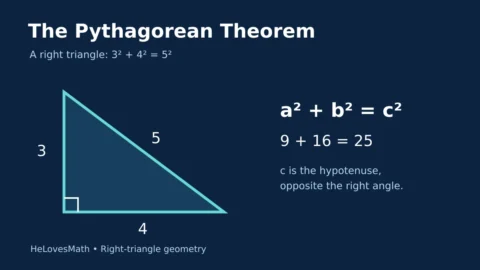
Use the trigonometric calculator with the correct angle mode. The Pythagorean theorem connects exponent and equality notation: a² + b² = c² for a right triangle whose hypotenuse is c.
Calculus: derivatives, integrals and indexed sums
f′(x) and df/dx denote derivatives with respect to x. If f(x) = x², then f′(x) = 2x. For a multivariable function, ∂f/∂x differentiates with respect to x while holding the other independent variables fixed.
An indefinite integral denotes a family of antiderivatives: ∫ 2x dx = x² + C. A definite integral has bounds: ∫₀¹ 2x dx = 1. It gives signed accumulation; it is not always the unsigned geometric area when the function is negative.
∏i=14 i = 1 × 2 × 3 × 4 = 24
In these indexed expressions, i is the index, 1 is the starting value and 4 is the final value. ∑ adds the terms; ∏ multiplies them. The infinity symbol ∞ is not an ordinary real number. A limit such as x → ∞ describes behavior as x grows without bound.
Big-O notation gives a bound relative to a comparison function, does not specify an exact growth rate or automatically a tight bound. For example, 3n + 2 = O(n) as n → ∞. See the math formula reference to connect notation with further formulas.
Probability and statistics notation
μ and σ commonly represent a population mean and population standard deviation. x̄ and s commonly represent their sample counterparts. For the sample 2, 4, 6, the mean is x̄ = (2 + 4 + 6)/3 = 4.
P(A ∣ B) is a conditional probability. For events with P(B) > 0, P(A ∣ B) = P(A ∩ B)/P(B). For example, on a fair six-sided die, let A mean “roll a 6” and B mean “roll an even number.” Then P(A) = 1/6 but P(A ∣ B) = 1/3.
X ∼ N(μ, σ²) commonly states that X has a normal distribution with mean μ and variance σ². Check the parameter convention in your source, because software and texts can parameterize distributions differently.
A p-value is not the probability that H₀ is true
Under the specified null model and its assumptions, a p-value measures how probable a test statistic at least as extreme as the observed one would be, using the test’s definition of “extreme.” It is not the probability that the null hypothesis is true or the probability that results happened “by chance.”
Use the statistics and probability formula sheet for formulas that use these quantities.
Typing math symbols and using LaTeX
Unicode is useful for text: copy π, ≤ or ∈ directly. A combining accent, such as the hat in p̂, is part of a multi-character sequence. Font support can differ across devices. Copying a symbol does not make a calculator understand its meaning.
LaTeX describes mathematical structure. In math mode, type \frac{a}{b} for a fraction, \sqrt{x} for a square root, \sum_{i=1}^{n} x_i for a sum, and A \subseteq B for a subset relation. Commands are case-sensitive: \sigma, \Sigma and \sum have different roles.
The table assumes standard LaTeX with amsmath and amssymb where needed, for example \operatorname, \mathbb, \nexists and \varnothing. For unusual glyphs, the table may give a clear equivalent expression rather than promise a command that every renderer supports. The command \coloneqq needs mathtools; \textfractionsolidus and \textperthousand need text-symbol support (such as textcomp) within \text. \rightangle requires a supporting package, such as unicode-math with a Unicode math engine. Some online equation editors provide only a subset of LaTeX.
Equation editors are helpful for fractions, limits, matrices and stacked indices. Keep the minus sign − distinct from a hyphen -, the letter x distinct from multiplication ×, and epsilon ε distinct from membership ∈. Always check the final display after pasting.
Frequently asked questions about math symbols
What are the most common mathematical symbols?
The basic operations are +, −, × and ÷. Common relationships include =, ≠, <, >, ≤ and ≥. You will also meet √ for square roots, π for the circle constant, ∈ for set membership, ∑ for summation and ∫ for integration.
What is the difference between = and ≡?
= states equality. ≡ can mark an identity or modular congruence. For instance, (x + 1)² ≡ x² + 2x + 1 is an identity, and 17 ≡ 5 (mod 12) means that 17 and 5 differ by a multiple of 12.
What does ∈ mean in math?
It means “is an element of.” If A = {1, 2, 3}, then 2 ∈ A and 4 ∉ A. Membership compares an object with a set; a subset relation compares two sets.
What is the difference between ⊂ and ⊆?
A ⊆ B permits A = B. Some authors use A ⊂ B for a proper subset, while others allow equality. A ⊊ B explicitly means A is a subset of B and A ≠ B. Follow the convention stated in your textbook.
What does the upside-down A symbol mean?
∀ means “for every” or “for all.” The statement ∀x ∈ ℝ, x² ≥ 0 says that the square of every real number is non-negative.
What does the backwards E symbol mean?
∃ means “there exists.” It asserts at least one example. The related notation ∃! means that exactly one example exists.
What does the vertical bar mean in mathematics?
Context decides: |x| can mean absolute value, |A| set cardinality or a determinant, a ∣ b divisibility, and P(A ∣ B) conditional probability. A bar in set-builder notation often reads “such that.”
How do I type the pi symbol?
Copy π from the reference, or type \pi in a LaTeX math field. Uppercase \Pi produces Π; \prod produces the product operator ∏.
Is this page a calculator?
It is a notation reference. Once you understand an expression, use the scientific calculator to evaluate supported calculations.
Sources & References
Definitions and examples on this page are written for this reference. These sources support the underlying notation, subject conventions and LaTeX guidance. Check your course’s notation when conventions vary.
- Symbol encoding and LaTeX: Unicode: Mathematical Operators chart; CTAN: The Comprehensive LaTeX Symbol List; LaTeX Project: Font selection guide (text symbols); mathtools package documentation
- Sets, logic and algebra: Carnegie Mellon University: Sets and notation conventions; Open Logic Project: Sets, Logic, Computation; OpenStax: Solving Systems with Inverses; Georgia Tech: Eigenvalues and Eigenvectors; UCLA, Romyar Sharifi: Topics in Group Theory
- Arithmetic, calculus and asymptotics: OpenStax: Radicals and Rational Exponents; OpenStax: Counting Principles; OpenStax: Partial Derivatives; OpenStax: The Definite Integral; OpenStax: Line Integrals; NIST DLMF: Asymptotic and Order Symbols
- Probability, statistics and number theory: OpenStax: Measures of the Spread of the Data; OpenStax: Independent and Mutually Exclusive Events; OpenStax: Mean or Expected Value and Standard Deviation; OpenStax: The Standard Normal Distribution; American Statistical Association: Statement on Statistical Significance and P-Values; NIST DLMF: Number-Theoretic Functions; NIST DLMF: Gamma Function Definitions; OpenStax: Torque