
Add fractions, understand every step
Find the exact sum, see the common-denominator working, and compare simplified, mixed-number and decimal forms. Start with 1/2 + 1/3 or enter your own fractions.
Add Fractions Step by Step
Enter signed integers in the numerator and denominator boxes. The tool adds two to eight fractions with exact arithmetic, shows the LCD and simplifies the sum.
Fraction addition means counting equal-size parts
A fraction a/b represents a divided by b, with b ≠ 0. For a positive unit fraction such as 1/6, the denominator describes the size of each equal part and the numerator counts those parts. To add quantities, they must use a consistent whole and unit. Half of a small pizza and one third of a large pizza cannot be combined as 5/6 of one unspecified pizza.
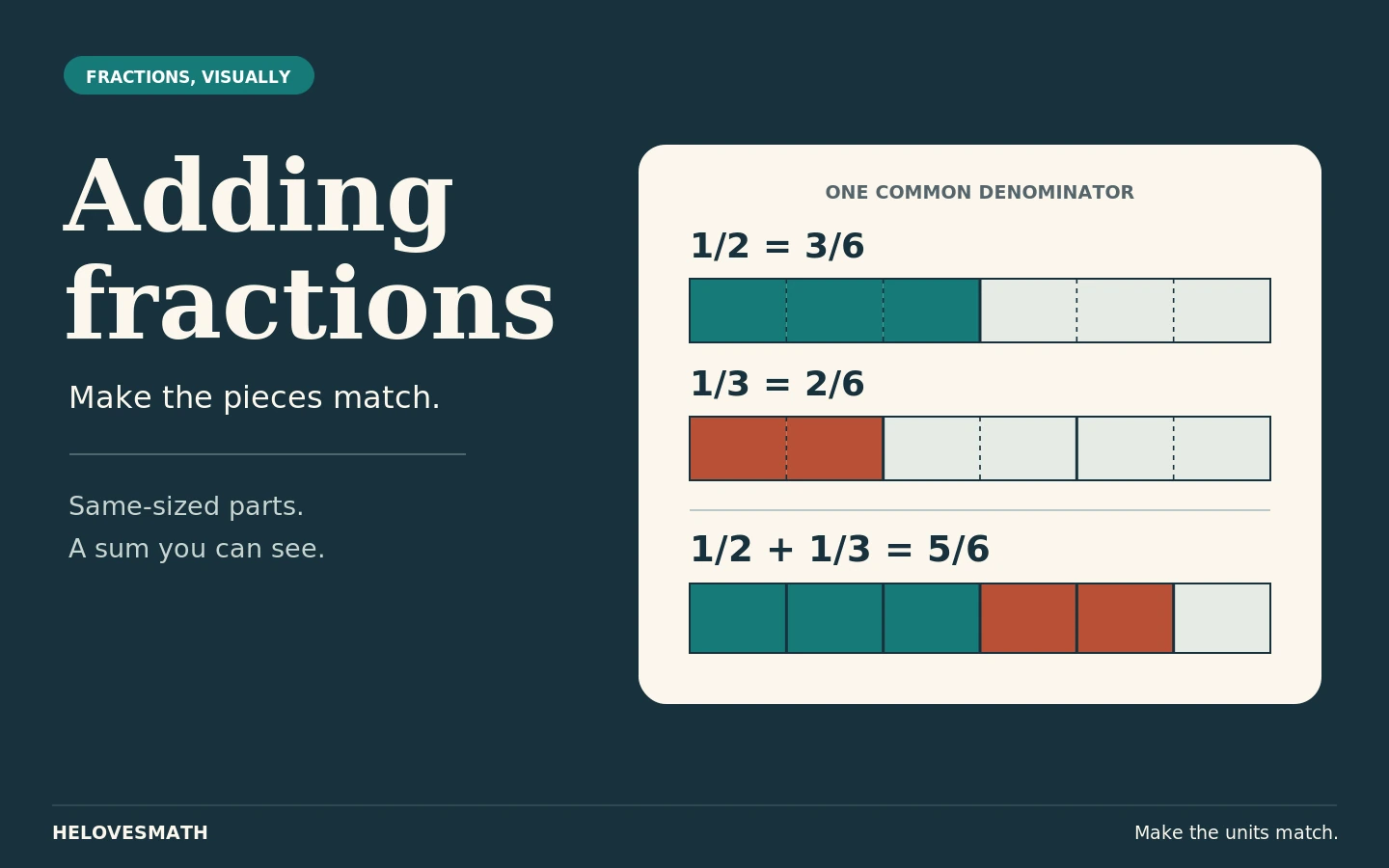
For the same whole, 1/2 + 1/3 = 3/6 + 2/6 = 5/6. Rewriting the fractions changes their names, not their values. This calculator shows that process, an exact simplified fraction, an optional mixed number and a decimal rounded to your chosen precision.

How to use the calculator
- Enter two fractions. Put each signed integer numerator and nonzero integer denominator in its own box. Negative denominators are allowed and are normalized in the working.
- Add more rows if needed. Use Add Fraction for up to eight fractions. Remove Fraction removes the final extra row; at least two rows remain.
- Convert mixed numbers first. Enter 2 1/3 as 7 over 3. Enter −1 1/2 as −3 over 2. Do not type a mixed number into one integer box.
- Choose your output. Select simplified fraction, mixed number where appropriate, or both. Choose 2, 4, 6 or 8 decimal places.
- Select Add Fractions or press Enter in an input. Read the equivalent-fraction steps before the answer. Any change clears the old result until you calculate again. Reset restores 1/2 + 1/3.
Each integer may contain up to 100 digits, optionally preceded by + or −. Use the ordinary keyboard minus sign in inputs. Decimals, comma separators, fractions typed with a slash and scientific notation are rejected rather than silently changed. The arithmetic is exact within these limits; only the decimal display is rounded. JavaScript is needed for the interactive tool, while the lesson and practice answers remain readable without it.
The formulas and what they mean
Same denominator
a/b + c/b = (a + c)/b, where b ≠ 0
The part size stays the same, so keep the denominator.
Different denominators
a/b + c/d = (ad + bc)/(bd), where b,d ≠ 0
This always supplies a common denominator, but bd need not be the least one. For positive denominators use L = lcm(b,d), then a/b = [a × (L/b)]/L and c/d = [c × (L/d)]/L.
Simplify after adding
g = gcd(|N|,L); exact sum = (N ÷ g)/(L ÷ g)
N is the sum of the converted numerators. A zero sum becomes 0/1, displayed as 0. For more fractions, take the LCM of all their positive denominators. The calculator uses the denominators as entered: 2/4 + 3/6 therefore has input LCD 12, even though simplifying both fractions first would let you work in halves.
Mixed numbers, including negatives
For n/d with d > 0, divide |n| by d: |n| = qd + r, with 0 ≤ r < d. The magnitude is q + r/d; put the sign of n in front of the whole quantity. Thus −7/3 = −(2 + 1/3), conventionally written −2 1/3. It does not mean −2 + 1/3.
Adding fractions with the same denominator
For 2/7 + 3/7, you are adding two sevenths and three sevenths. The total is 5/7, not 5/14. Adding the denominators would change the size of the pieces halfway through the calculation.
Sometimes the answer simplifies: 1/8 + 5/8 = 6/8 = 3/4. The intermediate 6/8 is valid; 3/4 is the same value in lowest terms. If the numerators add to the denominator, the answer is one whole: 3/7 + 4/7 = 1.
Adding fractions with different denominators
For 1/4 + 2/3, multiples of 4 include 4, 8 and 12; multiples of 3 include 3, 6, 9 and 12. The first shared positive multiple is 12. Multiply both parts of 1/4 by 3 and both parts of 2/3 by 4:
1/4 + 2/3 = 3/12 + 8/12 = 11/12
Multiplying only the denominator changes the value. The equality 1/4 = 3/12 works because 3/3 = 1. Another common denominator, such as 24, also works, but it gives larger intermediate numbers. For denominators 6 and 8, the LCD is 24, not their product 48.
Before calculating, estimate. Because 1/4 + 2/3 is greater than 2/3 and less than 1/3 + 2/3, its sum must lie between 2/3 and 1. The exact answer 11/12 fits that check. Use the comparing fractions calculator to investigate such bounds.
Adding mixed numbers and signed fractions
A positive mixed number w r/d means w + r/d, so its improper fraction is (wd + r)/d. For example, 1 1/2 = 3/2 and 2 1/3 = 7/3. Their sum is 9/6 + 14/6 = 23/6 = 3 5/6.
For a negative mixed number, apply the minus sign after converting its positive magnitude: −1 1/2 = −(1 + 1/2) = −3/2. Adding 3/4 gives −6/4 + 3/4 = −3/4. This is a move three quarters to the right on a number line, but it does not reach zero.

A negative numerator or a negative denominator makes a fraction negative; two negative signs cancel. For example, 1/(−4) = −1/4 and (−1)/(−4) = 1/4. The negative numbers guide explains the signs and number-line direction.
Six worked examples
1. Unlike denominators: 1/2 + 1/3
The LCD is 6. Rewrite 1/2 as 3/6 and 1/3 as 2/6. Add 3 + 2 = 5, keeping sixths: 5/6. Since gcd(5,6) = 1, it is already simplified. Its decimal to four places is approximately 0.8333.
2. One denominator divides the other: 3/8 + 1/4
The LCD is 8, so only the second fraction needs conversion: 1/4 = 2/8. Then 3/8 + 2/8 = 5/8. The decimal 0.625 is exact; with four decimal places it displays 0.6250.
3. A sum greater than one: 5/6 + 7/9
The LCD is 18. Convert to 15/18 and 14/18, then add to get 29/18. Dividing 29 by 18 gives one whole with remainder 11, so the mixed form is 1 11/18. Both input fractions exceed 1/2, so a sum above 1 makes sense.
4. Different signs: −1/5 + 3/10
Rewrite −1/5 as −2/10. The numerators add to −2 + 3 = 1, giving 1/10. The positive quantity has the larger magnitude, so the result is positive.
5. Three measured lengths: 3/4 m + 2/3 m + 5/6 m
All quantities are lengths in metres. Their LCD is 12: 9/12 + 8/12 + 10/12 = 27/12. Divide top and bottom by 3 to get 9/4 m = 2 1/4 m. The denominator changes during simplification, while the unit remains metres.
6. Negative denominators and cancellation: 2/(−3) + 5/6 + (−1)/6
Normalize the first fraction to −2/3. In sixths the sum is −4/6 + 5/6 − 1/6 = 0/6 = 0. A zero numerator is valid; a zero denominator never is.
Common mistakes and quick checks
- Adding denominators: 1/2 + 1/3 is not 2/5. For positive fractions the sum must exceed either addend, yet 2/5 is less than 1/2.
- Changing only the bottom: 1/3 is 2/6, not 1/6. Multiply numerator and denominator by the same nonzero factor.
- Misreading a negative mixed number: −1 1/2 means −3/2, not −1/2.
- Mixing units or wholes: convert centimetres to metres, or hours to minutes, before adding measured quantities. Identify a common whole in diagrams.
- Confusing exact and rounded answers: 1/3 + 1/3 is exactly 2/3, approximately 0.67 to two decimal places. Two separately rounded 0.33 values add to 0.66. Add exactly first and round once at the end.
- Treating a rounded zero as exact: 1/1000 + 1/1000 = 1/500, which rounds to 0.00 at two decimal places. The fraction is still nonzero.
The decimal uses a stated school-style rule: nearest value at the chosen precision, with exact halfway cases rounded away from zero. For example, 1/200 = 0.005 rounds to 0.01 at two places, and −1/200 rounds to −0.01. A decimal marked ≈ is an approximation. For division steps behind a decimal, see the long division calculator.
Try eight questions, then check your reasoning
Write a common denominator and an exact simplified answer before opening each solution. For question 8, also round to two decimal places.
1. 2/9 + 4/9
The parts are already ninths: (2 + 4)/9 = 6/9 = 2/3, dividing both parts by 3.
2. 5/12 + 1/8
The LCD is 24. Convert to 10/24 + 3/24 = 13/24. There is no common factor greater than 1.
3. 7/10 + 3/5
3/5 = 6/10, so the sum is 13/10 = 1 3/10.
4. −3/4 + 1/6
Use twelfths: −9/12 + 2/12 = −7/12. The negative addend has the greater magnitude.
5. 1 2/3 + 2 3/4
Convert to 5/3 and 11/4. Then 20/12 + 33/12 = 53/12 = 4 5/12.
6. −2 1/4 + 5/6
−2 1/4 = −9/4. In twelfths, −27/12 + 10/12 = −17/12 = −1 5/12. The minus sign applies to the whole mixed number.
7. 1/2 + 1/3 + 1/6
Use sixths: 3/6 + 2/6 + 1/6 = 6/6 = 1.
8. 1/6 + 1/3; round the sum to two decimal places
1/6 + 2/6 = 3/6 = 1/2. Its decimal is exactly 0.50 at two places; this display needs no approximation sign.
Adding fractions FAQs
What does an adding fractions calculator do?
It adds two to eight integer fractions, shows equivalent fractions using an LCD, simplifies the exact result, and displays mixed and rounded decimal forms.
How do you add fractions with the same denominator?
Add the numerators and keep the common denominator, then simplify: 2/7 + 3/7 = 5/7.
How do you add fractions with different denominators?
Rewrite each fraction with a common denominator first. For 1/2 + 1/3, use 3/6 + 2/6 = 5/6. The least common denominator keeps intermediate numbers smaller.
Can I add more than two fractions?
Yes. Add Fraction creates another row, up to eight in total. Remove Fraction deletes the final extra row. Both controls clear the old result until you calculate again.
What is the least common denominator?
It is the least positive common multiple of the positive denominators. This tool uses the input denominators without reducing the input fractions first, and then simplifies the final sum.
How do I enter a mixed number?
Convert it to an improper fraction before entering the two boxes. For 2 1/3 enter 7 and 3. For −2 1/3 enter −7 and 3, because the minus sign applies to the entire mixed number.
Can I use zero or negative denominators?
Zero denominators are undefined and rejected. Negative denominators are accepted and normalized: 1/(−2) becomes −1/2. A zero numerator is allowed.
Why do the exact fraction and decimal seem different?
The fraction is exact. A nonterminating decimal must be rounded for display; ≈ marks that approximation. Select more places to see more digits, or keep the exact fraction.
Use the working, not just the answer
Check the common denominator, the sign and the rough size of your result. Keep the exact fraction until the final rounding step, and follow your teacher’s requested answer format. Reviewed 5 October 2026.
Sources & References
The explanations and practice above are original. These educational references support the fraction, common-denominator and mixed-number methods.