Search
Menu

Comparing Fractions Calculator | Step-by-Step Comparison

Compare fractions by choosing a common unit and checking where each value lies on a number line.

Quick Answer

Comparing fractions is a core skill in arithmetic, pre-algebra, algebra, ratios, proportions, measurement, probability, statistics, cooking, construction, finance, and science.
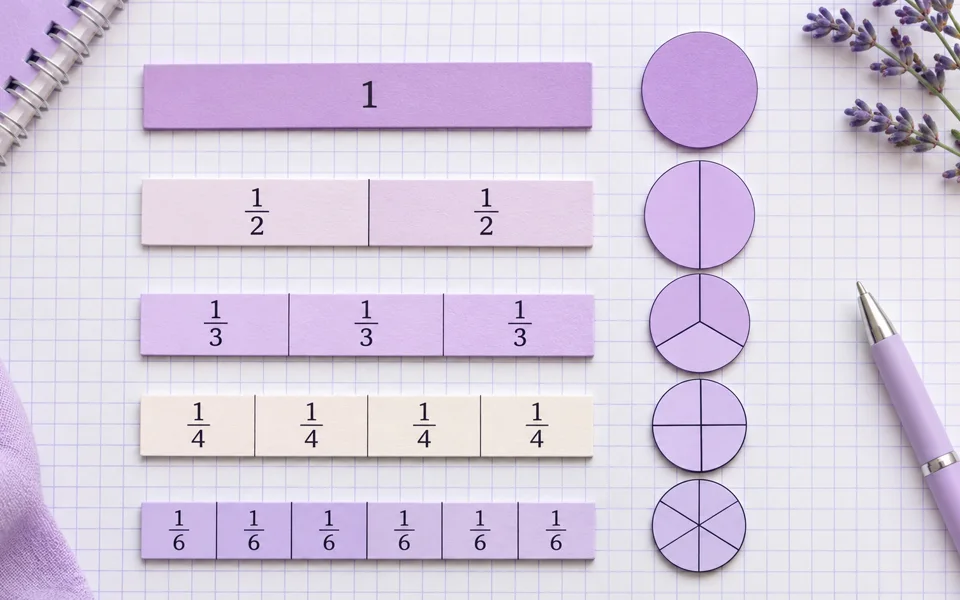
Two sets of fraction strips on graph paper
⚖ Free Fraction Comparison Tool

Comparing Fractions Calculator

Use this Comparing Fractions Calculator to compare two fractions, mixed numbers, negative fractions, proper fractions, and improper fractions. The calculator shows which fraction is greater, less, or equal using cross multiplication, common denominators, decimal values, simplified forms, and a visual fraction bar.

Compare Two Fractions Step by Step

Enter two fractions as numerator and denominator values. The calculator will compare them using exact fraction arithmetic, not only rounded decimals.

Rule: denominators cannot be zero. The calculator normalizes negative signs, simplifies fractions, and compares exact values using integer arithmetic.

What Is a Comparing Fractions Calculator?

A Comparing Fractions Calculator is a math tool that determines whether one fraction is greater than, less than, or equal to another fraction. It is useful for students, teachers, parents, homeschoolers, test-prep learners, and anyone who needs to compare rational numbers clearly. Instead of guessing from the numerator or denominator alone, this calculator uses exact mathematical methods to compare the two values.

Fractions can be difficult to compare because the numerator and denominator work together. A larger numerator does not always mean a larger fraction, and a larger denominator does not always mean a smaller final value unless the numerators are the same and the fractions are positive. For example, \(\frac{5}{8}\) has a larger numerator than \(\frac{3}{4}\), but \(\frac{3}{4}\) is greater because \(\frac{3}{4}=0.75\) and \(\frac{5}{8}=0.625\).

This calculator compares fractions using several methods: cross multiplication, least common denominator, simplified forms, and decimal comparison. Cross multiplication is often the fastest exact method for two fractions. The common denominator method is helpful for learning because it turns both fractions into equivalent fractions with the same denominator. Decimal comparison is intuitive, but it can become less reliable when rounded values are used. That is why the calculator primarily relies on exact integer relationships and uses decimals as supporting evidence.

The tool supports proper fractions, improper fractions, negative fractions, and equivalent fractions. It also normalizes denominators so the denominator is positive, which makes the comparison easier to understand. For example, \(\frac{-2}{3}\) and \(\frac{2}{-3}\) represent the same value. The calculator treats them consistently and shows the result in a readable form.

Comparing fractions is a core skill in arithmetic, pre-algebra, algebra, ratios, proportions, measurement, probability, statistics, cooking, construction, finance, and science. Students need it when ordering rational numbers, solving inequalities, comparing rates, interpreting slopes, and working with proportions. A strong comparison tool should therefore do more than give an answer; it should show why the answer is correct.

How to Use the Comparing Fractions Calculator

Enter the numerator and denominator of the first fraction. Then enter the numerator and denominator of the second fraction. A numerator can be positive, negative, or zero. A denominator can be positive or negative, but it cannot be zero. If a denominator is negative, the calculator moves the negative sign to the numerator for a cleaner standard form.

Choose how many decimal places you want to display. The decimal value is helpful for understanding the size of each fraction, but the comparison itself is based on exact fraction logic. This prevents errors caused by rounding. For example, two fractions may look similar when rounded to two decimal places, but exact comparison may still show one is greater.

Select a method display option. The default setting shows all methods: cross multiplication, common denominator, simplification, and decimal comparison. If you only want to teach or review one method, choose cross multiplication, common denominator, or decimal comparison from the dropdown.

Click Compare Fractions. The result area will show the correct inequality symbol: greater than \(>\), less than \(<\), or equal to \(=\). It also shows decimal values, common denominator, cross products, visual bars, and step-by-step reasoning.

The Swap Fractions button switches the first and second fraction. This is useful for checking that the inequality direction changes correctly. For example, if \(\frac{3}{4}>\frac{5}{8}\), then after swapping, the calculator should show \(\frac{5}{8}<\frac{3}{4}\).

Comparing Fractions Formulas

For two fractions \(\frac{a}{b}\) and \(\frac{c}{d}\), where \(b\ne0\) and \(d\ne0\), the comparison can be made by cross multiplication when denominators are positive:

Cross multiplication comparison
\[\frac{a}{b}\; ? \;\frac{c}{d}\quad\Longleftrightarrow\quad ad\; ? \;bc\]

If \(ad>bc\), then \(\frac{a}{b}>\frac{c}{d}\). If \(ad<bc\), then \(\frac{a}{b}<\frac{c}{d}\). If \(ad=bc\), then the fractions are equal.

Greater than condition
\[ad>bc\Rightarrow\frac{a}{b}>\frac{c}{d}\]
Less than condition
\[ad<bc\Rightarrow\frac{a}{b}<\frac{c}{d}\]
Equal fractions condition
\[ad=bc\Rightarrow\frac{a}{b}=\frac{c}{d}\]

The common denominator method uses the least common multiple of the denominators:

Least common denominator
\[LCD=\operatorname{lcm}(b,d)\]
Equivalent fractions with the LCD
\[\frac{a}{b}=\frac{a\times(LCD/b)}{LCD},\quad \frac{c}{d}=\frac{c\times(LCD/d)}{LCD}\]

Once denominators match, compare only the numerators:

Same denominator comparison
\[\frac{x}{m}\; ?\; \frac{y}{m}\quad\Longleftrightarrow\quad x\; ?\; y\]

Cross Multiplication Method

Cross multiplication is one of the fastest ways to compare two fractions. The method works because multiplying both fractions by the positive product of their denominators removes the denominators without changing the inequality direction. In practical terms, compare \(a\times d\) with \(c\times b\).

For example, compare \(\frac{3}{4}\) and \(\frac{5}{8}\). Cross multiply: \(3\times8=24\), and \(5\times4=20\). Since 24 is greater than 20, the first fraction is greater. Therefore, \(\frac{3}{4}>\frac{5}{8}\).

This method is exact and efficient. It is especially useful when the denominators are different and the least common denominator is not immediately obvious. It also avoids rounded decimal mistakes. However, students should understand why it works, not only memorize the arrow pattern. Cross multiplication compares the same scaled quantity on both sides of the inequality.

When negative denominators appear, it is best to normalize the fractions first by moving the negative sign to the numerator. This calculator does that automatically. Once denominators are positive, the cross multiplication rule is straightforward.

Common Denominator Method

The common denominator method rewrites both fractions so they have the same denominator. Once two fractions have equal denominators, the fraction with the larger numerator is greater. This method is very important for learning because it shows the meaning of fraction comparison visually: both fractions are being measured in equal-size pieces.

For example, compare \(\frac{2}{3}\) and \(\frac{3}{5}\). The least common denominator of 3 and 5 is 15. Rewrite \(\frac{2}{3}\) as \(\frac{10}{15}\), and rewrite \(\frac{3}{5}\) as \(\frac{9}{15}\). Since 10 fifteenths is greater than 9 fifteenths, \(\frac{2}{3}>\frac{3}{5}\).

The common denominator method is also useful for ordering more than two fractions. If several fractions all become equivalent fractions with one common denominator, their numerators can be compared directly. This is why the method appears often in elementary math, middle school math, and pre-algebra.

Decimal Comparison Method

Another way to compare fractions is to convert each fraction into a decimal by dividing the numerator by the denominator. For example, \(\frac{3}{4}=0.75\), and \(\frac{5}{8}=0.625\). Since 0.75 is greater than 0.625, \(\frac{3}{4}>\frac{5}{8}\).

Decimal comparison is easy to understand, especially when the decimals terminate. It is useful in calculators, measurement, money, and estimation. However, decimals can be misleading if rounded too early. For example, \(\frac{1}{3}\approx0.3333\) and \(\frac{333}{1000}=0.333\). If both are rounded to two decimal places, they may appear equal as 0.33, even though \(\frac{1}{3}\) is slightly greater. Exact fraction comparison avoids this issue.

This calculator displays decimal values for clarity, but the final inequality is determined using exact cross products. That makes the answer reliable even when decimal forms are repeating or rounded.

Comparing Negative Fractions

Negative fractions follow the same comparison rules as negative numbers. A number closer to zero is greater than a more negative number. For example, \(-\frac{1}{4}\) is greater than \(-\frac{1}{2}\) because \(-0.25\) is greater than \(-0.5\). This can feel counterintuitive because \(\frac{1}{2}\) is greater than \(\frac{1}{4}\), but the negative signs reverse their position on the number line.

The calculator handles negative numerators and denominators. If both numerator and denominator are negative, the fraction becomes positive. For example, \(\frac{-3}{-5}=\frac{3}{5}\). If only one part is negative, the whole fraction is negative. The standard form places the negative sign in the numerator or before the fraction.

When comparing negative fractions manually, using a number line or decimal values can help. Cross multiplication also works after denominators are normalized to positive values. This calculator includes both exact and decimal explanations so the result is easier to trust.

Comparing Fractions Examples

Example 1: Compare \(\frac{3}{4}\) and \(\frac{5}{8}\).

Example 1 using cross multiplication
\[3\times8=24,\quad 5\times4=20,\quad 24>20\]
Example 1 result
\[\frac{3}{4}>\frac{5}{8}\]

Example 2: Compare \(\frac{2}{3}\) and \(\frac{3}{5}\).

Example 2 using common denominator
\[\frac{2}{3}=\frac{10}{15},\quad \frac{3}{5}=\frac{9}{15},\quad 10>9\]
Example 2 result
\[\frac{2}{3}>\frac{3}{5}\]

Example 3: Compare \(\frac{4}{6}\) and \(\frac{2}{3}\).

Example 3 equivalent fractions
\[\frac{4}{6}=\frac{2}{3}\]

Example 4: Compare \(-\frac{1}{4}\) and \(-\frac{1}{2}\).

Example 4 negative fractions
\[-\frac{1}{4}=-0.25,\quad -\frac{1}{2}=-0.5,\quad -0.25>-0.5\]
Example 4 result
\[-\frac{1}{4}>-\frac{1}{2}\]

Common Mistakes When Comparing Fractions

The first common mistake is comparing only numerators. For example, a student may think \(\frac{5}{8}\) is greater than \(\frac{3}{4}\) because 5 is greater than 3. That is incorrect because the denominator changes the size of the parts. The correct comparison is \(\frac{3}{4}>\frac{5}{8}\).

The second mistake is comparing only denominators. A smaller denominator can mean larger pieces, but that only gives a shortcut when the numerators are the same and the fractions are positive. For example, \(\frac{1}{3}>\frac{1}{5}\), but this shortcut does not apply to \(\frac{2}{3}\) and \(\frac{4}{5}\).

The third mistake is rounding decimals too early. Fractions with repeating decimals can look equal when rounded, even when they are not exactly equal. Use cross multiplication or common denominators for exact comparison.

The fourth mistake is misunderstanding negative values. With negative fractions, the number closer to zero is greater. For example, \(-\frac{1}{10}\) is greater than \(-\frac{1}{2}\), even though \(\frac{1}{10}\) is smaller than \(\frac{1}{2}\).

Comparing Fractions Calculator FAQs

What does a comparing fractions calculator do?

It compares two fractions and shows whether the first fraction is greater than, less than, or equal to the second fraction.

How do you compare fractions with different denominators?

You can use cross multiplication or rewrite both fractions with a common denominator. The calculator shows both methods.

What is the cross multiplication rule for comparing fractions?

For \(\frac{a}{b}\) and \(\frac{c}{d}\), compare \(a\times d\) with \(c\times b\), assuming denominators are positive.

Can this calculator compare negative fractions?

Yes. It supports negative numerators and denominators and normalizes the sign before comparing.

Can two different-looking fractions be equal?

Yes. For example, \(\frac{4}{6}\) and \(\frac{2}{3}\) are equal because both simplify to the same value.

Is decimal comparison always reliable?

Decimal comparison is useful, but rounded decimals can be misleading. Exact methods such as cross multiplication are more reliable.

Important Note

This Comparing Fractions Calculator is for educational and general math use. It provides exact fraction comparison and step-by-step explanations, but students should still follow teacher instructions for showing work, simplifying fractions, using inequality symbols, and rounding decimal values.

How to Compare Fractions

Comparing fractions might seem challenging; it seems a bit like comparing apples and oranges. Fortunately, there are a few methods for comparing one fraction to another.
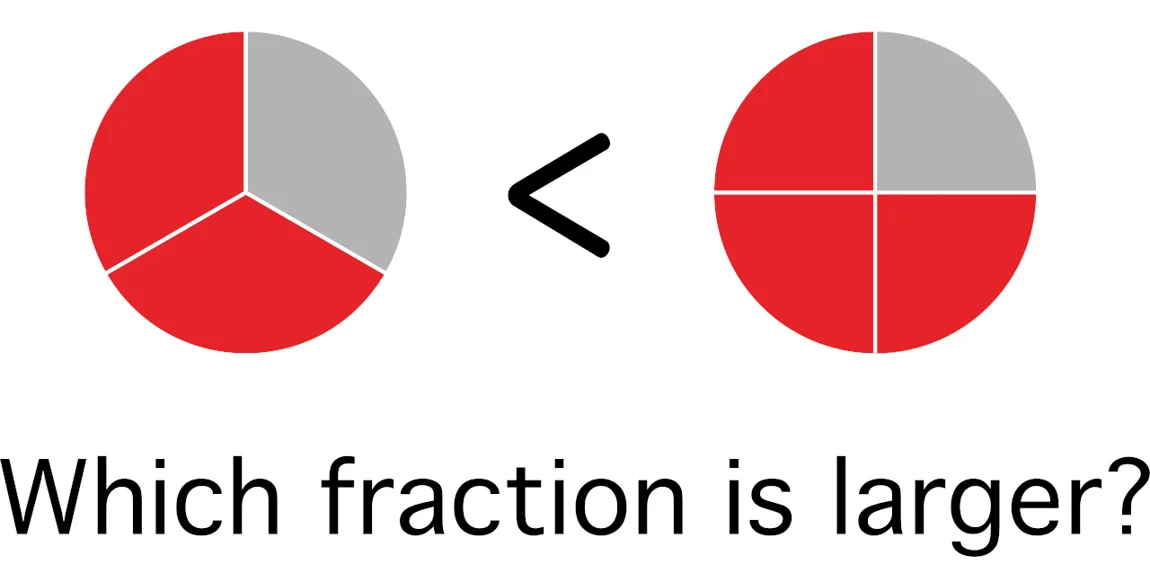
Which fraction is larger - pie charts showing how to compare fractions

Method One: Compare Fractions by Converting to Decimal First

The first way to compare fractions is to convert them to a decimal value. Divide the numerator of each fraction by the denominator, then compare the decimal values.

You can also convert the fraction into a fraction with a denominator of 100. This will make it easier to divide the numerator by the denominator.

Here’s a tip: use our fraction to decimal calculator to get the decimal value for your fraction. You might also want to check out our decimal equivalents chart to see the decimal equivalents for common fractions.

Method Two: Compare Fractions By Finding the Common Denominator

Another way to compare fractions is to rewrite all the fractions to equivalent fractions with the same denominator. To do this, find the greatest common denominator, then make the denominators of each fraction equal.

Start by finding the lowest common denominator, which we sometimes refer to as the least common denominator. This is the smallest number that each denominator divides equally into. If you’re not sure how to do this, our lowest common denominator calculator will help you find it.

For example, let’s find the lowest common denominator of 6 and 9.

6 × 3 = 18
9 × 2 = 18
LCD = 18

Next, convert each fraction to an equivalent fraction with the common denominator. To do this, multiply both the numerator and denominator of each fraction by the same number so that they have the same denominator.

For example, convert 1/6 to a fraction with a denominator of 18.

18 ÷ 6 = 3
3 × 1 = 3
1/6 = 3/18

You’ll want to repeat this step for each fraction until they all have the same denominator.

You can also use an equivalent fractions calculator or our equivalent fraction chart to see equivalents for common fractions, which might help shortcut the conversion.

Finally, compare the numerators to find which fraction is the largest or smallest. The fraction with the larger numerator is the larger number.

For example, compare 3/18 to 2/18 to see which is largest.

numerator #1 = 3
numerator #2 = 2
3 > 2

Thus, 3/18 is greater than 2/18

Method Three: Compare Fractions With the Same Numerator

When fractions have the same numerator, compare them by comparing the denominators. When the numerators are the same, the fraction with the smaller denominator is larger.

Saying this a different way, the larger the denominator, the smaller the number is.

For example, to compare ⅖ and 2/7:

  1. The numerators of both fractions are the same.
  2. The denominator of the first fraction is 5, while the denominator of the second fraction is 7.
  3. 5 < 7, so we know that 2/5 is larger than 2/7.

Method Four: Cross Multiplication

To compare fractions using cross multiplication, you can start by writing the two fractions side by side and then multiplying the numerator of the first fraction by the denominator of the second fraction.

For example, let’s compare 2/7 and 3/5.

2 × 5 = 10

2/7 is equivalent to 10/35

Then, multiply the numerator of the second fraction by the denominator of the first fraction.

3 × 7 = 21

3/5 is equivalent to 21/35

Compare the two products. The fraction with the larger product is the bigger fraction!

Since 21 is larger than 10, we know that 3/5 is larger than 2/7.

In addition to these methods, our fraction calculator also makes it easy to compare fractions.

How to Compare Fractions to Decimals and Percentages

To compare a fraction to a decimal or percent, convert the fraction to either a decimal or percentage and then compare the values.

To convert a fraction to a decimal, divide the numerator by the denominator.

To convert a fraction to a percentage, first convert the fraction to a decimal, and then multiply the decimal by 100.

You can also convert both the fraction and percent into a decimal and compare both values as decimals. To convert a percent into a decimal, simply divide the percent value by 100.

Comparing numbers, fractions, and percentages is also an essential step in sorting a set of numbers from least to greatest.

Frequently Asked Questions

Why do we compare fractions?

We may compare fractions for multiple reasons:

  • To determine which fraction is larger or smaller to compare quantities or measurements.
  • To simplify fractions and identify common factors.
  • To add or subtract fractions.
  • To convert fractions to decimals or percentages.

Why is it easier to compare decimals instead of fractions?

Comparing decimals is easier than comparing fractions because decimals are based on the base-10 numbering system, which provides a more precise representation of the number’s size.

You can easily compare decimals by looking at their values to the right of the decimal point, while comparing fractions involves finding common denominators and additional calculations.

How do you compare fractions with whole numbers?

To compare a fraction to a whole number, convert the whole number to a fraction with the same denominator as the fraction you want to compare it to.

You can also convert the fraction to a decimal and compare the whole number to the value.

How do you compare more than two fractions at a time?

You can compare more than two fractions at a time using multiple methods, including:

  1. Find a common denominator: Convert the fractions so that they share a common denominator, and then compare the numerators. The fraction with the largest numerator is the largest fraction.
  2. Use cross-multiplication: Multiply the numerator of the first fraction by the denominator of the second fraction and compare it with the numerator of the second fraction multiplied by the denominator of the first fraction. Repeat this process for all pairs of fractions. The fraction with the largest product is the largest fraction.
  3. Order the fractions: Order the fractions from smallest to largest and then compare the first and last fractions.
Advertisement

Compare five eighths with two thirds

Start with strips of the same length. Split each eighth into three parts and each third into eight parts. Five eighths covers fifteen of the new parts, whereas two thirds covers sixteen. Two thirds is therefore larger by one twenty-fourth. Cross multiplication produces the same numbers because both fractions have been expressed in twenty-fourths. Equal-sized wholes are essential when the fractions describe portions of real objects.

Convert Fractions to Decimals

In Decimals, we learned to convert decimals to fractions. Now we will do the reverse—convert fractions to decimals. Remember that the fraction bar indicates division. So 45 can be written 4÷5 or 54. This means that we can convert a fraction to a decimal by treating it as a division problem.
Write the fraction 34 as a decimal.
Solution

Solution

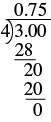
A fraction bar means division, so we can write the fraction 34 using division. A division problem is shown. 3 is on the inside of the division sign and 4 is on the outside.
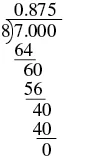
Divide. A division problem is shown. 3.00 is on the inside of the division sign and 4 is on the outside. Below the 3.00 is a 28 with a line below it. Below the line is a 20. Below the 20 is another 20 with a line below it. Below the line is a 0. Above the division sign is 0.75.
So the fraction 34 is equal to 0.75.
Write the fraction −72 as a decimal.
Solution

Solution

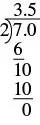
The value of this fraction is negative. After dividing, the value of the decimal will be negative. We do the division ignoring the sign, and then write the negative sign in the answer. −72
Divide 7 by 2. A division problem is shown. 7.0 is on the inside of the division sign and 2 is on the outside. Below the 7 is a 6 with a line below it. Below the line is a 10. Below the 10 is another 10 with a line below it. Below the line is a 0. 3.5 is written above the division sign.
So, −72=−3.5.

Repeating Decimals

So far, in all the examples converting fractions to decimals the division resulted in a remainder of zero. This is not always the case. Let’s see what happens when we convert the fraction 43 to a decimal. First, notice that 43 is an improper fraction. Its value is greater than 1. The equivalent decimal will also be greater than 1.
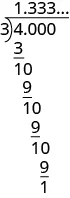
We divide 4 by 3.
A division problem is shown. 4.000 is on the inside of the division sign and 3 is on the outside. Below the 4 is a 3 with a line below it. Below the line is a 10. Below the 10 is a 9 with a line below it. Below the line is another 10, followed by another 9 with a line, followed by another 10, followed by another 9 with a line, followed by a 1. Above the division sign is 1.333...
No matter how many more zeros we write, there will always be a remainder of 1, and the threes in the quotient will go on forever. The number 1.333… is called a repeating decimal. Remember that the “…” means that the pattern repeats.
How do you know how many ‘repeats’ to write? Instead of writing 1.333… we use a shorthand notation by placing a line over the digits that repeat. The repeating decimal 1.333… is written 1.3–. The line above the 3 tells you that the 3 repeats endlessly. So 1.333…=1.3–
For other decimals, two or more digits might repeat. table shows some more examples of repeating decimals.
1.333…=1.3– 3 is the repeating digit
4.1666…=4.16– 6 is the repeating digit
4.161616…=4.16— 16 is the repeating block
0.271271271…=0.271––– 271 is the repeating block
Write 4322 as a decimal.
Solution

Solution

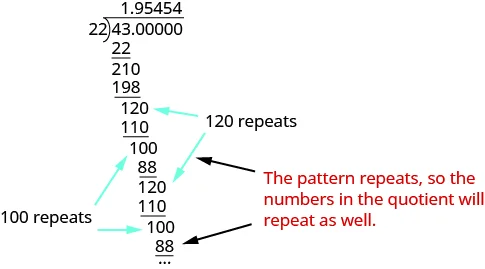
Divide 43 by 22. A division problem is shown. 43.00000 is on the inside of the division sign and 22 is on the outside. Below the 43 is a 22 with a line below it. Below the line is a 210 with a 198 with a line below it. Below the line is a 120 with 110 and a line below it. Below the line is 100 with 88 and a line below it. Below the line is 120 with 110 and a line below it. Below the line is 100 with 88 and a line below it. Below the line is an ellipses. There are arrows pointing to the 120s saying 120 repeats. There are arrows pointing to the 100s saying 100 repeats. There are arrows pointing to the 88s saying, in red, “The pattern repeats, so the numbers in the quotient will repeat as well.” The quotient is shown above the division sign. It is 1.95454.
Notice that the differences of 120 and 100 repeat, so there is a repeat in the digits of the quotient; 54 will repeat endlessly. The first decimal place in the quotient, 9, is not part of the pattern. So,
4322=1.954—
It is useful to convert between fractions and decimals when we need to add or subtract numbers in different forms. To add a fraction and a decimal, for example, we would need to either convert the fraction to a decimal or the decimal to a fraction.
Simplify: 78+6.4.
Solution

Solution

78+6.4
Change 78 to a decimal. . 0.875+6.4
Add. 7.275

Order Decimals and Fractions

In Decimals, we compared two decimals and determined which was larger. To compare a decimal to a fraction, we will first convert the fraction to a decimal and then compare the decimals.
Order 38__0.4 using < or >.
Solution

Solution

38__0.4
Convert 38 to a decimal. 0.375__0.4
Compare 0.375 to 0.4 0.375<0.4
Rewrite with the original fraction. 38<0.4
When ordering negative numbers, remember that larger numbers are to the right on the number line and any positive number is greater than any negative number.
Order −0.5___−34 using < or >.
Solution

Solution

−0.5___−34
Convert −34 to a decimal. −0.5___−0.75
Compare −0.5 to −0.75. −0.5>−0.75
Rewrite the inequality with the original fraction. −0.5>−34
Write the numbers 1320,0.61,1116 in order from smallest to largest.
Solution

Solution

1320,0.61,1116
Convert the fractions to decimals. 0.65,0.61,0.6875
Write the smallest decimal number first. 0.61,____,_____
Write the next larger decimal number in the middle place. 0.61,0.65,_____
Write the last decimal number (the larger) in the third place. 0.61,0.65,0.6875
Rewrite the list with the original fractions. 0.61,1320,1116

Find the Least Common Denominator

In the previous section, we explained how to add and subtract fractions with a common denominator. But how can we add and subtract fractions with unlike denominators?
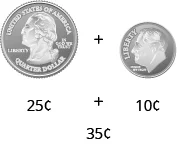
Let’s think about coins again. Can you add one quarter and one dime? You could say there are two coins, but that’s not very useful. To find the total value of one quarter plus one dime, you change them to the same kind of unit—cents. One quarter equals 25 cents and one dime equals 10 cents, so the sum is 35 cents. See diagram.
A quarter and a dime are shown. Below them, it reads 25 cents plus 10 cents. Below that, it reads 35 cents.
Together, a quarter and a dime are worth 35 cents, or 35100 of a dollar.
Similarly, when we add fractions with different denominators we have to convert them to equivalent fractions with a common denominator. With the coins, when we convert to cents, the denominator is 100. Since there are 100 cents in one dollar, 25 cents is 25100 and 10 cents is 10100. So we add 25100+10100 to get 35100, which is 35 cents.
You have practiced adding and subtracting fractions with common denominators. Now let’s see what you need to do with fractions that have different denominators.
First, we will use fraction tiles to model finding the common denominator of 12 and 13.
We’ll start with one 12 tile and 13 tile. We want to find a common fraction tile that we can use to match both 12 and 13 exactly.
If we try the 14 pieces, 2 of them exactly match the 12 piece, but they do not exactly match the 13 piece.
Two rectangles are shown side by side. The first is labeled 1 half. The second is shorter and is labeled 1 third. Underneath the first rectangle is an equally sized rectangle split vertically into two pieces, each labeled 1 fourth. Underneath the second rectangle are two pieces, each labeled 1 fourth. These rectangles together are longer than the rectangle labeled as 1 third.
If we try the 15 pieces, they do not exactly cover the 12 piece or the 13 piece.
Two rectangles are shown side by side. The first is labeled 1 half. The second is shorter and is labeled 1 third. Underneath the first rectangle is an equally sized rectangle split vertically into three pieces, each labeled 1 sixth. Underneath the second rectangle is an equally sized rectangle split vertically into 2 pieces, each labeled 1 sixth.
If we try the 16 pieces, we see that exactly 3 of them cover the 12 piece, and exactly 2 of them cover the 13 piece.
Two rectangles are shown side by side. The first is labeled 1 half. The second is shorter and is labeled 1 third. Underneath the first rectangle are three smaller rectangles, each labeled 1 fifth. Together, these rectangles are longer than the 1 half rectangle. Below the 1 third rectangle are two smaller rectangles, each labeled 1 fifth. Together, these rectangles are longer than the 1 third rectangle.
If we were to try the 112 pieces, they would also work.
Two rectangles are shown side by side. The first is labeled 1 half. The second is shorter and is labeled 1 third. Underneath the first rectangle is an equally sized rectangle split vertically into 6 pieces, each labeled 1 twelfth. Underneath the second rectangle is an equally sized rectangle split vertically into 4 pieces, each labeled 1 twelfth.
Even smaller tiles, such as 124 and 148, would also exactly cover the 12 piece and the 13 piece.
The denominator of the largest piece that covers both fractions is the least common denominator (LCD) of the two fractions. So, the least common denominator of 12 and 13 is 6.
Notice that all of the tiles that cover 12 and 13 have something in common: Their denominators are common multiples of 2 and 3, the denominators of 12 and 13. The least common multiple (LCM) of the denominators is 6, and so we say that 6 is the least common denominator (LCD) of the fractions 12 and 13.
To find the LCD of two fractions, we will find the LCM of their denominators. We follow the procedure we used earlier to find the LCM of two numbers. We only use the denominators of the fractions, not the numerators, when finding the LCD.
Find the LCD for the fractions 712 and 518.
Solution

Solution

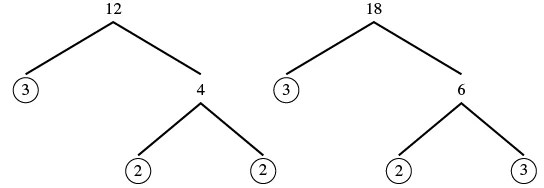
Factor each denominator into its primes. .
List the primes of 12 and the primes of 18 lining them up in columns when possible. .
Bring down the columns. .
Multiply the factors. The product is the LCM. LCM=36
The LCM of 12 and 18 is 36, so the LCD of 712 and 518 is 36. LCD of 712 and 518 is 36.
To find the LCD of two fractions, find the LCM of their denominators. Notice how the steps shown below are similar to the steps we took to find the LCM.
Find the least common denominator for the fractions 815 and 1124.
Solution

Solution

To find the LCD, we find the LCM of the denominators.
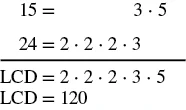
Find the LCM of 15 and 24.
The top line shows 15 equals 3 times 5. The next line shows 24 equals 2 times 2 times 2 times 3. The 3s are lined up vertically. The next line shows LCM equals 2 times 2 times 2 times 3 times 5. The last line shows LCM equals 120.
The LCM of 15 and 24 is 120. So, the LCD of 815 and 1124 is 120.

Convert Fractions to Equivalent Fractions with the LCD
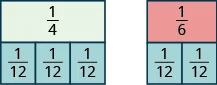
Earlier, we used fraction tiles to see that the LCD of 14 when 16 is 12. We saw that three 112 pieces exactly covered 14 and two 112 pieces exactly covered 16, so
14=312 and 16=212.
On the left is a rectangle labeled 1 fourth. Below it is an identical rectangle split vertically into 3 equal pieces, each labeled 1 twelfth. On the right is a rectangle labeled 1 sixth. Below it is an identical rectangle split vertically into 2 equal pieces, each labeled 1 twelfth.
We say that 14 and 312 are equivalent fractions and also that 16 and 212 are equivalent fractions.
We can use the Equivalent Fractions Property to algebraically change a fraction to an equivalent one. Remember, two fractions are equivalent if they have the same value. The Equivalent Fractions Property is repeated below for reference.
To add or subtract fractions with different denominators, we will first have to convert each fraction to an equivalent fraction with the LCD. Let’s see how to change 14 and 16 to equivalent fractions with denominator 12 without using models.
Convert 14 and 16 to equivalent fractions with denominator 12, their LCD.
Solution

Solution

Find the LCD. The LCD of 14 and 16 is 12.
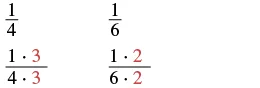
Find the number to multiply 4 to get 12. .
Find the number to multiply 6 to get 12. .
Use the Equivalent Fractions Property to convert each fraction to an equivalent fraction with the LCD, multiplying both the numerator and denominator of each fraction by the same number. .
Simplify the numerators and denominators. .
We do not reduce the resulting fractions. If we did, we would get back to our original fractions and lose the common denominator.
Convert 815 and 1124 to equivalent fractions with denominator 120, their LCD.
Solution

Solution

The LCD is 120. We will start at Step 2.
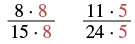
Find the number that must multiply 15 to get 120. .
Find the number that must multiply 24 to get 120. .
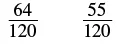
Use the Equivalent Fractions Property. .
Simplify the numerators and denominators. .