
Work through every question in the English-language August 2026 Geometry Regents. Each solution explains the method, gives the final answer, and highlights details that matter for a complete written response.
Try the question first, then compare your reasoning with the steps below. Select a question image or diagram to open a larger view. The question numbers and paper-page references follow the official exam. The original paper and NYSED scoring documents are linked in Sources & References.
For Parts II–IV, show your method. A final number on its own can lose substantial credit, and a question that specifies compass-and-straightedge construction or coordinate geometry requires that method.
These are independent HeLovesMath explanations, not an official NYSED publication. Answers and required methods were checked against the official scoring key, rating guide, and model response set. Valid alternative methods can also earn credit unless a question specifies a method.
Quick check: Part I answer choices
- Q1: (3)
- Q2: (2)
- Q3: (4)
- Q4: (3)
- Q5: (1)
- Q6: (3)
- Q7: (3)
- Q8: (1)
- Q9: (2)
- Q10: (1)
- Q11: (3)
- Q12: (4)
- Q13: (2)
- Q14: (2)
- Q15: (1)
- Q16: (2)
- Q17: (3)
- Q18: (2)
- Q19: (1)
- Q20: (4)
- Q21: (4)
- Q22: (1)
- Q23: (3)
- Q24: (4)
Use the worked explanations below to check why each answer is correct.
Part I: Multiple-choice solutions
Questions 1–24 • 2 credits each • 48 credits total
Question 1: Recognize a rigid motion
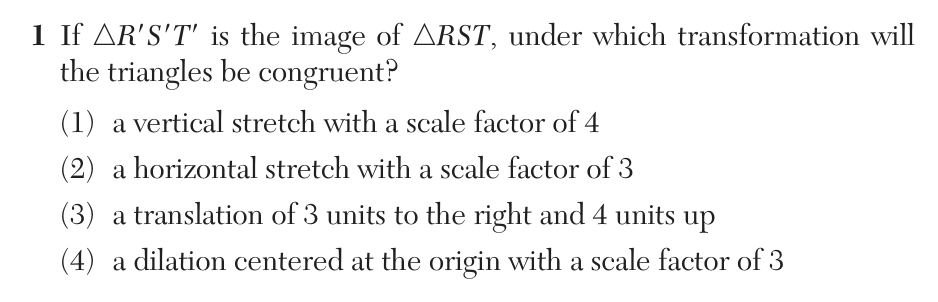
- A transformation is an isometry when it preserves the distance between every pair of points. Translations, rotations, and reflections are rigid motions.
- A translation slides every point by the same vector, so it preserves both side lengths and angles. The listed stretches and scale-factor-3 dilation change some distances.
Question 2: Use inverse sine to find an angle
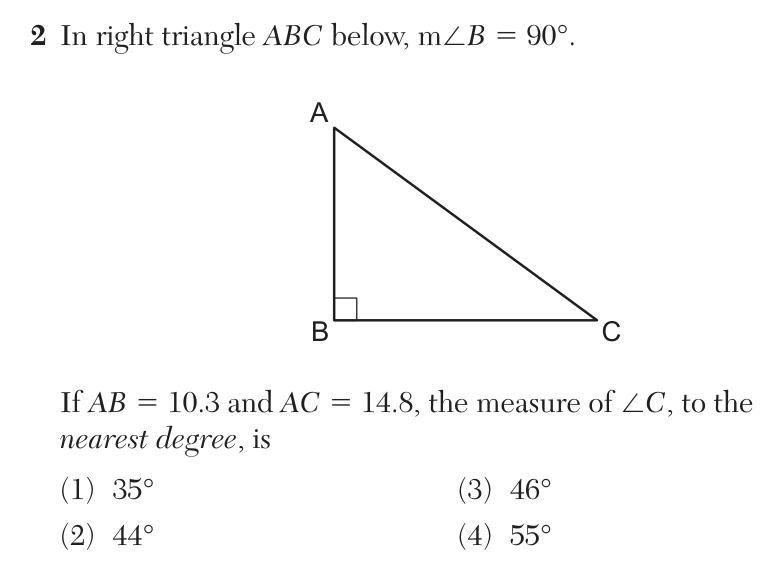
- The right angle is at B, making AC the hypotenuse. Relative to angle C, side AB is opposite.
- Use opposite divided by hypotenuse:
- In degree mode, apply inverse sine:Round to the nearest degree.
Exam detail: Use the inverse sine function to recover an angle from its sine ratio.
Question 3: Track corresponding vertices through two congruences
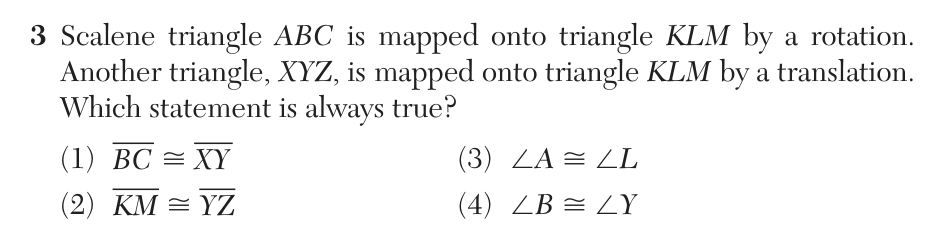
- The order of the triangle names gives the correspondence. In the first congruence, A corresponds to K, B to L, and C to M.
- In the second congruence, K corresponds to X, L to Y, and M to Z. Therefore B and Y correspond through the common vertex L.
- Corresponding angles in congruent triangles are congruent:
Exam detail: Follow the order in the congruence statements, even when a diagram is not provided.
Question 4: Find the mass of the metal sphere
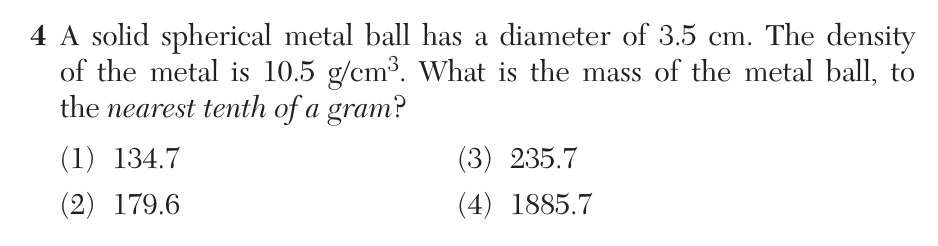
- The given 3.5 cm is the diameter. Divide by 2 to find the radius:centimeters.
- Calculate the sphere’s volume:cubic centimeters.
- Multiply volume by density. Cubic centimeters cancel, leaving grams:grams. Round to the nearest tenth.
Exam detail: Keep the full value of pi and the unrounded volume until the final mass.
Explore how radius changes volume with the sphere calculator.
Question 5: Use the centroid ratio
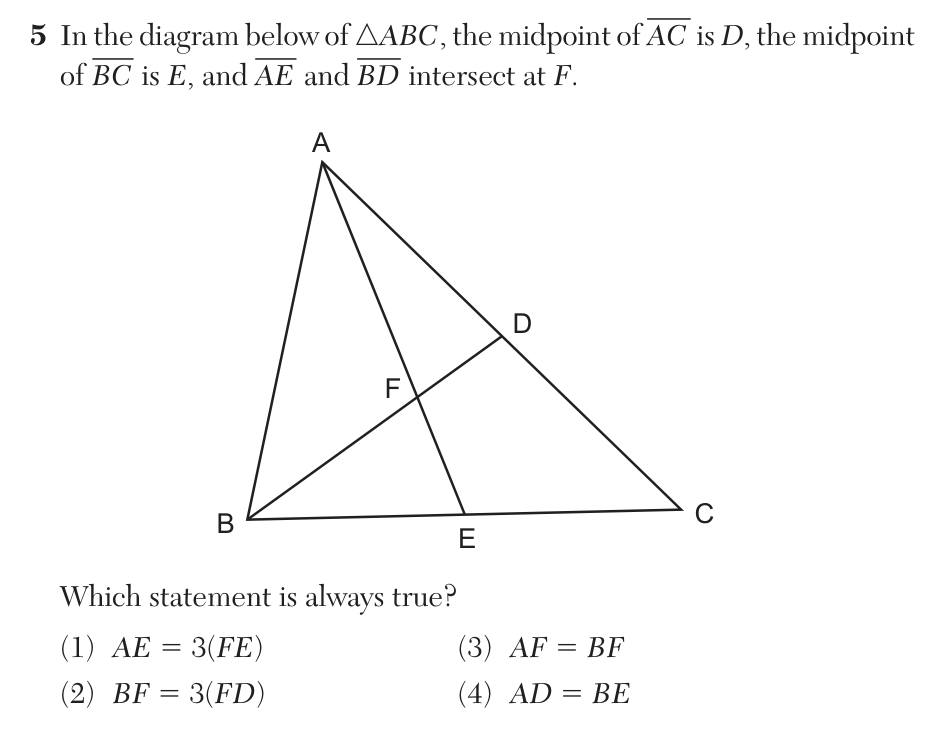
- The intersection of the medians is the centroid F. On median AE, the centroid is twice as far from vertex A as it is from midpoint E.
- Thus . Add the two pieces of the median:
Exam detail: The longer centroid segment is next to the vertex.
Question 6: Visualize the solid made by rotation
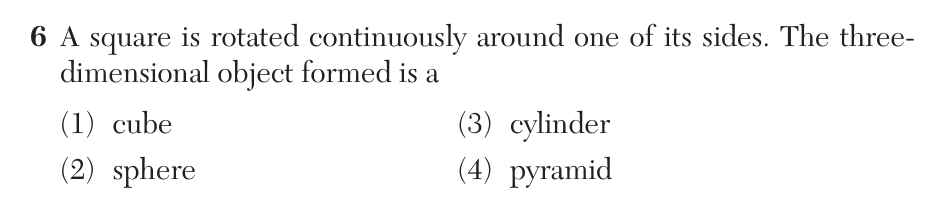
- Hold one side of the square fixed as the axis of rotation. The opposite side traces the curved surface of the solid.
- Every horizontal slice perpendicular to the fixed side sweeps out a disk with the same radius. The two endpoint slices form congruent circular bases.
- A solid with these circular bases and constant radius is a cylinder.
Question 7: Use an exterior angle and the given ratio
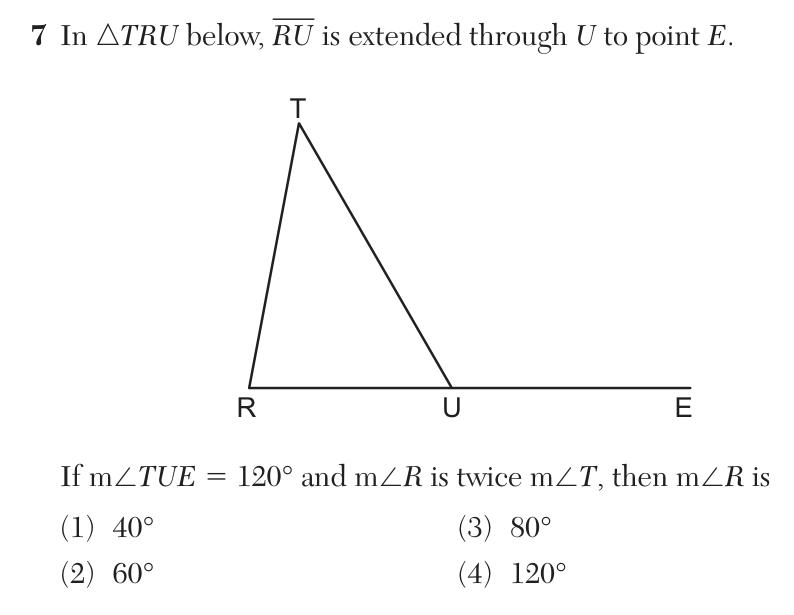
- The 120° exterior angle equals the sum of the two remote interior angles at R and T.
- Let the angle at T be . The angle at R is twice as large, so it is . Then:
- The question asks for the larger remote angle:
Question 8: Locate the horizontal line of symmetry
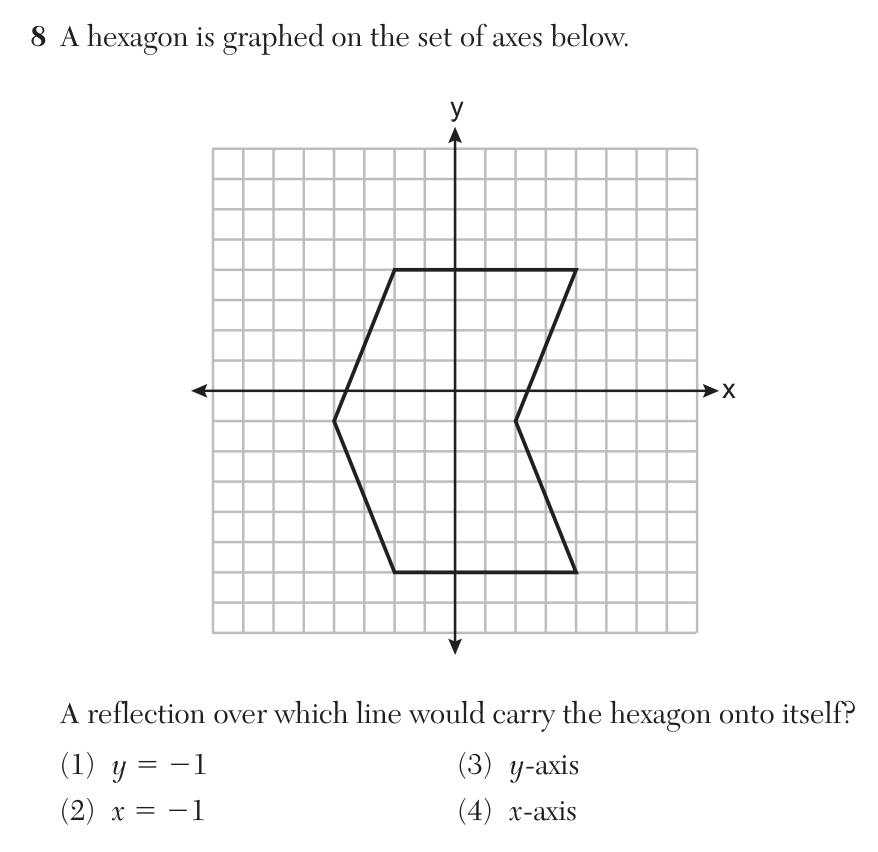
- Corresponding upper and lower vertices have the same x-coordinates and y-coordinates 4 and −6. The reflecting line is halfway between these heights:
- The two remaining vertices lie on this line. Reflecting across it keeps those vertices fixed and exchanges the upper and lower pairs.
- The reflection rule is , which maps height 4 to −6 and height −6 to 4.
Question 9: Identify the base angles of an isosceles triangle
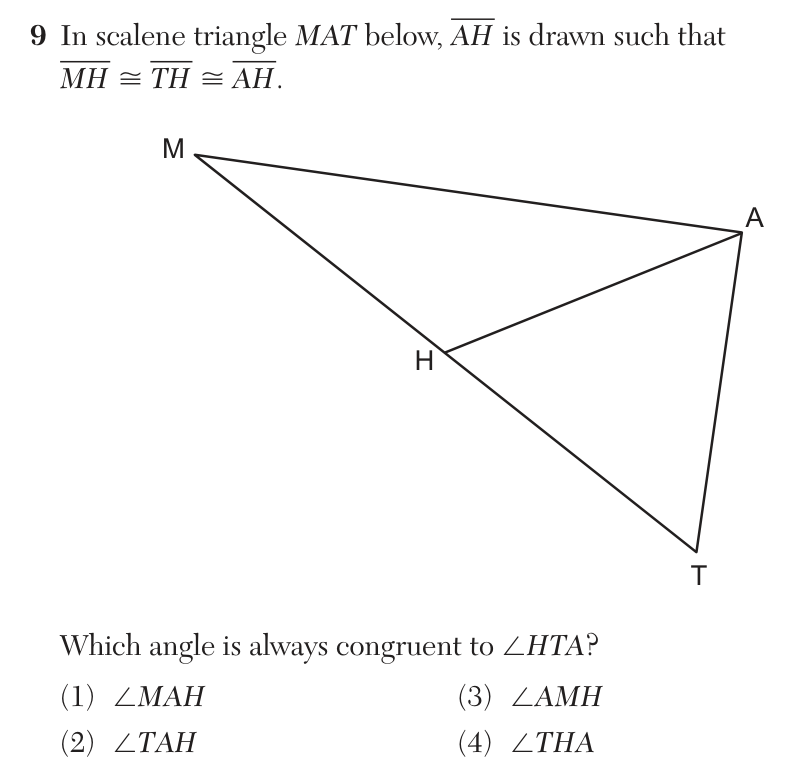
- The congruent sides are HA and HT, so the angle at their common vertex H is the vertex angle of the isosceles triangle.
- The base is AT. Its endpoint angles, at A and T, are congruent because they lie opposite the equal sides.
Exam detail: Angles opposite congruent sides are congruent; do not use the angle between the equal sides as a base angle.
Question 10: Solve the pyramid-volume formula for height
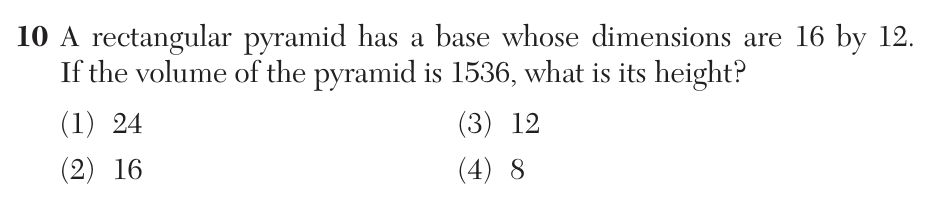
- The rectangular base has area square units.
- Substitute the volume and base area into the pyramid formula:
- Divide both sides by 64:
Question 11: Find the adjacent leg with cosine
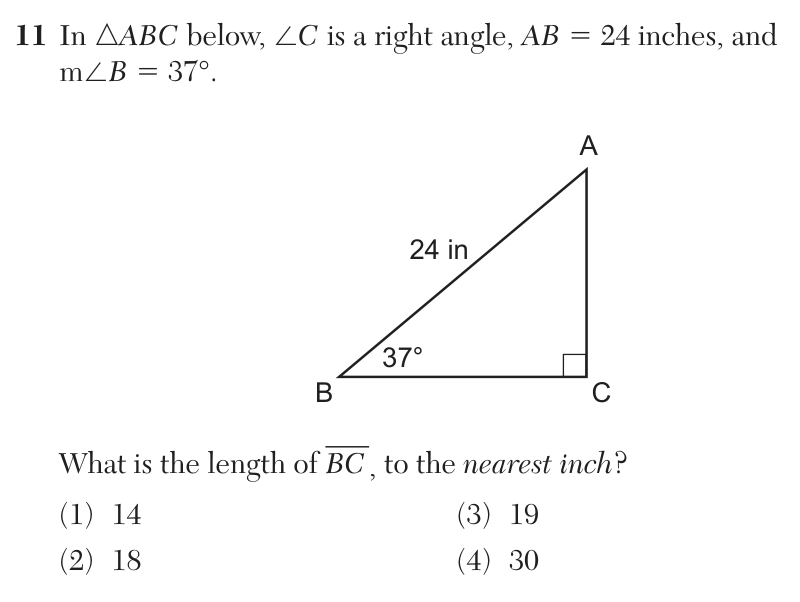
- The 24-inch side is the hypotenuse. Relative to the 37° angle, BC is the adjacent leg.
- Use cosine and solve:
- Round the length to the nearest inch.
Question 12: Partition the segment in the correct direction
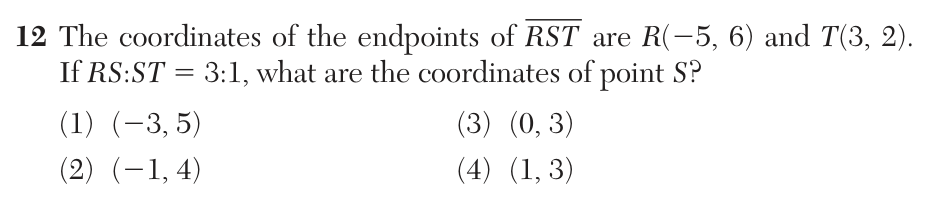
- The ratio places S three-fourths of the way from R to T.
- The coordinate change from to is . Take three-fourths of each change and add it to R:
Exam detail: The ratio describes three parts plus one part, for four equal parts in all.
Question 13: Describe the two transformations
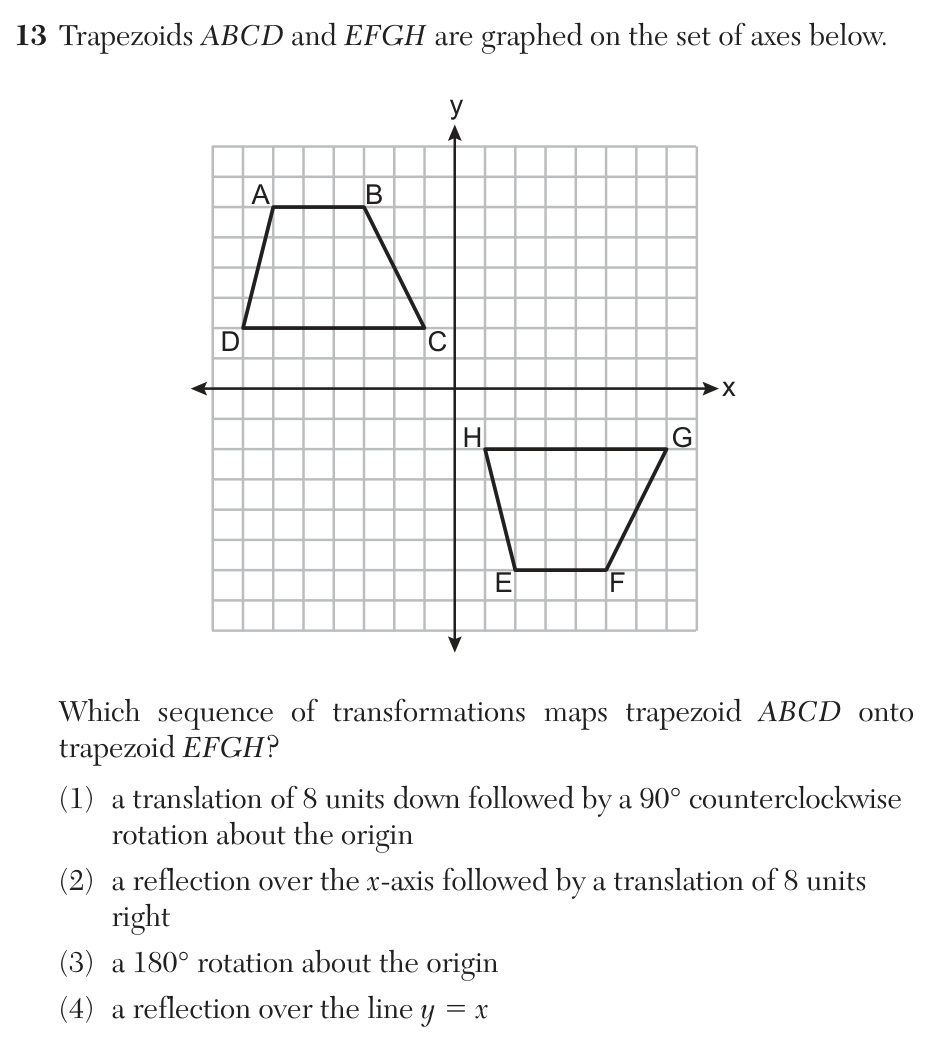
- The image is below the x-axis. Reflect the original figure across that axis, using .
- Then translate 8 units to the right. The combined rule is:
- Check the vertices: A maps to E , B to F , C to G , and D to H . All four agree with the graph.
Question 14: Use adjacent and opposite parallelogram angles
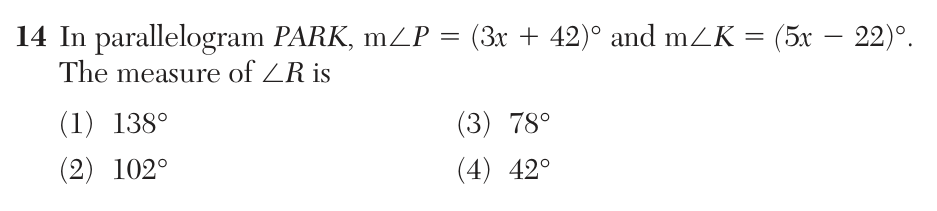
- Angles P and K are adjacent in parallelogram PARK, so they are supplementary:
- Combine like terms and solve:
- Angles R and P are opposite and therefore congruent. Substitute into the expression for angle P:
Question 15: Add the exact side lengths
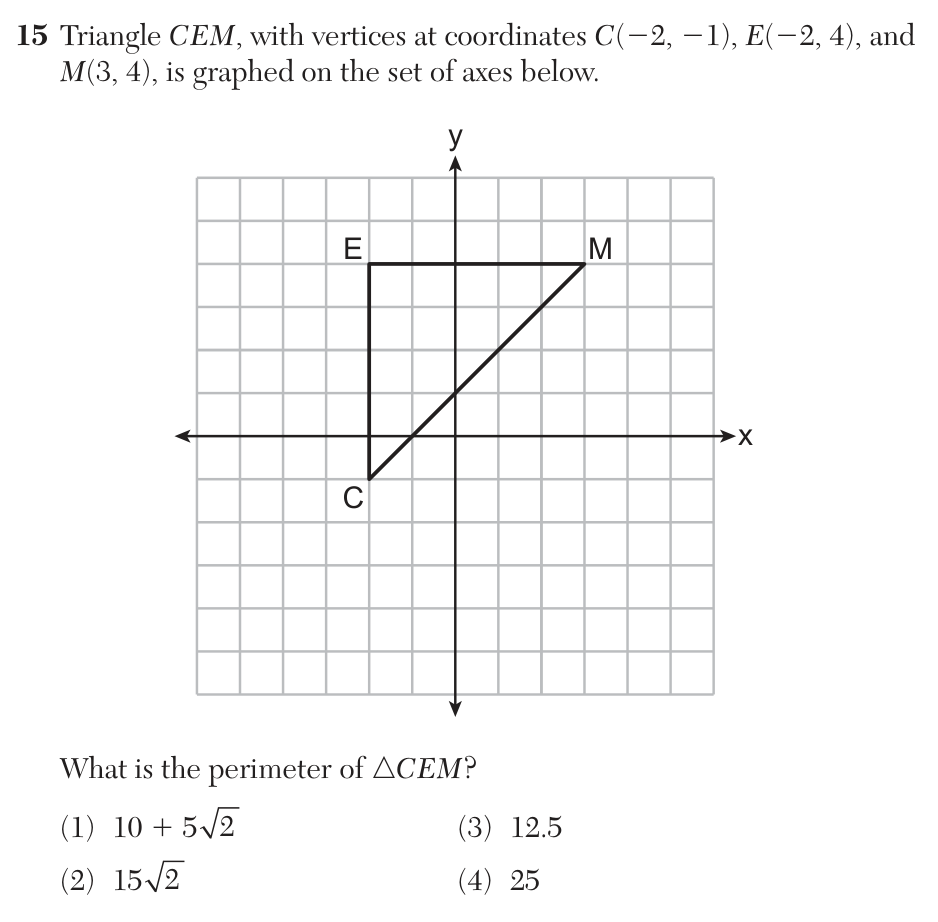
- From C to E , the vertical distance is 5. From E to M , the horizontal distance is also 5.
- The third side is the hypotenuse of a right triangle:
- Add all three sides without approximating the radical:
Question 16: Find the perpendicular slope
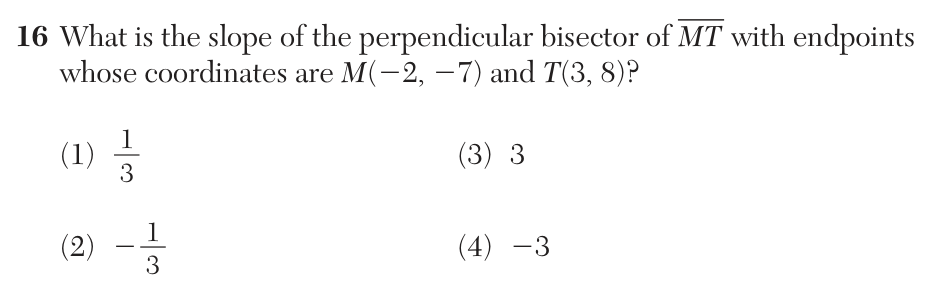
- Calculate the slope through M and T :
- For two nonvertical perpendicular lines, the slopes are negative reciprocals. The negative reciprocal of 3 is .
Question 17: Use both right triangles
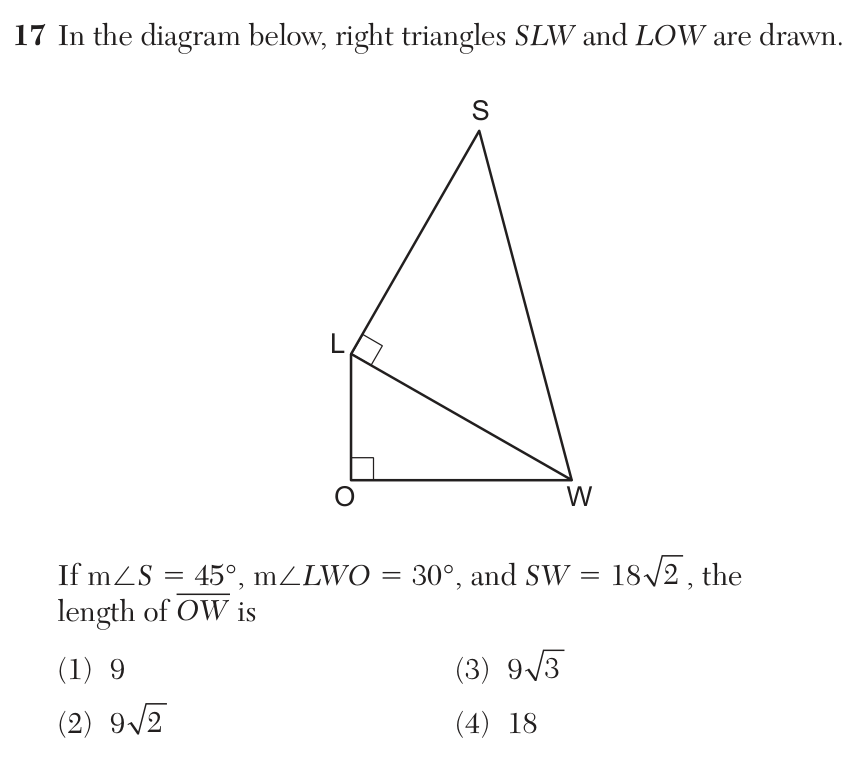
- In triangle SLW, the right angle is at L and the angle at S is 45°. It is a 45°–45°–90° triangle with hypotenuse . Each leg therefore has length 18, so .
- In triangle LOW, the right angle is at O. Here LW is the hypotenuse, and OW is adjacent to the 30° angle at W.
- Apply cosine:
Exam detail: The shared side LW is a leg of the larger triangle and the hypotenuse of the smaller one.
Question 18: Write the equation of the circle
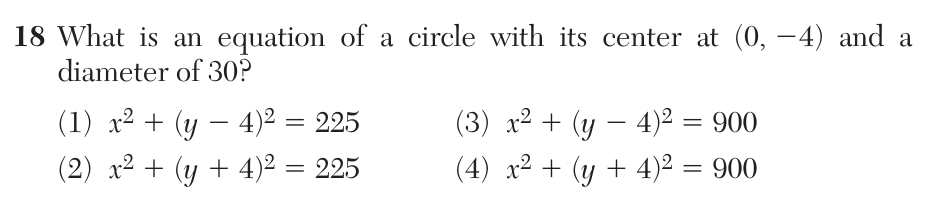
- The circle has center . Its diameter is 30, so its radius is 15.
- Use the standard equation . Substituting the center and radius gives:
Question 19: Use the actual depth of the batter
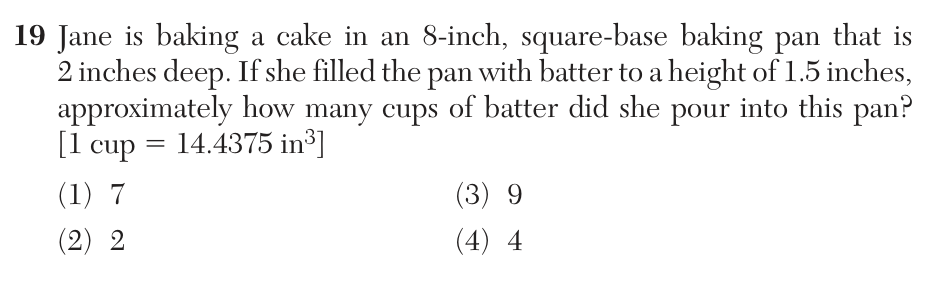
- The square pan’s base area is square inches. The batter is 1.5 inches deep, so its volume is:cubic inches.
- One cup is 14.4375 cubic inches. Convert the batter volume into cups:
- The problem asks for the nearest whole number of cups, so round to 7.
Exam detail: Use the batter depth of 1.5 inches, not the pan’s full 2-inch height. This question asks for ordinary rounding, unlike the full-cup maximum in question 32.
Question 20: Use the altitude to the hypotenuse
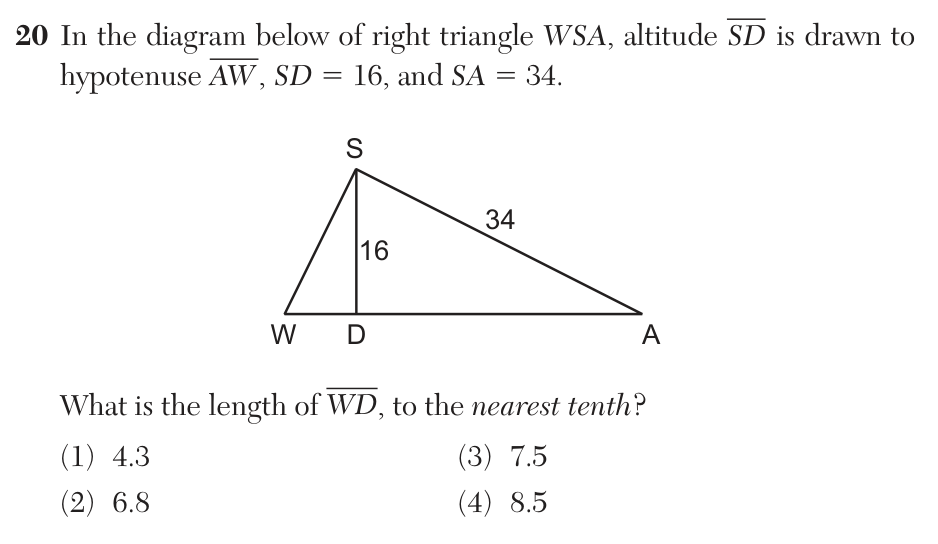
- First work in the right triangle with hypotenuse 34 and one leg 16. The other leg is DA:
- The altitude of length 16 divides the larger right triangle’s hypotenuse into WD and DA. The altitude theorem gives:
- Substitute 30 and solve:Round to the nearest tenth.
Question 21: Compare length and area scale factors
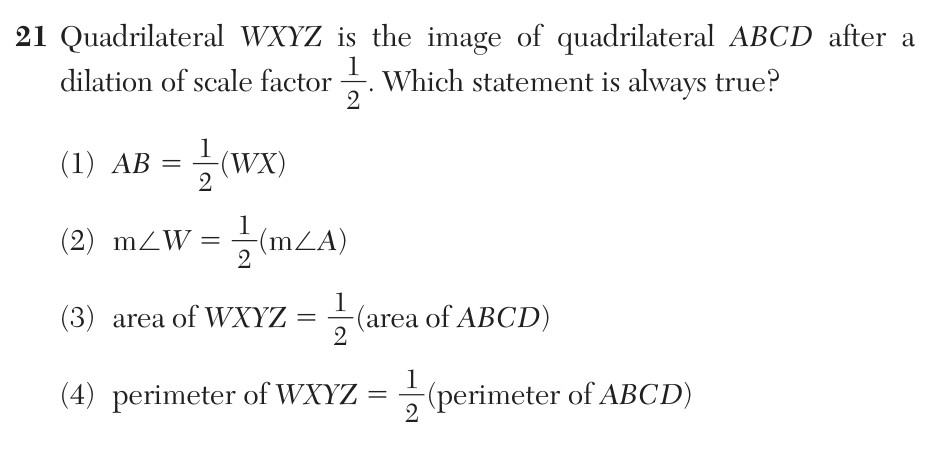
- A dilation with scale factor multiplies every side length by one-half. Therefore the perimeter is also multiplied by one-half.
- Area scales by the square of the length factor:
- Angle measures remain unchanged. The option about the perimeter being halved is therefore correct.
Question 22: Use two sides and the included angle
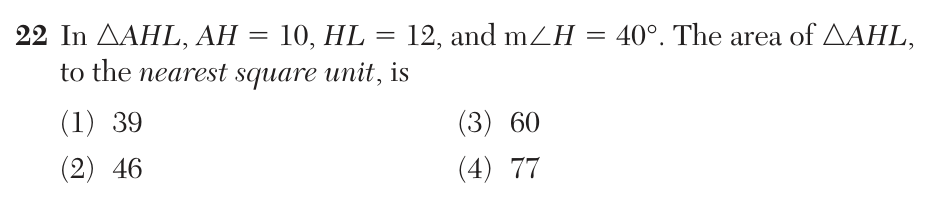
- The given 40° angle lies between sides of length 10 and 12. Use the triangle-area formula with the sine of the included angle:
- Substitute and evaluate in degree mode:
- Round to the nearest square unit.
Question 23: Recognize a rhombus from its diagonals
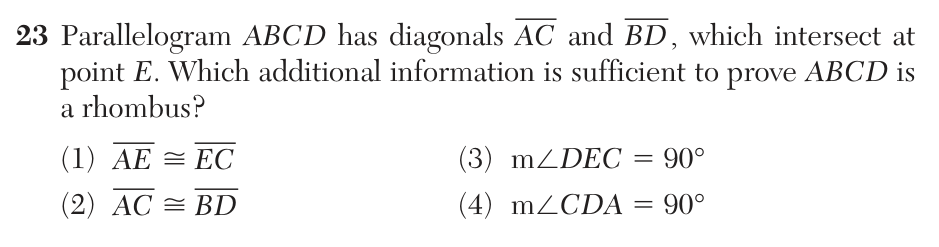
- Point E is the intersection of the parallelogram’s diagonals. Making a right angle makes those diagonals perpendicular.
- A parallelogram with perpendicular diagonals is a rhombus. Its diagonals bisect one another, so the resulting right triangles show that adjacent sides have equal lengths.
Question 24: Check whether the dilation center lies on the line
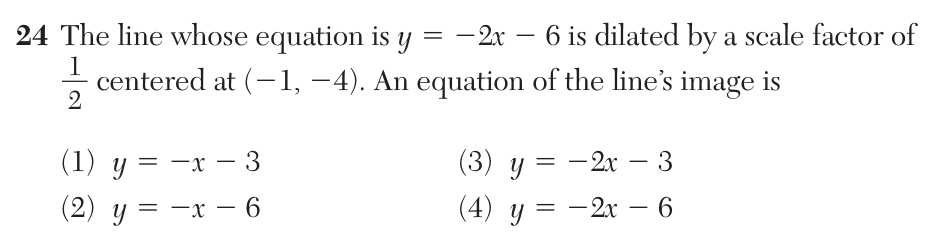
- Substitute the center into the original line:The point lies on the line.
- A dilation with a nonzero scale factor maps a line through its center onto itself. Points move along that same line, so its equation does not change.
Part II: Short constructed responses
Questions 25–31 • 2 credits each • 14 credits total
Question 25: Find the parallelogram angle through the right triangle
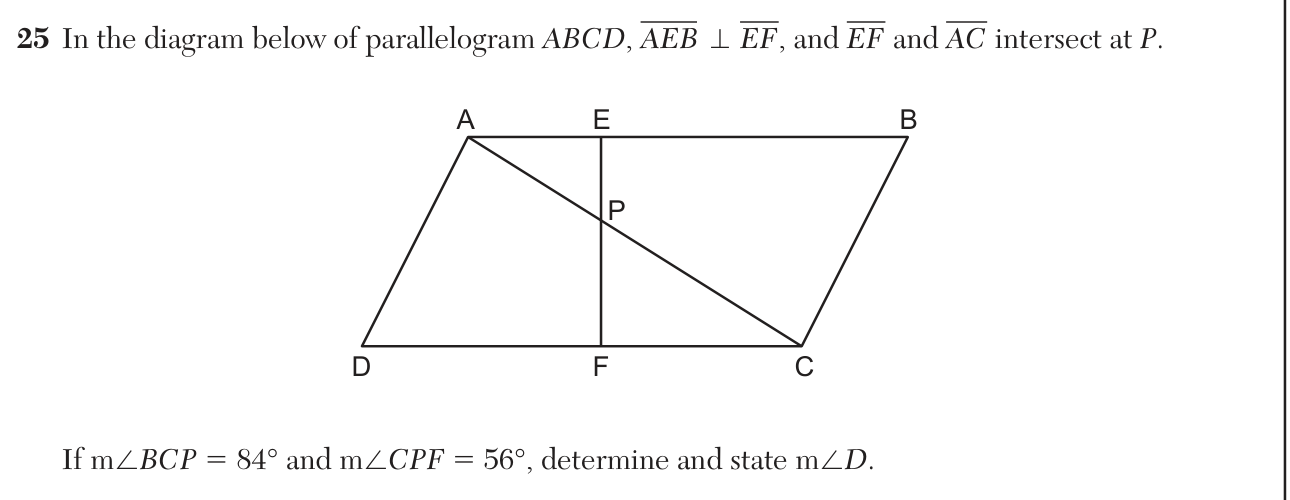
- Opposite sides AB and DC are parallel. Since EF is perpendicular to AB, it is also perpendicular to DC, making angle PFC a right angle.
- In triangle PFC, the other given angle is 56°, so:
- At C, combine the adjacent angles:
- Adjacent parallelogram angles are supplementary:
Question 26: Compare population per square mile

- Population density is population divided by land area. Use the 2013 figures supplied in the exam, with the same units for both cities.
- Buffalo:people per square mile.
- Albany:people per square mile.
- Buffalo has more people per square mile, so it has the higher population density.
Exam detail: Show both calculations and the comparison. A city name alone does not supply the requested justification.
Question 27: Use proportional segments made by a parallel line
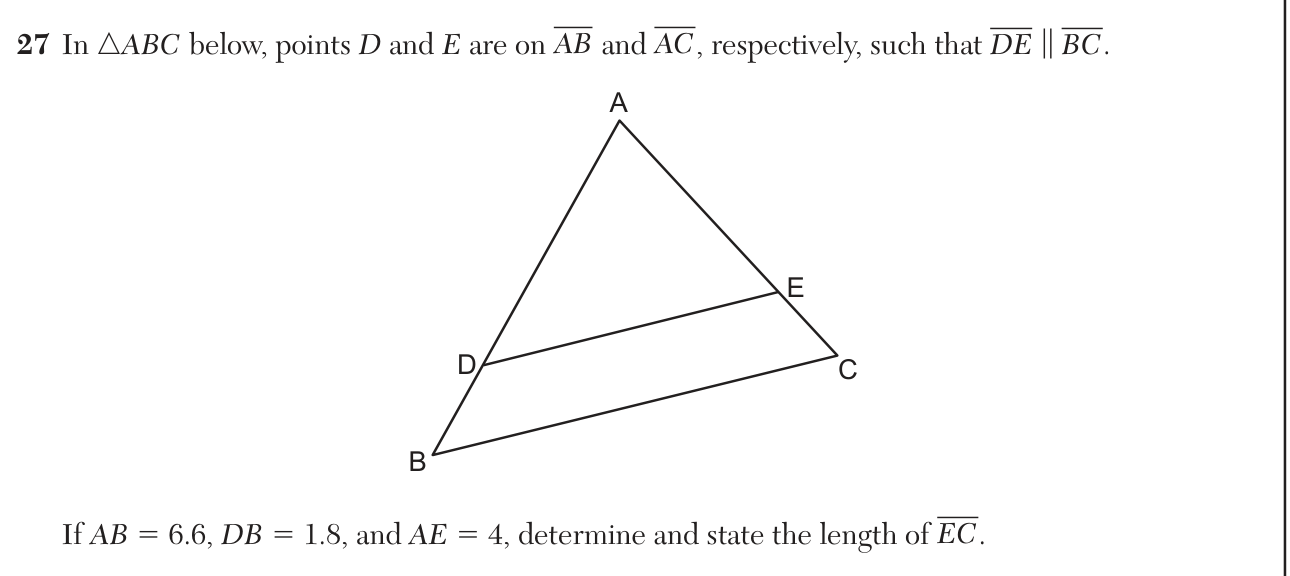
- Subtract DB from the whole side AB to find AD:
- Because DE is parallel to BC, it divides the other two sides proportionally:
- Cross-multiply and solve:
Exam detail: Use matching segment ratios on the two sides; do not mix a whole-side ratio with a part-to-part ratio.
Question 28: Average the two intercepted arcs
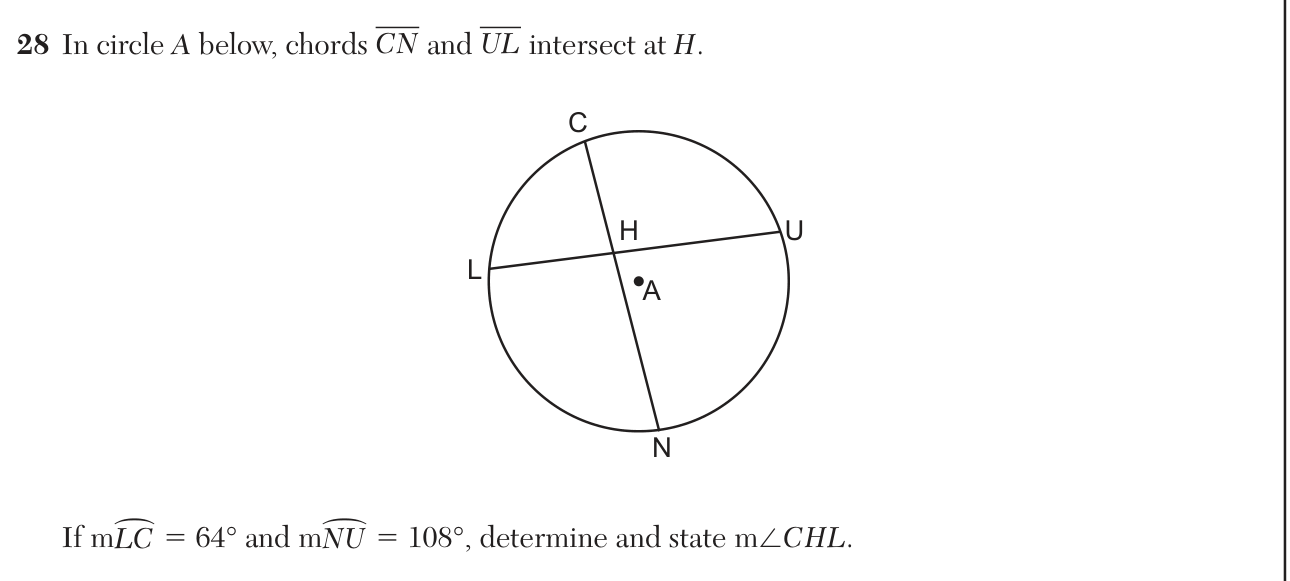
- Two chords intersect inside the circle at H. The angle CHL intercepts minor arc CL, while its vertical angle intercepts minor arc NU.
- An angle formed by intersecting chords is half the sum of those arc measures:
Exam detail: For an intersection inside the circle, add the intercepted arcs before halving.
Question 29: Construct an equilateral triangle in the circle
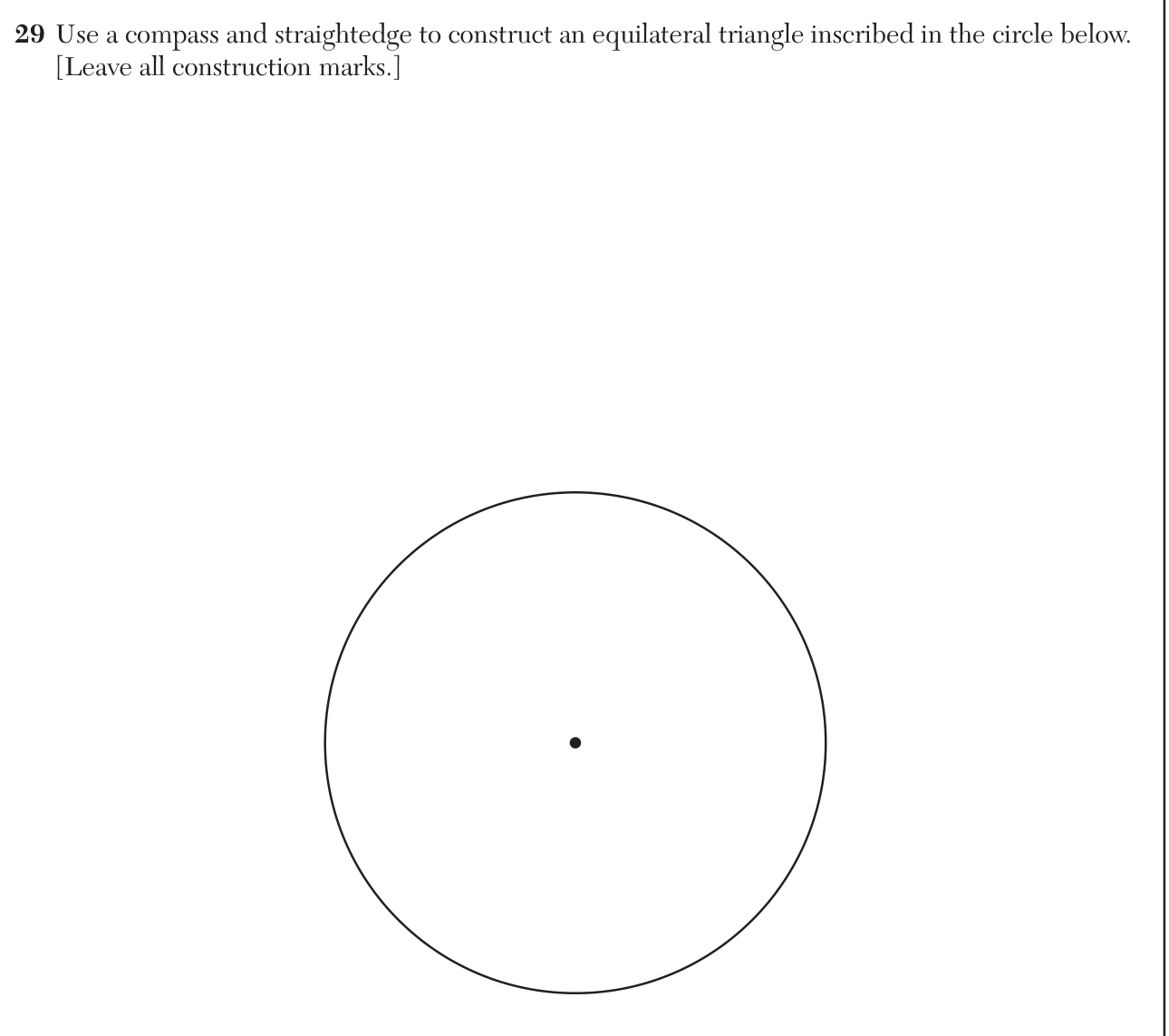
- Label the given center O. Choose any point A on the circle. Open the compass to OA, the circle’s radius, and keep this width unchanged.
- With the compass centered at A, draw an arc to mark the next point B on the circle. Move the compass center to B and mark C. Continue around the circle to mark D, E, and F, always taking the next intersection rather than returning to the previous point. Finally draw the same-radius arc centered at F back through A.
- Use the straightedge to join alternate points A, C, and E. Keep all six radius-step arc marks visible.
- Why it works: each neighboring pair and O form an equilateral triangle: two sides are radii, and the chord between the neighboring points was constructed to have that same length. Each central step is 60°, so consecutive chosen points A, C, and E are separated by 120° arcs. Equal arcs give equal chords, making triangle ACE equilateral.
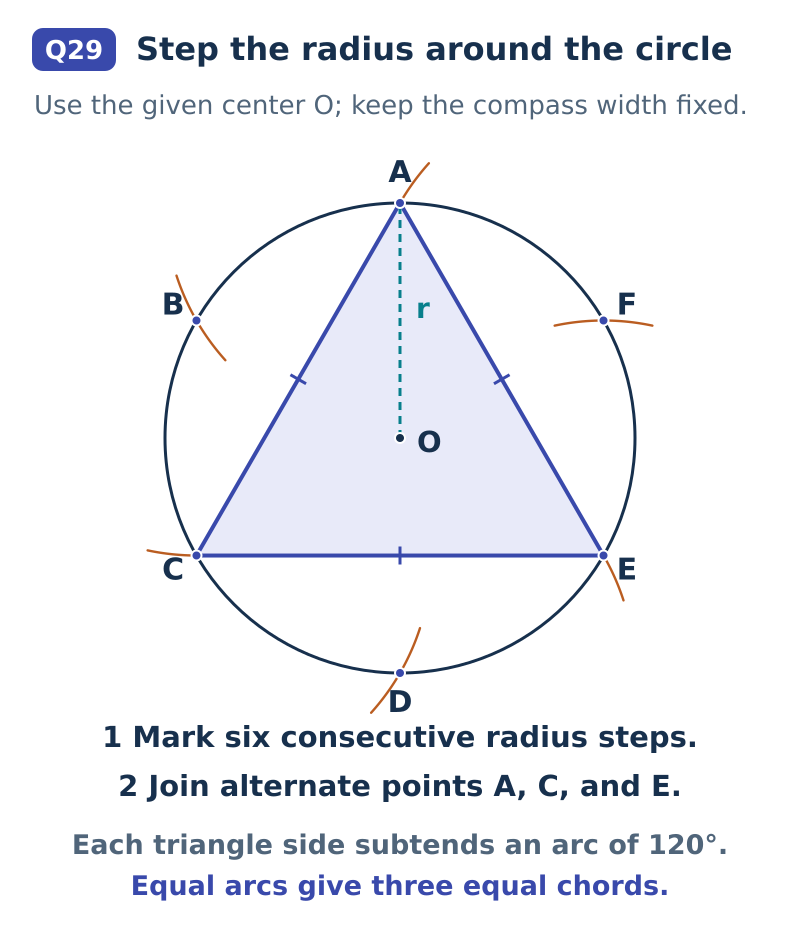
Exam detail: The center is already marked in the exam. A freehand sketch or a protractor-only drawing does not meet the compass-and-straightedge instruction.
Question 30: Explain all three proportional side pairs
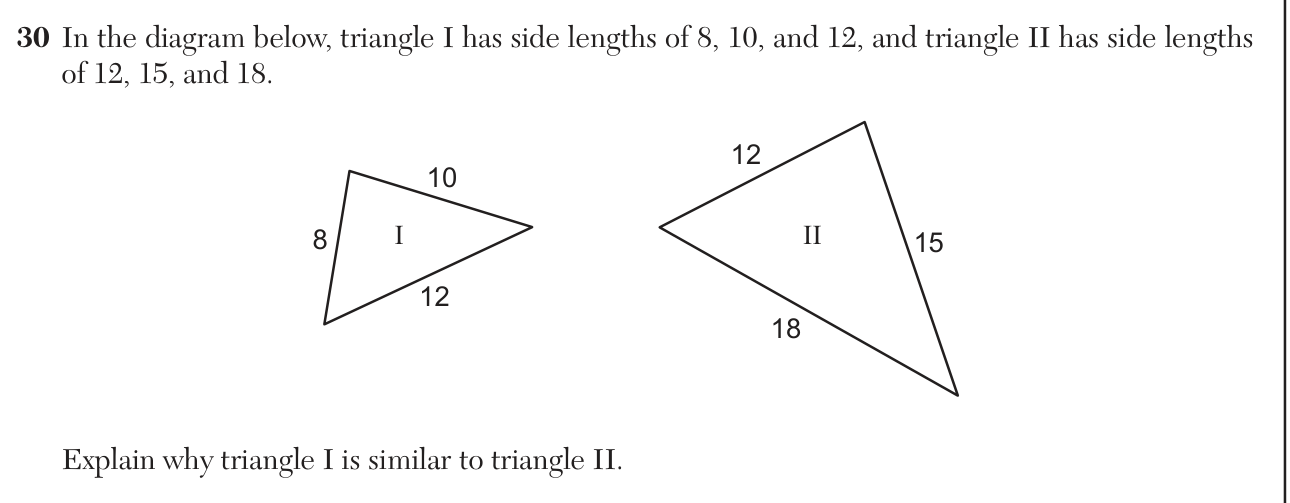
- Match the side lengths in increasing order: 8 with 12, 10 with 15, and 12 with 18.
- Calculate the three corresponding ratios:
- All three pairs of corresponding sides are proportional. Therefore triangle I is similar to triangle II by the SSS similarity theorem.
Exam detail: The written explanation is essential. Do not stop after listing the ratios.
Question 31: Find the sector angle, then its area
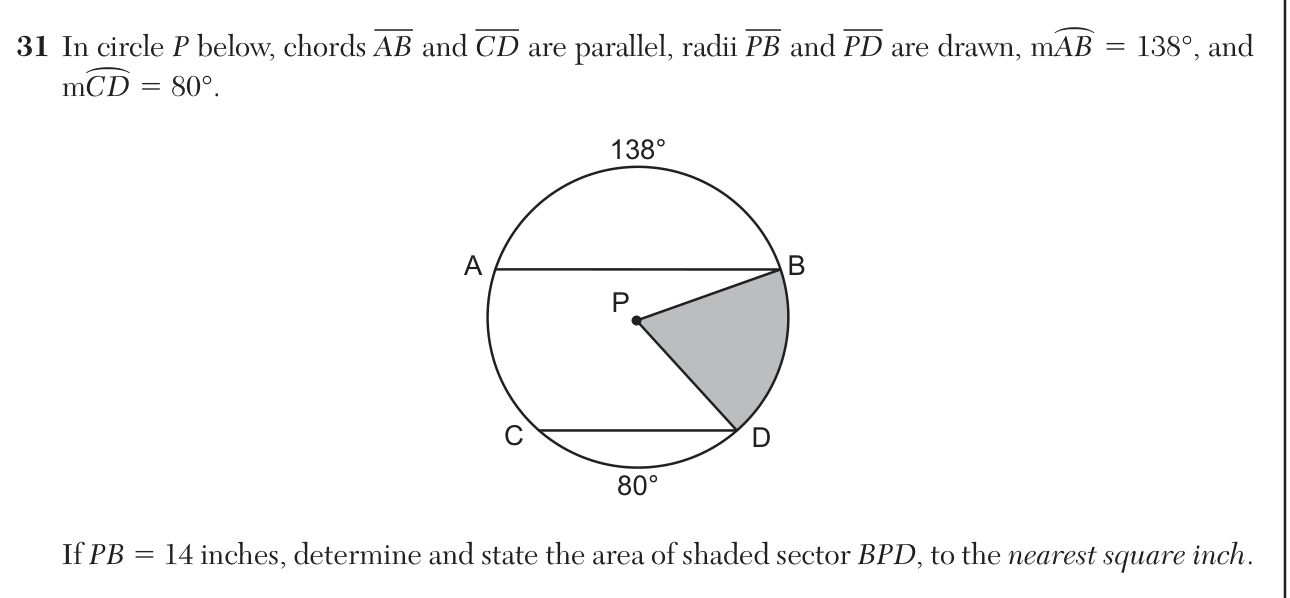
- Parallel chords AB and CD cut off congruent arcs AC and BD between them. Subtract the other two arc measures from the whole circle:This is the sum of the measures of arcs AC and BD.
- The two remaining arcs are equal, so arc BD measures . The central angle BPD also measures 71°.
- Use that fraction of the area of a circle with radius 14:square inches. Round to the nearest square inch.
Exam detail: Use the sector-area formula. Multiplying the same fraction by the circumference would give arc length instead.
Part III: Extended constructed responses
Questions 32–34 • 4 credits each • 12 credits total
Question 32: Count only completely filled cone cups
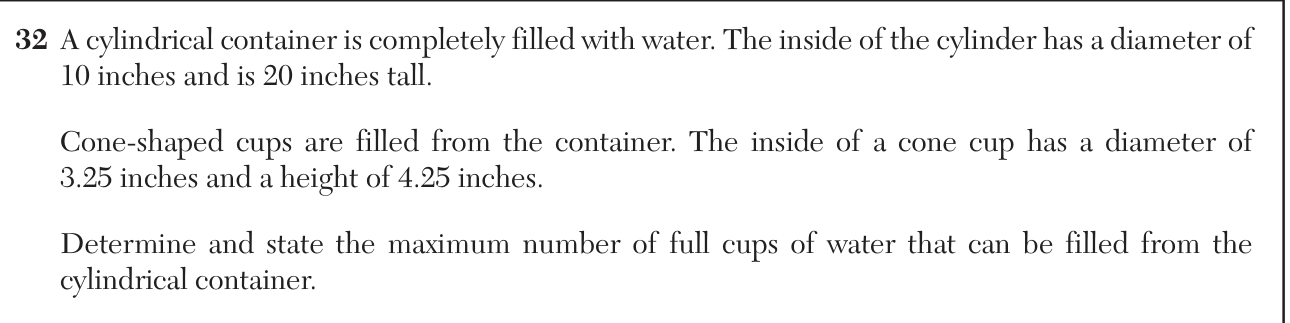
- Convert the cylinder’s diameter to its radius:inches. Its water volume is:cubic inches.
- The cone cup has radius inches and height 4.25 inches. Include the cone’s one-third factor:cubic inches.
- Divide the container volume by the volume per cup. The factors of pi cancel:
- Only full cups count, so use the greatest whole number below this quotient: 133. There is enough water for 133 cups, but not for a 134th full cup.
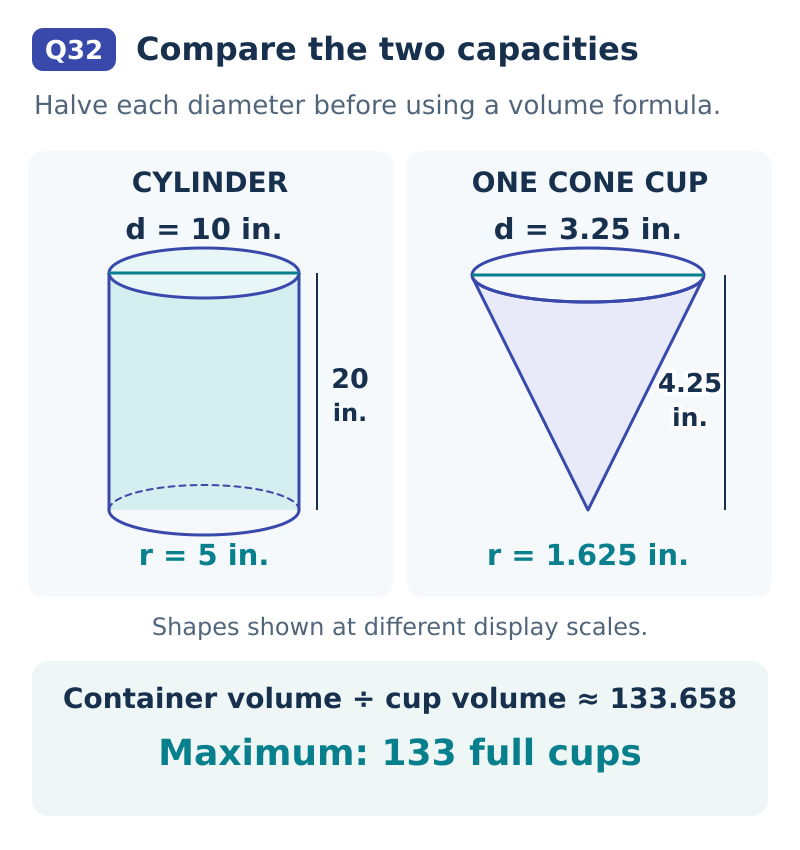
Exam detail: Round down for this maximum count. Rounding 133.6582 to the nearest integer would incorrectly give 134.
Explore the radius and height relationship with the cylinder calculator.
Question 33: Prove the triangles congruent by SAS
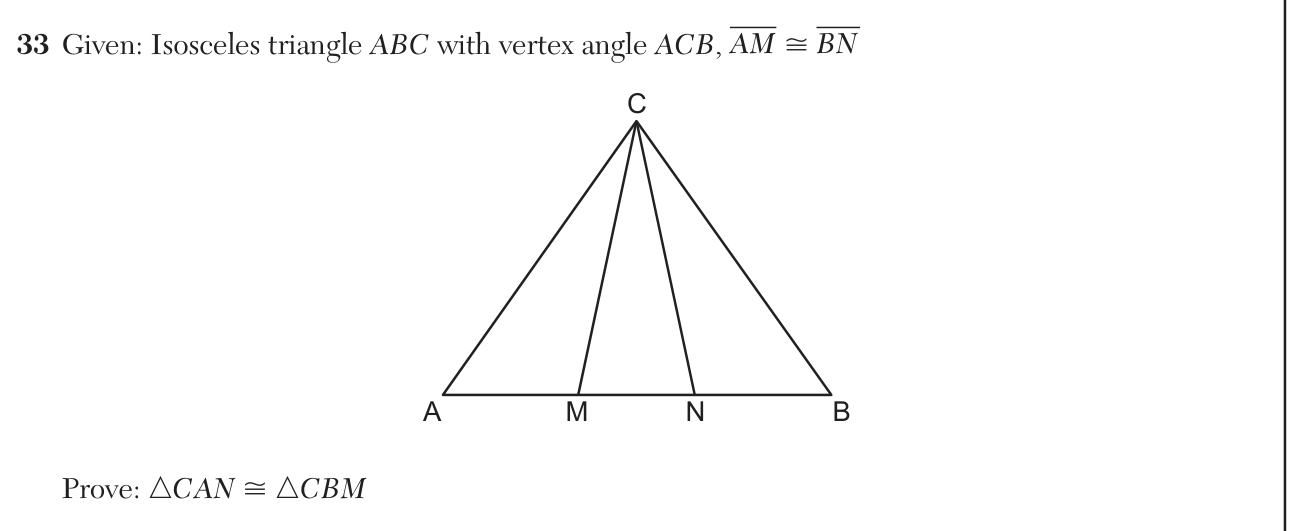
- Because triangle ABC is isosceles with vertex angle ACB, its legs satisfy and its base angles at A and B are congruent.
- Points A, M, N, and B are collinear in that order. Thus the angle CAN is the base angle at A, and angle CBM is the base angle at B:
- The given means . Add the common length MN to both sides:By segment addition, and . Hence .
- The two triangles have two corresponding sides and their included angle congruent. The correspondence is C to C, A to B, and N to M. Therefore:by SAS.
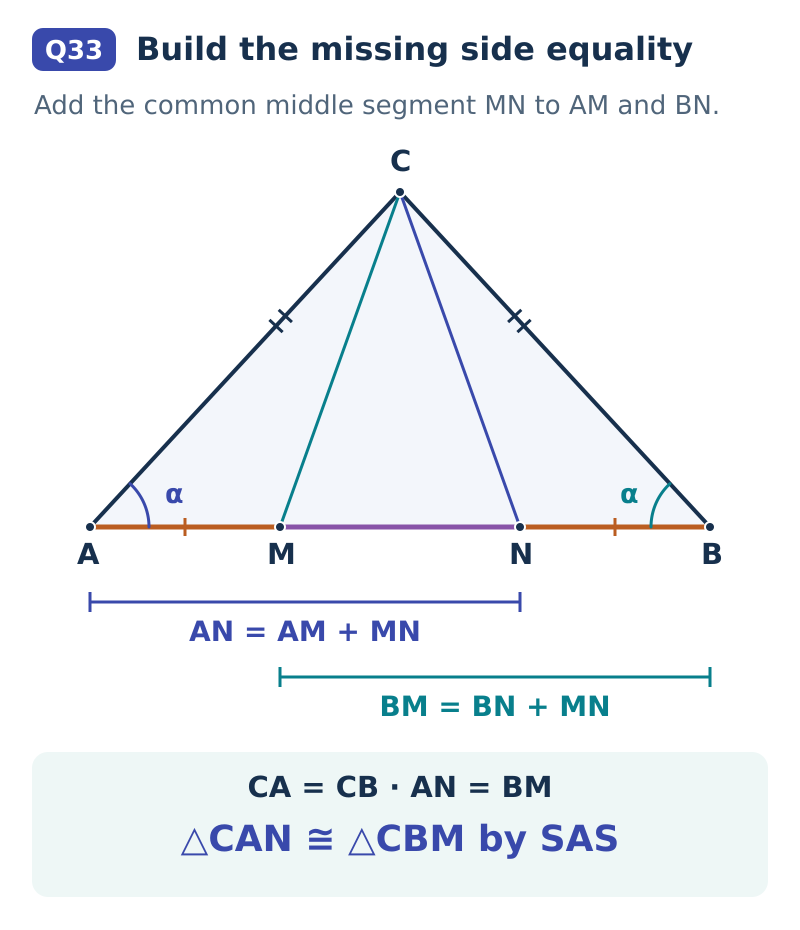
Exam detail: The longer base segments AN and BM are not directly given equal. Prove their equality by adding MN.
Question 34: Subtract the two horizontal ground distances
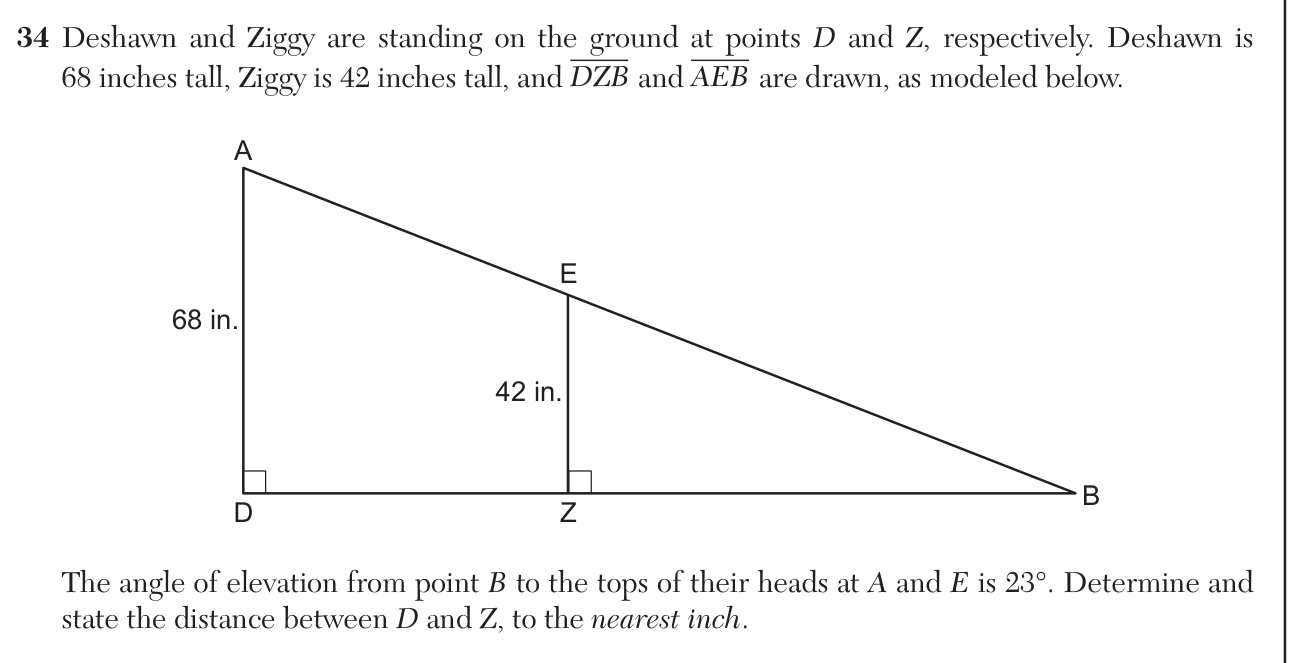
- In right triangle ADB, the 68-inch height is opposite the 23° angle at B and DB is adjacent. In right triangle EZB, the corresponding height is 42 inches.
- Use tangent to calculate both ground distances, keeping full precision:inches.
- Since D, Z, and B lie on the same straight ground line with Z between D and B, subtract:inches. Round only the final distance to the nearest inch.
- Equivalent shorter method: draw HE horizontally from E to AD. Then inches and . The angle AEH is 23° because HE is parallel to the ground. The same tangent ratio gives .
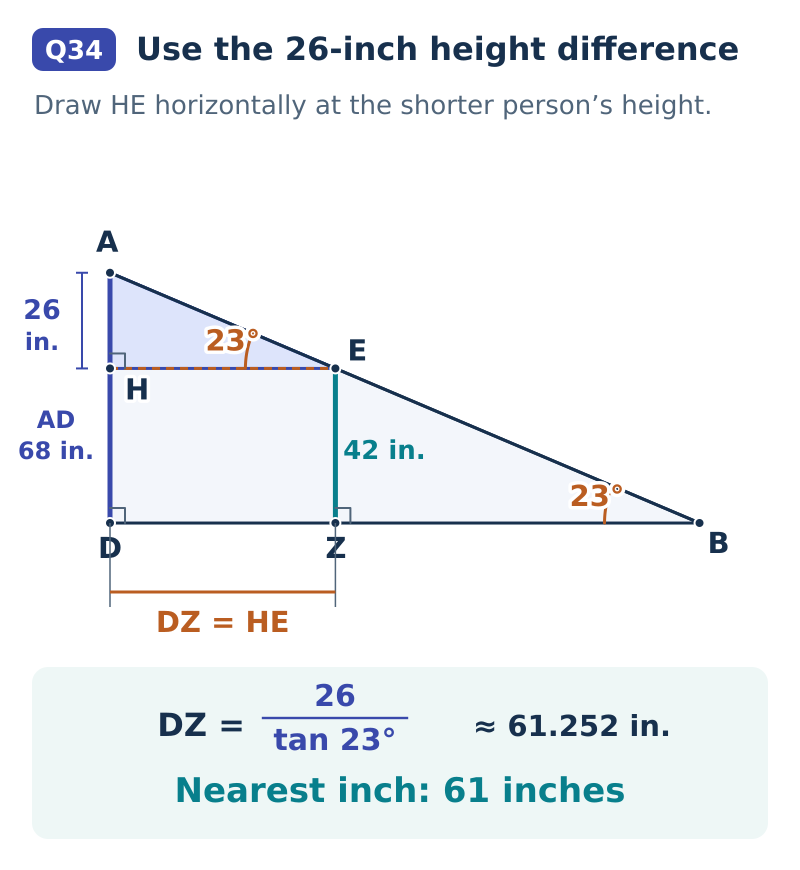
Exam detail: Subtract horizontal ground distances, not the slanted sight-line lengths. Use degree mode.
Part IV: Coordinate geometry proofs
Question 35 • 6 credits
Question 35: Classify SHED using coordinate geometry
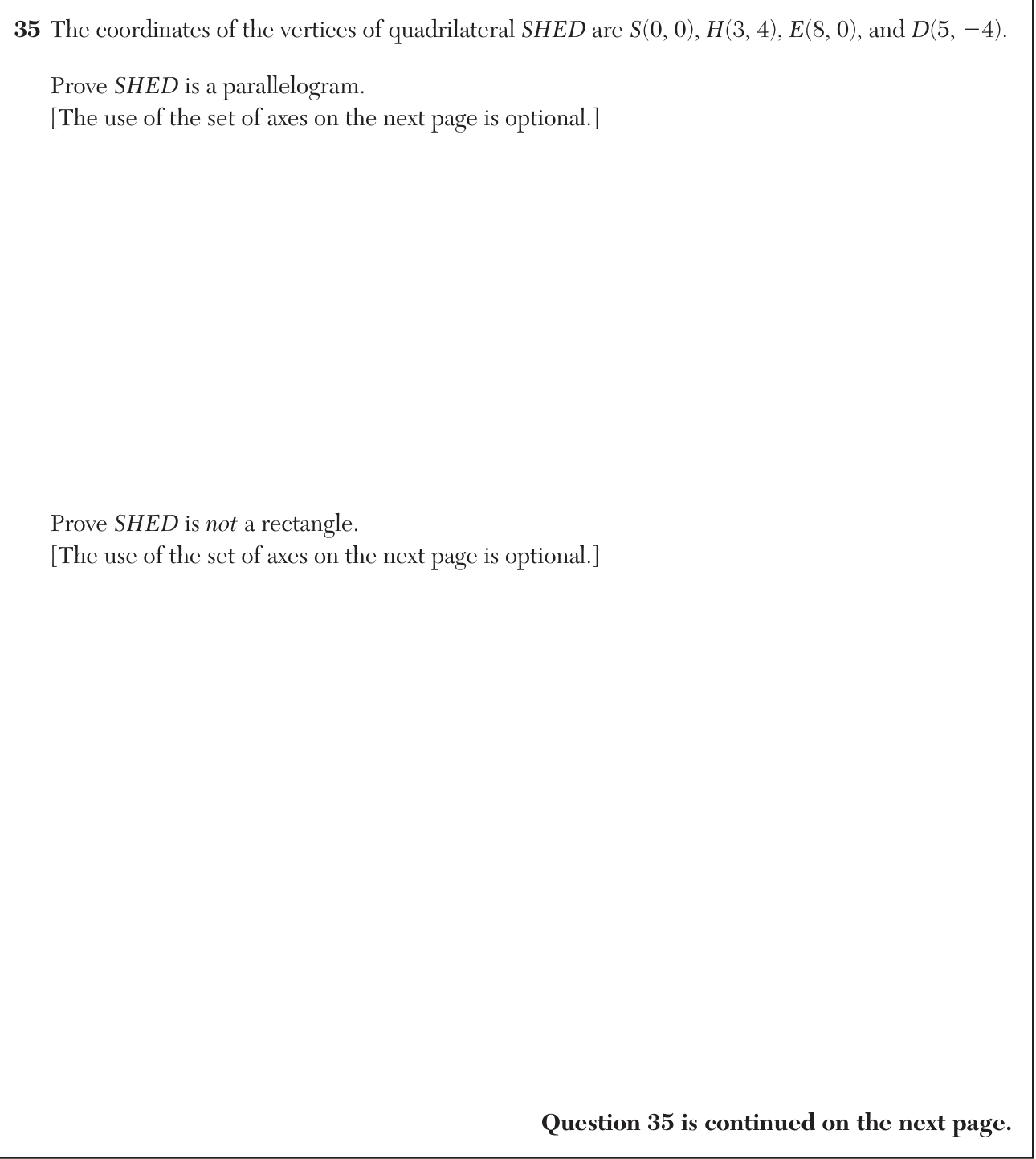
- Prove SHED is a parallelogram. Calculate both pairs of opposite side slopes:Equal slopes give and . Both pairs of opposite sides are parallel, so SHED is a parallelogram.
- Prove SHED is not a rectangle. Adjacent nonvertical sides of a rectangle must have negative reciprocal slopes. Here:Thus SH and HE are not perpendicular, so their included angle is not a right angle. SHED is not a rectangle.
- Prove SHED is not a rhombus. Compare two adjacent side lengths using the distance formula:Since , the adjacent sides are unequal. A rhombus must have all four sides congruent, so SHED is not a rhombus.
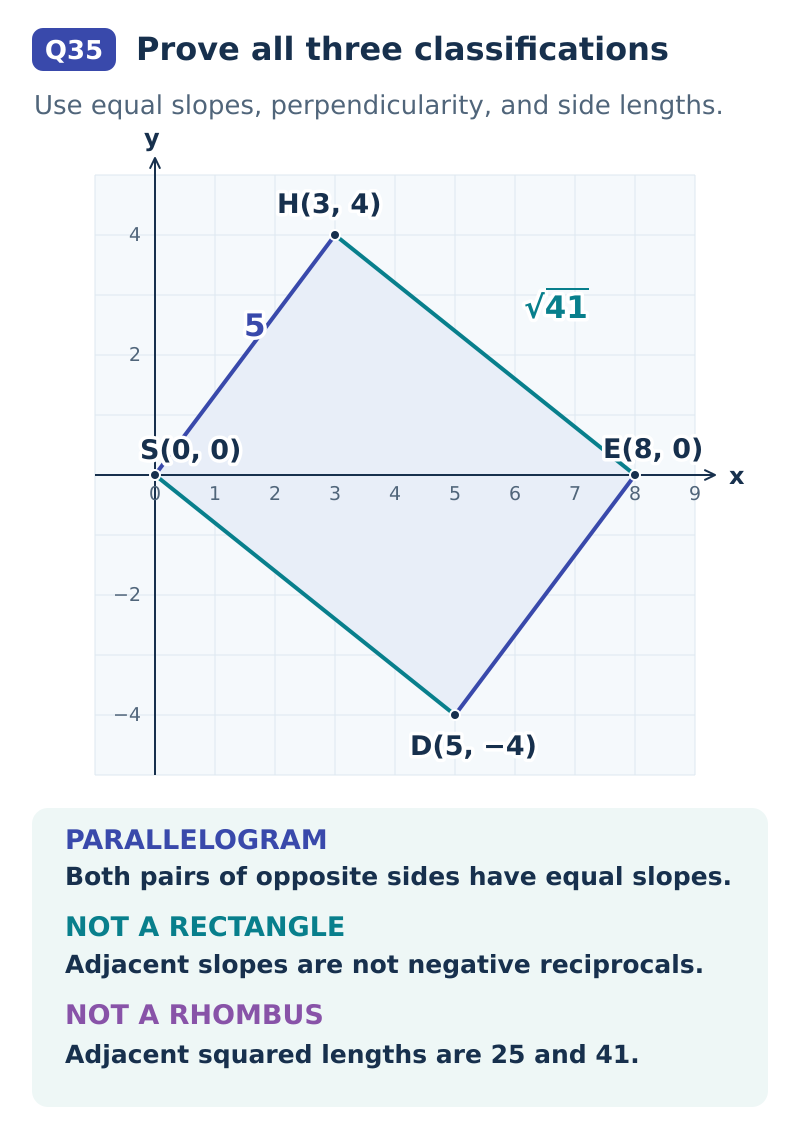
Exam detail: This question continues on page 23. Give all three property-based conclusions; a graph alone is not a coordinate proof.
Check another coordinate example in the 2D Points mode of the distance calculator.
Check your score carefully
The maximum raw score is 80. Use the official August 2026 Geometry conversion chart for the scaled Regents score; another administration’s chart may give a different result. For related practice, see the June 2026 Geometry Regents solutions.
Sources & References
Official materials accessed October 7, 2026. Question and scoring references use the English edition throughout this page.
- Official August 2026 Geometry examination (questions; PDF)
- Official August 2026 multiple-choice scoring key (PDF)
- Official August 2026 rating guide (PDF)
- Official August 2026 model response set (PDF)
- Official August 2026 conversion chart (PDF)
- NYSED Geometry past-examination index
- NYSED terms of use and reproduction conditions
From the New York State Education Department. Regents Examination in Geometry, August 2026. Internet. Available from the official examination link above; accessed 7 October 2026. Original question images are distinguished from HeLovesMath’s original explanations and solution diagrams.