
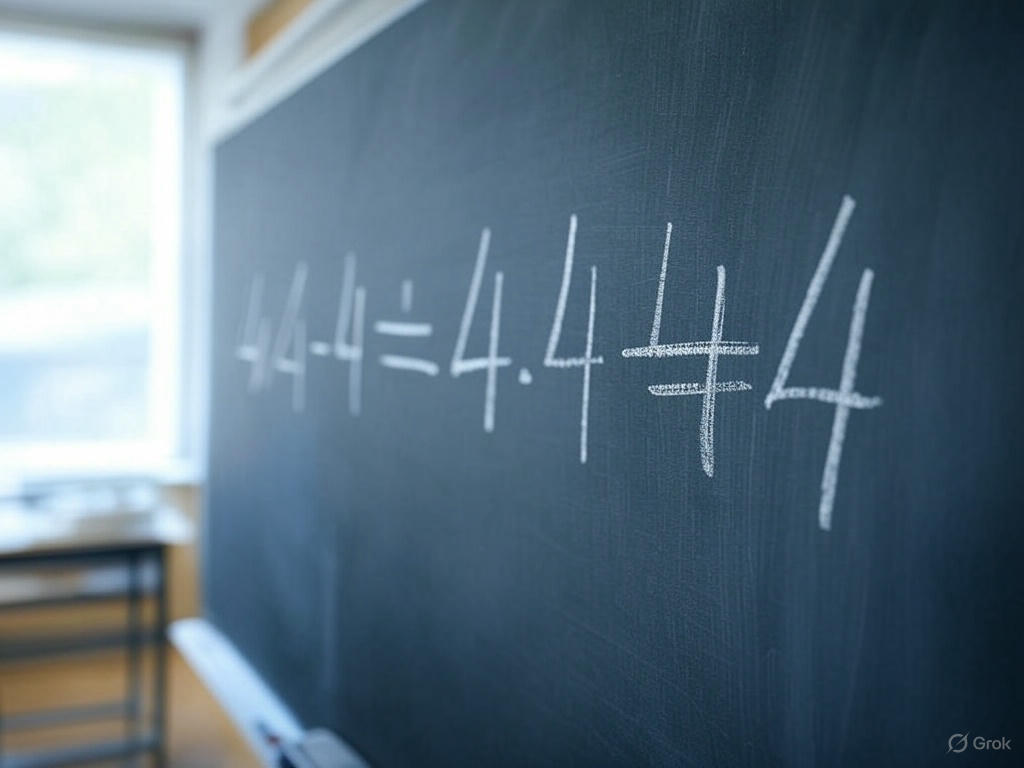
Order of Operations Challenge
4×4−4÷4+4 Challenge: Solve the Viral Math Problem
The expression looks tiny, but it tests a foundational skill: reading a calculation according to a shared mathematical convention. Here is the correct answer, the reasoning behind it, and a practical way to avoid the mistakes that make simple-looking expressions so confusing.
The answer is
\[ 4 \times 4 - 4 \div 4 + 4 = 16 - 1 + 4 = 19 \]
The important part is not memorising that answer. It is understanding why multiplication and division are completed before addition and subtraction, and why operations at the same level are handled from left to right.
What does 4×4−4÷4+4 mean?
The challenge is usually written as 4×4−4÷4+4. It contains four familiar operations: multiplication, subtraction, division, and addition. Nothing in it requires algebra, calculus, a trick, or an unusual rule. The difficulty comes from the fact that several operations appear in one line. To calculate such an expression consistently, everyone needs the same order-of-operations convention.
Written in mathematical notation, the expression is:
The multiplication sign means “multiply,” the division sign means “divide,” the minus sign means “subtract,” and the plus sign means “add.” In plain-text posts, the expression may appear as 4x4-4/4+4. In that setting, the letter x is being used informally as a multiplication sign and the slash represents division. It is better to write × and ÷, or use clear parentheses, because the reader should not have to guess how to parse the expression.
There is no hidden multiplication, no implied bracket, and no special exception in this problem. The standard reading is simply:
Those parentheses are not present in the original challenge, but they show the structure created by the normal precedence rules. The multiplication and division are completed first. Then the remaining subtraction and addition are completed from left to right.
A useful first habit
Before calculating, rewrite a crowded expression using standard symbols and spacing. Reading 4 × 4 − 4 ÷ 4 + 4 is easier and safer than reading a tightly packed string of characters. Clear notation reduces mistakes before any arithmetic begins.
The problem is closely connected to the basic skills of multiplication, division, subtraction, and addition. Each operation is simple on its own. The challenge is deciding which operation belongs first when all of them share one expression.
How to solve 4×4−4÷4+4 step by step
The solution becomes straightforward when it is written in stages. Do not try to hold the entire expression in your head while calculating. Instead, identify the highest-priority operations, replace them with their results, and then repeat.
-
Find multiplication and division.
The expression contains \(4 \times 4\) and \(4 \div 4\). Multiplication and division have equal priority, so they are handled from left to right. In this expression they are separate calculations, so evaluating either one first gives the same simplified line. -
Calculate the multiplication.
\[ 4 \times 4 = 16 \] The expression becomes: \[ 16 - 4 \div 4 + 4 \] -
Calculate the division.
\[ 4 \div 4 = 1 \] The expression now becomes: \[ 16 - 1 + 4 \] -
Work through addition and subtraction from left to right.
First: \[ 16 - 1 = 15 \] Then: \[ 15 + 4 = 19 \]
Therefore:
A good self-check is to ask whether every operation has been used exactly once. Here, \(4 \times 4\) gives \(16\), \(4 \div 4\) gives \(1\), and the final line \(16-1+4\) gives \(19\). No number has disappeared, no operation has been skipped, and no new bracket has been invented.
The key idea
Multiplication does not “beat” division, and addition does not “beat” subtraction. Each pair shares the same priority. When operations share a priority, read from left to right.
PEMDAS, BODMAS, and the real order-of-operations rule
Many students learn an acronym to remember operation precedence. In the United States, PEMDAS is common. In the United Kingdom and many other education systems, BODMAS or BIDMAS is common. The acronyms use different words, but they point to the same underlying structure.
| Priority level | PEMDAS wording | BODMAS/BIDMAS wording | What to do |
|---|---|---|---|
| 1 | Parentheses | Brackets | Evaluate the most deeply nested grouping first. |
| 2 | Exponents | Orders / Indices | Evaluate powers, roots, and similar operations. |
| 3 | Multiplication and division | Division and multiplication | Work from left to right. |
| 4 | Addition and subtraction | Addition and subtraction | Work from left to right. |
The most important correction to a common memory shortcut is this: the letters are not a strict one-by-one queue. PEMDAS does not mean “always multiply before dividing.” BODMAS does not mean “always divide before multiplying.” Multiplication and division are inverse operations with equal precedence. The same is true of addition and subtraction.
For example, consider:
Because division and multiplication have equal precedence, work from left to right:
Changing the order to \(24 \div (3 \times 2)=4\) would create a different expression. The parentheses in that version are meaningful; they are not automatically assumed in the original line.
The same left-to-right rule applies at the addition-and-subtraction level. Consider:
It would be wrong to force the final two terms into \(18-(5+2)\) unless parentheses explicitly say to do that. In the 4×4−4÷4+4 challenge, this is why the final line is \(16-1+4\), then \(15+4\), then \(19\).
Understanding the meaning of the rules is more durable than repeating an acronym. The convention exists so that a line of mathematics can be interpreted consistently by a student, teacher, calculator, spreadsheet, programmer, or engineer. It is a shared grammar for numerical expressions.
Why do people get different answers?
When a short expression becomes a social-media challenge, different answers are usually caused by one of four things: a mistaken precedence rule, a calculator in immediate-execution mode, unclear typing, or a change in grouping that has not been written with parentheses. The original expression still has a standard answer, but the alternate answers often reveal a useful lesson about notation.
Mistake 1: Treating all operations as equal
A person may move across the expression without first identifying multiplication and division. This happens when someone sees the line as a sequence of button presses rather than a mathematical expression. In this particular challenge, beginning from the left can accidentally lead to the right result for part of the calculation, which makes the method feel reliable even though it is not a general rule.
Try the same habit on a different expression:
Left-to-right button pressing gives \((6+3)\times4=36\). Standard order of operations gives \(6+(3\times4)=18\). The difference shows why multiplication must be handled before addition when no parentheses say otherwise.
Mistake 2: Reading PEMDAS as a rigid letter order
Some people remember “multiplication before division” and “addition before subtraction.” That rule is incomplete. Multiplication and division are one level; addition and subtraction are another. In the challenge, the correct progression is:
The expression does not require addition before subtraction or subtraction before addition. It simply requires the first operation at that level—subtraction—to be completed before the addition that follows it.
Mistake 3: Letting a calculator choose the mathematics
A calculator can be a useful verification tool, but it does not replace understanding. Some basic calculators operate in “immediate execution” mode: after each operator is pressed, they calculate the previous operation straight away. A scientific calculator, an algebraic-entry calculator, spreadsheet software, and most programming languages normally use standard precedence. If two devices give different answers, the first question should be: What input mode and grouping rule is each device using?
Mistake 4: Changing the expression without noticing
Parentheses change a problem. They are instructions, not decoration. Compare the original expression with several genuinely different versions:
| Expression | Value | Why it differs |
|---|---|---|
| \(4 \times 4 - 4 \div 4 + 4\) | \(19\) | The original challenge, evaluated with standard precedence. |
| \(4 \times (4-4) \div 4 + 4\) | \(4\) | The bracket forces \(4-4\) to happen first. |
| \(4 \times 4 - 4 \div (4+4)\) | \(15.5\) | The denominator becomes \(8\). |
| \((4 \times 4 - 4) \div 4 + 4\) | \(7\) | The subtraction occurs before division. |
| \(4 \times (4-4 \div 4)+4\) | \(16\) | The bracket changes the multiplication target. |
Every line in the table is valid mathematics, but each is a different question. That is the central lesson of viral arithmetic debates: when someone gives a different result, check whether they have silently added brackets or used a different calculator mode. The disagreement may be about notation rather than arithmetic skill.
Should you use a calculator for this challenge?
You do not need a calculator to solve 4×4−4÷4+4, and working it out on paper is usually the fastest way to understand it. The challenge is valuable precisely because it tests how you organise operations. A calculator can confirm the result, but it should come after the reasoning, not before it.
If you want to check a longer expression after showing your working, use the site’s scientific calculator. That page serves a different purpose from this guide: the calculator is for entering and evaluating many expressions, while this article explains the logic behind one specific viral challenge and the order-of-operations habits needed to solve it confidently.
When using any calculator, notice the display. An algebraic or scientific-entry display typically allows you to see the full expression before pressing equals. That makes it easier to spot missing parentheses, an incorrect symbol, or an accidental decimal. A simple four-function device may calculate as each operation is entered, so it can behave differently unless brackets are used deliberately.
Calculator check: do not confuse input order with operation order
Typing the same keys does not guarantee that every device evaluates them the same way. If a device gives a surprising result, rewrite the expression with parentheses or calculate the multiplication and division separately before entering the final line.
This distinction matters well beyond a classroom puzzle. In spreadsheets, formulas such as =A1-B1/C1+D1 follow precedence rules. In code, expressions such as price - discount / quantity + fee also follow a defined hierarchy. A misplaced parenthesis can change a result substantially, even when every individual number is correct.
How to write arithmetic expressions so nobody misreads them
The best way to avoid an argument about order of operations is to make the intended grouping visible. Professional mathematical writing does not rely on readers to infer a complicated calculation from a compressed string of symbols. It uses parentheses, fraction bars, spacing, and line breaks to communicate structure.
Use parentheses when grouping matters
Suppose you mean “multiply 4 by the difference between 4 and 4, then divide by 4, then add 4.” Write:
Suppose you mean “subtract the quotient of 4 and the sum of 4 and 4.” Write:
The horizontal fraction bar is especially helpful because it clearly tells the reader what belongs in the denominator. A slash is compact, but it can become difficult to interpret when several operations appear around it.
Do not use the letter x when a variable may be involved
For early arithmetic, writing 4x4 is commonly understood as multiplication. In algebra, however, \(x\) often represents an unknown. To avoid confusion, use \(\times\), a centred dot, or parentheses:
The last form appears often in algebra, where \(4(4)\) means \(4\) multiplied by \(4\). If letters are present, the distinction becomes more important. A page on linear expressions can help build that next step from numerical arithmetic into algebraic notation.
Leave visible space around operations
Spacing is not a mathematical operation, but it helps readers see an expression’s parts. Compare:
with a crowded plain-text version such as 4x4-4/4+4. The second may be quick to type, but the first is clearer. A well-written answer should make the next step easy for someone else to verify.
State the convention when the audience may use another system
PEMDAS, BODMAS, and BIDMAS describe the same precedence hierarchy, but students may remember them differently. If you are writing a worksheet, tutoring a learner, posting a puzzle, or sharing an answer online, say “multiplication and division from left to right; then addition and subtraction from left to right.” That one sentence prevents the most common misunderstanding.
A reliable method for any order-of-operations problem
The 4×4 challenge is useful because it is small enough to see every stage. The same method works when expressions become longer. Rather than relying on intuition, use a repeatable routine.
- Copy the expression accurately. Check every number, sign, exponent, decimal point, fraction bar, and bracket before calculating.
- Circle grouping symbols. Complete the innermost parentheses or brackets first.
- Handle powers and roots. Do this before multiplication, division, addition, and subtraction.
- Scan left to right for multiplication and division. Replace one completed operation at a time.
- Scan left to right for addition and subtraction. Keep negative signs attached to the values they affect.
- Check reasonableness. Estimate whether the final answer fits the scale of the numbers you started with.
For example, apply that routine to:
First complete the bracket:
Then multiply and divide from left to right:
Finally, add and subtract from left to right:
The routine is more valuable than the answer to any one puzzle. Once it becomes automatic, you can use it when simplifying fractions, evaluating formulas, checking a budget, entering a spreadsheet formula, or working with algebra. If fractions are the part that tends to slow you down, review the fundamentals of fractions before moving on to more complicated expressions.
Common order-of-operations errors and how to correct them
“I always go left to right.”
Going left to right is only correct after you have identified operations with equal precedence. You may go left to right within multiplication and division, then left to right within addition and subtraction. You may not ignore the higher priority of multiplication and division.
“The M comes before the D in PEMDAS.”
The letters are grouped. Read it as “multiplication and division,” not “multiplication, then division.” The same correction applies to addition and subtraction. A useful spoken version is: brackets, powers, multiply-or-divide left to right, add-or-subtract left to right.
“The calculator said something else.”
Check the calculator’s mode and the way the expression was entered. If it calculates immediately after each operator, enter parentheses or simplify on paper. If it shows the full expression, read the display carefully before pressing equals. Technology can evaluate a well-defined input quickly, but it cannot decide what you meant if the notation is unclear.
“I got the right answer, so my method must be right.”
A lucky answer is not proof of a reliable method. The 4×4 challenge can conceal an incorrect approach because some shortcut paths happen to land on 19. Test your method on a fresh expression such as \(6+3\times4\). If the method gives 36 instead of 18, it needs correcting.
“I changed the brackets because that looked more natural.”
Parentheses must come from the written problem, not from a guess about what seems natural. If you add brackets, say so and solve the new expression. Mathematical accuracy includes preserving the problem as it was stated.
Why this basic rule matters outside a viral math problem
Order of operations is not only a school topic. It appears whenever a calculation combines more than one operation. The numbers may become larger and the context may become more serious, but the need to communicate grouping clearly stays the same.
Spreadsheets and data work
A spreadsheet formula such as =Revenue-Discount/Units+Fee follows operation precedence. If the intended calculation is different, the spreadsheet needs parentheses. For example, =(Revenue-Discount)/(Units+Fee) is a completely different formula. Good spreadsheet users write formulas so that a colleague can inspect them and understand the grouping immediately.
Programming
Programming languages use precedence rules too. A developer may write a condition, price calculation, score calculation, or scientific formula containing multiplication, division, addition, subtraction, and brackets. Clear parentheses make code easier to review and reduce the chance of a subtle calculation error. The professional habit is not “trust the language to guess”; it is “make the intended logic obvious.”
Measurement, finance, and science
A formula can be mathematically correct but still produce a wrong result if it is entered with the wrong grouping. This is why formulas are often written using fraction bars, brackets, or separate lines. In science and engineering, the structure of a formula must be as clear as the numbers substituted into it. In personal finance, even a small misplaced bracket can change an interest, tax, or budget calculation.
That is why a compact challenge such as 4×4−4÷4+4 is worth understanding properly. It develops a habit of reading before calculating, checking structure before trusting a device, and showing enough working that another person can verify the result.
Practice: test your order-of-operations understanding
Try each expression before revealing the answer. Write one line per step. The goal is not speed; it is making the operation order visible.
1. Evaluate: \(\;7 + 3 \times 4 - 8 \div 2\)
2. Evaluate: \(\;(18-6) \div 3 + 2^2\)
3. Evaluate: \(\;24 \div 4 \times 3 - 5\)
4. Which is larger? \(\;6+2\times5\) or \((6+2)\times5\)
5. Create your own version. Insert parentheses into \(4\times4-4\div4+4\) to make a new, valid expression with a different answer.
For more foundational practice, revisit the ideas behind multiplication and division, then practise combining them with addition and subtraction. Strong arithmetic is built through short, correctly explained examples—not by memorising isolated answers.
How students, parents, and teachers can use this challenge
This problem works well as a discussion starter because the numbers are not intimidating. A student who hesitates with a large worksheet may still be willing to argue about four 4s. That makes the challenge an opportunity to move from “I think the answer is…” to “Here is the order I used, and here is why.”
For students
Do not rush to an answer. Copy the expression with clear symbols, mark multiplication and division, simplify one operation per line, and keep the previous line visible. If you get stuck, explain what you think should happen next. Saying the rule aloud often reveals whether you are treating multiplication and division as a pair or incorrectly separating them.
For parents and tutors
Ask questions that make reasoning visible: “Which operation has priority here?” “Do multiplication and division have the same priority?” “What would the expression look like if we wanted subtraction first?” These questions are more useful than simply saying “wrong.” They help a learner build a method they can use independently on the next problem.
For teachers
Use the challenge to contrast notation with intention. Give a small group the original expression, then give other groups versions with different parentheses. Ask them to calculate, compare answers, and explain why the answers differ. This turns a viral-style puzzle into a lesson about mathematical communication. Students see that brackets are not an arbitrary school rule; they tell every reader which quantities belong together.
A productive extension is to ask students to write a deliberately unambiguous word problem or formula. They can then exchange work with a partner and check whether the intended grouping was understood without verbal explanation. That activity develops both arithmetic fluency and the precision needed later in algebra.
Frequently asked questions
What is the correct answer to 4×4−4÷4+4?
The correct answer is \(19\). First calculate \(4\times4=16\) and \(4\div4=1\). Then calculate \(16-1+4=19\).
Why are multiplication and division done before addition and subtraction?
Mathematics uses a shared convention called the order of operations. It makes expressions consistent across textbooks, calculators, software, and classrooms. Multiplication and division form one precedence level; addition and subtraction form the next level.
Does PEMDAS mean multiplication always comes before division?
No. Multiplication and division have equal precedence. Complete them from left to right. PEMDAS is best read as “multiplication and division,” not as two separate priority levels.
Does BODMAS give a different answer from PEMDAS?
No. BODMAS and PEMDAS describe the same precedence structure. Both require multiplication and division to be handled from left to right, followed by addition and subtraction from left to right.
Why might a basic calculator give a different answer?
Some basic calculators use immediate execution, calculating each operation as soon as the next operator is pressed. Scientific and algebraic-entry calculators normally apply standard precedence. Check the calculator mode and use parentheses when grouping matters.
Is 4x4-4/4+4 the same as 4×4−4÷4+4?
In informal plain text, it is usually intended to mean the same thing: x represents multiplication and / represents division. For clarity, especially in educational writing, use \(\times\), \(\div\), fraction bars, and parentheses where appropriate.
What if parentheses are added to the expression?
Then the expression may have a different value. For example, \(4\times(4-4)\div4+4=4\), not \(19\). Parentheses change the grouping, so they create a different mathematical question.
Should I memorise PEMDAS or understand the reasoning?
Use an acronym as a reminder, but understand the grouping behind it. The most important details are that multiplication/division share one level and addition/subtraction share another. A clear method is more useful than memorising letters alone.
The real challenge is clarity
The answer to \(4\times4-4\div4+4\) is \(19\). More importantly, the expression shows why mathematics needs shared rules and clear notation. Identify the grouping, handle multiplication and division from left to right, then handle addition and subtraction from left to right. Once that process is clear, the problem stops being controversial and becomes a useful piece of mathematical reasoning.