GPA to Graduate Calculator: Minimum Cumulative GPA Requirements & Interactive Checker
Use this interactive calculator to check whether your cumulative GPA, completed credits, attempted credits, pace, and remaining coursework are on track for graduation. It supports high school, associate degree, undergraduate degree, graduate degree, financial-aid SAP, honors/scholarship, and custom requirement profiles.
Interactive Graduation GPA Checker
Enter your GPA, credits, pace requirement, and program type. The checker will estimate your graduation status and the average GPA you need in your remaining letter-graded credits.
Extra Tools: Semester GPA, Retake Repair, GPA Scale Converter
Use these tools to model next term grades, course retakes, and scale differences. The main graduation checker uses your official cumulative values.
Subject / Course Grade Calculator
Enter upcoming courses, credits, and expected grades. The calculator will estimate semester GPA and projected cumulative GPA after these courses.
| Course | Credits | Expected grade | Grade points |
|---|
Retake Repair Planner
Use this to estimate how repeating a course may improve your cumulative GPA. Select whether your school replaces the old grade or averages both attempts.
GPA Scale Converter
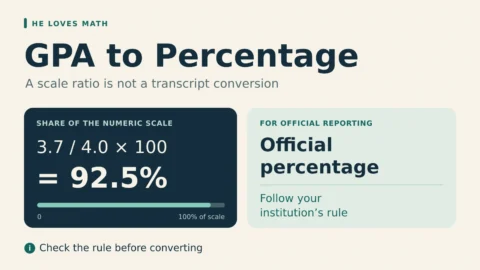
This converter uses proportional scaling only. Official conversions can differ because institutions may recalculate grades course by course.
Quick Reference: Minimum GPA Requirements by Goal
The table below gives practical default settings for this calculator. These are not universal rules. They are common planning benchmarks only. Your official answer comes from your transcript, degree audit, academic catalog, department handbook, and advisor confirmation.
| Student goal | Common GPA benchmark | Credit condition | Pace / completion condition | Best use in this calculator |
|---|---|---|---|---|
| High school graduation | Often local or district-based; many systems focus on required credits and passed courses more than one universal GPA | Enter your required graduation credits from your school plan | Usually complete all required course credits and exams | Use “custom” or “high school” and edit all requirements |
| Associate degree | Often 2.00 on a 4.0 scale | Often around 60 credits | Complete program and institutional requirements | Use associate profile and confirm catalog rules |
| Bachelor’s degree | Often 2.00 on a 4.0 scale | Often around 120 credits | Complete major, general education, residency, and degree audit rules | Use undergraduate profile |
| Graduate certificate or master’s degree | Often 3.00 on a 4.0 scale, though some programs use 2.70 or other rules | Often 9–60 credits depending on program | Department rules may include thesis, exams, candidacy, or professional standards | Use graduate profile and edit minimum GPA |
| Financial aid SAP | Must meet school-defined qualitative GPA standard | Must progress through program within allowed maximum timeframe | Many policies use completion pace such as 67%, but values vary | Use SAP profile and check GPA + pace + timeframe |
| Honors, scholarship, athletic, or visa standing | Often above graduation minimum, such as 3.00, 3.20, 3.50, or higher | Depends on award/program | May require full-time status, good standing, or completed milestones | Use honors/custom profile |
What Does “GPA to Graduate” Mean?
“GPA to graduate” means the minimum cumulative grade point average a student must have when the school awards the diploma, certificate, associate degree, bachelor’s degree, master’s degree, or doctoral degree. The phrase sounds simple, but a real graduation decision is rarely based on GPA alone. A graduation audit usually checks several layers: total credits completed, program-specific required courses, general education requirements, residency credits, major GPA, institutional GPA, transfer-credit limits, repeated-course policies, unresolved incomplete grades, financial holds, application deadlines, and academic standing. This calculator focuses on the most common quantitative parts: cumulative GPA, credits, completion pace, maximum timeframe, and the average GPA needed in future coursework.
A cumulative GPA is a weighted average. Each course contributes grade points, and those grade points are weighted by the number of credits or units attached to that course. A four-credit A affects your GPA more than a one-credit A because it carries more credit weight. That is why this calculator asks for GPA credits or quality hours rather than just number of courses. When a transcript says “GPA hours,” “quality hours,” “graded credits,” or “credits attempted for GPA,” use that number. If you only know total attempted credits, use the closest official number available and verify later with your registrar or advisor.
The most important graduation question is not only “What is my GPA today?” but “Can my remaining credits mathematically raise my GPA to the required minimum?” A student with 15 credits completed can repair a GPA quickly because future credits still carry a lot of weight. A student with 110 graded credits completed has less mathematical flexibility because the existing average is already anchored by many credits. That is why two students with the same current GPA may need very different future grades to graduate.
For example, suppose a bachelor’s student has a 1.90 GPA after 90 GPA credits and needs a 2.00 to graduate after 120 GPA credits. With 30 letter-graded credits remaining, the needed future GPA is calculated as: target quality points for 120 credits minus existing quality points, divided by remaining credits. The target quality points are 2.00 × 120 = 240. The existing quality points are 1.90 × 90 = 171. The student must earn 69 quality points over the remaining 30 credits, which means a 2.30 average in the remaining credits. That is mathematically possible on a 4.0 scale, so the student is not finished, but the plan must be disciplined.
If the needed future GPA is greater than the maximum possible on the selected GPA scale, the calculator labels the plan as mathematically impossible through ordinary future coursework alone. That does not always mean graduation is impossible. It means the student may need another strategy: retake courses under an approved grade-replacement policy, ask an advisor whether excluded grades can be renewed, correct transcript errors, add graded credits if allowed, change major requirements, request academic forgiveness if available, or extend the program. Policies vary widely. The calculator cannot decide those policy questions, but it can show when the arithmetic demands more than ordinary future grades can provide.
Minimum Cumulative GPA Requirements: What Students Should Know
Many undergraduate institutions use 2.00 on a 4.00 scale as the minimum cumulative GPA for graduation. A 2.00 is commonly interpreted as a C average. However, this is not a legal universal requirement across all countries, states, or universities. It is an institutional policy pattern. Some programs require a 2.00 cumulative GPA and a separate 2.00 major GPA. Some programs require higher grades in prerequisite courses. Education, nursing, engineering, business, health science, teacher certification, and professional-track programs often have extra rules. A student can sometimes have enough total credits and a 2.00 institutional GPA but still fail to graduate because one required course is missing or a major GPA condition is not met.
Graduate programs often use stricter standards. Many master’s, doctoral, and graduate certificate programs require a 3.00 GPA or require that grades below a certain level do not count toward degree requirements. Some graduate programs allow a lower numerical minimum, such as 2.70, while others require 3.00 in all graduate-level courses, all degree-counting courses, or all courses in the plan of study. This is why the calculator provides a graduate profile but keeps the minimum GPA field editable. Do not assume the default is your program’s rule. Use the default only as a starting point, then replace it with the value from your official handbook.
Financial-aid satisfactory academic progress is related to graduation GPA but not identical to graduation clearance. SAP policies normally include a qualitative requirement, such as GPA, and a quantitative requirement, such as completion pace. A student may be close to graduation but still lose aid eligibility if they fail SAP. Conversely, a student may meet SAP but still be missing a course required for graduation. The calculator’s SAP profile checks GPA, completion pace, and maximum timeframe together because financial-aid progress rules often review both grade quality and speed of completion.
Maximum timeframe is another SAP concept. It limits how many credits a student may attempt while remaining eligible under the aid policy. A common maximum is 150% of the program length. If a bachelor’s degree requires 120 credits, a 150% timeframe equals 180 attempted credits. A student approaching that number should speak with financial aid and academic advising early. Repeats, withdrawals, transfer credits, remedial courses, and failed courses may count differently depending on policy. This calculator makes the calculation visible so students understand the risk before it becomes urgent.
High school GPA requirements vary even more. Some schools publish a minimum GPA for graduation. Others emphasize course credits, state assessments, service hours, capstone requirements, civics tests, end-of-course exams, or local diploma pathways. International schools may use IB, GCSE/IGCSE, A-Level, national board marks, or internal grade scales instead of a U.S.-style GPA. For this reason, the high school profile in the calculator is intentionally editable. Students should enter the actual graduation credit requirement, GPA policy, and exam conditions from their school handbook.
How to Use the GPA to Graduate Checker
- Select the requirement profile. Choose the profile that best matches your situation: high school, associate, undergraduate, graduate, SAP, honors, or custom. The profile fills suggested default values, but the defaults are not official.
- Select the GPA scale. Use 4.0, 5.0, 7.0, 10.0, or 100-point scale. The current GPA and required GPA must be entered on the same scale.
- Enter your current cumulative GPA. Use the cumulative value from the transcript or student portal, not a single semester GPA unless you are checking only one term.
- Enter the minimum required GPA. This may be 2.00 for many undergraduate degrees, 3.00 for many graduate programs, or a custom value for scholarships and honors.
- Enter GPA credits and remaining credits. GPA credits are the graded credits already included in your GPA. Remaining credits are future graded credits that will affect your GPA.
- Enter required, completed, and attempted credits. Required credits determine graduation completion. Attempted credits determine pace and maximum timeframe checks.
- Review the status message. The calculator returns “eligible now,” “on track,” “at risk,” or “not mathematically possible through remaining credits alone.”
- Use the action plan. The action plan tells you whether your best move is to protect current GPA, improve next-term grades, retake low grades, complete credits, or speak with advising.
The most useful output is often the “Needed future GPA” number. If it is comfortably below your usual performance, your plan is realistic. If it is close to the maximum possible, you need a strict course strategy. If it is above the maximum GPA scale, ordinary future coursework cannot repair the gap by itself. In that case, do not panic, but do not ignore it. Ask about retake rules, grade replacement, course substitutions, academic renewal, incomplete grade deadlines, and whether additional graded credits can count toward the GPA denominator.
Students should also compare semester GPA with cumulative GPA. A strong semester can feel impressive but may not move cumulative GPA much when many credits are already completed. That is not a failure; it is how weighted averages work. The later you are in the program, the more each GPA movement requires consistent performance across multiple credits. The best strategy is usually not a dramatic one-week push. It is a term-by-term plan that protects attendance, assignment completion, exam preparation, and course selection.
Score Guidelines and Status Interpretation
This calculator uses four main status categories. These categories are designed for planning, not official clearance.
| Status | Meaning | Typical next step |
|---|---|---|
| Eligible now | Your entered GPA meets the required minimum, completed credits meet the required total, pace meets the minimum, and attempted credits are within maximum timeframe. | Confirm degree audit, required courses, applications, fees, and final transcript rules. |
| On track | Your GPA and pace are acceptable, but you still need additional credits or pending requirements. | Protect GPA, complete missing requirements, and verify future schedule with an advisor. |
| At risk | Your GPA, pace, completed credits, or timeframe does not meet the entered requirement yet, but future coursework may still repair the issue. | Use the needed future GPA and retake tools to create a realistic recovery plan. |
| Not possible by future credits alone | The required future GPA is higher than the maximum GPA on the selected scale, or there are no remaining credits to repair the GPA gap. | Discuss retakes, grade replacement, academic renewal, extra credits, or program policy options immediately. |
A GPA slightly above the minimum is still fragile. For example, a student with a 2.01 GPA and one difficult final semester can drop below the graduation minimum. If you are close to the line, treat the semester as a protection plan. Choose courses carefully, avoid unnecessary overload, attend office hours early, and monitor grades weekly. A student with a 2.80 GPA aiming for a 2.00 graduation minimum has more buffer, but still must complete credits and required courses.
For graduate students, a small GPA drop can be more serious because the minimum may be 3.00 and the grade scale may treat C grades as weak or non-counting. A graduate student should not rely only on the cumulative GPA calculation. They should also check whether every required course meets minimum grade standards. A program may require at least B- in core courses, no more than a certain number of C grades, successful thesis defense, comprehensive exams, practicum completion, candidacy approval, or faculty review.
Academic Review and Exam Timetable Planning for 2025/2026
A GPA graduation checker does not have one official national exam timetable. Exams are scheduled by each high school, college, university, department, board, or online program. Instead of publishing fake dates, this page gives a practical planning timetable that students can apply to the 2025/2026 academic year. Replace these windows with dates from your school calendar.
| Timing | What to check | Why it matters | Calculator action |
|---|---|---|---|
| Before registration opens | Degree audit, missing requirements, minimum GPA, major GPA, required credits | Prevents enrolling in courses that do not help graduation | Enter required credits and remaining letter-graded credits |
| First two weeks of term | Course load, syllabus grading weights, add/drop deadline, pass/fail rules | Early schedule changes are easier before deadlines | Use semester planner to compare realistic grade scenarios |
| Midterm / internal exam period | Current course grades, exam marks, attendance, missing assignments | Midterm is the best point to repair a weak course before final exams | Update expected grades and projected GPA |
| Before withdrawal deadline | Risk of F, W, repeat, scholarship loss, SAP pace impact | Withdrawing may protect GPA but harm pace or financial aid | Compare GPA outcome and completion pace |
| Final exam preparation window | Minimum final exam score needed, course grade cutoffs, remaining assignments | Final grades directly affect term GPA and graduation clearance | Set expected grades conservatively and plan study hours |
| After grades post | Final cumulative GPA, completed credits, repeated-course processing, degree audit | Graduation clearance normally uses official posted grades, not estimates | Re-enter official transcript values |
| Graduation application deadline | Diploma application, fees, name spelling, pending transcripts, advisor approval | Some students meet requirements but miss administrative deadlines | Use print result as an advising discussion sheet |
For best results, students should run this calculator at least four times: before course registration, after add/drop, after midterms, and after final grades post. The first check is strategic. The second check confirms that the schedule still matches the degree plan. The third check identifies grade risk early enough to act. The fourth check uses official data to confirm whether the next term should focus on graduation, retakes, extra credits, or advisor review.
Why GPA, Credits, Pace, and Timeframe Must Be Checked Together
A student can meet one requirement and miss another. GPA tells you grade quality. Completed credits tell you academic quantity. Pace tells you the ratio of completed credits to attempted credits. Maximum timeframe tells you whether you are taking too many attempts relative to the program length. A graduation system or financial-aid office may review these at the same time because they answer different questions.
Consider three students. Student A has a 3.20 GPA but only 105 completed credits in a 120-credit program. Student A is not ready to graduate because credits are missing, but the GPA is healthy. Student B has 120 completed credits but a 1.98 GPA where 2.00 is required. Student B has enough credits but may be blocked by the GPA rule. Student C has a 2.30 GPA and 118 completed credits but has attempted 178 credits in a 120-credit program under a 150% SAP policy. Student C may be near the maximum timeframe even though GPA is above 2.00. The calculator is designed to catch all three situations.
Many students focus only on GPA because it is the most visible number, but credit rules can be just as important. A withdrawn course may not hurt GPA, but it can reduce pace. A pass/fail course may complete a requirement but may not raise GPA. A repeated course may replace the old grade at one institution and average both attempts at another. A transfer course may count for credits but not institutional GPA. These details affect the graduation calculation. That is why official advising remains essential.
The safest approach is to maintain three documents: your unofficial transcript, your degree audit, and your next-term course plan. The transcript tells you GPA and posted credits. The degree audit tells you what remains. The course plan shows how you will finish. This calculator sits between those documents and turns them into a clear numerical plan.
Retake Strategy: When One Course Can Change the Outcome
Retaking a low-grade course can be the fastest way to repair GPA, but only if the institution’s policy allows the new grade to replace or reduce the effect of the old grade. Some schools replace the old grade in GPA calculations. Some average both grades. Some limit the number of retakes. Some allow grade forgiveness only for specific courses or only for first-year attempts. Some require petitions. Before making a retake plan, read the exact policy.
The retake planner in this tool supports two simplified models. The replacement model subtracts the old course quality points and adds the new course quality points for the same credits. The average model keeps the old course and adds the new attempt as additional credits. Replacement produces a larger GPA improvement. Averaging produces a smaller improvement but may still help if the new grade is much higher.
A retake strategy is strongest when the original grade was very low and the course had several credits. Replacing an F in a four-credit course with an A can move GPA more than earning an A in a new one-credit elective. However, retakes can delay graduation if the course is not offered every term or if it conflicts with required classes. Students should balance mathematical improvement with scheduling reality.
Common Mistakes Students Make When Estimating Graduation GPA
Mistake 1: Using simple course averages instead of credit-weighted GPA. A student may average grades as if every course has equal weight. That is wrong when courses have different credits. Always multiply grade points by credits.
Mistake 2: Confusing semester GPA with cumulative GPA. A semester GPA measures one term. A cumulative GPA measures all GPA-counting work. A high semester GPA helps, but the cumulative movement depends on how many previous credits already exist.
Mistake 3: Ignoring required courses. GPA may be high enough, but a student can still miss graduation because one required lab, capstone, practicum, language course, math course, or writing course is incomplete.
Mistake 4: Ignoring major GPA. Some programs require both a cumulative GPA and a major GPA. A student with a 2.50 cumulative GPA may still be blocked if the major GPA is below the departmental minimum.
Mistake 5: Treating pass/fail credits as GPA repair. Pass/fail credits may help credit completion but often do not add grade points. They may not raise cumulative GPA.
Mistake 6: Assuming transfer grades count in GPA. Many institutions count transfer credits toward degree progress but exclude transfer grades from institutional GPA. Others handle them differently. Always check.
Mistake 7: Waiting until the final semester. GPA repair is easier earlier. If you wait until the last term, there may not be enough remaining credits to move the cumulative average.
Frequently Asked Questions
What GPA do I need to graduate?
It depends on your institution and program. Many undergraduate degrees use a 2.00 cumulative GPA minimum on a 4.00 scale, while many graduate programs use a 3.00 minimum. Some programs require higher major GPA, course grades, or professional standards. Use this calculator as a planning tool and confirm the official rule in your catalog or degree audit.
Can I graduate with a GPA below 2.0?
At many U.S. undergraduate institutions, a cumulative GPA below 2.00 would not meet the common graduation benchmark. However, some systems use different scales, programs, and rules. If you are below the required GPA, use the needed future GPA and retake planner, then contact your advisor immediately.
What if I have enough credits but my GPA is too low?
You may need additional graded credits, course retakes, grade replacement, academic forgiveness, or correction of transcript issues. Whether those options exist depends entirely on your institution’s policy.
Does financial-aid SAP use the same GPA as graduation?
Not always. SAP usually includes a qualitative standard such as GPA and a quantitative standard such as completion pace. It may also include maximum timeframe rules. A student should check both graduation requirements and aid eligibility requirements.
Why does the calculator say my future GPA needed is impossible?
That means the average required in your remaining credits is higher than the maximum value on the selected GPA scale, or you have no remaining GPA-counting credits. You may still have policy options such as retakes or grade replacement, but ordinary future coursework alone cannot achieve the target based on the numbers entered.
Should I use institutional GPA or overall GPA?
Use the GPA required by your policy. Some schools use institutional GPA, some use cumulative GPA, some calculate program GPA, and some use multiple GPA checks. If your degree audit shows several GPA lines, ask which one controls graduation clearance.
Official Source Notes and Policy References
This page is designed as an educational calculator. It does not replace official advising. It is based on widely used GPA arithmetic and common graduation/SAP patterns, with examples from official academic policy pages. The calculator intentionally keeps every requirement editable because GPA requirements are institution-specific.
- Federal Student Aid SAP guidance explains that satisfactory academic progress checks include qualitative standards such as GPA and quantitative standards such as pace; schools define their policies within federal requirements. Federal Student Aid Handbook
- The University of Florida undergraduate catalog states that a minimum 2.0 GPA is required for graduation from undergraduate degree programs. UF Academic Progress Policies
- Penn State’s undergraduate bulletin states that a cumulative 2.00 GPA or higher is required to be in good standing to declare a major and graduate. Penn State Academic Progress
- Harvard College publishes credit and satisfactory letter-graded credit requirements for graduation, illustrating that graduation requirements are broader than GPA alone. Harvard College Curriculum & Requirements
- Georgia Tech program pages illustrate that graduate GPA requirements can differ by program, including examples such as 2.7 minimum GPA for certain master’s programs and 3.0 requirements for other graduate coursework contexts. Georgia Tech MS Physics Catalog
Summary for Students, Parents, and Advisors
The GPA to Graduate Calculator helps students answer a direct question: “Is my GPA high enough to graduate?” It goes beyond a simple GPA comparison by checking cumulative GPA, required GPA, completed credits, attempted credits, remaining credits, completion pace, and maximum timeframe. The most important feature is the future GPA needed calculator, which shows what average grade level a student must earn in remaining credits to reach the graduation threshold.
This tool is especially useful for students near a 2.0 undergraduate graduation threshold, students trying to keep a 3.0 graduate GPA, students on academic probation, students worried about SAP, students returning after failed or withdrawn courses, students planning retakes, and students preparing for final semester graduation audits. It also helps parents and tutors understand why one course may not dramatically change a cumulative GPA when many credits have already been completed.
For accurate planning, students should use official transcript values and update the calculator after every grade posting. If the result shows risk, the best next step is not guesswork. It is a focused advising conversation backed by numbers: current GPA, GPA credits, remaining credits, needed future GPA, pace, attempted credits, and retake options. Those numbers make it easier for an advisor to recommend the correct academic path.