A diagram uses a scale of one centimetre to four metres. A rectangular court measures 3.5 centimetres by two centimetres on the drawing. Its real sides measure fourteen metres and eight metres. Multiply those converted lengths to obtain 112 square metres. Multiplying the drawn area by four would apply the scale in only one direction.
Perimeter
Perimeter refers to the outside measurements of some area or region given in linear units. For example, to find out how much fencing you would need to enclose your backyard, you will need the perimeter. The general definition of perimeter is the sum of the lengths of the sides of an enclosed region. For some geometric shapes, such as rectangles and circles, we have formulas. For other shapes, it is a matter of just adding up the side lengths.
A rectangle is defined as part of the group known as quadrilaterals, or shapes with four sides. A rectangle has two sets of parallel sides with four angles. To find the perimeter of a rectangle, we use the following formula:
For example, to find the length of a rectangle that has a perimeter of 24 inches and a width of 4 inches, we use the formula. Thus,
The length is 8 units.
The perimeter of a regular polygon with sides is given as . For example, the perimeter of an equilateral triangle, a triangle with three equal sides, and a side length of 7 cm is .
Finding the Perimeter of a Pentagon
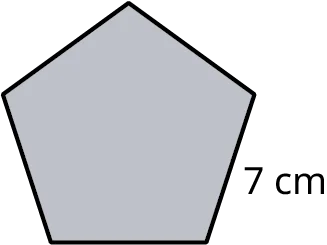
Find the perimeter of a regular pentagon with a side length of 7 cm (diagram).
Solution
A regular pentagon has five equal sides. Therefore, the perimeter is equal to .
Finding the Perimeter of an Octagon
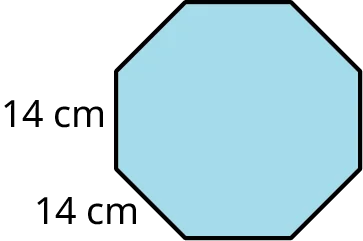
Find the perimeter of a regular octagon with a side length of 14 cm (diagram).
Solution
A regular octagon has eight sides of equal length. Therefore, the perimeter of a regular octagon with a side length of 14 cm is .
Sum of Interior and Exterior Angles
To find the sum of the measurements of interior angles of a regular polygon, we have the following formula.
For example, if we want to find the sum of the interior angles in a parallelogram, we have
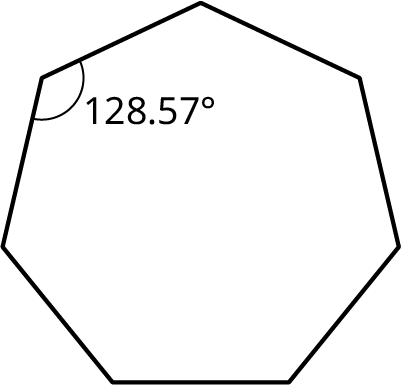
Similarly, to find the sum of the interior angles inside a regular heptagon, we have
To find the measure of each interior angle of a regular polygon with sides, we have the following formula.
For example, find the measure of an interior angle of a regular heptagon, as shown in diagram. We have
Interior Angles
Calculating the Sum of Interior Angles
Find the measure of an interior angle in a regular octagon using the formula, and then find the sum of all the interior angles using the sum formula.
Solution
An octagon has eight sides, so .
Step 1: Using the formula :
So, the measure of each interior angle in a regular octagon is .
Step 2: The sum of the angles inside an octagon, so using the formula:
Step 3: We can test this, as we already know the measure of each angle is . Thus, .
Calculating Interior Angles
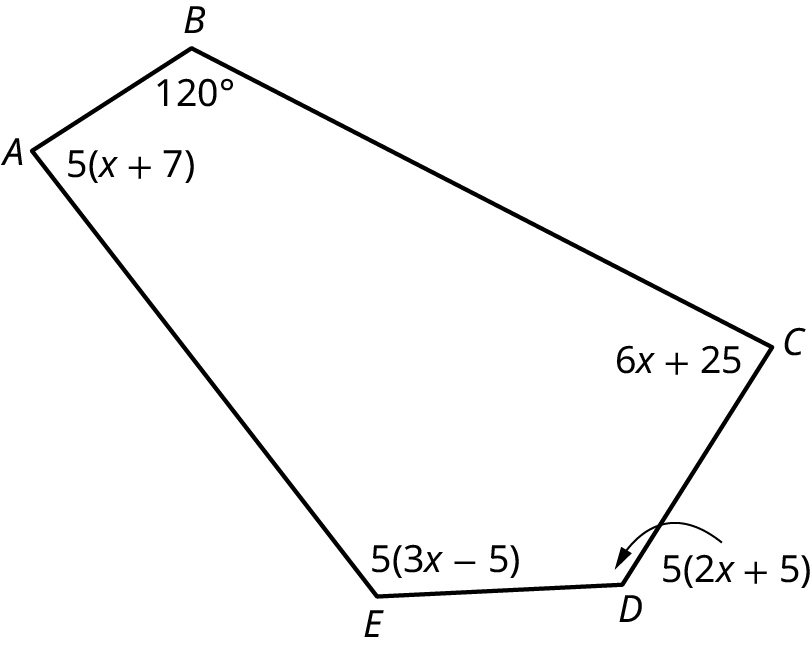
Use algebra to calculate the measure of each interior angle of the five-sided polygon (diagram).
Solution
Step 1: Let us find out what the total of the sum of the interior angles should be. Use the formula for the sum of the angles in a polygon with sides: . So, .
Step 2: We add up all the angles and solve for :
Step 3: We can then find the measure of each interior angle:
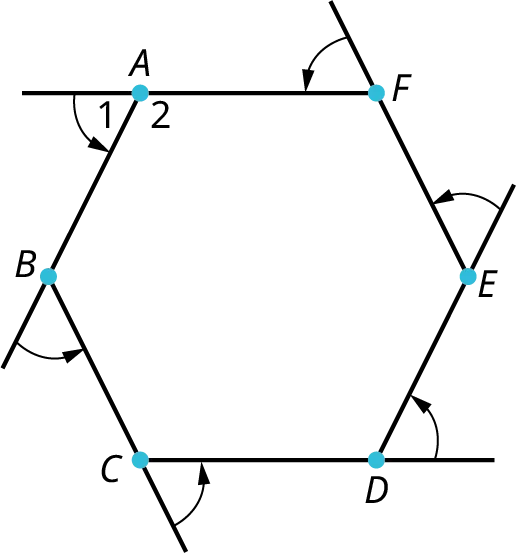
An exterior angle of a regular polygon is an angle formed by extending a side length beyond the closed figure. The measure of an exterior angle of a regular polygon with sides is found using the following formula:
In diagram, we have a regular hexagon . By extending the lines of each side, an angle is formed on the exterior of the hexagon at each vertex. The measure of each exterior angle is found using the formula, .
Exterior Angles
Now, an important point is that the sum of the exterior angles of a regular polygon with sides equals This implies that when we multiply the measure of one exterior angle by the number of sides of the regular polygon, we should get For the example in diagram, we multiply the measure of each exterior angle, , by the number of sides, six. Thus, the sum of the exterior angles is
Calculating the Sum of Exterior Angles
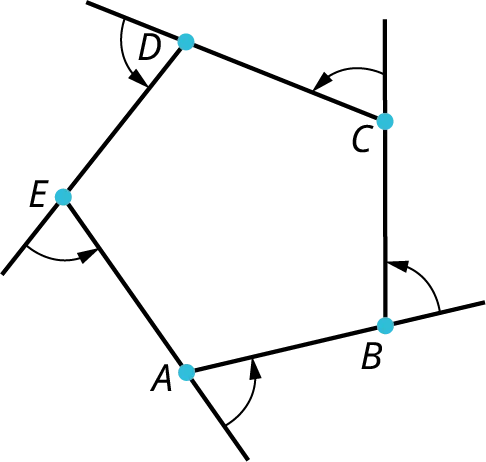
Find the sum of the measure of the exterior angles of the pentagon (diagram).
Solution
Each individual angle measures Then, the sum of the exterior angles is
Interior Angles
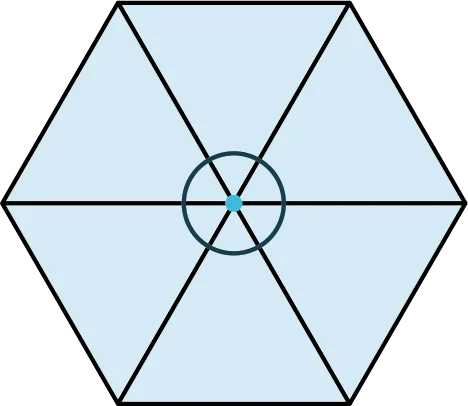
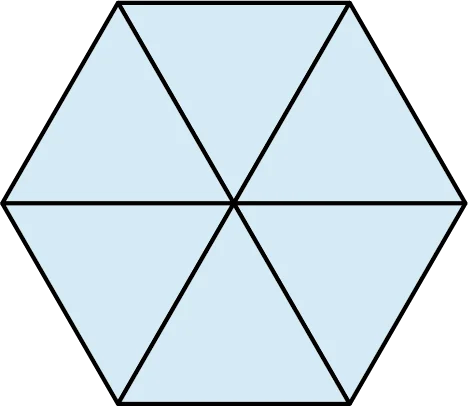
The sum of the interior angles of a tessellation is . In diagram, the tessellation is made of six triangles formed into the shape of a hexagon. Each angle inside a triangle equals , and the six vertices meet the sum of those interior angles, .
Interior Angles at the Vertex of Triangles
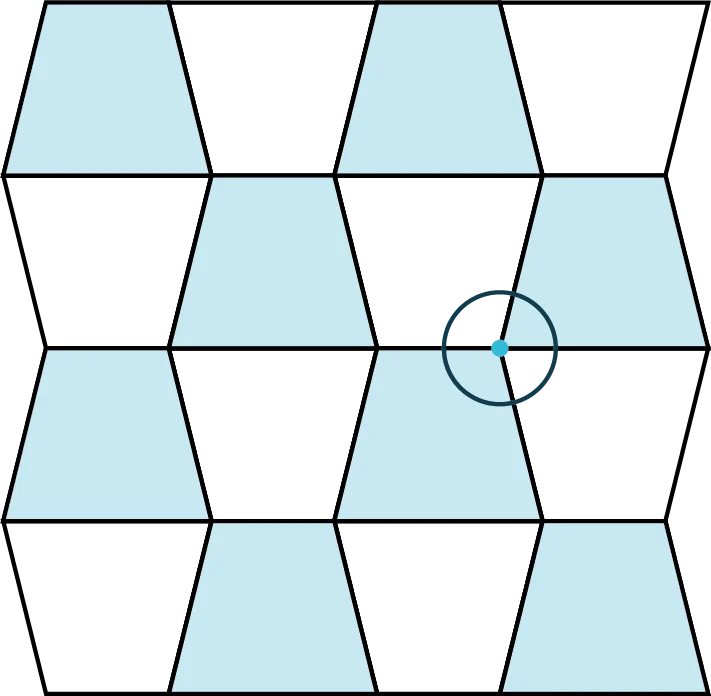
In diagram, the tessellation is made up of trapezoids, such that two of the interior angles of each trapezoid equals and the other two angles equal . Thus, the sum of the interior angles where the vertices of four trapezoids meet equals .
Interior Angles at the Vertex of Trapezoids
These tessellations illustrate the property that the shapes meet at a vertex where the interior angles sum to .
Tessellating Shapes
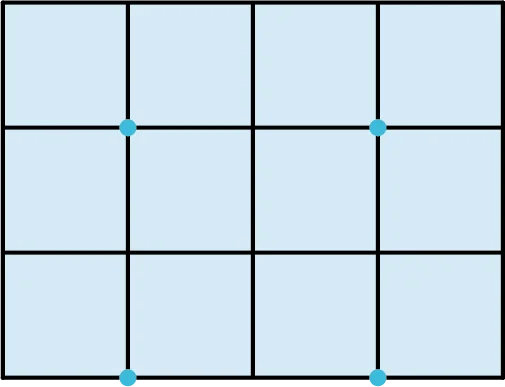
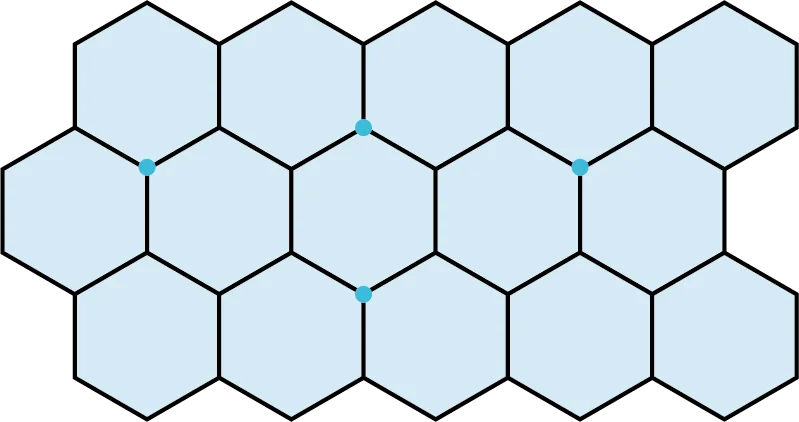
We might think that all regular polygons will tessellate the plane by themselves. We have seen that squares do and hexagons do. The pattern of squares in diagram is a translation of the shape horizontally and vertically. The hexagonal pattern in diagram, is translated horizontally, and then on the diagonal, either to the right or to the left. This particular pattern can also be formed by rotations. Both tessellations are made up of congruent shapes and each shape fits in perfectly as the pattern repeats.
Translation Horizontally and VerticallyTranslation Horizontally and Slide Diagonally
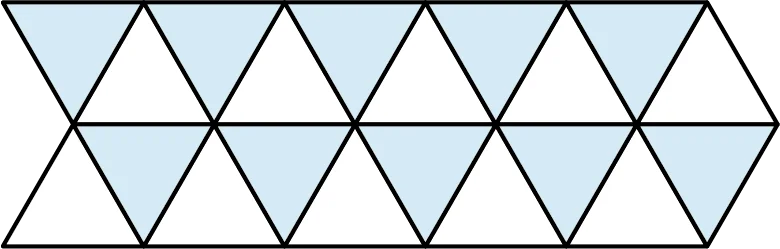
We have also seen that equilateral triangles will tessellate the plane without gaps or overlaps, as shown in diagram. The pattern is made by a reflection and a translation. The darker side is the face of the triangle and the lighter side is the back of the triangle, shown by the reflection. Each triangle is reflected and then translated on the diagonal.
Reflection and Glide Translation
Escher experimented with all regular polygons and found that only the ones mentioned, the equilateral triangle, the square, and the hexagon, will tessellate the plane by themselves. Let’s try a few other regular polygons to observe what Escher found.
Tessellating the Plane
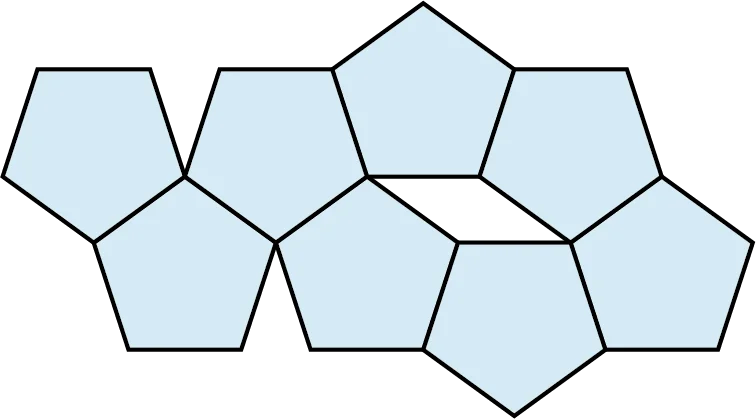
Do regular pentagons tessellate the plane by themselves (diagram)?
Solution
We can see that regular pentagons do not tessellate the plane by themselves. There is a gap, a gap in the shape of a parallelogram. We conclude that regular pentagons will not tessellate the plane by themselves.
Tessellating Octagons
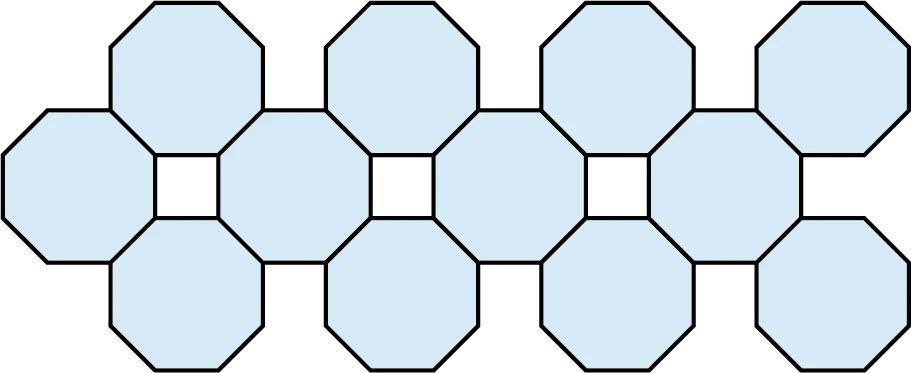
Do regular octagons tessellate the plane by themselves (diagram)?
Solution
Again, we see that regular octagons do not tessellate the plane by themselves. The gaps, however, are squares. So, two regular polygons, an octagon and a square, do tessellate the plane.
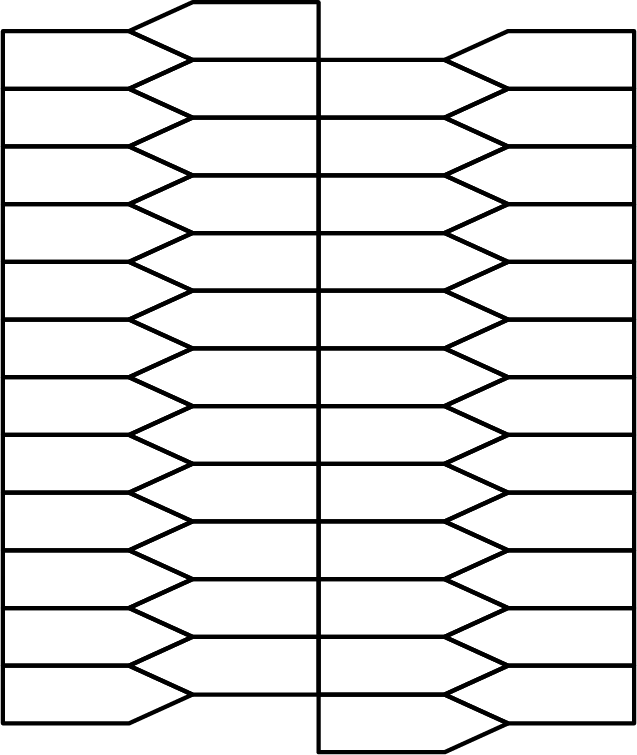
Just because regular pentagons do not tessellate the plane by themselves does not mean that there are no pentagons that tessellate the plane, as we see in diagram.
Tessellation of Pentagons
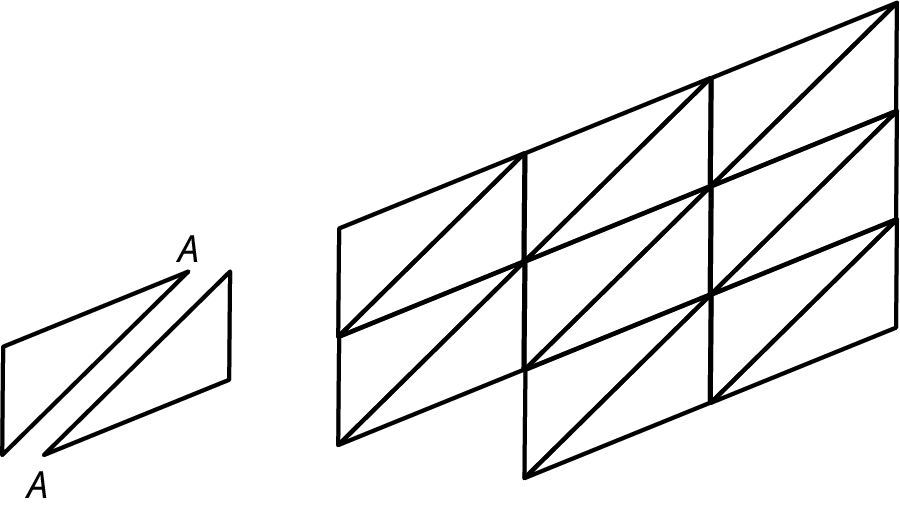
Another example of an irregular polygon that tessellates the plane is by using the obtuse irregular triangle from a previous example. What transformations should be performed to produce the tessellation shown in diagram?
Tessellating with Obtuse Irregular Triangles
First, the triangle is reflected over the tip at point , and then translated to the right and joined with the original triangle to form a parallelogram. The parallelogram is then translated on the diagonal and to the right and to the left.
Naming
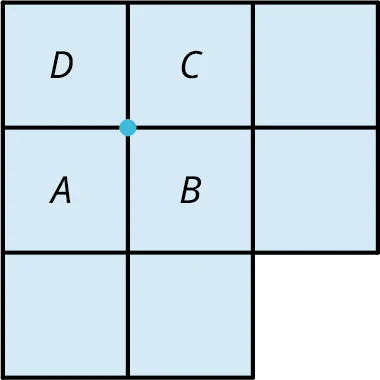
A tessellation of squares is named by choosing a vertex and then counting the number of sides of each shape touching the vertex. Each square in the tessellation shown in diagram has four sides, so starting with square , the first number is 4, moving around counterclockwise to the next square meeting the vertex, square , we have another 4, square adds another 4, and finally square adds a fourth 4. So, we would name this tessellation a 4.4.4.4.
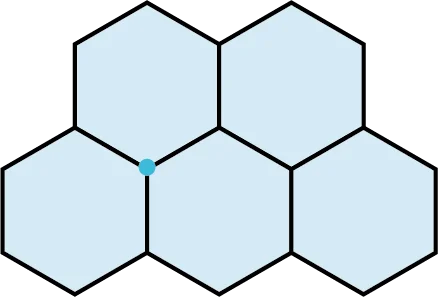
The hexagon tessellation, shown in diagram has six sides to the shape and three hexagons meet at the vertex. Thus, we would name this a 6.6.6. The triangle tessellation, shown in diagram has six triangles meeting the vertex. Each triangle has three sides. Thus, we name this a 3.3.3.3.3.3.
4.4.4.46.6.63.3.3.3.3.3
Creating Your Own Tessellation
Create a tessellation using two colors and two shapes.
Solution
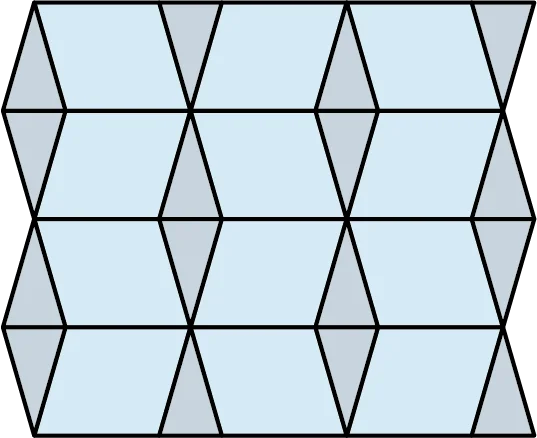
We used a parallelogram and an isosceles triangle. The parallelogram is reflected vertically and horizontally so that only every other corner touches. The triangles are reflected vertically and horizontally and then translated over the parallelogram. The result is alternating vertical columns of parallelograms and then triangles (diagram).
Constructing Ratios to Express Comparison of Two Quantities
Note there are three different ways to write a ratio, which is a comparison of two numbers that can be written as: to OR OR the fraction . Which method you use often depends upon the situation. For the most part, we will want to write our ratios using the fraction notation. Note that, while all ratios are fractions, not all fractions are ratios. Ratios make part to part, part to whole, and whole to part comparisons. Fractions make part to whole comparisons only.
Expressing the Relationship between Two Currencies as a Ratio
The Euro (€) is the most common currency used in Europe. Twenty-two nations, including Italy, France, Germany, Spain, Portugal, and the Netherlands use it. On June 9, 2021, 1 U.S. dollar was worth 0.82 Euros. Write this comparison as a ratio.
Solution
Using the definition of ratio, let U.S. dollar and let Euros. Then the ratio can be written as either 1 to 0.82; or 1:0.82; or
Expressing the Relationship between Two Weights as a Ratio
The gravitational pull on various planetary bodies in our solar system varies. Because weight is the force of gravity acting upon a mass, the weights of objects is different on various planetary bodies than they are on Earth. For example, a person who weighs 200 pounds on Earth would weigh only 33 pounds on the moon! Write this comparison as a ratio.
Solution
Using the definition of ratio, let pounds on Earth and let pounds on the moon. Then the ratio can be written as either 200 to 33; or 200:33; or
Using and Applying Proportional Relationships to Solve Problems
Using proportions to solve problems is a very useful method. It is usually used when you know three parts of the proportion, and one part is unknown. Proportions are often solved by setting up like ratios. If and are two ratios such that then the fractions are said to be proportional. Also, two fractions and are proportional if and only if .
Solving a Proportion Involving Two Currencies
You are going to take a trip to France. You have $520 U.S. dollars that you wish to convert to Euros. You know that 1 U.S. dollar is worth 0.82 Euros. How much money in Euros can you get in exchange for $520?
Solution
Step 1: Set up the two ratios into a proportion; let be the variable that represents the unknown. Notice that U.S. dollar amounts are in both numerators and Euro amounts are in both denominators.
Step 2: Cross multiply, since the ratios and are proportional, then .
You should receive Euros .
Solving a Proportion Involving Weights on Different Planets
A person who weighs 170 pounds on Earth would weigh 64 pounds on Mars. How much would a typical racehorse (1,000 pounds) weigh on Mars? Round your answer to the nearest tenth.
Solution
Step 1: Set up the two ratios into a proportion. Notice the Earth weights are both in the numerator and the Mars weights are both in the denominator.
Step 2: Cross multiply, and then divide to solve.
So the 1,000-pound horse would weigh about 376.5 pounds on Mars.
Solving a Proportion Involving Baking
A cookie recipe needs cups of flour to make 60 cookies. Jackie is baking cookies for a large fundraiser; she is told she needs to bake 1,020 cookies! How many cups of flour will she need?
Solution
Step 1: Set up the two ratios into a proportion. Notice that the cups of flour are both in the numerator and the amounts of cookies are both in the denominator. To make the calculations more efficient, the cups of flour is converted to a decimal number (2.25).
Step 2: Cross multiply, and then simplify to solve.
Jackie will need 38.25, or , cups of flour to bake 1,020 cookies.
Determining and Applying a Constant of Proportionality
In the last example, we were given that cups of flour could make 60 cookies; we then calculated that cups of flour would make 1,020 cookies, and 720 cookies could be made from 27 cups of flour. Each of those three ratios is written as a fraction below (with the fractions converted to decimals). What happens if you divide the numerator by the denominator in each?
The quotients in each are exactly the same! This number, determined from the ratio of cups of flour to cookies, is called the constant of proportionality. If the values and are related by the equality then is the constant of proportionality between and . Note since then and
One piece of information that we can derive from the constant of proportionality is a unit rate. In our example (cups of flour divided by cookies), the constant of proportionality is telling us that it takes 0.0375 cups of flour to make one cookie. What if we had performed the calculation the other way (cookies divided by cups of flour)?
In this case, the constant of proportionality is telling us that cookies can be made with one cup of flour. Notice in both cases, the "one" unit is associated with the denominator. The constant of proportionality is also useful in calculations if you only know one part of the ratio and wish to find the other.
Finding a Constant of Proportionality
Isabelle has a part-time job. She kept track of her pay and the number of hours she worked on four different days, and recorded it in the table below. What is the constant of proportionality, or pay divided by hours? What does the constant of proportionality tell you in this situation?
Pay
$87.50
$50.00
$37.50
$100.00
Hours
7
4
3
8
Solution
To find the constant of proportionality, divide the pay by hours using the information from any of the four columns. For example, . The constant of proportionality is 12.5, or $12.50. This tells you Isabelle's hourly pay: For every hour she works, she gets paid $12.50.
Applying a Constant of Proportionality: Running mph
Zac runs at a constant speed: 4 miles per hour (mph). One day, Zac left his house at exactly noon (12:00 PM) to begin running; when he returned, his clock said 4:30 PM. How many miles did he run?
Solution
The constant of proportionality in this problem is 4 miles per hour (or 4 miles in 1 hour). Since where is the constant of proportionality, we have
(30 minutes is , or , hours)
, since from the definition we know
Zac ran 18 miles.
Applying a Constant of Proportionality: Filling Buckets
Joe had a job where every time he filled a bucket with dirt, he was paid $2.50. One day Joe was paid $337.50. How many buckets did he fill that day?
Solution
The constant of proportionality in this situation is $2.50 per bucket (or $2.50 for 1 bucket). Since where is the constant of proportionality, we have
Since we are solving for , and we know from the definition that
Joe filled 135 buckets.
Applying a Constant of Proportionality: Miles vs. Kilometers
While driving in Canada, Mabel quickly noticed the distances on the road signs were in kilometers, not miles. She knew the constant of proportionality for converting kilometers to miles was about 0.62—that is, there are about 0.62 miles in 1 kilometer. If the last road sign she saw stated that Montreal is 104 kilometers away, about how many more miles does Mabel have to drive? Round your answer to the nearest tenth.
Solution
The constant of proportionality in this situation is 0.62 miles per 1 kilometer. Since where is the constant of proportionality, we have
Rounding the answer to the nearest tenth, Mabel has to drive 64.5 miles.
Adjacent Angles
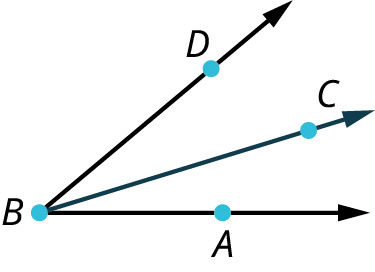
Two angles with the same starting point or vertex and one common side are called adjacent angles. In diagram, angle is adjacent to . Notice that the way we designate an angle is with a point on each of its two sides and the vertex in the middle.
Adjacent Angles
Supplementary Angles
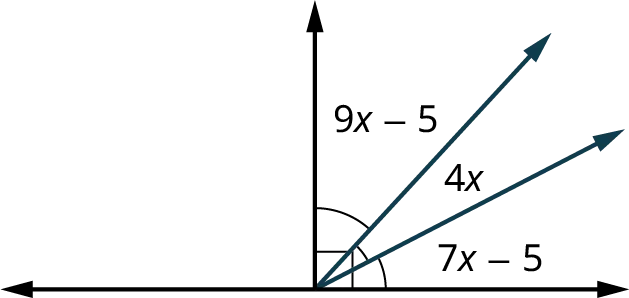
Two angles are supplementary if the sum of their measures equals In diagram, we are given that so what is These are supplementary angles. Therefore, because , and as we have
Supplementary Angles
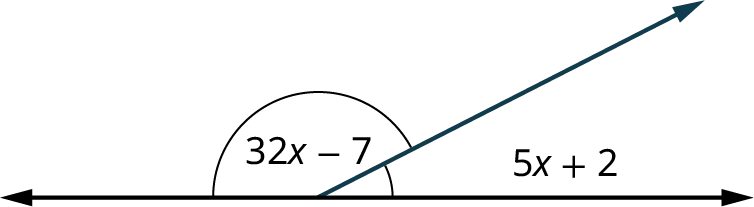
Solving for Angle Measurements and Supplementary Angles
Step 1: These are supplementary angles. We can see this because the two angles are part of a horizontal line, and a horizontal line represents Therefore, the sum of the two angles equals
Step 2:
Step 3: Find the measure of each angle:
Step 4: We check:
Complementary Angles
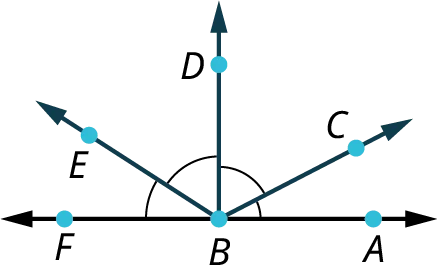
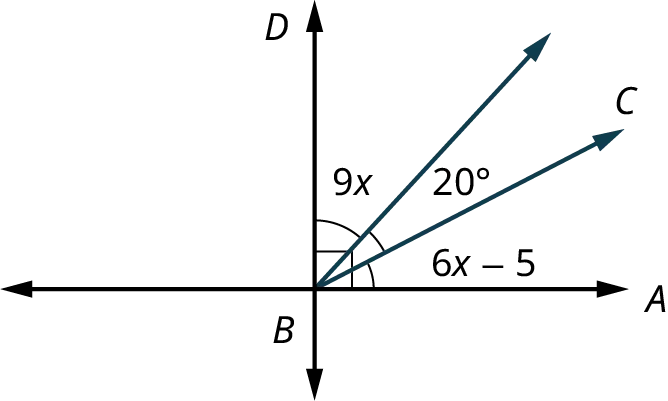
Two angles are complementary if the sum of their measures equals In diagram, we have and What is the These are complementary angles. Therefore, because the
Complementary Angles
Solving for Angle Measurements and Complementary Angles
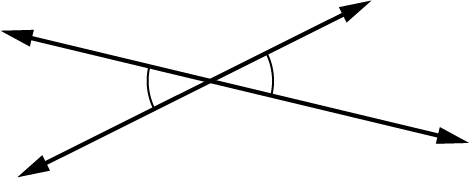
When two lines intersect, the opposite angles are called vertical angles, and vertical angles have equal measure. For example, diagram shows two straight lines intersecting each other. One set of opposite angles shows angle markers; those angles have the same measure. The other two opposite angles have the same measure as well.
Vertical Angles
Calculating Vertical Angles
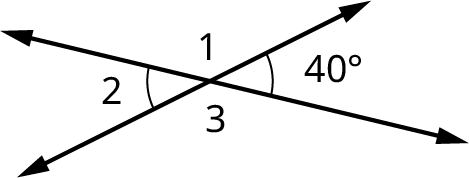
In diagram, one angle measures Find the measures of the remaining angles.
Solution
The 40-degree angle and are vertical angles. Therefore,
Notice that and are supplementary angles, meaning that the sum of and equals Therefore, .
Since and are vertical angles, then equals
Transversals
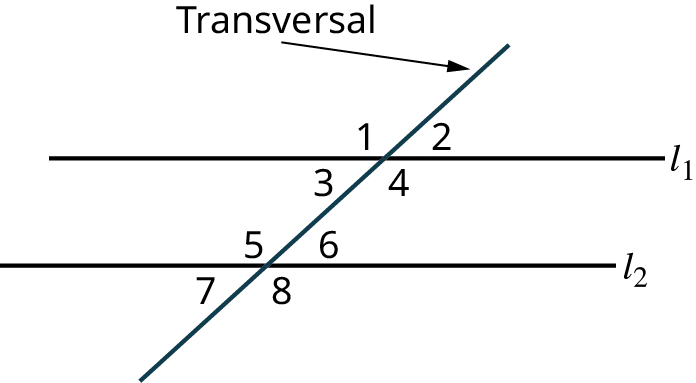
When two parallel lines are crossed by a straight line or transversal, eight angles are formed, including alternate interior angles, alternate exterior angles, corresponding angles, vertical angles, and supplementary angles. See diagram. Angles 1, 2, 7, and 8 are called exterior angles, and angles 3, 4, 5, and 6 are called interior angles.
Transversal
Alternate Interior Angles
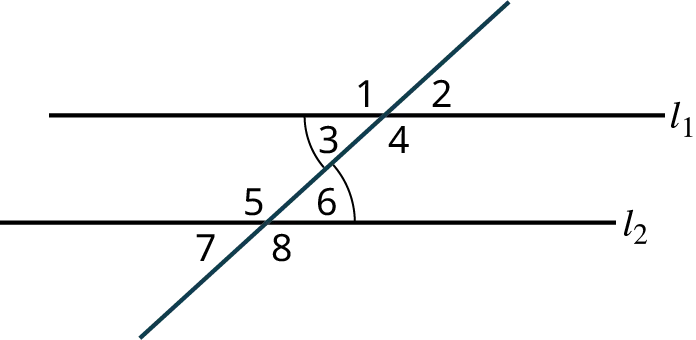
Alternate interior angles are the interior angles on opposite sides of the transversal. These two angles have the same measure. For example, and are alternate interior angles and have equal measure; and are alternate interior angles and have equal measure as well. See diagram.
Alternate Interior Angles
Alternate Exterior Angles
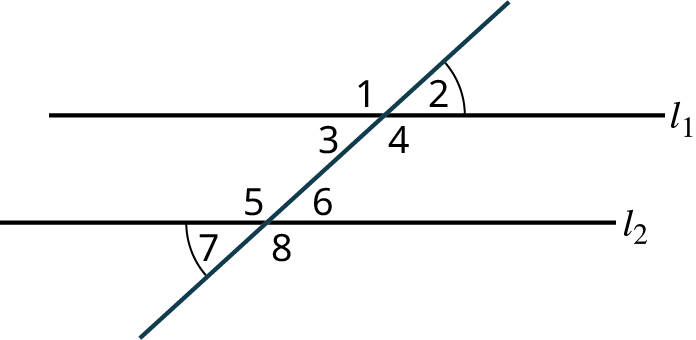
Alternate exterior angles are exterior angles on opposite sides of the transversal and have the same measure. For example, in diagram, and are alternate exterior angles and have equal measures; and are alternate exterior angles and have equal measures as well.
Alternate Exterior Angles
Corresponding Angles
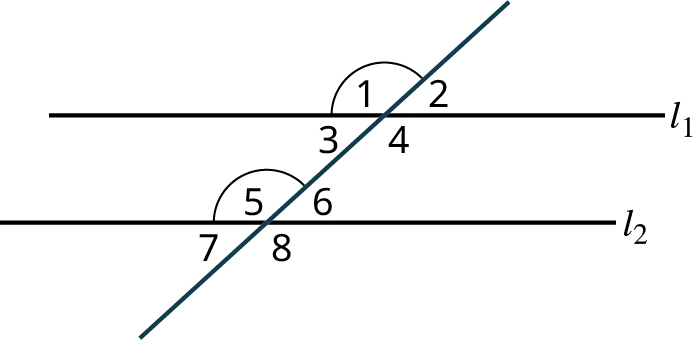
Corresponding angles refer to one exterior angle and one interior angle on the same side as the transversal, which have equal measures. In diagram, and are corresponding angles and have equal measures; and are corresponding angles and have equal measures; and are corresponding angles and have equal measures; and are corresponding angles and have equal measures as well.
Corresponding Angles
Evaluating Space
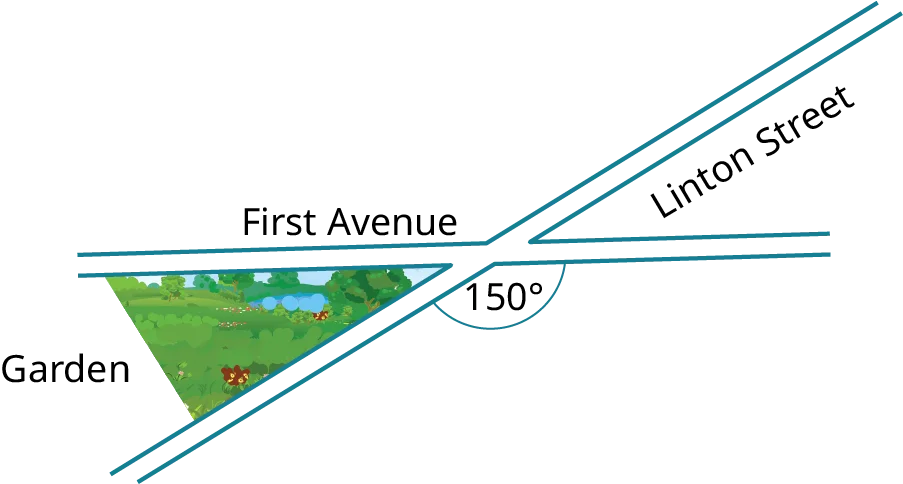
You live on the corner of First Avenue and Linton Street. You want to plant a garden in the far corner of your property (diagram) and fence off the area. However, the corner of your property does not form the traditional right angle. You learned from the city that the streets cross at an angle equal to What is the measure of the angle that will border your garden?
Solution
As the angle between Linton Street and First Avenue is the supplementary angle is Therefore, the garden will form a angle at the corner of your property.
Determining Angles Formed by a Transversal
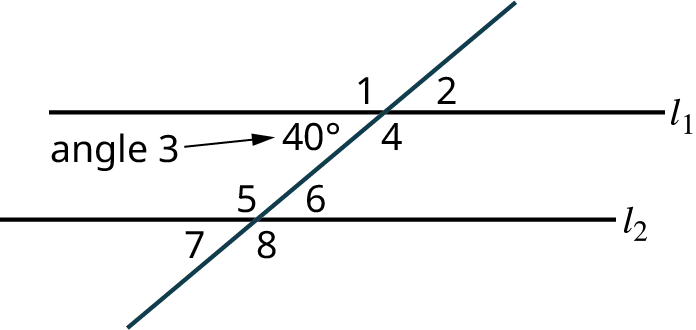
In diagram given that angle 3 measures find the measures of the remaining angles and give a reason for your solution.
Solution
by vertical angles.
by corresponding angles.
by vertical angles.
by supplementary angles.
by vertical angles.
by alternate exterior angles.
by vertical angles.
Measuring Angles Formed by a Transversal
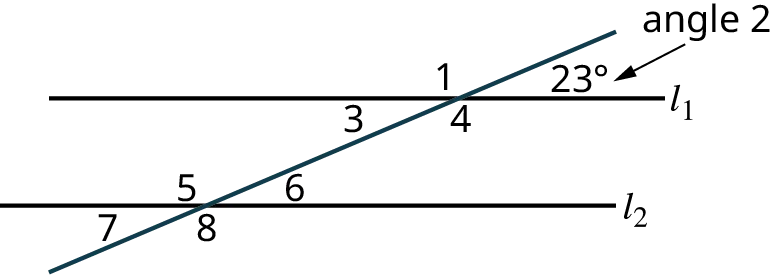
In diagram given that angle 2 measures find the measure of the remaining angles and state the reason for your solution.
Solution
by vertical angles, because and are the opposite angles formed by two intersecting lines.
by supplementary angles to or We see that and form a straight angle as does and A straight angle measures so
by vertical angles, because and are the two opposite angles formed by two intersecting lines.
by corresponding angles because they are the same angle formed by the transversal crossing two parallel lines, one exterior and one interior.
by vertical angles because and are the two opposite angles formed by two intersecting lines.
by alternate exterior angles because, like vertical angles, these angles are the opposite angles formed by the transversal intersecting two parallel lines.
by vertical angles because these are the opposite angles formed by two intersecting lines.
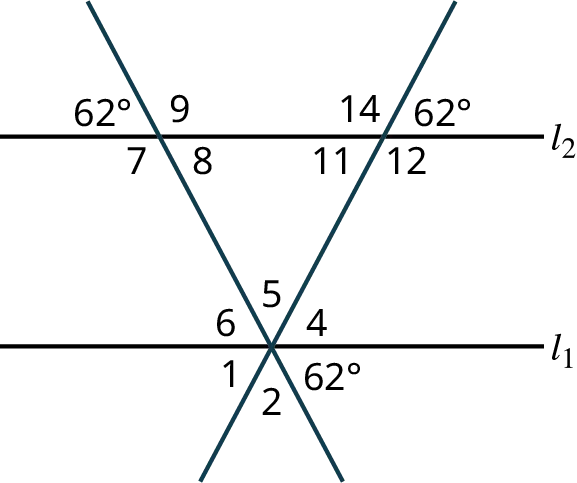
Finding Missing Angles
Find the measures of the angles 1, 2, 4, 11, 12, and 14 in diagram and the reason for your answer given that and are parallel.