239 activities • 12 worksheet topics • original guided practice
Find a worksheet, or learn the method first.
This geometry collection combines a topic-by-topic directory with worked examples and a ten-question self-check. The original PDF, editable Word and answer-sheet links remain below, credited to their creator.
Practise selected geometry skills with six worked examples, ten original questions and step-by-step answers. Start with the topic you need, then try the questions before checking your work. The examples cover angle reasoning, areas of triangles and quadrilaterals, circles, Pythagoras, similar shapes and coordinate transformations.
This is a focused KS3 and GCSE revision selection, not a complete course or an exam-board checklist. The area-scale-factor parts are labelled as extensions. Other topics, including constructions, bearings, trigonometry, circle theorems and 3D measures, need separate practice.
How to use this lesson
- Choose a topic and read its worked example.
- Cover the answers and attempt the matching questions. Write a reason for each angle calculation.
- Compare your method with the worked answers, not just the final number.
- Correct the first wrong step, then try a related worksheet from the directory.
Use a pencil and squared paper. A calculator is useful for circle values and square roots. Keep π or a square root in the calculation until the final step. Round only when asked. All lengths within one formula must use the same unit. Unless a task explicitly asks you to measure, use the stated information rather than measuring the picture.
Topic route: angles → questions 1–2; area → 3–5; circles → 6; Pythagoras → 7–8; similarity → 9; transformations → 10.
Key facts to choose from
- Angles on a straight line total 180°. Angles around a point total 360°. Vertically opposite angles are equal.
- A triangle’s interior angles total 180°. An isosceles triangle’s angles opposite its equal sides are equal.
- When parallel lines are crossed by a transversal, corresponding angles are equal and alternate angles are equal. Check that the lines are parallel before using these facts.
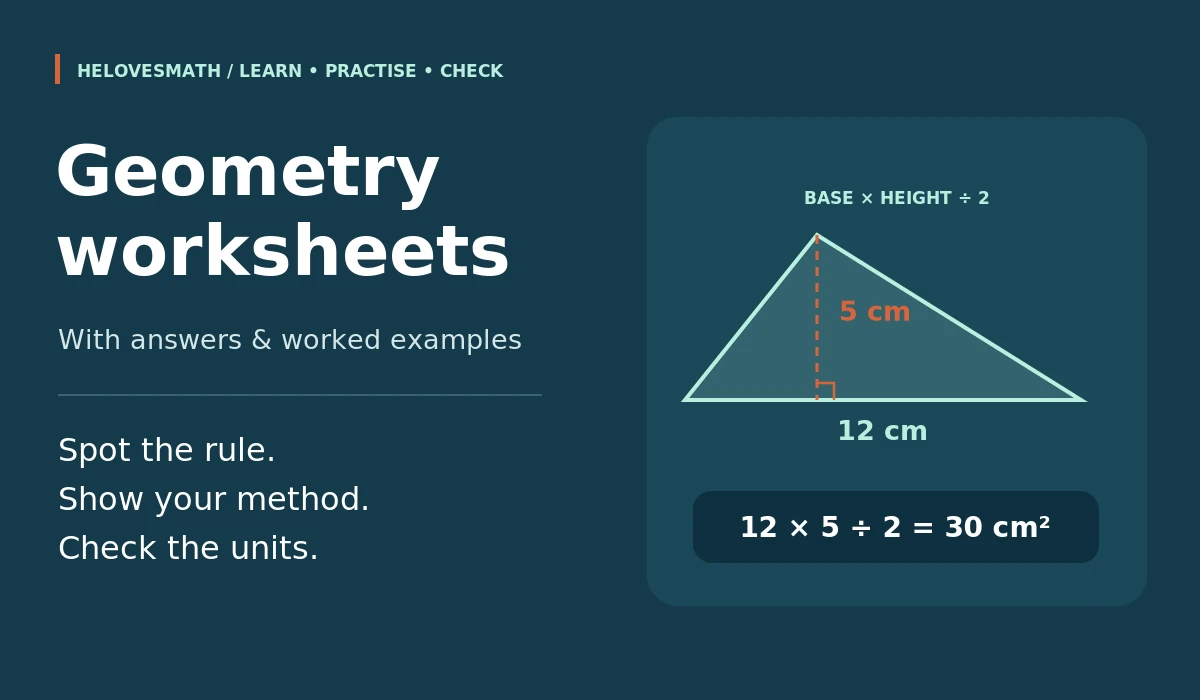
- Triangle area = ½ × base × perpendicular height.
- Parallelogram area = base × perpendicular height.
- Trapezium area = ½ × (sum of the two parallel sides) × perpendicular height. Here “trapezium” uses UK terminology.
- Circle diameter d = 2r, circumference C = πd = 2πr, and area A = πr².
- In a right-angled triangle, a² + b² = c², where c is the hypotenuse opposite the right angle.
- Similar shapes have equal corresponding angles and proportional corresponding lengths. A length scale factor k also multiplies the perimeter by k. Extension: the area is multiplied by k².
- Translation: move every point the same distance in the same direction. Reflection: use a specified mirror line. Rotation: state the centre, angle and direction. Enlargement: state the centre and scale factor.
Six worked examples
Example 1: give a reason for each angle
Triangle ABC has AB = AC and angle BAC = 44°. The line BC is extended through B to D, so D, B and C lie on one straight line in that order. Find angle ABC and the exterior angle ABD.
The two base angles are equal because AB = AC. Their total is 180° − 44° = 136°, so angle ABC = 136° ÷ 2 = 68°.
Angles ABC and ABD lie on a straight line. Therefore angle ABD = 180° − 68° = 112°.
Check: 44° + 68° + 68° = 180°. The exterior angle is also 44° + 68° = 112°.
Watch for: subtracting 44° from 180° finds the total of two equal angles, not one angle.
Example 2: use the perpendicular height
- A triangle has a base of 12 cm and a perpendicular height of 5 cm.
Area = ½ × 12 × 5 = 30 cm².
- A trapezium has parallel sides of 9 cm and 15 cm. Their perpendicular separation is 6 cm.
Area = ½ × (9 + 15) × 6 = ½ × 24 × 6 = 72 cm².
Why the formulas make sense: two copies of the triangle can form a parallelogram with the same base and height. Two copies of the trapezium can form a parallelogram with base 9 + 15 = 24 cm and height 6 cm. In each case, one original shape has half the new area.
Watch for: a sloping side is not necessarily the perpendicular height. Area needs square units.

Example 3: distinguish circumference from area
A circular sign has diameter 12 cm. Find its circumference and area, first exactly and then to one decimal place.
Circumference measures the boundary: C = πd = 12π cm ≈ 37.7 cm.
For area, first find r = 12 ÷ 2 = 6 cm. Then A = π × 6² = 36π cm² ≈ 113.1 cm².
Watch for: using 12 as the radius would give four times the correct area. Circumference is a length; area measures the surface enclosed.
Example 4: find a shorter side with Pythagoras
A right-angled triangle has a hypotenuse of 17 cm and one shorter side of 8 cm. Find the remaining side x.
The hypotenuse is opposite the right angle, so x² + 8² = 17².
x² = 289 − 64 = 225, giving x = 15 cm. Take the positive square root because a length is positive.
Check: 8² + 15² = 64 + 225 = 289 = 17². The answer is shorter than the hypotenuse.
Watch for: subtract the squared lengths, not the lengths. Pythagoras needs a right-angled triangle.
Example 5: match corresponding sides in similar shapes
A rectangle is 8 cm long and 5 cm wide. A similar rectangle has a corresponding length of 12 cm. Find its width and perimeter.
The length scale factor, small to large, is k = 12 ÷ 8 = 1.5.
Width = 5 × 1.5 = 7.5 cm.
Perimeter = 2 × (12 + 7.5) = 39 cm.
Check: the smaller perimeter is 2 × (8 + 5) = 26 cm, and 26 × 1.5 = 39 cm.
Extension: the smaller area is 8 × 5 = 40 cm². The larger area is 12 × 7.5 = 90 cm², which is 40 × 1.5². Area scales by 2.25 here, not 1.5.
Watch for: adding 4 cm to both dimensions would produce 12 cm by 9 cm, which is not similar to the original rectangle.

Example 6: translate every vertex
Triangle ABC has vertices A(1, 1), B(4, 1) and C(1, 3). Translate it 2 units left and 3 units up.
Apply the rule (x, y) → (x − 2, y + 3) to each point:
- A′ = (1 − 2, 1 + 3) = (−1, 4)
- B′ = (4 − 2, 1 + 3) = (2, 4)
- C′ = (1 − 2, 3 + 3) = (−1, 6)
The image has the same side lengths, angles and orientation as the original. The translation vector is −2 horizontally and +3 vertically.
Useful rules for question 10: reflection in the y-axis changes (x, y) to (−x, y); a 90° clockwise rotation about the origin changes (x, y) to (y, −x); enlargement by scale factor 2 about the origin changes (x, y) to (2x, 2y). These rotation and enlargement rules depend on the centre being the origin.
Watch for: x is the horizontal coordinate. Moving left makes x smaller even when it crosses zero.
Ten practice questions
Show your working. Give angles in degrees, lengths in the stated length unit and areas in square units. For questions 6 and 7, give both an exact answer and an answer to one decimal place. The parts of question 10 are separate transformations of the original triangle, not a sequence.
- Triangle ABC has AB = AC and angle BAC = 52°. BC is extended through B to D, with D, B and C collinear in that order. Find angles ABC and ABD. Give a reason for each step.
Answer 1: show the method
AB = AC, so the base angles are equal. Angle ABC = (180° − 52°) ÷ 2 = 64°. Angle ABD = 180° − 64° = 116°, using angles on a straight line. Check: 52 + 64 + 64 = 180 and 52 + 64 = 116.
- Two parallel lines are crossed by a transversal. One angle is 67°. At the other intersection, x is the corresponding angle. Angle y is adjacent to x on a straight line. Find x and y, explaining the angle facts used.
Answer 2: show the method
x = 67°, because corresponding angles are equal when the lines are parallel. y = 113°, because x + y = 180°, so y = 180° − 67°.
- A triangle has a base of 9.6 cm and a perpendicular height of 4.5 cm. Find its area.
Answer 3: show the method
Area = ½ × 9.6 × 4.5 = 21.6 cm².
- A parallelogram has a base of 8 cm, perpendicular height 3.5 cm and sloping side 4 cm. Find its area. Explain why one of the given lengths is not needed.
Answer 4: show the method
Area = 8 × 3.5 = 28 cm². The 4 cm sloping side is not the perpendicular height, so it is not used in this area calculation.
- A trapezium has parallel sides of 11 cm and 17 cm and perpendicular height 4.5 cm. Find its area.
Answer 5: show the method
Area = ½ × (11 + 17) × 4.5 = 14 × 4.5 = 63 cm².
- A circular badge has diameter 9.2 cm. Find its circumference and area, exactly in terms of π and to one decimal place.
Answer 6: show the method
r = 9.2 ÷ 2 = 4.6 cm. Circumference = 9.2π cm ≈ 28.9 cm. Area = π × 4.6² = 21.16π cm² ≈ 66.5 cm². Use the calculator’s π value until the final rounding step.
- The two sides meeting at the right angle of a triangle are 7 cm and 13 cm. Find the hypotenuse, exactly and to one decimal place.
Answer 7: show the method
c² = 7² + 13² = 49 + 169 = 218. Therefore c = √218 cm ≈ 14.8 cm. The hypotenuse is longer than either leg.
- A rectangle has diagonal 26 cm and width 10 cm. Find its length and area. Explain why Pythagoras can be used.
Answer 8: show the method
A diagonal divides a rectangle into two right-angled triangles. Let the length be l. Then l² + 10² = 26², so l² = 676 − 100 = 576. Thus l = 24 cm and area = 24 × 10 = 240 cm².
- Two triangles are similar. The smaller has side lengths 7.5 cm, 10 cm and 12.5 cm. The side corresponding to 7.5 cm is 12 cm in the larger triangle. Find the other two larger side lengths and the larger perimeter. Extension: the smaller triangle has area 37.5 cm²; find the larger area.
Answer 9: show the method
k = 12 ÷ 7.5 = 1.6. The remaining sides are 10 × 1.6 = 16 cm and 12.5 × 1.6 = 20 cm. Perimeter = 12 + 16 + 20 = 48 cm. Extension: area factor = 1.6² = 2.56, so area = 37.5 × 2.56 = 96 cm². The original sides form a right-angled triangle, providing an independent check: ½ × 12 × 16 = 96 cm².
- Triangle PQR has P(2, 1), Q(5, 1) and R(2, 3). Find the image coordinates for each separate transformation: (a) reflection in the y-axis; (b) 90° clockwise rotation about the origin; (c) translation 3 units left and 2 units up; (d) enlargement by scale factor 2, centre the origin.
Answer 10: show the method
Apply each rule to all three original points:
- (x, y) → (−x, y): P′(−2, 1), Q′(−5, 1), R′(−2, 3)
- (x, y) → (y, −x): P′(1, −2), Q′(1, −5), R′(3, −2)
- (x, y) → (x − 3, y + 2): P′(−1, 3), Q′(2, 3), R′(−1, 5)
- (x, y) → (2x, 2y): P′(4, 2), Q′(10, 2), R′(4, 6)
Before you move on
Check whether you can explain each of these mistakes:
- Using a sloping edge as the height in an area formula
- Using the diameter where a circle’s radius is needed
- Adding squares when finding a shorter side in a right triangle
- Multiplying an area by the length scale factor instead of its square
- Giving a rotation without its centre or direction
If one is unclear, revisit that example and try a matching topic worksheet below.
Related practice
Sources & References
The teaching examples and practice above are original HeLovesMath material. The linked worksheet collection below is by Dr Austin Maths. Some original resources contain unit-printing inconsistencies; specific notes appear beside the affected listings. The directory is a resource collection, not a claim of exam-board endorsement or full syllabus coverage.
Dr Austin Maths worksheet directory
The resources below were created by Dr Austin Maths and are hosted on the creator’s website. They are external resources, not He Loves Math downloads. Choose a topic to see its original worksheet, editable Word and answer links. Links open in a new tab; availability and files may change.
Answer links are included where the original directory provided them. Review a worksheet and its answer file before assigning it; a link availability check does not verify every question or answer.
Perimeter and Area
Show 30 perimeter and area resources
- Area of Rectangles and Squares Practice Strips (Editable Word | PDF | Answers)
- Area of Triangles Practice Strips (Editable Word | PDF | Answers) Teacher note: in the missing-base problem (b), the printed area is 22.5 mm² while the height and base use cm. The supplied answer 5 cm assumes an area of 22.5 cm²; taking the printed 22.5 mm² literally gives a base of 0.05 cm.
- Area of Parallelograms Practice Strips (Editable Word | PDF | Answers)
- Area of Trapeziums Practice Strips (Editable Word | PDF | Answers)
- Area of Rectangles and Triangles Odd One Out (Editable Word | PDF | Answers)
- Area of Parallelograms and Trapeziums Match-Up (Editable Word | PDF | Answers)
- Perimeter of 2D Shapes Practice Strips (Editable Word | PDF | Answers)
- Area of 2D Shapes Crack the Code (Editable Word | PDF | Answers)
- Area and Perimeter of 2D Shapes Practice Strips (Editable Word | PDF | Answers)
- Area and Perimeter of Compound Shapes Practice Strips (Editable Word | PDF | Answers)
- Area and Perimeter of Harder Compound Shapes Practice Strips (Editable Word | PDF | Answers)
- Area and Perimeter of 2D Shapes Sort It Out (Editable Word | PDF | Answers)
- Investigating Circles Activity (Editable Word | PDF) No linked answer file in the original directory.
- Circumference of a Circle Practice Strips (Editable Word | PDF | Answers)
- Circumference of a Circle Match-Up (Editable Word | PDF | Answers)
- Area of a Circle Practice Strips (Editable Word | PDF | Answers)
- Area of a Circle Match-Up (Editable Word | PDF | Answers)
- Circle Problems in Reverse Practice Strips (Editable Word | PDF | Answers)
- Area and Circumference of a Circle Practice Grid (Editable Word | PDF | Answers)
- Area and Circumference of a Circle Fill in the Blanks (Editable Word | PDF | Answers)
- Area and Circumference of a Circle Crack the Code (Editable Word | PDF | Answers)
- Area and Circumference of a Circle Name the Film (Editable Word | PDF | Answers)
- Area of a Sector Practice Grid (Editable Word | PDF | Answers)
- Area of a Sector Fill in the Blanks (Editable Word | PDF | Answers)
- Arc Length and Perimeter of a Sector Practice Grid (Editable Word | PDF | Answers)
- Arc Length and Perimeter of a Sector Fill in the Blanks (Editable Word | PDF | Answers)
- Area and Perimeter of a Sector Practice Strips (Editable Word | PDF | Answers)
- Area and Perimeter of a Sector Match-Up (Editable Word | PDF | Answers)
- Area and Perimeter Worded Problems Practice Strips (Editable Word | PDF | Answers)
- Area and Perimeter Revision Practice Grid (Editable Word | PDF | Answers | Additional answer PDF (originally unlabeled)) Teacher note: in question (k), the lawn area is 169π/4 m². Both original answer files label the result cm² in error.
Volume and Surface Area
Show 24 volume and surface area resources
- Volume of a Cuboid Practice Grid (Editable Word | PDF | Answers) Teacher note: in the bottom-middle missing-length problem, the answer is 6.5 m. The answer file labels it cm in error.
- Volume of a Cuboid Challenge Activity (Editable Word | PDF | Answers)
- Volume of Cubes and Cuboids Match-Up (Editable Word | PDF | Answers)
- Surface Area of Cubes and Cuboids Practice Strips (Editable Word | PDF | Answers)
- Volume and Surface Area of Cuboids Practice Strips (Editable Word | PDF | Answers)
- Volume and Surface Area of Cuboids Fill in the Blanks (Editable Word | PDF | Answers)
- Volume and Surface Area of Cuboids Give an Example (Editable Word | PDF | Answers)
- Volume of a Prism Practice Grid (Editable Word | PDF | Answers)
- Surface Area of Prisms Practice Strips (Editable Word | PDF | Answers)
- Volume and Surface Area of Prisms Practice Strips (Editable Word | PDF | Answers)
- Volume and Surface Area of Prisms Crack the Code (Editable Word | PDF | Answers)
- Volume of a Cylinder Practice Grid (Editable Word | PDF | Answers)
- Surface Area of Cylinders Practice Strips (Editable Word | PDF | Answers)
- Volume and Surface Area of Cylinders Practice Strips (Editable Word | PDF | Answers)
- Volume and Surface Area of Cylinders Fill in the Blanks (Editable Word | PDF | Answers)
- Volume and Surface Area of Cones Practice Strips (Editable Word | PDF | Answers)
- Volume and Surface Area of Cones Fill in the Blanks (Editable Word | PDF | Answers)
- Volume and Surface Area of Frustums Practice Strips (Editable Word | PDF | Answers)
- Volume and Surface Area of Spheres Practice Strips (Editable Word | PDF | Answers)
- Volume of Cylinders, Cones and Spheres Practice Grid (Editable Word | PDF | Answers)
- Surface Area of Cylinders, Cones and Spheres Practice Grid (Editable Word | PDF | Answers)
- Volume of a Pyramid Practice Strips (Editable Word | PDF | Answers)
- Mixed Volume and Surface Area Problems Grid (Editable Word | PDF | Answers)
- Volume and Surface Area Revision Practice Grid (Editable Word | PDF | Answers)
2D and 3D Shapes
Show 11 2d and 3d shapes resources
- Properties of 3D Shapes Practice Strips (Editable Word | PDF | Answers)
- Investigating 3D Shapes Activity (Editable Word | PDF | Answers)
- Similar Shapes Practice Strips (Editable Word | PDF | Answers)
- Similar Shapes Practice Grid (Editable Word | PDF | Answers)
- Similar Shapes Odd One Out (Editable Word | PDF | Answers)
- Similar Shapes Crack the Code (Editable Word | PDF | Answers)
- Similar Areas and Volumes Fill In The Blanks (Editable Word | PDF | Answers)
- Similar Areas and Volumes Practice Strips (Editable Word | PDF | Answers)
- Harder Similar Areas and Volumes Fill In The Blanks (Editable Word | PDF | Answers)
- Harder Similar Areas and Volumes Practice Strips (Editable Word | PDF | Answers)
- Similar Shapes Revision Practice Grid (Editable Word | PDF | Answers)
Angles and Polygons
Show 17 angles and polygons resources
- Angles Around a Point Practice Strips (Editable Word | PDF | Answers)
- Angles on a Straight Line Practice Strips (Editable Word | PDF | Answers)
- Angle Rules Crack the Code (Editable Word | PDF | Answers)
- Angle Rules Practice Grid (Editable Word | PDF | Answers)
- Angles in Parallel Lines Practice Strips (Editable Word | PDF | Answers)
- Angles in Parallel Lines Practice Grid (Editable Word | PDF | Answers)
- Angles in Triangles Practice Strips (Editable Word | PDF | Answers)
- Angles in Quadrilaterals Practice Strips (Editable Word | PDF | Answers)
- Angles in Quadrilaterals Practice Grid (Editable Word | PDF | Answers)
- Finding Interior and Exterior Angles in Regular Polygons Activity (Editable Word | PDF | Answers)
- Angles in Regular Polygons Fill in the Blanks (Editable Word | PDF | Answers)
- Angles in Regular Polygons Practice Strips (Editable Word | PDF | Answers)
- Angles in Regular Polygons Practice Grid (Editable Word | PDF | Answers)
- Angles in Irregular Polygons Practice Strips (Editable Word | PDF | Answers)
- Angles in Irregular Polygons Practice Grid (Editable Word | PDF | Answers)
- Angles in Polygons Crack the Code (Editable Word | PDF | Answers)
- Angles and Polygons Revision Practice Grid (Editable Word | PDF | Answers)
Circle Theorems
Show 17 circle theorems resources
- Investigating Triangles Inside Circles Activity (Editable Word | PDF | Answers)
- More Investigating Triangles Inside Circles Activity (Editable Word | PDF | Answers)
- Angle Notation in Circle Theorems Practice Strips (Editable Word | PDF | Answers)
- Circle Theorems and Triangles Practice Grid (Editable Word | PDF | Answers)
- Right Angle in a Semi-Circle Practice Grid (Editable Word | PDF | Answers)
- Isosceles Triangle in a Circle Practice Grid (Editable Word | PDF | Answers)
- Circle Theorems and Quadrilaterals Practice Grid (Editable Word | PDF | Answers)
- Angle at the Centre Practice Grid (Editable Word | PDF | Answers)
- Cyclic Quadrilaterals Practice Grid (Editable Word | PDF | Answers)
- Angles from the Same Segment Practice Grid (Editable Word | PDF | Answers)
- Perpendicular from the Centre to a Chord Practice Grid (Editable Word | PDF | Answers)
- Circle Theorems and Tangents Practice Grid (Editable Word | PDF | Answers)
- Alternate Segment Theorem Practice Grid (Editable Word | PDF | Answers)
- Mixed Circle Theorems Practice Grid (Editable Word | PDF | Answers)
- Mixed Circle Theorems with Tangents Practice Grid (Editable Word | PDF | Answers)
- Intersecting Chord and Secant Theorems Practice Grid (Editable Word | PDF | Answers)
- Circle Theorems Revision Practice Grid (Editable Word | PDF | Answers)
Pythagoras’ Theorem
Show 15 pythagoras’ theorem resources
- Discovering Pythagoras’ Theorem Activity (Editable Word | PDF | Answers)
- Using Pythagoras’ Theorem Practice Strips (Editable Word | PDF | Answers)
- Finding the Length of the Hypotenuse Practice Strips (Editable Word | PDF | Answers)
- Finding the Length of the Hypotenuse Practice Grid (Editable Word | PDF | Answers)
- Finding the Length of a Short Side Practice Strips (Editable Word | PDF | Answers)
- Finding the Length of a Short Side Practice Grid (Editable Word | PDF | Answers)
- Mixed Pythagoras’ Theorem Practice Strips (Editable Word | PDF | Answers)
- Mixed Pythagoras’ Theorem Crack the Code (Editable Word | PDF | Answers)
- Practical Pythagoras Practice Strips (Editable Word | PDF | Answers)
- Pythagoras Worded Problems Match-Up (Editable Word | PDF | Answers)
- Pythagoras Worded Problems Practice Grid (Editable Word | PDF | Answers)
- Multi-Step Pythagoras’ Theorem Practice Grid (Editable Word | PDF | Answers)
- Area and Perimeter Using Pythagoras Practice Strips (Editable Word | PDF | Answers)
- Pythagoras in 3D Practice Strips (Editable Word | PDF | Answers)
- Pythagoras’ Theorem Revision Practice Grid (Editable Word | PDF | Answers)
Trigonometry
Show 24 trigonometry resources
- Investigating Similar Triangles Activity (Editable Word | PDF | Answers)
- Sine, Cosine and Tangent Ratios Fill in the Blanks (Editable Word | PDF | Answers)
- Which Trigonometric Ratio Practice Strips (Editable Word | PDF | Answers)
- Find Angles Using Trigonometry Practice Strips (Editable Word | PDF | Answers)
- Finding Angles Using Trigonometry Fill in the Blanks (Editable Word | PDF | Answers)
- Finding Angles Using Trigonometry Name the Film (Editable Word | PDF | Answers)
- Find Lengths Using Trigonometry Practice Strips (Editable Word | PDF | Answers)
- Finding Lengths Using Trigonometry Fill in the Blanks (Editable Word | PDF | Answers)
- Finding Lengths Using Trigonometry Name the Film (Editable Word | PDF | Answers)
- Pythagoras and Trigonometry Practice Strips (Editable Word | PDF | Answers)
- Trigonometric Equations Match-Up (Editable Word | PDF | Answers)
- Mixed Trigonometry Practice Grid (Editable Word | PDF | Answers)
- Mixed Trigonometry Crack the Code (Editable Word | PDF | Answers)
- Multi-Step Trigonometry Problems Practice Strips (Editable Word | PDF | Answers)
- Angles of Elevation and Depression Practice Strips (Editable Word | PDF | Answers)
- Trigonometry Worded Problems Match-Up (Editable Word | PDF | Answers)
- Trigonometry in 3D Practice Strips (Editable Word | PDF | Answers)
- Pythagoras and Trigonometry in 3D Practice Grid (Editable Word | PDF | Answers)
- Exact Trigonometric Ratios Match-Up (Editable Word | PDF | Answers)
- Exact Trigonometric Ratios Practice Grid (Editable Word | PDF | Answers)
- Exact Trigonometric Ratios Crack the Code (Editable Word | PDF | Answers)
- Solving Trigonometric Equations Using Graphs Practice Grid (Editable Word | PDF | Answers)
- More Solving Trigonometric Equations Using Graphs Practice Grid (Editable Word | PDF | Answers)
- Trigonometry Revision Practice Grid (Editable Word | PDF | Answers)
Sine and Cosine Rules
Show 13 sine and cosine rules resources
- Sine Rule Practice Strips (Editable Word | PDF | Answers)
- Finding Lengths Using Sine Rule Fill In The Blanks (Editable Word | PDF | Answers)
- Finding Lengths Using Sine Rule Practice Grid (Editable Word | PDF | Answers)
- Finding Angles Using Sine Rule Fill In The Blanks (Editable Word | PDF | Answers)
- Finding Angles Using Sine Rule Practice Grid (Editable Word | PDF | Answers)
- Cosine Rule Practice Strips (Editable Word | PDF | Answers)
- Finding Lengths Using Cosine Rule Fill In The Blanks (Editable Word | PDF | Answers)
- Finding Lengths Using Cosine Rule Practice Grid (Editable Word | PDF | Answers)
- Finding Angles Using Cosine Rule Fill In The Blanks (Editable Word | PDF | Answers)
- Finding Angles Using Cosine Rule Practice Grid (Editable Word | PDF | Answers)
- Area of a Triangle Practice Strips (Editable Word | PDF | Answers)
- Mixed Sine and Cosine Rules Practice Strips (Editable Word | PDF | Answers)
- Sine and Cosine Rules Revision Practice Grid (Editable Word | PDF | Answers)
Measures
Show 32 measures resources
- Measuring Time Practice Strips (Editable Word | PDF | Answers)
- Converting Time Odd One Out (Editable Word | PDF | Answers)
- Converting Units of Length and Mass Practice Strips (Editable Word | PDF | Answers)
- Equivalent Lengths Match-Up (Editable Word | PDF | Answers)
- Equivalent Mass, Volume and Capacity Match-Up (Editable Word | PDF | Answers)
- Converting Units of Area and Volume Practice Strips (Editable Word | PDF | Answers)
- Converting Units of Area and Volume Practice Grid (Editable Word | PDF | Answers)
- Converting Units of Area and Volume Fill in the Blanks (Editable Word | PDF | Answers)
- Mixed Converting Units of Area and Volume Fill in the Blanks (Editable Word | PDF | Answers)
- Converting Units of Area and Volume Match-Up (Editable Word | PDF | Answers)
- Speed Calculations Practice Strips (Editable Word | PDF | Answers)
- Distance and Time Calculations Practice Strips (Editable Word | PDF | Answers)
- Mixed Speed Calculations Practice Strips (Editable Word | PDF | Answers)
- Speed Calculations Fill in the Blanks (Editable Word | PDF | Answers)
- Harder Speed Calculations Fill in the Blanks (Editable Word | PDF | Answers)
- Sporting Speeds Calculations Activity (Editable Word | PDF | Answers)
- Speed Calculations Match-Up (Editable Word | PDF | Answers)
- Multi-Step Speed Calculations Practice Strips (Editable Word | PDF | Answers)
- Harder Speed Calculations Practice Grid (Editable Word | PDF | Answers)
- Converting Metric Units of Speed Practice Grid (Editable Word | PDF | Answers)
- Reading Distance-Time Graphs Practice Grid (Editable Word | PDF | Answers)
- Completing Distance-Time Graphs Practice Grid (Editable Word | PDF | Answers)
- Speed-Time Graphs Practice Grid (Editable Word | PDF | Answers)
- Density and Pressure Practice Strips (Editable Word | PDF | Answers)
- Density and Pressure Fill in the Blanks (Editable Word | PDF | Answers)
- Density, Mass and Volume Practice Grid (Editable Word | PDF | Answers)
- Using Map Scales Practice Strips (Editable Word | PDF | Answers)
- Calculating with Map Scales (Editable Word | PDF | Answers)
- Interpreting Map Scales Practice Grid (Editable Word | PDF | Answers)
- Using Map Scales Practice Grid (Editable Word | PDF | Answers)
- Scale Diagrams Practice Grid (Editable Word | PDF | Answers)
- Compound Measures Revision Practice Grid (Editable Word | PDF | Answers)
Transformations
Show 24 transformations resources
- Line Symmetry Practice Strips (Editable Word | PDF | Answers)
- Line Symmetry Practice Grid (Editable Word | PDF | Answers)
- Rotational Symmetry Practice Strips (Editable Word | PDF | Answers)
- Rotational Symmetry Practice Grid (Editable Word | PDF | Answers)
- Flags of the World Symmetry Activity (Editable Word | PDF) No linked answer file in the original directory.
- Symmetry Maths Challenge Questions (Editable Word | PDF | Answers)
- Reflections Practice Grid (Editable Word | PDF | Answers)
- Reflections Create a Picture (Editable Word | PDF | Answers)
- Describing Reflections Practice Grid (Editable Word | PDF | Answers)
- Rotations Practice Grid (Editable Word | PDF | Answers)
- Rotations Create a Picture (Editable Word | PDF | Answers)
- Describing Rotations Practice Grid (Editable Word | PDF | Answers)
- Translations Practice Grid (Editable Word | PDF | Answers)
- Translations Create a Picture (Editable Word | PDF | Answers)
- Describing Translations Practice Grid (Editable Word | PDF | Answers)
- Using Vectors in Translations Practice Strips (Editable Word | PDF | Answers)
- Enlargements Practice Grid (Editable Word | PDF | Answers)
- Enlargements Create a Picture (Editable Word | PDF | Answers)
- Describing Enlargements Practice Grid (Editable Word | PDF | Answers)
- Mixed Transformations Practice Grid (Editable Word | PDF | Answers)
- Mixed Transformations Create a Picture (Editable Word | PDF | Answers)
- Describing Mixed Transformations Practice Grid (Editable Word | PDF | Answers)
- Combinations of Transformations Practice Grid (Editable Word | PDF | Answers)
- Transformations Revision Practice Grid (Editable Word | PDF | Answers)
Constructions
Show 17 constructions resources
- Constructing Bisectors Scaffolded Practice Grid (Editable Word | PDF | Answers)
- Constructing Perpendiculars and Bisectors Practice Grid (Editable Word | PDF | Answers)
- Constructing Triangles Practice Strips (Editable Word | PDF) No linked answer file in the original directory.
- Constructing Triangles Practice Grid (Editable Word | PDF | Answers)
- Measuring Bearings Practice Grid (Editable Word | PDF | Answers)
- Drawing Bearings Practice Grid (Editable Word | PDF | Answers)
- Measuring and Drawing Bearings Practice Strips (Editable Word | PDF | Answers)
- Measuring Bearings Match-Up (Editable Word | PDF | Answers)
- Tour de France Bearings Activity (Editable Word | PDF | Answers)
- Bearings and Scale Diagrams Practice Strips (Editable Word | PDF | Answers)
- Drawing Scale Diagrams Practice Grid (Editable Word | PDF | Answers)
- Calculating Bearings Practice Grid (Editable Word | PDF | Answers)
- Constructing Loci with Circles Practice Grid (Editable Word | PDF | Answers)
- Constructing Loci with Bisectors Practice Grid (Editable Word | PDF | Answers)
- Loci and Regions Practice Grid (Editable Word | PDF | Answers)
- Harder Loci and Regions Practice Grid (Editable Word | PDF | Answers)
- Loci and Regions Match-Up (Editable Word | PDF | Answers)
Vectors
Show 15 vectors resources
- Representing Column Vectors Practice Grid (Editable Word | PDF | Answers)
- Describing Vectors Practice Grid (Editable Word | PDF | Answers)
- Multiplying Vectors Practice Grid (Editable Word | PDF | Answers)
- Adding and Subtracting Vectors Practice Grid (Editable Word | PDF | Answers)
- Magnitude of a Vector Practice Grid (Editable Word | PDF | Answers)
- Defining Vectors Practice Grid (Editable Word | PDF | Answers)
- Defining Vectors Decode the Joke (Editable Word | PDF | Answers)
- Vectors and Coordinates Practice Grid (Editable Word | PDF | Answers)
- Vectors and Midpoints Practice Grid (Editable Word | PDF | Answers)
- Dividing a Vector in a Ratio Fill in the Blanks (Editable Word | PDF | Answers)
- Vectors and Ratio Practice Grid (Editable Word | PDF | Answers)
- Vector Proof with Parallel Lines Practice Grid (Editable Word | PDF | Answers)
- Vector Proof with Collinear Points Practice Grid (Editable Word | PDF | Answers)
- Equating Coefficients in Vectors Practice Strips (Editable Word | PDF | Answers)
- Vector Proof by Equating Coefficients Practice Grid (Editable Word | PDF | Answers)
Curriculum and teaching references
- DfE mathematics programme of study
- AQA geometry and measures specification
- DfE’s KS3 mathematics guidance
Original topic-heading artwork
The legacy page used image headings. Text headings now make those topics easier to navigate. The original image resources are retained here for reference.
- Perimeter and Area Heading.png
- Volume and Surface Area Heading.png
- 2d and 3d Shapes Heading.png
- Angles and Polygons Heading.png
- Circle Theorems Heading.png
- Pythagoras Theorem Heading.png
- Trigonometry Heading.png
- Sine and Cosine Rules Heading.png
- Measures Heading.png
- Transformations Heading.png
- Constructions Heading.png
- Vectors Heading.png