
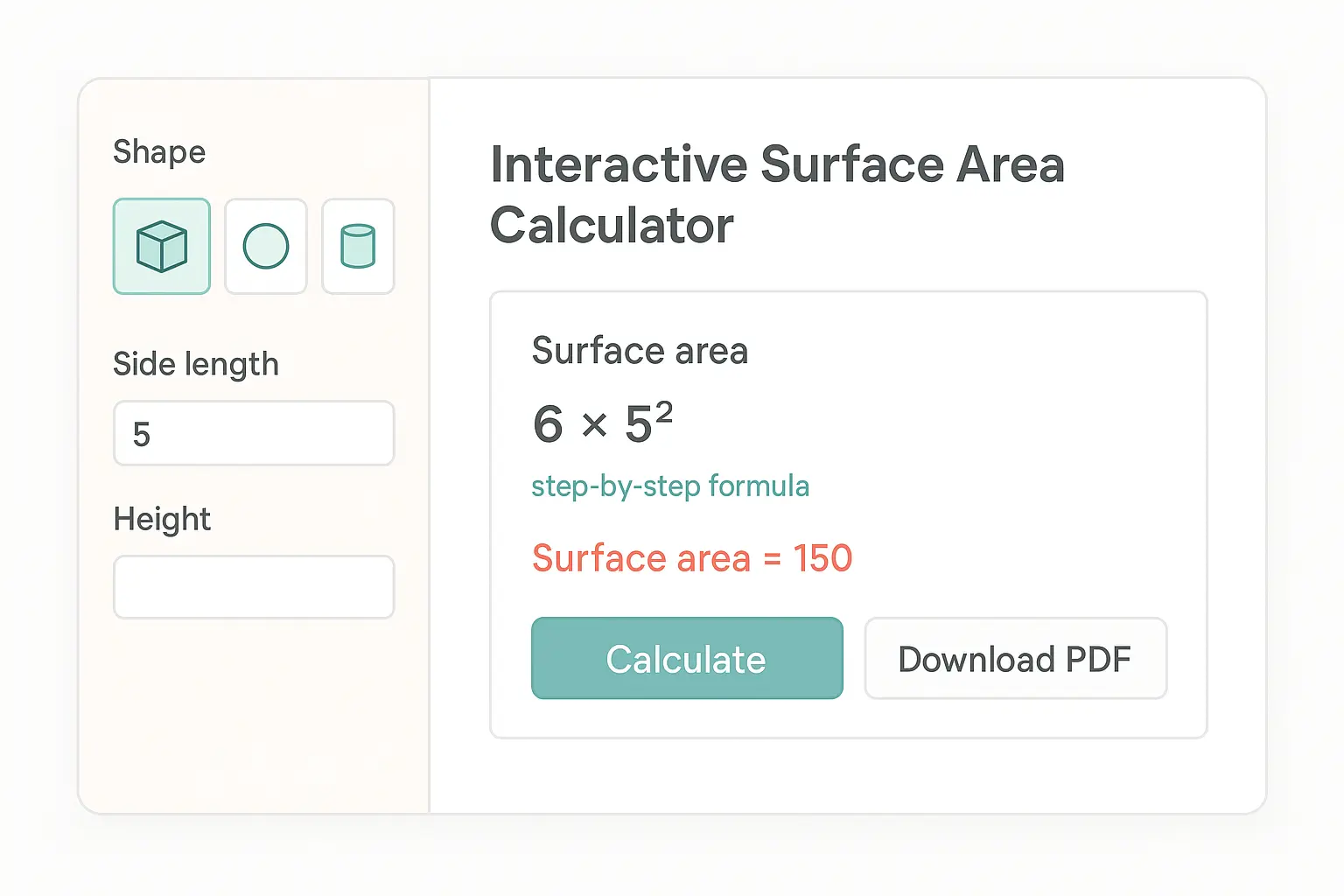
Surface Area Calculator
Use this Surface Area Calculator to calculate the total surface area, lateral surface area, curved surface area, base area, and unit conversions for common 3D solids, including cube, rectangular prism, sphere, cylinder, cone, square pyramid, triangular prism, capsule, hemisphere, and ellipsoid.
Calculate Surface Area
Select a 3D shape, enter the dimensions, choose a unit, and calculate. The calculator updates the needed inputs for each solid and shows the formula used.
What Is a Surface Area Calculator?
A Surface Area Calculator is a geometry tool that measures the total exposed area on the outside of a three-dimensional object. It helps you calculate how much area covers the faces, curved sides, bases, and outer boundary of solids such as cubes, rectangular prisms, cylinders, cones, spheres, pyramids, prisms, hemispheres, capsules, and ellipsoids. Surface area is measured in square units because it is an area calculation, not a length or volume calculation.
Surface area is one of the most useful ideas in geometry because it connects mathematics with real-world planning. If you want to paint a box, wrap a gift, cover a tank, design packaging, tile a structure, estimate heat transfer, calculate material coverage, or compare the outside area of shapes, surface area is the measurement you need. Volume tells how much space is inside an object, but surface area tells how much outside covering the object has.
This calculator is designed to act as both a practical tool and a learning resource. It gives fast numerical answers, but it also shows the formula, lateral or curved area, base area, and step-by-step calculation. That makes it useful for students, teachers, parents, homework help, test preparation, engineers, designers, DIY users, and anyone who needs clean geometry calculations.
The calculator supports multiple shapes because different solids use different formulas. A cube uses one side length. A rectangular prism uses length, width, and height. A sphere uses radius. A cylinder uses radius and height. A cone can use radius and height, or radius and slant height. A square pyramid uses base side and slant height. A triangular prism uses triangular-base dimensions and prism length. Choosing the correct shape is the first step toward a correct answer.
How to Use the Surface Area Calculator
Start by selecting the 3D shape from the dropdown menu. The input fields will adjust to show the dimensions needed for that shape. For example, if you select cube, you only need one side length. If you select rectangular prism, you need length, width, and height. If you select cylinder, you need radius and height. If you select cone, you can enter radius, height, and slant height. If the slant height is missing or too small, the calculator can use height and radius to estimate it.
Next, choose the length unit. The unit is applied to all length inputs for that calculation. If you enter values in centimeters, the result is shown in square centimeters. If you enter values in meters, the result is shown in square meters. Keeping all dimensions in the same unit is important. Do not enter length in meters and width in centimeters unless you first convert them into a common unit.
Enter positive dimension values. Surface area formulas require real physical lengths, so dimensions should be greater than zero. The calculator will display an input message if a required dimension is missing or invalid. After entering values, choose decimal places and click the calculate button. The result panel displays total surface area, lateral or curved area, base area, formula label, square unit, and a step-by-step breakdown.
For homework or teaching, read the step area carefully. It shows which formula was used and how the numbers were substituted. This is useful because many surface area errors happen when students know the formula but use the wrong dimension, confuse radius with diameter, forget a base, or write the answer in normal units instead of square units.
Surface Area Calculator Formulas
The calculator uses standard formulas for common three-dimensional solids. In the formulas below, \(SA\) means total surface area, \(LSA\) means lateral surface area, \(CSA\) means curved surface area, \(r\) means radius, \(h\) means height, \(l\) means slant height, and \(a,b,c\) represent side lengths or semi-axes depending on the shape.
What Surface Area Means
Surface area measures the total area covering the outside of a solid. Imagine wrapping a three-dimensional object with thin paper. The amount of paper needed, ignoring overlap and waste, is the surface area. For a cube, that paper covers six identical square faces. For a rectangular prism, it covers three pairs of rectangles. For a cylinder, it covers two circles and one curved rectangle-like side. For a sphere, it covers a smooth curved surface with no flat faces.
Surface area is different from volume. Volume measures three-dimensional space inside an object and is measured in cubic units, such as \(\text{cm}^3\). Surface area measures outside covering and is measured in square units, such as \(\text{cm}^2\). A container can have a large volume but relatively small surface area, or a small volume with a large surface area depending on shape and proportions.
This distinction matters in science and engineering. Heat transfer, evaporation, chemical reaction rate, biological exchange, packaging cost, coating requirements, and insulation performance can all depend on surface area. In math class, surface area teaches students how flat area formulas extend into three-dimensional geometry.
Lateral, Curved, and Total Surface Area
Total surface area includes every exposed outside part of a solid. For a closed cylinder, that means both circular bases plus the curved side. For a cone, it means the circular base plus the curved side. For a rectangular prism, it means all six rectangular faces.
Lateral surface area usually means the side area only, excluding bases. For a cylinder, lateral surface area is \(2\pi rh\). For a square pyramid, lateral surface area is the sum of the triangular faces, \(2sl\). For a prism, lateral surface area is perimeter of the base times prism length.
Curved surface area is commonly used for solids with curved sides. A cylinder’s curved surface area is the rectangle-like area wrapped around the cylinder, \(2\pi rh\). A cone’s curved surface area is \(\pi rl\). A sphere has only curved surface, so its curved surface area and total surface area are the same.
The calculator separates these values when the shape makes that distinction meaningful. This helps users understand which part of the object they are measuring. For example, painting only the side of a cylinder is a lateral-area problem; covering the entire closed cylinder is a total-surface-area problem.
Square Units and Surface Area Conversions
Surface area must be written in square units. If the dimensions are measured in meters, the area result is in square meters. If dimensions are measured in inches, the result is in square inches. The unit is squared because area has two dimensions: length times length.
For example, a square with side length 5 cm has area \(5\times5=25\text{ cm}^2\). A cube with side length 5 cm has total surface area \(6\times25=150\text{ cm}^2\). Writing 150 cm would be incorrect because centimeters measure length, not area.
When converting surface area, square-unit conversions must also be squared. For example, \(1\text{ m}=100\text{ cm}\), but \(1\text{ m}^2=10,000\text{ cm}^2\). This is a common source of mistakes. The safest approach is to convert all length dimensions before calculating surface area.
| Length Unit | Surface Area Unit | Example Meaning |
|---|---|---|
| millimeters | square millimeters, \(\text{mm}^2\) | Small objects, parts, engineering drawings |
| centimeters | square centimeters, \(\text{cm}^2\) | School geometry, models, packaging |
| meters | square meters, \(\text{m}^2\) | Rooms, tanks, construction, walls |
| inches | square inches, \(\text{in}^2\) | Small imperial measurements |
| feet | square feet, \(\text{ft}^2\) | Painting, flooring, construction |
Surface Area Worked Examples
Example 1: Find the surface area of a cube with side length 5 cm.
Example 2: Find the surface area of a rectangular prism with length 8 cm, width 4 cm, and height 3 cm.
Example 3: Find the surface area of a sphere with radius 6 cm.
Example 4: Find the total surface area of a closed cylinder with radius 3 cm and height 10 cm.
Common Surface Area Mistakes
The first common mistake is confusing radius and diameter. Many formulas use radius, not diameter. If the diameter is given, divide it by 2 before using the formula. For a sphere with diameter 10 cm, the radius is 5 cm, so \(SA=4\pi(5^2)\), not \(4\pi(10^2)\).
The second mistake is using volume formulas instead of surface area formulas. A cube’s volume is \(s^3\), but its surface area is \(6s^2\). A cylinder’s volume is \(\pi r^2h\), but its total surface area is \(2\pi r^2+2\pi rh\). Always check whether the question asks for outside area or inside space.
The third mistake is forgetting bases. A closed cylinder has two circular bases, but an open cylinder may have one or zero bases depending on the problem. A cone may include the circular base or only the curved surface. Read the question carefully.
The fourth mistake is using normal units instead of square units. Surface area is always in square units. A result such as 150 cm is not a surface area; it should be 150 \(\text{cm}^2\).
Surface Area Calculator FAQs
What does a surface area calculator do?
It calculates the outside area of 3D solids such as cubes, rectangular prisms, spheres, cylinders, cones, pyramids, prisms, hemispheres, capsules, and ellipsoids.
What is the difference between surface area and volume?
Surface area measures the outside covering of a solid in square units. Volume measures the space inside a solid in cubic units.
What is the surface area formula for a cube?
The formula is \(SA=6s^2\), where \(s\) is the side length.
What is the surface area formula for a sphere?
The formula is \(SA=4\pi r^2\), where \(r\) is the radius.
What is lateral surface area?
Lateral surface area is the side area of a solid, usually excluding the base or bases.
What units should surface area use?
Surface area should use square units, such as \(\text{cm}^2\), \(\text{m}^2\), \(\text{in}^2\), or \(\text{ft}^2\).
Can this calculator help with homework?
Yes. It shows formulas, substitutions, and step-by-step explanation so students can understand how the answer is calculated.
Important Note
This Surface Area Calculator is for educational, homework, design, planning, and general geometry use. For construction, engineering, manufacturing, safety, legal, or cost-critical work, verify measurements, tolerances, material waste, openings, overlaps, and professional requirements before making final decisions.