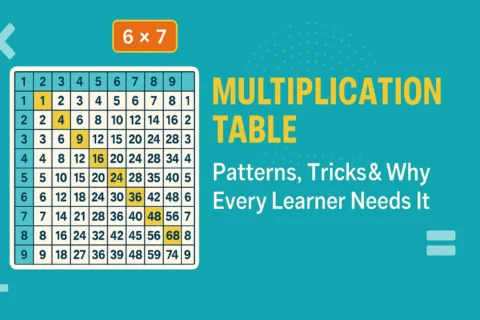
15 Times Table Chart & Learning Guide
Understanding the 15 Times Table
The 15 times table is an essential multiplication table that combines the simplicity of multiplying by 10 with the ease of multiplying by 5. Learning the 15 times table chart helps students develop advanced mental math skills and prepares them for more complex calculations. The table of 15 has clear patterns that make it easier to learn: every product alternates between ending in 5 and 0, and there's a powerful "multiply by 10, then add half" trick that makes calculations quick and simple.
Why Learn the 15 Times Table?
- Quarter-hour calculations: Essential for time (15 minutes = quarter hour)
- Money calculations: Useful for pricing (15 cents, 15 dollars)
- Mental math mastery: The 10+half trick enables fast calculations
- Clear patterns: Alternating 5-0 endings make it predictable
- Real-world applications: Measurements, percentages, conversions
- Advanced preparation: Foundation for higher mathematics
Complete 15 Times Table Chart
| Multiplication | Answer | Ends In | Tens Pattern |
|---|---|---|---|
| 15 × 1 | 15 | 5 | 1 (odd) |
| 15 × 2 | 30 | 0 | 3 (odd) |
| 15 × 3 | 45 | 5 | 4 (even) |
| 15 × 4 | 60 | 0 | 6 (even) |
| 15 × 5 | 75 | 5 | 7 (odd) |
| 15 × 6 | 90 | 0 | 9 (odd) |
| 15 × 7 | 105 | 5 | 10 (even) |
| 15 × 8 | 120 | 0 | 12 (even) |
| 15 × 9 | 135 | 5 | 13 (odd) |
| 15 × 10 | 150 | 0 | 15 (odd) |
| 15 × 11 | 165 | 5 | 16 (even) |
| 15 × 12 | 180 | 0 | 18 (even) |
Quick Reference - 15 Times Table:
15, 30, 45, 60, 75, 90, 105, 120, 135, 150, 165, 180, 195, 210, 225, 240, 255, 270, 285, 300
The Powerful 10 + Half Trick
The Formula: 15 × n = (10 × n) + (½ × 10 × n)
Example 1: 15 × 8
Example 2: 15 × 12
💡 Alternative Method: Add number to half itself, then ×10
Example: 15 × 6 = (6 + 3) × 10 = 9 × 10 = 90
Amazing Patterns in the 15 Times Table
Units Digit Pattern
Every multiple of 15 alternates between ending in 5 and 0:
Odd multipliers end in 5 | Even multipliers end in 0
Tens Place Pattern
The tens digit follows: Two odd, Two even (repeating)
15 (odd), 30 (odd) → Two odd
45 (even), 60 (even) → Two even
75 (odd), 90 (odd) → Two odd
105 (even), 120 (even) → Two even
Relationship to Other Tables
The 15 times table connects to others:
- 15 = 3 × 5: Combine 3× and 5× tables
- 15 = 10 + 5: Add 10× and 5× tables
- 15 × 2 = 30: Same as 3 × 10
- 15 × 4 = 60: Same as 6 × 10
15 Times Table Up to 20
| × | Answer | × | Answer |
|---|---|---|---|
| 15 × 1 | 15 | 15 × 11 | 165 |
| 15 × 2 | 30 | 15 × 12 | 180 |
| 15 × 3 | 45 | 15 × 13 | 195 |
| 15 × 4 | 60 | 15 × 14 | 210 |
| 15 × 5 | 75 | 15 × 15 | 225 |
| 15 × 6 | 90 | 15 × 16 | 240 |
| 15 × 7 | 105 | 15 × 17 | 255 |
| 15 × 8 | 120 | 15 × 18 | 270 |
| 15 × 9 | 135 | 15 × 19 | 285 |
| 15 × 10 | 150 | 15 × 20 | 300 |
Frequently Asked Questions
Tips for Mastering the 15 Times Table
Learning Strategy:
- Master the 10+half trick: This is the fastest method for any 15× calculation
- Know the 5 times table: Use 15 = 3 × 5 for double-checking
- Recognize the 5-0 pattern: Odd multipliers = 5, even = 0
- Practice the alternative: (n + n/2) × 10 method
- Learn related tables: Master 10× and 5× to support 15×
- Daily practice: 10-15 minutes with mental calculations
- Use skip counting: Count by 15s regularly (15, 30, 45...)
- Apply in real situations: Use 15× for time and money calculations