Create an addition practice worksheet
Choose whole-number practice within 10, 20 or 100, or set an addend range. Generate questions with matching answers, then print a focused worksheet for class, tutoring or home practice.
1. Worksheet Settings
2. Worksheet Summary
Generate a printable worksheet with an optional answer key.
Visual Model
Worksheet Mix
3. Printable Worksheet Preview
4. Answer Key & Strategy Notes
| # | Problem | Answer | Strategy Hint |
|---|
Addition Worksheet Formulas
Addition combines two or more addends into one total. In a two-addend problem, the basic structure is:
For three or more addends, the same idea extends:
The commutative property explains why changing the order of addends does not change the total:
The associative property explains why addends can be grouped in different ways:
The make-ten strategy helps students add mentally:
Place-value addition separates tens, hundreds, and ones:
A missing addend can be found by using subtraction as the inverse of addition:
Regrouping happens when a place-value column reaches 10 or more:
Choose practice that matches the skill
Start with a small set of addition questions the learner can explain. Use counters or drawings before symbols, then choose a worksheet setting that targets one next step. The generator above supports two to five whole-number addends, horizontal or vertical layouts, missing numbers, word problems and a separate answer key.
“Within 20” means the total is at most 20. By contrast, a custom range sets the minimum and maximum of each addend: two addends from 0 to 20 can total 40. Two-digit addition uses addends from 10 to 99, so its answers can be three-digit numbers. Zero is a valid addend; negative numbers, fractions and decimals are outside this tool’s scope.
| Learning goal | Try these settings | What to look for |
|---|---|---|
| Join small groups | Within 10; two addends; 8–12 problems | Counts each object once, including when one group is empty |
| Use mental strategies | Within 20; horizontal; two or three addends | Makes ten, uses doubles, or explains counting on |
| Keep place values aligned | Two-digit; vertical; no regrouping | Adds ones to ones and tens to tens |
| Regroup a ten | Two-digit; vertical; force regrouping | Explains why 10 ones become 1 ten |
| Find a missing part | Within 20; missing addend | Uses the total minus the known part and checks by addition |
| Apply a method | Word problem every third question | Identifies what the story asks, with an appropriate unit in the answer |
These are practice suggestions, not placement tests or fixed age expectations. Common Core links at the end provide a curriculum reference for early addition, unknowns and place value. Local teaching sequences can differ. This page is a classroom practice tool; it has no official exam score conversion or universal pass mark.
Generate, check and print
- Choose the range and addend count. A difficulty preset overrides the custom minimum and maximum. For custom settings, use whole numbers from 0 to 99,999 and keep the minimum no greater than the maximum.
- Choose the task. Normal and missing-sum questions both ask for the total. Missing-addend questions provide the total and ask for one part. Mixed mode varies the unknown.
- Set regrouping and layout. Vertical format is helpful for place value. With three or more addends, the amount regrouped can be more than one ten.
- Choose a manageable count. The generator accepts 4–120 problems. One or two problems per row and large print leave more room for written working; inspect print preview before making many copies.
- Generate and inspect the key. The same seed and settings reproduce a worksheet in this version of the generator. Repeats can occur, especially with small ranges; a seed is a reproducibility aid, not a guarantee of unique questions.
- Choose your output. Copy Worksheet gives the questions; Copy Answer Key includes answers. CSV is an answer-bearing export for adult preparation. Keep the key and CSV separate when giving practice to students.
- Print / Save PDF. Review the browser’s print preview and choose a printer or its PDF destination. Set Answer Key to Hide for a student-only worksheet. Browser paper size, margins and scaling affect pagination.
If settings cannot produce a valid worksheet: change the range or regrouping choice. For example, two addends fixed at 9 must regroup, while two addends fixed at 1 cannot regroup. The tool must show a clear error rather than quietly print questions that break the selected rule.
With Auto Generate off, click Generate Worksheet after changing settings. Do not use a previously generated worksheet as evidence that new settings have been applied. New Seed produces another seed; Reset returns to the tool’s starting settings.
Six worked addition examples
1. Count on: 6 + 3
Start from 6, then make three forward steps: 7, 8, 9. The answer is 9. Do not count the starting 6 as the first step. A number line makes the three changes visible.
2. Make ten: 8 + 7
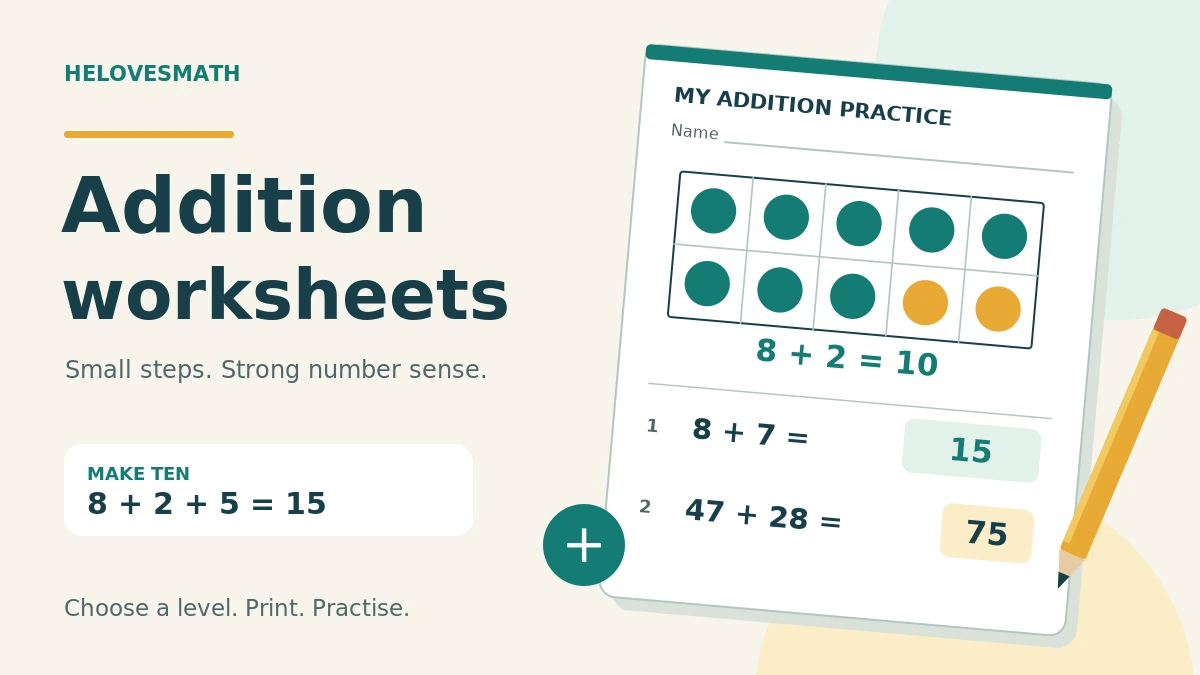
Eight needs 2 to make 10. Split 7 into 2 and 5, so 8 + 7 = 8 + 2 + 5 = 10 + 5 = 15. The 7 has been partitioned, not increased: both versions still contain the same fifteen counters.

3. Add without regrouping: 32 + 46
Add the ones: 2 + 6 = 8. Add the tens: 3 tens + 4 tens = 7 tens. Combine them to get 78. Neither column reaches ten, so there is nothing to exchange into the next column. Check with expanded form: 30 + 40 + 2 + 6 = 70 + 8.
4. Regroup: 47 + 28
The ones total 7 + 8 = 15 ones. Exchange 10 of those ones for 1 ten, leaving 5 ones. Now the tens total 4 + 2 + 1 = 7 tens. The answer is 75. The small carried 1 means one ten; it is not an extra one added to the ones column.

5. Find a missing addend: 9 + □ = 17
Seventeen is the whole and 9 is the known part. The other part is 17 − 9 = 8. Check by substitution: 9 + 8 = 17. Adding 9 and 17 would find a different total and would not make the original equation true.
6. Add three quantities: 18 + 27 + 35
A class collects 18 blue counters, 27 red counters and 35 yellow counters. In the ones column, 8 + 7 + 5 = 20, so write 0 ones and regroup 2 tens. The tens column is 1 + 2 + 3 + 2 = 8. There are 80 counters altogether. Rounding each addend to the nearest ten gives an estimate of 20 + 30 + 40 = 90. The exact total, 80, is reasonably close; an estimate checks size but does not replace the calculation.
Understand the method, then build fluency
Addition joins quantities. In a + b = c, a and b are addends and c is the sum. For whole numbers, adding zero leaves the number unchanged: 14 + 0 = 14. The equals sign says the expressions on both sides have the same value; it does not simply mean “write an answer next.” For instance, 11 = 4 + 7 is true too.
You can swap addends without changing the sum: 4 + 9 = 9 + 4. You can also change how a longer sum is grouped: (6 + 4) + 8 = 6 + (4 + 8) = 18. These properties help you choose a convenient calculation. In 7 + 3 + 6, pairing 7 and 3 makes a ten before adding 6.
Doubles and near doubles are another route. If 6 + 6 = 12 is secure, 6 + 7 is one more, or 13. Invite the learner to explain why the extra one is needed instead of memorizing an isolated trick. For larger numbers, the place-value calculator and chart can connect the written digits to hundreds, tens and ones.
A short feedback cycle is more useful than automatically increasing the question count. Ask the learner to solve a few questions, explain one strategy, and revisit one error. After a successful correction, change the numbers while keeping the structure similar. Save a seed with the settings if you want to revisit the same practice later.
Common mistakes and a useful correction
- Counting the start as a jump. For 6 + 3, counting “6, 7, 8” gives only two moves. Mark three jumps after 6 and land at 9.
- Lining up the first digits. For 7 + 24, the 7 belongs under the 4 in the ones column. Right-align whole numbers by place value.
- Writing 615 for 47 + 28. Six tens and fifteen ones must be regrouped into seven tens and five ones. The result is 75, not digits pasted together.
- Always carrying one. With three or more addends, a total of 20–29 in the ones column regroups two tens. Name the value being exchanged.
- Using the largest number as an addend. In 5 + □ = 12, the 12 is already the total. Find the missing part rather than calculating 5 + 12.
- Ignoring the story’s unknown. “Had 8, received some, now has 13” asks for the increase: 5. “Had 8, received 13” asks for the total: 21. Read the whole sentence before selecting an operation.
Try eight questions
Attempt these before opening the answers. A correct method and a sensible explanation matter alongside the final number.
1. Find 4 + 5
9. Count on five steps from 4, or use 4 + 4 + 1 = 9.
2. Use make ten for 9 + 6
15. Split 6 into 1 and 5: 9 + 1 + 5 = 10 + 5.
3. Calculate 41 + 27 without regrouping
68. One plus seven makes eight ones; four plus two makes six tens.
4. Calculate 58 + 26 and explain the regrouping
84. 8 + 6 = 14 ones, which is 1 ten and 4 ones. Then 5 + 2 + 1 = 8 tens.
5. Fill the box: 13 + □ = 20
7. 20 − 13 = 7; check 13 + 7 = 20.
6. Calculate 19 + 28 + 33
80. The ones total 9 + 8 + 3 = 20. Regroup 2 tens, then 1 + 2 + 3 + 2 = 8 tens.
7. A tray had 16 pencils and now has 25. How many were added?
9 pencils. 16 + □ = 25, so □ = 25 − 16 = 9. The answer is a missing part, not 41.
8. Find 205 + 178
383. 5 + 8 = 13 ones; regroup 1 ten. Then 0 + 7 + 1 = 8 tens and 2 + 1 = 3 hundreds.
Questions about the generator
Does “Within 10” mean both addends are less than 10?
It means the sum is at most 10, with nonnegative whole-number addends. An addend of 10 is possible when the other parts are zero. Custom ranges instead restrict each addend separately.
Can I make worksheets with or without regrouping?
Yes, use the regrouping setting. No regrouping excludes every column exchange; force regrouping requires at least one. Some small or fixed ranges cannot satisfy a requested rule. Change those settings if an error is shown.
Can I hide answers and still keep a key for myself?
Yes. Hide the on-page answer key before printing the student sheet, and retain the separate copied key or CSV for checking. CSV contains answers. Inspect the actual print preview before sharing copies.
Why can a question repeat?
Seeded random practice can include repeated facts. Small ranges have few possible combinations, so demanding a large worksheet does not guarantee unique sums. Repetition can support fluency, but check that the mix suits the learner.
What happens if I choose word problems and missing addends?
The story must describe a missing part while giving the total and the other parts. The answer key gives that missing quantity. A sum question instead asks for the combined total.
Is this an official grade or exam worksheet?
No. These are adjustable practice questions. Use your school’s curriculum and assessment criteria for placement or grading, and treat the curriculum links below as references rather than a claim of official endorsement.
Sources & References
The examples and practice questions above were written for this guide. These primary curriculum references support the learning sequence and mathematical concepts; they do not endorse this generator.