Mixed Number Calculator
Use this Mixed Number Calculator to add, subtract, multiply, divide, simplify, and convert mixed numbers, improper fractions, and decimals. Enter whole numbers, numerators, denominators, or decimal values to get exact arithmetic answers, mixed-number form, fraction form, and step-by-step work. Decimal conversion clearly distinguishes exact values from rounding.
Calculate Mixed Numbers
Select a mode, enter your values, and calculate. The tool handles mixed-number arithmetic and common conversions used in school math, recipes, construction, measurements, and everyday fractions.
First Mixed Number
Second Mixed Number
What Is a Mixed Number Calculator?
A Mixed Number Calculator is a fraction tool that works with numbers written as a whole number plus a proper fraction, such as 213, 578, or 1025. Mixed numbers appear in school arithmetic, measurement, cooking, woodworking, construction, craft projects, algebra, and everyday problem solving. They are easier to read than improper fractions in many real-life settings because they separate the whole quantity from the leftover fractional part.
This calculator can add, subtract, multiply, and divide mixed numbers. It can also convert a mixed number into an improper fraction, convert an improper fraction back into a mixed number, and convert decimals exactly or with a chosen rounding rule. The result area shows mixed-number and simplified fraction forms, plus a decimal value. A value smaller than one is shown as a proper fraction; a whole-number result needs no fractional part. It also displays step-by-step work so students can understand the process instead of only copying the answer.
A mixed number has three parts: a whole number, a numerator, and a denominator. In 325, the whole number is 3, the numerator is 2, and the denominator is 5. The meaning is 3 + 25. In decimal form, this is 3.4. In improper fraction form, it is 175. These three forms represent the same value, but each form is useful in a different context.
Mixed-number arithmetic is usually easiest when the mixed numbers are first converted into improper fractions. For example, 213 becomes 73, and 114 becomes 54. Once both values are improper fractions, normal fraction rules can be used. After the operation, the result can be simplified and converted back to mixed-number form.
This page is built for students, parents, teachers, tutors, homeschool learners, recipe users, measurement users, and anyone who wants a clean fraction calculator. Use the steps to check your own reasoning before comparing the answer.
How to Use the Mixed Number Calculator
Use the Add / Subtract / Multiply / Divide tab when you want to perform arithmetic with two mixed numbers. Enter the whole number, numerator, and denominator for the first value. Then choose the operation and enter the second mixed number. Click calculate to get the result. The calculator automatically converts both mixed numbers to improper fractions, performs the selected operation, simplifies the answer, and converts the result back into mixed-number form.
Use the Convert Mixed ↔ Improper tab when you only need conversion. If you choose mixed number to improper fraction, enter the whole number, numerator, and denominator. If you choose improper fraction to mixed number, enter the numerator and denominator. Enter nonnegative magnitudes in this tab and choose Positive or Negative with the Sign selector. Negative works even when the whole-number part is zero.
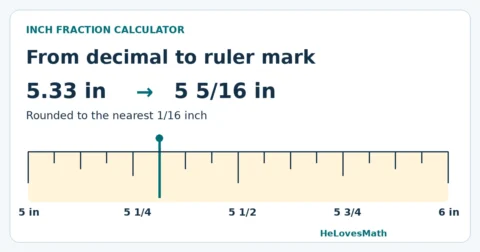
Use the Decimal to Mixed Number tab for decimals such as 4.375 or 2.75. Select Exact finite decimal fraction to preserve the entered value, Best fraction within maximum denominator for a nearby simple fraction, or Nearest selected increment for a ruler-style increment such as a sixteenth.
Always enter a denominator greater than zero. A fraction such as 30 is undefined because division by zero is not allowed. The calculator checks denominator values and shows an input message if a denominator is invalid.
Mixed Number Calculator Formulas
The main conversion formula turns a mixed number into an improper fraction:
Here a and b are nonnegative integers, c is a positive integer, and a mixed number in standard form has b < c. For a negative mixed number, first convert its magnitude, then apply the minus sign to the entire value: −112 = −(1 + 12) = −32.
To convert an improper fraction into a mixed number, divide the numerator by the denominator:
For nonnegative n and positive d, divide to obtain n = qd + r with 0 ≤ r < d. The remainder becomes the fractional numerator. If r = 0, write just q. For a negative numerator, work with its magnitude and put the minus sign in front of the complete answer.
Fractions are simplified using the positive greatest common divisor of the numerator’s magnitude and denominator. All denominators below are nonzero; the calculator uses positive denominators. In the division formula, the second numerator c must also be nonzero:
Addition and subtraction use a common denominator:
Multiplication and division are direct once mixed numbers are converted to improper fractions:
Adding, Subtracting, Multiplying, and Dividing Mixed Numbers
To add mixed numbers, convert each mixed number into an improper fraction first. Then find a common denominator, add the numerators, simplify, and convert back to a mixed number. For example, 213 + 114 becomes 73 + 54. A common denominator is 12, so the result is 2812 + 1512 = 4312 = 3712.
Subtraction follows the same structure, but the numerators are subtracted. If the answer is negative, the calculator keeps the negative sign with the complete value. This avoids the common mistake of treating the whole and fraction parts separately in a confusing way.
Multiplying mixed numbers is often simpler than adding because no common denominator is needed. Convert both mixed numbers to improper fractions, multiply numerator by numerator, multiply denominator by denominator, simplify, and convert back. Dividing mixed numbers requires one extra rule: multiply by the reciprocal of the second fraction. The reciprocal of cd is dc. Division by zero is not allowed, so the second fraction cannot equal zero.
The calculator displays the operation type and step sequence so users can follow the logic. This is useful for homework checking, teaching demonstrations, and self-study.
Mixed Number and Improper Fraction Conversion
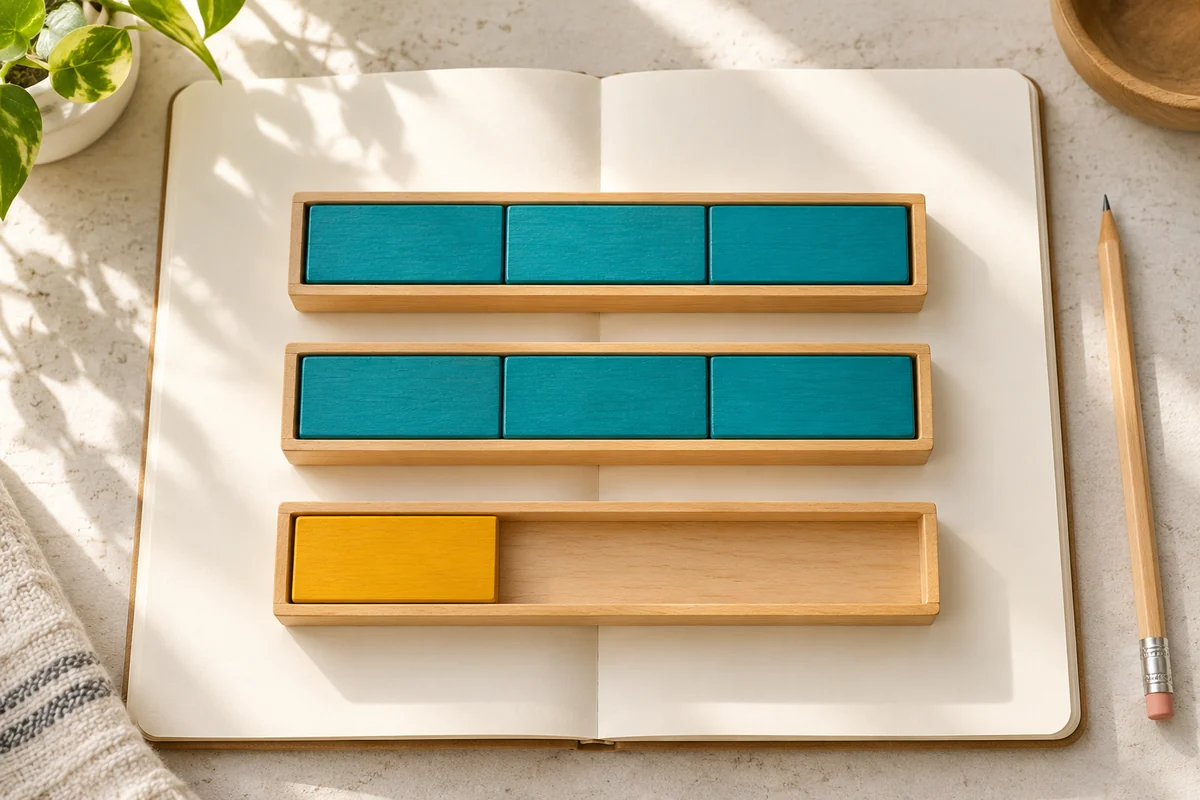
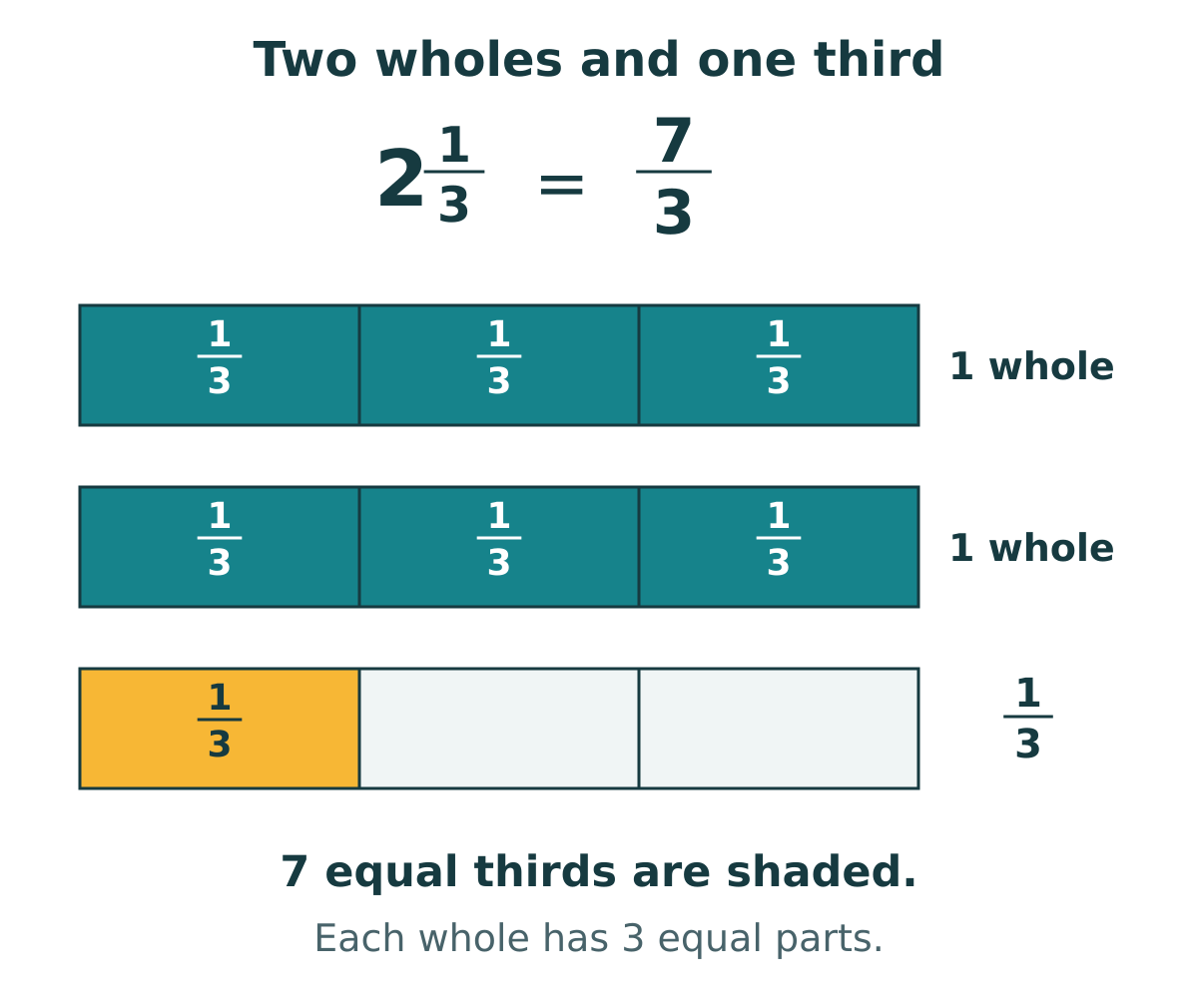
A mixed number is usually better for reading a final answer, while an improper fraction is usually better for calculation. For example, 438 is easy to understand as four whole units and three eighths. But if you need to multiply it by another fraction, 358 is more convenient.
To convert 438, multiply the whole number by the denominator: 4 × 8 = 32. Then add the numerator: 32 + 3 = 35. Keep the same denominator. So 438 = 358. To convert 358 back, divide 35 by 8. The quotient is 4 and the remainder is 3, so the answer is 438.
This conversion is important in math because improper-fraction notation makes fraction arithmetic easier. Students sometimes incorrectly multiply only the fraction parts or add only the whole parts. The reliable method is to convert first, operate second, and simplify last.
| Mixed Number | Improper Fraction | Decimal |
|---|---|---|
| 112 | 32 | 1.5 |
| 213 | 73 | 2.333… |
| 325 | 175 | 3.4 |
| 438 | 358 | 4.375 |
| 5716 | 8716 | 5.4375 |
How negative mixed numbers work
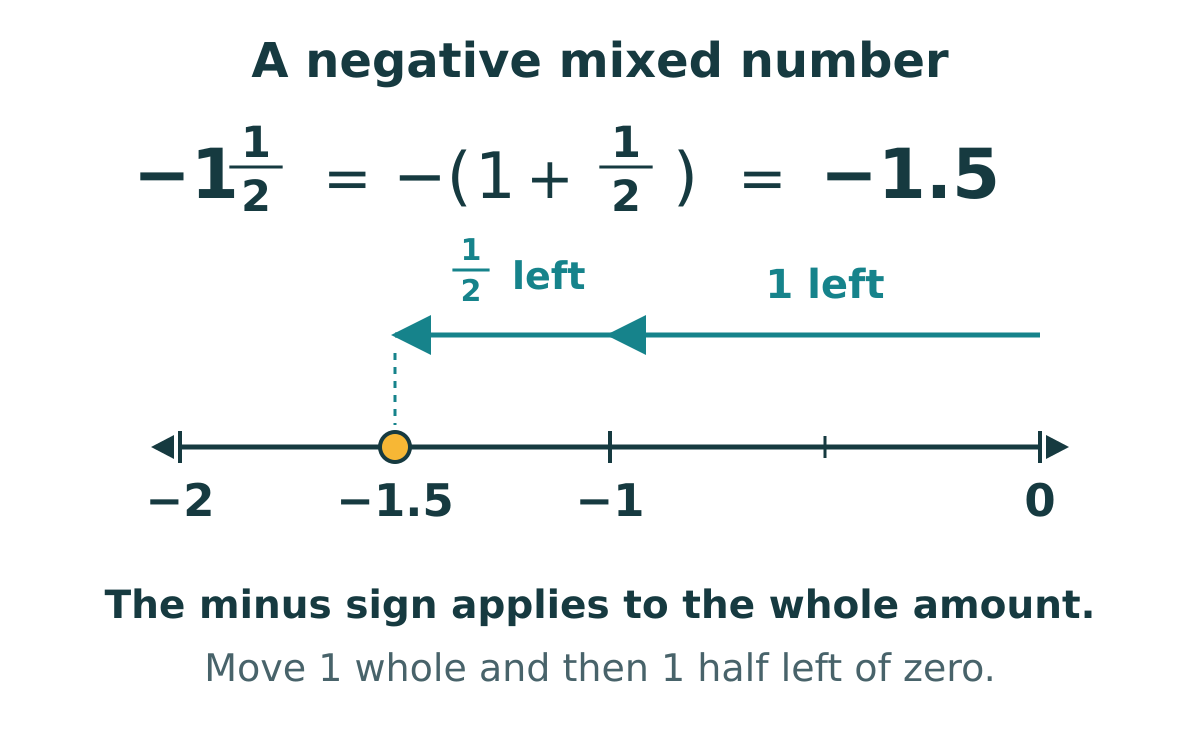
The minus sign belongs to the entire magnitude. Negative one and a half means negative one plus negative one half, placing it halfway between −2 and −1.
Decimal to Mixed Number Conversion
Decimals can often be written as mixed numbers. The whole-number part stays the same, and the decimal part becomes a fraction. For example, 4.375 has whole part 4 and decimal part 0.375. Since 0.375 = 38, the mixed number is 438.
A finite decimal is exactly a fraction with a power of ten as its denominator before simplification. For example, 0.1 equals 110. Exact finite decimal fraction preserves all entered digits; it does not treat a rounded decimal as an infinitely repeating value.
Best fraction within maximum denominator searches all denominators up to your limit, so 0.1 with a maximum of 16 returns 110 exactly. Nearest selected increment with 16 rounds to multiples of 116, so 0.1 becomes approximately 18. These are different tasks. Rounding may produce a whole number: 0.99 to the nearest sixteenth is 1. Halfway fixed-increment values round away from zero. Best-fraction ties prefer the smaller denominator, then the smaller magnitude.
Decimal input supports up to 30 significand digits, at most 60 decimal places, and an optional exponent from −30 to 30 (for example, 1.25e-3). The fraction result is exact when marked exact; decimal displays are rounded to at most 10 places when marked ≈. No finite decimal entry establishes an infinite repeating pattern.
Mixed Number Examples
Example 1: Add 213 + 114.
Example 2: Convert 325 into an improper fraction.
Example 3: Convert 296 into a mixed number.
Example 4: Convert 4.375 into a mixed number.
Common Mixed Number Mistakes
The most common mistake is adding whole numbers and fractions separately without checking denominators. For example, 213 + 114 is not 327. The fractions 13 and 14 need a common denominator before they can be added.
Another mistake is forgetting to simplify. A result such as 248 should be simplified to 212. This calculator automatically reduces fractions using the greatest common divisor.
A third mistake is dividing fractions without flipping the second fraction. Fraction division uses the reciprocal rule. ab ÷ cd becomes ab × dc, not ab × cd.
Finally, users sometimes enter a zero denominator. Denominators cannot be zero because division by zero is undefined. The calculator checks this and prevents invalid fraction results.
Mixed Number Calculator FAQs
What does a mixed number calculator do?
It performs arithmetic with mixed numbers and converts between mixed numbers, improper fractions, and decimals.
How do you convert a mixed number to an improper fraction?
Multiply the whole number by the denominator, add the numerator, and place the result over the original denominator.
How do you convert an improper fraction to a mixed number?
Divide the numerator by the denominator. The quotient is the whole number and the remainder becomes the numerator of the fractional part.
Can this calculator add mixed numbers?
Yes. It converts both mixed numbers into improper fractions, adds them, simplifies the answer, and returns mixed-number and improper-fraction forms.
Can this calculator handle negative mixed numbers?
Yes. Negative results are supported, and the negative sign is applied to the entire value.
Can decimals be converted to mixed numbers?
Yes. Choose exact finite-decimal conversion, a best fraction within a maximum denominator, or rounding to a selected increment. Approximate results show their exact absolute rounding error.
Important Note
This Mixed Number Calculator is for educational, measurement, recipe, and general math use. It is designed to explain fraction logic clearly, but students should still follow teacher instructions, textbook format, and required rounding rules for assignments or exams.
Try it, then check
Work these out before opening the answers.
- Subtract 214−312.
- Multiply 112 × 223.
- Divide 212 ÷ 114.
- Convert 0.1 exactly, then round it to the nearest sixteenth.
Show answers and checks
- 94−144 = −54 = −114.
- 32 × 83 = 4.
- 52 × 45 = 2.
- Exact: 110. Nearest sixteenth: 216 = 18. Absolute error: 140 = 0.025.
Sources & References
The fraction rules are consistent with OpenStax’s Prealgebra 2e. The calculator, explanations, examples, and diagrams here are original HeLovesMath work.