
KS3 Maths Papers & Year 9 Maths Tests
Find free historic KS3 maths papers, matching mark schemes and mental-maths resources, then use our original Year 9 diagnostic questions to decide what to practise next. Start with the written-paper library or mental-maths library. The downloads remain on their original resource host.
For England: these are historic practice resources. Compulsory national KS3 tests ended after 2008. The 2009–2011 papers in this collection are optional-era materials, not current national Year 9 exams. Schools may set their own assessments. Ask your teacher which topics, calculator rules and methods your test will cover.
Old labels such as “Level 4–6” describe the original paper’s difficulty range. They are not GCSE grades, current national attainment bands or a prediction of a pupil’s future result.
Which Year 9 maths paper should I use?
Choose by the work you have been taught, rather than by the newest date or the highest old level. The papers are useful question banks, but no single historic paper checks the whole present-day KS3 curriculum.
- Start with a short diagnostic. Try the questions below without notes. If a topic has not been taught yet, mark it “not yet taught” rather than treating it as a mistake.
- Select a manageable historic tier. Levels 3–5 offer an earlier starting range; 4–6 and 5–7 include overlapping material; 6–8 provides harder questions. These are archive labels only. Ask a teacher to select questions if a whole tier feels too easy or too difficult.
- Find the matching answers before you begin. Check the year, tier and paper number. A combined mark scheme can cover several tiers; follow its question-number mapping carefully. The 2010 and 2011 teacher’s guides are included with their paper groups.
- Follow the cover instructions. Use the time and calculator rule printed on that particular paper. For practice, it is also fine to work untimed first and record that you did so.
For mental maths, an answer sheet is the pupil’s blank response sheet, not the solutions. You need the matching audio or transcript to hear/read the questions and the mark scheme to check them. Some archive years do not have every component in this collection; the gaps are labelled below.
What should Year 9 maths practice include?
The Department for Education sets a programme for KS3 as a whole, rather than a single national Year 9 test syllabus. Schools sequence topics differently. Use your school’s revision list alongside this six-area check; the curriculum references are at the end.
Number
Signed numbers, fractions, decimals, percentages, powers, roots and estimation. Explain your method as well as calculating accurately. Revisit negative-number examples if sign errors recur.
Algebra
Simplifying, substitution, equations, sequences and graphs. Use the algebra worksheets with answers for targeted follow-up after you identify a weak skill.
Ratio and proportion
Sharing in a ratio, scale factors, percentages and rates. Check whether the quantities scale together and whether the answer’s units make sense.
Geometry and measures
Angles, constructions, area, volume, transformations and right-triangle relationships. Sketch, label units and distinguish a perpendicular height from a sloping side.
Probability
Events, outcomes, sample spaces and experimental results. Identify what is equally likely before writing a probability as a fraction.
Statistics
Tables, charts, averages, spread and comparisons. Explain what a statistic tells you, and what it hides about the data.
Across all six areas, practise explaining, checking and applying ideas in unfamiliar problems. If notation is the obstacle, use the maths symbols reference before returning to the question.
Original Year 9 diagnostic: 12 questions
Allow about 15–20 minutes as a starting guide. Use paper and a pencil, show working, and try these without a calculator. This is a short HeLovesMath practice set, not an official assessment or a complete curriculum test. Keep the answers closed until you have attempted the questions.
- Calculate −4 − (−7).
- Calculate ¾ + ⅔. Give an exact fraction or mixed number.
- A jacket costs £80. It is reduced by 15%. What is its new price?
- Share £35 between Amir and Beth in the ratio 2 : 3. How much does each receive?
- Simplify 3(2x − 5) + 4x.
- Solve 5x + 4 = 39.
- A sequence begins 5, 8, 11, 14, … . Find an expression for the nth term, where the first term has n = 1.
- For the line y = 2x − 1, find y when x = −2.
- Two angles in a triangle are 48° and 67°. Find the third angle.
- A right-angled triangle has perpendicular sides of 9 cm and 12 cm. Find the length of its hypotenuse.
- A bag contains 3 red, 2 blue and 5 green counters, otherwise identical. One counter is chosen at random, with each counter equally likely. What is the probability of choosing blue?
- For the data 2, 3, 3, 6, 11, find the mean and the median. Why are they different?
Worked answers and common traps
1–4: number, percentage and ratio
- 3. Subtracting a negative adds its opposite: −4 − (−7) = −4 + 7 = 3. A number line moves seven places right from −4.
- 17/12 = 1 5/12. Use a common denominator: ¾ = 9/12 and ⅔ = 8/12. Add the numerators: (9 + 8)/12 = 17/12. Do not add the denominators.
- £68. Ten per cent of £80 is £8; five per cent is £4. The discount is £12, so the new price is £80 − £12 = £68. £12 is the saving, not the sale price.
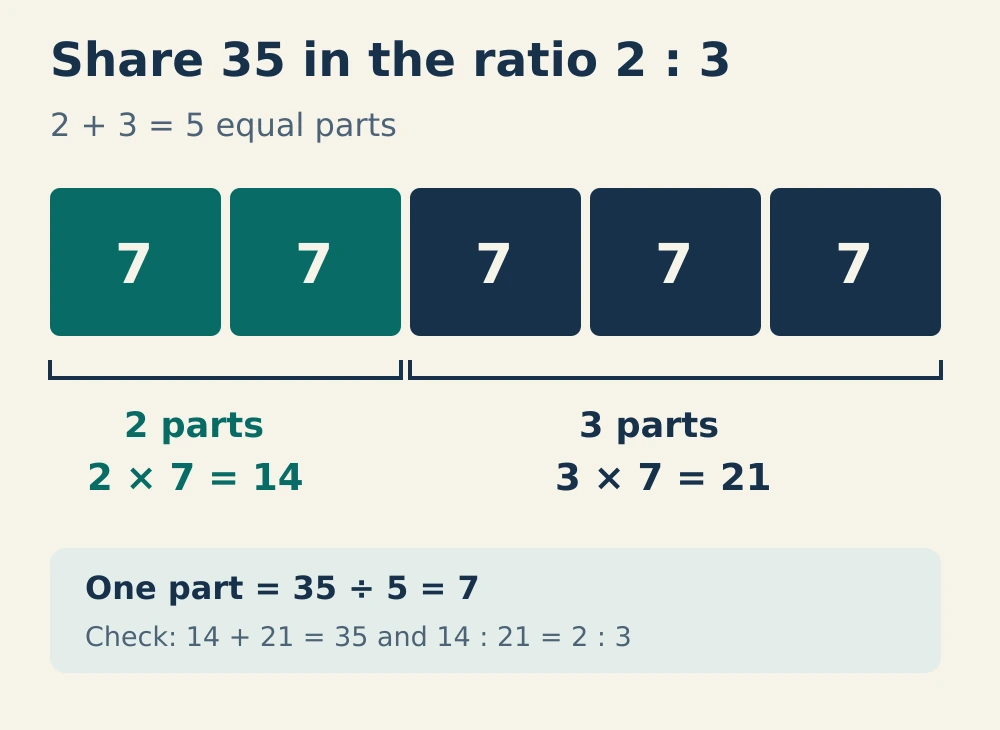
- Amir £14; Beth £21. There are 2 + 3 = 5 equal parts. Each part is £35 ÷ 5 = £7. Amir receives 2 × £7 and Beth 3 × £7. Check both the total and the ratio.
5–8: algebra and graphs
- 10x − 15. Multiply both terms inside the bracket by 3: 6x − 15 + 4x. Combine 6x + 4x. The constant −15 cannot be combined with the x terms.
- x = 7. Subtract 4 from both sides to get 5x = 35, then divide both sides by 5. Check: 5 × 7 + 4 = 39.
- 3n + 2. The constant difference is 3, so begin with 3n. At n = 1 this gives 3; add 2 to get 5. Check n = 4: 3 × 4 + 2 = 14.
- y = −5. Substitute −2 in brackets: y = 2(−2) − 1 = −4 − 1 = −5. The point is (−2, −5), not (−5, −2).
9–12: geometry, probability and statistics
- 65°. Triangle angles total 180°, so the missing angle is 180° − 48° − 67° = 65°. Check: 48 + 67 + 65 = 180.
- 15 cm. The hypotenuse is opposite the right angle. Its squared length is 9² + 12² = 81 + 144 = 225 cm². Taking the square root gives √225 = 15 cm.
- 2/10 = 1/5. There are 10 equally likely counters and 2 are blue. Counting three colours would incorrectly treat the colours as equally likely.
- Mean 5; median 3. The sum is 25, so the mean is 25 ÷ 5 = 5. The ordered middle value is 3. The high value 11 raises the mean; the median depends on the middle position.
Turn a marked paper into a revision plan
A useful result tells you what to do next. Keep each paper’s raw mark and conditions, but do not convert an old KS3 level into a GCSE grade or compare percentages from different tiers as though the papers were equally difficult.
- Classify each gap. Was it a topic you have not learned, a misunderstanding, an arithmetic slip, a misread instruction or a time problem? A blank answer alone does not tell you which.
- Correct the first wrong step. Write the reason beside it. For example, “I added fraction denominators; I needed equivalent fractions with a common denominator.” Copying the answer alone does not show understanding.
- Practise one narrow skill. Work through a few similar questions, explaining why each step works. Then try a mixed question where you must choose the method yourself.
- Check again after a gap. A day or two later, answer a different question without notes. If you can both solve it and explain it, move on; otherwise ask for help with the specific step.
Example revision decision: If question 6 is correct but question 5 is wrong, focus on expanding brackets and collecting like terms, rather than repeating every algebra topic. If the method is sound but the arithmetic slips, use a quick estimation or substitution check.
Questions about Year 9 maths tests
Are there national Year 9 SATs in England now?
No compulsory national KS3 SATs are listed for Year 9. Schools can use their own tests and assessment arrangements. The archive below includes former national-test papers and later optional resources.
Are the downloads free, and do they include answers?
The historic paper links go to free files hosted by SATs-Papers.co.uk. Written mark schemes and the available mental-maths components are grouped separately. A blank answer sheet is not an answer key. Paid commercial supplements are clearly separated at the end.
Can these papers tell me my GCSE grade?
No. The old level ranges, mark schemes and question coverage belong to their original assessments. Your teacher can interpret your current work alongside your school’s curriculum; a historic paper score alone does not establish a GCSE grade.
What if a download or audio file will not open?
Try the original host’s index in the references below. If an MP3 will not play in the browser, use your browser’s save-link option to download the full file, then play it locally. Match the year and test letter before switching to a transcript. If audio is unavailable, an adult can read the matching transcript using its printed timings; the answers must still come from the matching mark scheme.
Sources & References: free download library
External papers and audio below are hosted by SATs-Papers.co.uk; original publishers and copyright notices appear in the documents. HeLovesMath provides the organisation, guidance, original diagnostic and worked answers on this page. We have not copied or rehosted the third-party papers. Check the host’s and each document’s terms before redistribution.
Archive reviewed 2 October 2026. File availability can change. Historical years and level ranges are retained to help you match each question paper with its answers.
Written KS3 maths papers and mark schemes
2011 · 2010 · 2009 · 2008 · 2007 · 2006 · 2005 · 2004 · 2003 · 2002 · 2001 · 2000
2011 · optional-era practice
2010 · optional-era practice
Mark scheme (answers)
2009 · optional-era practice
Mark scheme (answers)
2008 · historic national-test materials
Mark scheme (answers)
2007 · historic national-test materials
Mark scheme (answers)
2006 · historic national-test materials
Mark scheme (answers)
2005 · historic national-test materials
Mark scheme (answers)
2004 · historic national-test materials
Mark scheme (answers)
2003 · historic national-test materials
Mark scheme (answers)
2002 · historic national-test materials
Mark scheme (answers)
2001 · historic national-test materials
Mark scheme (answers)
2000 · historic national-test materials
Mark scheme (answers)
KS3 mental-maths audio, sheets, transcripts and answers
2010 · 2009 · 2008 · 2007 · 2006 · 2005 · 2004 · 2003 · 2002 · 2001 · 2000
Download the MP3 from the source host to play it. Web playback may fail because the host’s audio-streaming requests did not work during our check; saving the full file and playing it locally is a useful alternative. Choose the same test letter for the audio, blank pupil sheet, transcript and mark scheme. For 2010, the teacher’s guide supplies instructions, transcript and answers. Missing components are stated explicitly.
2010 · optional-era practice
Blank pupil answer sheets
Questions, administration and answers
No 2010 audio link is available in this collection.
2009 · optional-era practice
Blank pupil answer sheets
Question transcripts
Mark scheme (answers)
2008 · historic national-test materials
Blank pupil answer sheets
Question transcripts
Mark scheme (answers)
2007 · historic national-test materials
Blank pupil answer sheets
Question transcripts
Mark scheme (answers)
2006 · historic national-test materials
Blank pupil answer sheets
Question transcripts
Mark scheme (answers)
2005 · historic national-test materials
Blank pupil answer sheets
Question transcripts
Mark scheme (answers)
2004 · historic national-test materials
Blank pupil answer sheets
Question transcripts
Mark scheme (answers)
2003 · historic national-test materials
Blank pupil answer sheets
Question transcripts
Mark scheme (answers)
2002 · historic national-test materials
Question transcripts
Mark scheme (answers)
No blank pupil answer sheets are linked for 2002; use plain paper alongside the matching transcript.
2001 · historic national-test materials
This collection has audio only for this year; no matching pupil sheets, transcripts or mark scheme are linked here.
2000 · historic national-test materials
This collection has audio only for this year; no matching pupil sheets, transcripts or mark scheme are linked here.
Curriculum, assessment context and original host
- Department for Education: mathematics programmes of study (see Key stage 3)
- GOV.UK: national curriculum overview and assessment by year
- Department for Education: teaching mathematics at key stage 3
- UK Parliament, 14 October 2008: end of compulsory KS3 national tests from 2009
- SATs-Papers.co.uk: original maths and mental-maths download index
Optional paid supplements from the existing collection
These commercial ExamNinja links were included in the original library. They are separate from the free historic downloads; check the seller’s current contents and price before buying. They are not needed for the diagnostic above.